Support WBUR
Unpacking the details of the Israel-Hamas ceasefire
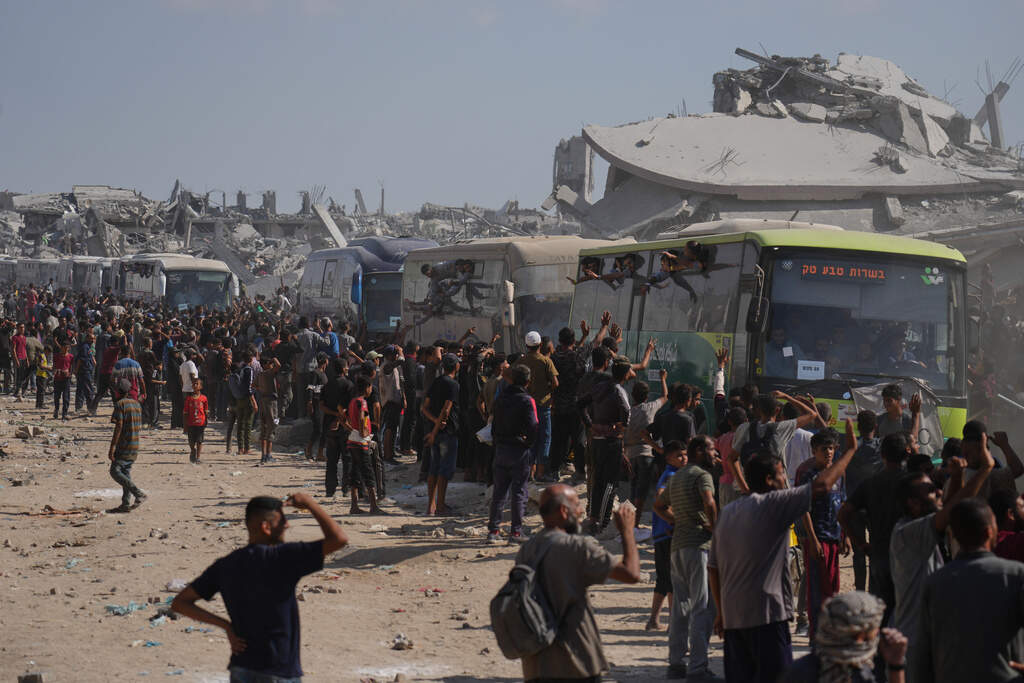
President Trump insists the ceasefire deal between Israel and Hamas is holding. But peace between the two sides rests on shaky ground. What aspects of the agreement are encouraging long-term stability, and what aspects are holding it back?
Guests
Dan Rothem, a nonresident senior fellow in the N7 Initiative within the Atlantic Council’s Middle East Programs.
Leila Farsakh, Palestinian political economist and professor of political science at the University of Massachusetts Boston.
Also Featured
Efraim Inbar, professor emeritus at Bar-Ilan University and senior researcher at the Jerusalem Institute for Strategy and Security.
Abeer Barakat, a Gaza City resident and university lecturer.
The version of our broadcast available at the top of this page and via podcast apps is a condensed version of the full show. You can listen to the full, unedited broadcast here:
Transcript
Part I
MEGHNA CHAKRABARTI: The fragile ceasefire between Israel and Hamas already seems at risk. Over the weekend, Israel launched airstrikes into Southern Gaza, killing at least 45 people, according to local health officials. The Israeli government said the strikes were retaliation for attacks on Israeli soldiers in Gaza.
Hamas denies responsibility for the attacks, claiming that Israel was fabricating a pretext for the IDF strikes. In other words, both sides have accused the other of violating the ceasefire agreement. It is hard to discern the validity of either claim without knowing the exact details of the U.S. brokerage ceasefire agreement.
And in fact, the text of the agreement has not formally been made public by the White House, Israeli or Palestinian officials. However, regional media have published it, the Times of Israel published the text, and a scan of a one-page document titled Implementation Steps for President Trump's Proposal for a Comprehensive End of Gaza War.
End quote. The October 9th document was signed by Israeli and Palestinian negotiators, plus representatives from mediating nations. Several days later, President Trump and leaders from Egypt, Qatar, and Turkey also signed the document at a ceremony in Egypt. Notably Israeli and Palestinian leaders were not at that peace conference.
Overall, as its title declares, the one-page ceasefire agreement is designed as a means to implement a 20-point piece plan the White House first made public in late September. So today we will examine both the specific October 9th deal and the 20-point plan and ask, do these agreements contain even the seeds for a lasting peace?
Leila Farsakh joins us today. She's a Palestinian political economist and professor of political science at the University of Massachusetts Boston. She's author of several books on the Israeli Palestinian conflict, including Rethinking Statehood in Palestine: Self-Determination and Decolonization Beyond Partition.
Professor Farsakh, welcome back to On Point.
LEILA FARSAKH: Thank you for having me, Meghna.
CHAKRABARTI: Dan Rothem is also with us. He's a non-resident senior fellow with the Atlantic Council's Middle East program. Previously he's advised Israeli leaders and other Middle East officials on peace negotiations in Gaza, and he's in Tel Aviv, Israel.
Dan, welcome to you.
DAN ROTHEM: Hi. Thank you for having me.
CHAKRABARTI: Professor Farsakh, let me just first ask you, and then Dan, I'll turn straight to you with the same question. Given the events, just even over the weekend, regarding the sort of exchange of blame in terms of if the ceasefire has been broken.
Do you think, professor, that the ceasefire has already been broken or is it still holding.
FARSAKH: No, I don't think it's broken. I think it's holding, but there is, of course, resistance a bit from Netanyahu who is not very keen on making this work. But we also see that there is an American determination in the Trump administration to make the ceasefire work.
We have now Kushner and Witkoff already in the U.S., Vice President Vance is also going to be in Israel to try and consolidate the ceasefire and go into the second phase. And I also think that Hamas is very much interested in making the ceasefire work and to go into the second stage.
Because the issue of ending this genocide that has cost the Palestinians so far, 67,000 who have been killed and over, 438 Palestinians have starved to death. And don't forget, we have massive destruction and 92% of all houses in Gaza have been destroyed. So I do think it's going to, the ceasefire is going to hold, but it's going to depend a lot on U.S. pressure to make it hold. And I think the U.S. is interested in making it work.
[The] ceasefire is going to hold, but it's going to depend a lot on U.S. pressure to make it hold.
Leila Farsakh
CHAKRABARTI: Okay. So Dan Rothem, one of my goals for this hour is to help we here in the United States make sense in part of the kinds of statements that we hear almost on a day-to-day basis. And I'll just keep with the weekend example in mind about this party broke the ceasefire, that party broke the ceasefire.
I hear Professor Farsakh saying that we need to put those statements in context and perhaps not pay as much attention to them, as perhaps the U.S. media does. Just your thoughts on that.
ROTHEM: Yeah, I generally agree. I don't think anybody's surprised that both sides are testing the flexibility in an agreement that is not 100% to their liking.
And they each need to maintain a victory speech on their part. And the blame game is part of it. It's been part of the historical peace process. It's certainly part of this first phase of the agreement. And as noted, it's President Trump's personal involvement and the empowering of Kushner, Witkoff, his key emissaries that really are holding this together, obviously together with the help of the regional mediators.
CHAKRABARTI: Okay. So I'd like to hear from both of you about this first phase, and I'm just looking once again at that one-page document that was signed on October 9th. Again, as I see published here in the Times of Israel. Then we'll talk about the 20-point plan in more detail, but thus far, it seems as if most of it has actually been implemented as written.
President Trump did announce the end, as he called it, the end of the war. The Israeli government did indeed approve this agreement. Military operations, and this is interesting, including aerial and artillery bombardment and targeting operations would be suspended. Then there's the immediate commencement of full entry of humanitarian aid and relief.
Professor Farsakh, in terms of the immediate needs of the stopping of the bombardment, the entering of humanitarian aid, and even the IDF withdrawal to agreed-upon lines, do you see that as having unfolded as hoped for and as expected.
FARSAKH: No, of course. We already have some stumbling block.
The withdrawal to this yellow line, which keeps Israel in control of 53% of the Gaza Strip has been implemented. The entry of aid has fluctuated. There was an agreement. The agreement says that we go back to the January 2025 aid entry, which is around 600 trucks per day.
Israel has not allowed that. It has been allowing 300 trucks per day to enter, which barely comes to the needs of the people of Gaza. Because as I said to you, they have suffered starvation. There's lack of water; there's lack of basic facilities. So I think Israel will play with the aid. Will use it also as a bargaining chip to have the full, a return of all the bodies.
Because I think the first part of the deal there, Palestinians, Hamas, has returned all the hostages who are alive and also started to return the bodies of deceased hostages. What is preventing the full return is the question of many are buried under the rubble and under the tunnels, and they need equipment for that.
And Israel is reluctant to send the equipment, because they're scared that the Hamas government will use it for removing the rubles and rebuilding Gaza. So we are going to play this tug of war, how much you going to give in, how much you going to give less. But again, I'm hoping that there is a serious push to make this ceasefire work.
Because it's in the interest, because the U.S. wants it, but also it is in the interest of the stability in the region.
CHAKRABARTI: Yeah, so we're going to come to that.
But Dan, because Professor Farsakh did mention hostages, both living and dead. There's a large section of this agreement that has quite a bit of detail on it, and I'm seeing one of them is that within 72 hours of the withdrawal of Israeli forces, it says here quite clearly, Hamas will release the remains of the deceased hostages in its possession and those in the possession of the Palestinian factions in Gaza.
To be blunt about it. Hamas representative signed this agreement knowing that there would be the 72-hour window. And I don't believe, and correct me if I'm wrong, that all the remains of the deceased hostages have yet been, have been returned, this continues to be a significant sticking point in Israel.
ROTHEM: It certainly is. I will say, first of all, that somehow, getting to this deal was partly because how committed President Trump has become to the question of Israeli captives in Gaza. Especially the living ones, but increasingly also understanding the importance of the remains of those that are dead.
I believe this evening Israel time we're supposed to receive two more bodies from Gaza Strip. And therefore, this will leave about, not about, exactly 13 dead captives still in the strip. I think early on, it was pretty clear to everybody, including the Israeli side, that although the agreement stipulates all the captives, in reality, it would be difficult for Hamas to get them all.
But the reading is that at least on the Israeli side is that Hamas could have transferred many more of them more quickly, but there's patience here and the focus is on getting all of them.
CHAKRABARTI: I think what's notable here for me, and I appreciate both of you going through these details, is because the document that was assigned on October 9th is indeed this one page. We just went through all five. There's six points of the document agreed that invoked the ceasefire. Which means that any subsequent steps towards peace are wide open or in terms of now it's whether or not parties can implement any of the 20 points that President Trump put forth in September.
And that leads me to item number six in the implementation steps document, where it says a task force will be formed of representatives from the United States, Qatar, Egypt, Turkey, and other countries to be agreed upon by the parties to follow up on the implementation with the two sides and coordinate with them.
Professor Farsakh, we only have one minute before our first break here. Even if this document really is just a ceasefire document. It feels though it has actually successfully set up the possibility of further peace points being either negotiated or even ideally, eventually implemented, does it not?
FARSAKH: Definitely. And this is why we have the Trump 20 plan. This page is the precursor for the 20 plan and the 20 plan is more detailed. But don't forget these plans, like anything Trump does, is vague on detail and it's important to keep it vague on detail. One, because he's not interested. But secondly, because that gives you scope to negotiate on the ground.
But what is clear there is a decision to actually move beyond the ceasefire. The question, how successful would that be? And there the devil is in the detail.
Part II
CHAKRABARTI: Professor Farsakh, I'll stick with you, as you mentioned that there's more detail in Trump's 20-point plan, but it still falls short of being a full roadmap.
And what people have already talked about is that there seems to be roadblocks already even in this 20-point plan. And the first one is the requirement in the plan for Hamas, not only to completely disarm, but also completely remove itself from the governance or political leadership in Gaza. Do you think that is possible at all?
FARSAKH: Hamas has declared a number of times that it's willing not to govern Gaza and it's willing to give it to a transitional Palestinian government. You have to bear in mind that the 20-point plan by Trump really relies on three main pillars.
The first it calls for the creation of what is called Gaza in transitional, international transitional government which would be supervised by Western powers. Then it calls for the creation of an international stabilization force, which so far, the plans seem to indicate it'll be four countries who will provide the police force to monitor Palestinian police, maintaining law and order, and also implementation of the agreement. And it also calls for a technocratic government. Palestinian government, which doesn't include Hamas, doesn't include the Palestinian authority people who will be responsible for law-and-order, water, facilities. Now, this disarmament of Hamas, of course, is a key issue, has been vague about it.
There is various plans, is worried about giving up its weapons if before it sees that there is a real intention for Israel to retreat from the Gaza Strip, which is far from being confirmed. Israel would retreat from certain areas, but we're not too sure that it'll fully retreat. But what is clear, Hamas doesn't want to govern.
Israel would retreat from certain areas, but we're not too sure that it'll fully retreat. But what is clear, Hamas doesn't want to govern.
Leila Farsakh
Also, what is clear at the same time is that Hamas has been governing for over the past 18 years, 20 years, since 2006. So when the ceasefire was signed, as you noticed, they are the one now, or people in the government, whether you call them Hamas people or not, but people in the government already, are taking away the robots where they can, trying to reconnect the water where possible and are responsible for law and order.
So I think it's a transition until we have this new force coming in place.
CHAKRABARTI: Professor, forgive the interruption there, but you just said, you see it, you believe it's clear Hamas does not want to govern. Why do you say that?
FARSAKH: Because Hamas understands that there it cannot be in the government, because there's an international and regional agreement.
These are the terms of the deal that it does, it cannot be apparent in the government. Will it rule in different ways? Most likely. But it does want to give the transitional Palestinian technocratic government the chance of succeeding. It wants to emphasize local Palestinian governments, because Hamas is also trying to act as a national party and not as a sectarian party.
CHAKRABARTI: Okay. Dan Rothem, let me turn to you here. Because I heard Professor Farsakh say there that Hamas has been reluctant to fully disarm as of yet because it's seeking more assurances. But my understanding is that the flip side is Israel cannot or is unwilling to offer more assurances or further withdrawal without Hamas having fully disarmed.
Is there a Catch-22 here?
ROTHEM: Absolutely. This is the biggest deadlock of them all as it relates to this transitional day after arrangements of the phase two of Trump's plan foresees. But just to be clear on that point, first of all in terms of governance, Hamas is willing to step back from the civilian governance of Gaza, predates this agreement.
It also predates actually the war. Hamas fundamentally in the context of the Israeli-Palestinian conflict is a resistance movement. What they call resistance, armed resistance which obviously the Israeli narrative and also in America are considered terror organization.
That was and is their key motivation. They, if you would, found themselves as rulers of Gaza because of their strife with the Fatah movement or the Palestinian authority at the time. Violently took over Gaza and have been ruling Gaza ever since, because it complimented their bigger agenda.
But if conditions are set as Layla noted, that both the Trump administration and all regional powers expect them to step back from governance, that they are willing to do. As for their weapons, certainly giving up weapons in this part of the neighborhood is usually a step that many actors are reluctant to take.
By the way, it's not just in this region, this happens. Disarming militia across the world is a complicated process and usually not a successful one. What's interesting in this plan is that in theory, you have an agreement foundation, or a foundation that sets conditions for an agreement or disarmament of Hamas. In the professional world, this is called a DDR process. DDR stands for the disarmament, demobilization and ultimately the reintegration of militias into the local structures.
Disarming militia across the world is a complicated process and usually not a successful one.
Dan Rothem
And whether this can come together, and be pursued in an agreement-based framework going forward is definitely the key point around which the viability of this phase two will stand.
CHAKRABARTI: A little bit later in the show, we're going to hear from a Palestinian living in Gaza City about how she sees not only the world she's living in now but her hopes for the future. But we also spoke with someone in Israel. He is Efraim Inbar. He's a senior researcher at the Jerusalem Institute for Strategy and Security, and he has a more hardline view of Hamas. Because he says Israel did not go far enough to completely eradicate Hamas from Gaza. And he argues that is why the region is already seeing sparks of violence.
EFRAIM INBAR: Hamas, what we see already is trying to get into power. And to expand its rule in Gaza, they are executing what they call traitors, and they try to gain back control over the piece of territory that we left them to rule.
And I don't think that anything else but Israeli military power will convince them to disarm. There are no other volunteers.
CHAKRABARTI: Inbar says Israel has needed to maintain peace through strength throughout its history. It's a small country surrounded by what it sees as hostile nations, and so he says Israel's actions in Gaza were necessary not only to respond to the terrorist attacks of October 7th, 2023, but also to maintain its position in the region.
INBAR: We are fighting the enemies of the west. The modern radical Islamists are the modern barbarians. The leveling of parts of Gaza, of the Gaza Strip is result of the fact that almost every other house had a cache of weapons, had entry to a tunnel. And we had to destroy it in order not to face unpleasant surprises.
The leveling of parts of Gaza, of the Gaza Strip, is result of the fact that almost every other house had a cache of weapons, had entry to a tunnel.
Efraim Inbar
So this was a result of the Hamas continuous buildup over the years, which we allowed, and this was obviously a mistake.
CHAKRABARTI: Now, multiple members of Prime Minister Benjamin Netanyahu's cabinet have vocally opposed any ceasefire deals. Inbar says he would like to see the Israeli military remain in Gaza until all Hamas members are out of the country.
INBAR: Frankly, I think the best way is probably Israel to conquer all Gaza and to send them by ship to a country that is willing to accept them. Now maybe Qatar to host them, or Turkey, or I don't know who, whoever is volunteering. We are not particularly sensitive about it.
CHAKRABARTI: Efraim Inbar, a senior researcher at the Jerusalem Institute for Strategy and Security, Leila Farsakh, your response to this particular view, which as Inbar himself noted, is also reflected amongst certain members of Prime Minister Netanyahu's cabinet, if not the Prime Minister himself.
FARSAKH: Oh, definitely. This is an old idea that Zionism always had, that Israel always had since its inception, that the only way it can exist is by projecting power and being most powerful and destroy any Palestinian resistance. This is why you have to understand that the problem did not start on October 7th, 2023.
It goes back to 1948 when Israel was created and its intention has always been to eliminate any Palestinian presence, but this strategy of denying Palestinian the rights, deny that they have a right to their land, which in Oslo was agreed upon, that we are going to go for giving the Palestinian eventually a Palestinian state. This is what the Roadmap to Peace, which was supported by the U.S. in 2003, stipulated this idea that has an international consensus of the two-state solution that many people in Israel oppose it.
But the idea that you can, but the fact on the ground has been that over the past 20 years, Palestinians have seen the ability to have a state dwindle, not increase. And I think the policy of putting Gaza on the siege for 17 years, which is between 2007 until 2023 actually backfired on Israel.
If anything, there's a lesson to learn from October 7th, is that Israel cannot be secure if Palestinians don't have their basic rights, do not have a minimum of dignity and life. And the idea of bombarding Palestinians into submission, which resulted in the longest war in Israel's existence, since 1948, this war of two years, that brought down 200,000 tons worth of ammunition that destroyed Gaza, did not destroy the Palestinian people, even if they destroyed their life. And shows that the only way forward for Israel is not if Hamas is eliminating another group would exist. There was not Hamas in 1970. There was the PLO. Hamas only emerged in 1987.
If you got to destroy Hamas, you're going to have somebody else. Because Palestinian have shown globally that, and internally, that they're going to continue fighting for the basic right to exist and have their independence.
CHAKRABARTI: So Dan Rothem, let me ask you this. Thinking of what Professor Farsakh just laid out to us in the history, I'm also recalling what Prime Minister Netanyahu himself has said over the past two years. I was looking at this opinion piece written by Shira Efron, whom you know, she's also an Israeli analyst.
It was published in the New York Times, and she says that while on the one hand Israel can say it has achieved a kind of victory in this ceasefire, because the IDF is still in Gaza and the ultimate goal in the 20-point plan is a kind of de-Hamasification of Gaza. She still says, quote, this victory is actually a defeat.
A necessary and blessed defeat of the Netanyahu government's Messianic vision. In fact, the agreement directly contradicts what the government has sold Israeli for two years, the promise of total victory and the destruction of Hamas. Your thoughts on that?
ROTHEM: So without re-litigating the past, if you would, 30 years of the peace process and the failure of it and focusing on Gaza.
I think as far as Netanyahu, first of all, I think it's a masterful diplomatic achievement right now to build a construct in which both sides can call their own victory, if you would. And this allows us to try and move forward specifically to the point of Netanyahu. Netanyahu's seen this 20 point plan.
It's a masterful diplomatic achievement right now to build a construct in which both sides can call their own victory.
Dan Rothem
Most of it, certainly phases one and two, as the fulfillment of the total victory that he imagined by diplomatic means, meaning that if all the provisions of this 20 point plan, at least the provisions of the first 18 points of it, will be fully carried out. You will end up with Hamas, I'm sorry, with Gaza, that has no Hamas governance in it.
A Gaza that is demilitarized, after which Hamas will no longer be possessing of weapons, big or small, and does not, poses a strategic threat to Israel in any way, shape or form. If this is carried out by agreement, then not just Netanyahu, all Israelis, I believe, are fully for it and would support it.
However, if Hamas does not abide by the agreement, by the provisions of the 20-point plan, then Israel certainly retains in its mind the legitimacy and the right according to this plan and the support of the United States to carry out the demilitarization of the Gaza Strip in a coercive manner, meaning by military force or resumed military force.
And if we look at the document, actually point 17 laid out exactly that, that in the case that Hamas does not agree, all the provisions of this transitional arrangement will be carried out only in the areas that the IDF has already declared, the Israeli military declared terror free and would be handed off to the international stabilization force to carry out there.
In the rest of the Gaza Strip, it's implied Israel will be able to pursue the forced demilitarization of the street and of Hamas.
CHAKRABARTI: Just, we have a minute before our next break. Let me just follow up, Dan. So does that mean that you see room in this 20-point plan for Netanyahu, should he choose to stave off the far-right wing of his party, of his cabinet that have been crying out for, I mean you just heard it. Basically, the illumination of not just Hamas, but most Palestinians from Gaza.
ROTHEM: Yes. Certainly, there's enough here so that both Netanyahu and also people to his right can live with it and give it, let's say room for development over the coming weeks and months to see where this goes. If indeed Gaza is being demilitarized by agreement as laid out in the Trump 20-point plan, they will be happy and stick with it. If, however, developments on the ground is that Hamas resurge as a military force and that the ceasefire doesn't hold, and war resumes, so be it, as far as they're concerned.
CHAKRABARTI: Professor Farsakh? Yeah, go ahead. We have 30 seconds before the break.
FARSAKH: Yeah. What is important to bear in mind that the 20-point plan allows Israel to do what it wants. It has the upper hand. Okay. Just like the Oslo agreement, there's the upper hand. The question is, will Israel understand the lesson of the past two years, of having to live with the Palestinians. Because deportation and expulsion has not worked, and Palestinians showed over and over again that they're not leaving this land.
Deportation and expulsion has not worked, and Palestinians showed over and over again that they're not leaving this land.
Leila Farsakh
Part III
CHAKRABARTI: We also wanted to hear from someone living on the ground in Gaza. So in order to do that, we're going to turn to Abeer Barakat, we've heard from her many times On Point over the past several years. She's a lecturer and PhD candidate in English, and she lives in Gaza City. She's lost several family members already during this war, including her own brother and his children.
Her home was completely destroyed in an Israeli airstrike. She has had to move 14 times in the past two years. But for the past few months, Abeer says she's found some stability living in a neighborhood with some of her in-laws. She had a steady stream of food and water and was making a living teaching online.
That is until about two weeks ago.
ABEER BARAKAT: The situation in Gaza was very dangerous. The Israeli occupation has escalated its bombardment on Gaza City by using the explosive robots that actually destroy neighborhoods, entire neighborhoods. So the sounds of these explosives were very high, very scary.
And they were going and marching block by block. So we were feeling that they were approaching to where we are staying. So it was very dangerous for us to stay here.
CHAKRABARTI: Abeer's family stuffed about six suitcases full of what they thought were their only belongings that they'd have left in the world, and they evacuated on foot for about four hours south of Gaza City.
Eventually, they were able to set up a tent. Abeer says it was both humiliating and uncomfortable.
BARAKAT: During the day, it's still very hot, so you feel like you are in a sauna while you are in a tent. And around the dawn time at about 2:00 or 4:00 a.m. in the morning, it's freezing cold. After that, there is no privacy.
When you are talking to your son or your daughter, or even your husband, the people in the next tent can hear your simple conversation.
CHAKRABARTI: And then Abeer heard about the ceasefire, but she waited with her family for about a week, unsure if the ceasefire was actually going to hold, but as she read news about hostage exchanges, Abeer decided it was time to go back to the neighborhood in Gaza City that she had fled.
And it turns out that neighborhood was still safe. The explosives had stopped just three blocks from her home, and so their family returned to their familiar home.
BARAKAT: It feels so refreshing. It feels so happy despite all of the destruction around us, despite of the difficulty in life itself. But it feels really very good and I hope, and I pray to God that we don't have to leave our land again.
CHAKRABARTI: Abeer says in the past couple of weeks, markets have reopened. More people are returning to their homes, but it's becoming clear just how monumental a task rebuilding Gaza is going to be. Gaza City now needs new housing, schools, hospital systems, internet towers, water infrastructure. Many products are still impossible to find or completely unaffordable.
BARAKAT: We are very tired of canned food. It doesn't carry any kind of nutritional values. Our bodies are very exhausted from these two last years. And for example, there is no fresh meat. We need meat. We need protein and the only protein we get is vegetable protein, chickpeas from chickpeas or these kind of canned food.
I haven't eaten bananas for two years. Can you imagine that? Can you live like that?
CHAKRABARTI: Abeer also says the humanitarian aid coming in does not cover the needs that she sees on the ground all around her. She's still hearing Israeli drones constantly and it makes her uneasy that during the supposed pause in the fighting, health, safety, and security still aren't guaranteed for her and her neighbors.
BARAKAT: Why are they, do they still keep hovering over our heads in such low heights? So this is crazy. They didn't stop. Actually, the only relief we had in the ceasefire is the stop of bombardment and the constant killing, although that didn't stop completely. Because it really, troops are still shooting people in what they call it, the yellow zones, shooting people who go to check on their homes.
CHAKRABARTI: And then there's this. If the ceasefire does hold, Abeer says she's still not in favor of fully disarming Hamas. She does not agree with Hamas' actions, but she feels that Israel or any third party should not force Palestinians into something that they didn't choose.
BARAKAT: It's very arrogant of the governments of the United States or Britain to play with the fate of the Palestinians.
We need to have our word on this. They should stop treating us like puppets. We do not want others to judge our fate, and they need to look at Hamas not only as a terrorist faction because it's not like that. It's a resistance faction that has been in government for a very long time. It has institutions, so they need to look at them as a legitimate government in Gaza.
CHAKRABARTI: And Abeer believes that for as long as Prime Minister Benjamin Netanyahu is in power in Israel, the long-term ceasefire between the two sides just isn't possible.
That's what she believes. However, she is ready to keep living in her neighborhood in Gaza City for as long as she can, or if she needs, she's ready to flee south again. The important thing to her is that she stays in Gaza.
BARAKAT: Our resilience is very strong. Our spirit is very strong, so we are resilient on our land and maybe this is the only weapon we have.
Our resilience is very strong. Our spirit is very strong, so we are resilient on our land and maybe this is the only weapon we have.
Abeer Barakat
So when you know that you are not doing anything wrong, you are not stealing the land, you are the rightful owner of the land. So you can't stand in the face of tyranny despite all its artillery. And this is our true power.
CHAKRABARTI: It's Abeer Barakat. She lives in Gaza City, Professor Farsakh. I want to in a minute or two talk about the specifics around the transitional technocratic governing body that's in President Trump's 20-point plan.
But even if buildings are rapidly reconstructed and schools are reopened and hospitals resume providing care in Gaza, Abeer there gives us insight into the deeper wounds of this war, and do those profound psychological and traumatic wounds that now millions of people in Gaza carry, will those possibly be an impediment to a lasting peace?
FARSAKH: You asked a very good question, but I think also what Abeer said is very empowering. You heard her, of course, the level of trauma that the Palestinians lived over the past two years and the level of destruction, the fact that we have 180,000 people who are injured, would need help. The fact that kids, 60,000 kids have not gone to school and have been traumatized.
We have 50,000 kids who lost a parent who are orphan, so it is an incredible toll on the population, but I'll have to say, unfortunately we've been there before. We Palestinians have lived that in 1948, don't forget in 1948, 750,000 Palestinians were kicked out from their land and they were living in tents.
What has been shocking about this war is that it's unbelievable that Palestinians had to live again in tents, 77 years ago. But I do think though the Palestinian this time are much better prepared, even if the magnitude of the trauma and the magnitude of the damage is much bigger.
And you see this resilience in exactly what Abeer said, in the fact that the Gazans, despite two years of war, and 200,000 tons worth of bombardment that had been fallen, more than what has happened in Dresden during the Second World War. The fact despite of this, despite going south 14 times, being displaced 14 times, she still insists on being in Gaza. And the fact that so few people left Gaza is an indication that the Palestinians are here to stay and are also resourceful in terms of helping each other.
Inside and outside, I think there is a determination to continue living on the land. And as she said, we are resilient and we know where we are right. Because this is our land. And we also learned all the history of 1948. If you leave it don't come back. So now everybody is staying ... but we are hoping that with this peace plan there will be attempt to actually enable these people to survive with some dignity.
But it's going to be a long process.
CHAKRABARTI: Okay. So Dan ... go ahead please.
ROTHEM: ... So thank you for this very important interview you conducted out of Gaza. I want to say something as an Israeli, we carry deep hurt and trauma from October 7th. And I think we're only now, this, like my society is only now with this conclusion of certainly the living captives ... are now moving from our trauma to our post-trauma.
But we also cannot ignore this immense suffering on the Palestinian side and to see their trauma which was taboo here in Israel up until I think recently. But we increasingly see that here, to see the loss and despair also on another side. And I think acknowledging that is not just recognizing reality and the experience, but I hope also a path forward.
We also cannot ignore this immense suffering on the Palestinian side, and to see their trauma which was taboo here in Israel up until, I think, recently.
Dan Rothem
But I think the interview you conducted from Gaza shows that the challenge now is not just a humanitarian, conditions one, which are grave and needs addressing. But it is also societal and political. And psychological. And peace plans and negotiations, they matter only, oh, am I going to say, to the extent that they really resonate within societies when people see that conditions are ripe for change.
And without that sense of readiness, even the most elegant plan, and this is not an elegant plan, but it has its merits. But even the best plans stay on paper if the negotiators don't really channel readiness amongst the people. And so we need to be very mindful of that as we examine both entering into this transitional period, assuming the ceasefire holds.
And certainly, if we look beyond that, to issues of real political horizon, potential two state outcome and regional normalization and integration.
CHAKRABARTI: So let me just quickly follow up on that. Because it does seem as if, in fact, potentially one of the strengths of the plan is how general it is.
But even within that generality, if I can put it that way. I'm looking at point 9 and Professor Farsakh had mentioned this before, that would set up this technocratic apolitical Palestinian committee to help rebuild Gaza with the inclusion of international not just nations but leaders as well.
I guess what's conspicuously absent from that is any Israeli involvement in that? Is that actually a good thing, Dan?
ROTHEM: It's a necessary thing. First of all, yes, I think by and large, except for a relatively small fringe in the Israeli political system, by and large, most Israelis and certainly the national security apparatus was really reluctant to say the least, to engage in direct civil governance of Gaza Strip, right?
It was always a military campaign. And all planning for the direct control over 2 million Palestinians was done reluctantly and never like never really materialized. Not in the level of motivations and not in the level of actual plans. That's on the Israeli side. Certainly, ultimately, governance in Gaza needs to be done by Palestinians.
This is also the conditions of the original actors. Their support was conditioned on the legitimacy that only Palestinian governance can extend. Initially, this will be this technocratic committee made of Gazans. Ultimately also in the plan, this would be transferred to a reformed Palestinian authority.
And maybe we'll have a couple of minutes to talk about that.
CHAKRABARTI: Actually, that's quite a big part. That's quite a big part, which it's all wrapped up in one sentence. About the Palestinian Authority. Actually, we only have two minutes left.
A Professor Farsakh, do you want to just quickly give me your thought on that?
FARSAKH: Yeah, I think the point that Palestinians have to govern themselves is a key point, but it's important to mention two points. One that Israel has always wanted to get rid of Gaza, has never wanted to govern Gaza, and that what was the redeployment in 2005.
Okay. It wanted to have Gaza under siege and now this plan has been destroyed, but it still doesn't want to govern it. It wants somebody that it can rely on. But also, the big problem we have with this plan, it doesn't respect Palestinian agency. As you mentioned, there is no Palestinian Authority. There is no Palestinian direct involvement.
There is actually supervision. We have this temporary transitional government, and then we have this GITA, the Gaza international transitional government, which is going to supervise this work. And that's where also the devil is going to come into, devil in the details, because that's a form of custodianship.
This is a way of disrespecting Palestinian agency, and this is a way also to happen while Israel is expanding its domination of the West Bank. We should not forget, Israel is expanding settlements in the West Bank. It's talking about annexing the West Bank. So in a way, Israel is continuing its colonial endeavor of expanding its hand on the Palestinian land while wanting other people to pay the bill.
So the vagueness of the plan is a good thing because you can interpret it whichever way you want, but the supervisory element, which also echoes of U.S. involvement in Iraq, with the Iraq, remember, coalition provisional authority? This GITA seems very similar to that, and we know how it backfired, so we are going to see what's going to happen.
I think ... there is the U.S. and a regional determination to end this, to bring a new ceasefire that is more solid and allow people to breathe. But we're still not out of the woods.
CHAKRABARTI: We have one minute left. And Dan, I'm going to let you have the last word today because both of you over the course of this hour have said a couple of times that President Trump's involvement and his desire to actually bring some sort of if not permanent, but at least longer-lived peace is really important here. Dan, my question for you is what needs to happen next such that we don't talk about this plan as we do talk about, say, Oslo from many years ago.
ROTHEM: Yes. So certainly, what we need is very early manifestations of success for this phase two, right?
Setting up, with all the question marks that come with it, setting up this transitional governance mechanism, looking at this international stabilization force, finding some anchors that A, are going to transform small parts of Gaza itself. But also communicate to President Trump that he has a victory waiting to be had here.
And this is not just yet another round of Israeli-Palestinian failure.
The first draft of this transcript was created by Descript, an AI transcription tool. An On Point producer then thoroughly reviewed, corrected, and reformatted the transcript before publication. The use of this AI tool creates the capacity to provide these transcripts.
This program aired on October 21, 2025.