Support WBUR
From unthinkable to politics as usual: The government shutdown story
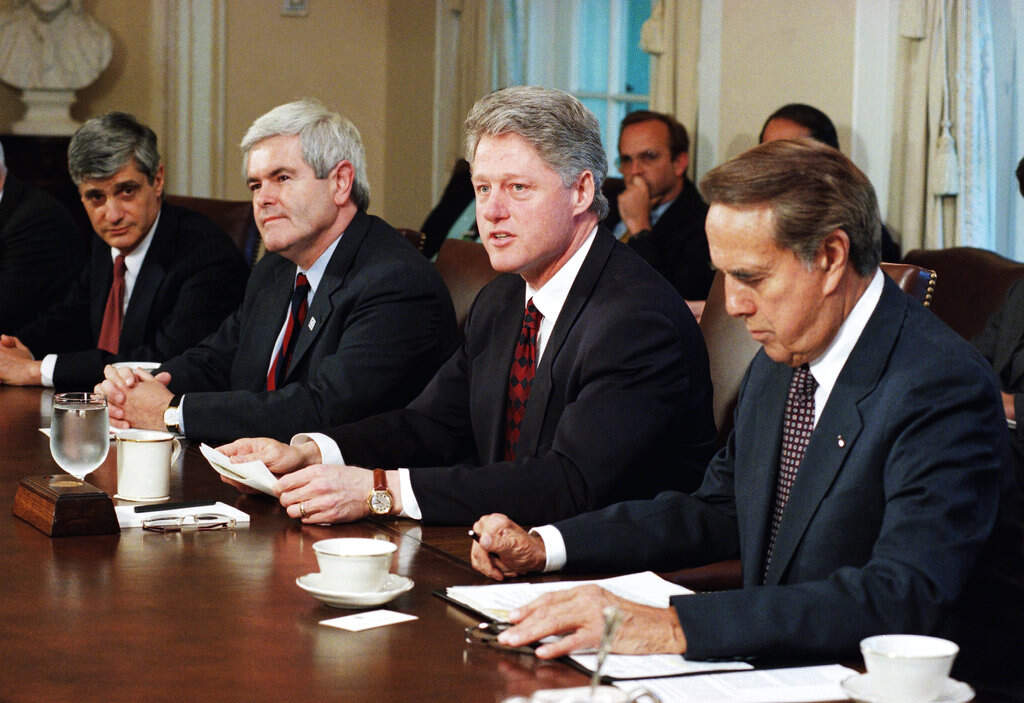
Government shutdowns have become an expected reality in American politics. But before 1980 they were pretty much unheard of. The history of government shutdowns in the U.S.
Guests
Mike Davis, adjunct professor of history at Lees-McRae College.
Jeremy Mayer, professor at the Schar School of Policy and Government at George Mason University.
Also Featured
Annette Meeks, former deputy chief of staff of Republican House Speaker Newt Gingrich.
The version of our broadcast available at the top of this page and via podcast apps is a condensed version of the full show. You can listen to the full, unedited broadcast here:
Transcript
Part I
MEGHNA CHAKRABARTI: It's Wednesday, October 22nd, which also happens to be day 22 of the latest U.S. government shutdown.
MIKE JOHNSON: Three weeks since the Democrats have decided to close the entire federal government. I mentioned yesterday when we were gathered that this is now the longest full shutdown in American history.
CHAKRABARTI: Republican House Speaker Mike Johnson there.
This also happens to be the second longest government shutdown overall. The government was partially closed for 35 days in the 2018 shutdown. Back then, the impasse was overfunding for the Southern border wall. This time it's over health care, specifically cuts to Medicaid in the Republican sponsored and passed One Big Beautiful Bill Act.
There's also the issue of enhanced subsidies under the Affordable Care Act, which are set to expire on January 1st, 2026. There is no appetite among Republicans to extend the subsidies, meaning millions of Americans could see their health care premiums more than double next year. Democrats have decided that's worth keeping the entire government shut down for, until Congress takes a vote on health care.
Here's House minority leader Hakeem Jeffries.
HAKEEN JEFFRIES: Republicans have shown zero interest in reopening the government and acting a bipartisan spending agreement that actually is designed to make life better for the American people and address the health care crisis that Republicans have created.
CHAKRABARTI: The political cartoon almost draws itself, right?
Giant caricatures of Democrats and Republicans pointing the finger at each other and trapped in the middle. Between those two-pointed fingers, the tired, squeezed and confused ragdoll body of you, the average American.
Meanwhile, around 1.4 million federal employees are on unpaid leave, or they are still working without pay, and many government services are indeed suspended or severely limited, including the closure of many national parks or services at those parks and museums like the Smithsonian. There's disruptions to food assistance programs, federally funded preschools, and even air traffic control.
Now, as mentioned, there was a government shutdown in 2018 and one in 2019. There was also one in 2013 in 1996, 1995, so on, so much so that government shutdowns in the U.S. have become normal. I'm reminded of once when I took a wilderness survival course up in Maine. One of my classmates was a young Air Force service woman, and I just, I don't know how we got talking about the government, but I do remember her shrugging and saying it's basically always shutdown, isn't it?
Now her resignation at having a dysfunctional federal government might be understandable, but this never used to be the case. In fact, prior to 1980, government shutdowns were practically unheard of. So what has changed? How and why did government shutdowns become so normalized in American politics? We're going to start with Mike Davis to help us answer that question.
He's an adjunct professor of history at Lees-McRae College and joins us from On Point Station, blue Ridge Public Radio in Asheville, North Carolina. Professor Davis, welcome to On Point.
MIKE DAVIS: Hi, Meghna. Glad to be here.
CHAKRABARTI: So the origin story of shutdowns begins not with Republicans, but in fact with Democrats in 1980, before November of 1980, correct?
DAVIS: Oh, that's right. The first shutdown, as we know it ... all the government closes down for lack of funding, is on one day, May 1st, 1980, when the FTC closes down because they don't have any authorized funding.
CHAKRABARTI: Okay. So Carter administration, we're talking about here, and a man which I would garner these days, not many people remember Benjamin Civiletti. He was what? The Assistant Attorney General, or AG at the time?
DAVIS: He had just become the Attorney General the year before.
CHAKRABARTI: Okay.
DAVIS: Because Carter, there's a kind of big cabinet purge and he goes from assistant to full AG.
CHAKRABARTI: Okay, so what caught Civiletti's attention?
DAVIS: What caught Civiletti's attention was he was asked a question that, as far as I could tell, the Attorney General's office had never been asked before. As back in 1870, Congress had passed the Antideficiency Act, which means that you can't have coercive deficiencies, meaning the government, the executive branch can't spend money that hasn't been appropriated for them.
This had been on the books since 1870, but it had almost been a dead letter. Agencies routinely spent more money than they had and waited for Congress to pay them. This continued even after they put criminal penalties in the Antideficiency Act in 1905, which still exists as of 1980, and nobody had ever been held criminally liable for violating this act.
But he is asked by Ron McCluskey, who's a congressional staffer, what happens if a federal agency isn't being funded by Congress? And Civiletti says the law says that is illegal and these are the criminal penalties for it. And if the FTC does it, you'll be prosecuted.
CHAKRABARTI: Oh, okay.
Hang on for a second. Prior to that, just to be clear, as you said, appropriations lapsed frequently. That wasn't unheard of, but agency, just agencies just kept going, doing what they do, presuming that Congress would eventually appropriate the funds.
DAVIS: Yes, this goes all the way back to the Jefferson administration.
There are complaints about this.
CHAKRABARTI: Okay, so how did the FTC then get dragged in here when Civiletti decides now, 110 years later, we are going to act on the Antideficiency Act of 1870.
DAVIS: The head of the FTC is a guy named Michael Pertschuk. He's a kind of a friend and contemporary of Ralph Nader.
He's a real kind of crusader for fairness in advertising, like he's why you can't have TV ads for cigarettes anymore. And in the late '70s, he's looking at children's television and making the argument that now these commercials are just selling sugary cereals and bad stuff to kids. So he's using the FTC to regulate that. The advertising industry does not like this at all, because that's a big breadwinner for them. They go to work lobbying congress. Congress says, Okay, we'll delay the appropriations bill for the FTC, because we want to pass a bill that will limit its authority. So they can't make rules so unilaterally and they can't do investigations.
And the context with McCluskey is he's working for a Congresswoman Gladys Spellman, who's from suburban D.C.
She's a Maryland representative, so they have a lot of federal employees in their district, and so they ask first the Comptroller General, then the Attorney general. So what does happen if a federal agency isn't funded?
And the Comptroller General says the law says it needs to be shut down, but Congress has generally appropriated money after a budget deficiency, and that apparently doesn't sit well with McCluskey. Because, you know, that is saying it's illegal, but it's okay. You can do it anyway. So he goes to the attorney general, and the attorney general says, Oh, this is what the law says.
If you violate the law, you'll be prosecuted by the Justice Department. And everyone is shocked by this. The idea of enforcing the Antideficiency Act, it blows people's minds. People at the time have never heard of this law, even though it's been around for over a hundred years. And much to people's shock, and you can read the bafflement, the concept of the government shutting down.
How could this be possible? The FTC shuts down until Congress appropriates them their revenue.
The idea of enforcing the Antideficiency Act, it blows people's minds.
Mike Davis
CHAKRABARTI: Okay. Hang on Professor Davis. American history is so wild. I love it so much. So you're saying that today we're seeing like ground stops at various U.S. airports because back in 1980, big cereal didn't want to be regulated from selling sugary cereals to American children, and so therefore we enter this world of government shutdowns.
Is that essentially what has happened?
DAVIS: Oh yeah. I think you can directly draw that line. Although I will say in defense of Benjamin Civiletti, he had a very long career as a humanitarian after being the Attorney General. He's why there's no death penalty in Maryland, among other things.
And you can read his frustration in the interviews in the last few years of his life. Because he lived until 2022, when they keep asking him about the government shutdowns and he affirms that this was not what he had in mind. That he was asked for an interpretation of the law, and he interpreted the law.
Which is, at least from my non-lawyer perspective, that is what the Antideficiency Act says. But that became a tool that gets used again and again in D.C.
CHAKRABARTI: Okay. So we'll get to Civiletti a little bit more in a bit.
But sticking with this May 1st, 24-hour FTC shut down, first of all, that was the only agency to shut down. Yes?
DAVIS: Yep.
CHAKRABARTI: Okay. Because it was the only agency that hadn't had its most recent appropriations completed in past. In terms of big cereal, did they get what they wanted?
DAVIS: Yeah.
CHAKRABARTI: So it worked as a political gambit.
DAVIS: Oh, yes. It seems to have surprised the members of Congress. But when they do come back, they fund the FTC and they do limit its power.
And that's why people of a certain generation got sold all kinds of sugary cereals with their cartoons in the '80s.
CHAKRABARTI: I literally can blame my cavities from my fruit loops over consumption as a child on a government shutdown. This is why I love doing this show. This is so fascinating. Okay so Professor Davis, let me ask you, again, I don't mean to make light of it, it's just almost absurd though.
But the reason why I asked you about using the government or a federal agency and its appropriations as a tool for leverage this time, r back in 1980 by essentially food lobbyists, did that not then set the template for why the government was pushed to a shutdown point in the many shutdowns we've seen since then.
DAVIS: I think it's the first big step. There are some short shutdowns under Reagan and the first Bush, but at the risk of getting angry letters, they aren't important. They're only about a day long. Most of them, the Bush shut down is over the Columbus Day weekend. So it's not really important. You don't really see shutdowns becoming this kind of tool really until the mid-nineties, until the Clinton-Gingrich years.
You don't really see shutdowns becoming this kind of tool really until the mid-nineties, until the Clinton-Gingrich years.
Mike Davis
When you have two shutdowns in 1995, then stretching into 1996. That's when you start seeing the pattern we think of. The long furloughs, the industry is taking a hit.
Part II
CHAKRABARTI: I want to note something that you said about
Benjamin Civiletti. He died in 2022, and you said that he had actually become perplexed by how government shutdowns had transmogrified into these giant monsters.
And he says, he told the Washington Post, I couldn't have ever imagined that these shutdowns would last this long of a time and would be used as a political gambit. But, and check me on this Professor Davis, even before 1980, there were a couple of times where, in fact, federal agencies themselves threatened to shut down unless Congress did what they want.
And were able to do that because of the zero penalties in the Antideficiency Act.
DAVIS: That had happened, for example the Post Office several times will spend all of its budget and then say, Hey, Congress, we need more money. A couple of years before 1980, in 1978, the Navy had actually gone $2 billion over budget and waited for Congress to make up the money. But I think Civiletti is part of that generation, that kind of came of age with the New Deal and then the New Frontier. That said, okay, we want government to work. We expect that everyone in government is going to keep working.
CHAKRABARTI: To be frank I want us as a nation to come back to that presumption that government's going to work. But the Post Office story is just a wonderful aside that in, what 1947, the Post Office basically said, appropriate more money to us, otherwise we're going to shut down. In 1879 it had spent its appropriated funds, announced it was shut down unless Congress gave the Post Office more money.
I have the best staff in the world. Our producer Paige, she dug up this historical quote that says a Congressman fumed over the blackmail, one asking quote, was there ever such audacity on the part of any departmental officer in a time of peace in U.S. history? One wonders what they would think about what's happening now.
But I don't want to let the Reagan administration in the '80s completely off the hook because you did say there were some shutdowns.
They weren't that big of a deal because most of them were a day, if not just barely more than that. But we do see an increase in frequency of even these day long shutdowns through the 1980s, do we not?
DAVIS: Yes. As the legal principle had not really been established before 1980 and 1981. Because Civiletti, he comes under a lot of pressure from the Carter administration after his initial opinion.
So he expands on that in October of 1980, and then in January of 1981, right before he leaves office, to clarify that, okay. If you are protecting life and property, you can stay open. If you're funded by something other than annual appropriations, you can stay open and the like, but we are still using his opinion.
When you have that one day shut down under Reagan in 1981, they go right to the precedent Civiletti set.
CHAKRABARTI: Okay. So one day shutdowns were manageable, but nevertheless, all of these shutdowns do create disruptions and cost the government money when agencies reopen.
But to your point, the shutdown of all shutdowns occurred in 1995.
ANNETTE MEEKS: We just had no idea what effect this would have, how it would be embedded in our mind as one of the most significant events that happened. We just had no playbook to explain to us what we were in for.
We just had no idea what effect this would have, how it would be embedded in our mind as one of the most significant events that happened.
Annette Meeks
CHAKRABARTI: That's Annette Meeks. She was the Deputy Chief of Staff for then Speaker of the House, Newt Gingrich, Georgia Republican.
The previous year in the 1994 midterm elections, Republicans gained control of the House and Senate for the first time in nearly 40 years, it was deemed the Republican Revolution. Bill Clinton was president at the time.
MEEKS: Congress always has sent bills to the President knowing that the president will veto them.
In this case, it was a real principled stand from the House and the Senate to say, we campaigned on this in 1994. We are going to cut government spending and trying to get the Clinton administration to understand how important that was to the new House majority. And they were not going to back down, nor should they.
They campaigned on this, they meant this. However, the president and rightly so, said, I didn't campaign on this. And so the first volley that was sent back to Capitol Hill was a veto of the bills.
CHAKRABARTI: So without a past budget bill, the government shut down on November 14th, 1995. Five days later, November 19th, Congress did pass a temporary spending bill to keep the government open, but that didn't mean the major sticking points had been resolved.
They were education funding, environmental regulation, and health care. Specifically, Medicare. Republicans had wanted to increase Medicare premiums for seniors by about $10 a month or about $21 in today's dollars, and President Clinton was strongly opposed.
BILL CLINTON: Yesterday, they sent me legislation that said we will only keep the government going and we will only let it pay its debts if and only if we accept their cuts in Medicare, their cuts in education, their cuts in the environment, and their repeal of 25 years of bipartisan commitments to protect the environment and public health. On behalf of the American people, I said, no.
CHAKRABARTI: And here's how Speaker Gingrich responded.
NEWT GINGRICH: We think all the President has to do is commit to a seven-year balance budget with honest numbers and an honest scoring system.
CHAKRABARTI: Once again, here's Annette Meeks.
MEEKS: This was a new House majority, a new Senate majority, and a president. To say that there was a lack of trust on both sides would've been an understatement, and so that was part of the deal. Was, I don't trust you that if we reopen the government, that we will be able to continue these discussions and talk about significant cuts in spending.
CHAKRABARTI: President Clinton and the Republican controlled Congress were unable to agree on a long-term spending plan. So on December 16th, the government shut down again.
MEEKS: It had never happened, and we never thought it would. And then once it was upon you, there's no game plan on how you handle a situation like this, that is so high stakes and is comprehensive in terms of capturing the average American's attention of, what do you mean? The government shut down? People just expect their government to work and it wasn't.
CHAKRABARTI: Meeks says the speaker's office was working around the clock answering the phones. And remember this was 1995, so also answering faxes.
MEEKS: Back in 1995, there was an email readily available. We had it in our office, but for outsiders, for constituents to contact us, they used the fax machine, and boy did they use it. We burnt out one fax machine completely, not running outta toner. We literally had to trash the machine and get a new one delivered.
CHAKRABARTI: Recall that before 1995, the longest government shutdown was a mere three days. Meeks says that as the 1995 shutdown stretched on, her office did not have a lot of answers for people.
MEEKS: For example, when a government employee would call and say, I'm a constituent and I just need to know, I need to make my mortgage payment on December 1st, will I be receiving back pay because I need to take out a loan to pay my mortgage and to have to say, sir, I'm gonna have to get back to you on that.
Because I don't know, this is their home. This is their livelihood. It wasn't easy. It wasn't very pretty at the time. And like I said, it was so unprecedented. We all really were just playing by ear to hope to get through that day and that tomorrow would be better and we'd be closer to opening up the government.
CHAKRABARTI: Now to state the obvious, a prolonged government shutdown means neither Democrats nor Republicans are willing to move substantially from their entrenched positions. One of the reasons why the 1995 shutdown became the longest to that date, now here's minority Senate leader, Democrat Tom Daschle, on December 31st, 1995, 15 days in.
TOM DASCHLE: All year, the speaker and his lieutenants have warned that they would shut the government down as part of their revolution. They didn't care what the price was. They wanted to force their radical agenda on the president and on the American people. And each day there's been a new demand. Each day, a new hostage, federal employees, people who depend on government services.
Now even the Middle East Peace process, the majority leader has worked in good faith in an effort to try to resolve this matter. The government remains shut because some members in the House want it shut.
CHAKRABARTI: And here's Senate Majority Leader Republican Bob Dole. During that same Senate session on December 31st, 1995.
BOB DOLE: We ought to end this. It's gotten the point where it's a little ridiculous as far as this senator's concerned. So we're going to keep trying and hopefully on Tuesday, if we can't do anything else, we may pass whatever it takes on the Senate side.
CHAKRABARTI: After 21 days on January 6th, 1996, the government shutdown finally ended.
MEEKS: Each day it seemed to get a little hotter working in the office and more miserable, and people more frustrated when in fact it took that to achieve a bill that the president would sign and that Congress found palatable and to move forward from there. The process of the 21 days of negotiations, which is building the trust that we will be able to have a discussion about real welfare reform.
Real spending cuts in the appropriations going forward, to trust that the president would sign those bills if we agreed to that.
CHAKRABARTI: The agreement that they came to called for modest spending cuts and tax increases. Annette Meeks says despite how bad the government shutdown was, it led to wins for the Republicans such as significant welfare reform in 1996 and a balanced budget three years later in 1999, they achieved both under Clinton, a Democratic president. That said, Meeks does not think that government shutdowns should become common.
MEEKS: If you would've told me how many times the government would shut down after that incident in 1995, I wouldn't have believed you. Is it the most effective tool to do high stakes negotiations? Perhaps, because it does force people to sit down, face-to-face and figure things out.
Is it the best? No, it's a horrible way of doing something that should be done in a much better, more professional situation than the bully club that's used to shut down the government. It's a horrible way to run our system.
If you would've told me how many times the government would shut down after that incident in 1995, I wouldn't have believed you.
Annette Meeks
CHAKRABARTI: So that's Annette Meeks. She was former Deputy Chief of Staff for then House Speaker Newt Gingrich back in 1995.
Mike Davis. Do you remember those times?
DAVIS: Yes, I was one of those middle school kids who was probably more into politics than they really should be at the age of 13 and 14.
CHAKRABARTI: Obviously it was a big turning point in American political history, so I wanna talk more about that shut down. And in order to do that, let's turn to Jeremy Mayer. He's a professor at the Schar School of Policy and Government at George Mason University and joins us from Arlington, Virginia. Professor Mayer, welcome to On Point.
JEREMY MAYER: Great to be with you.
CHAKRABARTI: Okay, so take us more into the 1995, '96 government shutdown.
Annette Meeks, she played it out pretty clearly. But why? What was going on politically at that time that made neither Democrats more broadly, but especially House Republicans just unwilling to move from their positions at the beginning of the shutdown.
MAYER: The Republican Party felt that it had won a historic election in 1994, and that Clinton was a fading sun.
And there was a headline in Newsweek that said the incredible shrinking presidency. And so this was the Republicans claiming the spoils of their great victory. And Clinton wasn't going to let them do it.
CHAKRABARTI: Until he did. Was it the government shutdown that finally forced Clinton's hand?
MAYER: So I don't think the Republicans won what Ms. Weeks calls great victories because of the shutdown. In fact, politically, the shutdown was how Clinton won his reelection. If you recall, the reason the Republicans took the house in the Senate in 1994 was that Clinton was about as popular as anthrax after two years in office.
And the expectation was the Republicans were gonna beat him like a redheaded stepchild for reelection, but in fact, using the shutdown, Clinton established that he was the adult and that Gingrich was a petulant child that you shouldn't trust with government.
CHAKRABARTI: Oh, fascinating. Okay. Speaking of petulance, there's a story about speaker Gingrich that from which the let's say the unkind name of Crybaby Newt emerges, Professor Mayer.
MAYER: Very much so, he didn't get the seat wanted on Air Force One and made the terrible mistake of complaining about it to the press. And the Clinton White House messaging team very effectively said, oh, so we're shutting down the government because of your wounded ego. And the New York Daily News just ran with it.
CHAKRABARTI: Oh, okay. But so the New York Daily News ran with it, but that wasn't necessarily the case. Was Gingrich shutting it or forcing the government shut down for the more, sort of, we ran on cutting costs and balanced budget, as Meeks said.
MAYER: Very much so, it was an issued position for the Republicans, but it also represented, I think, the first great symptom of polarization in American politics.
That the Republicans and the Democrats no longer had the bipartisan tradition. There weren't enough Bob Doles, like the little clip you played of Bob Dole. Bob Dole didn't want the shutdown. He was not part of the Gingrich Revolution, and so there weren't enough establishment Republicans to keep the government open.
It ... [represented] the first great symptom of polarization in American politics. That the Republicans and the Democrats no longer had the bipartisan tradition.
Jeremy Mayer
CHAKRABARTI: That is such a good point, because honestly, I'd had to do a double take listening to Dole saying the House is just getting ridiculous. We need to reopen the government. And I had to remind myself they were of the same party. Mike Davis, let me turn back to you. Your thoughts on how the 1995 government shutdown didn't just change the mechanics of what happens when the government shuts down, but the politics and the strategizing at play.
DAVIS: Oh, yes. I definitely agree with Professor Mayer with making the connection to the Gingrich win. It's interesting, if you look back to that short shutdown in 1990, that was also Gingrich. That was back when he was the House minority whip, before he really took over. So this was not the first time he pulled this tool out of his tool belt.
But he did have that famous image that got a little bit taken out of context of crying Newt, but Gingrich himself even says afterwards that, this was his biggest mistake as speaker. Because he made himself look silly and made Clinton look strong. And that is one of the reasons why Clinton wins in '96.
And I think that's why you get a big gap, that you don't get a repeat of shutdowns until 2013. Because the general consensus was, okay, this was a failure. This made Gingrich look ludicrous. People are going to side with the president over Congress.
Part III
CHAKRABARTI: Professor Mayer, before we actually do move into the 2000s, it's sticking with that 1995, '96 shutdown. You said that Clinton benefited from it because it directly helped him get reelected. But also, I would say in terms of achieving some policy goals, Republicans maybe benefited from it. Because he heard Annette Meeks say that they were able to get a balanced budget and some other cuts through welfare specifically.
So was it a wash in terms of who, quote-unquote, won politically?
MAYER: So the wash is on the policies. That I agree that the Republicans were able to get Clinton to agree to some kind of balanced budget deal, although in actual fact, I think it was the tech boom in the stock market that really allowed that balanced budget.
But politically, it was not a wash politically. Clinton won that shutdown, and it becomes the great dream of all subsequent people involved in a shutdown that they'll achieve some great political victory. And that's one reason today's shutdown is going on so long. Both sides need to have a victory.
It becomes the great dream of all subsequent people involved in a shutdown that they'll achieve some great political victory. And that's one reason today's shutdown is going on.
Jeremy Mayer
CHAKRABARTI: So it becomes this great dream.
But I guess for Clinton, in reality, it was a political victory. Have you seen it? Have you seen government shutdowns subsequently produce the same kind of clear cut political victories for either party?
MAYER: No, I don't think so. If you look at the 2013 shutdown with Obama, I don't think that really helped him in the 2014 election.
I don't think it helped the Democrats in the 2016 election. By the time we have the election, it's not one of the top things that people are thinking about.
CHAKRABARTI: Okay, let's just listen to President Obama from October of 2013. That was the government, the shutdown in which the government was closed for 16 days.
The Republican-led House and several GOP Senators had stalled budget negotiations in an attempt to delay or defund the Affordable Care Act. It's actually quite interesting how often health care plays a role in these government shutdowns. So here's then President Obama at the White House on October 8th, 2013, eight days into the shutdown.
BARACK OBAMA: The American people do not get to demand a ransom for doing their jobs. You don't get a chance to call your bank and say, I'm not going to pay my mortgage this month unless you throw in a new car and an Xbox. If you're in negotiations around buying somebody's house, you don't get to say, Let's talk about the price I'm gonna pay, and then if you don't gimme the price, then I'm gonna burn down your house.
That's not how negotiations work. That's not how it happens in business. It's not how it happens in private life. In the same way members of Congress and the House Republicans in particular don't get to demand ransom in exchange for doing their jobs. And two of their very basic jobs are passing a budget and making sure that America's paying its bills.
CHAKRABARTI: Professor Mayer, you hear no drama Obama there in 2013 trying to apply some logic to how government should function. But it seems like he's screaming into the wind there because making these kinds of demands is exactly what has become the expected tenor of government shutdowns.
MAYER: Very much and this was also the Tea Party shutdown. Again, a Republican victory in the house in 2010 was fueled by this populist rage at government spending, particularly ACA, the Obamacare health plan. And so you had two immovable objects. There was never a chance that Obama would agree to kill his signature first term achievement and that the Republicans also, they had promised their base that let us take the House and we'll put a stop to Obamacare, and they couldn't both win.
CHAKRABARTI: So being completely devoted to either achievements or campaign promises is also a distinguishing factor of the shutdowns in the 2000s, because in 2018 when the government shutdown in December for 35 days, that I think is the longest one on record. Now, the budget dispute at that time was about President Trump's promises to build that southern border wall and the funding for it.
So here is President Trump talking with Senate minority leader, I should say, Chuck Schumer, just days before that government shutdown.
DONALD TRUMP: If we don't get what we want one way or the other, whether it's through you, through a military, through anything you want to call, I will shut down the government.
CHUCK SCHUMER: Okay. Fair enough. I disagree.
(CROSSTALK)
TRUMP: And I am proud, and I'll tell you what --
(CROSSTALK)
SCHUMER: We disagree.
TRUMP: I am proud to shut down the government for border security, Chuck.
CHAKRABARTI: Professor Mayer, that sort of extreme devotion to fulfilling promises for political wins, it seems to me that it's become just ever easier with each passing year, because the two parties are so wildly polarized now.
MAYER: Oh, I agree. Trump is both a symptom of our polarization and he's gasoline on the fires of existing polarization. He doesn't like his opponents. He calls them enemies. He hates them. And we haven't had a president like that. And so he's almost by nature driven to the kind of brinksmanship that leads to a government shutdown.
[Trump is] almost by nature driven to the kind of brinksmanship that leads to a government shutdown.
Jeremy Mayer
And I think the assumption in 2018 was, Hey, presidents usually win shutdowns and Congress gets blamed. But if you walk into the shutdown saying, I'm going to do it and I'm proud to do it, it's hard to win the shutdown.
CHAKRABARTI: He may be remembered as the cause for that shutdown, but I also recall that frequently people say we're forced to this brinksmanship game, as you said, Professor Mayer, because our goal is eventually to save money.
So it's better to shut down the government to achieve that money savings than it is to keep the government opened and have negotiations just be infinitely prolonged. So do shutdowns actually save money?
MAYER: No, government shutdowns cost the government tremendous amounts of money. The longer they go on, the more expensive.
It's not each day cost an amount. The accumulated cost gets worse and worse with each passing day, and they also hurt the economy, which lowers tax revenue. So it's a double whammy.
CHAKRABARTI: How much did the 2018 shutdown cost the economy?
I have an estimate here that says about $3 billion in long, a long-term hit.
MAYER: Oh. So I've seen an estimate from that shutdown that said it reduced GDP by 0.5%, which is huge. If you have 0.5 reduction in national GDP growth that's a lot of people who don't have money in their pockets.
CHAKRABARTI: Wow.
MAYER: As individual Americans.
CHAKRABARTI: That's a huge number. What does it say about the importance of the functioning of the government in terms of keeping the engine of the American economy going?
MAYER: There's so many things that government does that facilitates the economy. It's a myth that the market is über alles and does all its magic by itself. Government in things like tourism, like think of all the national parks, all the people that travel from overseas and within our own country to see these gorgeous things.
If the government shuts down the national parks, you lose all that revenue.
CHAKRABARTI: I want to just step back for a moment here. Bcause obviously we're totally immersed in the American context, but check me on something, Professor Mayer, do other governments around the world shut down when there are corollary or analogous political impasses?
MAYER: You really don't see it in parliamentary systems very often. They'll get a deadlock. The parties can't agree. And so then you have a caretaker government, which just continues what we would think of as a continuing resolution. And so there are analogous situations in some governments, but they're not this silly, they're not this stupid.
CHAKRABARTI: Okay, so these caretaker governments and parliamentary systems are like automatically enacted. But if they're analogous to continuing resolutions, then that brings us right back to Congress here, because Congress itself has to pass those CRs. And if Congress is dysfunctional and polarized, is that not yet another thing that leads to shutdown after shutdown getting longer and longer?
MAYER: As Congress scholars have been screaming for more than a decade, Congress is broken by polarization. It is the broken branch. The presidency still functions because it's unipolar. It's either Republican or Democrat. But Congress has to be bipartisan to function, or it has to be so overwhelmingly Democratic or Republican that it doesn't need the other side, and it's almost never that overwhelming.
So we're a divided country, and that has broken the Congress.
CHAKRABARTI: You know what's fascinating? I'm thinking back to what Annette Meeks had told us about 1995, that as that shutdown was dragging on, staffers were still in the House in Congress working furiously to the point where they're burning out fax machines to answer questions from very concerned constituents.
But right now, in 2025, the House isn't even in session. And I think just this week, Senate majority leader John Thune said it might be time for the House to actually come back to do its work so that they can pass at least another stop gap funding bill. But we're still lurching though from momentary fix to momentary fix.
This isn't necessarily an overall solution to the body politic of the United States federal government. You have a metaphor, Professor Mayer, for what shutdowns are like as a biological metaphor, right?
MAYER: Yeah. I tell my students that a shutdown is like government going into an induced coma, and if you've ever had a relative so desperately sick that their doctor puts them in an induced coma, they only do it because the alternative is death.
And this shutdowns are terrible for government. The bureaucracy is wounded by shutdowns. It takes many months for them to get back to where they would've been on October 1st with a budget. And continuing resolutions are no victory either. They're like chemotherapy, they're not good for federal agencies.
Shutdown is like government going into an induced coma.
Jeremy Mayer
So Congress is failing in its budget duties. Ever since this new budget model was put into effect in 1974, it almost never finishes on time, and our government gets less and less efficient because of Congress's brokenness.
CHAKRABARTI: Quick reminder on the budget model that was instituted in '74.
MAYER: So Congress was like, Hey, the president has taken too much budget power since 1921.
We are the budget branch. We have the power of the purse, and they tried to set up a new system that would involve all the committee chairs and all the committees and appropriations committees. And it is so complex that I think there've been three years that they've hit it on time since '74.
CHAKRABARTI: Okay. But on the other hand, they should have the power of the purse. Maybe it was an understandable move at the time. Problem is that the dysfunction that has firmly set in since then.
MAYER: And you haven't asked me this question, but where that points to the actual thing that I think will solve this.
CHAKRABARTI: Yeah, go for it.
MAYER: There's two ways to solve this current shutdown. One is, and this is what President Trump is likely to try to do, he's going to go back to the Civiletti interpretation and say, Hey, my attorney general says I can just spend. I can do what all the presidents did before Carter, and my interpretation is the government keeps functioning. And then he will portray himself as many authoritarians do, as above politics, as the problem solver, no one else could do it. I had the courage to do it.
The other way it gets solved was brought up by the Democratic senator from Pennsylvania just yesterday, that the Republicans in the Senate will give up on the filibuster. They'll say, we actually don't need seven or eight Democratic votes to pass.
We'll just do it with 51 or 52. And that would get rid of the filibuster and then Trump who's wanted to get rid of the filibuster, can again, claim victory.
CHAKRABARTI: Wait, isn't that the nuclear option?
MAYER: It is, but Congress is broken. We are operating with sort of a parliamentary feel of the parties are just absolutely at each other's throats, but we still have these bipartisan requirements, like a super majority in the Senate.
The way that a lot of parliamentary systems avoid shutdowns is they just have a legislature off in unicameral, that if you just get 51% of the votes, you get a budget. We don't have that. Maybe we should.
CHAKRABARTI: So back to the president perhaps just reinterpreting Civiletti. That's not an unreasonable approach, if I can put it that way, because we got into this mess to begin with because of a single AG interpretation.
So if it just requires another administration to say, no, we see it differently. Why not? Professor Mayer.
MAYER: I would agree with Trump doing that. I think this has been a bad experiment. Let's end it now. I remember the '95 shutdown. I was in D.C. and I saw all my friends who were federal workers. We had some great games of hearts.
But it was not good for the country to have so much talent and so much money being wasted. Let's stop this. And if President Trump does it, I think he should deserve some credit.
CHAKRABARTI: I wanna come back to who is really suffering in the middle of all this. A, we have federal workers, but B, all the Americans that rely on the services of the federal government.
I think the greatest shame of these political games that are being played with shutdowns is that it has terrible impact on Americans. And B, we're not talking about insignificant, federal regulations. We are talking repeatedly about things like health care. And now, as the government shutdown itself gets prolonged, we're talking about people, will they be able to get their assistance for food and things like that. I'm not sure how long the American people should tolerate being held hostage for perceived political wins.
MAYER: I couldn't agree more in my predictions. This ends before Thanksgiving, or right as people are stuck at the airports.
I have tickets to go to Florida that week. And if this isn't solved, the TSA Union is going to have sick ins that are going to shut down so much travel. Because their workers are being forced to work without getting paid. And that's wrong, that's wrong in a very fundamental way.
The first draft of this transcript was created by Descript, an AI transcription tool. An On Point producer then thoroughly reviewed, corrected, and reformatted the transcript before publication. The use of this AI tool creates the capacity to provide these transcripts.
This program aired on October 22, 2025.