Support WBUR
Should states cut their property taxes?
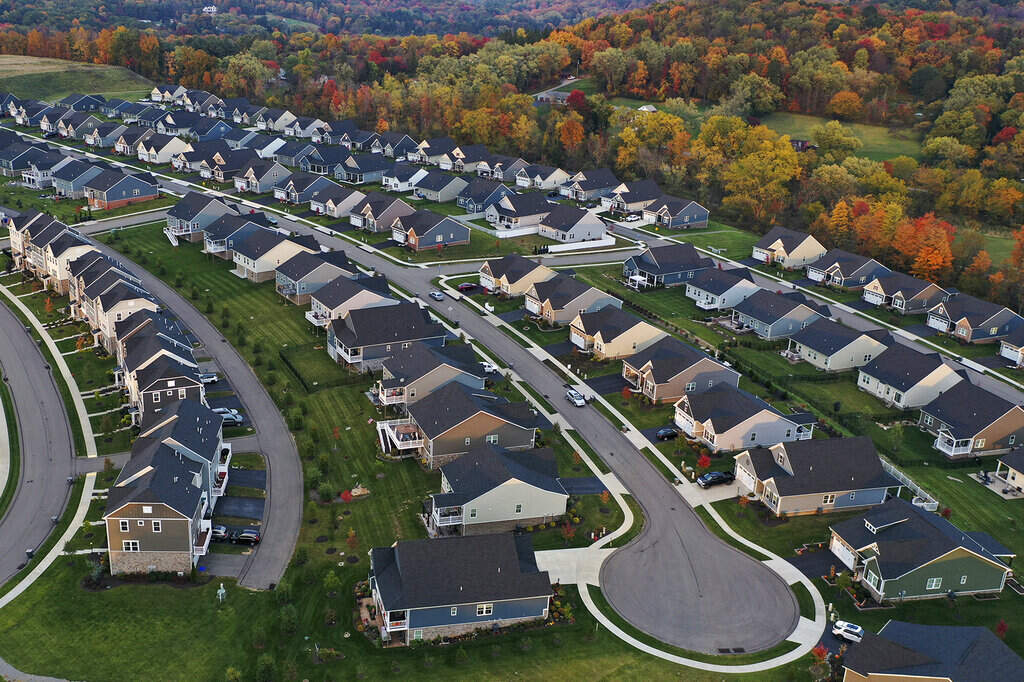
Rising property tax bills are squeezing homeowners across the country. So, several states are proposing expanded tax relief programs or even the complete repeal of property taxes. How these changes would impact local communities.
Guests
Jared Walczak, vice president of state projects at the Tax Foundation.
Karla Wagner, Founder of AxMITax, a citizen-led initiative to eliminate property taxes in Michigan.
Chris Jensen, the mayor of Noblesville, Indiana, which is a city of just under 70,000 people about 35 minutes from downtown Indianapolis.
The version of our broadcast available at the top of this page and via podcast apps is a condensed version of the full show. You can listen to the full, unedited broadcast here:
Transcript
Part I
MEGHNA CHAKRABARTI: John Marra built his first forever home about 35 years ago outside of Cleveland, Ohio. He's a contractor, so he remembers building rooms for his kids, a kitchen, a patio. One summer, he even dug his own pool in the backyard.
JOHN MARRA: My whole idea was to have all my grandchildren come there and enjoy. Because I had a pool there and it was just tree house in the back was along the woods on a ravine.
It was just, like I said, it was a fun house for kids to grow up in, like little ponds in the front. I called it my eco system and no, I never wanted to leave there.
CHAKRABARTI: But John says over the years living in his forever home became less affordable. John's health took a turn for the worse, and he lost some money in a bad business investment.
But he says his property tax bill became one of the biggest pressures on his finances.
MARRA: Taxes started out there about $2,000 a year. Within 25 years, it went all the way to $13,000. Okay. I was paying more than I was paying for my original mortgage. Okay.
CHAKRABARTI: John decided to downsize about seven years ago, a three-bedroom brick house on the shore of Lake Erie.
But during the pandemic, John started to notice property values rising again, this time even faster. And all of a sudden, one of his neighbors sold their home for what felt like an absurd price.
MARRA: The person bought it. He had grown up in the neighborhood, and he wanted to be on the lake and he was out of state.
He had the money and basically, he overpaid for it. Because he just wanted it, and basically, he was turning into Airbnb too, so he was running it as a business. It was an emotional buy, so he paid whatever it was. If they would've asked a million for it, they would've got a million, but he paid him $700,000, which was double what it was worth really.
But that's because again, he wanted it, then with that there was, they used that as a comp, okay, to raise the value on my house.
CHAKRABARTI: In one year, John's yearly bill went from $6,000 to $10,000, a 67% increase. So he is putting off renovation projects and borrowing from his parents just to pay his tax bill.
MARRA: Now they're pushing me outta my second forever home now, where I want to hopefully retire in peace and be able to not get kicked outta my property and become homeless.
Okay. And again, I'm only getting $2,000 in Social Security, my wife gets $1,000. Property taxes are $10,000. Doesn't take a rocket scientist. The electric rates keep going up. Gas rates keep going up. We're not allowed to have money left over for food.
CHAKRABARTI: Across the country, many people are struggling with their yearly property taxes. This has long been a concern of the elderly and people on fixed incomes, but now, as you heard with John, the pandemic pushed housing prices even higher and more rapidly than we've seen in a while. Strictly speaking, this also means that people who own these homes are in fact wealthier. Because they own an asset that's worth significantly more than it was before.
And there is huge value in that, but of course it's not liquid value. You get cash out of your home in two ways. Selling it or taking a home equity loan, neither of which John wants to do. So John is now a part of a campaign to completely abolish property taxes in Ohio. The group Citizens for Property Tax Reform is trying to get an anti-property tax question on the Ohio ballot next year.
They've collected more than 100,000 signatures so far, and many other states from North Dakota to Texas to Michigan are considering lowering or even eliminating property taxes too. Florida Governor Republican Ron DeSantis also supports this idea. Here he is speaking in front of the state legislature earlier this year.
RON DeSANTIS: You buy a home, you pay off the mortgage, and yet you still have to write a check to the government every year just for the privilege of living on your own private property. Is the property yours or are you just renting it from the government?
CHAKRABARTI: That government, specifically local and municipal government, isn't just pocketing the money.
It's paying for stuff. Most notably schools, a.k.a. teachers, police, namely officers, fire departments, meaning firefighters, city maintenance of all kinds. That is what property taxes pay for. More than 70% of all local tax revenue in this country comes from property taxes. So what would happen if that revenue was suddenly gone?
Today we are talking about the current property tax revolt in this country, and lessons we could learn from when this has happened in the past and how to reduce property tax burdens without hurting the services they fund. Jason Walczak is Vice President of State Projects at the Tax Foundation. He's author of multiple reports about property tax repeal efforts nationwide.
Jared, welcome to On Point.
JARED WALCZAK: Thank you for having me.
CHAKRABARTI: Okay. We started out with kind of a generalization in terms of property taxes are up nationwide, but let's put some detail on that. How are we seeing a uniform increase in property taxes across the states? Are there some states that are higher?
Is there an urban rural divide? How would you describe what's really going on across the country? It is far from uniform, but it's significant just about everywhere. Nationwide, on average, property assessed values are up over 50% since the start of the pandemic. Even after you adjust for inflation, that's about 27%.
Nationwide, on average, property assessed values are up over 50% since the start of the pandemic. Even after you adjust for inflation, that's about 27%.
Jared Walczak
That's really significant, but that disguises a lot of variation. You have states where there's been a just a dramatic increase in values, maybe because there's a population boom, maybe because there's constraints on new construction, but you can find states, and you can find cities and counties where property values have doubled in the last four or five years.
And if the local jurisdictions have not reduced the rates commensurately, that can be an enormous tax increase.
CHAKRABARTI: An enormous tax increase. Okay. So, have we also at the same time had, clarify this for me, an increase in the actual rates? Or are we just plainly speaking that the dollar value that people are paying is going up because of these greater assessed values?
WALCZAK: It is assessed values. In fact, many jurisdictions have reduced rates, and some of them have reduced them enough that these higher assessed values have not translated into tax increases. But that's not always the case. And it's not the case in enough instances that you are seeing the fueling of this property tax revolt, where people are saying, I'm paying 30% or 40% more than I was a few years ago.
Why? I have the same property.
CHAKRABARTI: Okay. So this is the other, the historical comparison I'd love to make. Because we, as I noted, we have seen property tax revolts in the past, and we'll talk about that in a minute. But this seems to be coming after this really short term, but dramatic increase.
In assessed values. Have we seen that before? Because in places, as you're noting, in places where people were relatively happy with steady sort of on par with inflation increase, they seem to be undergoing kind of a shock that maybe they hadn't had before.
WALCZAK: Yeah, the closest comparison is what we saw in the late 1970s and the early 1980s.
What's considered the first property tax revolt. It really began in California and spread across the country. At that point, it was mainly fueled by proposals for property tax relief, assessment limits, levy limits, not for elimination.
Now we're seeing something, I think, more radical, where not only do you have those proposals, but you have this marriage of the anger, sometimes very legitimate, about significant property tax increases that were unlegislated, not voted for, with undercurrent and underground movement of people who just never believed in property taxes. And those have been married together. And now we see in a bunch of states conversations, I don't think very realistic ones, but conversations about abolishing the property tax altogether.
CHAKRABARTI: Okay, so give me some examples of where this abolish property tax idea has taken root.
WALCZAK: You are seeing it in Florida with Governor DeSantis calling for it, and some legislators doing the same. In Ohio, where there's ballot measure, in Nebraska where there was an attempt to do a ballot measure that failed.
North Dakota, Wyoming, some of the states, you see it because they've just seen these radical increases. I think when you're looking at the mountain West, whether it's Wyoming, North Dakota, other places, just dramatic increases in property taxes and assessed values in other jurisdictions. Maybe it's more of the political environment, whether that's Texas or Florida, but it's a combination of all these things and you're seeing it in a lot of states.
CHAKRABARTI: You said it's not realistic, and yet, to the point you made earlier, we have had revolts, if not a complete abolishment, against property taxes before. And I wonder if politically now it actually is more realistic than it ever has been before. Given that sort of mix of factors that you talked about earlier, Jared.
WALCZAK: Yeah, there's both the political question and the practical question of what do you replace it with, and I think that's the missing part of this conversation. You look at the ballot measure in Ohio, and it just would require the full repeal of the property tax and then instruct the legislature, come back and figure out how you raise this revenue.
So I've run those numbers. Ohio next year is going to have a 2.75% flat one rate income tax, 2.75%. Now there's local taxes as well. If you wanted to replace the property tax with higher income taxes, you'd need to add another 8.35%. On top of a 2.75%, that's how much larger this would have to be. If you look at a state like Florida, if you want to replace the property tax with sales tax, you have to go to a 15% statewide sales tax.
And if you want to do this at the local level, massive variation, because you have bedroom communities that have very few sales. You have areas that don't have a lot of income. If you want to replace the property tax, either you have radical distribution differences, or the state has to take this and plow it back in, which creates its own problem.
So politically, yeah, I think there's an appetite for this in some states, but policy makers take that second step and say, how do we replace a tax that raises 70% of all local tax revenue nationwide? In 18 states, it's more than 80%. How do you replace that? That's a really hard question to answer.
CHAKRABARTI: Wow. Okay.
Let me just go over these numbers one more time, Jared. Because they're big. So in Ohio, if they were to fully replace the revenue lost from the property taxes, through an increased income tax, their income tax would have to jump to something like 11%.
WALCZAK: Yeah, that's absolutely correct. It would be 2.75% before your local taxes now, and it would add 8.35% just to that.
CHAKRABARTI: I have an 11.1% total income tax.
That's huge. And then in other states, sales tax, if that was the place, the money would come from would be 15%. Now, of course something like sales tax and actually also income tax, those are things that that hit people who don't even own homes.
WALCZAK: They do. Though I think it's important to mention that even if you're a renter, you're paying a significant portion of the property tax as well, just as in your rent.
Part II
CHAKRABARTI: Now let's go to Rockford, Michigan, where Karla Wagner joins us. She's founder of AxMITax, that's spelled Ax, and then MI for Michigan. AxMITax. It's a citizen led initiative to eliminate property taxes in Michigan. Karla is a realtor and business owner in Rockford, Michigan, about 20 minutes north of Grand Rapids.
Karla Wagner. Welcome to On Point.
KARLA WAGNER: Hi, Meghna. Thank you so much for this opportunity. I appreciate it.
CHAKRABARTI: It's great to talk with you. First of all, I'd actually love to get to know a little bit about you more and your life in the community. Because you're a realtor and a business owner. How have your property taxes changed in, say, let's talk about the last five years.
WAGNER: Yeah, definitely. I think the biggest movement has been since COVID. Why? Here in Michigan, we were one of the states that was locked down the hardest. Correct. So everything I did, and I'm a real estate agent, but I am also a residential contractor. I own a little restaurant and a little antique shop.
So retail, restaurant, all of those things. Everything I did was deemed non-essential. Except my property taxes. How do you pay property taxes when you have no income? You can't. And then what happens after that? You start losing. You lose your business, you lose your home, you lose your equity, you lose your generational wealth, and then you're put out into the street, if you have nowhere else to go.
CHAKRABARTI: So can I just jump in here? That's a really good point. Because it wasn't just the taxes, it was the fact that a lot of people lost income during the lockdown. Totally important reminder. Were you able to apply for PPP or any of that, the small business relief that the federal government was offering during that time?
WAGNER: We tried and we didn't qualify because our small restaurant had not been, we were just trying to open our restaurant in February of 2020, didn't have our final inspection. We had food in the coolers. We had people hired, we had everything all set, ready to go. COVID shut us down. Basically, all that stuff got thrown away, so we lost a ton of money and product that we had already purchased.
We could never get our final inspection done. We weren't allowed to open. So because we weren't allowed to open, the government said you have nothing to compare it to, so you have no loss. Because you had nothing to compare it to.
CHAKRABARTI: Oh, I see. Oh man. One of those devil in the detail issues. Okay. Thank you for explaining that.
And so you had no income, but what about on the real estate side? Was property being sold or bought and sold at that time?
WAGNER: No.
CHAKRABARTI: No. Okay. We were not allowed to show houses. You couldn't have open houses. You couldn't go do listings; you couldn't do anything. We couldn't build houses. Here in Michigan, you couldn't have contractors in a house because they had to be six feet apart.
We had a dozer sitting out on 34 vacant acres by himself, and somebody turned and called the cops, and they forced that guy in the dozer to go home.
CHAKRABARTI: Okay.
WAGNER: It was ridiculous. Michigan, we were hit hard here, but the lockdowns here were extreme.
CHAKRABARTI: So then what happened to you over the next couple of years regarding what you were actually paying in your property taxes?
WAGNER: Yeah, so you know what, COVID basically gave me the opportunity to sit down and start looking at things. Because somebody had made, I think you maybe, or Jared had said, it all of a sudden became a problem, like we were, everything was going swimmingly along, right? People were paying property taxes, and nobody was really making too much of an issue about it.
But during COVID, like I said, everything got shut down, and then I think we had, it's just when you have no builders out there building houses, you lose your supply, right? You lose your supply, but the demand is still there, but there's no supply. It takes a while, it might take you a day to buy a house, but it takes nine months to build a house.
And we lost a lot of our people; we lost a lot of our skilled trades people because they couldn't work. They couldn't work; they couldn't earn a living. They went and they tried to go get a job, something, doing something else, or they moved outta state. Here's what happened to Michigan.
We're losing people. Michigan is losing jobs. We're losing businesses. We're losing people and we're losing money. We are a bankrupted state.
CHAKRABARTI: I promise you, Karla, later in the show with Jared, I'm going to talk about the supply issue because ultimately that's the long-term solution.
But again, if I could just ask, do you, can you give us a ballpark in terms of how much your own property taxes have gone up?
WAGNER: Sure.
CHAKRABARTI: Yeah, go ahead.
WAGNER: Yeah, you know what? My property taxes on my house on a few acres is $7,500 right now. So it has gone up probably from $4,500 to about $7,200 to $7,500.
CHAKRABARTI: Oh wow.
WAGNER: Probably since 2014, I think is when we built, but we've not done any additions. We've not done anything to it. But they've gone up. But the problem too is that there's these thing called millages, right? People vote on millages. You talked about this, you talked about services. You said, Hey, property taxes, pay for services.
Okay, I don't have a problem paying for services. Bill me. What I have a problem paying for is a pickleball court. Or a splash pad. This is what our tax dollars are being used at, and people are losing their homes over that.
CHAKRABARTI: Okay. So let me ask you. I've pulled up the '24, '25 budget from Rockford. And I'm seeing Rockford is almost 7,000 people. And it's interesting. Michigan is a really fascinating state, so I'm really delighted to actually to talk with you, because the budget overall, let me. Okay, so first of all, it says here your tax bill with homestead. This is from the city of Rockford.
WAGNER: Yeah, and I'm not, and just to be clear, I'm not in the city. I'm in a township.
CHAKRABARTI: You're in a township.
CHAKRABARTI: I'm in Cannon Township. I am not in the city of Rockford, so I'm not as familiar with their property taxes, but go on please.
CHAKRABARTI: Okay. Okay, good. But I'll still use Rockford as an example.
Because we have that data and you can just comment on it however you want. Of the overall tax bill for people who live in Rockford, a third of it goes to the city of Rockford. 20% of it goes to Rockford Public Schools, 14% goes to state education tax and looks like about 28% goes to the Kent County Intermediate School district and the county itself. So it doesn't all stay in Rockford specifically. Okay. Now you talked about services. So again, with the point that this being the city of Rockford, in that 2024, '25 budget, the city says its overall tax revenue was about $4.1 million.
And out of that, 2.4 million was spent on public safety. Law enforcement, essentially. Now I get your point about you don't want pickleball courts, et cetera, but how is eliminating the property tax as a whole going to take care of the problem? Then you have to find a way to fund public safety.
WAGNER: Absolutely. So one of the other things that I did was I was a volunteer deputy with one of our sheriff's departments here in Michigan. I do not want to defund my police, but what people, this is what people do not understand. We pay multiple other taxes in our state and in other states. What we are asking in our petition is for the state government to cut their spending of non-essential services.
And send more money back down to the townships and the counties, the cities and the villages, through a constitutional revenue sharing program, which we already have in place. They need to send more of that money down, because what is the government supposed to do for us?
Protect our lives, protect our liberties, and protect our properties. That's it. Let's get down to the nitty gritty first. You don't, if you make $1,000, let's just say you make $1,000 a month. Okay. Easy numbers. And your rent is $700. And then you pay food for $100 or whatever.
Are you going to say, I'm going to go shopping and buy $500 worth of clothes? Then I'll see if I have money left over for the essentials, like my rent and my food and my utilities. No, but that's what the government is doing to us right now. They're spending money foolishly, wastefully, and then telling us, with the property tax bill, you have to pay more to afford the government spending.
We can't even afford our own spending. People cannot afford food. They cannot afford prescriptions. They cannot afford insurance. They cannot afford to have a vacation. They cannot afford the essentials, to put clothes on their kids' backs to send them to school. And yet, if they don't pay property tax, now they lose the roof over their head, as well.
People ... cannot afford the essentials, to put clothes on their kids' backs to send them to school. And yet, if they don't pay property tax, now they lose the roof over their head, as well.
Karla Wagner
CHAKRABARTI: You mentioned school for almost every municipality in this country, property taxes, whether they flow then through the state and then back to the local district. But those taxes are the things that are funding public schools. What would you, how would you fund the public schools then?
WAGNER: So again, here in Michigan, any of your local millages, your local school millages on your property tax bill has nothing to do with education. Even if you look at mine, mine says Rockford Public Schools Parks and Rec., Rockford Public Schools Building and Site, Rockford Public Schools Past Debt, that has nothing to do with the education of our kids.
What pays for the education of our children? Okay? Your income tax, your sales tax, your real estate transfer tax, your gas tax, the lottery, right? All of those other taxes that we pay, in Michigan that flows into, that becomes a $17.3 billion fund from all of those other taxes. That is where we educate the kids.
That is the money that educates the kids on a per pupil basis. All of those other taxes, we pay local property taxes, do not educate your kids.
CHAKRABARTI: Maybe not in Michigan, but there are other states for sure where it's like a one-to-one correlation, that the vast majority of school funding comes from their direct municipality.
But I take your point about Michigan.
WAGNER: That could be, yeah.
CHAKRABARTI: I take your point about Michigan. Overall, a lot of what you're saying, Karla, and I know it resonates with many of our listeners. Because everything has gotten so expensive and many people still haven't firmly been able to get back on their feet since COVID.
So this is why we're doing the show. Because there's many people who are like, this is just too much. But then overall, let's say you were successful in eliminating property taxes in Michigan. Would you just leave it up to others to then decide how to make up that money that you talked about before? Go ahead. Yeah.
WAGNER: So our petition is a constitutional amendment to the Michigan constitution. And it can only do so much. We can only do, so we can't, there's 1,240 townships in the state of Michigan and there's 83 counties. I cannot prepare a budget for every single one of them.
I can't guarantee that every single one of 'em is going to be fine. But what our petition does is it actually provides funding for the essential services, police, fire, county roads, a place to go and vote, because that's essential, right? It funds and protects that funding so it can't be hijacked and used somewhere else.
So our essential services are going to be covered here, but yes, people, when Jared said, oh, we have to replace the revenue, I don't want to replace waste. I don't, since 2019, Michigan spending has increased by over $30 billion. The spending, not the revenue. Our revenue has hardly changed at all.
We only bring in $48.5 billion. We're spending $86 billion now with the new budget that was passed, $86 billion. $30 billion in spending, and no one can tell me where that money goes. If people can tell me where that money went, I will be able to tell them how to replace property taxes, because we don't collect anywhere near that amount of property taxes in the whole state.
From every single person, every single business does not pay anywhere near $30 some billion dollars. That money is gone and where has it gone? And no one can show us, because they're trying to raise more taxes still to fix the damn roads that our governor has promised was going to be fixed when she first started campaigning.
When the budget was $58 and a half.
CHAKRABARTI: Is the money gone? Doesn't the state have to put a publicly available budget out every year?
WAGNER: Yeah, they do, but no one sees the effect. Why is our life here, why are people in businesses leaving Michigan? Because it's gotten so unaffordable to live here.
People are leaving in droves. Where did the $30 billion go to make our lives better?
CHAKRABARTI: Ah, okay.
WAGNER: You know what? Here's what we've built. We've built equestrians, the state with our taxpayers dollars. We have over 800 pork barrel spending projects. Over 800. This is equestrian centers. These are curling facilities.
These are splash pads being paid for by our tax dollars. You don't realize how many billions of dollars our governor has given to companies from out of state to come here to bring jobs to Michigan, and it's not worked. It's failed.
CHAKRABARTI: Karla Wagner, founder of AxMITax, a citizen led initiative to eliminate property taxes in Michigan.
Joining us from Rockford, Michigan. Karla, thank you so much for being with us.
WAGNER: I really appreciate, like I said, I appreciate the opportunity to educate people and we were the ones that got Ohio started. Ohio's getting a lot more press than what we are, which is awesome for them. Brian Massie, Leonard Gilbert, they're leading the charge down there and I'm so glad we got them started on it.
And there's multiple states across the United States that are doing this and should be doing this.
CHAKRABARTI: Karla, thank you again for joining us from Michigan. Jason Walczak. Thanks for listening to Karla there. Because I think she is a very strong representative of what you were saying earlier, which is the combination of the actual fiscal burdens people feel, plus you heard her very open critique about how state government spends its money and not feeling. I think the key thing she said is she didn't feel it's actually going to make her life or the lives of Michiganders that she knows more affordable. Just your response to what you heard Karla say.
WALCZAK: Sure. So I sympathize with what some of what she says.
So when she talks about how much her property taxes have increased, I think there's a very legitimate case that local governments should have reduced their mill levies, reduced those rates. If everyone's assessed values have gone up substantially, then the levy should come down to reflect that fact.
And you can even have levy limits that do that automatically and force an actual vote if you're going to exceed that. I think that's a responsible way to keep property taxes in check and listen. Is there government waste? Absolutely. Would I like to eliminate government waste? Sure, I would, but let's put some numbers on this.
She talked about if we eliminate the property tax, the state can come in and use the income and sales tax revenue for this. Local property taxes, property taxes in Michigan raise 40% more than the state income tax. They raise two thirds of the total amount that the income and sales tax combined do.
So you take your two major state revenue sources, two thirds of that go to offsetting the property tax. What do you have left for state services? And she said schools aren't funded at the local level. It is 30% that comes from local governments. I just think we have to talk about, what do we do to replace that revenue?
Part III
CHAKRABARTI: You heard earlier from Karla Wagner in Michigan, who absolutely wants to do away with all property taxes in the state of Michigan. We also got a lot of input from listeners with the completely opposite point of view, and here are some of them.
(MONTAGE)
IAN: I am a homeowner, and yes, my taxes have gone up. I think they go up excessively according to the increased value of the home which has doubled in the last seven years that I've been here. But I'm proud to pay my property tax and pay my fair share.
I'm proud to pay my property tax and pay my fair share.
Ian, On Point listener
COURTNEY: Of course, as an investor, if they were minimized, that would be wonderful. But my gut says they're fair.
ROBERT: They are very inexpensive to collect. It is very hard to cheat on your property taxes. People who receive the services are the homeowners and the people who live there, and they're the ones who are paying for those services.
ALEXANDRIA: I would probably prefer a reduction in my property taxes as opposed to an elimination of property taxes, considering property taxes that support schools and local initiatives and projects to improve the city.
JOE: Many in this country have gotten into the habit over the last half century that someone else will pay for it. To their horror, they realize too late that the someone else ends up being the person that they look at in the mirror. There is no Santa Claus.
CHAKRABARTI: That was Ian from North Carolina, Courtney in Virginia, Robert in Georgia, Alexandria in Florida, and Joe in Massachusetts. We've been joined today by Jared Walczak. He's Vice president of state projects at the Tax Foundation.
I would probably prefer a reduction in my property taxes as opposed to an elimination of property taxes, considering property taxes that support schools and local initiatives and projects to improve the city.
Alexandria, On Point listener
CHAKRABARTI: And now let's go to Indiana, where Mayor Chris Jensen joins us. He's mayor of Noblesville, Indiana. City of just under 70,000 people. It's about 35 minutes away from downtown Indianapolis. Mayor Jensen, welcome to On Point.
CHRIS JENSEN: Meghna, great to be with you.
I would love to talk about EA sports at some point in time too. I got a 14-year-old gamer at home. I can get some data for you later today.
CHAKRABARTI: (LAUGHS) You should grab the On Point VoxPop app mayor. And have --
JENSEN: At least maybe he can offer some productive feedback versus say, Hey, boss, when I walk in the door.
So --
CHAKRABARTI: I'd 100% love to hear his thoughts on EA.
JENSEN: Thanks for having me on today.
CHAKRABARTI: It's great to have you. Okay. In Indiana this past April, Governor Mike Braun signed Senate Bill 1, which promised to lower homestead property tax bills of, what, two thirds of Indiana homeowners. So what impact will that have on Noblesville?
JENSEN: Yeah, I think it's important in Indiana, first of all, I would invite Karla and all her friends to move to the Hoosier State. I'm glad I'm not in Michigan, quite frankly, after I listened to that. But I'll tell you this really dates back to 2009. I was a young staffer working for governor, Mitch Daniels at the time when Hoosiers were really frustrated in 2009 about property taxes.
Our legislature actually made an interesting move to codify into the state constitution property tax caps. So we capped residential at 1%. Rental and farmland at 2%, commercial at 3%. So this dates back nearly almost two decades now. That instantly, as a staffer for the governor at the time, I cheered that effort.
I can tell you now as a mayor of a municipality, one of the fastest growing in the Midwest, I see a different side of that conversation. And that we instantly saw a reduction in $5 million annually because of that movement. Fast forward in 2025, Governor Braun comes in with this initiative that he felt was a passion of his to reduce property taxes through Senate Bill 1, it's been a robust conversation, but it's a huge challenging one.
Like I said, we are now home to about 75,000 hardworking Hoosiers. We're one of the fastest growing cities in the Midwest. And we just passed a budget two weeks ago. That's an $8 million dollars in 2026 than we were spending in 2025. And we're going to see over the next four years about a $28 million reduction in revenues that we were planning for as we continue to grow out our community.
We have some pencils to sharpen and some hard conversations to have amongst our community, but we're not afraid of it, and we'll get through it.
CHAKRABARTI: Okay, so Senate Bill 1 offers a tax credit that has a 10% or maximum of $300 to every Indiana homestead, if I can put it that way.
JENSEN: Correct.
CHAKRABARTI: And so that's a tax credit then. Can you just give me a little bit more information about how that then turns into that $28 million loss of revenue, as you said, for Noblesville.
JENSEN: Yeah, so it is multiple buckets, that $300 per household equates to about a $10 million hit on us.
They also adjusted some, we have held a $1.10 tax rate in Noblesville, for example, for the past six years. What we have done is we budget to that tax rate. We allow then a short-term bond that we pass annually in order to budget appropriately, that we use for capital expenses. We have, for the first time ever, a 10-year capital improvement plan for our city, roads, bridges, water, wastewaters, all those things.
It's about $800 million of unfunded projects. We've used those short-term bonds to fund infrastructure improvements in our community. That's going to go away. Our ability to do that annually is now gone. We have to have a year off cooling off period, which I respect, but that's a decent reduction as well.
So when you add all that up, you're looking at a $28 million hit over the next four years. And then our legislature is going to require local municipalities to pass a local income tax starting in 2027, that would help replace some of this revenue. So in a way, we're robbing Peter to pay Paul here with this conversation.
CHAKRABARTI: Oh. So is there a local income tax in Noblesville right now?
JENSEN: We have a county income tax. And now this will allow for a local municipal income tax.
CHAKRABARTI: Okay. I should note that I'm seeing here that the budget, proposed budget for the town for 2026 is about $120 million.
CHAKRABARTI: Correct.
CHAKRABARTI: Okay. So that $28 million loss, then.
JENSEN: It's sizable, and I think that, yeah.
Thanks for pointing that out, because I think we need to have context around that. That's a big number for us. And again, I think I also need to weigh in and say that we are one of the fastest growing cities in the Midwest. So you're trying to manage this loss. And legislatures will tell you it's really just a loss of your perceived gain.
I respect that, but we, just like the state, budget off of proposed streams of revenue into the future. Every household probably does that too, as you look at your spending year over year. So that shift just can't, we're a sizable government, we're a sizable community. Turning on a dime is not the easiest thing.
CHAKRABARTI: Okay. Jared, I promise to bring you back here in a second, but let me ask Mayor Jensen a couple more quick questions. Mayor, you heard Karla Wagner in Michigan before, and she was very clear that it's not just property taxes that she has an objection to. She said, I will happily fund public safety 100%, but that's where she drew the line.
She felt that so much else of local and state spending was pork. As she said, it was wasteful, was going into a black hole. I am sure, maybe there are some people in Noblesville who have the same criticism of how local taxes are being spent there beyond public safety.
JENSEN: Absolutely. Maybe that include schools in that, what would be your response to them?
JENSEN: I fully respect that and I really appreciate the variety of opinions that are on the conversation today, and I've heard a lot of 'em, as you can imagine, over the last several years. But I will tell you, Michigan's not much different than Indiana in the fact that you're either growing or you're dying as a city or as a state.
We are constantly in battles with our neighbors to attract population growth to continue to grow our communities. And part of that investment is quality of life investment. We've made quality of life investments in Noblesville. We're attracted a new NBA G League team, for example, to Noblesville, Indiana.
We funded a new arena for them, that actually, you know, but we did that based on a study that shows that yes, we are going to fund this arena. That actually A, we're going to fund it out of existing TIF revenues, which is tax increment finance. And so existing dollars we have, and it's going to show a $2 billion, billion with a B, dollar impact over the next several decades to our communities.
So I think any community that's making decisions like that without a study to show the long-term ROI on that is probably not being responsible. We've turned that on its head and said, we want to make sure we have an ROI case to be made before we make an investment in that quality of life.
You have to invest in quality of life. If you want to attract the talent that you need to move your city, state or community forward.
CHAKRABARTI: Mayor, when you tell people that in order to begin to claw back the shortfall that Noblesville is facing, that you're going to have to raise people's income taxes. What kind of response do you get?
JENSEN: I can tell you; we really haven't even gotten to that conversation yet because we've been, the legislature really built this plane while they were flying it last spring. I think every legislator will tell you a lot of them didn't even know what was in the bill, which is incredibly frustrating.
And mayor, I don't, I can't look at my constituents and just say that every day. I go to church, I go to the store, I go to Little League games every day with my constituents, so I have to produce. Every single day. And I can tell you, at the end of the day, I've heard, I can count on two hands the number of people in six years that I've heard about that have been frustrated with their property taxes.
I can count on two hands the number of people in six years that I've heard about that have been frustrated with their property taxes.
Mayor Chris Jensen
Sure. There are folks out there. We have a hardship program in place for those that are struggling, we want to make sure people can stay in their home. I sympathize with those. At the same time next year, what we're going to have to do is that roundabout that was planned for major intersection improvement in 2026 is now going to be 2029, mowing services that were once every week are now every three weeks.
So there's going to have to be some give and take in this conversation next year, and I think there's going to be some real frustration on the back end of what we're going to have to do, but we have to respect all opinions and keep moving forward.
CHAKRABARTI: Mayor Jensen, hang on here for just a second. Jared Walczak, let me turn back to you.
Obviously, you had mentioned this earlier. California's Pop 13 from the 1970s was essentially like the granddaddy of them all, right? Of tax revolts. But from California's example, we learn one clear lesson in that the revenue has to come from somewhere in terms of closing those gaps.
In California, there was an increase in income tax. We had a lot of sales tax increases, et cetera, et cetera. But the other part of the whole equation that we haven't discussed yet, but Karla did bring it up, is in a lot of places, this is a supply issue. So isn't the best long-term solution to get the housing market juiced and to just get more housing constructed.
WALCZAK: Absolutely. That's a huge part of it. And there's a property tax component of that, but there's also a reg reform component of that. There's a zoning and land use element of that. There are all kinds of things that go into this that we have constraints on housing in this country, and when you can't build housing fast enough and when you have changing sizes of families, the same number of houses with smaller families, that means, you know, more homes are needed.
That is driving up property values, it's limiting supply, you have that limitation of supply. That is a fundamental problem here that has to be addressed and that has to be part of this conversation, and it's being missed in just talking about the property tax element. There's another piece here that I think is really important though, and you heard this in Mayor Jensen's talk.
You heard this in Karla's talk. Both of them want overall economic competitiveness. They disagree on a lot of things. But they both want that, and the property tax actually is good for that. When we think about property taxes, it's really transparent. You know what you paid in property taxes last year? I bet you don't have a clue what you paid in sales taxes last year, and that transparency is really good.
We like that. But of course, it's actually a problem for the property taxes because people know, they say, I paid this much. I can't believe it. I paid $7,500. You don't know what you paid in sales tax. But then because of that transparency, it's a benefits test tax, more than just about any other tax you can have, except a few use taxes. You're paying for the benefits that you received that were down to you as a property owner, and it even increase the value of your property.
And if you think that it's out of line, and hey, sometimes it's out of line, it's a responsive tax, you can go to local government in a way you can't go to state government. When Mayor Jensen talks about, he hears from people, if your property taxes are too high, you have an approach that you don't have.
And then fundamentally, it's pro-growth compared to the alternatives. If you want a growing community, income taxes, sales taxes, both of them put more pressure on economic growth, especially income taxes, lower jobs, lower wages, reduced economic growth. So if you replace all the property tax with something else, that's really not going to be good for your economic competitiveness.
CHAKRABARTI: Interesting. Mayor Jensen, on the supply side, I mean, is Noblesville open to doing the kind of zoning changes? Or sort of tax credits, et cetera, et cetera, to get more housing built in Noblesville?
JENSEN: This is the fundamental issue across the nation is a supply issue around housing. We have averaged nearly 800 new homes a year since 2010.
We have been pulling our weight in Noblesville, as I said, we used, when we were funded with some ARPA dollars around COVID, so many communities put those ARPA dollars to work on programs that would require long-term funding. I felt as a fiscal, small government conservative, that was irresponsible.
We put ours in the ground. We opened up new area for growth with infrastructure, water, sewer, roads. That has allowed us to add more housing and add more inventory. Because that is the competitive nature in which we're going to see going forward and not just housing for new families. We need folks to age in place.
We need to have 55 and better communities. We want to have mixed communities that have multifamily and retail and residential all within them. And we've done that in Noblesville because we know we have to. And we're growing. Or we are dying. Jared hit it right there. You're growing or dying as a state.
We can scream about this all day long, but we need to have, and we want to have a plan in place to protect those, but we've got to continue to grow.
Chris Jensen is Mayor of Noblesville, Indiana. Mayor Jensen, thank you so much for joining us.
JENSEN: That's an honor. Thanks for having me.
CHAKRABARTI: And also, don't forget to get your son to send us a VoxPop about Electronic Arts, Mayor Jensen.
Okay, Jared, we've got one minute left here. Overall, this isn't the kind of show we're just going to resolve the problem of property taxes, but when you look across the country, what advice would you give to people who, they are struggling right now because their tax bill has gone so up.
And what would you ask them to think about in terms of weighing in their minds, like what is an acceptable amount of tax for them to pay?
WALCZAK: Yeah, I would encourage people, think about your options here. If you want to engage with policymakers, talk about levy limits that keep the rate of growth in check.
Think about circuit breakers that help the most unfortunate, who maybe have fixed incomes or retirees to make sure that we can keep them in their homes. Those are really valid concerns. But don't try to throw the baby out with the bath water. The property tax is better than the alternatives, and you really don't have a functional alternative.
The first draft of this transcript was created by Descript, an AI transcription tool. An On Point producer then thoroughly reviewed, corrected, and reformatted the transcript before publication. The use of this AI tool creates the capacity to provide these transcripts.
This program aired on October 27, 2025.