Support WBUR
Is Trumpism what you think it is?
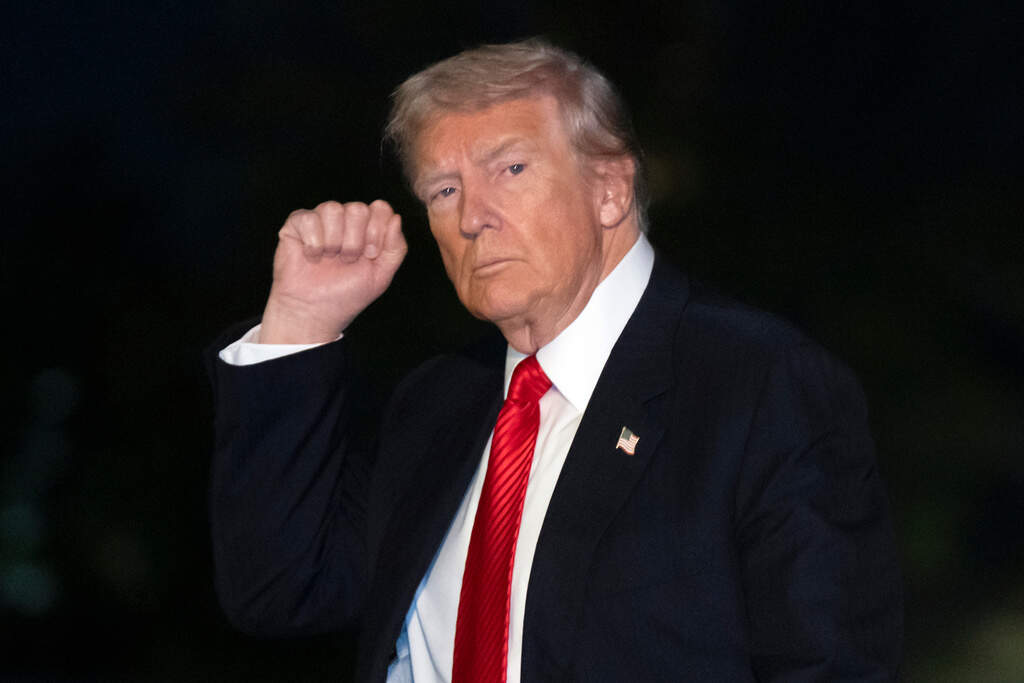
President Trump's supporters say he’s a heaven-sent savior, cracking down on bloated government and unauthorized immigrants. Critics call him authoritarian – targeting political opponents and using the presidency for personal enrichment.
Guests
Jonathan Rauch, senior fellow in the governance studies program at the Brookings Institution. He wrote The Atlantic article “One word describes Trump."
Stephen Hanson, professor of government at William & Mary University. Co-author of “The Assault on the State: How the Global Attack on Modern Government Endangers Our Future.”
Donald Kettl, professor emeritus and former dean of the University of Maryland School of Public Policy.
The version of our broadcast available at the top of this page and via podcast apps is a condensed version of the full show. You can listen to the full, unedited broadcast here:
Transcript
Part I
MEGHNA CHAKRABARTI: Last night, Democrats were celebrating.
(NEWS MONTAGE)
In the New Jersey Governor's race, NBC News projects that the Democratic candidate Congresswoman Mikie Sherrill has prevailed over Republican candidate Jack Ciattarelli.
It's a celebratory mood here in Brooklyn and the watch party for Zohran Mamdani.
If I told you five months ago, he was going to be the next mayor of New York, what many consider to be the second most powerful executive office in the land after the presidency, you might have said I was crazy. But after what has been an eye-opening run, he is now going to be New York City's next mayor.
Virginia now has its first female Governor elect. Former U.S. representative Abigail Spanberger has won the race defeating the Republican, the incumbent Lieutenant Winsome Earle-Sears.
CHAKRABARTI: So yes, yesterday's election brought wins for Democrats in three key East Coast races, New York Mayor and the governor's races in Virginia and New Jersey, as you just heard. Now, Zohran Mamdani, Abigail Spanberger, and Mikie Sherrill represent very different wings of the Democratic Party.
Now, a lot of Democratic analysts say this signifies a new emergence of a coalition of Democrats that perhaps did not exist before. Now meanwhile, in Maine, voters there soundly rejected a sweeping proposal that would have added photo ID requirements to voting, limited the use of ballot drop boxes, and made changes to the state's absentee voting system.
In California, Golden State voters overwhelmingly approved Proposition 50. That measure would redistrict California's congressional map and possibly provide five more seats to Democrats. Prop 50 supporters, including Governor Gavin Newsom, launched the effort in response to Republican redistricting moves in states such as Texas and Prop 50 passed in California with 65% of the vote, including eight California counties that went for Trump in 2024.
So perhaps it's understandable that political pundits on TV and the extremely online crowd over in places like Bluesky were downright giddy last night talking about things like the first good news in years or more ambitiously declaring yesterday's election a total repudiation of President Trump and a heroic saving of democracy.
But over on Truth Social, the social media platform owned by President Trump, the president posted, quote:
"Trump wasn't on the ballot and shutdown were two reasons that Republicans lost elections tonight."
End quote. And all caps for that matter. And you know what? He may be right.
All elections definitely signal something, but some more than others. Democrats calling last night the debut of a new party coalition from a Democratic socialist mayor in New York to a resolutely centrist governor in Virginia. But is it really? Or is it exactly what it is?
Voters responding to local candidates who best meet their local needs, and especially if you look at Abigail Spanberger's win in Virginia. She handily won the statewide vote count, but county by county, Virginia voters are as polarized as ever with the entire southwest of the state staying very deep red.
More importantly, the reason why I think President Trump may be right is that an off cycle, not even midterm, low turnout election is not the same thing as any election where a president is on the ballot. This is a truism as much for Trump as it was for President Obama. Remember, 2014 in the middle of Obama's administration, only 36% of voters turned out for that one, a historic 70-year low.
And see I'm rehashing all this history because it remains to be seen if the Democratic Party can carry any of last night's momentum into just next year's midterms, let alone to 2028. But what has not changed is President Trump's power among American Republicans. For a decade now, Trump has been the premier example of political power in the United States, and for some, Trump just isn't a president. He's a heaven-sent savior.
I believe there he is a gift from God that's trying to save our country.
CHAKRABARTI: For others, Trump is using his power to dismantle the very democracy he leads.
We're worried about a president who is displaying an authoritarian agenda and carrying it forward.
CHAKRABARTI: What is also true about Trump is that precisely due to that decade he's been at the pinnacle of Republican party power. An entire generation of young people attracted to the GOP are there because of Donald Trump, which means that long after the man himself exits the political scene, the movement in ideology he has led could have considerable staying power in shaping how millions of Americans think and vote.
So today, in order to better understand the impact Donald Trump has had on American democracy, we want to better understand Trumpism. What is it exactly? What does it stand for, and does it indeed have that staying power that I just suggested? So we're gonna start today with Jonathan Rauch. He's senior fellow in the governance studies program at the Brookings Institution, and he recently wrote an article titled “One word describes Trump." And it appeared in the Atlantic earlier this year after President Trump was inaugurated for his second term. Jonathan Rauch, welcome to On Point.
JONATHAN RAUCH: Happy to be here. Thank you.
CHAKRABARTI: What is the word?
RAUCH: Patrimonialism.
CHAKRABARTI: And what does that mean?
RAUCH: Patrimonialism is the oldest and most traditional form of government, and it's when the government is run as the personal property and family business of the leader.
Patrimonialism is the oldest and most traditional form of government, and it's when the government is run as the personal property and family business of the leader.
Jonathan Rauch
CHAKRABARTI: Okay. So in that sense, it sounds, does have some familiar echoes in what we're seeing with Trump. What are some of the examples that you would say are classically patrimonial in Trump's behavior and this administration in particular?
RAUCH: Patrimonialism is pretty much the principle of the entire government. In Washington, we used to have, for example, a policy process in the White House, which various policy nerds and lawyers would check on policies and develop them. There would be independent bureaucracies. Which the president couldn't necessarily fire. Congress would have an independent will and cabinet secretaries would be appointed on grounds other than their personal willingness to do whatever the president tells him.
That's all gone. The policy process now is the president wakes up one morning and decides if we're going to launch military strikes against Venezuelan boats, or if we're going to raise tariffs against Canada because he doesn't like an ad or if he's going to put the National Guard on the streets. The president is the policy under this system.
CHAKRABARTI: But in a sense, what you've described many people have talked about before, but I haven't heard the word patrimonialism, specifically applied to, I guess, what in the media we've been loosely referring to as just Trump's mercurial behavior. No one around him being willing to say no. So tell me more about, you said it's the oldest form of government in human history.
RAUCH: Yeah. Basically, it's the simplest way to put together a social order is you pick someone to be in charge and that person says, okay, what I say goes, this is not the same as classic 20th century authoritarianism. Because authoritarianism, like what you saw under Soviet communism and the Nazis and so forth, is very bureaucratic.
It sets up these institutional structures that are designed to outlast the leader. Patrimonialists aren't interested in that. They're interested in, it's all about me and it's about personal loyalty to me. So they go through what might have been an independent bureaucracy, and they fire anyone who's independently minded and replace them with personal loyalists or traditionally, family members.
This is a form of government in the public sector, but it's also the way mafia is run. It's the way gangs are run. It's the way religious cultures are run. It's a very standard way of doing things that took thousands of years to get rid of.
CHAKRABARTI: In a way it's like the simplest form of government, right?
RAUCH: Yeah.
CHAKRABARTI: Just do what the guy says.
RAUCH: It's the first scene of the Godfather. You went to the police, don't go to the police. You come to me if you need help, and then you kiss my ring and maybe you get the help.
CHAKRABARTI: Jonathan, I wanna say thank you for this because for, honestly, for 10 years now, whenever talking about Trump, I will fully admit that the word authoritarian has come up on this show almost every single time, at least once. And for some reason it hasn't really sat well with me, partially because Sarah Longwell, who is, one of the co-founders of the Bulwark, still a Republican but a Never Trumper, and a very respected pollster and focus group leader.
She told us on this show once that when you ask people in general, but particularly supporters of Donald Trump if Trump is an authoritarian, she says that they look at her not out of like anger or disgust, but with general genuine questioning in their eyes, saying, I don't even know what authoritarianism is.
So it's the generic word that maybe we in the media and policy folks and pundits use a lot, but to most Americans, it doesn't mean as much as, like you said, the opening scene of the Godfather.
RAUCH: Yeah, of course all these words, patrimonialism and authoritarianism and populism are all in the air and all being bandied about by political scientists.
And the Trump system has elements of all of these things. But I think when you weigh it all up, it's pretty clearly just old fashioned patrimonialism in action.
CHAKRABARTI: Yeah, I'm sorry. I didn't mean to interrupt you, but this also, my mind is immediately going to, under Project 2025 under Russell Vought, with the help of DOGE and Elon Musk, the very actually organized effort to kneecap the bureaucracies of the federal government would fit into the idea of patrimonialism above all.
RAUCH: Yes. There are people around Trump and you've named some of them, who are more ideological, and Russell Vought, for instance, has called himself a constitutional radical, I think is the term that he's used. And they are interested in setting up a long-term system of enhanced presidential power. Some would say almost a kind of monarchism, writing that into law, rejiggering American institutions.
But I don't think that's Trump's personal agenda. I think Trump's personal agenda is that he gets to go around the world and if someone wants to give him a plane, he says, 'I'm president, I can take it.'
Trump's personal agenda is that he gets to go around the world and if someone wants to give him a plane, he says, 'I'm president, I can take it.'
Jonathan Rauch
CHAKRABARTI: Or if someone runs an ad in Canada that he doesn't like. We just talked about this yesterday on the show, so it's jumping back into my mind.
I can slap more tariffs on that country.
RAUCH: Yeah. Or if he says, the White House doesn't, may not officially belong to me. It belongs to the American people and Congress and some committees are supposed to sign off before I tear it down. He just says, no, the White House is mine. I do what I want with it.
Part II
CHAKRABARTI: Jonathan, let me just play some moments from the president himself that we can check against your idea of patrimonialism. You had mentioned Qatari jumbo jets, and that of course is because earlier this year the president did accept a Boeing 747 from the Qatari government, it's valued at $400 million. It was provided supposedly as a, quote, unconditional gift. Critics say it's a bribe now. The gift was a flashpoint when it was announced with Trump supporters and detractors both saying the gift was used for political cover, but Trump is unswayed.
DONALD TRUMP: I think it's a great gesture from Qatar. I appreciate it very much. I would never be one to turn down that kind of an offer. I could be a stupid person, say, no, we don't want a free, very expensive airplane.
CHAKRABARTI: So that's the president on that Qatari 747. President Trump has also quite frequently said he is willing to go after and prosecute his political enemies, use the DOJ for that purpose exclusively.
And here he is in September of last year, prior to winning the election in 2024, where he said as much on the campaign trail.
TRUMP: That means that if I win and somebody wants to run against me, I call my attorney general and I say, listen, indict him. He hasn't done anything wrong though, we know. I don't know.
Indict him on income tax evasion. You'll figure it out.
CHAKRABARTI: President Trump in September of 2024. Jonathan, let me ask you, the centrality of Trump to himself is obviously nothing new. I believe it was in the 2016 Republican National Convention that he unleashed what I have taken to calling the 'I alone can solve it' speech, right?
The idea that he would be the beginning, middle and end of his government. Is as old as he is in terms of being on the political scene.
RAUCH: Yes, that's basically right. I'm not quite sure where you were going with that.
CHAKRABARTI: And what I'm saying is I think, thank you for asking for clarification.
What I'm saying is that people seem to be really focused on this much more this time around in his second administration. And perhaps that is because of the fact that the administration itself, the Russell Vought's of the world, have been so much more active in actually pushing policy.
RAUCH: Oh, yes. Yes.
CHAKRABARTI: But the fundamental thing about patrimonialism was there from the start, which is, I guess what I'm getting at is, that is the thing, the very thing that attracted so many millions of Americans to Trump.
RAUCH: I hope not. I really hope Meghna, that in 2024 what attracted them to Trump was that they thought that Joe Biden was a failed president and that they had been hornswoggled with a last-minute candidate swap and that prices were up and that the border was out of control.
And they wanted a president who would settle things down and fix them, and they're getting something very different from that. And the results of that were quite visible in the elections that were held last night.
That being said, however, you are correct, he is being far more aggressive the second time around than the first, in terms of trying to make not just policy changes in the government, but an out and out regime change. He's going through the power agencies, the military, the bureaucracies and replacing capable career people with loyalists left and right. And that's how you convert a standard consolidated liberal democracy to something closer to Hungary.
[Trump] is being far more aggressive the second time around than the first, in terms of trying to make not just policy changes in the government, but an out and out regime change.
Jonathan Rauch
And ultimately, if it goes terribly wrong, even Russia.
CHAKRABARTI: With that in mind, do you think that Trumpism, à la patrimonialism is here to stay, at least amongst the Republican party for some time? Because I could hear in my mind a counter argument to that, in that if it's so focused on one man, when that man exits the scene, does that open up the space for, I guess, the clawing back of some kind of democratic norms?
RAUCH: There's good news and bad news, Meghna. The good news is that if it stays with just what it's mostly been, yeah, it probably passes mostly when the charismatic leader who can command the loyalty moves along. The problem is that over time, patrimonialists embed themselves. Once they realize, Hey, wait a minute, what about my kids?
I want them to have power too. I want to continue to wield power behind the scenes, so they begin to institutionalize their power. They begin creating structures. And it tends to morph over time into classic authoritarianism. That's what we've seen, for instance, in Russia, which starts out just basically being Putin's in charge and you're loyal to him, you're okay.
But now is an out and out pretty much Stalinist regime. I'm not saying that will happen here. But we do see some worrying signs, for example, in the creation of what is it, tripling the budget of ICE and turning it into an agency that looks like it may become a personal enforcement arm for the president and his administration.
So it's a danger, but we don't know yet how long of a stay we're looking at.
CHAKRABARTI: Okay. But it's fair to say that patrimonialism, once having taken root, is not something that can live harmoniously with a democracy.
RAUCH: Correct. And it has two great Achilles heels, two great shortcomings, which are the reasons it faded in modern societies to begin with. One is that it is invariably incompetent, because it replaces professionals who know what they're doing, who are loyal to the rule of law, with hacks who don't know what they're doing, and loyal to one person. And second, it is invariably corrupt. Because it doesn't even distinguish between the interests of the state and the interests of the leader.
It's just all about him. If he wants to put his hand in the cookie jar and get $200 million from the Justice Department, he does it. And the public doesn't like corruption and incompetence, and that's how you hit back.
CHAKRABARTI: So then, and through what means? Elections being one of them and another?
RAUCH: The incompetence will pretty much show itself. And right now, the fact that they can't keep the government open and the airways are tied up, because they can't pay air traffic controllers, is one of many signs of that. The other corruption you need to highlight. Patrimonialism has been defeated in many places, including America in the late 19th century, when the spoil system was replaced by campaigns that focused relentlessly on the issue of corruption.
Telling the people, you're being ripped off for the personal benefit of these people. The state, your government, your people's house is being turned into a piggy bank for these guys. But you have to hammer away at that. That has to be a relentless narrative. That's how Navalny went after Putin.
Unfortunately, it cost him his life. This is what got rid of the Peace party in Poland, which was a patrimonialist regime. But you've got to hammer away at it.
CHAKRABARTI: I might say though, that this actually is exactly the message that Donald Trump himself hammered over and over again. It wasn't true, but part of his appeal was that he was telling millions of disaffected Americans, you have been forgotten. Because the deep state, because of the swamp, because of lifetime politicians who have been pocketing money and rigging elections.
He actually did shine a light on a fiction, but he used the same tactics that you're talking about.
RAUCH: That's right. Corrupt Hillary. Yeah. Corrupt Hillary. Corrupt Hillary. If you say it enough, it sticks in people's mind and they believe it. But that's just evidence that people do care about corruption and it is a powerful issue.
In Trump's case, he benefits from a kind of presumption of authenticity. That, in a way, he's more honest than other politicians, because he just speaks his mind and he also benefits from this sense in the public that they're all corrupt. So what does it matter if he's corrupt?
That's why you've got to repeat this message and break through. It's got to become the big organizing theme of the many other criticisms that you level at his administration. You've got to dent that reputation of being the guy who, in some sense, is honest and authentic.
CHAKRABARTI: Okay, Jonathan Rauch, hang on for just a second.
I want to bring in another voice into the conversation and also a little later in the show, we will hear from someone who has a very different view of what Trumpism is. But let's turn now to Stephen Hanson. He's a professor of government at William & Mary University and co-author of “The Assault on the State: How the Global Attack on Modern Government Endangers Our Future.”
Professor Hanson, welcome to you.
STEPHEN HANSON: Thank you so much for having me.
CHAKRABARTI: So what would your definition of Trumpism be?
HANSON: I agree completely with Jonathan that patrimonialism is the right definition. I want to add a dimension to that, which is this is also built on a longstanding distrust of the state in the U.S. and in many countries around the world now.
One of the reasons Trump was so appealing in two elections is that people really don't believe anymore in the grassroots, that those experts and those bureaucrats are really acting in the public interest. That of course has a long history in U.S. culture. Americans love to hate the state as Jeff Kopstein and I wrote in our recent book.
One of the reasons Trump was so appealing in two elections is that people really don't believe ... that those experts and those bureaucrats are really acting in the public interest.
Stephen Hanson
And some of that's very healthy. You don't want to have people trust the state to the point where they don't criticize enough or they don't patrol the kinds of things going on in inefficient bureaucracies. But having said that, if you mobilize this distrust of the state the way that Trump has done, you're substituting the rule of law state with a very personalistic regime, which actually doesn't deliver public goods at all.
CHAKRABARTI: So it's just an additional point to Jonathan's.
CHAKRABARTI: Okay. So let me just ask you then to compare Trump style patrimonialism to some other forms of leadership that I've read people, trying to see if we can compare Trump to those. Mercantile authoritarianism comes up every now and then, like China style, would there be any links between Trump's patrimonialism and that form of authoritarianism, Professor Hanson?
HANSON: Mercantilism is traditionally associated with this kind of patrimonial rule. Because when you run the state as a family business of sorts, it's quite natural to think about the state and its assets as available for your loyalists and even your family members.
You use state assets literally in the case of, say, Putin. Oil and gas assets to reward loyalists to the tune of hundreds of billions of dollars. If you have state ability to weigh tariffs on the companies you don't like or the foreign competitors you don't like, but also lift tariffs and make them easier for your friends and the people who support you, you can gradually shift a kind of modern rule of law market economy to one which functions in a mercantilist way.
I will say it's different from China, because China is still a Leninist regime when it comes to the way the state is organized. It's got a very powerful Communist party. It even still treats its ideology with great respect, and it's much more mobilizational than patrimonialism.
It tries to delve deeply into the private lives of citizens. Whereas patrimonial regimes are demobilizational. They let people mostly go about their business in private, as long as they don't touch the ruler in his prerogatives.
CHAKRABARTI: That's interesting. Okay. I was going to ask something else, but tell me more about this Professor Hanson, because again, this seems to be a characteristic of patrimonialism that minus some deep and pervasive upset within the people themselves, if they're mostly allowed to go about their daily lives. It sounds like that could contribute to patrimonialism staying power.
HANSON: Yeah, I think in the case of Putin's rise to power, this is one of the key factors. Russians didn't all notice that things had shifted in the 2000s.
They thought that the economy got better and Putin benefited from a drastic rise in oil prices that happened just after he came to power. But in terms of going to clubs or nice restaurants or even getting on the internet and reading critical articles about the state. You could do that until pretty recently in Russia.
The full scale invasion of Ukraine in 2022 started to change things in a much more authoritarian direction. But for a couple of decades, Putin didn't clamp down on the parties in Moscow, so to speak. And so I think here in the U.S. it's a similar phenomenon. You were talking about ... talking to Trump supporters and saying he's an authoritarian, and people say, I don't see any change in a local circumstance. Also, I voted for him, by the way. So if you call him undemocratic, what are you calling me?
CHAKRABARTI: Exactly. And/or the very fact that people say I could actually cast a vote. So our democracy is healthy. So Professor Hanson, in that regard, I ask you this genuinely because I've heard the exact same question as you noted from supporters of President Trump. Even if they are casual supporters and not like his deep red base, they might, folks might say, if I can still go about my daily life, why is everyone having a breathe in the bag moment for the past 10 years about the future of American democracy?
HANSON: Yeah, the problem is that the timescale of the decay is a little longer than the headlines. It takes a couple of years for a civil service to be dismantled or for the state as a whole to be repurposed in the service of the family business of the ruler. And public goods can even be provided for a while because you have the past achievements of the experts.
You could create a Operation Warp Speed and create a really effective vaccine in a hurry in the first Trump administration, because you hadn't yet dismantled universities or the scientific establishment or the health experts.
Now, when you get rid of essentially a working CDC, you begin to attack research budgets of universities around the country, you're basically eating the seed corn for future addressing of these problems. So people are right to be very concerned about the direction, but it's a little tricky sometimes to explain to people who don't see it happen on a kind of day-to-day basis.
CHAKRABARTI: Okay. So Jonathan. Let me turn back to you then. I don't know if you dare, but do you have a sense as to where the trajectory of Trump's patrimonialism might go? He's only been in this administration; this is just the first year of it. We have three more years to go.
As Stephen Hanson said, today's headlines aren't actually talking about what could happen next month or next year or three years from now. Do you see the kinds of negative national effects that Professor Hanson just dared to raise?
RAUCH: Oh, sure. In terms of negative effects, we're seeing them already. Huge amounts of, for example, domestic law enforcement have been repurposed to the president's personal pet project of interior immigration enforcement and away from things like counter-terrorism and monitoring violent extremists.
And we'll see a price for that. We'll see a price in foreign relations as well, as of course, prices in the supermarket go up because of personalistic tariffs that are done on presidential win. There will be no shortage of exhibits to show the American public. But when you ask where this is headed, be very interested in Steve's take on this.
I think it's those diagrams of potential energy that show the ball bearing at the top of the sombrero shape. And it has high potential energy, but could go in either of two directions. I think that's where we are.
Patrimonialist regimes will work as quickly as they can to shore up government in ways that insulates them from accountability in elections. I have pretty high confidence we will see ICE and National Guard, maybe active-duty military station near polling places, for example. The question is whether there's enough accountability quickly enough. Especially in the midterms, to put a stop to this process.
Patrimonialist regimes will work as quickly as they can to shore up government in ways that insulates them from accountability in elections.
Jonathan Rauch
Part III
CHAKRABARTI: Professor Hanson, I just wanted to give you a chance to answer Jonathan's question or his analogy that maybe right now we're at the top of that parabolic sombrero in terms of which way patrimonialism could go, either into worse and more eroding of democracy or perhaps a natural check coming on it.
Your thoughts.
HANSON: Yeah, I think we are at a tipping point and really something to watch is the kind of mainstream Republican party, which has been turned into a personal vehicle and total loyalty to the leader. But there are plenty of people in Congress who are aware that these recent electoral results don't portend wealth for the midterms and they're going to be interested in their own survival and reelection to both Houses of Congress. So if people begin to feel it's an electoral liability to stick with the loyalty principle, you'll start seeing people peel off, and that can create divisions among the patrimonial elite.
Which would be very salutary, frankly. Having said that, it's not a one-off. Even if you defeat these leaders, as happened in Brazil or Poland, as Jonathan mentioned, there's a huge repair job that has to happen after that to rebuild trust in the state and meritocracy.
CHAKRABARTI: Also, I would say that the other repair job, if you want to put it that way, has to be at an even more fundamental level, and I keep thinking about all the young people who have come into the Republican party.
Because of their attraction even fealty to Donald Trump. And that is a whole way of thinking about what an appropriate use of presidential power even is, has been completely changed by Donald Trump. And folks say, 40 and younger, or even younger than that, 30 and younger don't necessarily have a very, an equally vital alternative example that we all used to consider the norm in this country.
HANSON: Yeah, that's definitely true. I'm teaching right now at William & Mary, and students 18 to 22 years old have mostly grown up with this America. This is their experience. So part of the job, as you say, of rebuilding trust is getting the next generation to think about public service and support for the American government as a duty, as something that makes our republic stronger in the old-fashioned way of contributing to the public good.
And that's different from what is on the blogosphere a lot of the time.
CHAKRABARTI: Yeah. Stephen Hanson and Jonathan Rauch. Hang on for just a second. Because now I'd like to bring in Donald Kettl into the conversation. He is the former dean of the University of Maryland School of Public Policy. Dean Kettl, welcome to On Point.
DONALD KETTL: It's so great to be with you there, Meghna.
CHAKRABARTI: I would love to hear from you, a slightly, an answer to a slightly different question than I led with Jonathan and Stephen on, and that is, how would you define what Trumpism was in the President's first term starting back in 2016?
KETTL: I think it's really important to separate Trumpism with Trump on the one side, as the person, as the leader, as the patrimonial leader, where I really agree completely with both Steve and Jonathan.
But then there's also Trumpism as a broader movement, and I think you have to understand them as being separate. That Trumpism existed before Trump and my concern is that it'll continue long after Trump, because of the deep base that was there.
Trumpism existed before Trump, and my concern is that it'll continue long after Trump.
Donald Kettl
Because Trump, we were talking a while ago as he was coming down the golden escalator and wondering whether or not this was just a joke and could this guy ever possibly win.
But he found a way through Steve Bannon, in particular, of messaging what American people wanted to hear, of really building on a collection of things that have been just growing up for a while, with the combination of Bannon's America First and stay out of foreign entanglements policy, and focusing the economy and then Citizens United decision for the Supreme Court that allowed a virtually infinite amount of dark money collections into political campaigns.
And then a campaign really against Obama that had all kinds of tinges to it, part policy, part racist, and he fashioned his first term around that. And so I think, in my mind at least, we have Trump the leader, Trump the person, but Trump also the guy whose great genius was sensing a movement that was building.
And had been building for a while, and finding a way like a drum major to run to the front of the parade without actually having put the parade together himself.
CHAKRABARTI: I appreciate this, forgive me, Dean Kettl, but I appreciate this different take on it because I would love to actually hear you tell me a little bit more then about, okay, Trumpism, the movement that now has his name. But I'm hearing you say that it existed even if not perfectly jelled before 2015. Then how would you define what that movement is, other than what we've heard frequently, which is people just being aggrieved for any number of reasons and then voting on those grievances.
KETTL: Exactly, and it's much, much more than that. Because the Republicans for a long time were in disarray. They were ringing their hands over losing political campaigns and losing presidential races. They were trying to figure out what it was that had done them in, that included that. In fact, there were all these grievances that you talked about, Meghna, but also more fundamentally, there was a concern about the economy.
About the fact that the United States was getting itself entangled too much in foreign wars and great disputes, which then I think obviously was something that had spun off of what some of the Democrats had done. There's this enormous separate flood of conservative money that really made it possible to build grassroots actions at the bottom.
And then big ideas at the top. That ... led, of course, to Project 2025. And then on top of that, COVID, which was the great elixir that stirred up people across the country, a sense of that the government was just engaged in enormous amounts of overreach. They were shutting, the government shutting down the schools, with closing down restaurants.
It got to be impossible to go to a bar on a Friday evening for a drink after work, and you have to wear a mask. No, not wear a mask, which kind of mask? We don't know. We'll change your mind about that kind of stuff. Did vaccines work? How safe were they? All of this that led to enormous amounts of distrust at the grassroots level.
So put all this together in a cauldron and stir it together. And what you had was an enormous amount of popular disaffection with government in general, with Republicans of course, with the Democrats even more and then a guy who is supremely good at reading the public and what it is that's going to work for him and for them, and finding a way to be able to fashion a message around that.
Trump is the kind of patrimonial leader that we've been talking about, but the movement is much bigger, much deeper. And just one nugget that I can't help but toss in here is that we've been talking, for example, about what happened last night.
But on the night before the election and something that will escape notice for the most part. But Texas Governor Greg Abbott talked about putting a 100% tariff on all New Yorkers who moved to Texas. So that if we think that somehow the debates about tariff and about the big ideas are only embodied in the person of Donald Trump, we're missing a large part of what's happening out there otherwise.
If we think that somehow the debates about tariff and about the big ideas are only embodied in the person of Donald Trump, we're missing a large part of what's happening out there otherwise.
Donald Kettl
CHAKRABARTI: So this is exactly where I want the conversation to go. Jonathan, let first turn to you your response to what Donald Kettl is saying there.
RAUCH: All correct. I think as far as it goes, I do tend to think that a lot of people who analyze the situation tend to underestimate the importance as a transformative factor of a demagogue. There's a new book about this by William Galston called Anger, Fear, Domination. And I think Bill is right. There's a lot of factors that we're swirling around out there in Trump's success. But the most important factor is Trump himself, and that he was willing to go where no other politician would, in terms of the kinds of things he said, in terms of the norms that he would violate.
You remember, the very first thing he did is say that he didn't respect John McCain's military service. And it's just been much, much more of the same ever since. And that kind of behavior does over time transform the character of our politics. And it can transform the character of our people.
And I'm afraid that we're seeing that.
CHAKRABARTI: Stephen Hanson, what do you think?
HANSON: I think here's the tricky part, right? It's a movement around the world to restore personalistic rule. And machismo in the leadership actually quite explicitly. And that's Putin and Orbán and Netanyahu in Israel and Erdoğan in Turkey, and Modi in India, as well as Trump.
So clearly, it's more than just a single individual. Having said that, the regime is built around that individual, and so once it's in place, the individual matters enormous to its trajectory. I will say if you look at the UK right now, that just restoring a Keir Starmer Labor Party government does not solve the problem.
In fact, the popularity of that government has plummeted, and now you have Farage and Reform UK basically making, yet again, a pitch to dismantle the old liberal meritocracy. So I think this kind of bigger struggle that Don talks about is very much part of the global story, and yet I also agree with Jonathan that if Trump were no longer in the picture, we'd have a very different trajectory in the U.S.
CHAKRABARTI: My view of what's happening in the UK is just restoring some kind of nominally recognizable form of leadership is not going to work if that leadership is terrible, right? Like the Starmer government seems to be doing things that very few people in the UK want. Digital IDs are one of them.
So it can't be normal, but bad leadership. Professor Hanson?
HANSON: Yeah, no, absolutely. The leader does matter. It's tricky to find leaders who are charismatic, kind of meritocrats and Max Weber talked about this back at the turn of the 20th century in Germany, it's a different thing, right?
To be an expert is not to be charismatic. You have occasional figures like Obama who managed to project a kind of charisma around a very moderate, liberal platform, in fact. But it's hard to find those people.
CHAKRABARTI: Donald Kettl, let me turn back to you here. Because I guess what I really want to know from you now is given how you described as Trumpism, the movement, are you saying just clearly, are you saying that this movement in your mind has staying power?
Even though if it has, as it's been defined under Trump himself, if when he leaves the political scene, whenever that might be, the movement won't need him anymore.
KETTL: It surely has needed him a lot to get the thing moving and to try to provide the energy.
And I don't disagree with anything that Jonathan and that Stephen have talked about, but I think it's important also to understand that Trumpism as the movement has very strong and powerful grassroots support in the U.S. in particular, which are the kinds of things also happening, I think, in some other parts of the world. But here in the U.S. in particular, you can look at what's happening in Texas and Florida as bellwethers, but also in other Republican states as well.
Things that tend not to get as much national attention, but which are the great grassroots generators and the grassroots drivers. I just have a book coming out in the spring that is called The Right Wing Idea Factory, and I've spent a lot of time trying to understand where all this stuff is and where it all comes from.
And the closer that I look, the more I see roots in communities across the country, but more importantly happening in red communities across the country, that we have a country increasingly separated on red and blue lines. And ways that I think escape national attention, but which at the local level are driving powerful forces.
Do we want to, we're talking about building a wall around some cities in Texas to try to keep migrants out. We're talking about in Florida a massive change and the nature of higher education.
And in fact, if you want a bellwether for what's happening at the state level, look simply at the role of public universities across the country and where the pressures and pain points are, and where the big transformations are coming politically.
You can get an understanding about how Red v. Blue America are separating even more deeply and where the differences are driving, I think, truly fundamental movements that are going to sustain themselves over a long period of time.
Yeah. Not that Trump isn't important, which he is, but on the other hand that the movement itself has long legs that will last long past him.
CHAKRABARTI: Donald Kettl. Do you mind, I'm about to ask you a question which I almost never just plainly ask guests. Because I don't like using labels like far left, far right.
Center left, center right. Because I'm not even sure what they mean very much anymore these days. But how would you describe where you come, like where your point of view comes from politically. And the reason why I'm asking is as we were preparing this hour and doing our research and talking to a lot of experts, I really, we really wanted to find someone who didn't necessarily come from a quote-unquote traditional liberal view.
And your name came up several times, but as I hear what you're saying, I'm having a hard time distinguishing what you're saying from the fundamental analysis that both Jonathan and Stephen give us.
KETTL: I guess I would call myself a raging moderate. I often find myself annoying people on the left and the right in about equal measure and I've got another piece I'm working on right now that really looks at Trumpism and the role of just expertise in government. And I think this will enrage everybody for sure.
But I think that in a lot of ways what Trump started out to do at the beginning of this administration was exactly right, in terms of identifying the big problems, but terribly wrong in the way in which he carried it forward.
And particularly the way in which some of his other people working with him, starting of course with the DOGE movement and a lot of the other pieces that came out of that. This annoys the left enormously by acknowledging that there's any value in what Trump is saying. Annoys the right terribly by saying that the strategies for trying to follow through on that have been extremely damaging.
What Trump started out to do at the beginning of this administration was exactly right, in terms of identifying the big problems, but terribly wrong in the way in which he carried it forward.
Donald Kettl
And so that I end up often having relatively few friends to talk to about this, but I'm personally a raging moderate. But I think that the point is important, because if we're trying to find a way to build on the future, the only way I think is to try to escape some of the ideologies that have limited our vision.
And the left needs to understand that it's responsible for some of the problems that it created and that the right needs to take responsibility for creating a government that actually works and has the capacity to serve what the American people want. And it's going to be very hard to get out of this unless we find a way through that.
The first draft of this transcript was created by Descript, an AI transcription tool. An On Point producer then thoroughly reviewed, corrected, and reformatted the transcript before publication. The use of this AI tool creates the capacity to provide these transcripts.
This program aired on November 5, 2025.