Support WBUR
The real reason for the U.S.-Argentina bailout
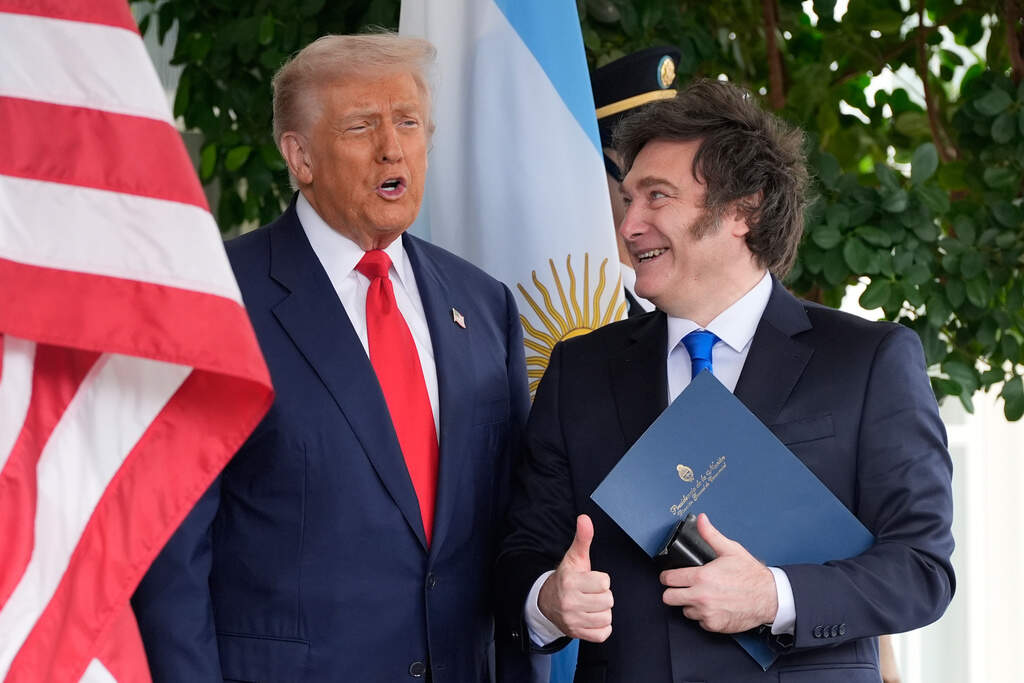
American taxpayers are bailing out Argentina to the tune of $20 billion. But what does the U.S. get out of it? And can it really fix Argentina’s economy?
Guests
Monica De Bolle, senior fellow at the Peterson Institute for International Economics. Professor at Georgetown University.
Natalie Alcoba, Argentine-Canadian journalist based in Buenos Aires.
The version of our broadcast available at the top of this page and via podcast apps is a condensed version of the full show. You can listen to the full, unedited broadcast here:
Transcript
Part I
MEGHNA CHAKRABARTI: Let's go back to a little less than a year ago to a show we did on December 19th, 2024. Argentina's President Javier Milei had been in office for about a year. He'd slashed at least 30,000 jobs and cut many government programs. He said his shock therapy would fix Argentina's economy.
Now at the time, Elon Musk and Vivek Ramaswamy, then-advisors to President Donald Trump, had said that what Milei was doing in Argentina was what they wanted to do here in the U.S. with DOGE: Chainsaw the federal government into submission.
While much of the media coverage at the time focused on Milei's flamboyant personality — he really did fire up a chainsaw at election events — there was also talk about poverty levels in Argentina and whether cutting government spending would improve or worsen the problem.
In our show that day, one of our guests, Monica De Bolle, slipped something into the middle of the conversation.
(TAPE)
MONICA DE BOLLE: So Argentina is an economy that functions with two currencies, not one. So it has its own currency, the peso, and it also uses the U.S. dollar. And so this kind of dependence on the U.S. dollar makes it vulnerable to shocks, turns in sentiment or even domestic problems. If people don't trust the currency, they're not gonna hold it. Every time Argentina has had a crisis, it has had that component to it.
CHAKRABARIT: What has President Milei done to address that particular issue?
DE BOLLE: That's just it. He hasn't really anything on this particular issue directly.
CHAKRABARTI: Now, if I may say, sometimes if you listen to On Point, you can be weeks or even months ahead of the news, because fast forward to now, 11 months later, and we have this.
(NEWS BRIEF MONTAGE)
NEWS ANCHOR 1: The Trump administration authorized a $20 billion financial lifeline for Argentina as it faces a deepening economic crisis.
NEWS ANCHOR 2: Slump in the polls. A bad result in the Buenos Aires local elections and a weakened expected economic recovery sparks a selloff in the peso.
NEWS ANCHOR 3: That currency right now is so weak it would take almost 1,400 pesos to make one U.S. dollar.
NEWS ANCHOR 4: U.S. Treasury Secretary Scott Bessent helped orchestrate a $20 billion swap arrangement.
NEWS COMMENTATOR: So it's the United States saying we're going to buy $20 billion worth of Argentinian pesos. So the idea here is a lifeline, it's a bailout of sorts in the sense that this is going to stabilize a very volatile Argentinian peso.
DONALD TRUMP: Argentina is one of the most beautiful countries that I've ever seen, and we want to see it succeed. Very simple.
CHAKRABARTI: So the U.S. Treasury is bailing out Argentina to the tune of $20 billion, and it's buying up pesos because of the very kind of crisis Monica De Bolle warned us about in 2024.
Monica De Bolle is back with us today.She's a senior fellow at the Peterson Institute for International Economics.
Monica, welcome back to On Point.
MONICA DE BOLLE: Hi, Meghna. I'm happy to be back.
CHAKRABARTI: Let me first ask you, do you have next week's winning lottery numbers?
DE BOLLE: (LAUGHS) I wish.
CHAKRABARTI: (LAUGHS) Because I thought I'd ask. Because when we were thinking of when this news about the peso popped up, one of the first things I thought, just wait, I've heard about this before. And then I remembered, holy cow, it was about a year ago that you had said this exact same thing. So thank you so much for coming back.
And so first of all, I'd like actually a little bit of — some explainers from you about what's happening in Argentina and what this $20 billion actually is. So what's been going on with the Argentinian peso?
DE BOLLE: So the Argentinian peso has weakened quite a bit, about 20% over the last few months, and that was due to a number of problems. There were political problems. There are also some economic problems, because even though Javier Milei's reform have, to date, done well, in terms of lowering inflation and other things for the economy, they have also weakened the economy quite substantially.
So the economy isn't growing very much. There is a very high unemployment rate. People are cash strapped; they're also getting very impatient. And all of this, including the political situation, resulted in a lot of market turmoil that led to this weakening of the currency that we have seen.
The Argentinian peso has weakened quite a bit, about 20% over the last few months.
Monica De Bolle
And ultimately that ended up leading to the United States playing a part to resolve Argentina's problems as you just mentioned.
CHAKRABARTI: Okay. So market turmoil within Argentina. Was there also an election that fed into this?
DE BOLLE: There were two elections. So there was an election back in September for the province of Buenos Aires.
So it was a provincial election. But Buenos Aires being what it is, that province specifically, it's very important. It serves as a kind of a barometer for the rest of the country. So the fact that Milei and Milei's coalition lost that election, led markets to become extremely tense, leading to the first bout of turmoil that we saw, and then there were other elections scheduled for the end of October, and everybody was very nervous over what the elections in September would mean for these elections in October.
And there was this wide-ranging fear that Milei would lose quite substantially in the October elections. In the end, he didn't, but that was what was going on, and that led to a lot of market distress.
CHAKRABARTI: Why was the fear of Milei's possible loss? Which again, to underscore, you said he didn't in October, but why did that cause even more turmoil in the Argentinian economy and with the peso?
DE BOLLE: Yeah, that's a very good question. The reason is that he's had all of these reforms or this huge reform agenda that he began when he took office in 2023. And even though he's seen a lot of these reforms through, they're not concluded yet. So there are a number of things that are yet to be done, and therefore the fear was if Milei had lost the election, that these reforms would then, the reform agenda would then be compromised.
This is what investors were fearing. In the end, it didn't come to pass exactly in the way that they were fearing, but the fear itself was sufficient to lead to the kind of currency turmoil that we saw.
CHAKRABARTI: I see. Okay. Sort of the Econ 101 version of explaining this is, and correct me if I'm wrong, but is that anytime there's a lot of political or economic turmoil in a country, just the basic value of that country's currency drops, right?
Because people lose confidence in it. Correct?
DE BOLLE: Yeah. Correct.
CHAKRABARTI: And that's what's been happening in Argentina.
DE BOLLE: That is what's been happening in Argentina. The thing that makes Argentina different is the fact that it has the two currencies. It has the dollar and the peso. And so whenever these kinds of situations happen in Argentina, they happen in a way that is more extreme or more amplified than in other countries.
The thing that makes Argentina different is the fact that it has the two currencies. It has the dollar and the peso.
Monica De Bolle
So yeah, it's true. Whenever you have a political problem or political turmoil and economic problems coming with that, they tend to result in a weakening currency.
But in Argentina, that effect is amplified.
CHAKRABARTI: Amplified because people want more dollars. Okay.
DE BOLLE: Exactly.
CHAKRABARTI: The peso then isn't necessarily pegged to the dollar.
DE BOLLE: The peso is picked to the dollar. So the system that they have in Argentina at the moment establishes a range, and the peso is allowed to fluctuate within this range. And this range has a floor and a ceiling. So it's what they call an exchange rate band. And if the exchange rate is fluctuating within the band, then there is no intervention.
So there is no peg, it's just fluctuating in the band. But if it hits the floor or hits the ceiling, then what happens is there is intervention by the central bank. So in other words, they will buy or sell dollars in order to keep the exchange rate within the band. So it is a peg of sorts. It's just not the kind of peg that we're used to thinking about.
CHAKRABARTI: Okay. How did Argentina even end up with two currencies?
DE BOLLE: Oh, that's a long story, Meghna. (LAUGHS) Basically, to summarize and put it in a nutshell, it's a country that has a very fraught history with financial crises. And what happened was that at some point, the population just said, you know what?
Every time there's a crisis the peso devalues, the currency weakens. We don't want to hold this currency, we don't want to save in this currency. We'd rather save in a currency that we perceive to be trustworthy. So we'd rather save in dollars. And the government or successive governments in Argentina allowed this situation to take place.
So Argentina today is de facto a dollarized economy that also has its own currency.
CHAKRABARTI: That is a little hard to wrap my head around. I'll be perfectly honest.
DE BOLLE: I bet.
CHAKRABARTI: So let's shift our focus for one second back to the United States, because as you are well aware, the Trump administration is asserting that under no circumstances of the $20 billion that the treasury has given to Argentina, they are saying this is not a bailout.
So for example, here is how U.S. Treasury Secretary Scott Bessent put it on MSNBC's Morning Joe, just yesterday.
SCOTT BESSENT: Do you know what a swap line is?
JONATHAN LEMIRE: It's a currency swap. Yes.
BESSENT: Yes. But what is that?
LEMIRE: That's — you're the treasury secretary, sir.
BESSENT: Yes. But why would you call it a bailout?
LEMIRE: That is how --
BESSENT: In most bailouts, you don't make money. The U.S. government made money. We used our financial balance sheet to stabilize the government. One of our great allies in Latin America during an election. The president there won via in a landslide. By stabilizing the economy there and making a profit, then that's a very good deal for the American people.
CHAKRABARTI: Okay, Monica, I'm just using you as our econ professor right now. A currency swap line is actually very frequently used. I know that central banks use it around the country to, in fact, do what Secretary Bessent there has said, is to stabilize governments or even large corporations.
But he's also asserting that it's impossible for the accrediting nation to lose money on that. Is that true?
DE BOLLE: No, a donation that's providing the swap line can very easily lose money if markets simply do not move in the direction that they would wish it to move. And markets can basically do anything.
The U.S. government does not control markets. There are instances in which a swap line or a swap arrangement can actually result in a profit. But that profit could be temporary if markets turn the other way and things don't go as well and don't actually support those profits. So you can make a loss from a swap line. And that has happened.
Part II
CHAKRABARTI: When we say a currency swap line, does it actually mean that, okay, the United States we know gave Argentina $20 billion.
Does it mean that we got $20 billion of pesos in exchange that are now living at the U.S. Treasury?
DE BOLLE: Yeah, so the way this works is $20 billion has been made available to buy pesos in exchange for dollars. They haven't yet used the entire swap line. They've used a little bit of it, so they've used so far, I think, something to the tune of $1.5 billion to buy pesos.
So what it means is that the U.S. Treasury has bought $1.5 billion worth of U.S. pesos, so it got pesos and in exchange it supplied this amount to Argentina in dollars. But the full $20 billion hasn't been spent. The full $20 billion is available to be spent in this manner.
CHAKRABARTI: Understood. Okay. So Argentina says it needs it. Or as the United States decides to buy more pesos, Argentina gets the dollars in exchange. In that sense, it's pretty straightforward, right? When people travel, they do it all the time. When, in visiting other countries. But again, then that makes me wonder if also the potential risks are very clearly understood. Because it presumes that the peso will rise in value for us. Do we sell them back to Argentina and get dollars in return. And what if the peso doesn't rise in value?
DE BOLLE: Yeah, that's exactly the question. And that's exactly the sense in which I said, the U.S. Treasury is providing Argentina a lot of money.
It's the U.S. government, it's big, it's credible. But the U.S. government doesn't control markets. So there can be a situation, and we are not in any way, shape or form out of the woods of this kind of situation where say something else develops in Argentina, say it's political turmoil or any of the things that can go wrong in Argentina.
And there are many of them. And markets react in a way as to say, okay, fine, there's this $20 billion that the U.S. is making available to Argentina, but we still don't like Argentina's prospects. We're not going to invest in Argentina. In fact, we're going to take our dollars out.
If investors react in this way, the peso is going to weaken. And if the U.S. is holding a whole bunch of pesos, because it's gone through with this swap line, then those pesos are losing value. So that's a lose situation for the United States. It's not a win-win situation by any stretch of the imagination.
And that could happen.
CHAKRABARTI: So it is entirely possible that essentially the U.S. taxpayer, if these are treasury dollars, could in fact lose money on this currency swap. So in that case again, the Trump administration is saying it is not a bailout. From your point of view as an economist, is that correct, that it's not a bailout?
DE BOLLE: It's not correct. A bailout is a situation where a country is in crisis and somebody steps in to resolve or to help that country come out of its crisis. This is what the International Monetary Fund does. For example, I worked there for a number of years and it's precisely that situation that defines a bailout.
So in other words, a bailout is a rescue operation. The U.S. is rescuing Argentina. So yes, the U.S. is bailing out Argentina, and whether or not the U.S. makes money out of this has nothing to do with the fact that it is a bailout by definition, the treasury secretary may not want to call it that, but that's what it is.
The U.S. is bailing out Argentina. ... The treasury secretary may not want to call it that, but that's what it is.
Monica De Bolle
CHAKRABARTI: We've actually also had similar bailouts in this country after the 2008 economic crisis, for example, where the government gave money to companies to bail them out.
DE BOLLE: Absolutely.
CHAKRABARTI: And the presumption was those companies would pay back the money. Okay. So Monica, hang on here for just a moment. Because let's listen to Argentina's President Javier Milei himself. Because he told CNBC's Sara Eisen just last month, that the U.S. Treasury restored quote, total and absolute confidence with its bail out of Argentina.
And in this clip, you'll hear Milei speaking through an interpreter.
SARA EISEN: How much confidence do you think was restored by the treasury stepping in with the $20 billion swap line?
JAVIER MILEI (TRANSLATION): A total in absolute, but then again, the status quo has other bets. In fact, they lost a lot of money on those bets against the country.
That's why they react the way they do. But the fact is the swap is intended to provide Argentina with the financing to honor its debt, but the U.S. Treasury showed that it is even more than that. Because it also bought pesos on the foreign exchange market.
CHAKRABARTI: Argentina's President Javier Milei on CNBC last month. Joining us now from Buenos Aires is Natalie Alcoba. She's an Argentine-Canadian journalist based in Argentina. Natalie, welcome back to the show.
NATALIE ALCOBA: Hello. Thanks for having me.
CHAKRABARTI: So tell us what it's like in Argentina right now in terms of just the people's sense of has confidence been restored in the economy by this $20 billion promised by the United States.
ALCOBA: Yeah, so first of all, it's been super interesting to hear the first part of this conversation. I've been taking notes myself because yeah, it's just the economic picture in Argentina is always really hard to decipher whether you're close or you're far. And for a moment you feel like you get it and then something changes.
I don't, I think we're all still, I think the country is still adjusting to the result from the election that happened at the end of October. It was this really important midterm election that was going to tell us what kind of power Javier Milei had.
And the result was one that people really didn't expect. It certainly was against the kind of narrative that was dominating the media here and that came as a result of the political and economic volatility that Monica spoke about as well. And that result in which he really received a very strong vote of confidence from Argentines with almost 40%.
His party received that vote of confidence, changes the political map here. And we're still figuring out what that means. The government has talked about how it wants to continue its reform agenda. And the reality is that yes, the peso, the currency continues to be within that band that Monica spoke of.
Things appear to be, have returned to some sort of stability. But that also doesn't change the context that we had going into it. Which is, I know there's lots of, Argentina has lots of faces, lots of experiences. Lots of ways people are living it.
So on the one hand, President Milei has absolutely changed something in terms of inflation, which is this longstanding chronic problem in Argentina, a year or two years ago, annual risk inflation was almost 300%. Now it's around 35%, which of course 35% is still a huge number by many standards, but is a dramatic change.
So on one hand you've got that kind of stability that you feel. But then on the other hand, his policies, which a lot of them have had to do with deregulating, removing subsidies, obviously cutting back on government spending, has meant that a lot of other aspects of cost of living here have gone up. And people really are also feeling the pinch.
And when I say people, people who don't support him, but also people who do support him, are feeling that things are tough. It's just that those who support him are continuing to bet there.
It's tough. It's really tough to say what, I think, it's really tough to say what role the U.S. bailout played in the mind of an Argentine voter when he or she went to cast their ballot.
CHAKRABARTI: So Natalie, do you mind if I just jump in here? Because what I would love to know more is, as you said, this October election, which actually gave Milei's party something like 90 seats, right?
And you said it was a surprise given how poorly the September elections went. What can you tell us about why you think that his party showed up performed so strongly in Argentina? Again, to everyone's surprise.
ALCOBA: So yeah, I think a lot of the driving force behind Javier Milei in the first place, and I think the election continues to show this, is this rejection of the previous, this idea that like we can't go back to whatever we were living before. This kind of, so it's a vote that is as much for him as it is in opposition to the alternative.
And the alternative in Argentina, the dominant alternative continues to be the Peronist party, the Peronist movement, which is this long-standing political movement that is at points at right wing, at points left wing. The last 20 odd years it has been left of center. And that has been largely in power. And a lot of Milei's brand is fashioned against that idea ... of a larger government, of spending on state spending, on trying to redistribute wealth.
His approach has been smaller the government the better, the market will take care of things. He's really vilified that other side. And when you go out on the street and talk to people who support Milei, so much of it is this sense that anything about what we had before.
And not willing to give up on the idea that things can improve under his model. It has been two years. And there are a lot of indicators that are a lot more difficult. But people, again, speaking largely of his supporters still want to bet on that.
CHAKRABARTI: Monica De Bolle, let me go back to you on this because you had also said earlier that Milei's sort of large-scale plan for Argentina wasn't anywhere near completion yet. Hypothesize, best case scenario, if the belt tightening and the removal of subsidies and the deregulation, et cetera, all do eventually take place in Argentina.
Is there not a possibility that it could indeed strengthen the economy there for the long run?
DE BOLLE: There is. There certainly is. The thing that concerns me, the aspect of all of this that concerns me is it is still going to be a country that functions with these two currencies. So you still have, at the end of the day, this problem that kind of goes beyond the economy and is, in a sense, psychological, cultural, or whatever we might want to call it, that the people of Argentina do not trust the peso.
And even if these reforms end up helping Argentina to a large extent, and they are fully implemented and so on and so forth, the mistrust of the peso is still going to be there. Because there's an element of this, as I said, that kind of transcends the broader sort of economic/political issue.
It's Argentinians cannot function without the dollars, because they have a mindset whereby their savings are in dollars, they will never save in pesos, and that creates a situation where any shortage of dollars that occurs for whatever reason in Argentina automatically weakens the peso, justifying people's fears in the first place, and that problem's going to remain.
CHAKRABARTI: Oh, so yeah, it's basically like a self-fulfilling prophecy. I understand.
DE BOLLE: Exactly.
CHAKRABARTI: Okay. So Natalie, I'd love to hear your thoughts about that. And then in addition, I think in order to partially address this. Or maybe it has the opposite effect. I don't know. But am I remembering correctly that Milei has gotten rid of whatever kind of currency control there was in Argentina about how many dollars the Argentina people could actually buy?
ALCOBA: ... He has, and so that has also, so a few years ago, just before Milei actually, but two, three years ago, there was this huge gap between what the government told the world and acknowledged that the peso was valued at, in relation to the U.S. dollar, and then what it actually was valued at in terms of what Argentines on the street would pay to be able to access U.S. dollar.
And that was because of, in part, Monica would understand. I understand it, we understand it here on the ground that a lot of that had to do with the currency control. So you were only able to, can't recall if it was $200 or $300, purchased, $200 or $300 U.S. dollars a month through the official channels at the official rate.
That was half the value of what you would then spend. There's also, in Argentina, there's places on not every block, but there's lots of companies that will sell you U.S. dollars. I don't even, here, we would call them financieras or another word is cuevas, caves.
These are places that you go and you're buying your foreign currency off the books. And so there was this huge gap between those two values. But because there were controls in terms of what you could buy officially and then what you would have, what you could otherwise.
But people still, to Monica's point, would, because again, despite that gap, people would rather save in U.S. dollars.
And so they would rather spend extra to get that, to have that harder currency. And so that also distorted a whole bunch of things. Somebody who earns in a foreign currency can make double the amount of pesos when they bring it and exchange it on the local black market, if you want to call it.
That has gone away. So now the rate is essentially the same everywhere.
CHAKRABARTI: Natalie, do you mind if I, forgive me for interrupting, but we just have a minute left to go and there's one more question I wanna ask you. Because I'm thinking to myself that most Americans or at least people who've always lived in the United States, do not have a sense of what it's like to live in a country where you look at your currency and you cannot trust it.
Like when we look at a dollar, the world trusts the dollar. What is it like living in Argentina with this currency fluctuation, the dual currency? Like not even being able to trust your own nations money.
ALCOBA: Yeah, these things all become pretty normal very quickly. It's not here, of course, people earn in pesos. I have pesos. I go out, I buy something in a peso. It's just that you're doing so many more calculations in your head than you would normally because you are considering like what that value could, how that value could change in a week.
I think it's a lot more. Yeah, there are many more things that you're taking into account when you're spending your money here.
Part III
CHAKRABARTI: American politicians across the political spectrum have actually been criticizing this action by the Trump Treasury, for example, here's Georgia Republican Congresswoman Marjorie Taylor Greene.
MARJORIE TAYLOR GREENE: That's probably one of the grossest things I've ever seen. I have no idea who is telling our great president that this is a good idea.
I can't think of another country that's further away from the United States of America than Argentina. It's literally at the bottom of South America in the Southern Hemisphere, and we're all the way up here at the top. I don't know how that's America first.
CHAKRABARTI: And here's Kentucky Governor Andy Beshear, a Democrat.
ANDY BESHEAR: The Trump administration is talking about providing Argentina a $20 billion bailout during a government shutdown, but won't provide SNAP benefits, food assistance for our own people.
CHAKRABARTI: Also from Kentucky, Republican Senator Rand Paul.
RAND PAUL: I've been a fan of Milei. I think he's doing some good things in Argentina, but I'm not forgiving away money we don't have. We have to first go to the bank, which is China, or the Federal Reserve. Borrow the money or print it up to send it to other countries. It's a terrible economic plan.
CHAKRABARTI: And one more. This is Massachusetts Democratic Senator Elizabeth Warren, who even introduced a bill last month in October called the No Argentina Bailout Act to try to stop the U.S. Treasury.
ELIZABETH WARREN: Argentina has just cut a deal with China that takes the legs out from underneath American soybean farmers. Argentina hurts American farmers, and the president of the United States responds by giving $20 billion to Argentina plus Secretary Bessant saying, and a blank check if they need more.
CHAKRABARTI: Okay. Monica De Bolle, both Senator Rand Paul and Senator Elizabeth Warren brought up a factor here that we haven't yet discussed, and that's China and Argentina, why is that important?
DE BOLLE: China's extremely important in this equation because one of the main reasons why this bailout has come about it is way less about economic reasons or economic justifications, and way more about political/geopolitical justification.
So from the China angle alone, China over the last several years has greatly increased its presence in South America. It's become a major player in a lot of different countries, neighboring Brazil, Argentina, but also other countries in the region.
And, yes, the U.S. administration has realized that it has lost ground to China in the region, and hence, the Argentina bailout or the Argentina package comes at a moment where it places the U.S. in a situation where it can actually confront China in the region.
And it is very much that rationale that drives this 20 billion package.
CHAKRABARTI: Okay. And China's interest, I mean you heard Warren there mention soybeans, but also it's things like lithium, right? And the very elements that we need to like power the modern economy.
DE BOLLE: Yeah, no, absolutely.
Argentina has, in terms of natural resources, apart from soybeans and grains in general, Argentina has a lot of natural gas, which the U.S. is interested in, and so are the Chinese. And on top of that, it has a lot of critical mineral reserves, in particular lithium as you mentioned, which obviously China's interested in.
And so is the U.S.
CHAKRABARTI: Okay. So in that case, from what you described, the Trump administration may be actually making an excellent move here in terms of propping up, even if it's just a bailout and U.S. taxpayers stand to lose potentially some, a significant amount of money. But propping up Argentina to, as you said, reinsert the United States as a major player in in Argentina, in the face of Chinese encroachment, that actually seems like sound geopolitical strategy that ultimately would be good for the United States, yes or no?
DE BOLLE: Yeah, this is interesting. Because when you look at the situation from the geopolitical perspective, you see very clearly why the U.S. is doing it, which you don't really see when you look at it from a solely economic perspective.
So you are right. It doesn't make economic sense, but sometimes geopolitical concerns override the economic sense aspect of things, and this is exactly what's going on here.
CHAKRABARTI: In Argentina though and maybe just even, let's talk about Milei specifically. Does he value a closer relationship with China over that of the United States, or is he equally receptive to both nations?
DE BOLLE: He's not in a position where he can reject either. So he has to be equally receptive of both. Now, what this does though, the U.S. involvement in Argentina, what it does do is put a lot of pressure on Milei.
Because the Chinese, as I said, have been present in Argentina and elsewhere in the region for the past several years, and they have a lot of interest in the country, including all sorts of things pertaining to electric vehicles and car making.
Chinese car makers are operating in Argentina. They have nudged, somewhat, by being present European and American car manufacturers. So there's a lot going on here and it certainly puts Milei in this position that is really not comfortable at all.
CHAKRABARTI: So we're going to get back to the economic details here, but I'm wondering what you think is actually a more effective strategy in the long run. Because the United States does have a longstanding habit of sort of the temporary incursion, whether it be by the military or by virtue of sending billions of dollars overseas, right?
It's like we pump the economy, a foreign economy full of money and we say, okay, great we're in good relationships here, but China has long had a very different approach. And that is in terms of actual investment in those nations, other than Argentina, Africa is a huge example.
I'm just wondering what you think is the smarter long-term strategy.
DE BOLLE: So the long-term game has to be more China-like. Yeah. In other words, China has this very pragmatic strategy in the region, which is they don't care which administration is in power as long as they're advancing their economic and geopolitical interests.
They'll play ball and they'll play ball with whatever regime is in place. The U.S., in this latest move with respect to Argentina, seems to be saying that, oh, we want a like-minded leader in Argentina and elsewhere in the region for that matter. And hence we're gonna help Milei out. Now Milei has another two years in office, and next year is going to be already a pre-election year for Argentina.
Even though it's two years, sounds like a lot. Perhaps, this U.S. support will last for the entire time that Milei has left in office, but perhaps it won't. One wouldn't be hard pressed to think of a situation where Argentina, again, in a few months time, falls into the same kind of currency turmoil that is saw recently.
Because, like I said, the fact that it has two currencies makes a vulnerability be real. So the vulnerability is there. So if that comes to pass, there are going to have to be some choices here. Choices are going to need to be made. And one such choice is, which currency is Argentina going to prioritize?
Is it going to be in a situation where it can still maintain this regime with two currencies, or is it going to have to choose, the peso or the dollar?
CHAKRABARTI: Okay, so that leads us to this term called dollarization, which has been, you know, up in the air in Argentina before even President Milei came to office.
What is Dollarization?
DE BOLLE: So Dollarization, formally speaking, is when a country gives up on its own currency and adopts the dollar. We have countries in Latin America that have done this, ranging from Panama and El Salvador all the way to Ecuador in South America. These countries are all dollarized.
They don't have their own currencies, in effect, they use the dollar. Argentina is unique because it is dollarized, but not in the same way. They're dollarized, they use the dollar, but they have their own currency and that puts them, as I said, in this vulnerable spot that they're constantly in, which means that eventually they need to choose which currency they want to have.
Ecuador had to do that. Ecuador came to a point where they really needed to choose whether they were going to still have their own currency or they were going to fully dollarize and they chose full dollarization. Perhaps that will be a dilemma that Argentina will face as well.
CHAKRABARTI: Okay, so this is what President Javier Milei has said on the Lex Fridman podcast, this was last year about dollarization and Milei was asked if that should still be what Argentina eventually does, and here is President Milei answer through an interpreter.
MILEI: Of course, if you were to give me the money right now, I would go ahead and dollarize. I'd have no problem with that. For example, I did have a proposal for this, and this could have worked because the largest creditor of the Argentine treasury is the Central Bank, but Central Bank bonds were trading at 20 cents. If I had sold those bonds at 20 cents and nowadays, they are trading between 60 and 70 with the whole bunch of Neanderthals that are the opposition.
Who, besides being ignorant in economics, also have bad intentions. I would be in jail today.
CHAKRABARTI: Monica, explain what he's saying there.
DE BOLLE: So what he's saying essentially is back in 2023 when he ran for president, he had a plan to dollarize Argentina, and he did. He had a plan. It was set out; it was spoken of in the campaign.
It got support from the population. When he became president and he put in his cabinet and all of that, dollarization or formal dollarization, in the sense, giving up completely on your domestic currency, is something that economists usually say, we have to think about this carefully. Because given that we're going to be doing away with a currency that is our own, that can create future problems.
So Milei had a lot of economists working for him, of that view, and so he shelved the dollarization plans. But what he's really saying is if the conditions are there, if I have the dollars to do it, I would dollarize. That's what he's saying.
CHAKRABARTI: How much would it take?
DE BOLLE: It's less a question of how much it would take.
Because it's not that much money. Argentina is already partially dollarized, so they already have a big portion of their economy that only functions in dollars. It's more a question of who would provide the dollars. You would need somebody to provide those dollars. And it seems like that somebody could now beat the U.S. Treasury.
CHAKRABARTI: Interesting. But perhaps not only the U.S. Treasury, because what, this year also maybe in the spring, the IMF gave another $20 billion to Argentina, and I believe Argentina is the IMF's single largest recipient of funds from the IMF.
DE BOLLE: Yeah. And that is a story that I wish I didn't know as intimately as I do.
But yes, Argentina has been the biggest recipient of International Monetary Fund resources, and it has been involved in this relationship. Let's put it that way, with the IMF for the better part of the last 25 years, and it's a very troubled relationship. But nonetheless, you are right. In terms of thinking about who would be responsible for ultimately this dollarization in Argentina?
Yeah, the U.S. Treasury encompassed with the International Monetary Fund.
CHAKRABARTI: Okay. But, so this now brings together both the currency question and the fundamentals of Argentina's economy. And what Milei said he'd set out to do. Because the IMF story, I think is really relevant here.
Because several decades later, multiple infusions of cash. I think Argentina owes the IMF something like more than $55 billion now. Yeah, something like that. And still the economy doesn't have the kind of stability that it requires to even absorb even temporary political shock. So in the longer run, it doesn't even sound like dollarization would be the solution.
DE BOLLE: And that is a very pertinent question. No, dollarization is not a solution to long-term stability in Argentina. It is a solution of sorts. One that I'm very cautious with, because it does bring a lot of problems with it. It is a solution of sorts to the kind of currency turmoil that they have on a recurrent basis.
So it could solve that, but it doesn't solve the bigger, more structural, more consistent problems at the economy. And the political systems of our Argentina, which are very deeply connected, have.
CHAKRABARTI: So what would you advise President Milei or even President Trump or Secretary Bessent do right now?
DE BOLLE: Caution. You don't want to be throwing $20 billion to Argentina without a clear picture of how it is that they're going to resolve or think about the monetary side of the problems that Argentina has. Because to date, they have focused extensively in the reform effort on the institutional/the fiscal side of the equation.
But there needs to be a focus on the monetary side as well, because the monetary side is the vulnerability that they have remaining, what are they going to do about that? So an answer to that question is what would help us think about the long-term in Argentina? But at present, we do not have an answer to that question because everyone's avoiding it.
CHAKRABARTI: Monica, this is almost verbatim what you said last year.
DE BOLLE: Yes, I realize that. But that's the thing. The problems in Argentina, they don't change. The issue is that it is such a unique situation. It is so different from everything else, that people never really stop to think, oh my God, yes, Argentina really is different, and we have to think about these issues rather than the typical issues that we think about when we're dealing with developing economies in emerging markets.
CHAKRABARTI: I see. The last question I have for you, actually, it just occurred to me, you said you wish you didn't have this experience at the IMF with Argentina. Why? What did you do, first of all, and why do you seem so mournful about it.
DE BOLLE: I'm not mournful. I think it's more frustration than anything else.
It's a frustrating situation because you keep seeing the same problem playing out over and over again. And the reaction that institutions and now the U.S. Treasury have to it, is let's just give Argentina money. And that let's just give Argentina money simply doesn't work. Because it puts you in this situation where you're always just, let's give Argentina money, mode.
And that mode doesn't help. It hasn't been helping, hasn't helped over the last 25 years and will continue not to help if the real problems aren't faced well.
The first draft of this transcript was created by Descript, an AI transcription tool. An On Point producer then thoroughly reviewed, corrected, and reformatted the transcript before publication. The use of this AI tool creates the capacity to provide these transcripts.
This program aired on November 12, 2025.