Support WBUR
Wasted money, effort and opportunity in Afghanistan
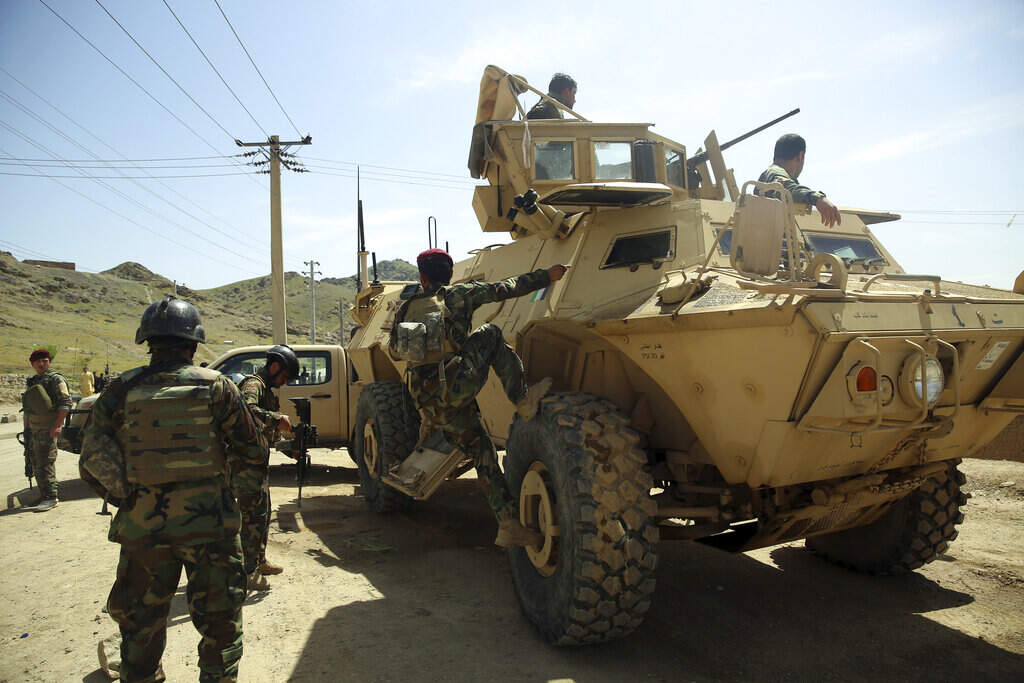
A government oversight report exposes billions in wasted U.S. aid during Afghanistan’s reconstruction — highlighting corruption, mismanagement, and the human toll of failed policy.
Guests
John Sopko, the special inspector general for Afghanistan reconstruction from 2012 to 2025. He has more than 30 years of experience in oversight and investigations as a prosecutor, congressional counsel and senior federal government advisor.
Also Featured
Shaharzad Akbar, an Afghan human rights activist who served as the chairperson of the Afghanistan Independent Human Rights Commission. She is currently in exile living in the UK and is a Visiting Scholar at Wolfson College, Oxford.
The version of our broadcast available at the top of this page and via podcast apps is a condensed version of the full show. You can listen to the full, unedited broadcast here:
Transcript
Part I
MEGHNA CHAKRABARTI: In October 2001, President George W. Bush launched the invasion of Afghanistan. Called Operation Enduring Freedom, it was the U.S. military response to the September 11 terrorist attacks. One year later, October 2002, President George W. Bush spoke at the Dwight Eisenhower Executive Office Building in downtown Washington, D.C. He pledged to rebuild Afghanistan.
BUSH: Today, America affirms its full commitment to a future of progress and stability for the Afghan people.
CHAKRABARTI: Congress approved almost $39 billion to begin reconstruction efforts in Afghanistan. President Bush said the taxpayer dollars, and U.S. Military and government effort, were essential to create the foundations for long-term democracy across Afghanistan.
BUSH: We believe every life counts. Everybody has worth. Everybody matters whether they live in America or in Afghanistan. And so we are helping the people to now recover from years of tyranny and oppression. We're helping Afghanistan to claim its democratic future, and we're helping that nation to establish public order and safety. Even while the struggle against terror continues in some corners of that country.
CHAKRABARTI: The United States ended up staying in Afghanistan for more than 20 years. It is the longest war in American history. Officially, the Defense Department estimates that military spending topped $825 billion across those decades. More comprehensive estimates that include debt service payments, and the cost of long-term medical and disability care for injured veterans, put the total price tag of the Afghanistan war at more than $2 trillion.
There is a specific number within that tally that we want to look at. It’s the amount that U.S. taxpayers spent to fund reconstruction efforts, specifically. From 2002 to 2021, Congress appropriated more than $140 billion to those efforts. Inflation adjusted, that’s far more than the U.S. spent to rebuild Germany and Europe during the Marshall Project following World War II.
Across every administration since 2002, Bush, Obama, Trump, and Biden, Republican and Democratic, Presidents and Congress reaffirmed their commitment and written the checks to keep building in Afghanistan.
OBAMA: And we will seek a partnership with Afghanistan grounded in mutual respect. To isolate those who destroy to strengthen those who build to hasten the day when our troops will leave and to forge a lasting friendship.
TRUMP: Our nation must seek an honorable and enduring outcome, worthy of the tremendous sacrifices that have been made.
BIDEN: We'll continue to support the Afghan people through diplomacy, international influence, and humanitarian aid. We'll continue to push for regional diplomacy engagement to prevent violence and instability. We'll continue to speak out for the basic rights of the Afghan people, especially women and girls as we speak out for women and girls all around the globe.
2002, 2009, 2017, 2021.
And yet, just a week ago, December 3, 2025, the Special Inspector General for Afghanistan Reconstruction issued its final report. The conclusion: a vast amount of that $140 billion was wasted, lost to corruption, criminality, and lack of mission clarity. “The mission promised to bring stability and democracy to Afghanistan, yet ultimately delivered neither.”
John Sopko was the head of the Special Inspector General for Afghan reconstruction or SIGAR from 2012 to 2025, and he joins us now from Washington.
John Sopko, welcome to On Point.
JOHN SOPKO: Thank you. It's a pleasure to be here.
CHAKRABARTI: Is it really, we're having you here for to talk about waste, fraud, and abuse in an effort that was supposed to transform a nation out of the stone age and into democratic freedom. So I can't actually imagine that you are genuinely happy to be here, Mr. Sopko, to be honest.
SOPKO: In a way, you're right. It's a bad news story, but I think the good news is first of all, my little agency that most people thought couldn't do it, did do reporting and we told the American people in Congress that there were problems, not now.
We told them for the last 12 years, and we have to leave it up to them to do something about it.
CHAKRABARTI: Yeah. So we are going to talk about that, that this report should not come as a surprise to anyone who's been following. SIGAR reporting for more than a dozen years, as you said. Just to be clear, I want listeners to know for sure that you are, as of the beginning of this year, you were no longer in Special Inspector General because the Trump administration came in and you were part of the number of IGs that were let go.
Yes?
SOPKO: That's correct.
CHAKRABARTI: Okay, so we'll talk about that too in just a minute. But let's dig into some of the findings of this final SIGAR report. There are several examples I'd love to look at how the percentage of waste, fraud and abuse, if I can put it that way. Out of that 140 million, 140 billion rose to almost 30 or more than 30%.
So first of all. Here's an example. The report found $486 million were wasted on unused aircraft. What does that mean?
SOPKO: Those were what we called the G.222 airplanes that were purchased from the Italian government. They were basically supposed to give, be used by the Afghans to give support for transporting troops and equipment.
They were able to, were supposed to be able to fly in that environment, high altitude, dusty environment, and to land in short runways. What we discovered were that they couldn't fly. Actually they had to use test pilots to fly the planes into Afghanistan. And when they landed at the Karzai International Airport, parts fell off the airplane.
They were really death traps. We went in there and we tried to start some of the engines on some of the planes we found, and we had to shut down because of leaking fuel and sparking from the electrical system. It was a total disaster.
CHAKRABARTI: Were these new aircraft?
SOPKO: No. They were old Italian aircraft that had been sitting in a boneyard in Sicily and were refurbished at U.S. government expense and then flown over to the Afghans and we were going to teach 'em how to fly 'em.
But our pilots and the Afghan pilots just the planes couldn't work. And the irony is that they were sitting there right across from the main airport where every ambassador, every USA official, every DOD official, every IG official flew into the airport and saw these hulking gray airplanes just sitting with trees growing between them. And it wasn't until one day I asked my staff what were they? We knew there were military planes. What were they doing there? They never move. That we got to the bottom of it that it was a total waste.
CHAKRABARTI: How did this happen, John Sopko, because this is a $486 million expenditure, what were you able, and your staff able to determine about how the decision was made to buy these very aging G.222s. Who made those decisions? What kind of analysis was done prior to the aircraft even leaving that boneyard in Sicily? It sounds like a cascading set of logistical failures.
SOPKO: It was, and it goes back to a lot of the decisions made in Afghanistan, is that the record keeping was pretty poor.
So it was hard to find out who made the decision and why they were purchased. We dug very deeply, we were very suspicious of some of the decisions made to purchase these planes and by some of the people involved in that. And we actually, we had thought we had a strong case to actually prosecute individuals, but we couldn't convince the Justice Department nor the military to do anything about it.
CHAKRABARTI: Who were those people?
SOPKO: You can read our reports on that. I'm not going to name names right now. All of that stuff is public. The problem is, I think, and again, this is a problem if we go through each one of these horror stories, is that apparently wasting money is not either criminal or should be held against a senior military officer.
Now, if you're a buck private and you back up a backhoe into an airplane. You may end up in Leavenworth for doing that or get fired, but apparently if you're a general or former general or former senior official, you don't get penalized for such wasteful spending.
CHAKRABARTI: Because what's a half a billion dollars between friends?
It's quite stunning when you put it that way, especially. Not only do the American people deserve to understand this, what you found in this very forensic decade long series of reports. But we're also in a place right now where it's hard not to make the comparison between that waste, fraud and abuse and the fact that domestically here at the moment the government and people and various parties are fighting over whether to continue funding health care subsidies or SNAP funding for families. It's just a kind of a shocking disconnect there.
SOPKO: I agree, and that's part of the frustration about it.
And particularly Afghanistan. It's indicative of the way we do business. And by we, I don't mean IGs, but our government, we tend to view that throwing money at a problem will succeed. And that's not always the answer. And we can go on in detail on that.
The real lessons learned from that report is that we are not prepared to do something this big again. And we don't do nation building very well. And we saw that in Vietnam. We saw it in Iraq, we saw it in Afghanistan, and we tend to do it again. But we never learn any lessons from the past.
CHAKRABARTI: And by the way the SIGAR found that of those 20 G.222 aircraft, they were barely flown. As John Sopko says, 16 of them were sold and scrapped in Afghanistan for approximately 6 cents per pound, meaning $32,000 of that 486 million was repaid to the U.S. government.
Part II
CHAKRABARTI: John, if I may, I want to go back in time and listen a little bit more to President Barack Obama. Here he is in 2009 at the U.S. Military Academy, and he said that the United States needed to pursue a more effective civilian strategy in Afghanistan.
OBAMA: We'll support Afghan ministries, governors, and local leaders that combat corruption and deliver for the people.
We expect those who are ineffective or corrupt to be held accountable. And we will also focus our assistance in areas such as agriculture that can make an immediate impact in the lives of the Afghan people.
CHAKRABARTI: So John, in terms of immediate impact a few years later there was another SIGAR report that came out in 2015 that had yet another example of really areas of urgent need for the Afghan people that the United States could not follow through on.
And one of them was a $335 million power plant. Can you tell us that story?
SOPKO: Electricity is important in a country like Afghanistan, and we built like a lot of things, we built these plants without really talking to the Afghans and finding out if they needed it or could they use it or could they maintain it.
And I believe the plant you're talking about was a facility that we found was only being used 1% of the time, so it was just sitting idle. Because problems with maintaining it and connecting it to the net and that was a constant problem. We spent the money, and this goes to some of the key findings that we looked at. And that was, why are we doing this? And the problem is people came in and they had to show success and every president wanted to get out of that country. Bush himself, Obama, Trump, Biden, and everything was based on fast turnarounds.
So we totally underestimated the amount of time required to rebuild Afghanistan, and we created these unrealistic timelines. And expectations that prioritized really just spend them on quickly, money quickly. Build the plant. Build the road. And whether it works or not, you don't really care because you just got a promotion and left.
Most of the people in Afghanistan that were working for the U.S. government were there less than a year. The military came in, sometimes six-month rotations, they didn't even know where the latrine was and they were gone, but they had to prove success. We used to joke about something called the annual lobotomy, and that was every year, I would say 70% to 80% of our embassy staff.
U.S. embassy staff left and 70%, 80% of new people came in who didn't know their what from a hole in the ground. And they had to learn, and Afghans learned about this too. And if you were a corrupt Afghan and you wanted to get contracts given to your brother or cousin or nephew or whatever and you had a strict DOD official or U.S. official there, you just waited.
He'd leave. The next person coming in had to show success and you could just tell 'em, Hey, your predecessor was an idiot. He didn't sign this contract, but here, sign this and let's go. And we found that. So that was one of the problems, was the quick turnarounds or we couldn't hire people fast enough and we couldn't hire the right ones and keep them long enough.
CHAKRABARTI: Okay. This is really important, John, because I want to also first emphasize that the radically underutilized power plant. Again, it was operating at less than 1% of its capacity. When SIGAR examined it, that was USAID constructed. Was there any evidence that USAID, which ostensibly was a government agency that chiefly has exactly this kind of experience of standing up sort of infrastructure, civil society, supporting groups on the ground, in the countries that they're working on, over long, working in, I should say, over long periods of time to help at least assure some tangible forward progress.
What went wrong here with USAID's involvement with this power plant?
SOPKO: Again, you had to show success. And again, we ignored the situation on the ground to our peril. And what was driving our programs was not the reality on the ground, but the politics in Washington or Berlin or London or at the UN.
And there was a big disconnect between the reality on the ground and what was going on. And, again, a lot of those aid officials, good people, but they're short rotations too. A lot of 'em couldn't get out to actually see what was going on because of the security situation.
And that's another thing you have to consider. I would keep that in mind. ... I think a lot of good people tried, but we gave our people out there, I call it a box of broken tools. Our procurement system is broken. Our human resources system was broken.
It still is. Our planning system is broken and we're shocked that there's failure. We shouldn't be. That is the problem of doing these very complex, long term projects in a war zone, and you have to be prepared for it. And the U.S. government, like I say, is never prepared for it. Because what happens, and this and I don't want drone on about this, but ... this happened after Vietnam.
This is when we came back from Vietnam and the Pentagon and the senior political officials say, we're never going to do that again. So all the capabilities that we had built up were eliminated. And after Iraq, we're never going to do that again. And after Afghanistan, it was within days of the withdrawal from Afghanistan.
The Pentagon was saying, we're never going to do that again. Sure, as heck, we're planning to do it in Gaza. We're planning to do something like that in Ukraine. I don't know how many umpteen times we're trying to do something like that in poor Haiti, but we don't learn lessons and there's a lot of blame going around for not learning lessons.
It's not like they weren't written up and given. We wrote some 800 some reports and the other IGs in the GAO did too. But the civilian leadership in our country and these agencies totally ignored 'em.
CHAKRABARTI: Let me just point out something, which from my lay person's perspective, seems shockingly simple.
And that is, for example, the United States military, the issues that you brought up about staff being rotated in and out, taking a long time to even figure out where the bathroom was. And then major gaps not being filled in terms of a continuity of oversight. Separate from what SIGAR was doing, the reason why this sounds so surprising is that you'd think the U.S. military is masterful at this very thing.
Logistics, people are rotating in and out on deployments all the time, and yet there's a continuation of mission, however, for what was happening in Afghanistan regarding reconstruction, that fundamental strength of the U.S. military somehow disappeared. And you're talking, and also for other agencies.
And what you're saying is it disappeared because we just didn't care. Because we cared much more about impressing the top brass at the Pentagon or members of Congress or the President. Is that essentially what you're saying?
SOPKO: To some extent. Yes. Yes. I think the other thing is and I don't want to blame the soldiers.
We keep talking about the military. The military is gung-ho. You give 'em a mission, they will carry it out. You take that, you want to take that hill, we'll take it. You want to destroy that enemy, they'll do it and they'll come up with a plan and carry it out. But we weren't talking about taking hill number 672 here.
We were talking about trying to rebuild a country from scratch, had no economy, no education. No real military, no rule of law, totally corrupt in a horrible environment, which had been subject to decades of war fighting. And we plop the military in and says, okay, your mission now is to get Al-Qaeda.
And then your mission is to get the Taliban, and then your mission is to fight terrorism in general, and then your mission is to fight corruption. Oh. And then your mission is to train a new military. Oh. And while you're doing it, you have 30 other countries there to help you and you got to use them too, although they don't always show up to help.
You got the NATO operations, so it was a cluster to say the least, and nobody was in charge.
CHAKRABARTI: Yeah. I want to just emphasize something you said. I am not asking this question at all to blame individual members of the U.S. military who are on the receiving end of orders.
Absolutely not. They are excellent at doing what they are told to do. But it's not just in the military at the higher ranks, but it's the more powerful decision makers across Washington really that, I don't know how else to do it, other than to hang the total responsibility on them.
Now, one thing, John, you said earlier is that there was not enough attention being paid to what was happening on the ground, or more importantly, the Afghan people themselves. So to that point now, while the amount of waste, corruption, fraud may come as a surprise to Americans, for Afghans, the signs were there from the start.
SHAHARZAD AKBAR: It was very obvious that there is a lot of waste in mismanagement and fraud and corruption, and it didn't seem like the Americans don't know that this is happening. It was just considered as part of the operating costs in a way.
CHAKRABARTI: Shaharzad Akbar is former chair of the Afghanistan Independent Human Rights Commission.
She's now living in exile in the UK. While still in Afghanistan, she watched the upper class in her neighborhood get richer from the flow of American dollars, but conditions in the country were not improving. In fact, the World Bank found that the poverty rate in Afghanistan rose from 34% in 2007 to 54% in 2016.
AKBAR: People were sick of it because it didn't only mean corruption. You then don't get the right road. You don't have a hospital that's serving, meeting your needs when you should. You don't like your kids in the school, don't have the right building. It also meant soldiers are dying because the consequence of corruption was beyond lack of access services.
It's meant that the soldiers were not getting the food that they should get. It meant that the soldiers, there were ghost soldiers, like literally soldiers who didn't exist, but there was payroll being diverted so it had consequences on the battlefield.
CHAKRABARTI: And Shaharzad says the biggest problem was that the U.S. simply did not understand the people they were supposedly trying to help from the moment they invaded the country.
AKBAR: That's very clear. It's very well documented. We Afghans initially asked very strongly for a transitional justice process, and this was completely thrown off by the Americans because the U.S. wanted to be friends with the warlords because they were the good guys who are now on the U.S.' side, despite the fact that they were deeply unpopular with Afghans and deeply corrupt and serious allegations of war crimes.
This was all disregarded because who has the time to think through a process where, that takes time, that you build consensus around that new set of leaders. No, let's just go with the guys who helped us out. This attitude was extended to everything.
CHAKRABARTI: And of course, Afghanistan has since returned to what it was before the 2001 U.S. invasion when the Taliban returned to power in 2021.
AKBAR: Initially people thought, oh, Taliban are different. It'll be less corrupt. But there are now complaints about aid diversion, about Taliban trying to influence the aid or kind of this whole normalization that also happens within the political elite.
Some of it, the legacy of it has also been carried through to the Taliban, even though the resources are so much more limited. Even though there's not that kind of money going to Afghanistan at all. The institutions will be kept weak, especially now with the Taliban who have, there's no free media, no civil society, no pushback, no investigative journalism.
I imagine many of them will try to keep the institutions weak so that they can continue having utilize the same weaknesses and gaps to extract money for their self-interest.
CHAKRABARTI: So that's Shaharzad Akbar, former chair of the Afghanistan Independent Human Rights Commission. She's now living in exile in the United Kingdom.
John, we talked about waste, while terrible, also not being criminal or illegal, but Shaharzad there is talking directly about corruption. What did SIGAR and its final report conclude about that?
SOPKO: Yeah, it's nothing new. We were highlighting the corruption issue from day one.
And it was a major problem. And the Afghan government was reluctant to hold accountable senior officials, military or political from day one. And we, being the U.S. government, didn't really force 'em to do it. If you were a friend of a senior leader or a provincial leader or a relative, you got a get out of jail card.
And there were many cases where we actually did criminal cases with honest Afghan prosecutors and police. And we would help them work the case, would help 'em with the evidence, they would do the case, and if they were lucky to get it prosecuted or arrest somebody. Usually the police or prosecutors disappeared.
And after a while you just didn't do, if he were an Afghan, do any of those big cases. So it was a serious problem. And what she also identified about us getting in bed with the warlords who were horrible, horrible for violations of human rights and corruption is it tainted our mission.
And if you were an average Afghan out in the provinces and you saw that the people who the Taliban originally kicked out for horrible violations of human rights and corruption are now the friends of the U.S. government we quickly lost the support of the Afghan people and so did that government in Kabul.
Part III
CHAKRABARTI: John, I want to just ask you something following on from what we heard Shaharzad say earlier, because in listening to her voice, I kept thinking about Afghan women.
Because one of the consistent things that multiple administrations said was that by creating the foundation for democracy in Afghanistan, by strengthening civil society, by even just directly building the schools and centers from which Afghan women could benefit, that the United States was in the position to transform the lives of women in a way that was unimaginable in Afghanistan.
And yet now here we are under the Taliban again, and Afghan women are the most oppressed and repressed women on the earth right now. Do you think about that in terms of the long-term impact on the people of Afghanistan? When you consider all that went wrong in our reconstruction efforts.
SOPKO: Oh yeah, I think about it all the time because I worked with a lot of really brave, intelligent Afghan women and their daughters who were for the first time going into schools, higher education. That was one of the successes. But the problem with our policy is that it was a success in Kabul.
It was a success in some of the major cities in Mazar, but it was not a success out in the hinterland. And in part is because and I remember talking to President Ghani's wife about this. And she was just flustered and frustrated about this huge program that the head of USAID under Obama's administration, was testifying on the hill.
That this is the largest, the best, the greatest, the most significant program to assist women. And she was so upset, because yes, you were spending a lot of money. And again, spending money became the name for success, but we never looked at the end result. The end result was to get this money to participate in this program, which I don't know who the heck designed it.
You had to have a high school degree. And what Mrs. Ghani was saying is that eliminated 90% or more of the Afghan women, and particularly about a hundred percent of them out in the countryside, from benefiting from this program. And that again goes back to a point that I think she was making is we didn't understand the environment.
And that is so serious. We decided to create a little Norway, so it looked exactly like us, but we discovered that it was built on sand. We did the same thing with the military. We required the Afghan military to have so many women in certain offices and to have so many schools for them.
And yeah, we built the schools and the women attended them in Kabul. But the schools out in the countryside, were not finished. Or when they were finished, they were turned over to men. So again, I feel for those women. I also feel for the tens of thousands of Afghan soldiers. Police, judges, female judges, female as well as male reporters and news announcers who believed in us. And we've left a lot of 'em high and dry still there. We, I still hear from Afghans saying that they're stuck and they gotta change their house or where they live every couple days, because the Taliban are looking for 'em.
This is horrendous. At least one thing after Vietnam is we took all the Vietnamese who helped us or tried to, but now they're left high and dry, which is horrible.
CHAKRABARTI: Yeah. I'm thinking about when we say the word corruption. It's easy for Americans to think, oh, it's the warlords, it's the Taliban.
It's groups in Afghanistan who were corrupt. But I just had our amazing staff go back and look at previous SIGAR reports about those G.222s that you mentioned earlier, the almost $500 million that were wasted in those unused aircraft that ended up just sitting around growing weeds on them because they were so unsafe to fly.
We looked in an older SIGAR report and we found that previously you had reported that there were Wright-Patterson Air Force Base officials involved in awarding that contract for the G.222s. And in fact, one specific general at Wright-Patterson Air Force Base, before he retired in June of 2009 was central to this.
Because after retirement, he became vice president of air mobility programs for Alenia North America. And one year later he was responsible for the same Alenia contract that he was involved with while in active duty in the U.S.
And SIGAR found that the retired general's post government ethics violations in a report from November 2013, found that he, quote, knowingly made with intent to influence communications to employees of the United States on behalf of Alenia North America in connection with that contract, meaning he acted at the best unethically and perhaps illegally. Now, I brought that point back around because as you said earlier, John. It's not as if SIGAR wasn't informing regularly Congress about all of these issues regarding waste, fraud, abuse, and corruption in reconstruction spending.
So I'm not sure you're going to enjoy this, but let's go down memory lane a little bit. Because first of all, back in 2014, here you are in front of a Senate caucus on International Narcotics control meeting, talking about efforts to control drug trafficking in Afghanistan.
SOPKO: If our goal was to decrease the production of opium, just look at that statistics. We have failed. If our goal was to cut down on the amount of money going to the Taliban, we failed. Now we have failed in all of those missions with a lot more resources, a lot more DEA agents, a lot more DHS agents, a lot more people doing money laundering than is proposed now under the transition planning by the State Department.
So our question as the Inspector General is, How are you gonna do more with less?
CHAKRABARTI: So that's you John, in 2014 talking about anti-narcotics efforts. Let's move to 2016. When you spoke in front of the House Armed Services Subcommittee on Oversight, and you were talking about the Task Force for Business and Stability Operations, or TFBSO, which was trying to attract investments for things like energy projects and gas stations in Afghanistan.
But you found that the program was unsuccessful, and here you're explaining to the armed Services subcommittee why.
SOPKO: I'm sorry, but do a cost benefit analysis. And it doesn't seem like anyone did a real cost benefit analysis on this program. You would've seen there were inherent problems. Everyone had written, you have to have an infrastructure in place. There is no infrastructure in Afghanistan. You have to have a market. There is no market. And that is just a repetition we've seen through almost all of the TFBSO programs.
CHAKRABARTI: Okay, so 2014, 2016, and here you are again in 2020 once again before the House Oversight and Reform subcommittee in a hearing that was all about the Trump administration's Afghanistan strategy.
And by this time, it's sounding a little bit like Groundhog's Day.
SOPKO: You gotta force the administration to be honest and it's not political, it's Republican, Democrat. The administration has to come in and tell you specifically why are you spending this money? What do you expect to accomplish at the end?
Are you going to spend $9 billion in counter narcotics? And the end result is that there's actually more opium being grown? Are you going to spend $500 million on airplanes? And they can't fly. You're going to spend millions of dollars on buildings that melt. You need to hold people accountable.
You need to bring in the head of those programs and say, what were you thinking?
CHAKRABARTI: 2014, 2016, 2020. And this last one, 2023, you testified in front of a House Oversight Committee about aid that continued to flow to Afghanistan. Even after the U.S. military withdrew in 2021.
SOPKO: While I agree and we all agree, Afghanistan faces dire humanitarian and economic situation, it is critical that our assistance not be diverted by the Taliban.
Unfortunately, as I sit here today, I cannot assure this committee or the American taxpayer, we are not currently funding the Taliban. Nor can I assure you that the Taliban are not diverting the money we are sending from the intended recipients, which are the poor Afghan people.
CHAKRABARTI: John Sopko, some of the people in those, on the dais of the testimony rooms or the meeting rooms were probably there for almost all of those meetings, all of the times you testified.
What stopped them, do you think, from heeding your warnings? ... At least bring people in front of your very own committee and have them testify about why every so much is going wrong. What do you think stopped those members of congress?
SOPKO: That's the $10 billion question.
CHAKRABARTI: Or the $150 billion question.
SOPKO: Yes, I say $150 billion question. Or if you look at the entire war fighting, the $3 trillion question, I don't have an answer. And I'm sorry, I don't. This is one of the issues I wanted of this final report to really focus on. Why didn't we succeed? By we, the oversight community and SIGAR. We held everybody else accountable. We tried to hold people accountable too, we looked at the inputs. That's the amount of money being spent. The outputs, what you got for that money, and also what was the outcome? And did you accomplish that outcome? That report that I initiated when I was the SIGAR, talks in great detail.
The one we just released, or my former agency just released last week talks about the inputs and talks about out inputs and outputs. It doesn't really talk about outcome. If the outcome of the 1978 IG Act and the Act that created SIGAR was to improve the way government works, I would say if that's the outcome, we, SIGAR, failed.
DOD IG failed. State IG failed. Aid IG failed. And the GAO failed. Because ask yourself this, and I'm troubled with this myself. I asked the question is, are things, is the government run better now than it was in 1978 when the IG Act? I don't think so. And I don't know what the answer is.
Is the government run better now than it was in 1978 when the IG Act? I don't think so.
John Sopko
I think the problem is we really need to look at how Congress is organized. By we, I think the American people need to do it, and I think when you have a big war like this, you may want to go back to having a select committee that's main focus is the authorizing and appropriating and reviewing and holding oversight hearings.
Have your staff, if you're interested in this, I would highly reckon, have your staff take a look at the quote-unquote oversight hearings that the Senate Armed Services Committee did on Afghanistan, and I'll bet you 10 to one what those oversight hearings included was the Secretary of State or the Secretary of Defense, or some senior official came in and gave a briefing and gave a little presentation and said, we're turning the corner.
We're turning the corner. We're almost gonna win.
CHAKRABARTI: Mission accomplished.
SOPKO: Mission accomplished. We're turning the corner, sir, and if you give us more money, we'll turn it faster. And that was their oversight. Now, I worked for some great senators and congressmen. Two in particular was Sam Nunn and John Dingell. They knew how to do oversight. I put on 20 some days of hearings for John Dingell, looking at food safety. Why? Why did we do 20 some days of hearings? Because he wanted to find out what was going on with food safety. And he did it intense. He did it fairly. He did it bipartisanly, and at the end of those hearings, Republicans and Democrats and industry supported the recommendations he made. And Sam Nunn used to do that, working closely with the Republicans and we don't find that anymore.
It's all gotcha politics up there and I don't know what happened. I came to this town in 1982 and, boy, sometimes I am ashamed to say that I worked in Congress doing an oversight for 15, 20 years because it sure ain't the Congress I knew when I came in '82.
It's gotten worse, and that's the problem. Congress did not do its job in Afghanistan, period. And I'm going to turn it over to somebody who's smarter or wiser and got more time than me to find out why. I don't think it's corruption, except maybe it's political corruption. It's just, I don't know the answer.
I can't do it.
CHAKRABARTI: I think you said it earlier, you said it's self-interest, and I think that explains a lot.
SOPKO: To be determined.
The first draft of this transcript was created by Descript, an AI transcription tool. An On Point producer then thoroughly reviewed, corrected, and reformatted the transcript before publication. The use of this AI tool creates the capacity to provide these transcripts.
This program aired on December 11, 2025.