Support WBUR
The once and future dictionary
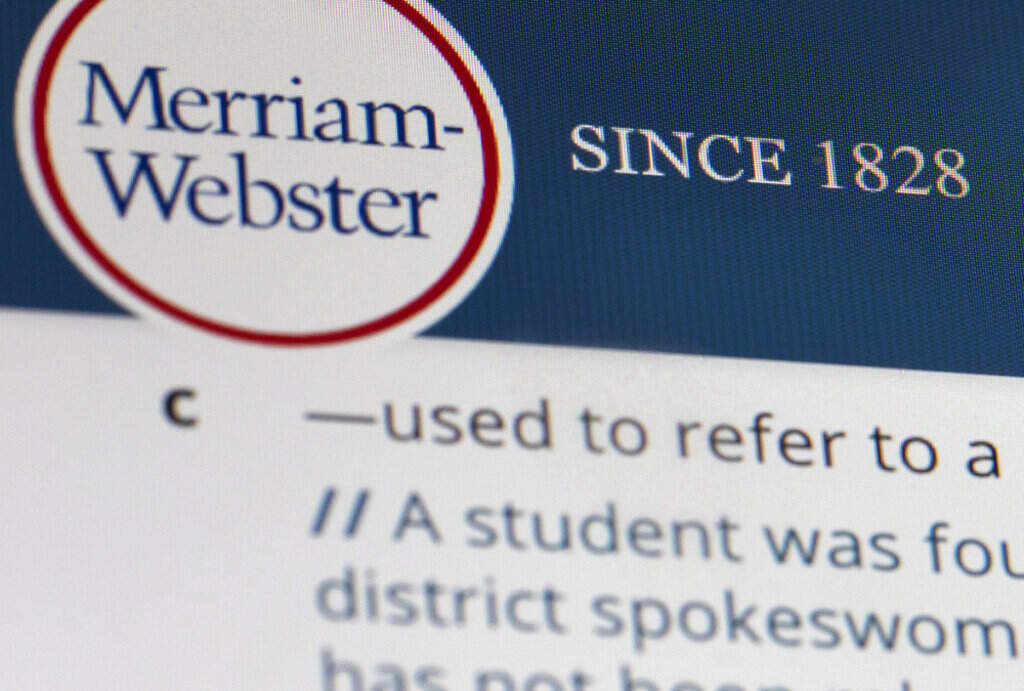
The quest to define and canonize new words in American English is as old as the country itself. In the new book "Unabridged: the thrill of (and threat to) the modern dictionary," author Stefan Fatsis explores how that quest has changed in the age of the internet.
Guests
Stefan Fatsis, author of “Unabridged: The Thrill of (and Threat to) the Modern Dictionary.”
The version of our broadcast available at the top of this page and via podcast apps is a condensed version of the full show. You can listen to the full, unedited broadcast here:
Transcript
Part I
MEGHNA CHAKRABARTI: Stefan Fatsis is a longtime belletrist at Slate, the Wall Street Journal, the New York Times. For the superannuated among us, you will also know him from his many ingresses on NPR.
He has penned many perspicacious monographs, including Word Freak: Heartbreak, Triumph, Genius, and Obsession in the World of Competitive Scrabble. And A Few Seconds of Panic: A Sportswriter Plays in the NFL. At his pertinacious core, Stefan is a salamandrous devotee of lexicography. Ever since his golik youth, Stefan has ydepted himself to the tome to which he is most sagaciously affixed. The lexicographers vast annual compendium.
The dictionary. And most recently, Stefan has published Unabridged: The Thrill of and Threat to the Modern Dictionary, and he joins us now from Connecticut Public Radio in Hartford, Connecticut. Stefan, welcome to On Point.
STEFAN FATSIS: Sorry, I'm busy looking up half of the words you just used in your introduction, Meghna, but it's great to be here.
CHAKRABARTI: (LAUGHS) Having you here today allowed me carte blanche to indulge in my most public radio self ever. Stefan, I have to tell you, I'm so thrilled. What do you want to talk about? Golik? 1175 according to the Oxford English dictionary. A word for joyful. That's where I got that one from.
FATSIS: That's a good one.
CHAKRABARTI: How about, I don't even know if I said this one right. Ydepted from 1340 in the English language, devoted yourself. Ydepted yourself. And my favorite one is salamandrous. 1711 according to the OED. Now notice I'm looking at the Oxford English dictionary here.
FATSIS: Yes, that's okay.
CHAKRABARTI: Yeah. But it obviously can mean of being like a salamander, but also refers to the great passions of a salamander somewhere, in Greek mythology, a salamander that was engulfed by fire, but --
FATSIS: Wow, I'm honored to be salamandrous.
CHAKRABARTI: Did I know anything about any of these words before yesterday? No, I did not. But let me ask you, when did you first, it feels like from reading your book, almost literally, fall in love with the dictionary?
FATSIS: When I was a kid. My mom on my 11th birthday gave me a copy of Webster's New World Dictionary, and it was a color edition, so it had this really cool, glossy color with these amazing full color drawings. And then there were lots of pages of full color drawings inside of rocks and spaceships and knights, and I loved those drawings, those pictures.
But I also discovered that I love the words, and it wasn't long before I started writing for my local newspaper and my high school newspaper, and I used that dictionary through high school and college and into my career as a reporter, and I still have it. It's all taped up. The spine broke many times.
I lost that cool cover years and years ago. But the book still sits on my shelf as a sort of reminder of where I came from and one of my most treasured and oldest artifacts.
CHAKRABARTI: What was it about words that just thrilled you? Even as an 11-year-old.
FATSIS: I think as an 11-year-old, it's just the curiosity.
It's that serendipity of looking things up and discovering something that you didn't know and that wow moment of, Oh man, I didn't know that. Look at that. And then as I got older, it was mostly just, I loved being a reporter. I loved writing. And that's the tool of what you and I and so many other people do.
Meghna, words are the foundation of who we are as people. And the breadth and the depth and the endless of discoveries with language are something that have followed me throughout my life as a reporter, but also my life as a Scrabble player. That book you mentioned.
Words are the foundation of who we are as people.
Stefan Fatsis
For Scrabble, I've learned tens of thousands of words that I will never use in my writing, but I would love to be able to play salamandrous in a Scrabble game if it's acceptable in Scrabble. I'm not even sure that it is, so.
CHAKRABARTI: Well, I honestly, don't tell anyone, but I don't really play Scrabble.
I can't believe I'm saying that to a public radio audience, but that's okay. But if you're playing in the U.S. this is a bit of a divergence. Sorry, Stefan. But can you only use American English words, or can you use English from anywhere on planet Earth?
FATSIS: And now we're going to get in the weeds for one second.
There are two separate Scrabble dictionaries. One is a North American dictionary, that includes a lot of British spellings because those are used in printed material and have been added to American dictionaries that have been used to compile the Scrabble dictionary. But there is an international English dictionary that is published by the English Dictionary publisher Collins, which does include more sort of Chaucer and Shakespeare and Milton.
And then also words from English diasporas like South Africa, the subcontinent, and other places around the world. It's a richer lexicon than the one in North America.
CHAKRABARTI: I got it. Yeah.
FATSIS: Done with Scrabble.
CHAKRABARTI: Gotcha. It's so interesting. One more tiny step into the Scrabble rabbit hole.
Because so many people, people who don't even speak English, can be, are fantastic at English language Scrabble. So that's both just a kind of brain that they have, which is actually different from loving, discovering the meaning of words in the English language, right?
That doesn't mean that they can't love words in their own sort of mother tongue. I mean, because I am terrible at Scrabble. Last time I played was probably 10 years ago and I absolutely got a obliterated when my opponent used the word ads. Which I didn't know at the time, and I think it means like a small axe or something.
FATSIS: Yeah, that's what it is.
CHAKRABARTI: I should have had you at the table. But so focusing though on like the thrill of discovery of what words mean. I'm not an often reader of the dictionary, but I do dip in and out of it, and I'm always charmed by finding out what the first known use of the word is, and then just looking at the history of its development and thinking about what was going on at that time in history that such a word would emerge.
And then later on become accepted as part of, maybe not common, but part of the accepted parlance in the English language. Each word has a story, which I find to be quite amazing.
FATSIS: That was one of the most thrilling and part of pieces of my reporting for this book. I embedded at Merriam-Webster, the American Dictionary publisher.
They let me become a lexicographer in training. I defined words for the dictionary. I defined about 90 words, 14 of them at least as of right now have made it into Merriam's online dictionary. And one of the things I wanted to do was do exactly what you were talking about just now, which is to explore individual words and go down the sort of paper and digital rabbit holes.
I embedded at Merriam-Webster, the American Dictionary publisher. They let me become a lexicographer in training. I defined words for the dictionary.
To create these biographies of words, which is what lexicographers do. They have to dive into the history and development of individual words. So that they can create these short, concise explanations of what words mean, that users can look at and go, Oh, I get it now. That's what this means. And the job of lexicographer is to assimilate so much information because you are drowning in data.
If you are a definer these days, because there's so much on the internet, social media, databases of print materials, dating back centuries, that you can look at. And at Merriam-Webster, which is based in Springfield, Massachusetts, there is this amazing card catalog with 16 million slips of paper that document the evolution of words from the early 20th century to the start of the 21st century, when everything went digital.
And one of the great thrills for me in working at Merriam and writing this book was being able to riff through these files and get lost in the history of words.
CHAKRABARTI: Wow. From the beginning of the 20th century. Interesting. We're going to come back to that card catalog. And what else do you discover during your embeddedness?
I feel very self-conscious about the words I use today, Stefan, to be perfectly honest. But how is it that you got to be inside and to actually work with the lexicographers there.
FATSIS: I'd always been fascinated by Merriam, when I wrote my book about Scrabble which was published in 2001, I got to know the people at Merriam-Webster because they publish the official Scrabble Players Dictionary. I've written a lot about Scrabble in the intervening years. And in the early 2010s, Merriam undertook this project to revise its Unabridged a dictionary, which was published in 1961 and had never been updated.
And they were going to do this all online. And I got wind of this because I am a word dork and I knew about the project, and I proposed writing a piece and I wrote a 10,000-word piece for Slate Magazine about this project. And when I was done with the project. I asked the then publisher of Merriam, John Morse, if I could write a book.
I wanted to write a book, and he said, let me think about it. And he said, yes. And then I said and if I write a book, I would want to embed. Because this is what I've done for a couple of my previous books. I became a expert gravel player. I became a kicker for the Denver Broncos to write my book, A few seconds of panic.
So I wanted to be inside Merriam and see how the linguistic sausage gets made, and John agreed to let me do that. So for the next few years, I went up to Springfield, to Merriam's headquarters, this brick building, built in 1940 and did the work of the definer and did my own research in Merriam's voluminous archives in this sort of dungeon-like basement, in that big card catalog and learned how people do this.
CHAKRABARTI: Okay, so we have a couple of minutes before our first break. I have Merriam's online dictionary open in front of me. What is one of the words that you have officially put into the Merriam-Webster dictionary?
FATSIS: Okay, let's go with microaggression because it's something that everyone is familiar with and an important word.
I was very proud to be able to define this.
CHAKRABARTI: That is you. Okay.
FATSIS: Because it is something that is looked up a lot and has an interesting history that I was able to dive into and there were cards in that Merriam catalog that dated to 1973 and 1974, when the word was coined as a hyphenated word, micro hyphen aggression, and used in an academic journal.
And it took another 30 years effectively for the word to migrate from academia into public popular usage.
CHAKRABARTI: Wow. Okay. So I'm looking at it here under word history, 1969. In the meaning defined above. Yep. Yep.
FATSIS: Earlier, yeah. '69 was the first. Yeah.
CHAKRABARTI: The word was introduced by the Black American psychiatrist, Chester Middlebrook Pierce.
Probably earliest in the essay Offensive Mechanisms in the Black seventies. Oh, fascinating. Okay. And ah, we're headed towards the break here. This is, see, words are like they suck you in, don't they? Okay. So I'm gonna do all my staff a favor and not absolutely crash this break. We are talking with Stefan Fatsis today.
Part II
CHAKRABARTI: Stefan, let me just ask you to tell me a little bit more about how you figured out or found the first official usage of microaggression, one of the words that you got into the online version of Miriam.
FATSIS: Yeah. My first thing I did when I was allowed to define this word, I had to ask because microaggression and companion word safe space were in Merriam's spreadsheet called 'New words,' where editors ad words that they see that are not in the dictionary already. And I saw them there and I really, I wanted to write about words that were important, political, contemporary.
Because I'm writing a book, I need narrative story and stories about words are interesting. So I asked the editor who had put them there, a woman named Emily Brewster, whether I could define those words. And she said, sure. And my first stop was those filing cabinets. They're called the consolidated files.
And in those files I discovered two slips of paper. One was from 1973, and one was from 1974 from a magazine called The Black Collegian. That were little slips of like cutouts that were pasted on these three by five cards, and they're lovely. Beautiful little historical artifacts, these cards, you can wander through this catalog all day and never be tired of finding amazing things.
And once I did that, I did a database search to see if those actually were the first references to the word or whether it went back even further in time, because as comprehensive as the consolidated files are, back in the day, there were no databases to comb through. So editors were relying on their own reading.
It was called reading and marking. They had to read publications for an hour a day, looking for interesting or new uses of words and then clip things out and put them in the files. But there wasn't, there were earlier citations. And the ones that I then found through database mining was the one you mentioned, you said 1969 for microaggression, and you mentioned a guy named Chester Pierce, and he was a Harvard professor of education and psychiatry.
And the first known use that we have of the word was in a speech that he gave at Vassar College in October, 1969. And I'm just going to read it to you. Pierce, who was Black, was quoted as saying that the American education system permits generation after generation of Black children to grow up to be second class citizens.
Meaning that it accommodates them to political reality and makes them passive, docile, accepting. This is done according to Dr. Pierce by visiting on the child and accumulation of microaggressions. Little put downs and demeaning oversights, which make a Black person constantly on the defensive, unable to assume the offensive in any situation, even to fear to initiate conversation with a white person.
And then he got into an explanation of the word that he apparently coined even more in a book that he published the next year.
CHAKRABARTI: That's so interesting. Okay. There's so many rabbit holes, but we're not going to resist them. So in terms of first known usages, especially since you said, obviously, before the digital age, long before the digital age, we had lexicographers who were, I think you said relying almost on their own reading.
... Does that mean that first known usage relies on it being in print? And B, again, for these early words pre-digital age. Is there room then for kind of unconscious bias to dribble into the dictionary making process if lexicographers are just doing their own reading?
Because it's not possible for them to read everything. And it's also a stretch to ask them to read things that maybe they aren't terribly interested in.
FATSIS: They were instructed to read everything and anything they could get their hands on. Not just what they're interested in, but in terms of just lexicographers being the sources for new words.
A counter example to that is the way that the Oxford English Dictionary was compiled in the late 1800s and early 1900s . The editor of that book ... put out a call to the public, which sent in tens of thousands, hundreds of thousands of examples of words in print. And they came in envelopes, mailed letters, written on the requested slip of paper at the right size, but also scribbled on the backs of print documents and theater bulletins and whatever.
And that's how the OED amassed its vast collection of what they call quotation slips. Miriam calls them citation slips. So there's this combination of crowdsourcing, which was an important part for the OED, but also just the diligent work of a big staff of lexicographers doing research into the use of words.
CHAKRABARTI: Okay. Alright. I should say that we asked our audience, we asked On Point listeners to send us little voice memos of what their favorite words are. And we got a lot of responses. Here are a few.
(MONTAGE)
CONWAY: My favorite word today is belonging. Belonging.
KRESSE: Abicidarian. It means a person who is learning the ABCs,
USCHOLD: Hibernaculum. A hibernaculum is a place where animals such as snakes or insects, hibernate. During the winter months
KASKA: PETRICHOR, P-E-T-R-I-C-H-O-R. It's defined as the smell in the air that lingers after a rain that follows a warm dry spell.
WEE: Defenestrate, which means to throw someone out the window.
RICE: My favorite word is onomatopoeia because it sounds nothing like what it means.
DE DEA: frothy, and it's not because of the definition, it's because of the sound and the images that folks of a milkshake or a root bear float.
CHAKRABARTI: Okay, those are great. So those were On Point listeners Jennifer Conway, who brought us belonging.
Jenny Kresse, who brought us abicidarian, which holy cow, I'm gonna put into my vocabulary. ... Then there was Suzanne Uschold who brought us hibernaculum.
Kathy Kaska, who brought us petrichor, which by the way, that may be my new favorite word. What a beautiful word. The smell in the air that lingers after a rain that follows a warm, dry spell.
Wow. Okay. Then there's Michelle, we who brought us Defenestrate, as in people who have crossed the Kremlin often find themselves defenestrated by Russian spies. Then there is John Henry Rice with onomatopoeia and Bob de Dea with frothy.
... Stefan, let me ask you, is it of a greater challenge, I don't know if you had a chance to compare the dictionary making process in the English language in the United States versus, say, France is always the one that comes up with so profound strictures around the French language. Do you think it's more difficult or just more enjoyable to come up with a dictionary for a language like English, which has basically no official body that puts bounds around it.
FATSIS: I thought you were gonna ask me what my favorite word is.
I'm a little bit upset that you didn't.
CHAKRABARTI: Wait! Stop. Let's go back then. Okay. Can we go back, run back? What is your favorite word?
FATSIS: My favorite word is tatterdemalion. T-A-T-T-E-R-D-E-M-A-L-I-O-N. Noun. A person dressed in ragged clothing. I'm reading from the Merriam-Webster definition, adjective, ragged or disreputable in appearance, being in a decayed state or condition.
Dilapidated. And I ran across the tatterdemalion, I came across tatterdemalion for the first time, reading a New Yorker article by Roger Angell about the 1987 baseball season in which he referred to the New York Mets as the lowly, tatterdemalion Mets, which I didn't know the word. I thought it was amazing.
And I have used tatterdemalion over and over in books and other writing. I've snuck it in there and at one point I actually did a story for Slate about Roger Angell's use of the word tatterdemalion. So I got to talk to him about it.
CHAKRABARTI: 1608. I'm seeing here.
FATSIS: There you go.
CHAKRABARTI: Wow. Okay.
FATSIS: Great word.
CHAKRABARTI: Tatterdemalion.
Everyone write that down. Tatterdemalion. I'm trying to think of a way to tatterdemalion to my question about French versus English, but I cannot, so go ahead and just because I'm trying. In order to find out more about what you learned when you were embedded with Merriam. This question always comes up, like, how do you draw the lines around what is an acceptable word to go into the dictionary?
Versus something that's just a meme for a moment.
FATSIS: It's a combination of science and art really. We don't have language institutes and national governing bodies that oversee language the way that France or Sweden or other countries do. And in England it doesn't really either.
Oxford is the de facto, perceived institution that oversees language. The Oxford English Dictionary is publicly funded by the university. It's not a commercial moneymaking enterprise. Oxford University Press is, but the dictionary itself is proudly agnostic when it comes to moneymaking.
We have a very different system in the United States, lexicography began and continued as a commercial competitive business. You can go back to Noah Webster toiling away on his dictionary by himself. His first dictionary came out in 1806. His master work came out in 1828. And by the way, your colleague was correct. 1755.
CHAKRABARTI: He's always right.
FATSIS: There you go. But after Noah did his solo effort to create this American dictionary, this book that he believed was important to establish the identity of the new nation. After his death, his dictionary was acquired by these two brothers, George and Charles Merriam, who were in Springfield.
And they were businessmen. They didn't view the dictionary as something that was a national project, they viewed it as a commercial project that also was essential to the republic. So these guys wanted to make money, and they very quickly recognized, they made changes to Noah Webster's dictionary.
They sold it for less money. They figured out a better way to publish it. They undertook revisions. They hired a staff of academics at Yale to revise the dictionary. Which was a big departure from the solo efforts of Noah Webster. And from that point forward dictionary making in America was all about competition.
Who could get to the marketplace faster? Who could do a better job? Who could persuade the public that buying your book was essential.
CHAKRABARTI: Yeah. So you write beautifully in your book Unabridged how from a moneymaking competition, dictionaries also became in the United States, actually a prime field for the culture wars, right?
You have a lot of examples in there about words that controversially became officially recognized by Miriam Webster. And the controversies always seem to surround the power that the dictionary has to grant sort of validity to things that might have been on the fringe of the culture or in popular culture and not necessarily as widely accepted.
I think the story is really greatly told when you talk about the year that Merriam decided to add the word sheeple to the dictionary.
FATSIS: Yeah, that was my doing. I added sheeple.
CHAKRABARTI: You did that. I forgot about that definition. Yes. Okay. So we have you to blame then, instead. Yes, go ahead. Go ahead.
FATSIS: I knew this word and thought it was an amazing, it's a great word. So useful to describe people that are compliant and docile and just do what they're told. And I assumed that it was already in there. So when I went into Merriam's online dictionary and I typed in sheeple, I got nothing. So I added it to that new words spreadsheet and set about defining the word, and I went down the rabbit hole that lexicographers do.
I was much slower at defining words than the pros. Every one felt like pushing a boulder up a hill for me, whereas other, the staff, the actual definers on Merriam's staff could do five or 10 definitions a week if they had to. But sheeple, I traced back to the mid 1940s. I found this this Atlanta newspaper columnist who used it a few times to describe the people in Germany and Italy who followed Hitler and Mussolini and watched it morph from that sort of casual usage to being adopted by the fringe right-wing conspiracy theorists in the 1990s.
To then becoming back to being a colloquial use. And when you define a word, you're not just writing the definition, you're also including for the entry in the dictionary. Some examples of usage from newspapers, magazines, whatever popular sources you can find. And so I suggested a handful of quotations that could be appended to the definition.
And one of them was a review of an Apple iPhone case. Yeah. Which implied that, it was a negative review of the case, but the writer said that the Apple sheeple would still buy it. And this actually went viral and not in a good way. If you're Merriam-Webster, people started criticizing the company saying, Merriam-Webster disses Apple. NPR did a little spot about how this rogue quotation had gone viral. So inside Merriam, with my editor, a guy named Steve Perrault, whose title is Director of Defining, which I love. Steve felt that the quotation and the attendant media were distracting from the definition itself.
And the job of the dictionary is to be unobtrusive. It's not to generate controversy. Or get clicks or generate attention because of the content. The idea is to give readers a sense of what a word means. So they actually removed the Apple quotation and took it down because it just wasn't working.
CHAKRABARTI: Yeah. But Merriam might not be seeking to create controversy, but it will inevitably come and has multiple times in the past because words, language is controversial. And if you're seeking out to set definitions. For these very powerful tools in terms of how we communicate. You're not going to avoid the controversy.
FATSIS: No. And Miriam has revised words that have triggered criticism against the company. Revisions to entries for the words like racism and marriage and woman have created their own sort of right wing, echo chamber criticisms in recent years that have been really damaging publicly, I think.
Part III
CHAKRABARTI: Okay Stefan, this year, the Oxford English Dictionary has picked its word of the year as rage bait.
I should note that Merriam-Webster, I think as of today still hasn't released its word of the year for 2025, but we have to talk about what Dictionary.com has done, Stefan.
FATSIS: Sure.
CHAKRABARTI: We have to talk about. I can't believe I'm about to use --
FATSIS: Of course, we do.
CHAKRABARTI: '6-7.'
FATSIS: Are you moving your hands up and down?
CHAKRABARTI: 6-7. Yeah. Oh God. High points and low points of my career right now wrapped up into one. Stefan, it's not even a word, it's it like we, even the users of it, I pulled a couple of fifth graders just last night and they're like, it doesn't mean anything. It's just sitting.
FATSIS: It doesn't.
It's a lexical item.
CHAKRABARTI: How can it be a word of the year?
FATSIS: It's a lexical item. Words of the year. Words are lexical items. They are, they can be anything. A word can be a word of the year, can be a suffix. It could be an emoji or a hashtag. The word is pretty expansive when we think about how language is used, and that's how the proprietors of dictionaries and groups like the American Dialect Society, that pick the word of the year or a word of the year.
Tend to use the term, it's pretty loose and wide because language is loose and wide.
CHAKRABARTI: Oh, but I object. Stefan, this one crossed a line for me. Because look, I look to, people look to the dictionary to help provide meaning. You can disagree with the strictures around a particular definition, but you got a --
FATSIS: I didn't disagree with you.
CHAKRABARTI: Oh, come on. But this isn't even a word, it's a phrase. It's an utterance.
FATSIS: People look to dictionaries. People looked at dictionaries, Meghna, to understand the world around them.
CHAKRABARTI: How can you understand a word that's not a word that has no meaning?
FATSIS: Because then we have to find a way to describe it.
And I think the dictionaries have done a pretty good job of giving the little lexical portrait about 6-7 to indicate how it emerged, where it came from, and how it's used, which is ridiculously and innocuously and annoyingly by tweens and other kids. Both dictionary.com and Merriam-Webster in recent years have added slang portals to their websites, because when someone is curious about a word and they actually do turn to a dictionary, which increasingly is declining because of AI and Google, and we'll talk about that in a minute.
But the Merriam and dictionary.com have discovered that, look, we want to give people some information. Maybe we don't sanction 6-7 as an official word that merits inclusion in the dictionary because its use is current, and it may not last. It almost definitely won't last. But we want to give them some information so that when someone goes to our website, they can stay there. These are companies.
CHAKRABARTI: Okay, so we get back to this is about business.
FATSIS: Yes, of course. It's about business. All right. Dictionary.com made a very conscious decision to pick 6-7 as its Word of the Year, knowing certainly that it would generate outrage and conversations like this one, which would send people to dictionary.com's website, to read its press release and its description of what 6-7 means and where it came from.
CHAKRABARTI: So you're saying I fell into the rage bait trap?
FATSIS: Yes.
CHAKRABARTI: God, I was so easily baited too. I like literally jumped up and down when I found out that 6-7 was the word of the year at Dictionary.com. Okay. Thank you for explaining that because it actually will, I will step back from the abyss of anger about, I love how dynamic and non-exclusionary the English language is.
I do love it. But this one, I have to say, I was like, it is not a word. It has no meaning. Even the people who use it say it has no meaning. It has to be out of, first of all, my children's vocabulary and second of all, Dictionary.com's word of the year.
Okay.
FATSIS: There are like classrooms of bandits use for obvious reasons.
CHAKRABARTI: But the reason why I find this example actually so compelling, other than my own personal outrage is because, okay, even if it's a business ploy by Dictionary.com. For some time now, because of course, because of the internet.
Tell me about the conversations happening inside the world of dictionary makers where they're trying to keep themselves relevant. Still useful, but living in a world where language is changing at light speed, and even people don't even go to the dictionary anymore to find that sense making and meaning making that they once did.
FATSIS: And they don't go because of the way that we use the internet. If I type a word into a Google search bar the first thing that today is going to pop up is an AI overview. Which has culled, scraped information from different places and put together a few sentences explaining a word, very often pretty good.
Also, often inaccurate or filled with errors. But that prevents users from scrolling down the page to get to the link to Merriam-Webster's website or Oxford's website, or Cambridge's website or dictionary.com's website. It is a real threat. And if you go scroll back like 15 years, Google licensed dictionary content and created what are known as knowledge panels or knowledge boxes, and those would pop up at the top of a search.
Also having the same net effect. And when I was at Merriam, and this is pre pandemic, there was a stretch where Merriam's search engine optimization was losing a sort of fight against these Google boxes. And clicks were declining to the website, which means revenue is declining to the website. And that led to some layoffs at Merriam, which were unprecedented and very demoralizing for the small staff.
So there's a cat and mouse game going on between dictionary makers online and AI and Google, but at the same time, companies like Merriam-Webster have to find ways to innovate and diversify. So Merriam has lots of games on its website now, like the New York Times has lots of games that it offers to readers to keep them engaged with the content.
There's a cat and mouse game going on between dictionary makers online and AI and Google. But at the same time, companies like Merriam-Webster have to find ways to innovate and diversify.
So we're going to see that it is really unpredictable right now. AI can write a decent dictionary definition. I have a chapter in my book about artificial intelligence, and I did a comparison, like a taste test, plugging in a lot of words that I defined and other new terms and see how AI performed.
There have been academic papers written about AI and its impact on lexicography, so we're still in the early, very early stages. But the remaining dictionary companies, and there aren't many in North America, are going to have to do more to battle against the tide of AI and the way that people consume language online.
CHAKRABARTI: Can you tell me more about some of the tests that you did with AI. And if, I don't know if you have a specific word you can share, because this is very interesting to me. Given how AI works, it's almost like it's a little similar to the process that the lexicographers go through. Because they're searching everywhere they can.
But it's also fundamentally different. So do you have an example you wanna share?
FATSIS: Sure. I'll give you two. One was microaggression and what AI returned when I prompted ChatGPT to write a definition of microaggression in the style of Merriam-Webster was my definition verbatim.
So AI had scraped Merriam's website and returned the actual content. And by the way, Merriam and its parent company, Encyclopedia Britannica, have sued Perplexity, one of an AI company for stealing data. But so that was a direct copy. Here's another example. I had defined the word dogpile.
Celebration with athletes after a game when everyone jumps on top of one another. And ChatGPT told me that dogpile was typically used, quote, in the context of online searches or discussions. Which, okay, that is not, it is a sense of the way that word is used online. People piling on in a conversation.
And I write in my book, I questioned whether it wasn't also used to describe a celebration in sports. It said I was right and then it offered a separate definition reflecting that usage. I had to pry that information out of ChatGPT, it didn't come up with it on its own. I'll give you one more example.
I defined, I revised the entry for Pompom Girl from Merriam's unabridged dictionary, which in the unabridged dictionary was defined as a prostitute. And this is like World War II slang. And the editors at Merriam-Webster in the 1950s didn't find citation usage of Pompom girl to mean a cheerleader, which emerged in the 1940s.
So this was one of the problems with analog defining. So I revised this and it still, it never got into the unabridged dictionary, and it's not in the collegiate online dictionary. For business reasons, Merriam scraped that project to revise the unabridged. Yeah. So I asked ChatGPT, I asked Gemini actually about this, and it told me that Pompom Girl emerged.
Both in the early 20th century and the mid 1970s to early 1980s, meaning the cheerleader sense. When I probed about the outdated prostitute sense, ChatGPT categorically rejected the meaning. When I cited the entry in the online unabridged, Gemini reported an outdated and offensive slang definition, and it cautioned.
You'll find this definition in some online dictionaries, but it's important to understand it's a derogatory and uncommon usage. So one minute AI was telling me I was wrong. The next minute, it was issuing warnings about the word based on the information I provided. So not super reliable.
CHAKRABARTI: I mean in all, in both cases, you actually had to provide it with critical information.
Yeah. Okay. Versus when you're actually looking at a definition in a dictionary, you see the multiple definitions. Right there in front of you, so --
FATSIS: Correct.
CHAKRABARTI: Yes. Okay. That's a very important difference.
FATSIS: And that's why humans have done this for centuries and still are better. ChatGPT can write a good definition.
What it's not good at is creating good example sentences. Or performing the historical research that human lexicographers can do.
CHAKRABARTI: Or just broadening your world. I mean the examples you gave were actually a narrowing of the possibility of what a word can mean. In a sense, I wonder if let's get straight to this.
Do you think the dictionary is gonna survive?
FATSIS: I don't know, honestly. Merriam has done a great job so far of broadening its offerings to get people to the website. They've expanded the business connections. They're doing more sort of partnerships. They've done a lot of work with the English learning tools, apps so they are expanding the business in an attempt to stave, to not rely entirely on lookups. And Merriam never really has relied entirely on lookups or book sales. It's been a pretty flexible company, but that's the core business. And without it, what's Merriam-Webster? It's not clear to us.
So Merriam even brought out a new edition of the print collegiate dictionary. Which it hadn't updated in 20 years. And mostly as a marketing thing. It's a throwback, it's retro cool to have this book. And it's a beautiful book and the revision is lovely. But what's it for?
The marketing around it by Merriam has pitched the dictionary as the anti AI. Artificial intelligence. This is actual intelligence. That was the tagline in one of their promos. So Merriam is trying to be creative in how it repositions the business going forward, but it's challenging.
The number of dictionary companies in North America has steadily declined. American Heritage has gone. Random House doesn't publish dictionaries. Webster's New World. The book that I got when I was 11. Nope. So we are down to Dictionary.com, which has a very small defining staff and Merriam-Webster.
This is a business that is going to face challenges over the next decades.
CHAKRABARTI: You know why this actually fills me with some sadness is that in this day and age when we're finding so many ways to divide ourselves in this country, one of the great things about a dictionary was even though definitions may be controversial, dictionaries help us understand.
They provide a common cultural ground to help us understand what each other means. When we're talking with each other. In the absence of that, I don't know. Sometimes I feel like do we go back to a time where words can mean anything? Or even spelling isn't held in common? Is it just one more way in which we can become strangers to each other without having that linguistic and definitional common ground?
FATSIS: Dictionaries positioned themselves as authorities for centuries. Merriam Webster's marketing in the late 1800s and into the 1900s, up until fairly recently, were focused enormously on the authority that this book conveys, one of their marketing taglines for several decades was the ultimate authority.
You buy this book, you become educated, you share the common language, you learn about our culture and it's important to have this. Is it important to have a physical book? No. The internet is a really good delivery system for dictionaries. But in the absence of that, in the absence of people doing this important work, collecting and preserving and defining what language is, I think you have a point about the risk of chaos.
It's just the chaos of the internet. We like things that are organized and explainable. And the work that lexicographers, the people at Merriam and Oxford do to preserve the history of words and language I think is enormously important. And if the commercial marketplace can't support it, we have to figure out a way to allow it to persevere.
The first draft of this transcript was created by Descript, an AI transcription tool. An On Point producer then thoroughly reviewed, corrected, and reformatted the transcript before publication. The use of this AI tool creates the capacity to provide these transcripts.
This program aired on December 12, 2025.