Support WBUR
What's driving the rise in grandparent childcare
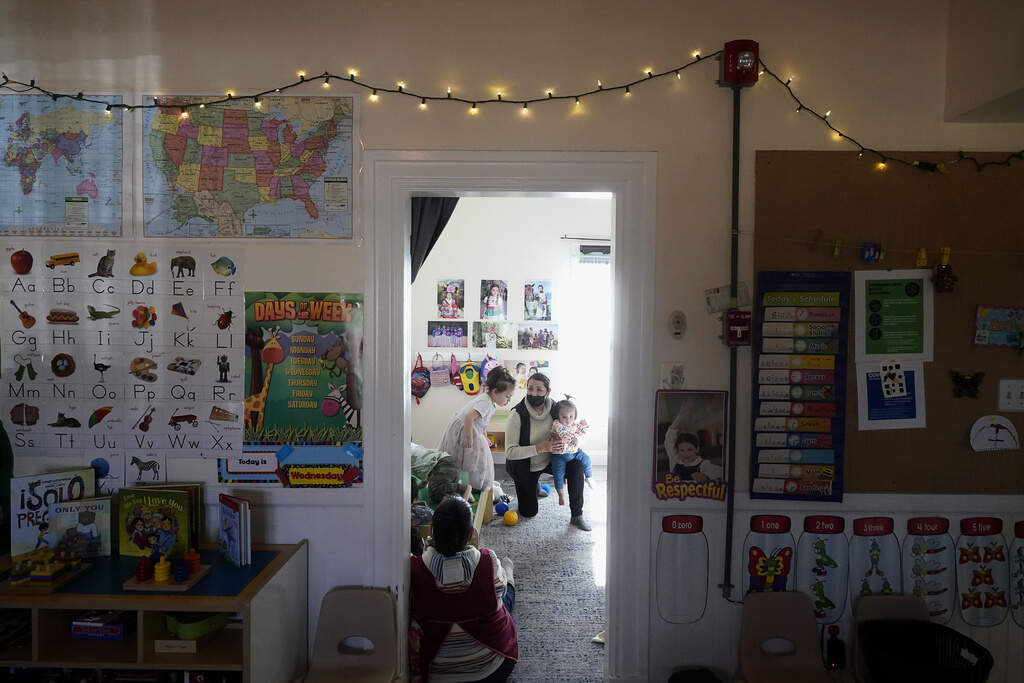
The number of grandparents helping with childcare is going up nationally. According to a 2023 Harris Poll, 42% of working parents rely on grandparents for childcare. What does it mean for the lives of those grandparents and the support they need?
Guests
Jovanna Archuleta, early childhood program director at the Los Alamos National Laboratory Foundation (LANL), which supports public education and community development in northern New Mexico.
Madonna Harrington Meyer, sociology professor at Syracuse University. Author of several books on grandparenting, including “Grandmothers at Work” and “Grandparenting Children with Disabilities.”
Also Featured
Jessica Naranjo, New Mexican grandmother raising 4 grandkids.
The version of our broadcast available at the top of this page and via podcast apps is a condensed version of the full show. You can listen to the full, unedited broadcast here:
Transcript
Part I
MEGHNA CHAKRABARTI: Jessica Naranjo lives in Santa Clara, Pueblo, New Mexico. She is the mother of three and the grandmother of eight.
JESSICA NARANJO: My mom, which is their great grandma, is known as grandma to them, but what they call me is sa’yda which is grandma in Tewa.
CHAKRABARTI: Tewa is a Tanoan language spoken by several Pueblo nations in New Mexico’s Rio Grande valley. But Jessica isn’t just any grandma.
In fact, she is the full-time caretaker of four of her grandkids aged 4 to 15 years old. They live with her. She’s raising them. Something she never thought she’d have to do after raising three children of her own.
NARANJO: I just, you know, assumed like every other grandparent that, you know, that their parents would be there to take care of them. But that wasn’t the case.
My oldest granddaughter who is 15 and my 11-year-old granddaughter belonged to my son and his girlfriend at the time, have alcohol addictions. They also had domestic violence issues. And then at one point they were also incarcerated, so that's how I took on caretaking for my oldest granddaughter and my 11-year-old.
CHAKRABARTI: The girls were young when Jessica began raising them in 2016. Soon after - she took on full-time care of her daughter’s first born and later her daughter’s second child.
NARANJO: My second oldest granddaughter, who is the 13-year-old, and her brother who is a 4-year-old, belonged to my daughter who has an addiction to fentanyl and heroin.
CHAKRABARTI: When Jessica’s daughter had her second child, she was still in active addiction.
ARCHULETA: My grandson was born addicted to several drugs that were in his system because his mother used the whole time that she was pregnant with him.
CHAKRABARTI: According to New Mexico’s Department of Health - the state has had the highest alcohol-related death rate in the country for over a decade, and it's only gotten worse. Roughly six people die every day in New Mexico from alcohol-related causes.
The state also ranks sixth in drug overdose deaths. Those tragedies are a major reason why many grandparents in New Mexico like Jessica are taking on full-time grandchild care. In fact – the state has the highest rate of kinship care in the nation – more than double the national average.
NARANJO: I didn't have any issues with taking on that role, once it did happen. But in the long run, like financially, I didn't realize how much of a toll it was going to take on our family. Based on my income, we don't qualify for a lot of services. I basically have had to do it on my own. I have to juggle whether, you know, my grandchild needs this or this needs to get paid.
So I kind of don't pay one bill and I hold off to pay it at a later date so that I could be able to provide for my grandkids. And yes, there are times that we do have food insecurities, but you know, there's always a way that I manage to provide for my grandkids.
CHAKRABARTI: Now Jessica would be considered a young grandmother - she’s only 52. That also means she’s not retired and is still working full-time.
NARANJO: So, luckily my job is very helpful that my supervisors are aware of my situation, and they work with me. Before my three older grandkids were going to school at our charter school here in Espanola. So, I was given the time to drop off my kids in the morning.
For work, I work through my lunch so that I could use my lunch hour later on in the day to pick them up from school. I have the support of my parents who would babysit my grandkids during maybe like an hour to two hours during the time that I picked them up from school until I get off of work so that I could return back to work.
CHAKRABARTI: Given these kids’ parents still struggle with addiction - Jessica is and remains to be their sole caretaker.
NARANJO: So, you know, everything that I do throughout my day is basically, is always focused on caring for my grandkids.
Everything that I do throughout my day ... is always focused on caring for my grandkids.
Jessica Naranjo
CHAKRABARTI: That’s Jessica Naranjo, who is raising four of her grandkids in New Mexico. We will hear more of her story later in the show.
Last month New Mexico launched a first in the nation universal free childcare program. But it’s not just for parents, it’s also for grandparents too. Meaning grandparents who are raising their grandkids can get free childcare, regardless of whether they are still working or not.
So we wanna learn more about this new initiative and how it works. And to do that we're joined by Jovanna Archuleta. She’s the early childhood program director at the Los Alamos National Laboratory Foundation (LANL), which supports public education and community development in northern New Mexico. She joins us from Santa Fe. Jovanna, welcome to On Point.
JOVANNA ARCHULETA: Hello Meghna.
CHAKRABARTI: Now is what you heard from our grandparent just then, similar to what you've heard from others that you've spoken with?
ARCHULETA: I think this is one of many stories. I think the theme is all the same, that the children are suffering from substance misuse or mental health disorders. And so these young children will be raised by kinship caregivers or grandparents.
CHAKRABARTI: Can you tell us more about the rates of alcohol and drug use and how they're disrupting family life in New Mexico?
ARCHULETA: Sure. Part of what's coming into New Mexico, what has been in New Mexico is due to historical trauma. And because of that, we have where the LANL Foundation service areas are and the seven counties we serve near the Los Alamos National Laboratories.
Santa Fe, Sandoval County, Rio Arriba County remain the counties with the highest counts of overdose deaths. And this trickles into how children learn, how children love, how children show up for their community. And so in New Mexico, we have approximately 16% of adults experiencing substance misuse.
And this is according to our report that we did last year.
CHAKRABARTI: 16% of adults. That's shockingly high.
ARCHULETA: Yes. Yes. We have a high percentage.
CHAKRABARTI: Wow. So that's one of the main reasons that's translating into the other set of disturbing numbers. That I had said earlier that the rate of New Mexico's kinship care is double that of the national average.
So the national average is about 3%, meaning 3% of grandparents nationally are taking care of their grandchildren. And how high is it in New Mexico?
ARCHULETA: So between 2017 and 2023, we are at 8%. Again, double the 3% national average. And we went from about 30,000 grandparents or kinship caregivers to 36,000.
CHAKRABARTI: In that short period of time?
ARCHULETA: Yes.
CHAKRABARTI: Wow.
ARCHULETA: And I'm sure it's doubled after COVID, as drug misuse continues to increase, where the number of grandparents raising grandchildren.
CHAKRABARTI: Wow. So it's at least, at the very least, one in 12 grandparents in New Mexico right now is caring for their grandchildren.
Okay. So you did this survey of grandparents, the Los Alamos National Laboratory Foundation, or LANL as you said a little earlier. What were some of the challenges that the grandparents were telling you about?
ARCHULETA: I think some of the challenges continue just to be economic support. We continue to hear from grandparents. And Jessica said, income is not always considered with the number of children that they have, that they won't qualify for maybe SNAP benefits or TANF benefits.
And so they are struggling to make ends meet with what they have, and they're raising multiple children. And multiple children have some disabilities or themselves have mental health disabilities. And so grandparents need support with that. They need respite, they need, they've talked about often just a community to come together and share their own experiences.
CHAKRABARTI: I was just about to ask you about that, Jovanna. I'm sorry for interrupting but given how so many of these children need to be cared for by their grandparents because of the trauma in their own families, right? All the drug and alcohol addiction in terms of those additional supports that the kids need.
We also heard Jessica talk about the fact that she has to build her life around getting her grandkids to the places and the programs that they need. Does New Mexico have an adequate number of sort of mental health supports for children of grandparents?
ARCHULETA: They currently do not, they don't definitely have the supply.
But in Northern New Mexico, we have great programs like Las Cumbres. They have a grandparent program, Family Strengths Network. They have a grandparent program. In the more rural parts of our county, there's some people that are trying to start their own grandparent program as a place to connect. So they're popping up with not a degreed social worker or mental health therapist, but they're popping up with community support.
It occurred to me that, okay, so many parents, grandparents, excuse me, are taking on this care. Because what's the other option? The only other option is foster care for these children.
ARCHULETA: Yeah. The only other option would be, and that gets tricky, some of the grandparents don't want to go into formal custody agreements because they want to leave the option open for the children to reunify or connect back with their biological parents.
And so because of that, that cuts off some support from the state. Because the parents are receiving the SNAP benefits. They're receiving the Medicaid and all that, and the grandparents' support. The biological parents, to get that, and so they often lack or go without those services.
CHAKRABARTI: Yeah. We're heading toward a break and when we come back, we'll talk about New Mexico's new universal childcare program.
But I just want to quickly ask, did any of the grandparents that you spoke with also talk about the double, there's obviously the physical and the economic hardship, but there's got to be an emotional hardship too. Because so many of these grandparents are taking on the care of their grandkids because their own children are suffering with addiction or incarceration or death even. Did they talk to you about that?
ARCHULETA: Layered on everything else, they are still grieving the loss of their children and grieving the loss of their own lives. But also grieving that they couldn't just be a grandparent.
Layered on everything else, they are still grieving the loss of their children and grieving the loss of their own lives. But also grieving that they couldn't just be a grandparent.
Jovanna Archuleta
Part II
CHAKRABARTI: So tell me, in more detail, what exactly New Mexico's new law is designed to achieve and how it supposed to go about doing that.
ARCHULETA: This is something we're all very excited about, the access to childcare, free childcare. I think under Governor Michelle Lujan Grisham, she has really tried to support education in our state. And so with access to universal childcare, this means grandparents who have begged for respite care now can take advantage of enrolling their children, their young children, into care.
With access to universal childcare, this means grandparents who have begged for respite care now can take advantage of enrolling their children, their young children, into care.
Jovanna Archuleta
And with the activity requirement removed from the law and from the regulations, parents, grandparents don't have to be working or going to school. And that usually was a requirement. They can now get some respite care. Get their children in some spaces to learn and be in community with other children.
It's been a long time coming. I know this was a long vision of the governor and of the department, and we are now seeing the results of that, as families are enrolling. And I think Secretary Groginsky mentioned there's at least now 4,000 children, since November 1st when it launched, are now enrolled in childcare.
CHAKRABARTI: Wow. So when we talk about childcare, do we mean daycare and preschool? Is there a sort of an age cutoff for the kids?
ARCHULETA: Childcare, usually they're really trying to fill infant and toddler slots. So it would be between the ages of zero and five. We do have universal pre-K as well in our state, so children three and four have access to that as well.
CHAKRABARTI: Is there a cap on how much families, but in this case, grandparents, can receive? And are grandparents paid directly to then find the care that their grandkids need? Or how does it practically work?
ARCHULETA: Grandparents would qualify now for childcare assistance, so they would enroll their children into a childcare provider wherever they have open spots. And funding would go directly to the childcare provider.
CHAKRABARTI: Is it 100% paid for?
ARCHULETA: 100%. No copays, no tuition. It's 100% paid for by the state.
CHAKRABARTI: And do the grandparents have to be the legal guardians of the children?
ARCHULETA: Not legally, they can attest, much like they do in public ed.
They can attest that they are caring and the primary caregiver of the children.
CHAKRABARTI: I see. Okay. So immediately when we talk about childcare in any context in this country, two questions come up. First of all, how is it going to be paid for in New Mexico?
ARCHULETA: That's where we were lucky enough as a state to establish an early childhood trust fund.
We were really lucky, and we had advocates across our state that were able to pass the land grant permanent fund. And so those continued revenues have grown into the billions, and that is where funding will get drawn down from. To support universal childcare. And we're about to go into our next legislative session where the agency is asking for more money to support children getting into childcare.
ARCHULETA: So this, as you said, this is due to a bunch of sort of considerable foresight by state leaders. Because I'm seeing here that this fund was only established back in 2020. And it started with some $320 million. And these are primarily from tax collections on the oil and gas industry.
So from $320 million in 2020 to now. Now, as you said, it's up to $10 billion, which is quite remarkable, like state government can do good things when it wants. And also, I see here that there was a group in New Mexico that worked to be sure to establish a constitutional amendment that then guaranteed a portion of this, of another state fund went specifically to childcare.
Can you tell us more about that?
ARCHULETA: Yes. That was the land grant permanent fund that I had mentioned where we were able to tap into that. A portion of that now comes to early childhood. So in combination with the trust fund, the land grant permanent fund, I think this is where everything came together to work in this moment for universal childcare.
Again, with Governor Lujan Grisham, you know, her vision to have universal education in our state.
ARCHULETA: Yeah. So first big hurdle crossed for now, right? With the money. Second big hurdle everywhere, but including in New Mexico, is does that, are there enough caregivers, are there enough early ed workers or even facilities to fill the need that this money is supposed to help support?
ARCHULETA: No, that is a definitely a hard no. But that is where we're community again, just like we did for the funds, are coming together to build the supply across New Mexico and LANL Foundation. Again, leading this, the charge in Northern New Mexico to make sure that rural New Mexico has access to childcare and we build capacity of home childcare providers.
And so we've started doing that. We've started working on that, just last week, we held a session on what does it take to become a home childcare provider, and we had three grandparents who are on their way to become home childcare providers and get paid to care for their grandchildren.
CHAKRABARTI: Oh, so their own grandchildren.
ARCHULETA: Yes. Yes.
CHAKRABARTI: I see.
ARCHULETA: And this is very exciting.
CHAKRABARTI: Okay. Gotcha. And then I also see here that the state is offering low interest loans to assist providers who want to maybe expand their centers or even build new ones.
ARCHULETA: Yeah. ... In 2026, they're advocating for more funding in their budget request. But we have, at least in Northern New Mexico, we have quite few older buildings. Some of them, hundreds years old. So we definitely need to renovate and expand if we want to meet this vision. And the agency wants to include 12,000 new slots for childcare.
We need a workforce of 5,000 new early educators. So there's a lot of work to do.
CHAKRABARTI: I see 5,000 more. Gotcha.
ARCHULETA: A lot of work to do, but these first steps seem very promising actually. So Jovanna, hang on here for just a second. Because I'd like to use New Mexico's example and zoom out to the rest of the nation as a whole and see what can be done elsewhere given the blueprint that New Mexico has now created. So to do that, let's go to Madonna Harrington Meyer. She's a sociology professor at Syracuse University and author of several books on grandparenting, including “Grandmothers at Work” and “Grandparenting Children with Disabilities.”
And she joins us from Syracuse, New York. Professor Meyer, welcome to On Point.
MADONNA HARRINGTON MEYER: Hello. Thank you. I'm glad to be here with you and very glad to hear these stories from New Mexico.
CHAKRABARTI: Yeah. Tell us a little bit more about what your research and actually research in terms of the lives of grandparents in America show.
Why are grandparents taking on more care for their grandchildren than before?
HARRINGTON MEYER: We've seen a tremendous intensification of grandparenting in the United States over the last few decades, and there are several reasons that I can go through with you. What I want to point out is historically the role of grandparent was very different than the role of parent, right?
But increasingly, the two roles are becoming very similar, and a lot of the grandparents I interviewed for my books said I would love to take off my parenting hat and put on my grandparenting hat. So what the grandparents told us is it is more intense than they expected it to be. They're providing more care than they planned to provide, and more care than their parents provided when their own children were little.
So the summary from the quotes of the people I interviewed is this. We'd love to see them come and we love to see them go.
CHAKRABARTI: Yeah. That's supposed to be the great joy of grandparenting, right? So you get to give the kids back at the end of your time together.
HARRINGTON MEYER: That's right. And what grandparents told us is we want to take them to the zoo, we want to take them out for ice cream, but we're too busy helping them with their algebra or taking them to their saxophone lessons.
CHAKRABARTI: So actually, this is something that I think a lot of people don't think about, in terms of just the factual difference in the expectation of what parenting is now, right? Versus a couple of generations ago, it's just expected that parents be more intensely involved in almost the hour to hour lives of their children, and for grandparents who raise their own kids in a completely different way, that's a huge adjustment, but it's also like just in incredibly, any parent can say this, let alone grandparents. It's incredibly physically demanding.
HARRINGTON MEYER: It is very physically demanding. So about 10% of grandparents live with their grandchildren, and only a third of them are primary responsible providers.
And so those are the third. It's about 3% nationally who have stories that are similar to Jessica's. Where there's been hardship among the parents and the grandparents have had to step in and fill the role and raise the grandchildren. But there's a tremendous amount of care work being provided by grandparents who do not live with their grandchildren.
For example, 10% of grandparents live with their grandchildren, but 47% of them feed them. And 42% of them provide daycare for them. So there's a lot of non-residential grandparents who are providing very intense care as well.
CHAKRABARTI: In fact, there's some pretty significant numbers. When we broaden the scope of what grandparenting is now.
Because there was a 2024 survey that we found that said half of all grandparents in the United States care for their grandkids at least every few months. 20% every week, 8% every day. And then another way of looking at it is that 42% of working parents say that at least in some capacity, they rely on grandparents to help with childcare.
And these numbers seem to be going up. Can you tell me like what are the forces driving the numbers up every year?
HARRINGTON MEYER: These numbers are definitely going up. Both the quantity of grandparenting and the quality of grandparenting are intensifying. So there is demographic reasons. We have more and more single moms, and this has been going on for decades in our country.
If you're a single mom, you don't have anyone to share the duties with, so every snow day falls on you. Every sick day falls on you, every time the child needs some reason to come home early from school, that falls on you. So single moms are way more likely to reach out to grandparents for assistance with the children.
There's also an increase in working moms of young children. Decades ago, women with young children didn't really work that much, but now they're very likely to be working. And in fact, employment rates among working moms with young children are the highest they've ever been. So if you're working, you absolutely need childcare.
The thing is the supply of childcare, as you mentioned a few minutes ago, is difficult, and the price of childcare is difficult. So increasingly, they're reaching out to grandparents for childcare that is both flexible and either free or very low cost.
CHAKRABARTI: ... The other forms of grandparenting care that Professor Meyer just talked about, are those on the rise too in New Mexico? Because we had initially talked about the group of grandparents who are caring for their grandkids full time.
ARCHULETA: It's hard to say because New Mexico has a culture where grandparents are very active. We have multi-generational, intergenerational households that it's hard to say it's on the rise, because it's always been the culture. Like my mom for example, helps pick up my daughter, bring her home.
She helps in the summer. She helps during holidays but it's something that she does because she wants to do.
CHAKRABARTI: That's really interesting and I'm glad you made that point because I should ask you now, does New Mexico's new law also, say, provide someone like you with financial assistance to, in fact, maybe pay your mother for the times where she is actually, it's helping with childcare no matter how we look at it. Whether it's out of love and desire or necessity or both. So could parents like you use the money to help pay for the grandparents looking after their kids occasionally?
ARCHULETA: Yep. Yes. Now with Universal Childcare, that's my mother was one of the three I just mentioned earlier.
She's going to become a home childcare provider and now get her own financial assistance in helping us. It does take gas. She does feed them. So there's money that comes out of her pocket too. It takes a village. It definitely takes a village to raise children.
CHAKRABARTI: Yeah. No kidding. Professor Meyer, let me turn back to you. In terms of the programs that are seeking to assist parents and grandparents.
At the state level, there isn't anything elsewhere in the country that exists like what just got launched in New Mexico, is there?
HARRINGTON MEYER: I don't think so.
This is an amazing model that they're providing.
CHAKRABARTI: Yeah. We have some city-based programs I know here and there that are seeking to provide universal pre-K, but this is even a step beyond that.
HARRINGTON MEYER: This is very much a step beyond it. When we think about why grandparents are doing so much in the United States, compared to, say, European countries, part of the reason is that we don't have very many welfare state programs in place that are guaranteed. So we have no federal guarantee for paid vacation, no federal guarantee for paid sick days, no federal guarantee for paid parental leaves.
And if parents had more of these sorts of support in place, it would be easier for them to juggle jobs and children, and they might not need to rely on grandparents quite as extensively.
If parents had more of these sorts of support in place, it would be easier for them to juggle jobs and children, and they might not need to rely on grandparents quite as extensively.
Madonna Harrington Meyer
CHAKRABARTI: The other thing I was thinking about New Mexico is that maybe there are some other states that could really closely follow New Mexico's model.
Because that initial money coming from oil and gas taxes, maybe Texas, Alaska, South Dakota, a couple other places. But I imagine most of other states are like, where are we going to find the funds to start essentially a childcare endowment for the state?
HARRINGTON MEYER: Yes, this is a difficult ask to make right now, particularly since, for example, federal funding from Medicaid and SNAP have just been reduced and states are expected to pick up some of that slack. And so this is a hard time to think about adding yet another layer of support for families, but it makes it even more important that we try to do.
CHAKRABARTI: And Jovanna, just fact check me on something, because we heard from Jessica earlier in the hour and we're going to hear from her again in a couple of minutes. But if grandparents receive these or participate in this universal childcare program in New Mexico, does that still help them retain other benefits in the state or do they lose them?
ARCHULETA: They could still retain their benefit.
Part III
CHAKRABARTI: Now, as I said at the very beginning of the show today, we heard from Jessica Naranjo. A grandmother in New Mexico who is raising four of her grandchildren. Now, there's no doubt that she loves her grandchildren to the moon and back, but raising four children in her fifties is also taking a toll on her.
JESSICA NARANJO: There's times when I could be driving somewhere and I'll just break down for no reason. And it's just all the issues that have piled on my shoulders that I don't usually open up to a lot of people and let them know how our situation is. I don't let them know like issues that my grandkids may be facing, if we're behind on bills.
I don't open up a lot of times to people, so I tend to keep that on my shoulders, so I don't have a lot of self-care time for myself.
CHAKRABARTI: And given that her grandkids have a lot of childhood trauma, they require more services than most. Her 13-year-old granddaughter has extreme anxiety and is in therapy.
Her youngest, the 4-year-old, struggles with behavioral issues from his mother's drug dependency while she was pregnant with him. That means a lot of extra doctor's appointments.
NARANJO: I don't take time out for myself. I have sick leave and annual leave that I earn here at my job, but I don't use that leave personally for me so that I could take time off for myself.
As for self-care, the leave that I have is used towards whatever time I need to take off for my grandkids. So if they have doctor's appointments or there's events at their school, that's the time I use so that I don't lose out on hours that I still get paid for.
CHAKRABARTI: The only break Jessica gets, she says, is when she's at work.
NARANJO: I feel like when I'm here at work, at least I have that break from them. It's just a break from not being with them in person. There's always something that comes up that I still have to address during the day with one of them.
CHAKRABARTI: And on the weekends, Jessica still gets no time for herself.
NARANJO: My entire life is based around my grandkids' schedules. Whatever sports they're playing, if that's what's taking place that weekend, that's where we go. If they have other activities because they're a part of different organizations, then you know, that's where we'll take 'em.
CHAKRABARTI: Jessica says she loves spending time with her grandkids. Loves it, but sometimes she wishes she could just be a grandma and not a full-time mom again.
NARANJO: I feel like because I have these four other grandkids that I'm raising, that I don't give my other four grandkids the attention that I should, and I don't have the opportunity to spend time that I would like to spend with them.
Like taking them on a trip or hanging out with them, taking them to the movies or to get ice cream. Because my life is centered around the four grandkids that I am raising. So I don't have that opportunity to be that grandparent that I would like.
CHAKRABARTI: That's Jessica Naranjo raising four of her grandkids in New Mexico.
Professor Harrington Meyer. Can you talk more about this, because the first thing that Jessica said really grabbed my heart. That she feels like she can't even talk about some of these challenges with others. Is that something that you've heard from other? Yeah go ahead.
HARRINGTON MEYER: Absolutely. In fact, Jessica's stories parallel the interviews that I've conducted nationwide. She raises nearly all of the issues that the grandmothers who I interviewed raised with me. One of the reasons I think they're willing to do the interviews with me, even though they're very busy and very stressed, is because it's finally somebody who's going to listen and hear their story.
They don't really feel like they can complain to their friends about caring for their grandchildren because that's expected, but there are real financial consequences. There's usually less money coming in and more money going out. So for example, she might be declining overtime or promotion or reducing her work from full-time to part-time in order to care for the grandchildren.
But yet she's picking up all kinds of grandchild expenses. Scientific calculators that they need for school, winter coats, boots, food, all kinds of things. Therapies, doctor visits, all have copays, so financial implications can be enormous, but the social implications can be enormous as well. Some grandmothers are able to really protect their own social lives.
They say, I'm going to play bridge every Wednesday night. Don't bother me on Wednesday nights, but others replace their own social lives with social lives based entirely around their family. They spend all their time going to the T-ball fields or to the dance recitals. And I had several grandmothers tell me, I don't have a single friend my own age.
CHAKRABARTI: Oh, wow. Wow. Now, let's be clear here. I keep saying grandparents, but really, are we talking about in a majority sense, grandmothers, Professor Harrington Meyer?
HARRINGTON MEYER: We are talking primarily about grandmothers. My first book was called Grandmothers at Work, and I meant for it to be grandparents at work, but I literally couldn't find grandfathers who were working and taking care of grandchildren.
I know they exist, but I couldn't find them. So in the end, the book was based entirely on interviews with grandmothers. The book about grandparenting children with disabilities, however, we did interview grandfathers for that book, and we found grandfathers providing very intense care, really providing a lot of care to their grandchildren who had special needs and needed special care.
CHAKRABARTI: Why do you think the difference then between who you're able to find for both books?
HARRINGTON MEYER: I think that there's going to be a real cohort sea change when we look at how much care fathers are currently providing for their own children. As I look forward, I expect to see grandfathers in the future providing more and more care, but I think in the case of children with disabilities, it's just that they need so much more care.
It was very often an all-hands-on-deck kind of response. The entire family was pitching in. To help, to be sure that this wonderful child received the care and the supervision and the assistance that it needed.
CHAKRABARTI: That's really interesting. Okay. Jovanna Archuleta, let me bring you back in here. I was just wondering what you thought about what Jessica shared about the impact of all the care she has to give now on her.
ARCHULETA: Jessica is amazing and she's resilient. I have known Jessica for a long time, and we were just with her, but Jessica's voice helped pass a bill this year in New Mexico. It was a house Bill 52, it's a kinship caregiver support pilot project, and it's to do just that support with stipends, navigation, legal services if needed.
She's just an amazing person who, she carries her stress very well. She has never let us know that's how she felt that. She's just an amazing person.
CHAKRABARTI: Yeah, I hear you. And yet she's still, that stoicism and the loving of her grandchildren and wanting to do the best for them.
I actually am very grateful to her for letting that just give way a little bit when she told us that sometimes she just breaks down a little bit in her car. Because that, I think, gets to the isolation of the situation that grandparents find themselves in sometime, that Professor Harrington Meyer talked about.
And actually, professor, let me turn to you. Because in terms of the reason, the reasons why we see the amount of kinship care rising across the country, I can't remember if there's another important one that you may have mentioned, but I'd like to hear you talk more about it. And that is in terms of the greater rigidity that many people find at work.
Or the sort of inconsistency of the work they're able to find, that the quickest childcare that they can have access to given those rigidities or inconsistencies is grandparents, right?
HARRINGTON MEYER: That's right. Increasingly people have jobs in what we call the gig economy, so they have volatile work schedules.
Maybe I need you to work on Saturday. Maybe I don't. Maybe I need you to work Sunday. Maybe I don't. And so how do you arrange childcare at a typical, traditional childcare facility where you have to commit to full-time, Monday through Friday, eight to five, if your job has none of those features? If your job is weekends, if it's more on Saturdays, less on Sundays. If it's after hours, after five o'clock, you don't have very many childcare options.
So I mentioned earlier, people turn to grandparents in part because they're usually low cost or free, but also because they're very flexible. They'll come over on a moment's notice, they'll cancel their bridge club meeting so that they can race over and help you if you need to stay late, and they'll take care of the kids when the kids are sick.
The daycare centers usually would not. They'll take care of the kids when facilities are closed, when it's holidays, religious holidays, school holidays. Grandparents tend to be very flexible and responsive.
CHAKRABARTI: Interesting. So I imagine that there are some listeners out there, or even if just not listeners, but there's definitely groups out there who say, look, people should be more focused on their families.
And if one parent can't stay home full-time to raise the kids, then they should be looking to grandparents or grandmothers as the next best option before they look to the government for some kind of support. Professor Harrington Meyer, what's your response to that?
HARRINGTON MEYER: My first thought, honestly, is it's 2025.
Women have been in the labor force for decades. Grandmothers have been in the labor force for decades, and women are doing important work that is actually beneficial to our country, beneficial to their families, and a lot of women don't have a partner who would support the family if they didn't work. So I think women's work is very important for families.
And I said, think it provides important economic support for families. And I think it would be good to support families, take care of their families, rather than ask women in particular to leave the labor force.
CHAKRABARTI: Jovanna Archuleta, would you like to chime in on that same question?
ARCHULETA: I think now with the universal childcare, the point of it is try trying to expand the number of hours childcare is open. And as Jessica mentioned, she needs respite care. She needs time for herself. And if it's available and we are able to build out the supply to support that, I think that would be very great for our grandparents so they could be healthy and well, as well, in raising these children who are coming with traumatic experiences.
And when it comes to grandparents as I mentioned, it's just a culture we have in New Mexico, that we can rely on grandparents as we need to and most times, they want to be a part of their grandchildren's lives. Some way, somehow.
CHAKRABARTI: No, point well taken. And I would say, I would add to that, that many grandparents, regardless of where they live, want to take part in their grandchildren's lives in some way. But here we're talking about taking part in their grandchildren's lives maybe beyond what anyone in the family initially expected.
Professor Harrington Meyer. That makes me wonder, there are also a lot of parents whose own parents, so grandparents, who actually don't live that close to their grandkids, but they're actually still being asked by parents to somehow be involved in childcare. What needs to change so less of that is happening?
HARRINGTON MEYER: I think that most grandparents are very happy to provide as much support as they can to their grandchildren, and they talk a lot about joy. In fact, every interview I did, the grandmother welled up with happy tears at one point, just talking about how much she loves spending time with her grandchildren and providing care for them.
I think even when grandparents are far away, there's all kinds of ways they especially can use technology. We saw this during COVID. Grandparents who came online and read a bedtime story to their grandchildren every night before bed. I think there's all kinds of creative ways that families who are far apart geographically are able to stay close emotionally and provide really important support.
I'll tell you, a lot of the grandmothers I interviewed were frustrated that they had to help with math. And if there's a grandparent who can do that online, I think they would be thrilled to have that grandparent step in and take care of all the algebra and calculus.
CHAKRABARTI: Wow. That's a great potential idea for a lot of folks.
But there's also, again, trying to find the whole, all the dimensions of this challenge, in terms of kinship care, Professor Harrington Meyer. I also think that you, some of the grandparents that you have spoken with, they've actually felt like they've had to step up because they see their own kids not parenting their grandchildren well enough. Do I have that right?
HARRINGTON MEYER: That's correct. When I did the interviews, I never mentioned enabling, but one third of the grandmothers I interviewed brought up the question of enabling. They were concerned that by stepping in so often they were enabling their adult children to be not very good parents. So for example, one grandmother said, my son has custody every other weekend, and I call and I can hear the party raging.
So what do I do? Of course, I go over and I take my grandson for the rest of the weekend. So that means my son is now freed up to party for the rest of the weekend. So this concern that they were enabling their children to be not very good parents came up repeatedly with grandparents. They really wanted their children to step up and be strong, important, successful parents and not rely quite so much on grandparents in these situations.
The first draft of this transcript was created by Descript, an AI transcription tool. An On Point producer then thoroughly reviewed, corrected, and reformatted the transcript before publication. The use of this AI tool creates the capacity to provide these transcripts.
This program aired on December 17, 2025.