Support WBUR
Why seeing red can give you the blues
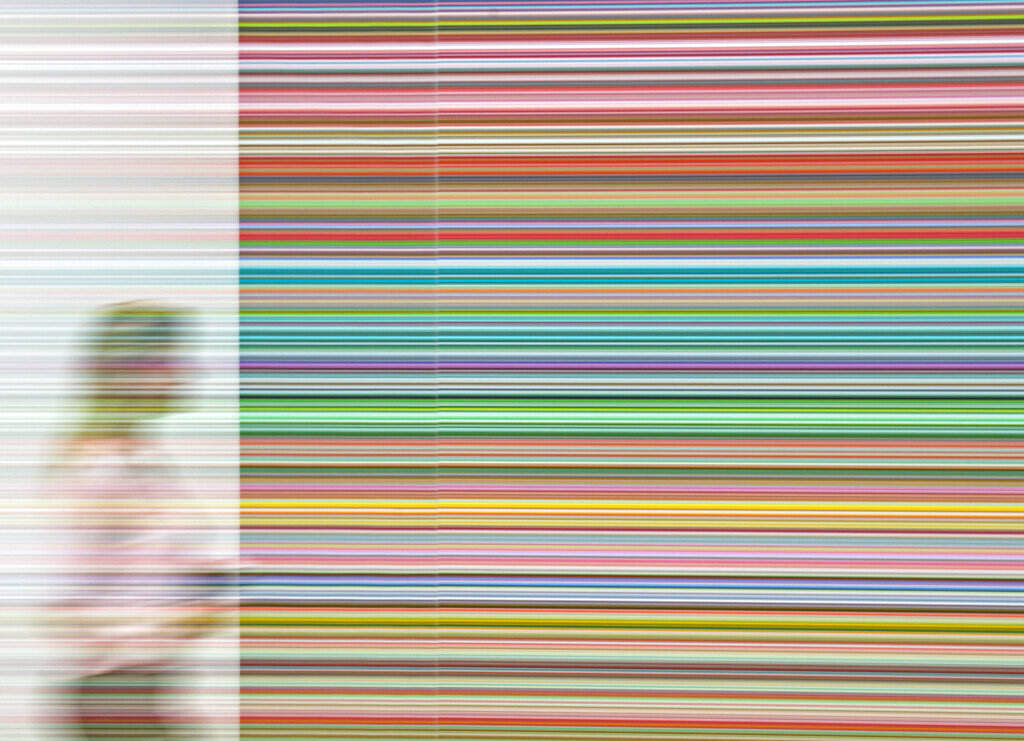
Color can affect our mood, memory and relationship to people and places. How is color being used to design the world around us and shape our feelings?
Guests
Olivia Kuzio, lead technical Imaging Specialist at the Getty Museum in Los Angeles. She has a Ph.D. in color science from the Rochester Institute of Technology.
Melanie McClintock, professor of Color, Materials and Design at the College for Creative Studies.
The version of our broadcast available at the top of this page and via podcast apps is a condensed version of the full show. You can listen to the full, unedited broadcast here:
Transcript
Part I
MEGHNA CHAKRABARTI: Pantone is a company that creates a widely used color coding system, and they announce an annual color of the year. For 2026, the color of the year is cloud dancer. The company described the color, full name Pantone 11-4201 Cloud Dancer in a video.
A billowy white imbued with a feeling of serenity. Cloud dancer demonstrates our desire for contentment and feelings of peace, unity, and cohesiveness.
CHAKRABARTI: If you're a little confused, more simply, for the first time in the company's entire history of choosing a color of the year, this year, it's white or a version of white. Cue the online hecklers who did not appear to feel serene or peaceful about the announcement.
It feels dystopian.
Is the song of the year silence?
Neutrals can be elegant, subtle, but today, honestly, I'm so disappointed.
CHAKRABARTI: Color of the Year is part of a very big business. Pantone's parent company Veralto has a market cap of almost $25 billion. It generated $5.2 billion in sales in 2024. And obviously Pantone's influence is major.
Pantone's colors have been used to perfect marketing, such as Gap's logo, or that ultra specific Barbie pink. Pantone's influence can be seen in the colors of your office walls, on runways each season. It's the preeminent color standard in almost all of design. The thing about those internet haters is that they are actually proving what Pantone already knows. Like a color or hate a color, you are experiencing an emotional reaction to it, and that is the point.
Colors have always been and have always had the power to influence our moods, our memories, how we see the world. Look way back in time. There are 45,000 year old cave paintings in Indonesia that depict wild pigs and human hands outlined in crimson and shaded in a dark maroon.
Two different colors there. There are 35,000-year-old French cave paintings that show horses, stags and rhinos rendered in red, black and yellow. And of course, those cave paintings are remarkable for the delicacy of the art made by prehistoric hands, but they're also amazing for their color choice. In more modern times, we have things like International Klein Blue invented and patented by Artist Yves Klein in 1960.
In 2014, Ben Jensen and his team at Surrey Nanosystems invented Vanta Black. The World's blackest black. It absorbs almost all of the light that hits it.
But color is of course about more than art history or just technology. As I said before, it is about us and how we understand the world. It's in everything from capturing nature's beauty to oppressing entire groups.
Think of the Scarlet Letter. Or the yellow Star of David. Color is also in pop culture. Paint it Black, Rhapsody and Blue, Little Red Corvette. I'm sure you can think of other songs with color in their names. And it's also this stuff, of course, of everyday wonder. We asked some of our own On Point listeners about this and here's Cy Madrone from Santa Barbara, California.
CY MADRONE: When I encounter the color blue/periwinkle, I feel the glad emotion, bordering on exhilaration.
CHAKRABARTI: And then there's Sarah Robinson from Charlottesville who bought herself a Volkswagen Beetle with a distinctive color from a few years ago.
SARAH ROBINSON: A couple of years ago, I bought myself a 2019 VW Beetle Convertible, Red. It's called Tornado Red, and I consider it my late life crisis car.
I love that car and everybody who sees it just smiles big. And so that affected my perception at least of my local world, in that everybody smiled and was happy when they saw that color.
CHAKRABARTI: And here's John Zack from Hawaii, who's been traveling to Guatemala a lot recently.
JOHN ZACK: The textiles made by the Mayan weavers are absolutely fabulous.
The combinations of colors, the textures, they just put me into such a euphoric state. But then I love monochrome as well. Just simple black and white, and that puts me into more of a meditative state. Color just makes me happy.
CHAKRABARTI: This hour, mood manipulation and color science. Joining me now is Olivia Kuzio.
She's a color scientist and lead technical imaging specialist at the Getty Museum in Los Angeles. Olivia, welcome to On Point.
OLIVIA KUZIO: Hi, Meghna. Thanks for having me.
CHAKRABARTI: Okay, cloud dancer. Love it. Hate it. Something in between.
KUZIO: Something in between. It's not a bold choice. We'll say that.
CHAKRABARTI: Why? But why does that matter?
I'm going to just be transparent this hour. I'm here to stand up for cloud dancer. Okay.
KUZIO: Oh you're a fan. Okay.
CHAKRABARTI: We'll get to my thinking about it in a second, but we're really here to listen to you. So why do you have a meh reaction to it?
KUZIO: It's not got any visual punch to it.
I just think that if we're going to say that this is the color of the year, let's give something ... vibrant, give them something really inspirational here to wrap out the year.
If we're going to say that this is the color of the year, let's give something ... vibrant, give them something really inspirational here to wrap out the year.
Olivia Kuzio
CHAKRABARTI: I see it as, first and foremost, it's a marketing exercise. Let's be clear about that.
KUZIO: Absolutely.
CHAKRABARTI: So I'm not going to give Pantone more credit than it deserves for what is essentially something about the bottom line at the end of the day. But on the other hand, when I first saw it, I was like, oh, you know what? This works for me because I feel like the world's so chaotic.
It's crazy. We're getting bombarded with news and like economic problems that the idea of being surrounded by a color that's supposed to, quote, provoke serenity, like really worked for me. And so that's my take on it. But it seems like more people are just thinking, no, this has no soul to it.
KUZIO: I do understand that, but to your point, yeah, color is such an emotional, evocative experience for us, and if it's evoking these things inside of you that you want to feel a sense of calm or a sense of peace, or literally, it's called cloud dancer to feel like you are dancing among some soft pillowy clouds, if that's comforting to you, based on everything else that you're experiencing in your busy life.
In the busy world, I don't think there's anything wrong with that either.
CHAKRABARTI: Yeah. Okay. So let me ask you, you've got a PhD in color science from the Rochester Institute of Technology, which I understand is, what, the only college or university in the country where you can get such a PhD is that.
KUZIO: It's the only U.S.-based institution where you could get an accredited degree in color sciences.
CHAKRABARTI: Got it. Okay. So that makes it like really a very important center of this kind of research and knowledge. In the process of getting your PhD there, Olivia, was there any or did you do any research into exactly why certain colors may provoke certain feelings in us?
KUZIO: We talk a lot about color perception. We talk a lot about human vision in color science, less so about the color psychology and color forecasting, color mood, that kind of thing.
My colleagues and I, the faculty who taught me there were really interested in color from material point of view in understanding how color is created, how materials out in the world interact with light, how we interpret that light in our visual system and engineering all of that, understanding how it's created so that we can harness the color science to better recreate color for your displays, better capture color in your cameras, better create, manufacture colors in your paints and coatings. So we're really on the scientific and material side of color.
CHAKRABARTI: Okay. So then walk me through the steps of what it would take to create a color honestly like cloud dancer because everyone thinks, oh, it's just white. How hard can that be? Oh gosh. But that actually makes it, that makes it even more interesting, right? Because I think it is probably pretty challenging.
So what would the steps be?
KUZIO: It's really challenging, honestly, white neutrals are really hard to dial in. So color isn't just one simple thing that happens to you out in the world. Color is an entire phenomenon. So color is created when light, visible radiation, strikes a surface, strikes an object, and interacts with the chemicals, the molecules in that surface.
The light gets modified by the chemistry that's happening in there and then bounces back and is detected by your eyes. And our eyes are very specific sensors. They detect light in a very specific way. And we actually, pointing to cloud dancer. We as humans are really, we have a really good achromatic visual system, so we're good at picking up small, tiny minute differences in blacks, grays, whites.
It's a way that we see visual detail in our world. So if there's like even a tiny hint of, for instance, blue in that cloud dancer recipe, or if there's a tiny bit of green, we'll be able to pick that up and you can see, think about a warmish gray versus a coolish gray, one that's got a little bit of red in it versus a little bit of blue, dialing in that recipe.
Pantone is a color specification system. We'll back up to that. So Pantone has very specific recipes that uses very specific inks and colorants when they want to make a specific color code. So cloud dancer has that code associated with it, and there are really specific amounts of really specific chromatic colorants that go into that paint bucket mixture.
Then to make the exact shade of that neutral cloud dancer.
CHAKRABARTI: How, so maybe we can get into more of the molecular level now then, because we'll talk about the effect of the light that's hitting the color, in this case specifically paint, we'll talk about that in a second. But what exactly is in the paint that influences the color we perceive?
KUZIO: Sure. So there are chemical elements in the paint, and when visible radiation strikes the atoms, the molecules in the paint, the electrons that are associated with those molecules get a little excited and they jump around. And there are electronic transitions happening in the molecules. That then the light that's bouncing out and is detected by our eyes has been affected by those little chemical excitations that are happening.
And it's those specific sort of fingerprint like chemical excitations that are specific to the chemistry of that molecule and the exact electron configuration in that molecule that affects the radiation and then the shape, the character of that radiation, is what our eyes detect as specific colors.
CHAKRABARTI: Okay. And are those molecules then designed by color scientists, or are you, are we still limited to what we can find in initial resources or places where the pigments actually come?
KUZIO: Absolutely. So that's something that I think a lot about in my own work at the Getty Museum. So ancient pigments, thinking about the cave paintings, right, in France. Ancient people would've been using found materials out in the environment, literally picking up rocks and stones that are colored.
Think about a red iron rock, right? And scraping that on a cave wall, that's got red molecules in it that are just found minerals. Whereas in the post-industrial age now, we've got synthetic materials that we're able to engineer exactly with the kind of handling properties, the color and properties, the vibrancy that we want to see in those materials.
Part II
CHAKRABARTI: I just want to share another reaction we had from an On Point listener.
This is Barbara Thomas in Westwood, Massachusetts, and she told us she's found a new relationship with color since she went into retirement. She says one color seems to speak specifically to that period of life.
BARBARA THOMAS: The color orange is there in the early rising of the sun, sunrise in the morning, and also the beautiful orange that can happen with the sunset.
In addition, orange is in between either moving towards red or moving towards yellow, so it is one of those transition colors that I feel completely reflects the point that I'm in my life right now, which is the transition called retirement.
CHAKRABARTI: Olivia, it's so interesting to me. We asked people to share with us colors and how they make them feel.
So yes, we were narrowing the pool of possible answers. But at the same time, I'm hard pressed to think of a conversation that included something about color that didn't eventually get back to emotional response, unless I'm speaking to someone like you who is a color scientist down to the molecular level.
It's really interesting to me, and I presume that's been true for all of human history. How does it actually, how does that truth about human beings and color make its way into the work that you're actually doing at a place as important as the Getty Museum?
Olivia, you there?
Okay we'll try to get Olivia back. Let's move now to Melanie McClintock. She's joining us from Detroit. She's a professor of color, materials and design at the College for Creative Studies. Professor McClintock, welcome to you.
MELANIE MCCLINTOCK: Thank you, Meghna. It's a pleasure to be here.
CHAKRABARTI: Okay. I'm going to start with you with the same question I asked Olivia, because I'm the defender of Cloud Dancer today.
But what ... was your reaction to it?
MCCLINTOCK: I was hoping I could respond to the last question, which was fantastic. I love that connection to transition of color, but I'm happy to talk about Cloud Dancer if you like.
CHAKRABARTI: We'll do both. How's that? First start with Cloud Dancer.
MCCLINTOCK: I think that I have a similar response as an educator and a designer to Olivia's that there are a lot of different ways in which to react to color. Color, obviously, context is everything. And looking at it as an opportunity for transformation, which I think was the intent, is definitely one way.
But we have to also understand that the way that we perceive color, understand color, even if color is seen or spoken, is based on our lived experiences and also our current state of mind. So how we react to that color in the moment is very personal.
The way that we perceive color, understand color ... is based on our lived experiences and also our current state of mind.
Melanie McClintock
CHAKRABARTI: Okay. So then back to that question I was asking, and we have Olivia back, we'll bring her into the conversation just a second.
But so this relationship between emotion and color and how it actually feeds into, specifically to your work Professor McClintock. Because that's what I was asking Olivia. So go ahead.
MCCLINTOCK: What was interesting about the answer of like, first of all, taking that time to be able to see color, having that opportunity to even, to be able to observe and appreciate color.
The fact that we're having this conversation about color obviously makes me very excited. But I think what was most interesting is that it's about nuance, right? So when we are looking at creating new colors or palettes, it is an exercise in nuance, and it involves going into those spaces between what are seen as standard hues, by manipulating value in chroma and intensity.
And from the perspective of a designer and an educator, it's less about understanding color and emotion. Memorizing meanings of color, like blue means sad or yellow means happy. And more about just learning that language of context.
Because we know it's not static, it changes. Its meaning is based on where it sits, what it's touching. And ultimately who it's looking at. Who's looking at it.
CHAKRABARTI: And that who's looking at it, is that the individuals are also highly influenced by the social context they're in, by culture.
MCCLINTOCK: Correct. Culture, it could be your upbringing, culture, upbringing, generation it's a biological language. It's something that is like deeply impressed, not just in our own personal experiences, but there's also more of a, like this process of emotion and memory and responding to how those colors, how we receive those colors.
Some of it, a specific color could immediately evoke such a powerful emotional state as it has with Pantone, reaching back into some memories that we might not even realize that it's tapping into.
CHAKRABARTI: Olivia Kuzio, I think we have you back, right?
KUZIO: Hi, I am here.
CHAKRABARTI: Sorry. Sorry about that technical glitch there. But what I was trying to get to when I asked that original question about how these issues of emotion and perception of color play back into the work that you're doing at the Getty, first of all, why don't you take a shot at that question?
KUZIO: Yeah. So artists have been harnessing color in interesting ways for as long as art has been being made, right? And it really is this visual, tactile phenomenon that kind of happens to you, you experience it. But then understanding the color science behind why that happens. So for instance, I was working on this project recently, one of our most beloved pieces at the Getty is Vincent Van Gogh's Irises.
And we had interesting questions around whether the paints in this painting are as they looked when Van Gogh painted it, or whether some of them have faded away. We really strongly suspected that, we had this suspicion because we knew that Van Gogh was so interested in harnessing color in an emotional, evocative way.
He was really paying attention to the color science that was coming out in his modern day. So at the end of the 19th century, there were color scientists who were writing about perception science. So what happens specifically when you juxtapose two complimentary colors next to each other, how they serve to enliven each other, enhance each other's vibrancy and make each other appear brighter in a painting, in a composition.
And he was really interested in using this effect called simultaneous contrast in his works. So when we were looking at this painting, we were realizing that those color balances were a little bit off. The irises as they look to us now are blue. The petals are a deep cobalt blue, and the background of the painting has these beautiful yellow splashes of other flowers painted in, where you would think if he's really interested in harnessing simultaneous contrast, the compliment of yellow is actually purple.
And as we know, just from lived experience, violets out in the world are purple. So why are the flowers in this painting blue? And that's how some of these questions around color come up in my work. How do we know based on how artists use color, how that tells a story about what an object might have lived through and how it might have changed and faded and degraded over time.
CHAKRABARTI: So how, for what the artist is trying to do, first of all, very interesting. And then also how the artist actually sees the world. Even down to a physical level, because please correct me if I'm wrong, but I remember hearing a story sometime about Monet's water lilies, I think. And how some of the paintings that he made during this time the colors seem a little off, or the impressionism is in part due to his own sight not being great at the time.
Am I making that up? Is that apocryphal? Olivia?
KUZIO: You're not making that up. Monet, he was a master of light. These impressionists were so fascinated to capture the effect of glittery, sparkly light. So water lilies, glittery, sparkly light on the surface of the water versus the more matte surface of the water lilies and really choosing pigments that have specific like pigment particle size to capture that glitter ... using pigments that have very specific tonality to them to capture the way that light interacts with materials out in the world.
CHAKRABARTI: Interesting. Professor McClintock talked, did you want to add to that?
MCCLINTOCK: Sure, yeah. Ultimately when we're looking at creating new color or palettes, we're looking at really breaking those boundaries, understanding color and evolution level, so you know, in the program, whenever we start the program, I like to start the semester with the kind of a deceptively simple exercise.
We ask students to pick their five absolute favorite colors. And then they put them, pin them to their wall and usually, it's an ice breaker, but it's actually a barometer. So that they understand what it means to know the difference, the nuance between colors and understand that within their preference and bias, and how these colors, in some way, end up in the decisions that they make.
CHAKRABARTI: If you were to do that exercise on yourself and pin your favorite colors to the wall, what would they be?
MCCLINTOCK: Ooh, that is a great question. I definitely know I lean toward the warm palettes, the reds, the oranges, one of my favorites.
I call electric salmon. So something between that red, yellow, pink and then of course balancing with something like a celadon. I like that tension that you get when you're with the complimentary colors.
CHAKRABARTI: And Olivia, just out of curiosity, same question to you.
KUZIO: I just have to say I love the color descriptor electric salmon. Color names are so awesome. If I had a second career, I would love to name colors.
I'm a nature person. I love being outdoors. I love being in the mountains around Los Angeles. I love green, all different shades of beautiful, vibrant greens, emerald greens leafy trees.
I also love, I live in the more arid part of Los Angeles, north of the city, the brown, deep, earthy tones. Yeah, that's really kind of my vibe.
CHAKRABARTI: Oh, interesting. Okay. So I keep coming back to my inability to separate our perception of color from the context McClintock, that you talked about. Both the sort of design context that particular color is in, but then the greater context of the cultures that we live in.
Professor McClintock, that also raises some ethical concerns about how color is used. Is that something that you talk about or teach with your students?
MCCLINTOCK: Absolutely. So this has become a much larger conversation. For many reasons, one, because we're moving away from this sort of material color. Is material pigment-based thinking into more the era of digital. And so there are colors that, you know, that frankly are very difficult to achieve in real life with real materials. And then also, there are concerns about how are these material colors being sourced?
How are the materials for these colors being sourced? I know Olivia, when you first mentioned something about white is simple, must be simple, but actually the extraction of what the material to make that color would not be. And so just being conscious of those decisions, understanding the impact of their choices in relationship to color, that's become a much larger conversation.
CHAKRABARTI: Olivia, you want to add to that?
KUZIO: Oh, I agree completely. Yeah. Simplicity probably shouldn't be extended beyond just my own, personal visual take of this color. Color is complicated. It's because it's so deeply ingrained in our world every day, I think it's easy to simplify it. It's easy to think that it, oh, it's just a thing that sort of happens to us.
But yeah, there are much more complicated things happening around resource extraction and those types of questions.
CHAKRABARTI: Olivia, can you tell me more about those complicated things? Are there specific examples that you have?
KUZIO: Oh, this probably isn't a topic I can speak to super well.
Okay. But thinking about the industrial consequences of the ways that we produce some of these chemical. Paints are chemicals, right? Thinking about the environmental impact of the way in which we're producing artist materials.
CHAKRABARTI: Olivia, you still there?
KUZIO: Yeah.
CHAKRABARTI: Okay. Okay. Sorry. Just wanted to be sure.
Okay. So I guess what I'm trying to understand is, or Professor McClintock, do you have some examples of, again, specific aspects of ethical concerns? Both of you mentioned resource extraction.
MCCLINTOCK: Right. That's one way to look at it. Another way to look at it is exactly what sort of spawned this conversation is that our addiction to trends and having the feeling as if we need to shift color palettes every season or every year. We talk a lot about legacy color, and are there colors that can transcend time and continue season after season. That's another way to look at ethical color. Of course, trying to make decisions that aren't using chemical versions of materials or chemicals to make materials for color is definitely another way. Let's just go back to white for a second.
It's like that extraction, looking at titanium dioxide, yeah. That there are other pigments that could be used to replace this, or other techniques that could be used to replace materials like this. So just being conscious of those decisions.
CHAKRABARTI: Okay. So Olivia, actually that takes my mind back to the irises that you were talking about. I don't know what kind of restoration, if any, the painting needs, but say you needed to actually create a color similar to the blue and the irises, how exact of a match could you make?
KUZIO: Oh my gosh. This is a really great question and something that we talk about all the time in conservation science. The thing about color is the materials, they reflect light. And just because something looks blue doesn't mean that it reflects light in the same way as another blue object. So you have to think about the way in which a blue object reflects all wavelengths of the visible spectrum.
Red wavelengths, orange, yellow, green, blue, purple the entire rainbow and different blues will reflect different wavelengths of visible light in different proportions. So that means when you have light in an environment striking the surface of an object. It could look different based on the color, temperature of the light.
So really, you've got to get a chemical match. In order to do really good conservation work.
Part III
CHAKRABARTI: Olivia, if you don't mind, I still want to learn a little bit more about the example of Van Gogh's Irises. Because before we talk about how you would actually chemically make a perfect match of that blue in that very famous painting, I suddenly thought during the break, actually.
What kind of blue would you want to match? Is it the blue that we're seeing now in the painting, or you talked earlier about how colors themselves change over time. Because the chemical configuration of the pigment changes over time. Would we want to match what it might have been when Van Gogh first painted it?
KUZIO: Yeah, great question. There are a couple different ways to answer that. So the first thing probably gets at the ethics of conservation and minimal intervention if at all possible. Because conservation is a field that recognizes that the science, the scientists who are supporting this kind of work, our tools and techniques and technologies are only going to get better, and we're probably going to be able to understand these materials better in the future.
The things, the interventions that happen now are all done extremely sparingly and in conversation with curators, with conservators, with scientists who are all at the table, talking about how best to take care of an object, with Van Gogh Irises, I should say, it's in really good condition.
Aside from this one thing that we have found, with the fading of the petals, it's in extremely good structural condition. The paint's great. It's not going anywhere. What one would do in this case, we want that painting to look really visually clean up on the wall. It doesn't need any kind of in painting, any kind of restoration, but at this point a conservator would go in really carefully and use a pigment that's really similar to the blue pigments that we know are present in the painting based on analyses that me and my team have done, that have identified on a chemical and molecular level, the colorants that are present.
And therefore, we know the exact materials, the exact pigments that are there. For example, those blue pedals contain a pigment called Cobalt blue. They contain a little bit of Prussian blue and also a little bit of Ultramarine blue.
So Van Gogh was this master of using different kinds of blue that have different ways that they interact with light, that give them slightly different tonalities and really evoke different kinds of shadows and different ways that light would've been hitting those petals in the garden when he was looking at these flowers.
So it's really imperative that conservators then take the analyses, the mapping of these chemical elements that we've provided them, and understand where Van Gogh distributed each of these different colorants so that they can go back in with the same or very similar, chemically similar paints that we have now, that they can match the chemistry down to a specific brushstroke or part of a brushstroke so that it wouldn't stand out in a gallery under the specific lighting that we've got in our galleries at the museum.
CHAKRABARTI: Professor McClintock, I promise to get back to you here, but there's just a couple more interesting questions that this hypothetical around Irises brings up. Because Olivia, as you were just describing, it suddenly occurred to me, we're not just talking blue that came out of the tube, right? When Van Gogh was first painting, because I presume if not him, then every other painter was also just mixing on their palettes.
Right? And so that's one of the things that makes, as you said, not even from brushstroke to brushstroke, but like even within the same brushstroke. You can have the spectrum of totally unique colors that probably never existed anywhere else because it's the distribution of the paint on the brush and also Van Gogh's own original desire of mixing this with that and that gets the color that I want.
KUZIO: Yeah, exactly. And Van Gogh, he was such a gestural painter, and we call his technique wet in wet. So he was doing this mixing of paints right on the pallet and swirling them together, and it's really an amazing, fascinating, beautiful world to look at this painting under a microscope and see up close and personal, down to the pigment particles of how these different colorants are all swirled together in the same like square millimeter of a paint stroke.
CHAKRABARTI: That's so interesting. So it makes the idea of conservation or like leaving the microscopic fill-ins, becomes infinitely more complex. And my final question about Irises, is that it's not just the pigment in the paint, it's what's the pigment is suspended in.
These things, I presume, also have an influence on the color that we see. And then that must also be true today. So when we're, again, hypothesizing about creating an exact molecular match, would we have to use the same sort of suspension compounds?
KUZIO: Yeah, so what would happen is a conservator would lay down what's called an isolation layer of varnish, so a clear coat of varnish on top of the original paint to isolate any kind of restoration paint that they would be using to make fills or small corrections.
And then, yeah. Based on, again, the analyses that us supporting scientists do, we understand the chemistry of the materials of the paint binder, is what you're getting at? Oh, yeah. So the media that the pigments are suspended in doing our best to match the media.
CHAKRABARTI: Okay. That's so interesting.
Professor McClintock, I don't know if you had anything to add to that before I get to more specific questions about what you teach your students.
MCCLINTOCK: Nothing specific. No.
CHAKRABARTI: Okay. Okay, good. Just wanted to check. But the theme that is merging to me from the example of Van Gogh is how, obviously, this is also true in design, how incredibly personal and perhaps even then sometimes unconscious decision making is in terms of how we use color. We've been talking about Pantone, which gives you a color number for standardization. But design is all about not creating things that are totally standard, right? And evoking some kind of feeling, emotion or response to it. So how do you teach your students about how to balance those things?
Because it's not just about what they think looks good, they're designing for someone or for some purpose.
MCCLINTOCK: That's definitely where we have the conversation about bias and perception. First, we understand that we are really looking at the material, materiality of color for blending pigments that find more sophisticated or off tones, that exists, that are beyond, excuse me, our understood colors. We're pushing into nuance. We're looking for something that may be more complex or a hybrid color that has more of a profound impact on our psyche, because this challenges our brain to not categorize.
So we're pushing. It helps us to push beyond those biases. Excuse me. Or preferences that we have, we know primary colors, signal or trigger bold reactions, happiness, danger.
With a more complex hue, we know that we can trigger more complex emotions, so that we really push students to look at larger ideas around nostalgia or calmness or futuristic tension. Some examples would be, looking at maybe neutrals. We call 'em liminal neutrals, they sit between a color and a neutral. Many know about greige, so this idea of gray and beige, and this can feel very organic, like stone.
It's warm, but it could also feel very architectural, like concrete, and it's cool. It just depends on its context. So we really push students to think about the emotional connection they want to make. Whether it's to a product, it's to an environment, or excuse me. Even an experience, to really define what those colors look like.
CHAKRABARTI: Interesting. Okay. Actually, since we're talking about students who are going to go into the world to become professional designers. Olivia, let me turn back to you, because I presume we've been talking about beautiful things because it's nice to talk about beautiful things, but really the business of color is so much bigger than that.
And I think, I'm sitting here in front of a computer screen and yes, I do have my phone next to me and I'm thinking that, so a lot of really investment, heavy color science right now is going into what we see on screens. Is that fair, Olivia?
KUZIO: Absolutely. We experience so much of our world through screens now and many of my colleagues who I studied with at the program at RIT, they have gone on to work in tech, to work in big tech, up in the Bay Area. And they're the folks who are engineering the actual hardware of your display screens. So your TVs, your monitors, your cell phones.
They're engineering the cameras in your cell phone to make it take really good pictures on the hardware side, but they're also folks who are involved algorithmically, programmatically on the software side, on the image processing side, on the how images are produced on your displays side to make images appear in a way that is nice to look at, pleasing to look at. So these folks have studied using a kind of science called psychophysics.
The kinds of images and the kinds of image manipulations. For example, boosting saturation or really making reds pop or greens pop. People like to see images like that. So harnessing that kind of information and making us really like to look at our screens.
CHAKRABARTI: And so that we can't put them down.
... Professor McClintock let turn to you on that. Because I totally hear what Olivia's saying that people are really drawn to now, I would say, what I believe are hyper saturated and overly vibrant default settings on phone cameras.
But it has come to the point, gosh, and maybe just because I'm a crotchety old, middle-aged woman, but I'm like, reality, this is not the scene I actually saw when I was taking the picture on my phone, it's actually crossed into a place where everything is the modern version of Technicolor. It's too bright. I don't, you can feel free to push back against that.
MCCLINTOCK: No, I fully agree. And I think it, again, it's like we've gone from that kind of pigment-based understanding of color to this pixel base, so it's like we have backlighting and we're seeing these colors that are really difficult to physically reproduce, and so these expectations that we're having of color are very unrealistic. This kind of cyber line or electric magenta or the ... neons, they vibrate on the screen.
But translating those into real life is, if not impossible, very difficult. Recently had a student doing a thesis on this topic of how our addiction to AI has changed our perception of our expectations on color. And it's definitely having an effect.
We're expecting more iridescence and holographic, glowing.
CHAKRABARTI: And it's all because of business, right? Not because it's actually making our lives richer through the use of color. So in the last few minutes that we have, I want to to turn back to the more positive ways in which color enriches, I'm using that word a lot.
But it's the only one I can really think of in terms of how color enhances not just our perception of the world, but how we feel about our place in it. And the best example we received came from On Point listener Glenn Freeman, who lives in Mount Vernon, Iowa, and he told us that his most striking experience with color occurred while taking a final trip with his wife.
Because after she passed away, he took her ashes to a favorite Florida beach and placed them right at the tide line in the late afternoon. And Glenn told us that it was there where he tried to say goodbye.
GLENN FREEMAN: I was asking her to forgive me for things that I didn't do well when she was sick.
And right at that moment, I should say that we are both intense birders. Right at that moment, a flock of sanderlings flew right in front of me with their very white chests, and the sun was behind me, and it hit, and they're flying in a perfect geometric pattern.
And the sun behind me hit those white chests, and for this was only for seconds, but it flashed a color I've never seen before. And I can't find, it was a brilliant, the best I can say is a green gold, but I really, I cannot find the color. Nothing quite like it at all. And so it was only for seconds. But it was the most profound color and experience of color I have ever seen.
CHAKRABARTI: That's Glenn Freeman who listens to On Point in Mount Vernon, Iowa.
Olivia, I'm just curious what that made you feel or think.
KUZIO: That was extremely powerful. I got chills. What a powerful image to share. And just the way that Glenn described it, I can picture the moment and the beauty of that moment. And what I will say is color is an experience that happens to us in our brain.
And we detect that, detect color with our eyes. And really your retina is the first part of your brain. The retinal cells are really an extension of your brain. So this is powerful cognitive memory, tied emotion, tied experience that Glenn was experiencing on that beach that day.
And it's very real.
CHAKRABARTI: Yeah. Professor McClintock, I'll give you the final word today.
MCCLINTOCK: Oh, very heavy after that. Speaking of an emotional experience, I had to mute myself. Beautiful. When we're talking about color and emotion, it really is something that we understand from our lived experience.
And so everyone has an opinion, everyone has a feeling about color. I'll just add that there is no good or bad color. All colors are valid. And it really is just from our own perspective.
The first draft of this transcript was created by Descript, an AI transcription tool. An On Point producer then thoroughly reviewed, corrected, and reformatted the transcript before publication. The use of this AI tool creates the capacity to provide these transcripts.
This program aired on December 18, 2025.