Support WBUR
Why giving can feel so good
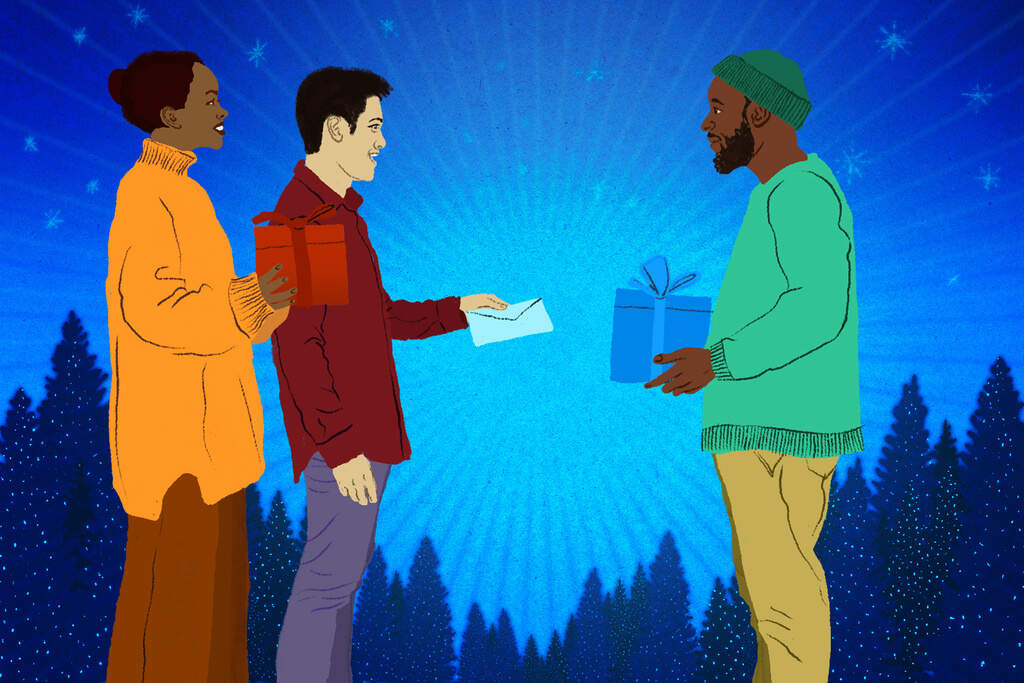
The holidays are all about giving, whether it's presents, donations or volunteer work. What's causing the warm glow you feel when you give someone a gift?
Guests
Jamil Zaki, professor of psychology at Stanford University. Director of the Stanford Social Neuroscience Lab.
Monica Whitham, associate professor of sociology at Oklahoma State University.
The version of our broadcast available at the top of this page and via podcast apps is a condensed version of the full show. You can listen to the full, unedited broadcast here:
Part I
MEGHNA CHAKRABARTI: How do you feel when you give someone a gift? Is it a jittery anticipation? Is it that familiar, warm feeling, or are you overwhelmed with the fear of rejection or the weight of obligation? This time of year, many Americans are shopping for loved ones, volunteering in their communities and donating to their favorite charities because it is the season after all.
NICOLE: I absolutely love gift giving. It's a fun challenge for me to think about the recipient and figure out creatively what it is that they're really going to want or need or love. It gives me that warm glow when I see them open the gift, and I can just tell on their face that, yeah, I got it right. Even better a year from now if I see them using the thing that I got them; I get that warm feeling all over again.
CHAKRABARTI: That's On Point listener Nicole from Franklin, Massachusetts and the warm glow she's experiencing is real. Studies show you do have a physiological response when you are giving, and this response isn't limited to just material gift giving. It also happens when you give a helping hand, except then it's called the helper's high.
You can also get that feeling when you make a donation, something that On Point listener Michael from the Twin Cities experiences.
MICHAEL: I actually sponsor a child through Compassionate International. It's a ministry thing, but just being able to support with a monthly amount this child's life that I would never have otherwise known is really, truly amazing.
It is almost intangible, the energy and the love that returns to me just through his little letters. So not really about religion, it's just about love.
CHAKRABARTI: So what exactly is going on in our brains and bodies when we feel that warm glow or the helper's high? Does generosity even have a purpose in modern society where almost everything can at least feel transactional?
So today we're looking at why giving feels so good, and I'm really pleased to welcome back Jamil Zaki. He is a professor of psychology at Stanford University and the director of the Stanford Social Neuroscience Lab, where he and his colleagues study social connections. Professor Zaki, welcome back to On Point.
JAMIL ZAKI: Hi Meghna. It's great to be here.
CHAKRABARTI: We tend to have you on whenever we all need a pick me up about the fundamental goodness of human beings. So tell me, let's start just quite quickly, not quickly, but in depth, with what exactly is happening in our brains when we are doing an act of generosity.
ZAKI: So there's an old stereotype in science, and I think in our culture that really selfishness is what we want and doing for others is what we should do. It's what we ought to do. It's that being selfish is like psychological chocolate and giving to others is like psychological broccoli.
It's good for you, but maybe not exactly what you want. But it turns out that research shows, it tells a quite different story. In our lab, for instance, we've scanned people's brains while they make decisions to either take money for themselves or give to others. And we find that the very same parts of the brain are activated by both.
And those are also the same parts of the brain that are activated by rewards like food, beautiful paintings, you name it.
CHAKRABARTI: Okay. So I'm going to jump in here because we have the time to really go into granular detail. And I'd love to do that. So take me into the lab. When you bring one of your test subjects in, what do you do?
How do you perform the analysis on them?
ZAKI: We will bring, we'll bring two people into the lab, actually strangers, and we'll put one of them in an MRI scanner where we can look at the activity in their brain over time. And then the other person will be sitting outside and then we have the person in the scanner make real choices.
Do you want to give an amount of money to this stranger who you just met? Or do you want to take it for yourself? And we find that people, first of all, are quite generous. They make choices to both take for themselves and give to others. They could hoard all of the money for themselves, but they don't. We further find that when people give to others, they activate the very same parts of their brain as when they receive. And the same parts of their brain as when they receive other types of rewards like water when you're thirsty.
CHAKRABARTI: Okay. So what parts of the brain are, do you see light up in MRI?
ZAKI: One is called the ventromedial prefrontal cortex. And then in other research similar effects in a part of the brain called the nucleus accumbens. These are regions that process dopamine and they're thought of as really reward centers in the brain.
So one way of thinking about it is that really giving to others is less, at least at the level of the brain, like broccoli. And more like chocolate. No shade to broccoli, by the way. I happen to like it, but stereotypically.
CHAKRABARTI: Okay, so this is really interesting. So now, I want to peel back more layers here.
Does the neurological response vary depending on how much money you're asking the person they would give away. If you say I'm giving you $1,000, you get a certain response, versus if you had $10,000, you get a different response.
ZAKI: It does. And in our study, we don't go, the amounts don't vary that much, but we do see that the more money that you give to people, the more rewarding that it is, both for self and for other.
The more money that you give to people, the more rewarding that it is, both for self and for other.
Jamil Zaki
CHAKRABARTI: Okay. I'm going to suggest that your next experiment include variations in the amount of money. Because I really would be curious about that. The other thing I wanted to know is after the experiment, and you've done the MRI, so you have the brain imaging. Do you ask the person who was in the MRI, how did they feel?
Because I wonder how that brain activity translates into a person's actual emotional experience.
ZAKI: Yes, so we do, and we find that people feel, report feeling positively both when they take for themselves and when they give to others. We also find, I should say, that the amount of reward in your brain when you give to others tracks how generous you are as an individual.
... Some people in our study were more generous than others. They gave more to the other person. Other people took more for themselves, and we found that we could predict how generous an individual was by how rewarding it appeared at the level of their brain when they gave to somebody else.
CHAKRABARTI: Oh, okay. So some people like really like chocolate.
ZAKI: Yes. Yes. And giving is chocolatier to some than to others.
CHAKRABARTI: Interesting. Okay. And so how did you measure how generous they were in regular life?
ZAKI: Oh, we measured how generous they were in the lab.
CHAKRABARTI: Oh, in the lab. Okay.
ZAKI: But I should say there are studies that find correlations between this sort of reward in the brain when you give, and how much, for instance, people donate to charity in their day-to-day lives.
CHAKRABARTI: Okay. That's so interesting. So just so I have the picture clear in my head. Let's just hypothesize that you gave, you said, okay, you have $10. How much would you give, I think, critically to this person that you do not know, right? And so if someone said $5, they had a particular brain response. But if they said, oh, I'd give it all away, you have even higher levels of activity in those same parts of the brain.
ZAKI: That's right.
CHAKRABARTI: Okay. Okay. What do you think is the significance of the fact that, as you said a little bit earlier, it's the same parts of the brain, the same pathways that are excited as when we receive something? Because, to me, those actually seem like almost two different actions that are producing the same neural response, which is really interesting.
ZAKI: To me there's two ways to read data like this. I know you're talking about the term warm glow. That term was coined 35 years ago and it by an economist, and the idea was warm glow actually means that we are not very kind. It's impure because when we're giving, we're actually rewarding ourselves.
So it's not really giving. There was this whole lot of consternation about this idea when it was first raised, but I think that warm glow is really beautiful. I think that the idea that the same parts of our brain are active when we give and receive, actually show how interdependent we are as a species, how we are connected at such a deep and physiological level that when I do for you, that reward comes right back to me.
CHAKRABARTI: All due respect to the economists out there, but there's a reason why they call it the dismal science. I swear.
ZAKI: (LAUGHS) No comment. No comment.
CHAKRABARTI: I am not throwing shade on all economists. We have many fabulous economists on this show. Discussing why the presumption has to be that being generous is a sort of emotionally neutral or should be an emotionally neutral experience is for another day. But tell me more, because this is the thing that I'm really interested in. Is, I guess I want to say, is so what if it feels good, right?
Even better that it does, because that promotes more of the kind of generosity that, if I can dip into evolutionary biology, I would presume is essential for pro-social species like human beings.
ZAKI: That's such a great point. If you wanted to design an animal that worked well together, what design features would you want it to have?
One is that you would want it to have this level of interconnection where it shared rewards and it pooled resources. So this is really, for me, one of the biological features that allows us to be this hyper cooperative species. Despite what you read in the news, we are by far world champions of kindness compared to other animals. We help strangers halfway around the world. We make decisions to help future generations who don't even exist. And it's hard to imagine that type of positive behavior, absent some deep sense of connection, between us at a biological level.
CHAKRABARTI: I do want you to provide me with the data or evidence that human beings are the kindest species in the world.
ZAKI: I think that for me it's the idea that we are generous not only towards fellow human beings who are right in the room with us, but that our generosity extends. What you might call the diameter of our moral circle extends far beyond people in our own communities, people right in front of us.
I think it's hard to imagine another species acting at that level of generosity and there's no evidence that they do.
CHAKRABARTI: Okay. That makes sense. Because I was going to debate you on human generosity within like kinship groups or physical social communities versus other animals, but the at a distance part makes a lot of sense.
Okay. So what do you think is driving all of this? Because there's been a pattern every time we've had you come on Professor Zaki, that, like, empathy is the thing that provides us the pathway to connect to others, which then, does that facilitate being generous?
ZAKI: Yes. And you have clocked me exactly. This is straight out of central casting for me. But yes I think empathy and I don't just think empathy is a mechanism here. There's a bunch of evidence that it is. In my lab, we've studied people over two weeks. And we've asked them how many kind actions they performed, and how much empathic connection they felt towards the person they were being kind to.
And we find that helping others raises our happiness and wellbeing only when we have that sense of empathic connection, when we feel care and concern for their wellbeing. If you act out of obligation, not as helpful to yourself.
Part II
CHAKRABARTI: I just want to share some more listener reflections on generosity. This is Nicole from Franklin, Massachusetts. And she says, the challenge and satisfaction of finding the right gift applies even when she's shopping for strangers.
NICOLE: Early on in my marriage, it was difficult for me to go through Christmas and not have children to dote on.
So what I started to do was sponsor families through charities at Christmas. There's one in particular that I sponsor all the time, and it's something I look forward to every year. Where I get a family of approximately four children, I learn all of their wants and their needs and their interests.
So I put together a set of gifts for them that I'm hoping that they love, and it gives me a lot of satisfaction to do this. And a lot of good feeling that I'm going to make their Christmas morning enjoyable and fun.
CHAKRABARTI: And Nicole told us that while she still loves donating and sponsors a family in need every Christmas, she finds that being one step removed from the gifting process doesn't hit with quite the same warm glow.
NICOLE: What I found is I don't have that warm feeling when I give this way, because if only I could be a fly on the wall. And see that reaction on their faces, that would make it all the better.
CHAKRABARTI: So Professor Zaki, a little earlier we were talking about how human beings are actually quite distinct in our ability to be kind and generous to people far away who we don't know and will never see.
But what's your response there to Nicole reporting that it's not the same kind of warm glow.
ZAKI: I think both can be true. So warm glow from the research perspective has two main sources. One is that when we act kindly, we are acting in a way that is consistent with who we want to be with our best selves, with our values.
And the second is that when we act kindly towards somebody who's right in front of us, we get to see the effect of that kindness. And so those are two separate sources of warm glow. And when you give a gift to somebody that you're really connected with, who you feel a lot of empathy towards, and then you get to see their face light up, of course, you're getting both channels there.
When you act kindly at a distance, hopefully you still feel the warm glow of acting consistently with your values. But you don't get that same feedback. I think one of your other listeners was talking about how he sponsors a family and receives notes from them, and you see a lot of charities will try to generate feedback for givers to tap into that second type of warm glow.
But I think that your listeners' comments make perfect sense because she's just calling out the difference between one type of warm glow versus two.
CHAKRABARTI: Okay. Professor Zaki, stand by for just a second. Because I want to bring Monica Whitham ... into the conversation now. She is associate Professor of Sociology at Oklahoma State University.
Professor Whitham, welcome to On Point.
MONICA WHITHAM: Hello Meghna. I'm happy to be here talking with you today.
CHAKRABARTI: It's great to have you. So let's zoom out a little and take the sociologist perspective, your perspective. What is the function of generosity as you see it in broader society.
WHITHAM: Yeah, so I think Professor Zaki hit on some of these points as well, we are social beings. We crave connection, and so when we give to others, that is this positive social connection, this positive thing we're putting out into the world that connects us not only to the person we're giving to.
But also, in a larger sense, this broader social community, the social fabric of kindness and generosity I think. Which is the kind of world most of us want to live in.
CHAKRABARTI: Okay. So are there different, I'm sorry to say this, but I keep coming up with reasons why people aren't generous sometimes.
We are social beings. We crave connection, and so when we give to others, that is this positive social connection.
Monica Whitham
So let's go through a couple of examples. Okay. First of all, what if you feel compelled, right? Obliged that you feel like you owe someone something and so therefore you give them something, whether it's time, a material thing, whatever, in return. Professor Whitham, let me stick with you.
Does that have the same function?
WHITHAM: I think it can, I think when you do something positive for someone else, even if you maybe feel a little bit obligated, you can still get, perhaps, that warm glow. It might not be quite as valuable. I think some of that speaks to the idea of who we want to be, right?
So if you imagine yourself as this generous, kind person who goes out and picks out the best gifts that really match what this person wants. And you do that, you feel like this capable contributor to society, you've met this person's needs, you've made them happy. But if you imagine yourself as less generous or just obliged to do something, but you're going to do it anyway.
So it feels like this burden. If you then go and give in this way that feels burdensome, you're going to feel that your identity is being verified in that moment. You feel like, okay, this fits with who I imagine myself to be. So I think that kind of gets to this selfishness that you're still stuck on this idea of, do you see yourself as a selfish person and then you go out and you behave selfishly?
That can potentially also feel good, right? Because it matches who you think you are.
CHAKRABARTI: Okay. Interesting. Professor Zaki, I'd love to hear you on this.
ZAKI: I think Professor Whitham is exactly right and this is what we find as well. Interestingly, we find in our own research that people's sense that they're connected to the person that they're helping is pretty uncorrelated with how much they help. So it seems like people are actually helping a lot of times because they feel obliged. And we do find that the benefits of helping when you feel obliged and not connected to the person are near zero. So really the sense that you're doing something because it's who you are and because you're connected with this other person, that's what matters.
That's the psychological fuel for the warm glow.
CHAKRABARTI: Oh, interesting. So it's definite, it sounds like it's not a one-to-one correlate. Let me rephrase that, that it's not the same thing when you feel extrinsically motivated to give, like that sense of obligation, versus the intrinsic motivation to give Professor Zaki --
ZAKI: That's a great way of putting it.
Yes. I don't want to say that it's zeroed out completely, warm glow. I think that giving can be its own reward in lots of different contexts, but generally speaking, you will have a lot more warm glow, a much stronger response if you are doing it out of care versus obligation.
CHAKRABARTI: Okay, so Professor Whitham then, I'm also wondering what we know or have research has discovered are people's motivations for wanting to give. Because not everyone's a saint, to be honest.
WHITHAM: Unfortunately. Yeah. So I think we really want to feel connected to others. And so I think when we get that opportunity to do that and enact the sense of, I'm a giver. I want to be kind, that feels really good. I think it's also a sense of accomplishment.
So if I can give something to someone else or help them out in some way, that reminds me that I'm this capable contributor, I can do good things for people that are really meaningful and matter to them, and then that matters to me as well. It's this sense of connection to the world.
I think in today's epidemic of loneliness that we've all heard about, when we instead get this chance to connect with someone, to give someone, even just like in a fleeting, helping out a stranger or doing something kind for someone we don't know, it's that moment of connection that I think people really need in their lives.
CHAKRABARTI: And then also do you find that for that moment of connection to truly happen, that the person on the receiving end also has to be willing, perhaps even happily receive that act of giving from another person.
WHITHAM: Yeah, I think that's so important, this idea of, yeah, we all want to be givers, or many people want to be givers, I guess not all of us, we want to do nice things for people, but they have to be receptive to that.
So if you want to help someone out, but they're shutting you down or not appreciating it, or even potentially when you give to someone, if they perceive it as charity, that can be really off-putting. So I think people often, need to open themselves up both ways, right?
So open yourself up to being kind to others, but also open yourself up to having people help you out and do something kind for you.
So open yourself up to being kind to others, but also open yourself up to having people help you out and do something kind for you.
Monica Whitham
CHAKRABARTI: Okay, so Professor Zaki, I'd love to hear you on this too. Because this was a point of significant conversation in our editorial meetings. Because we could all think of moments where maybe we're giving something a time, service or especially a gift to someone, and there's like kind of this like cringey feeling where you're on the precipice of being rejected or seeing the person who you're giving the gift to look at you and go, That's nice. (LAUGHS)
Look, I think, does fear, I'm thinking of rate limiting steps in terms of spreading acts of generosity. And I do wonder if fear of rejection is one of them.
ZAKI: Absolutely. Again, I think Professor Whitham is right on point. And I think there's two things to say here.
One, yes, that fear that our gift will fall flat, that our generosity will be cringe. It causes hesitation. It stops people from wanting to try it out. But there's a bunch of research actually from Nick Epley and others that finds that actually we far overestimate the risk that our gifts will fall flat, that our kindness will fall flat.
People imagine that their acts of generosity will lead to much more awkwardness than they really do, and they underestimate how happy the other person will be. And this, by the way, not just for material gifts, also for giving compliments, for expressing gratitude, for trying to help somebody with your time.
So I think that oftentimes we overestimate that risk. And then the second thing I'll say is that we talk a lot about being good gift givers, but we should all, again, just building on what Professor Whitham was saying, focus on being good receivers. When you allow people to help you, when you ask for their help, when you appreciate and show gratitude for their help, you are actually helping them by strengthening their warm glow and helping them be the best version of themselves.
So when we ask for help, we should say, you're welcome for giving you the chance to help me.
CHAKRABARTI: For all those stingy parents out there, when your children give you gifts, do not respond with why did you spend so much money? But Professor Whitham, this makes me wonder, I don't think I've asked this question. If I had, I still want to hear both of you answer it.
Is there, do you think there's a difference between material gift giving and the giving of time, service, compliments, attention, just non-material forms of generosity. I want to actually think that there is, but I'm going to trust you guys to correct me if there isn't. Because if so much of what we benefit from while giving has to do with the profundity, both neurological and societal of that social interaction, it would make sense that giving yourself rather than giving a thing would be a more positive experience.
WHITHAM: Yes, I agree with you, Meghna. Absolutely. So stuff is easy to give, right? We can order gifts online in the middle of the night if that's what we choose to do. But showing up and helping someone out and connecting with them in that moment is so much more powerful in a lot of ways.
It can, it leads to that connection. It gives them a chance to express their generosity. It gives you a chance to see their face light up. And having this interaction and this time spent together can be so positive. And I think it also matters what people want. So some people want gifts, but a lot of other people in your life probably want to just maybe spend some time with you. Or do something together that might be so much more powerful and more memorable than some sweater that they got Christmas morning.
CHAKRABARTI: Professor Zaki, your take on that.
ZAKI: I totally agree. My daughter was just asking me what I wanted for the holidays. And I said, I really just want to spend time with you. So if you figure out something that we can do together, that's great. And the research, I think here, it drives home the same point. Because if you give of yourself, if you give time, or if you give somebody a shared experience with you, taking them to a basketball game or a concert, you're really winning twice. One, you're winning through the warm glow of having acted kindly, doing something for that other person.
Two, as Professor Whitham said, we live in a connection starved moment in our history, in our culture, and so when you give somebody the gift of time, you also give both of you the gift of connection, of time spent together, which is sadly rarer than before and still a very precious resource.
CHAKRABARTI: I love the idea of asking the person to come up with something to do together, right?
Because then that's giving them the opportunity to be an active gift giver rather than saying, sure, I'll spend time with you. I love that idea. That is so cool. Okay, so now I'm thinking about the fact that hearing both of you, there's this sense that giving does not have to be a happiness neutral act.
Right? That we will feel good. There are literally physiological reasons why we feel good. So should we be redefining our notions of what altruism is, right? Because the presumption of generosity, if it equals altruism, is that you're not supposed to get anything out of it. So I wonder is a better definition for altruism now, just putting this out there, is that an act for somebody else that may actually cost you something?
WHITHAM: ... Absolutely. I love your point. I think it's almost impossible not to get something out of giving, and so if your motivation is to give something and not get anything from it, that might even be impossible.
You're just, you're probably going to feel good, right? So I think if we think about altruism as giving maybe more than is expected then you might otherwise have given. Going above and beyond, you're probably still going to get some benefits of it, but that might be a better way to think about altruism.
You're going to get that warm glow whether you're seeking it or not.
CHAKRABARTI: Professor Zaki, go ahead.
ZAKI: This is so deep and philosophical. I think that if we want to define altruism as giving where you really get nothing out of it, it's actually very hard to locate any acts of altruism on Earth and I don't know that's a bad thing.
I think that it's really wonderful that we are built by evolution to care for one another, such that actually most of our, if not all of our acts of generosity, give something back to us because we are so deeply connected.
Part III
CHAKRABARTI: Here's one more On Point listener. This is Sarah in Maryland. She told us that even the smallest gestures of generosity give her that warm glow.
SARAH: Around this time of year, something I love to do is when I'm in a store, before I get to the checkout, I'll put a drink and a candy bar or a little plant in my cart, and after I check out, I say, this is for you, and I give it to the cashier, and the reaction that I get is always incredible. The person is always emotional and so grateful, and I get to say thank you and happy holidays and that I appreciate their work. And it's just a shared feeling of just joy that I get from giving.
CHAKRABARTI: That's such a wonderful story and a wonderful idea.
Professor Whitham, is even small acts of generosity like that enough to encourage the receiver to pay it forward, essentially.
WHITHAM: Yeah, and I think it's those small acts that people are likely to pay forward. They don't cost very much. They're easy, they're usually well received. And they do, research shows that these small acts of giving can cascade.
So the more we give within our community or our group, it creates this social fabric where folks are generous with one another. They're used to giving and receiving. It's comfortable, these norms of reciprocity foster these social connections that are characterized by trust, commitment to one another.
You like the other members of the community. And then that fosters even further giving, in a sort of virtuous circle. And this can cascade from one person to another. And it just feels good and it ties the community together. Of course, the opposite is also true. Weaker norms of reciprocity lead to weaker ties.
That can also feed into or onto itself. But these small acts of giving, if you can just get that cascade going, research shows that folks are likely to pay that forward.
CHAKRABARTI: Norms. Okay. I will definitely come back to that because that's really important. But now for this part of the conversation, Jamil and Monica, I do have this, I actually do have this like warm, lovely feeling about the potential of humanity, talking with both of you, but also the journalist in me cannot resist, like confronting the icy cold edge of reality of people as well.
And one of them is, I know a lot of people may see this anecdotally, but there is research behind the fact that especially when it comes to giving, it seems like the richer you get, the less generous you get. And we dug up a 2010 study from Berkeley that basically did this experiment or series of experiments with folks.
They first interviewed them to find out where that person thinks they are on the socioeconomic ladder. And then they did experiments to just measure how generous they are. And they absolutely found that people who are on the higher levels of the socioeconomic scale were less generous than people who had less money. And that that divide was actually pretty persistent. The people on the lower socioeconomic side of things, in fact, gave more when they were given imagery or conversation that was intended to evoke generosity. The people on the higher end did give a little bit more, but it wasn't in proportion to what they could have given.
Professor Zaki, why do we see that divide?
ZAKI: Okay. I want to be careful here because that finding, which is really famous, and I think a very strong set of studies has not been replicated every time. Okay. So there are mixed findings on the relationship between socioeconomic status and giving.
I certainly think the first study was strong, but there have been different findings since then.
CHAKRABARTI: Wait, but don't be afraid. Don't be afraid to continue this pushback because if it hasn't been replicated, then that's a significant sort of asterisk. What were the findings in the other studies that tried to replicate it?
ZAKI: Yeah so in essence, there have been a bunch of studies now. That first study inspired a lot of follow-up work, and in some cases, you do see higher SES, socioeconomic status tracking, lower levels of altruism. But in other studies, you do not see a relationship between socioeconomic status and altruism.
So from my perspective, the jury is out. We do not know yet whether that sort of depressing, I think you're alluding to a pretty depressing finding. If richer people give less, we don't know whether that's true or not.
CHAKRABARTI: Okay. Professor Whitham, did you have a thought on that?
WHITHAM: No, I agree with Professor Zaki. I think that it's not necessarily clear how or why these things tie together.
CHAKRABARTI: Okay, so I'm not giving up on my skepticism though.
ZAKI: (LAUGHS)
CHAKRABARTI: It's a way of fleshing out the complexity of human beings here. There's also a trend that a lot of people may have seen on social media, and it has to do with the Salvation Army's Angel Tree tradition.
And that's when they have Christmas trees out. And kids who are less fortunate can write down on a little ornament, a few Wishlist items. And the Salvation Army displays them on Christmas trees at partner stores, and shoppers can come in and pick out one of those ornaments and buy the present essentially.
And then donate it. And now it seems as if social media influencers are actually filming themselves doing these Angel Tree shopping halls.
(VIDEO PLAYS)
And we are going to do some Angel Trees. There isn't very many left on the tree, so I think that we are just going to grab them all. This one is stuck. Okay, I think this is the last one. The tree is empty.
CHAKRABARTI: Okay, so it's a wonderful potential act of generosity, but it's also very faddish and that has sparked some controversy as users are accusing each other, or excuse me, accusing other influencers of A, having the wrong motives, B, not spending enough money, and C, even faking their shopping videos altogether. So Professor Whitham, what's your first response to that?
WHITHAM: Oh, wow. I think if people are giving, even if they're doing it to post and talk about it, and get, I don't know, fame and rewards from it, they're still giving, which seems like a good thing. If they're faking it, that's terrible.
But I think, if you're doing it. If you're benefiting a child somewhere. I don't know, it's hard to necessarily see that as a bad thing. Starting a fad of giving. Yeah, that's my first take.
CHAKRABARTI: So Jamil Zaki, this gets back to where we started, right? With the presumption that it has to be a completely non-self-fulfilling kind of act as well.
ZAKI: That's right. And look, I think that people can differ on their opinions about whether we should be grandstanding in our giving. But I agree with Professor Whitham that an act of kindness towards somebody in need is an act of kindness towards somebody in need.
And I think that if, especially somebody who's influential does that, yes, they might be drawing attention to themselves, but they might also be drawing attention to an opportunity like this giving tree that folks didn't know about before.
CHAKRABARTI: Honestly, we can have that same perspective of when we think about million-dollar gifts to colleges and people put their names on the sides of buildings, right?
Like you might be like, Ugh, that's gross. But on the other hand, it is a major act of giving.
CHAKRABARTI: Okay, so here's another one and Professor Whitham really eager to hear you on this, and that is, are there different norms for giving, coming back to that word, in different societies?
Has it, are we capable of coming up with a system of measurement that says, culture X is actually more generous than culture Y?
WHITHAM: Yeah, I think you can measure that. I think if we think about just giving and the expectations of, if I give something good to someone else in my community, do I have a sense that will be paid back to me in some way?
Even if you're not like having this strict calculation of, oh, I'm going to do this because I'll get it back. But having this sense of, if I do something good, I'm going to receive good things. Other people are also doing good. And that's just what we do around here. I think that absolutely can be measured.
I've created those sort of scenarios in the lab where folks tend to give more or give less. Look at how that creates a sense of trust and appreciation and that sort of thing. But so I think we can measure that. I think it's important to think about how these norms play out and how they feed onto or feed into one another and potentially cascade as both a positive cascade of generosity and shared reciprocity.
Or cascade of I'm not going to be generous, because no one else is being generous. And that's not what we do around here and that's fine. So I think that can be measured and I think it's important to think about.
CHAKRABARTI: So you've used some phrases, which I'd love a little, to understand a little bit better, like generalized reciprocity. What exactly does that mean?
WHITHAM: Yeah, so that's just the sense of, so there's this idea of generalized exchange where if you're going to give to someone who's not going to be able to pay you back. So if you help out a stranger, if you donate a kidney, if you do something just that no one's really going to be able to directly pay you back. We talk about that as generalized giving or generalized exchange. But we nevertheless expect, typically, something in return, it's still an exchange, right? So we imagine, if I do this good thing, maybe when I'm in need something will flow back to me, or something will flow back to someone I care about.
So it's this sense of giving with this idea of, it creates this social fabric that you can then rely on if you need something, or even if you don't need something and somebody who just does something nice for you, it'll flow back to you.
CHAKRABARTI: But there's one more thing about that generalized reciprocity that you've written about Professor Whitham, which is, you've written about that there's a risk of it encouraging free riding, of some people never being generous because they're just like, why do I need to be right?
WHITHAM: Yeah, I think that's absolutely a risk. So some folks are just maybe not going to give, even if they're in the sort of group or community where that's the norm or expectation. And that can potentially disrupt the system. So if there's somebody who doesn't pay it forward, that can maybe prevent the next person from also having this general sense of, Oh, I need to pay it forward.
So that can be disruptive, but within certain kinds of groups and communities, that can actually be fairly well absorbed, if there's someone who kind of free rides or takes without giving. But for the most part, I think, people are a little bit hesitant to free ride when they're in this space of, people generally give, especially if there's some way to account for that with reputation.
So if people are going to know that you were the selfish one who took without giving, of course then people are less likely to behave in those ways.
CHAKRABARTI: Aha. Okay. So this leads me to a question I've been very eager to ask both of you. And Professor Zaki. Let me start with you, because when Professor Whitham first mentioned the idea of norms.
It got me thinking, how can we encourage a culture of greater generosity? How can we change the norms upward so that people are more likely to give? A, talking about how it does actually benefit you, I think works. But B, I'm wondering about the effects of not just technology, but also cultural leadership.
And to be specific, what I'm thinking about is right now in the White House, we have a president who is the opposite of generous, right? He's making money by virtue of being the president of the United States, much more than we've ever seen before. All of his actions are pretty much self-serving, from everything like tearing down the east wing of the White House for a 90,000 foot Gold Ballroom, to just recently the announcement that the Kennedy Center will now be named the Kennedy-Trump Center, to not that long ago the decision that his face is going to appear on annual passes for the National Park Service. I could go on and on. Does leadership like that create a new norm that is actually less generous?
CHAKRABARTI: I think Professor Whitham is exactly right that we do follow norms. And Meghna, you're right, that a lot of those norms come from leaders and very visible figures. I think in general, the U.S. is a very individualistic culture, and I'm afraid that we have learned pretty selfish norms that actually make it harder for us to thrive as individuals.
I'll give you an example. In lots of studies, people predict that they would be happier if they spend money on themselves, even though in actual fact, they're happier when they spend it on others. So I feel like there's a lot of voices, a lot of very loud, powerful voices, whether it's from politicians or influencers, telling us that the best way to succeed, quote-unquote, is to focus on ourselves instead of others.
And frankly, that's a misdirection. I think about these trends in focusing on self-care, which is really important. I'm not saying that there's anything wrong with self-care, but the idea that the best way to be there for yourself is to be alone in a bubble bath, eating bon bons, watching Ted Lasso.
There's nothing wrong with any of those activities, but that picture of wellness, that picture of success as an individual solo sport is just wrong, according to the research. And I worry that we're guiding ourselves into greater loneliness, into greater unhappiness through that path. So one interesting counter example is this season. People give more in December than in any other month.
Success as an individual solo sport is just wrong, according to the research. And I worry that we're guiding ourselves into greater loneliness, into greater unhappiness through that path.
Jamil Zaki
And I think a lot of us are happy when we do that. So one question is, can we move away from whatever cultural voices are telling us to be selfish and actually just pay attention to how we feel this month, and then try to take that with us into the rest of the year? Can we build norms that are more pro-social?
CHAKRABARTI: Wellness is not a solo sport. I love that. And it sounds like both of you are saying that even just small daily acts of giving can actually have a much larger effect on us as individuals. So what a wonderful way to actually end this conversation.
The first draft of this transcript was created by Descript, an AI transcription tool. An On Point producer then thoroughly reviewed, corrected, and reformatted the transcript before publication. The use of this AI tool creates the capacity to provide these transcripts.
This program aired on December 19, 2025.