Support WBUR
What's lost when churches close
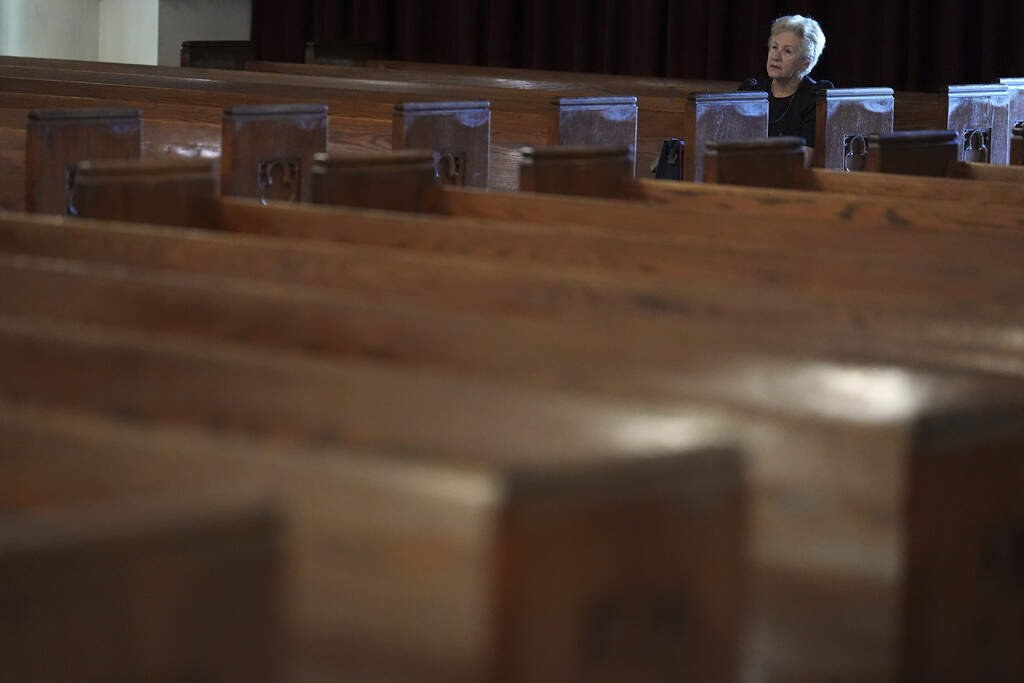
An estimated 15,000 churches in the U.S. are likely to close in the next few years. Churches are more than places of worship – they are community centers, shelters, food banks. What's the community impact with church closures on the rise?
Guests
Ryan Burge, professor of practice at the John C. Danforth Center on Religion and Politics at Washington University in St. Louis. His Substack newsletter Graphs about Religion focuses on the impact of religion on American life. Author and co-author of, among other books, The Nones: Where They Came From, Who They Are, and Where They Are Going and The Great Dechurching: Who’s Leaving, Why Are They Going, and What Will It Take to Bring Them Back?
Also Featured
Mandy Olson, former pastor for the Grace Covenant Church in Chicago, IL, which closed in 2022.
The version of our broadcast available at the top of this page and via podcast apps is a condensed version of the full show. You can listen to the full, unedited broadcast here:
Transcript
Part I
MANDY OLSON: Church is so much more than just a religious home for worship services. It’s part of the fabric of people's lives.
MEGHNA CHAKRABARTI: Mandy Olson is the former pastor of Grace Evangelical Covenant Church in Chicago, Illinois. It’s been a fixture of Chicago’s West Walker neighborhood since the early 1900s.
OLSON: It is a really unique, kind of transitional neighborhood is what I would say. The Old Irving neighborhood, southwest of us, had some wealthy pockets to it. Just north and northeast of the West Walker neighborhood is Albany Park. And Albany Park is one of the most diverse zip codes in the country, a lot of new immigrants that are coming in.
And West Walker sat kind of right between those two. We had people who were high school dropouts and people who had their PhDs and everything in between. And so it really was an eclectic mix of people.
CHAKRABARTI: People who sat side by side together in the pews every Sunday.
OLSON: I felt a kindred spirit with the congregants early on, even when my parents came to visit one time, they said to me, "You can just be yourself when you're here." And I think that that's true, and I think that that's true for other people.
CHAKRABARTI: But on August 28, 2022, Pastor Olson gave her very last sermon at Grace Evangelical Covenant Church.
OLSON: It was a key part of their rhythm and routine of each and every week, and all of a sudden, that piece is gone.
CHAKRABARTI: Gone because the church itself had to close its doors.
Grace Evangelical's closure is part of an increasing trend of church closures over the past several years. Estimates show that around 15,000 churches in the U.S. across denominations are expected to close in just the next few years. Dwindling attendance and financial strains make it very difficult for small local churches to stay open, and that was the case for Grace.
Here's Pastor Mandy Olson again.
OLSON: We were still at a membership of about 80, but the reality is, is that those people who were, and they were so committed, they continued to be so committed, but what it was going to require to keep the building open and the ministries going was just unrealistic.
CHAKRABARTI: In 2022, the church was sold to an Islamic school. Although it was the right decision to close the church, Pastor Mandy says the decision was not easy.
OLSON: It's a huge loss on so many levels. Obviously people have a spiritual home, a place where they have experienced God's comfort, God's presence. And there's a relational loss. This is a group of people who were brought together, you know, they did life together. They became friends. They shared tears together. They found a place where they could participate in a community and serve other people.
It was devastating. The loss was tangible.
CHAKRABARTI: But Grace was much more than just a religious place.
OLSON: We had a pretty core group of people who would never come to Sunday service, but were there nearly every Saturday for our food pantry. And that became a place of community and connection for people in the neighborhood, especially people that needed services, people that needed assistance, where, you know, we were a nice place, a safe place.
So people would line up outside two hours before our doors opened on a cold Chicago winter for food. And I wonder about those people. I worry about those people.
CHAKRABARTI: Besides the weekly food pantry. Grace also had a second congregation held in their very church.
OLSON: We served a large Hispanic community. We had a sister church in the building that was also a Spanish language church that did a lot of good ministry and was a point of contact for Spanish language neighbors. And yeah, that's gone, too.
CHAKRABARTI: So through all of these programs in its 100-plus year history, Grace became woven into the community.
OLSON: It is very hard for me to go by the church. I've actually only done it twice in the last three years. It's painful. It makes me sad. I have fond memories, which make me smile, but also a lot of regrets and disappointments. Makes me think of people that I was connected to that I don't see anymore.
CHAKRABARTI: So that grief isn't just personal. Pastor Mandy says it's across the entire neighborhood.
OLSON: When our neighborhood library burnt down, we stepped in and offered the building for folks to be able to come and vote. So there were just a lot of things we would have, you know, through the years. There were block parties and there were different, you know, gatherings and events where we did ice cream socials and stuff like that.
Those kind of things build community and build connection and introduce people to one another, that they make a community a little more known. And I think that that makes a community feel a little more safe and feel a little more part of something bigger than themselves.
CHAKRABARTI: Pastor Mandy knows more churches like hers will have to close in the future, and that hole, she says, is going to be very hard to fill wherever that closure happens.
OLSON: Whether those people be members who come in regularly and connect and pray and share life together, or whether it's a neighborhood spot of a place where someone who is cold can know that they can go in and be warmed. Or someone who is desperate and scared know that they can come and find safety and peace.
These places are integral to our communities. And at the same time, it's impossible to keep them all open. And it's a huge loss for a neighborhood. It's a huge loss for church members. I think it's gonna be a huge loss for our society.
CHAKRABARTI: Mandy Olson, former pastor at Grace Evangelical Covenant Church, which closed in 2022.
Well, joining us now to talk about what's driving these church closures is Ryan Burge. He's a professor of practice at the John C. Danforth Center on Religion and Politics at Washington University in St. Louis.
He has a Substack newsletter called Graphs About Religion, which focuses on the impact of religion on American life. And he's also the author of several books, including The Nones: Where They Came From, Who They Are, and Where They Are Going. It's about the rise of non-religious Americans. He joins us from Mount Vernon, Illinois.
Professor Burge, welcome to On Point.
RYAN BURGE: Thanks so much for having me.
CHAKRABARTI: Well, tell me, first of all, we've been hearing for many years about just the decline in overall church membership and in fact your book, The Nones, I imagine has a pretty strong connection to that. What is distinct about church closures from the decline in how many people are actually going to church?
BURGE: Yeah, so I mean, every church is its own unique thing, right? It's got its own culture, it's got its own history, it's got its own financial situation, membership situation. And obviously with the rise of the nones, the non-religious Americans, that's gonna put pressure on many, many churches.
But I think what people don't fully understand is the average church in America is not those churches you see on TV with 10,000 people or 20,000 people. The average church in America has about 70 people in worship on an average Sunday. So, small. And so if those 70 become 50 or 30, that just makes all the financial pressures, logistical pressures, organizing pressures that much harder.
And you know, if that's the median church you're talking about, you know, maybe 150,000, 200,000 churches in America are smaller than that. So even a a 20% drop in religiosity could really put some of those churches outta business.
CHAKRABARTI: Yeah. You know, I also wanna note that you're author of other books, you've been following this for quite some time.
One of them is The Great Dechurching: Who's Leaving, Why Are They Going and What Will It Take to Bring Them Back? And you have a book coming out next month called The Vanishing Church: How the Hollowing Out of Moderate Congregations is Hurting Democracy, Faith and Us.
I'm gonna touch on what you wrote in The Great Dechurching and what's coming up in The Vanishing Church throughout this hour, because these are all related, as you obviously know, Professor Burge. So first of all, just tell us like, what would you say are the most compelling factors that are driving the physical closures of especially these smaller local churches now?
BURGE: Yeah, it's this, you know, Robert Putnam wrote a book called Bowling Alone, you know, 25 years ago where he talked about people aren't joining the Elks and the Moose and the VFW and the American Legion and the Boy Scouts and the Girl Scouts and church.
I mean, church is a voluntary social organization. No one compels you — unless, well, some kids are compelled to go — but as adults, you know, we show up on our own volition. And people are just not hanging out, they're not being social. And every generation is significantly less social than the prior generation, especially amongst Generation Z. They're easily the least social generation we've ever seen in modern social science.
So, you know, church is, people have to show up in person. And when they don't show up, someone else has to carry the load. And all these things that people don't think about, you know, in running a church, things like the light bill and the insurance and the plumbing and cutting the grass. I mean, someone has to do all those things and you either have to pay someone to do it or someone in the church does it.
But if your congregation is small and aging, the number of able-bodied people who can do stuff like that decreases, which means you've gotta pay more people outside to do it, which means you have more budget pressure. So it's really this downward spiral that leads a lot of churches to close down.
CHAKRABARTI: And you're not getting that one-to-one replacement for every longtime church member who passes away with a new member or a younger member.
BURGE: And that's the even scarier part is I think a lot of churches are sort of gliding along thinking they're gonna be okay right now. But in many denominations, 45 or 50% of their adult members are Baby Boomers, which statistically speaking, those people are in their sixties and seventies and in 15 or 20 years, they're not gonna be here, or they're not gonna be able to come to church on a regular basis.
So who's gonna replace those people? The answer in a lot of those smaller churches is no one, and then the people left are gonna have to carry even more of this voluntary burden. And a lot of them don't wanna do that.
CHAKRABARTI: Hmm. You know, it's really interesting 'cause just last night I went to a candlelight and carol service at one of our local Episcopalian churches. My husband grew up with, you know, observing that every year. So we go to the candlelight and carol service.
And our teenager came along with us. She's done it for quite some time. And as we were filing out of the church, the pastor was shaking everyone's hand and he saw my teenager and really grabbed her and was like, was like, "So happy to see you here. Thank you very much." I mean, honestly, like his genuine gratitude that someone under the age of 50 seriously showed up was, it was quite striking to me.
BURGE: That's the, I call it the iron law of church growth. If you look around a congregation and you see a whole lot more gray hair than you see young couples, I mean, the end is near. Because how do you replace all those people that die off if you don't have, you know, young couples who are having children, and even for every child born in the church, that only offsets one death. So that's just keeping the boat level. I mean, these pressures, these demographic pressures are hard to fully understand and they're gonna hit us like a freight train the next 15 or 20 years.
Part II
CHAKRABARTI: Professor Burge, we talked about the first maybe most obvious issue, which was intergenerational changes in religious practice or religiosity in this country. But I imagine a lot of people are also looking at the other side of things and saying, well, we have all these megachurches in the country and they seem to be adding members at a clip and increasing in their power and reach. So, you know, how does that balance out with the closure of these smaller churches?
BURGE: It can to some extent. But the thing is, even those large churches, if there's a group, so a list called the Outreach 100 List, it's the fastest growing churches in America, many churches on that list add a thousand or 1,500 new members every year. Which sounds like a lot, but if you add all those churches together, that's a hundred thousand new members in a country of 345 million people. So, I mean, that barely tips the balance.
Think about how many, you know, older Americans are dying every single day in America. And again, to go back to that median church of 70 people, I mean, those churches are not adding, I mean, many of them are the same size they were 50 years ago, maybe even somewhat smaller than they were 50 years ago.
So those big churches tend to, you know, sort of suck up all the attention and all the resources and all the discourse. But the median church is the one that's sort of struggling. And what's gonna happen really in this whole ecosystem is mergers and acquisitions. I mean, these smaller churches are basically gonna be subsumed, not not, you know, organizationally, but it's gonna happen organically into these larger megachurches. And these megachurches are gonna get bigger and these smaller churches dotted throughout the landscape are gonna close down.
CHAKRABARTI: Mm. You know that number of 70 as the median congregation size, it does come as a surprise. Right? How long has it been that low?
BURGE: At least for the last 10 or 15 years. I mean, this is hard to track, obviously, because if you call pastors up, they're gonna, they're gonna be coy about how many they actually have on Sunday morning. But I mean, the reality is that most churches just aren't that big, have never been that big.
And we have over 350,000 houses of worship in America. So you start doing the math and you think about what that looks like, you can't have 5, 6, 700 person churches. And in most communities, you might have one church of over 500 people and then a whole bunch in that, you know, 50 to 75 range, which is, you know, the church I pastored, that's exactly where we were.
CHAKRABARTI: Mm. Okay. Now, there's been a great amount of news and coverage over the past many, many years about, say, sex scandals and or sexual abuse scandals, I should say, and how churches, I'm thinking, of course, particularly of the Catholic Church have ha have been kind of sent reeling financially because of, well, the failures to their flock and the financial penalties for all these sex abuse scandals.
But I wanna set those churches aside when we're talking about finances and just talk about, you know, these average, median-sized local churches. I mean, how expensive are they to run?
BURGE: So to give my church as an example, we had about a 14,000 square foot building that was built in the 1960s on about eight acres of property on a highway frontage. Really kind of good land set up, good building set up for the 1960s. At the end, our power bill was running about $1000 a month, and that was only being in the church probably 10 hours a week.
CHAKRABARTI: Oh, wow.
BURGE: Not even being there every day. The insurance, we actually got dropped from our insurance because we made a roof claim of $75,000, so we had to renegotiate new insurance. The premiums on that were $7,000 a a year, and they wouldn't even pay a roof claim for the first three years on that new policy.
So at one point we were spending somewhere between 40 and 50% of our budget just on the physical plant, just on the utilities. And God forbid the boiler goes out or you have a plumbing leak. Because we have no one to fix that.
So, I mean, these are, these buildings were built at a time when, you know, we didn't have modern conveniences, nothing's efficient. So the cost of maintaining these buildings rises every year. And there's deferred maintenance costs that continue to pile up, too. So many of the churches are just, the building's becoming more decrepit, more run-down every single year. And there's really nothing these people can do about it because there's just no money there.
CHAKRABARTI: And the money's typically supposed to come or comes from the congregants?
BURGE: In many cases, you know, a lot of these churches are running off endowment funds. You know, people who died 20, 30, 40 years ago, they're kind of taking off the interest, sometimes touching the principle of those endowment funds. And for many churches, that's actually what's sustaining in them right now because the actual giving would not keep the boat afloat because the money coming in does not match the money coming out. You have to dip into those reserve funds.
CHAKRABARTI: Okay. That's interesting. So you mentioned your church. This was the First Baptist Church of Mount Vernon?
BURGE: Correct. Yeah.
CHAKRABARTI: You were the pastor there for almost 18 years. How'd you first get that position?
BURGE: Yeah, I have to say, for people who are outside of, you know, Protestant Christianity, the Baptist church is basically, "You wanna be our pastor?" And if you say yes, then you're the pastor. (LAUGHS)
I had very little, I had 15 hours of Bible in undergraduate. I was a religion minor. I grew up in the church, grew up in a Southern Baptist church, so I was around church a lot and I always sort of had some leadership skills. I fell into my first job as a youth pastor when I was 20 years old. And then I took a job as a senior pastor at 23 years old of a congregation where I was legitimately the youngest person there by 40 years.
CHAKRABARTI: (LAUGHS)
BURGE: I had one suit. They wanted me to wear a suit every Sunday when I preached. And one time one of the older guys in the church goes, "Ryan, how many suits do you own?" I go, "One." He goes, "Here's some money. Go buy another suit." So I had two suits.
CHAKRABARTI: (LAUGHS)
BURGE: And then I actually stopped doing that 'cause I was going to grad school. And then a little church in Mount Vernon, Illinois called me and said, "Wanna preach Sunday?" I said, "Yeah, sure." "You wanna preach next Sunday?" I said, "Yeah, sure." They called me the next Sunday and said, "You wanna be our interim pastor?" I said, "I mean, I guess. If that's what you want." And I was an almost 18 year interim pastor at First Baptist Church from Mount Vernon, Illinois.
CHAKRABARTI: (LAUGHS) 18 years as interim?
BURGE: You better believe it.
CHAKRABARTI: Okay. Tell us what your congregation was like. Who came to church?
BURGE: Yeah, when I first got there, we had about 50 on a good Sunday. And a sanctuary that seated 300 comfortably. I mean, even then it felt very, very sparse. But it was, I mean, it was kinda the classic well know problem we talked about.
It was a lot of people in their mid fifties and up, sixties and seventies. I mean, these were people who grew up in that church. I mean, literally got married in that church, baptized their children in that church, buried their spouses in that church for many of them. A lot of widows. You know, their husbands had died in their seventies or sixties and they were sort of looking for a community. And the church was that community for them.
And then, you know, over time, you know, time doesn't stop. People die. And we lost a whole lot of people to the funeral home. And that 50 became 30 and that 30 became 20, and that 20 became 10 near the end.
CHAKRABARTI: So you mentioning the, um, the widows who were looking for a community. I'd love you to talk more about that, about the community building that went on inside the church, but then also as we heard Pastor Mandy in the opening of the show, how the church was contributing to the greater community at large. Tell me about both of those things at your church in Mount Vernon.
BURGE: Yeah, so people are lonely, you know, especially older folks who aren't super tech-savvy. They don't wanna get on Facebook and you know, meet people that way or whatever. They just wanna be around people on a regular basis.
And what was so great about my church was even after the service was over, people would just hang around in the sanctuary, in the hallways, and just talk and set up plans to have lunch. I mean, there was a group of five or six older women who had lunch once a week together. Just as a way to sort of build community and keep those ties and connections.
And the most important thing that I did as pastor, which, you know, obviously I'm the least successful pastor in American history because I pastored three churches and two of them don't exist anymore. But one thing I did that I think was really helpful was I heard a pastor say one time, if your church closes and no one outside your membership really cares, then what are you doing? Like, what's the point of what you do?
And so we set up a program called the Brown Bag Friday program, where we started packing a brown paper bag full of 13 food items for kids in our public school system. My kids go to public school here; 85% of kids are on free or reduced lunch. It's actually one of the poorest districts in Illinois. And we were being told by the social workers that kids were coming to school on Monday hungry and couldn't learn.
And we thought, well that's stupid, you know, in modern America that people aren't being fed on the weekend. So we started collecting money, we started packing these bags. And at our peak we were packing 285 bags for kids in our local schools. One-third of our entire budget our last year went to the Brown Bag Friday program. And the money never ran out. People wanted to help us, people serve with us.
CHAKRABARTI: Wow.
BURGE: It was the best thing we ever did as a church because it gave a meaning and purpose to what we were doing.
CHAKRABARTI: That's interesting. Did you ever wish that some of that money would also go to the overall maintenance and sort of functioning of the church itself?
BURGE: You know, Meghna, honestly, no. Because we needed to stop. The church, the way it was, was not, it was not as edifying. When you go to church and there's 10 people in a sanctuary that seats 300, that doesn't lift your spirit. You know, and, and what we had going was fine. Like even if the money was still around, we actually still had a little bit of money in the accounts when we closed down. We actually wrote that to the Brown Bag Friday program. That's where our last check went to.
But, you know, we needed to stop. We had run our course, we had done our thing. And not saying I don't have regrets about that, and don't second-guess that all the time. But man, it's really hard to maintain a church when you've got 10 or 15 people on an average Sunday.
CHAKRABARTI: Mm-hmm. Okay. Well that brings us to July 21, 2024. So just what, a year and a half ago, where the congregation at First Baptist Church of Mount Vernon voted to shut its doors for good. And so here's a moment from that. This is church council moderator Gail Farnham.
GAIL FARNHAM (Tape): For the last two Sundays, we have published in the bulletin that we would be doing this today in a special business meeting to formally vote to close the church on August 1. And we've talked about it and all know that this is where we're going. So at this time, I would entertain a motion to that effect. And the second is by Ryan Burge. So all those in favor of that motion please signify by saying "aye." Aye. Anyone opposed? Nay. Okay. We will formally close as of August 1.
CHAKRABARTI: So that's the moment that the church congregation voted to shut the doors of First Baptist Church in Mount Vernon. Professor Burge, you offered the second there. What was that moment like for you?
BURGE: Yeah, there's a lot of emotions even listening to that right now, to be honest with you. I mean, what's so funny, people don't realize, like that whole audio, the whole meeting we had was less than five minutes to close the church down.
But we'd been talking about it for years and years and years. And I think when we got to that point, we were all just, we were resigned to our fate. We knew what was gonna happen. There was no point in debating it anymore, or thinking about, "well, what if?" and we could do this, or maybe this is a possibility.
I think we all just had sort of, we'd run out of steam and we knew that this was inevitable, and I guess I just felt compelled to be the one who had to, you know, put the deciding blow on the whole thing.
CHAKRABARTI: What was it like for the rest of the, of the members who made that vote?
BURGE: I think a lot of 'em made it with great trepidation.
You know, I mean there was, Georgeanna, the lady who made the first on that motion, I mean, she, her, both, three of her, all three of her kids were born and raised in that church. They were all baptized in that church. She was married in the church. She buried her husband in that church. And she's 95 years old now. And I mean, to close the church down where we can't have the funeral for her in that church building, I think hurts me more for her than it hurt her.
No one ever, you know, expressed to me any sort of, you know, anger at me or resent for me. But I think I put a lot of that on myself that this church that existed for, you know, since 1868 and people had given their blood, sweat, tears, money, time, energy, you know, to maintaining that organization ended on my watch. I don't know if I'll ever fully get over that feeling of regret.
CHAKRABARTI: Well, the day that that vote was taken, you also gave what turned out to be your final sermon right, at the church, and we've got a couple clips of that sermon you gave. Again, this is Pastor Ryan Burge on July 21, 2024.
BURGE (Tape:) There were so many little things that happened over the course of those years that I will never, ever forget.
I'll never forget that some of you left food on our porch when we brought both our kids home. I'll never forget that. I can never forget how the church, without even a hint of hesitation, paid for my family's health insurance when I lost my job. Ah, I can't even read this next part. I was writing this last night. I was crying as I was writing this last night. I will take these memories with me for every moment of my life.
CHAKRABARTI: How much did being the pastor of that church mean to you, Professor Burge?
BURGE: Oh man. I mean, it, it was, it was a huge, I mean, I started when I was 24 years old and I left the pulpit when I was 42.
I mean when I started, I had a bachelor's degree. Then I got a master's degree, a PhD. I got married to my wife. We had two children. I got a job. I lost a job. I got another job. I wrote books. All while I was a pastor of that church. And those people were with me every step of the way. They were the ones who were always encouraging me, buying a copy of my book when I said, "Please don't buy the book. I'll give you a book." They bought copies of the book.
They paid our health insurance when our kids were little, when I lost my job. I mean, that was, you know, when you live life with people for that long a period of time, how can you not, you know, be deeply impacted by what they were and what I was, and how I learned how to be a better person? A better father, a better husband, a better Christian, because of all these people that I was surrounded with.
I mean, that's the great thing about hanging out with people who are 60 and 70. They know what they are and they know who they are, and they live their lives by examples. And so I think a lot of my success in my life is just by watching these people, how they went about their day-to-day lives and saying, "I wanna be more like them. What can I learn from them?" So it's been incredibly formative for me, and the person I am right now is a direct impact from being a pastor of that church for almost 18 years.
CHAKRABARTI: Mm. Well, we have one more clip if I may, Professor Burge. This is once again Ryan Burge on his final sermon, July 21, 2024.
BURGE: The Kingdom of God does not end at the conclusion of this worship service. Your relationship with Jesus will not see even as First Baptist no longer exists. The memories that we made, the love that we shared, the lives that we touched will live on long past this day.
Let me leave you with this simple phrase that's been rolling around in my head the last couple of days: It was worth it. It was worth it. I can stand here and tell you that every single hour I spent on sermon prep, every single church council meeting that I sat through — and I hate meetings — and every single brown bag that we packed over the last dozen years was absolutely, positively worth it. It's worth it.
CHAKRABARTI: That's Ryan Burge in his final sermon at his church, which closed in July of 2024. What happened to the church building, Professor Burge?
BURGE: So actually before we closed down, actually a couple years before we closed down, we gave it to a private Christian school that was starting up in our community, and they'd actually grown so much they couldn't be in their current church building, and so we gave them the building for a dollar. And they allowed us to worship there on the weekends.
We paid them a hundred dollars a month for, you know, utilities and copy costs and trash removal. But we basically were renters at that point. And they were there during the week and we were there on the weekends and we basically barely saw each other. But doing that arrangement, that financial arrangement is actually what saved us from closing, you know, three or four years before we did.
CHAKRABARTI: So help me understand something. You had a private Christian school that was growing significantly at the same time that your church couldn't keep its own doors open. How did that happen?
BURGE: You know, that's what's funny about religious organizations. There's a church literally less than a mile from my house that has 1,800 people in worship on an average Sunday.
CHAKRABARTI: Wow.
BURGE: They're doing a Christmas set of Christmas program and they gave, gave away 12,000 tickets to doing 12 different Christmas shows. Meanwhile, our church had 10 on Sunday morning. So, you know, overall Christianity's in decline, but there are pockets of growth there.
But my church is sort of the median outcome that's gonna be happening more and more. Those outliers, you know, they're growing very rapidly, but again, the boat's still taking on water pretty, pretty significantly. People don't wanna go to churches like the church I pastored and for many of them, I don't blame them. But that's gonna be the norm going forward.
Part III
CHAKRABARTI: Professor Burge, we'll get back to the national picture in just a moment. But do you mind if I share with you something that came to mind as I was listening to those clips of your final sermon?
BURGE: Of course.
CHAKRABARTI: You sounded to me what I always imagined that a young Rev. John Ames of Gilead, Iowa would sound like. You know what I'm referring to there?
BURGE: No, go. Gimme more.
CHAKRABARTI: Yeah, no, it's okay. So in 2004, the literary genius, I think, Marilynne Robinson, she won the Pulitzer Prize for her book Gilead, right? And for folks who don't know it, first of all, just go get it and read it. I cried through every page of it. It's that beautiful.
But it's the story right, of a fictional town in Iowa called Gilead. And it's a series of letters that Rev. Ames writes to his very young son. And also it's about obviously not just the life of his tiny little congregationalist church, but the town of Gilead more broadly.
And the part that really struck me, professor Burge, is when you said like, "it's all worth it. It has all been worth it," even in the face of the church closure. And that just reminded me so powerfully of the book's ending, where Rev. Ames kind of looks around his little town and his church, which is somewhat falling apart, and he says kind of almost in, its in Gilead and his church's increasing decrepitude, if I could put it that way.
He said that very fact makes his service to his church and the church itself. Not just the building, but the congregation. He said it's very humble and Christ-like. And I was really struck by that. Because you talked about the relationship that people have with Christ, with God as a community in the church, in your sermon. And I thought, how does a community continue to foster that relationship when the church building itself is gone?
BURGE: Yeah, that's actually what the new book — pivoting to the new book — yeah, the new book's really about those congregations that used to be, you know, old and young, white collar, blue collar, educated, less educated, you know, Republican, democrat. They would mix and match and you would sit next to people who were different than you. And you realized that they were good people, too. They loved their family, love their church, love their community. Just 'cause they voted for someone that you don't like, doesn't mean they're a bad person.
I mean, that's what I learned over and over again. You're not defined by who you cast a ballot for in November. You're defined by how you live your everyday life, how you treat people around you. You know how you, how you live out your faith and your values. And I think whenever you don't know people who are different than you, it's easy to create the worst version of them in your minds, calling bigots and racists and baby killers or whatever it is.
But man, people are three dimensional. You know, they got needs and wants and fears and desires, just like I do. And seeing the humanity in the other. That's what church did for me every Sunday I saw the humanity. And when I served communion, I would walk to every single person and hand them the element and say, "This is the body and blood of Christ." Like you can't look at someone in the face like that and hate them. And that's what we're, that's what we're losing by not having these, these mixing places in American society.
CHAKRABARTI: So what has been the impact, I mean, obviously not just as a place for coming together that the church served as, but even like the other services that you and your congregation were providing with the the Bag Lunch program, what's been the impact on those things since the church had to close?
BURGE: That was actually our biggest worry at the end was not, you know, what to do. Actually, there's some weird worries you have when you close a church, by the way. People don't realize, like for instance, we have record books like baptismal records going back to the 1860s. Like who do we give those to to make sure they like, you know, stay part of the genealogical record? But the biggest worry we had was who's gonna do the Brown Bag program?
And we, you know, we asked a bunch of different people. We prayed, you know, we did everything we could. Eventually, the Minister Alliance, which is uh, an alliance of a lot of churches here in our community, decided to come together and do the program. We wrote 'em a check for $15,000. Like I said, our last check was to them for $15,000.
But what happens when another church closes that has a program that someone else has to absorb, and the next one, and the next one, and the next one? They could absorb ours because ours was one of the first churches to close in the community. But what if you're the fifth or the seventh or the ninth church that closes? There's just, there's not gonna be enough organizational support there to take on, you know, all these programs. And people are gonna be hurt by that in really tangible ways. Even if you're not religious, you've got to think about what that actually means for local communities.
CHAKRABARTI: Oh, yeah. I mean, 'cause I think anyone listening right now could probably point to several services that they're either indirectly or directly relying on that come through just even the physicality of the church building itself. Like obviously many people have like daycares in the churches, food drives, we talked about that. Voting, right? Like it might be your, your local precinct location.
Also, I was thinking that in the event of, I don't know, natural disasters or any kind of disasters, churches often are the places where people can either gather or they reach out to the community. I mean, there's so many non-religious things that church buildings defacto have been home to.
BURGE: They're the invisible social safety net for many communities. And, you know, well, let's be real here. The government's not gonna expand the federal social safety, the state social safety net. So when that's not filling in the gaps and these churches are going away, these people are gonna fall through the cracks.
You know, the people that in my faith teaches me, those people we should care about the most, the people in the fringes of society, the people struggling to get by, the addicted, the depressed, the lonely, the hungry, the prisoner. Who's gonna take care of those people? And their lives are gonna be demonstrably worse with the decline of religion in America.
And I think a lot of people step back and go, "Well, I'm not a person of faith, so it doesn't affect me." It will absolutely affect every single community in America as more and more of these churches close down.
CHAKRABARTI: Yeah. So I wanna just also apply a little bit of journalistic skepticism, if I may, to this conversation, professor Burge.
BURGE: Sure.
CHAKRABARTI: Because I absolutely hear you In terms of, uh, you know, the effect of increasing isolation due to technology that young people don't have less of a practice of going to church than they ever had before. Totally see all of that.
But at the same time, it's kind of like a two-way street. Do you think that these small local churches also haven't been offering what younger potential congregants are seeking? Whether it be flexibility in scheduling, because I know a lot of those mega, mega churches, they may have like six or who knows how many services on Sunday, let alone every other day of the week. But also, I mean, I don't actually know what young spiritually, young people who are seeking some kind of spiritual connection. I don't know what they're looking for. But it seems like if they find, even found a little bit of that in the kind of churches that we're talking about today, that would stave off the decline in the number of congregants.
BURGE: What's so funny is I saw a tweet one time. This guy goes, "I wish there were a place for us to like hang out that didn't have like alcohol or anything. It was free to go and you can just socialize as much as you want." And I was like, I hate to be that guy, but there's probably one literally a mile from your house right now who would absolutely love to have you in the, and all the comments were like, "No, not like that."
Like I write in my new book, like the perfect is the enemy of the good. Like you're not gonna find the perfect church. You're not gonna find the perfect Elks Lodge or Boy Scout troop. You're gonna find a good enough one. And that's the thing is people think, well, I don't believe all these things that I shouldn't show. I'll feel like a fraud. Guess what? Most people sitting in those pews don't believe everything that we say.
As a pastor, sometimes I didn't believe everything I said. You know, sometimes I hope this is true. I hope the gospel is true. I hope when I say the creed, I'm not lying. I'm trying my best, but by showing up, it changes me in ways that I don't see and I don't feel in that moment. Staying at home is not gonna make your life that much better. I mean, being in a group of people can just lift your spirits. I think I've learned that in my own life over and over again.
We just have to do the harder thing. The easier thing is to scroll your phone on Sunday morning. The harder thing is to get up and go to a local church, and you know what? You might not find a church you like the first time around, but if you find a community of faith, I think for most people, their lives will be significantly better by being part of a religious community over a long period of time.
CHAKRABARTI: I'm just wondering why more pastors don't say, "Hey, on Friday night, if you're, you know, whatever age you are, but especially if you're under the age of 25, come hang out. We'll like, watch a movie." It seems like, like, could these median-sized churches be doing more of that?
BURGE: Absolutely. I mean, I think it's a two-way street, like you said. I think a lot of these churches say, this is what we're gonna do and we're gonna go out doing the exact same thing we did 50 years ago, and if that causes our church to close, then I'd rather close by doing what we've always been doing than change for the culture.
And they look at those mega church and go, we don't do the smoke and the mirrors and the, and the sounds and the, all that stuff. We stick with what we think is right. And I think in some ways that's probably the death knell for a lot of these churches. But you gotta understand the leadership in those churches is 75 years old and they've been doing this the same way for 50 years. They don't wanna change. They'd rather go out doing what's comfortable to them.
So really unfortunately for a lot of the churches, they're serving their older membership and not really worrying about what the future looks like. Because for a lot of those members, they won't have to deal with disposing of the building and the records and everything that we had to go through.
CHAKRABARTI: Yeah. Okay. I wonder, you had said earlier that a mile from your smaller church, there was a much bigger house of worship that was kind of like a vacuum cleaner sucking up anyone that it could from around. Do we also see that on a national level that in a sense like we need more churches in the places where they're closing the fastest versus like maybe in other states there's just a lot more churches doing well?
BURGE: Yeah, so the, the question is like, are there, you know, like people say I go to these small towns in the South and there's a church in every corner. That's actually true. In Arkansas, there's a church for every 400 people. So there's, you know, there's plenty of capacity in Arkansas, but if you go into the state of Nevada, it's 2,400 people per church.
So, you know, there's some places in America that are deeply under churched in some ways, and there are places in America that are deeply over churched. The problem is how do you move a church from Arkansas to Las Vegas? Like, it's, it's not that easy, right? These churches have, you know, foundations physically, but also emotionally and psychologically.
So, you know, I think the, the problem is, you know, where we have religion in America is sort of the older part of America and where people move to. Actually religion, there's a lot of space to grow in places like Phoenix in, in Las Vegas and Southern California. I mean, there are, there's really a need for more churches in that part of America.
And there's not a need for more churches in places like Mississippi, Alabama, Louisiana, Arkansas. There's too many churches, to be honest with you.
CHAKRABARTI: Right. And I think this gets back to what your new book is about that with such a concentration of churches maybe in places where politically many people are quite closely aligned and without a similar number of churches and elsewhere where maybe people of different backgrounds can be sit, shoulder to shoulder. I mean, is that one of the things you think that is also kind of driving this polarization that your new book is gonna be about?
BURGE: Yeah. I think one thing, we didn't talk a whole lot in this, my church was a mainline Protestant church. We weren't evangelical. We were American Baptist, which means that our theology tends to be less conservative than Southern Baptist.
We had female pastors, some churches were open and affirming to LGBTQ people. When my church closed down, there are a total of four mainline Protestant churches in my county of 40,000 people now. And three of them have less than 50 people on in worship on Sunday.
CHAKRABARTI: Wow.
BURGE: So there might be one mainline Protestant church in a county of 40,000 people in 10 or 15 years, and probably a hundred Evangelical churches. So even like, if you want to be religious in a community like mine, your choice is either Catholic, evangelical, or not religious at all. I mean, there's, there's nothing there for those churches that tried to go down the middle, tried to have left, right, and center. Tried to be a church for doubters and certain believers, it's gonna just be one-note going forward.
And I think a lot of people, the book was written for people like me who want to find a place to go that is not evangelicalism, but can't find a place to show up. Those people aren't going anymore. I think their lives are honestly worse for not being part of a church community.
CHAKRABARTI: For those people though, professor Burge, does the church building itself really matter? I mean, are there other places that you could start a mainline congregation that doesn't necessarily have to be, I mean, I get it. The buildings are important. We've been talking about this the whole hour. But in terms of growing the number of congregants in these mainline Protestant churches, do you have to have a church building?
BURGE: I think for a lot, a hard reboot would be helpful for like the Episcopalians we talked about earlier. Their denomination, that's declining very rapidly now. 400,000 people, average Sunday attendance, I mean, declining from 750,000 to 2009. So, I mean, rapidly heading towards extinction.
But a lot of those congregations are very well-resourced. So they're actually finding young Episcopal priests who seem to be energetic and they're basically saying, how much money do you need to start a new church? Mm. Let's just start something fresh here. Let's not try to revive something that's been going on for a hundred years. 'cause it has all that institutional baggage and, and logistical baggage.
And they've actually seen some success doing that. So I do think there is an effort there, but man, there are not enough Episcopal priests in the pipeline to sort of offset all the losses from those prior churches closing down.
CHAKRABARTI: Yeah. Well, I guess my last question for you, professor, is that I imagine there are a lot of people listening saying, hey, in this conversation the two of you have described all sorts of like external factors, why churches may be closing, meaning decline in just the number of people who wanna go to church. As you said, not enough new pastors coming into the pipeline. Um, you know, things like that that are more about what Americans as a whole, the direction they're moving in, versus the churches themselves.
So I'm wondering whether a person listening to this is religious or not, why would you, what would you tell them about why they should care about all these church closures?
BURGE: Because people will be hurt by this. And not just churchgoing people will be hurt by this. I mean, when my church closed, 12 people were hurt by my church closing. But then there were 285 kids who could potentially have been hurt by my church closing.
Where are you gonna have the Alcoholics Anonymous meetings? Where are you gonna get the afterschool care? Where are you gonna get the free backpacks? Where are you gonna give, you know, Sunday school opportunities or vacation Bible school opportunities for kids to go to during the summertime? I mean, churches have always been an essential part of the fabric of America since literally our founding religion was woven in to who we are as a culture, not legally, but as a cultural force.
It's always been there and we're moving and people go, well, look at Europe. They're not religious at all. I, yeah, if you go to Europe, it's not like they've gotten rid of xenophobia, racism and all the problems we face in America. Getting rid of religion doesn't make those problems go away. Actually, in some ways it makes them worse. Because now you're fighting about which soccer team you like better.
So, you know, ending religion is not going to solve all the problems facing in America. I actually think on balance it might make some of those problems worse. We just need to think about that a little bit more.
CHAKRABARTI: Well, Ryan Burge is a professor of practice at the John C. Danforth Center on Religion and Politics at Washington University in St. Louis. Thank you so much, Professor Burge.
The first draft of this transcript was created by Descript, an AI transcription tool. An On Point producer then thoroughly reviewed, corrected, and reformatted the transcript before publication. The use of this AI tool creates the capacity to provide these transcripts.
This program aired on December 22, 2025.