Support WBUR
Your fitness resolution is 200 years old
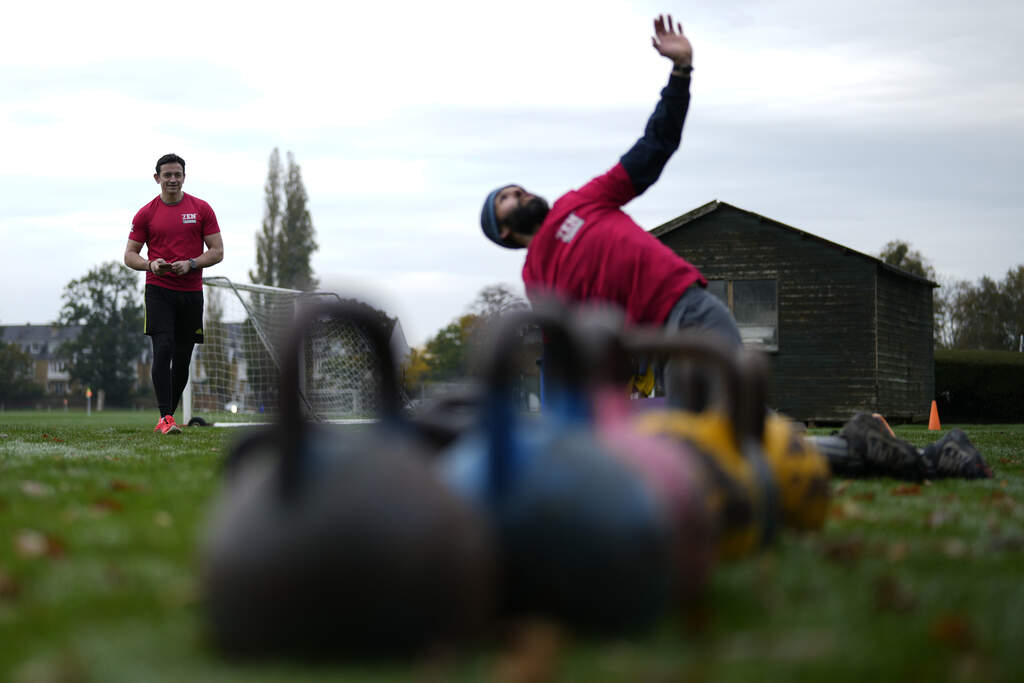
Humans have been obsessed with fitness for centuries. But how did this fascination start? In the new book “When Fitness Went Global” historian Conor Heffernan examines the rise of physical culture worldwide.
Guests
Conor Heffernan, lecturer in the Sociology of Sport at Ulster University in Northern Ireland. Author of “When Fitness Went Global: The Rise of Physical Culture in the Nineteenth Century.”
The version of our broadcast available at the top of this page and via podcast apps is a condensed version of the full show. You can listen to the full, unedited broadcast here:
Book Excerpt
© Conor Heffernan, from When Fitness Went Global (Bloomsbury Academic). Reproduced with permission.
Transcript
Part I
MEGHNA CHAKRABARTI: With every new year comes a new, actually, truthfully, it's a very old obsession, and that is with fitness, gym memberships go up, clubs are packed as everyone sets new fitness goals. So we asked our listeners, what role does fitness play in your life? And here's a little bit of what they said.
(MONTAGE)
Fitness is a huge part of my life.
It's the center of my social life. It's where I meet all my friends. It's what I get psyched up about.
It's always been a positive effect in my life in many ways. Not an obsessive way.
I was a varsity athlete in college many eons ago, but once an athlete, always an athlete. So today, I watch my weight. I play ping pong, I swim and I bike ride around the neighborhood. Being an athlete is well heaven, and the feeling of it is heaven.
I've started to view fitness as foundational for the rest of my life. I used to view it as something more of a vanity. It was for people who just wanted to look good. But really it ties into the rest of your life, your mental state, my performance at work, my energy levels, everything that I do has gotten better since I started exercising regularly.
Fitness is one of my top priorities because I have watched my mom who had a sedentary lifestyle, lose her mobility. She's now wheelchair bound, and watched the acceleration of her dementia. Everything I read says if it's good for your heart, it's also good for your brain.
While a lot of subjects out there in the current political stream are rather depressing, fitness is a positive.
CHAKRABARTI: That was Greg Dornoff, Casey McCoy, Becky Bell, Barb Thomas, Anthony Zarate, Cathy Kaska, and Kyle Joyner.
They are from Ohio, California, Maine, Massachusetts, Washington, Iowa, and Montana. Now, of course, this obsession with fitness beyond the normal daily activities of life, that is actually nothing new. In fact, it's been around for hundreds of years. And our guest today, author Conor Heffernan, argues that really, it began in the 19th century, and that's according to his book “When Fitness Went Global: The Rise of Physical Culture in the Nineteenth Century.”
Heffernan is also a lecturer in the sociology of sport at Ulster University in Northern Ireland, and he joins us today from Dublin, Ireland. Conor, welcome to On Point.
CONOR HEFFERNAN: Thanks so much for having me. And those listener experiences of fitness are just so validating for why it's important to talk about fitness and where it came from.
CHAKRABARTI: Exactly. And we have a terrific group of listeners across the United States. They're always very ready to share their opinions and personal experiences. But the fact that so many people did respond to us so quickly really says something. I'd like to actually hear, Conor, your own relationship to fitness.
Would you call yourself a fitness buff?
HEFFERNAN: Ooh, let's not go down the psychiatrist chair too soon.
CHAKRABARTI: No, let's do it now actually.
HEFFERNAN: Let's just get it all out in the open. I love fitness and I think one of the pieces that your listeners said about the difference between fitness as obsession and fitness as maybe vocation or fitness as passion is something I've experienced in my own life.
So I went from natural bodybuilding shows and Olympic weightlifting and quite restricted, disciplined ideas about how my body should look and move, to more expressive. I lift historic lifting stones. I lift sandbags. I enjoy what I eat. I enjoy how my body moves. So I think none of us can escape having a body.
I enjoy movement and strengthening and stretching and all of these things while actively avoiding a lot of fitness cultures, especially online. Which sometimes don't reflect that enjoyment.
CHAKRABARTI: Yeah. Interesting. So we'll talk about that in a bit, but I'd actually like to also now get what your definition of fitness or fitness culture is, right?
Because what you just described, actually, to me, seems to be on one end of the spectrum, right? You were doing natural bodybuilding; you were very disciplined about your fitness regime. I guess it sounds like you still are. But when we're talking about fitness culture more broadly, does one have to be at that end of the extreme to be in that culture?
HEFFERNAN: I would really hope not. Because that is an over extreme emphasis on fitness. And it's funny for the book, I use the term physical culture, which is what people would've called, say, fitness in the 19th century. And physical culture was about movement. It was about strengthening. It was about feeling better.
It was that sound mind, sound body idea. And it oftentimes wasn't about bodybuilding or power lifting or elite sport or six pack abs, et cetera. That was part of it. But the overall idea was whole body, whole mind, whole person. And I think that's what fitness is. It's going for a walk, it's stretching, it's calisthenics, it's swimming, it's moving your body.
And I think sometimes we get uber focused on the extremes. When actually, the radical 98% of people who just want to move and remember they have a body. I feel like that's the fitness that we sometimes ignore.
CHAKRABARTI: Yeah, good point. Because to me, reading through your book, I was thinking that really what we're talking about are, as you say, the conscious or deliberate movement of your body outside the realm of your daily life.
HEFFERNAN: Yes, exactly. And I think this is something that's become more important obviously in the last 200 years because ... we had work, your manual labor through life kept you strong and fit and you walked long distances. And over the last 200 years, we've obviously become more sedentary.
We've forgotten that we had bodies. And if you let me drop an Irish author, James Joyce, he once wrote about a Mr. Duffy who is said to live just a short distance from his body. So sometimes I think we're more Mr. Duffy than we care to admit.
Over the last 200 years, we've obviously become more sedentary. We've forgotten that we had bodies.
CHAKRABARTI: You can always drop an Irish author in this conversation, Conor. One more thing about your current relationship with physical culture.
You said, did you say that you do like historic fitness? Something about lifting Irish stones.
HEFFERNAN: I can hear my wife's eyes rolling.
CHAKRABARTI: (LAUGHS)
HEFFERNAN: So around the world, there are dozens of us, to quote Arrested Development. There are historic stones of strength that men and women have lifted for centuries.
So we've had a revival actually in Ireland in the last two or three years, thanks to a man called David Keohan who's helped rediscover these stones. But you can find 'em in Scotland, Iceland, the Basque region, Japan, India, Pakistan. There's actually some current revivals in the U.S. and Canada where people are trying to lift these stones.
But it's effectively, you go out to the middle of nowhere, there's a stone in a field or by a brook or in a cemetery, and you try and lift it because someone 200 years ago lifted it, and as I vocalize it, I realize that is a strange thing to do and to share with people.
CHAKRABARTI: Why? It doesn't, honestly, it doesn't sound strange to me at all, but maybe I'm strange as well.
HEFFERNAN: Yeah, it's an enjoyable thing. It brings together hiking, strength, mindfulness, nature, et cetera. But people sometimes abhor lifting a barbell or a kettlebell or a dumbbell, and to say to them that stone over there, which is sharp and will cut you as you try and pick it up, may be center left of acceptability.
CHAKRABARTI: Okay. The reason why I asked you about this specifically, actually see, now the rabbit hole of intrigue when it comes to niche things I cannot resist. How heavy are these stones?
HEFFERNAN: Anywhere from 50 kilos, so 110 pounds, to 450, 460 pounds.
I'm more in the middle between that zone. There are a variety of weights. There's a variety of ways to lift them. There's a variety of stories and legends attached to these things. But the thing that is beautiful, I will say this about stone lifting, which actually ties back to one of your original questions, is there's a beautiful ethos in the community, which is you get wind underneath the stone.
And what that means is nothing about flatulence, it's about just lifting it as high as you can. So if you lift it up an inch off the ground, you've done it, you're good, if you lift it over your head. You've done it, you're good. There's no idea of, you need to hit a certain standard. And even ideas of failure.
I once nearly blew my back out in a graveyard trying to lift a stone. Yes, weirdness. But someone put a hand on my shoulder and they said, the stone's not ready for you to lift it yet. Beautiful conception.
CHAKRABARTI: I hope you don't mind me saying this, but I've never had an unenjoyable conversation with someone from Ireland on this show.
The reason why I asked you about these stones in particular is some of these stone lifting traditions go way back, like more than 200 years, much more, centuries further back. But I don't think the, correct me if I'm wrong, Conor, but the purpose then seemed more to be a demonstration of strength, power. Of power in terms of being able to physically, I don't know, defend your clan or your village. It wasn't necessarily to give one personal satisfaction about the body's ability, was it?
HEFFERNAN: It is funny. There's two lanes you can go down, there's utilitarian and then there's playful.
So utilitarian. Absolutely. In Scotland, you know, there's the Castle Menzies stone, the king's bodyguards would lift up that stone. And supposedly if you could pick it up and walk to the top of the castle, you'd be the head bodyguard. There's the Dritvík stones in Iceland that are related to a fishing boat. If you can pick up a certain stone, it relates to your position on the fishing boat.
So there's interviews. Imagine there's a stone mason stone in Ireland. Your job interview is picking it up and putting it onto a wall. The pressure, so you have utilitarian, but then there's playful. There's a lot of stories that a man or a woman just pick this up, because no one thought they could do it, and then they put another one on top of it and pick that up.
So there's like a joyful expression in the body. With some of these stones and then with others, it is the job interview from hell. Can you pick this up in front of your employers.
CHAKRABARTI: You added, or a woman in there. Frankly, I would say half a millennium ago, or even 200 or 300 years ago. The number of women doing this, again, correct me if I'm wrong, would be diminishingly small.
HEFFERNAN: Oh, absolutely. And I mean it's something that even in the current age, obviously we know that women are not encouraged to have the same physicality as men, which is why stories of say the Húsafell Stone in Iceland, which is supposedly the farm owner's daughter, picked up 180 kilo stone and walked a lap around the field, I think are so powerful.
And a mentor and friend of mine, Jan Todd, she went to Scotland to lift the Dinnie Stones, which are very historic and heavy lifting stones. And one of the reasons Jan did it was to show other women that, you know, you can be strong, you can be physical, you can go outside of society's ideas of strength. So I think sometimes the stories of women lifting these stones.
Are almost more powerful than the men's one, because they're bucking so many more additional pressures and barriers that men typically would've.
CHAKRABARTI: We had Jan on the show actually a couple of weeks ago, maybe a month or so ago, and she talked about how at her age, still, I think in their seventies now, she can still bend.
She's so strong, she can still bend bottle caps in half with her fingers. It's just a remarkable story. So folks, if you actually, if you want to listen to our conversation with Jan Todd, or actually our featuring of Jan Todd on a show from a while ago about women and fitness, go to our On Point podcast stream wherever you get your podcast and check it out.
Part II
CHAKRABARTI: So Conor, what changed in the 19th century that made people move from not really thinking about fitness to a culture or cultures emerging around it?
HEFFERNAN: It's a really great question and it is the thing that really fascinated me when I was writing this book, because I was interested in when did people start exercising the same way? When did the trainee in Manchester or Melbourne or Mumbai or another city that begins with M begin using the same exercises as one another?
And there's three kind of major shifts, which I think people are probably familiar with. Obviously industrialization. There's factories, there's office work that leads to people moving into cities. People begin to live more sedentary lives. But there's also two other things going on in the 19th century.
The first is the growing importance of schools. So schools become more important, education becomes more important, and physical education becomes more important. So schoolboys and schoolgirls begin getting trained in P.E., physical education in the 1800s. And also, militaries begin to take physical training seriously in the 1800s, and that starts from the early 1800s after Napoleon's army sweep across Europe.
Napoleon's troops are fit and strong and agile, and they do calisthenics. So the people who want to overthrow Napoleon's army like the Prussians and the Germans do calisthenics and gymnastics and physical exercises, and then that creates this cascade where militaries begin doing regimented gymnastics, weight training, barbell work, dumbbell work.
So you get people becoming more sedentary in recreational or civilian life. School children begin to be trained in PE and soldiers begin to be trained in gymnastics and calisthenics. So you have this kind of perfect institutionalization of movement and exercise in the 1800s for the first time in human history.
You have this kind of perfect institutionalization of movement and exercise in the 1800s for the first time in human history.
CHAKRABARTI: Institutionalization of movement. Okay, that's really interesting. One more question about Napoleon's armies. Were they coming into the infantry ranks more fit, or was the Napoleonic military, did they actually pioneer this strength or fitness training within the ranks?
HEFFERNAN: I feel like if I just say that Frenchmen are naturally better than the rest of us, I might be given the keys to Paris, but no, what happens is Napoleon's armies are deliberately trained in physical fitness, and there's a book written by one of Napoleon's generals in 1815, which talks about we physically train our troops because one of the main maneuvers that they do is they split half of the Army. So you'll face Napoleon's army head on.
While the other sneak behind the back in a pincer movement and one of Napoleon's generals effectively says, we can do this, because we physically train our troops. So it's not that Frenchmen are better than the rest of us. I'm very sorry to my Gaelic friends, but they were using physical training a little bit sooner than a lot of their rivals in Europe and the rivals then caught onto that and began to copy or mimic or inspire themselves with the use of physical training for security purposes.
CHAKRABARTI: Interesting. Okay, so this institutionalization, the other thing that I thought about as I was reading this history in your book, which again is called When Fitness Went Global, was that especially because of the industrial revolution as well, it seems to me that fitness culture from the start had a very strong class basis to it, right?
Because in the Industrial Revolution there were still lots of people working. They might have been more sedentary, but they were making 500 new pairs of shoes at a sewing machine every day, or they were mining in like Northern England deep down in the pits.
So if you were still a working-class person, you weren't necessarily enjoying the fruits of fitness culture. Because you were still working really hard.
HEFFERNAN: Exactly. And there's a really interesting book published by a British man called Donald Walker in 1837 called Exercises for Ladies designed to improve and preserve their beauty.
So you can imagine his kind of take on gender politics, but he says in it, and he is writing to middle- and upper-class women. You need to stop letting your working-class servants clean the household. That should be exercise for you, which you are being deprived of by letting your servants do it. And it's interesting when you look at how fitness is deployed in the 19th century for working class men and women, it's often quite disciplinary based.
We need you to be fit and strong and healthy and moral. And that's through schools and through the military. For middle- and upper-class men and women, it's more aspirational. It's to be a better man, you need to have a better body; to be a better wife or to birth healthier children, you need to buy X, Y, and Z.
It's more aspirational and expressive than oftentimes the very rigid forms of exercise that are being directed at the working class by militaries, churches and schools.
CHAKRABARTI: I feel like that hasn't gone away because there's a kind of fitness born of hard physical labor that still exists, versus, I don't know, the Lululemon kind of fitness where you have the time and the money to afford all the trappings of the culture, while also running 20 miles a day or whatever, what have you.
I think the similarities are still there.
HEFFERNAN: Oh, absolutely. And something that I would hope people would take from the book is that the past isn't the past when it comes to fitness. We're still mimicking and using a lot of these same ideas. Oftentimes anyone who's played sport in North America, I used to teach in Texas, so a lot of my football players would talk about their training being used as punishment.
Do 20 burpees. Do 60 pullups. Do 80 pushups if you don't listen to coach. Versus the people who, you know, do see fitness as a lifestyle identifier. I'm fit, I'm healthy, I'm of a certain wealth because you can see me in my Lululemon, or in England, my Sweaty Betty, and I have the latest iPhone, and it's linked to my Garmin watch or my Fitbit and all of these.
And I go to Barry's or insert expensive gym membership here. It can be both a lifestyle identifier, this is who I am, and you can see how wealthy I am through the gear that I'm using, the training that I'm doing. Or it can be troops in the military. It can be bad experiences with your P.E. teacher because they're using exercise as punishment.
These are things that begin to crystallize in the 1800s.
CHAKRABARTI: Okay. So a lot of what you just said had to do with the social aspect of fitness culture. I was thinking about all of the fitness apps where you're like constantly posting how much you lifted that day, or if you made your goals, et cetera, so that either your friends or everyone who has the app can see it.
Was there also a profound social aspect to this, again, in the 19th century? And what are some good examples of that?
HEFFERNAN: So I'm going to really stress that I do love fitness, and I know you kindly asked me that at the start. So there is this joyful expression for people and there are writings from men and women in the 1800s who talk about this newfound community that they have through fitness.
They talk about the gym as this special place where they come and they meet people. There's people writing into fitness magazines. Talking about, I've met so many people through fitness and communicating with people from around the world. There's some wonderful stories in the 1890s and some early fitness magazines where people in New Zealand are communicating and actually befriending people in Ireland based on their love of physical culture and physical fitness.
And likewise, people in colonial India making friends with people in the west coast of the U.S. through fitness magazines. So you do get those spaces, and you do also get like gyms emerging. In this time, and I think for me, there's a beautiful moment in the book where I have a photo of an Irish man, FA Hornbrook, who moves to Australia and New Zealand in the 1890s, sets up a gym in Fiji in the mid 1890s. And then takes photographs of all of his clients and sends them to a Prussian man who's in England to show him the benefits of his system being used in Oceania.
So like you can see that there are these communities being forged around these places. But then there is in the most common form of fitness and exercise training, which I think we oftentimes tend to neglect, is the military barracks. It is the classroom, and it is coming at a time in the 1800s when colonialism is really at its height.
And I think this is important for this standardization of fitness, the fact that men and women use the same movements around the world and still do today. I've trained in New Zealand, Australia, Hawaii, that was a beautiful three months, the U.S., Europe, et cetera, and I've always had access to the same gym equipment.
So that standardization still exists, but colonialism and British militaries making their colonial subjects do the military training that their soldiers are doing, and likewise in France and Germany. That also means that the barracks and the classroom is also a space where people are meeting and experiencing certain fitness systems.
CHAKRABARTI: Tell me more about that, because this colonial link is really interesting. Obviously, it's interesting to you as well, Conor, because I honestly, I never thought about one of the, perhaps are we calling this a positive outcome of colonialism? That this, the idea of a fitness culture spread that way?
HEFFERNAN: No. And the Irish man in me will never say there's any positive of colonialism. And you won't make me, plenty have tried. No. What I think this is though is it's a consequence of colonialism. So to give people maybe a context for what that looks like. In 1860, the British military create their first gymnastics system, and it's created by a Scotsman Archibald MacLaren, and it's dumbbell lifting and club swinging and calisthenics.
By 1864, they create a gym in Ireland to train troops who are going to be fighting in the British military. By 1867, they've opened a gym in India, and they have Indian men and also British soldiers training with the same system. And from 1867 to really 1914, 1918, they begin to spread it. So the next colony that they set up, the troops will be trained using this system. And the schools in these colonial enterprises or these colonial states will also start to use the military gymnastic system for their P.E. systems. And sometimes there's an idea that these gymnastic systems will train people into how to be a proper British citizen.
Especially with German and French colonies in Africa. They deliberately use gymnastics, military gymnastics, as a way of teaching the locals what a German man, or what a Frenchman or a French subject, rather, should act like, how they should look, how they should behave, how they should be disciplined.
So it's not a positive element of colonialism. It's a consequence of colonialism, I would say.
CHAKRABARTI: I would never dare ask an Irishman to defend colonialism. I can guarantee you that. But as you're describing, it's really the spread of fitness culture that seems distinctly different, again, as you argue, starting in the 19th century, because of course, as we talked about before, demonstrations of strength or seeking a higher kind of fitness is ancient, ancient. You mentioned India a couple of times.
They've had a long history of wrestling, for example in India. And of course, my mind naturally goes to the ancient Greeks, right? Having invented the concept of Olympic games. And even in the ancient world across planet Earth, you can find examples in art, sculpture, et cetera, of what an ideal body was said to, was thought to be like.
And these are all sort of ways that fitness culture spread through societies for several thousand.
HEFFERNAN: Absolutely, and it's something that I really try and stress in the book. The first chapter is all about pre 19th century fitness, making the point that in religion and medicine and education, in military settings, there has always been a documented human interest in physicality and being fit, and being strong and being healthy.
The difference in the 1800s is that the lyrics begin to become the same around the world. I had a friend who read the book and he compared it to cuisine. If I go to Italy, I'm thinking pizza and pasta. If I go to Spain, I'm thinking paella. If I go to Greece, I think Mediterranean diet, if I go to Ireland, I think potatoes, unfortunately.
What happens is you get a McDonaldization, if I want to train in Australia, okay, I'm going to use the same exercises that I would use in Boston. As Ireland, as Moscow, as Berlin, we begin to use the same exercises. And that has never happened at that scale before in human history.
And that's a really important turn because we still live in that fitness space where a gym in Boston is the same as a gym in Dublin, for all intents and purposes.
We still live in that fitness space where a gym in Boston is the same as a gym in Dublin.
CHAKRABARTI: Yeah. But one, a major part of what you write about in the book is it's not just this kind of rough standardization of fitness culture, but also even like the trends.
I didn't realize that there were like fitness influencers in the 19th century, or that trends came and went. I'd love for you to talk about that a little bit.
HEFFERNAN: This is why I'm the most cynical fitness person in the world, because I'm like, it just repeats itself.
Why can no one see this? So to give people a context, there's a Prussian man called Eugen Sandow. Look him up. He has a mustache and a glorious six pack, and he's really the first modern bodybuilding star. And he comes to fame in 1889 in London, and from 1889 to 1914, at least, he's seen as the world's most perfectly developed specimen.
I'm not a fanboy. This is a title given to him by Dudley Allen Sargent, who's a physical educationist in Boston, the Natural History Museum in London commissions a bust of Sandow's body to show later generations how perfect he was. But Sandow is a businessman, and this is where people are going to see echoes in the modern age.
Sandow sets up his own fitness magazine. Sandow's Magazine of Physical Culture. He sells fitness books, teaching people how they, too, can become a Sandow like him. He sells his own proprietary workout equipment, which he says will turn you into a Sandow in six easy steps or close enough to it. He even takes a supplement called Plasmon, which is an early protein supplement, and he writes that he survived off Plasmon alone for one month and he did not lose weight.
He did not lose strength. In fact, he got stronger just using Plasmon. So you can see these sort of echoes that we still deal with today. Because that commercialization, which begins in the 19th century, creates like a useful playbook for fitness marketers because even in Sandow's magazines, and he's not the only one. There's dozens and dozens of them. He's telling people that fitness will make you a better man. It'll help your job prospects. It'll help you stave off illness. He even opens up a Curative Institute of Physical Culture in 1907 in London, where he says that you can overcome a variety of illnesses, including cancer, through physical culture alone.
And he claims a 99% success rate in doing that. So you can see that kind of bold, outlandish marketing still existing today and it begins in the 1890s and early 1900s.
CHAKRABARTI: That is so fascinating. The protein supplement is the one that really got me. Because I had thought that was a distinctly modern thing.
But was diet, was Sandow unique or roughly unique in his tying of fitness and diet together? Or were other Victorian fitness influencers doing the same thing?
HEFFERNAN: It's a really interesting question. Because if we look at the bigger story, which is the institutionalization of fitness in militaries and schools, they don't really talk about diet.
Because that makes a difficult conversation for governments. We need to improve people's costs, their wages. We need to improve sanitation; we need to improve access to food. But in recreational fitness. Which is more geared towards the middle and upper class. You do get that soldiering on of diet and fitness and you get people like Bernard McFadden in the US who's the original health quack and he talks about the milk cure to cure a variety of diseases.
Just drink pure, raw, that is unpasteurized milk. You'll get people selling early nutritional supplements. There's an Australian physical culture as Tom Burrows who says that iron gels, as delicious as they sound, give him abounding energy and they stop him being tired and fatigued. You have Bovril, which is a beef extract drink, which tastes interesting, and that gives you strength and energy, et cetera. So for the middle- and upper-class recreational fitness enthusiast, they're selling exercise and workouts, but also diet.
Part III
CHAKRABARTI: In the previous segment when we were talking about 19th century protein supplements, it reminded me that I don't know how YouTube is targeting me, but I cannot watch a single YouTube video without seeing an intrusive ad about, you can eat anything you want. Just follow this one little trick and you'll lose 50 pounds. Or don't eat blueberries. I'm a doctor. Blueberries are toxic. I mean, like, the snake [oil] of fitness culture is still there, perhaps stronger than ever. And as you mentioned earlier, money is the big driver. Was that the same thing in the 19th century as physical culture began to take off?
HEFFERNAN: I refer back to my point about I've always loved fitness. Now let me be cynical. So I would say that for recreational physical culture, so the things that most of us do in gyms, outside with friends, et cetera. Money has always been an important component in it. And something that I think is in the book and is important for people to know is that an asymmetry exists in the fitness industry and has always done.
And what I mean by that is the people selling the information, not all of them, but oftentimes hold more information than the people who are buying it. So to refer back to Eugen Sandow, the Mustachio six pack, Prussian man, he built his body lifting heavy weights. He was also born genetically predisposed to building muscle.
He knew both of these things. When he was selling his workout equipment to people. He said, don't lift heavy weights. That's dangerous. Instead, buy my five-pound dumbbell. Now my five-pound dumbbell has spring grips in it, so you have to squeeze it really tight and squeeze the spring grips down, and that means you're concentrating.
And if you just concentrate and squeeze my light dumbbell, you two can build a body exactly like mine. Very few people call him out on this publicly, except a man called Arthur Saxon. Arthur Saxon is a weightlifter who actually defeats Eugen Sandow in a weightlifting competition in the 1890s. And he writes in his book, unlike some strong men or charlatans, I will tell you that I've always been strong.
I've always lifted heavy weights, and this is how I've built my body. So Sandow saying you only need to lift my dumbbell. He knew that he was misleading people. Sandow saying that, I existed on Plasmon for a month. He knew he was misleading people.
And what's really interesting is if we stick with Sandow who opened up a Medical Institute of Physical Culture, he actually gets brought before the British Medical Authority in the mid 1900s, because they bring 'em to task. They say you claim to cure people through physical culture. Prove it. And Sandow's doctors, because he has doctors aligned with them, get struck off the medical registrar. And it's one of the few times that he's actually asked to provide evidence for his claims.
And I think this idea that a lot of times the main commercial sellers know that certain things will work, and certain things won't work, and it's easy to sell this idea of simplicity and ease to people. I think that does still exist today. As you say, don't eat blueberries, just use this, five minute abs, et cetera, et cetera.
That still exists and there's a certain preying upon people's anxieties, I think when it comes to their bodies, which is certainly there in the 1890s, and from my perspective, and from my own experience, still exists in the 2020s.
CHAKRABARTI: There's an overwhelming predatory aspect of the business side of fitness culture, I'd say.
There's my cynicism coming through. I keep hearing you say that you love fitness, but you have to be cynical about it. You are essentially writing a cultural, the book is a cultural history of a global phenomenon. It wouldn't be interesting if there were no cynicism in it. With that in mind, let me try to tie two things together that emerged from the book.
One is that it's so interesting, because bodybuilding comes up so often and even all the way through today, you know this Conor, but you'll hear bodybuilders when they're speaking honestly about their sport. They'll always say I can do this with my training. I can do this X with my diet, but I eventually run up against the genetic limit of what I can do.
And then some bodybuilders go and use pharma, let's call it pharmacological enhancement and others like you go down the natural bodybuilding path. But the reason why I brought up genetics is because this is another one of those darker aspects of fitness culture, I think. Because in a lot of places you can't really separate the push for fitness from the push for a certain kind of body. And anyone else who did not have that kind of body in physicality or looks, I'm talking about eugenics, essentially. That connection is there.
HEFFERNAN: So I'm laughing, I'm not laughing at the idea of eugenics. It's the tip toeing. I'm like, yeah, it's eugenics, Meghna. You can say eugenics.
CHAKRABARTI: Yeah, I could just spit it out.
HEFFERNAN: Yeah, you can just say it, we're friends here. And there's two bodies to reference in that.
The first is the size of the body. Because, in the 1800s, whether it's P.E. teachers, military leaders or physical cultures like Sandow, the early bodybuilders, they try and standardize the male body and the female body. So they say the ideal body is this size, and the muscle size is this size.
And you can measure and use a tape measure on your body and see you have 13-inch biceps or 15-inch biceps, or 32-inch waist, whatever the case may be. So in the first instance, there's a very narrow idea of what a perfect body looks like, and it tends to be lean and muscular for men. And slim and delicate for women, and these would be the terms that they'd use in the 1800s.
There's then the race of that body, and there's a really important point in the early 1900s. Bernard McFadden, an American physical culturalist, hosts a bodybuilding show, and he has people submitting. He says it's a global show. It's open to anyone and everyone, and he has submissions from people from India, Southeast Asia, Oceania, different parts of Africa.
But the bodies that go on stage are the white bodies. Eugen Sandow hosts a bodybuilding show in 1901. He then hosts an Empire Bodybuilding show, which is just through his magazine, and that tends to preference white bodies. When Sandow's body, which I mentioned, the Natural History Museum in London, creates a bust of his body to show later generations how perfect he was.
It was to show later generations how perfect the white body was. So there's two eugenic ideals going on here. One is size. And the other is then the race or the color of the body and fitness has, and still tends to privilege a white male body in particular.
CHAKRABARTI: And it also has this long lasting, centuries long effect of that standardization, which maybe race is a little less a part of it, but body shape still.
And that links back to the sort of global aspect of fitness culture beginning about 200 years ago. Everywhere around the world, I'd say, most people when asked about what is the ideal kind of body shape would say the same thing.
HEFFERNAN: Yeah. And if I ask them to show me how strong you are, they're probably going to do a front double bicep pose or a bicep pose, where you bring your arm up about neck height and you squeeze, and you bring your fist towards your head.
And that's a really simple illustration that I use for people from different countries, and I'm illustrating this. That we tend to have this rough idea, and I often say it's those experiments that they do with schoolchildren where they say, draw me a picture of a scientist. And it's usually a man with glasses and a big fuzzy beard who's kind of Santa Claus adjacent.
But these ideas of the perfect body, they were tracked and they were measured obsessively in the 1800s. You have military officials measuring each troops or each soldier's body to see how to adhere to these guidelines. You have recreational cultures where, you know, Sandow again, but Bernard McFadden ... Apollo and all of these other physical culturalists.
They'd send you a chart and they'd say these are the perfect measurements. Measure up. How do you do? So these things, they were actually put on paper. And people measured and tracked and taped and all of these things, and took photographs. We have before and after photographs in the 1800s where people were obsessive about tracking this and it created that foundation, as I say, Meghna, for what is the perfect body.
And then that spreads across countries and across continents.
CHAKRABARTI: It's so interesting because what is the perfect body is of course a very different question than what is a healthy body for you, an individual. So we're going to get to that a little bit in a second.
But to move away from the cynicism for a moment, I would love to return to the issue of women and fitness culture again, 200 years ago, and then all the way through today. Because in the book you write about several people, but one that I'm thinking of in particular was the German American strong woman, Katie Sandwina.
And here's an archival clip. This is from 1929 of Sandwina training someone on how to best hit a punching bag.
(CLIP PLAYS)
CHAKRABARTI: I love that clip for so many reasons. Not only is she a very focused punching coach but very German at the same time. So tell us more about Katie Sandwina.
HEFFERNAN: That was also her training her son Teddy Sandino, which makes it all the better. Because if mom is berating you and showing you how to do your job, that's even better.
But Katie Sandwina, she's part of a new generation of women who emerged in the 1890s and 1900s. Because one of the big things in shifts in fitness is that strong men and strong women begin to become professionals, and they're doing musical hall shows, and vaudeville shows, and circus acts, and circus shows, and that actually opens a space for a very small, admittedly select group of women to gain a living for being a strongwoman.
And to actually exist and to be celebrated for being a strongwoman. And Sandwina is undoubtedly the most famous individual. She comes to America in the early 1900s and she has stories about being able to pick her husband Max up overhead with one hand, of pushing barbells weighing 280 plus pounds overhead.
And her stage shows will see her lifting cannons, lifting vaults, lifting people with ease. And what's really interesting about Sandwina is she's treated as pretty and powerful, to use a phrase that Tony Bruce, a wonderful academic uses, she's celebrated for both her strength. But also for her femininity.
And what's interesting with Sandwina, and a lot of these early strongwomen in the 1900s, is that being strong and powerful doesn't seem to be in contrast to being a woman. And now the pity of that is that it's only for a select small group of women who exist in a marginal space. I'm gonna say a term from the ear, which would be like the freak show adjacent to people.
You're expecting them to be odd or not normal, or not things that you'd usually encounter. But it does actually create a seed that women can be strong. And Sandwina is a wonderful example. Because she inspires women across generations. Jan Todd, who you had on, references Katie Sandwina. Early Women's Olympic weightlifting is defined by Sandwina. Because Karyn Marshall beats Sandwina's overhead press record in the 1980s and she talks about wanting to beat Sandwina.
So there's like an echo across time of Sandwina's influence.
CHAKRABARTI: So now let's spend the last couple of minutes here, Conor, talking about the vestiges of 19th century fitness culture and how they seem actually quite alive today. So I'm going to return to our listeners, because we also asked them, like, what did they make of the culture of fitness today?
And here's what they said.
I am disgusted with the current fad for iron bodies and people showing off their abdominal muscles, which is so materialistic and macho. Being fit involves a lot more than extreme exercise. Lowering stress and finding peace through spiritual practices is also a crucial form of fitness.
I am trying to prove that 60 is the new 40. So I'm into things like jump training to prevent bone loss, aerial yoga. I eat high protein and creatine.
I think a lot more people are starting to view fitness as really this holistic health benefits that kind of come with them.
The fitness culture has begun to co-mingle with the quote, wellness community, and I find it to be a little murky.
Fitness culture of today feels both very self-focused and very performative. A lot of it is done for the sake of views because people are fitness influencers now and people are posting for a certain audience. So in my experience working at a gym, I really want more people to do it just for them.
Go back to the basics. Running, swimming, lifting, and field games, and no special foods or supplements or anything. Just listen to your body and be outside playing games with your friends. And have fun.
CHAKRABARTI: We have the best listeners. Those are On Point listeners from the top. D.P. Snyder, Maeve, Anthony Zarate, Heather Millward, Sofia Moulton, and Barb Thomas.
They're from North Carolina, Wisconsin, Washington, California, and Massachusetts. First of all, your reaction to what they said, Conor.
HEFFERNAN: We've obviously just finished the Christmas period, so Conor's, it's said that Conor's heart grew two sizes that day. I think that's the thing, and that's what I hope people get from the book, is that there's a very rigid idea of fitness.
It's created in the 1800s. But we've had a longer history where you got to make your own meaning with regards to fitness and the body and your own body. And I think rather than being restrictive, we should make fitness more open for people.
Rather than being restrictive, we should make fitness more open for people.
CHAKRABARTI: One interesting thing that the listeners mention there is another echo of the Victorian past, is there's still a lot of judgment, a lot of moralizing around fitness today, as there was back then.
Why do you think that is?
HEFFERNAN: It's a difficult thing to unpack because it's become so ingrained, but we have ultimately taken on the idea that your body is reflective of your self-worth, and that's something that, you know, has been written about by historians looking at obesity and fatness in particular, where in the 1800s, there's a shift to someone's physique is seen to be reflective of their body.
In the 1800s, there's a shift to someone's physique is seen to be reflective of their body.
So if you have a lean and mean iron body, so to speak, you must be disciplined. You must be hardworking, you must be vibrant, you must be wonderful. You're someone that I can trust. We tend to equate a very rigid idea of a body with who a person is, but just seems wrong. When you look at it at the face of it.
CHAKRABARTI: That's because of the cultural aspect of it. One thing which I've heard you say, and I was really inspired by a lot of the listeners is that, and I mentioned it before, there is a difference between trying to be fit for the sake of being celebrated within a culture, versus going to your doctor, for example, and saying, what is fit for me and how do I get there?
In a sense the cultural aspect is both good and limiting.
HEFFERNAN: And I think there's a potential to shift from fitness to health. Yeah. Because fit is fit, for what? I'm fit to run a marathon, but I'm not fit to deadlift 500 kilos. I'm fit to deadlift 500 kilos, but now I'm not fit to walk up the stairs, versus health.
Am I able to move pain free? Am I able to live and exist and move in my daily life? And I think the fitness industry preys on fit because you get caught in a treadmill, in a loop, you'll never be good enough. You can always get tremor. You can always get stronger. You can always get leaner.
Whereas if you focus on health and vibrancy and expression, how you feel, I think there's a joy in that, versus more rigid forms.
The first draft of this transcript was created by Descript, an AI transcription tool. An On Point producer then thoroughly reviewed, corrected, and reformatted the transcript before publication. The use of this AI tool creates the capacity to provide these transcripts.
This program aired on January 6, 2026.