Support WBUR
Rep. James Clyburn on the Black politicians that shaped America
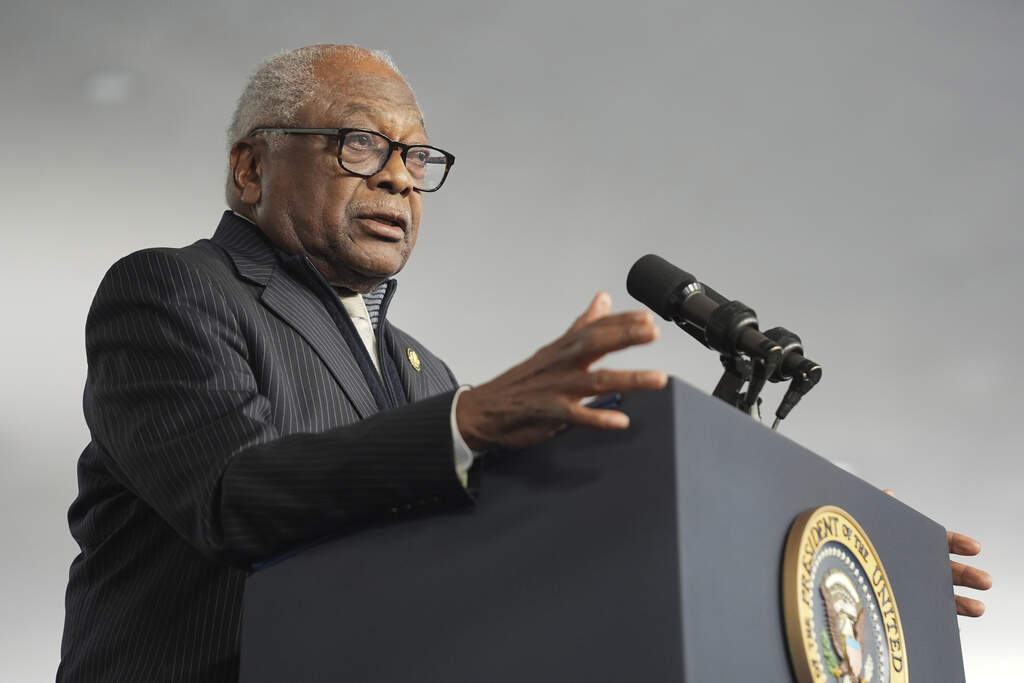
James Clyburn is one of the most influential Democrats in Congress. His new book “The First Eight" is about the Black South Carolina Congressmen who preceded and inspired him.
Guests
Rep. James Clyburn, U.S. Congressman representing South Carolina’s 6th Congressional District in the U.S. House of Representatives. He’s held the seat since 1993. Author of “The First Eight: A Personal History of the Pioneering Black Congressmen Who Shaped a Nation.”
The version of our broadcast available at the top of this page and via podcast apps is a condensed version of the full show. You can listen to the full, unedited broadcast here:
Transcript
Part I
MEGHNA CHAKRABARTI: Congressman James Clyburn is one of the most influential Democrats in the House. He was first elected in 1992 to represent South Carolina's sixth Congressional District. He's held that seat for the last three decades. Congressman Clyburn served as the second African American and First South Carolinian to be Majority Whip, which he did twice from 2007 to 2011, and again from 2019 to 2023.
And as a Black man of his generation, Clyburn's life has been inseparable from the Civil Rights Movement. In the House, he has worked on issues as far ranging as increasing the federal minimum wage to helping establish the Affordable Care Act.
Congressman Clyburn is also the author of the memoir "Blessed Experiences: Genuinely Southern, Proudly Black." And now he has a new book, which we'll talk about today. It's called "The First Eight, A Personal History of the Pioneering Black Congressman Who Shaped A Nation." And he joins us now to talk about it.
Congressman Clyburn, welcome to On Point.
JAMES CLYBURN: Thank you very much for having me.
CHAKRABARTI: It's a great pleasure to be able to speak with you. Now in the title of your book, it's called the pioneering Black Congressman who shaped a nation, but we're talking about congressmen from a specific state, your own, correct?
CLYBURN: That's correct. These eight men were from South Carolina. They all served during and post reconstruction. As one will see in the book, I'm a stickler for getting the facts right. And to me reconstruction period lasted for only about 13 years. And so some of these men served after reconstruction came to an end, but they all left before the century ended.
CHAKRABARTI: Now I'm sure a lot of listeners who know at least a little, if not a lot of your congressional career, are doing a double take at the moment. Because they're saying, wait, what? I thought James Clyburn was the first Black congressman from South Carolina.
CLYBURN: That's correct. A lot of people have that mistaken notion, but I always say to those, before I was first there were eight. And I undertook to write this book because people kept looking at their pictures on the walls of my office. And inquiring about them. And one day I said to my staff, my next book is going to be about these eight people.
Before I was first there were eight.
And that's what I intended to do. Just simply introduce them, and maybe the period within which they served. But in the middle of writing the book, the 2020 elections came about. And then there was the reaction to that election. And the night I was watching the news and watching those people banging on the doors and windows up there in Michigan.
Same kinds of things going on in Pennsylvania and that infamous telephone call down to Georgia. And it occurred to me that the same kind of reaction to the 1876 presidential election is what caused the downfall of these eight people I was writing about. So I decided to refocus the book.
Not just on these eight people, but the circumstances under which they worked and the conditions that led to the 95-year gap between number eight on this list and yours truly, number nine.
CHAKRABARTI: But that's the richness of the book, right? Because it directly, it actually directly connects not only the lives of these men to their time, but that we're not actually that far away from that time in certain manners, Congressman Clyburn.
But before we get to those connections and those reflections you were talking about from then and now, let's talk about these men, because they're quite incredible. I will be completely honest. None of their names came up in any of the history classes that I took. So who do you want to start with?
Do you want to start with Robert Smalls?
CLYBURN: Let's start with Robert Smalls, but I think that he was probably, not probably, I said emphatically in the book that Robert Smalls was the most consequential South Carolinian to ever live. And I said that in a public speech one day. And a gentleman in the audience came up to me afterwards and said, I really enjoyed your speech today, and I think I agree with you that Robert Smalls was the most consequential Black South Carolinian who ever lived. And I said to him, that is not what I said. He was the most consequential, irrespective of skin color or gender.
And if you look at the book, and you just think about Robert Smalls. Born enslaved, was sent away from Beaufort, his home county, to Charleston to work on the waterfront to earn money to send back to his enslaver. Was allowed to keep only $1 a week. Robert Smalls while working on the docks in Charleston got a job as the overseer. And he had the habit of kind of mocking the captain a little bit.
Every time the captain of the ship would leave the ship as he did every Friday and went into Charleston and would not come back until Saturday. One day Robert Smalls flopped that cap on his head, start prancing around the ship, imitating the captain. And one of his buddies said, when you put that cap on, you look exactly like the captain.
And that planted a seed in him. And he began to really plan his escape. And Robert Smalls pulled off one of the most eventful events to occur during the institution of slavery. He studied the currents and learned how to navigate the ship. He studied the sounds of the whistles and learned how to make the signals of the whistles on the ship to gain free and safe passage in and out of the harbor.
And one day when the captain and his two buddies left the ship to go into Charleston, he and his friends commandeered that ship and took it, them and his wife and child to freedom. And when they delivered that ship to the union forces, they gained their freedom and a financial reward for having done so.
And he went on from there to participate as the navigator, first of the ship, and later the captain, about 17 different skirmishes and gained all kinds of heroism during that walk. Then the most amazing thing about Robert Smalls is that he gained his freedom in April of 1862.
CHAKRABARTI: Oh, wow.
CLYBURN: And that following August, he was sitting down here in Washington, D.C. with Abraham Lincoln, the president of the United States.
CHAKRABARTI: How did that happen, Congressman?
CLYBURN: The union was losing the war because they didn't have the manpower to win. And Saxton, general Saxton who was a union soldier running the war in the South needed more manpower. And he tried to get President Lincoln to allow freed Blacks to serve in the army, to help fight the war. And it was being prevented. Even Frederick Douglas was up here in Washington trying to get Abraham Lincoln to let these people come into the war, but they were barred from doing so.
Saxton thought that because of his notoriety maybe Smalls could convince the president to change his mind. And so he sent Smalls to Washington to sit down with the president. And he did succeed in getting Lincoln to change his mind. And Lincoln allowed Smalls to go back to South Carolina and recruit 5,000 formerly enslaved and free Blacks to serve in the war.
They went on to get up to a number of 140,000.
CHAKRABARTI: Congressman, do you mind if I interrupt for a second?
CLYBURN: Please.
CHAKRABARTI: I don't know. I'm just, in my mind, I'm trying to imagine Smalls sitting across a table from Lincoln.
CLYBURN: (LAUGHS)
CHAKRABARTI: Part of you has to wish that you were a fly on the wall for that kind of conversation.
CLYBURN: Absolutely. And there were others. He just really became a star. People in Pennsylvania tried to get him to move there after he got his freedom. Up in New York he became a really national celebrity.
So you can imagine, in fact, I've written in the book about some of the conversations that took place between him and the cabinet, Lincoln's cabinet, as well as Lincoln himself, and Lincoln said at the end of the war, were not for these freedmen, he called them, that the war would not have been won.
So when you look at entirety of Small's life, not only was he just a hero in the Civil War, he was given credit for having brought into the war the manpower that made this country the loudest country to survive the Civil War. And after the war, he was elected to the state legislature in South Carolina for 10 years.
And after that was elected to the United States Congress for 10 years, and Smalls introduced and got passed the resolution in the 1868 constitutional Convention in South Carolina that led to free public education for everybody.
Part II
CHAKRABARTI: Congressman Clyburn, you were just about to tell us what Robert Smalls did in South Carolina while he was part of the South Carolina legislature, about helping to provide free public education for everyone in the state.
CLYBURN: Yes. And it was the first time in this country that free public education was allowed for everybody. Before that time, only the elite had the opportunities to get educated. Even my father was not allowed an education beyond the seventh grade in the county. He grew up in South Carolina. And it was part of why my dad made me learn about Robert Smalls.
Now, you mentioned at the top of the show, that none of these men showed up in the history books you got in school. They didn't show up in mine either. But my dad never took the chance of me not knowing about these people. And so my dad taught me a lot about Robert Smalls and made me learn about Robert Smalls. He thought he was the greatest person to live.
Now, my mother felt differently. She thought that person was Mary McLeod Bethune. It made me learn everything about Mary McLeod Bethune. So I grew up thinking that a woman could be just as great.
CHAKRABARTI: Yeah. So let's, before we get to more of how you reflect upon America now.
In the context of these stories, let's learn about some more of these gentlemen.
CLYBURN: Sure.
CHAKRABARTI: How about, actually you write in the book that as you reflect on the lives of these men, it's Robert De Large's story that really resonates with you. So share that. Yeah.
CLYBURN: He was my least favorite.
CHAKRABARTI: (LAUGHS)
CLYBURN: I might say. He was born in Aiken, South Carolina and De Large's parents were pretty wealthy. And they had slaves. And of course, he was of a mixed race and De Large left Aiken and went to Charleston because he thought the opportunities for brown people, is what they called the mixed-race people at the time, were greater in Charleston. And he took advantage of that as best he could, even served in the Confederate army. And every chance he got, he tried to straddle the line. When he saw that the union was winning the war he started to modify his attitude a bit.
But it came too late for me and most of the people around him, in fact he only served one term and much of that term he served trying to hold onto the office, because he was accused of having stolen his election or maybe having purchased it. And then he got very sick, he died before he was 30 years old, only served one term.
CHAKRABARTI: I know factually you must include him, right? Because he's one of --
CLYBURN: Yes. He is one of the eight.
CHAKRABARTI: Yeah. But what does his story tell you about that time?
CLYBURN: So there's a whole part of the book that I wrote, I called Colorism. Because that was a big issue at the time. Of these eight people, five of them were of mixed race.
CHAKRABARTI: Including Smalls.
CLYBURN: Including Smalls. No one ever, I guess, I'm sure his mother knew who his father was, but she never told who the father was. Now, I have done my own research on this even before writing this book, I came to the conclusion that his enslaver, a guy named John McKee, I'm convinced was Robert Small's father.
CHAKRABARTI: And so then the colorism issue, which I mean many people would, I think, successfully argue, hasn't really gone away in the United States, was it just like more pronounced and even just not seen as another form of bigotry.
CLYBURN: Oh yeah. When I first moved to Charleston, I was born and raised in the town of Sumter, where George Washington Murray, number eight on this list, his home county. In fact, I write in the book extensively about him and the rumors that float around at my family reunions, that there was a relationship between our family and his family.
And some people make it even closer than that. Not just the relationship but a blood relationship. I discussed that in the book a whole lot. But the fact of the matter is his last campaign was against Thomas Miller. Thomas Miller was number seven on this list. But Thomas Miller really was not Black. And he was not mixed. He was all the way, 100% white. He was born out of wedlock. And his family put him up for adoption. And he was adopted by an African American family, and he made the choice to live his entire life as African American. And in the book on page 229 of the book, you'll find a tombstone.
It's Thomas Miller's tombstone. And the inscription on this tombstone is an admission that he made the choice to live his life as a Black person rather than as who he really was.
CHAKRABARTI: Congressman, what do you think about that decision that he made? Because in this day and age, it would get him canceled, right?
CLYBURN: A lot of people at that time, and still during this time, when they find themselves able to, they do what we call pass as white which is what happened in a lot of South Carolina's history, the first African American to serve as a professor at the University of South Carolina came here.
He died here. Richard Greener here in Washington, D.C.
Greener decided to live as Black. But much of his family went away up to New York and lived their lives as white. So there's nothing unusual about this. But the fact of the matter is in this book, I decided to discuss it in such a way that people will get a real understanding.
I believe our history is what it is. You can't change it and you ought not try to camouflage it. And that's why I wrote this book. Because I want people to get it as it really was. Because if you don't understand it as it really was, you might make the same kind of mistakes that were made by these gentlemen that led to this 95 years between number eight and number nine.
It is what led to Jim Crow. And now how do you avoid it if you don't know it's there? And so I think it's important for people to know these facts, so that when stuff pop up that's popping up now, the attempts to erase history, they call it DEI, that's only an attempt to erase history.
That's an attempt to use this country's history against people of color, and if you don't know that, then you might fall into that trap. We called it, you see all the talk today about redc aps. During this period of time, they wore red shirts. You see the day, the confrontation between the National Guard that we had here in Washington. The biggest massacre to take place during this period in South Carolina was called a Hamburg Massacre. And there was a confrontation between the citizens and the National Guard. So all those things that we see unfolding today, these things are not new.
CHAKRABARTI: And the red shirts from this era, for people who don't know, they were a white paramilitary group, white supremacist paramilitary group in South Carolina in the 1870s.
CLYBURN: That's exactly right. And they were the ones who put together that 1876 presidential election that led to Jim Crow.
CHAKRABARTI: Yeah. So I'd like to talk a little bit more about how these men actually even made it to Congress, because as you write about in the book, quickly post-Civil War, now that we have formerly enslaved people being officially recognized as the majority of South Carolinians. The South Carolina State government worked pretty hard to try to even suppress their freedom back then.
You write about something called the Color codes. Is that right?
CLYBURN: Color Codes you said?
CHAKRABARTI: Yes.
CLYBURN: Yeah. It was very clear. I call it creative devices that were used to affect the outcome of elections. It's one thing to not be able to read and interpret the Constitution. And we've heard some of these things.
John Lewis when he first started out across that Edmund Pettus Bridge, along with a couple hundred other people, Hosea Williams walking alongside of him, only 3% of African Americans in the whole state of Alabama were registered to vote. Because of all of these creative devices that were used to keep people from voting, how many jelly beans are in their jar, sitting there on this counter?
How many bubbles are in the bar of soap? Now, people may laugh at that, but these were actually devices used to keep people from voting. And I would ask any of your listeners, how many of you can tell anybody how many bubbles are in a bar of soap? So these kinds of indignities were visited upon these people as well.
When I first ran for office, there was something called a full slate law in South Carolina, which meant that if there were 11 seats open, you couldn't just vote for one person, you had to vote 11 times. So if you wanted to go to the polls and vote for me. As happened in 1970 when I lost an election, you had to vote for me, but then you would have to vote for 10 other people who were running against me in order for your vote to count.
CHAKRABARTI: Oh, wow. Okay.
CLYBURN: So these are the kinds of creative devices that were used. And I remember being invited to a professor's class at a college in South Carolina. And when I mentioned this, the professor who was teaching these people, said to me, what are you talking about? I said, I'm talking about the campaign I ran in 1970 for the South Carolina legislature.
He said, I never heard anything like that. I said it took place, sir. It may not be in these books you were teaching, but let me tell you about one who was the only Democrat to lose in the 1970 election for the legislature because of this full slate law. And these are the kinds of devices that were used, and they're the kinds of things to the Supreme Court of the United States.
In these decisions that they've been making recently to nullify or neutralize the voting Rights Act of 1965. They've already gotten rid of Sections 4, that made Section 5 obsolete. And they are now about to make a decision on Section 2. And a lot of people are saying, if the Supreme Court rules against Section 2, we are going to revert back to the same kind of created devices that they're now using in Texas, and there are some people who are trying to bring it back in South Carolina as I speak.
CHAKRABARTI: So what's so remarkable as I read the book, is that from this period between, what, 1870 to 1897.
CLYBURN: Yes.
CHAKRABARTI: So just 20 plus years here. We have eight Black men going to Congress from South Carolina. That is just a remarkable fact. In the book you also call them Redeemer Democrats.
CLYBURN: Yeah.
CHAKRABARTI: Which were, again, with my probably a little average plus historical memory here. They weren't Democrats in South Carolina, then they were Republicans, so why do you call them Redeemer Democrats?
CLYBURN: The eight African Americans were Republicans. My mother and father were Republicans. They were all members of the party of Lincoln.
CHAKRABARTI: That's right.
CLYBURN: Now the Redeemer Democrats or those white supremacists, they were the Democrats, and they called themselves Southern Democrats, but they also said that they existed for one purpose only: to redeem the south to its pre-Civil war existence.
So they wanted to redeem the south, so they were redeemers. And so I called them throughout the book, Redeemers. And I say very clearly that we're not gonna call them Southern Democrats or they also call themselves conservative Democrats. My father was a conservative. I joke a lot about that because people say, what's the difference in the conservative and the liberal?
I don't think there's any real difference, if you think about conservatism. My father, always ask his congregations for liberal offerings. As conservative as he was, he would always tell us, Turn out the lights. When you leave a room, you've got to conserve energy. If you make a dollar, you can save a nickel.
You've got to conserve your earnings. But he always asked his congregations for a liberal offering. Liberalism and conservatism I don't think are at war with each other. White supremacy is a problem. Trying to redeem the South to its pre-Civil War ways is a problem. That's not conservatism. That's racism.
CHAKRABARTI: One day in the future, Congressman, I'd love to have you back on with someone else of equally respected stature to have a debate over whether or not conservatism and liberalism are at war with each other. That's really fascinating.
Part III
CHAKRABARTI: Before we get to more modern connections here, I just want to take a second to ask you when you think about how you practice politics, which one of the eight are you most?
CLYBURN: I suspect it may be George Washington Murray. I think if I could bubble all the way down to one and it could very well be because of a DNA thing. And maybe some of the rumors are correct.
But I watched the way he operated, born in the same area of Sumter County that my father was born in, and of course, went to Charleston. As I went to Charleston to pursue his political career. But the way he confronted issues, never standing back when he thought he needed to speak up. And of course, being very pragmatic in his ability to reach across the aisle, even when he left Sumter to avoid serving a five-year prison term on trumped up charges.
All these men ended up going to jail at one time or another. Robert Smalls was locked up. The judicial system was used against them to get them out of office. The same way you see the judicial system being used today against political opponents. I found myself probably closely identified with him.
All these men ended up going to jail at one time or another. ... The judicial system was used against them to get them out of office. The same way you see the judicial system being used today against political opponents.
Not quite as magnanimous as Robert Smalls, though I wish I had his intelligence. There was something about him that just made him way above everybody else.
CHAKRABARTI: Yeah. You know what's so interesting about this book, beyond the story of the lives of these men that you tell, is I think outside of academia, this period between the end of the Civil War and the onset of Jim Crow, is almost, it's very rarely written about. I think in, in popular historical works. So what do you want people to learn about when you share the stories of these gentlemen?
CLYBURN: The first thing I want people to learn or realize is the power of one vote.
The three most significant things that happen in these gentlemen lives, especially their political lives, were the impeachment of Andrew Johnson who succeeded Abraham Lincoln to the presidency after Lincoln was assassinated. Andrew Johnson was a white supremacist, Lincoln had put him on the ticket in order to balance out things in the south, to try to in some way placate the south.
And so when Lincoln died, Andrew Johnson became president, and he set out to undo everything Lincoln had done. And even the stuff that the Congress was doing, and the House of Representatives impeached them. And when the impeachment was sent, the Senate failed to convict him by a single vote.
One vote kept him from being impeached, kept him in office and kept him on the course of dismantling all the progress that Lincoln had made. And that led to that 1876 election. And in that 1876 election when the voting count was over ... Rutherford B. Hayes had 165 votes, but he needed 185. Samuel Tilden had 184 votes, but he was one vote short. And Hayes, the Republican, became president of the United States because he convinced a 15-member commission that had been appointed by the House of Representatives, to advise them on how to resolve this issue.
Only time the president's election have been thrown into the House and what they were trying to do on January 6th 2021. They voted. Their 15-member committee voted eight to seven to give those 20 votes to Hayes. So Hayes became president because of a single vote, eight to seven. And when he became president by a single vote of 185 to 184, it says to me that the three most important issues taking place at that time were each settled by a single vote.
So it was not this overwhelming thing that swept people out of office. And so this should give people a good understanding of how important a single vote is. In fact, just two days ago, Tuesday in South Carolina, an African American woman ran in a legislative district that President Trump won by six points. She lost that race by 21 votes in a district that had 22 precincts.
So she lost by less than one voter precinct, one more vote in each precinct, and she would've gotten elected. So that one vote is very important. And I think that's one thing this thing teaches us.
The second thing I think we need to learn, and we will learn from this history that I call the cautionary tale, is the fact that our democracy is very fragile. The least disruption can lead to catastrophic consequences, and I think that's what we are experiencing today.
Our democracy is very fragile.
CHAKRABARTI: Okay. So with that, what I'd love to explore with you now is how one particular branch of that democracy that you serve, the legislative branch, Congress obviously has changed in how, I'll be frank, how it has contributed to the increasing fragility of American democracy. In your 30 years in the House thus far, how has, this is a big question, but how has it changed Congressman?
CLYBURN: The House over time has allowed the presidency to creep into I would call it imperialism. This, we've allowed an imperial presidency to take hold in the country. And there's an attempt now to move our once fragile democracy into a budding autocracy. And so I think that's because the House most especially, one of the things you learn early is that all money bills, appropriations, originate in the House.
The House over time has allowed the presidency to creep into, I would call it imperialism.
That ain't true. That's not true, but that's constitutional, that's what's supposed to happen. Congress has the power of the purse and all money bills are supposed to originate in the House. But we have allowed all kinds of gadgets and processes to creep into the system that allow that to be done away with.
CHAKRABARTI: Oh, wait, so tell me more about this. Are you talking about how the appropriations bills are written? Who's contributing to it? What do you mean?
CLYBURN: You write the appropriations bills in the House. No question about that. But I've seen a lot of things that we voted on in the House involving money that did not originate in the House.
It gets to us, we have to vote on it. But of course, all money bills do not originate in the House, I've seen a lot of them originate over in the Senate. And we've got ways to allow that to happen. Like we can send something to the House and something to get tagged onto it in the Senate and come back to us and we had to vote for it.
But whatever is tagged onto it did not originate in the House. Originated in the Senate.
CHAKRABARTI: Maybe it's just my generation. I just, I feel like that seems normal to me, Congressman. But you're saying that it's not how it's supposed to be.
CLYBURN: It's not how it's supposed to be. No. It's normal now.
Yes. Because we made it. There are a lot of things that we were accepting as being normal now that when I first started in politics, were as abnormal as things could be.
There are a lot of things that we were accepting as being normal now that when I first started in politics, were as abnormal as things could be.
CHAKRABARTI: Yeah. One of the things I see in all of Congress, but we'll stick with the House, is this slide or purposeful move towards a politics of pure power, rather than a politics of actual policy or programming that are supposed to help the very people that members of the House represent.
And so it's winning at all costs that seems to be the most important priority, and that has undermined the trust that the people have in the House. Horribly. I feel like it's one of the least trusted institutions remaining in the United States.
CLYBURN: We are trusted. I don't think the least, I really believe the Supreme Court has fast taken over that.
It was, one time though, most trusted. I don't think that's the case anymore. Now I have not seen any polling on this. I do know that the Congress is held in very low esteem. But I think the Supreme Court has now given us a run for our money on that issue. I do watch the polling that takes place on the presidency and people are just losing faith in the presidency.
The Congress is held in very low esteem. But I think the Supreme Court has now given us a run for our money.
They're losing faith in the Congress, they're losing faith in the Supreme Court, so they're losing faith in government. And so it all depends on what the issue is and where the discussions are taking place as to who they dislike on that particular day. And so I think we are going to see, we've already seen Supreme Court decisions taking place.
Citizens United was a Supreme Court decision which really in so many ways made corporations a person. The kind of stuff that we never would've thought about even 20 years ago. Not just the Citizen United case, the most recent decision, given almost blanket immunity to the President.
How many times have you ever heard growing up, no person is above the law. The Supreme Court in that decision on immunity just made the president of the United States above all the laws that apply to us here, walking on the streets. And we do have issues taking place in the country and makes us wonder and make people wonder.
Where do we go from here? Martin Luther King, Jr.'s last book was called "Where Do We Go From Here: Chaos or Community?" And I think that question's being answered hopefully one would believe toward community, but I think it's chaos.
CHAKRABARTI: Yeah. Speaking of chaos, that seems to suit President Trump just fine.
And your Republican colleagues, again, just sticking with the House, have been pretty open in defining themselves as a rubber stamp for the president, if I may say, their fealty to president, to Donald Trump. Not the presidency itself, but to Donald Trump is very out in the open.
If I may though, for as long as Democrats are having difficulty consistently winning elections and consistently holding onto a majority in the House, what's going to change? Congressman Clyburn?
CLYBURN: The only thing that can change is for there to be definitive elections. And we talk about Democrats having the ability to, or inability to consistently win.
It is because the whole machinery of misinformation is allowed to run rampant. That's why the president has made it his business to co-opt the media. Now I used to be in this business, so I know a lot of people don't like to hear that. But when you are saying that you are going to make the determination as to who owns what media.
When you say that you are not going to allow yourself to be fact checked by the media, and when there's acquiescence from the media to that. Then what can we do?
CHAKRABARTI: Congressman, if I may, just only because we have about just about a minute left. This is where I go back to thinking of the eight gentlemen that you write about in your book, because saying it's misinformation or Republican control, the media, et cetera.
Frankly, to me, that lets Democrats off the hook. And we can talk later about whether or not the party is in touch with average American voters, but the eight men you write about in the book, they faced challenges, overwhelmingly, I'd say, over, you write about it.
Overwhelmingly larger than what a well-funded Democratic party faces today. So let me ask you, what are one or two of the things that people like Robert Smalls either embodied or did that Democrats today should be trying to follow or emulate?
CLYBURN: Oh, we're doing the same thing to the day. The question is whether not the outcomes is going to be different.
Robert Smalls ... and Robert Brown Elliot, these were fantastic people who battled. But when the judicial system was used against them, all of these guys were indicted and put in jail. And so don't we see that happening today? What just happened to the to the Attorney General of New York?
An African American woman? She's been indicted. Indicted again, and now they're talking about indicting her again. So she is willing to run in her office. She's fighting to stay out of jail. It's the same thing that happened to these gentlemen. And so what I'm saying in this book is, we saw what happened to them before. Let's not sit idly by and allow it to happen again. And she's a Democrat.
The first draft of this transcript was created by Descript, an AI transcription tool. An On Point producer then thoroughly reviewed, corrected, and reformatted the transcript before publication. The use of this AI tool creates the capacity to provide these transcripts.
This program aired on January 8, 2026.