Support WBUR
If Trump broke international law, so what?
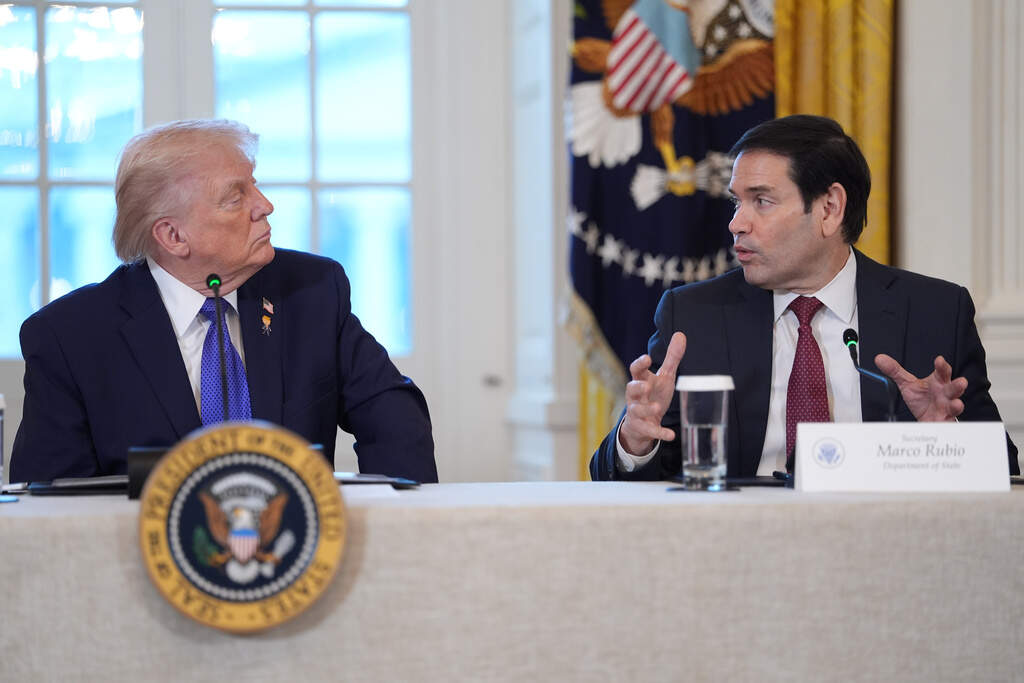
Many legal experts say the Trump administration's attack on Venezuela broke international law. But Trump doesn’t seem to care. What does that say about the strength of international law?
Guests
Rebecca Hamilton, professor of law at American University’s Washington College of Law. Previously worked as an attorney in the prosecution division of the International Criminal Court. Executive editor at the publication Just Security.
Scott Anderson, fellow in Governance Studies at the Brookings Institution. General counsel and senior editor for the publication Lawfare. Former U.S. diplomat and government attorney.
The version of our broadcast available at the top of this page and via podcast apps is a condensed version of the full show. You can listen to the full, unedited broadcast here:
Transcript
Part I
MEGHNA CHAKRABARTI: On January 5th, two days after the U.S. strike on Venezuela, the United Nations Security Council held an emergency meeting. Many leaders from around the world sharply criticized the Trump administration. They said the attack on Venezuela violated international law.
But three days later, here's what President Donald Trump told reporters from the New York Times on January 8th.
REPORTER #1: Do you see any checks on your power on the world stage? Is there anything that could stop you if you wanted to?
DONALD TRUMP: Yeah, there's one thing, my own morality, my own mind. It's the only thing that can stop --
REPORTER #2: Not international law?
TRUMP: And that's very good. I don't need international law. I'm not looking to hurt people.
REPORTER #2: Do you feel your administration needs to abide by international law in the global states?
TRUMP: Yeah I do. I do, but it depends what your definition of international law is.
CHAKRABARTI: Joining us now is Rebecca Hamilton. She's a professor of law at American University's Washington College of Law.
She previously worked as an attorney in the prosecution division of the International Criminal Court, professor Hamilton, welcome to On Point.
REBECCA HAMILTON: Thanks Meghna.
CHAKRABARTI: So let's be brutally honest here. Isn't President Trump right? That really there are no truly effective enforcement mechanisms to force him to comply with international law other than his "own morality."
HAMILTON: If he's truly right, then we're in an even worse position than it may feel to many like we are currently in. What he said about enforcement is true of any kind of law. Law is only as good as everybody makes it become. It is something that we set out, we aspire to, and it sometimes gets breached, and we see this in domestic law as well.
We have a law against murder, and yet every day we see that people are murdered. And the question is, what happens when the law is breached? Does everyone just shrug and say, 'Okay, I guess there's nothing we can do about it.' Or do we see consequences? And it's the same for international law.
International law's enforcement doesn't look the same as it does in a domestic system. But when international law is violated, there are consequences. And if there are not consequences, that's when we need to be concerned that it is ceasing to be law. But typically, we would see diplomatic consequences, economic sanctions, a range of measures by those who are watching the violation of international law in order to signal that this was a breach.
When international law is violated, there are consequences. And if there are not consequences, that's when we need to be concerned that it is ceasing to be law.
Rebecca Hamilton
That breach is not okay, and we want to uphold the legal system.
CHAKRABARTI: And where are these consequences now for the United States, for President Trump?
HAMILTON: So one of the challenges is with the post-World War II International order that was set up, has put the United States, along with the United Kingdom, France, Russia, and China as the permanent five members of the UN Security Council.
In that post-World War II system, those permanent five members of the UN Security Council have a role to uphold international peace and security. And that is fine for them to be the guardians of peace when there are other people violating the law. But what happens when one of those permanent five members becomes the aggressor?
The violator of international law. That's what we've started to see. We saw it first with Russia's invasion of Ukraine. And now we are seeing it with the U.S. and what we've seen take place in Venezuela.
CHAKRABARTI: Okay. So there's just, if I may, I have the utmost respect for your work.
And by the way, I should mention that you're also executive editor at the publication Just Security, which many people look to for guidance in times like this, like legal insight. But today I'm really going to push a particular point and I'm eager to hear all of your counter arguments.
Okay, professor? And that is, right now, on the ground, in reality, not just due to the five permanent members of the security council, but due to, let's say, a collapse or a cracking of that post-World War II consensus, as you talked about, regarding what the consequences are following or not following international law. That it seems to me that President Trump is right. Because there's no, there was an action against Russia, as you said, following the invasion of Ukraine. A lot of that action though came from individuals, individual nations, and nothing terribly effective, I would say, out of the security council. Because Russia being a member thereof.
Am I wrong?
HAMILTON: I certainly think Ukrainians would agree with you. I don't think you're wrong about the ineffectiveness of the UN Security Council when one of its permanent members is violating international law, but I'm not willing to cede the ground to say that Trump is simply right about this. Because it casts the violation of international law as an inevitability that we can do nothing about when it happens, and that is simply not true.
Again, law is what we make it, and when I say we here, I don't just mean the five permanent members of the UN Security Council. All of the citizens in every state of the world, at least every state that has a democratic system needs to come forward at this moment and decide, do we want to live in a world that is governed by the rule of law or do we want to be living in a world where it is just might makes right.
That is the challenge, and it's been put to us in extremely stark relief by that Trump interview excerpt that you played. It's a moment of decision. What is the kind of world that we want to live in? And law and power are always intertwined. I'm not suggesting that they aren't. But there's a very big difference between recognizing that law and power are intertwined, and having one of the most powerful, arguably the most powerful nations on earth, acting as though law doesn't matter at all.
CHAKRABARTI: Indeed. So the might makes right is something that has been so clear, a belief that has been so clearly articulated by the Trump administration that I agree with you. They are setting up a challenge for the international community, right on the validity and purpose of international law. A couple of days ago we played some tape from Stpehen Miller, who's the white House Deputy Chief of Staff of Policy, and he absolutely said, power and force are the only things that he and the Trump administration believe matter anymore.
So I guess my next question then is now that the gauntlet essentially has been laid down by Vladimir Putin first, Donald Trump second, what are the, let's talk in theory, first of all. What are the things that the international community, those that still abide by international agreements and law could do in the U.S.-Venezuela situation?
HAMILTON: So first let me say I agree 100% that the gauntlet has been thrown down. Second, I'd say it's never easier to stop a situation from deteriorating than it is at the first point that you see it. And action is better to be sooner rather than later. What would those actions look like?
We understand the UN Security Council is going to be blocked because of the U.S. veto, but that doesn't stop the UN General Assembly, the 193 other states in the United Nations from coming together and condemning in the strongest terms what took place under Operation Absolute Resolve. We saw something like this happen after Russia's invasion of Ukraine.
140 states came together in that plenary body of the UN General Assembly and said, this is not okay. This is not the international legal order as we understand it. And what followed have been sanctions and condemnation, and as imperfect as all of those things are, and certainly Ukrainians would say it is not enough.
It's not. But it still strives for that vision of international order that is governed by law instead of by power. And we need to see those same things happen here again now in response to what the U.S. has done in Venezuela. The consequences, if we, and again I'm using a very broad definition of we, it's each and every one of us, don't take action now. Then it is handing over to those who want a world in which might is right. It's handing that over to them. And they'll take it. And the world has learned these lessons before, and it would be really great if we don't have to learn them again by yet another World War.
The system that we have in place now was the product of absolute devastation through two world wars. After which time the international community came together and decided that this was not the way forward, that instead we wanted to move to a law-based system. Key to that was this Article 2(4) of the UN Charter that says, One state can't threaten or use force against another state.
This is not a way to resolve your disputes. And so that's the choice before us today.
CHAKRABARTI: It seems to me, to be frank, and please do correct me if I'm wrong, but the kind of international consensus that we're talking about regarding how to have a planet, right? That won't destroy itself completely, but [that] consensus have come after near total destruction, right?
The first World War brought about League of Nations, for example, as imperfect as it was. The Second World War, as you mentioned, brought about this sort of new perspective that stayed with us, what, for 70, 80 years? Did you think it could require a, I mean you mentioned another World War.
Would we have to get to that point to rebuild the consensus that it's not great for countries to just be smashing each other all the time?
HAMILTON: I certainly hope not. And I mean it would be such a dishonor to all of the lives that were lost in both of those world wars if we didn't take the lessons that those generations learned from those wars seriously. Again, it is put very starkly before us what the choice is in this moment, and it's upon each of us to figure out how to act in response to that choice. This is nations all around the world. It's also, and we might talk about this later, but it's also the U.S. Congress has a really important role to play in this moment as well.
CHAKRABARTI: Just briefly before our first break. I wonder if the bluff has been called on the influence of a UN condemnation long ago, right? Not just Russia, but I think I can't even count how many UN condemnations have gone against Israel. Is this just, is this only different because we're talking about the world's most militarized country, the United States, the world's biggest military and economy as well.
HAMILTON: Look I think it's the value of UN condemnation is not only towards the aggressor state, in this case the U.S., but it's also the signal that it sends to every other leader that might be watching. And that is a really important norm to uphold so that we don't see a further escalation.
Part II
CHAKRABARTI: I'd like to bring Scott Anderson into the conversation now. He's a fellow in governance studies at the Brookings Institution, General Counsel and senior Editor for the publication Lawfare. Also, a very highly respected legal publication. Scott's also a former U.S. diplomat and government attorney, Scott Anderson, welcome to On Point.
SCOTT ANDERSON: Thank you for having me, Meghna.
CHAKRABARTI: I'd like to spend the next few minutes talking with you and Rebecca both about what specific aspects of bilateral or multilateral agreements or international law as we understand it, apply or could apply to the Trump administration's attack on Venezuela.
First of all, Rebecca had mentioned the UN, Article 2 of the UN Charter. Scott, can you just briefly explain what that is?
ANDERSON: Sure. Article 2 really contains, and particularly Article 2 for the foundational commitment and prohibition of the UN Charter system, which is a prohibition on the interstate use of force, a force between two states.
That is one of the big objectives of the UN system, is to limit the use of military force, and that's, of course, the prohibition that the Trump administration in taking military action against Venezuela is violating, or at least arguably violating.
CHAKRABARTI: Okay, so let's listen to how the Trump administration itself has dealt with the question of the violation of Article 2.
Here's the U.S. Ambassador to the UN Mike Waltz. He was on Fox News's Sunday Morning Futures on January 4th. This was the day after the U.S. attack and a day before that emergency UN Security Council meeting. And here's what he said about international law.
MIKE WALTZ: You're going to hear a lot of hand wring on Article 2 of the UN Charter, which deals with sovereignty.
I will remind everyone of Article 51, which is a nation's inherent right to self-defense. You have a drug kingpin, an illegitimate leader coordinating with the likes of China, Russia, Iran, terrorist groups like Hezbollah, pumping drugs, thugs, and weapons into the United States of America, was President Trump just going to let that status quo continue?
CHAKRABARTI: Professor Hamilton, I'd love to hear your response to that.
HAMILTON: Yes, everything that he listed, even if it were true, would not count as self-defense under international law, the exception that we have to Article 2(4) of the charter for self-defense is an exception for a situation where a state is facing an armed attack or an armed attack against it is imminent.
International law doesn't expect you to be a sitting duck and just have an armed attack happen. You are able to defend yourself if it is necessary and proportionate. The drug trade, as horrific as it is, and no matter the number of human lives that it is costing, it is not an armed attack. And therefore, it doesn't fall under one of the exceptions to the use of force under the UN charter.
CHAKRABARTI: Scott, your take. I agree with everything Rebecca just said, but it's worth noting that the Trump administration, at least, is on the record not agreeing with that, they have put forward an international legal justification for the maritime strikes it's been suing, pursuing against alleged drug traffickers, where essentially they posit that narcotics trafficking in the United States, combined at least with a variety of other kind of undefined factors, make it to that Tren de Aragua.
One of the key cartels that it has been targeting those strikes, is engaging in a quote-unquote armed attack that gives rise to a right of self-defense. And I suspect that's the same argument where it hasn't quite said as much anymore clearly than what we heard Mr. Waltz say in that comment.
I suspect it's gonna make the same argument ultimately regarding Maduro, because of course it has been arguing all along that Tren de Aragua is simply acting as an agent of Maduro and the Maduro regime. That is a hugely destabilizing interpretation of international law. Because in opening the door to treating narcotics trafficking as an armed attack, I think you are opening the door to treating lots of things as an armed attack.
In opening the door to treating narcotics trafficking as an armed attack, I think you are opening the door to treating lots of things as an armed attack.
Scott Anderson
And you would be opening the door to military responses for all sorts of conduct, which is exactly what the UN charter was supposed to prevent from happening, but I do still think that they are making an argument that tries to fit into these international law forms. I think we're going to see them do the same thing in the Maduro operation ultimately.
CHAKRABARTI: Here, in fact, is what President Trump said on January 3rd, and a part of his justification for the administration's actions.
TRUMP: The illegitimate dictator Maduro was the kingpin of a vast criminal network responsible for trafficking colossal amounts of deadly and illicit drugs into the United States. As alleged in the indictment, he personally oversaw the vicious cartel known as Cartel de los, which flooded our nation with lethal poison, responsible for the deaths of countless Americans.
The many Americans, hundreds of thousands over the years of Americans died because of him.
CHAKRABARTI: Professor Hamilton, can you gimme a more specific information on Article 2? Does it specify armed attack?
HAMILTON: So it's Article 51 of the charter that provides this exception for a self-defense.
CHAKRABARTI: Oh, 51.
Excuse me, I'm getting my articles confused. Go ahead.
HAMILTON: That's alright. But yes, it is specifically an armed attack, and it is narrow and specific for a very important reason. Again, back to our conversation in the post-World War II era, there was a real understanding that we needed to stop a system where one country who had a disagreement with another country could just use force against it.
And so it was very intentional that this exception for self-defense would be narrow. And as soon as you start to open that door to self-defense being justified, any time that one country perceives that it is being threatened by another country, then the whole thing will start to crumble.
Because while the Trump administration may in very good faith believe everything that it is saying about Maduro, about the Venezuelan regime and I'm certainly not here to justify or condone what has been a terrible situation for Venezuelans for a long time. But as soon as you open the door in one case, then what is to stop the next person?
What is to stop? Xi Jinping saying, I see Taiwan as a threat to China, and so I'm going to use force there. So that's the reason why it is so narrow.
CHAKRABARTI: So this again, is one of those points in which I do wonder if that post-war legal consensus, while effective for more than half a century, has now become too antiquated and just irrelevant for the modern era.
Scott, you said that the Trump administration's justifications may be dangerously opening the door to considering many other things as a form of attack on a nation. But I just, I do wonder, there are other things that could potentially be equaling, equal, if not more damaging to a country, that you wouldn't have to fire a shot for.
There's technological warfare, there's crippling a nation's infrastructure through, I don't know, taking out their satellites or turning off their lights. There's even the long-term really catastrophic effect of economic sanctions. In this day and age, it seems to me you do not have to launch a hot war to threaten the sovereignty of another country.
So isn't the Trump administration, while they may be opening the door, are they not right to do so given what modern day, I don't even want to call it warfare, but national aggression might look like.
ANDERSON: Notably, exactly what you just described, that logic is something the United States has opposed in recent years.
Because one of the biggest users of economic sanctions among other indirect tools is the United States, and they have been very reasonably, very hesitant to open the door to the suggestion that such tools could be rise to the level of an armed attack. And of course, those tools, many of them, some, there are new ones like cyber incidents, cyber-attacks, things like that.
Economic sanctions existed at the time of the UN charter system. The authors knew those tools were on the table. In fact, they were a big focus of the World War I League of Nations system as a set of sanctions to try and regulate against the use of warfare. They saw armed attacks as uniquely different, particularly because they knew they were in a nuclear era.
And notably, I would just posit, I'm not sure that it's clear the vast majority of countries have moved away from that or even the United States in a major way just because of this one incident. The United States and other countries have done damaging things that are violative of these principles before, but these principles have persevered.
Because there's a lot of logic to them. There's a reason a lot of states are wedded to them, and you can damage the system. You can hurt the system without tearing it down entirely. And I think that might be a better way of framing what may be happening here. I would not argue, I don't think anyone would argue this is good for the international system.
It's definitely not. But I don't think that means that the international system is dead or that it stopped having power or consequences for states that violate it. And I think that's something the United States is about to experience.
CHAKRABARTI: Professor Hamilton, your response.
HAMILTON: So I agree that it's not dead yet, but I do think it's really an incredibly important moment to recognize that the actions that everyone in the international community as well as here in the United States takes in this moment, are going to help determine whether the international order, as we've known it since the end of World War II survives.
And given the transnational nature of so many of the challenges of the 21st century, when you think about nuclear weapons, when you think about AI, when you think about climate, all of these things are going to require an international community that is able to come together on important issues.
And if we move back to a might makes right system then I think we lose the ability to do that. So I'm maybe more terrified about this current moment than Scott. But I think we're on the same page that the system is not dead yet. I think it depends on the actions that we take in the coming months.
CHAKRABARTI: So we talked about two aspects of the UN Charter. Professor Hamilton, what other aspects within the UN charter itself or other areas of international law come into play here?
HAMILTON: Yeah. Turning to my international criminal law background this action in Venezuela is an act of aggression.
It's an international crime. When you are using the state's resources to do something that is in such clear violation of Article 2(4) of the charter. Now, I think that's actually the less important conversation to be having in the moment because there is no court on the planet that I can realistically see trying to move forward with a prosecution of President Trump.
And in any case, while he's the sitting president, he has head of state immunity as by the way arguably does President Maduro. But that is something that will need to be dealt with in due course as well. So we have not only a violation of the charter, but we also have what the people who were prosecuting at Nuremberg understood to be the crime of crimes, this crime of aggression.
CHAKRABARTI: May I just jump in right here? If, as you just said, no court, let alone the International Criminal Court would dare to move a prosecution against Trump as a sitting president, that part's understood. But even after he exits the White House. Haven't we just belied the fundamental weakness of the ICC?
HAMILTON: Okay, let me say I misspoke if I said wouldn't dare to. There's a jurisdictional issue for why the ICC can't undertake this prosecution. But for courts around the world, they can't undertake the prosecution while he's a sitting head of state because of head of state immunity.
But they can after he leaves office.
CHAKRABARTI: Do you think anyone would dare? I'm just going to put it that way.
HAMILTON: After he's out of power, it's possible. We've certainly seen leaders who seem to be invincible for the longest time, subsequently be held to account.
CHAKRABARTI: So give us an example. This is important. Give us an example.
HAMILTON: Yeah. Miloševic, for example. In the former Yugoslavia, it would be a great example. He was seen to be invincible. Right up until he wasn't. And so again, though, I think that's not the pressing issue right now. The pressing issue is how we going to sustain Article 2(4) so that we uphold the international order.
And I'd also say there's nothing even while Trump is the sitting head of state here, that means other domestic courts can't prosecute him. But our own domestic courts. If we wanted to, we could make that decision.
CHAKRABARTI: We could, but the Supreme Court and Trump v. USA basically said you can't.
The reason why I'm pressing this for both of you, and please forgive me about this, for this, but Professor Hamilton, earlier, you said something very important, right? That to uphold international law, it takes the belief of all of us. You even said down to the individual person, but there's a huge amount of, I would say cynicism about the effectiveness of international law down to the person in the United States.
Which is why even though the example of Miloševic may not be the most pressing thing right now, we'll get back to Article 2(4) later. Can you just give me a little bit more information or give us more information about that?
Because if you cite that as a moment in which international violations were ultimately held to account, let's learn from it.
HAMILTON: So I actually want to flip this.
Because I think what you said about belief in international law down to the individual person speaks to something about international law that I've always felt, which is that it has a marketing problem. In that it does most of its good work in ways that are unseen.
International law works hardest for non-events, for the invasion that doesn't happen. For the bombs that are not dropped, for the person that is not tortured. This is the work that international law is doing each and every day all around the world, and regular people don't hear about it because they're non-events, the news media is not coming out and reporting. International law was upheld today. There was no invasion of country X, Y, or Z. We only hear about it when there is a breach. And that's human nature, that we pay attention to events, not to non-events. But I think it puts international law always in this kind of defensive posture.
And I really want to make this sort of fulsome case for all of the work that international law does in order to stop things happening so that we are not focused on it all the time.
CHAKRABARTI: Scott we have another minute before our second break here. Did you want to respond to what Rebecca Hamilton has said?
ANDERSON: All I would add to it is the focus on formal mechanisms of accountability overlooks the actual meaningful short-term consequences of these unlawful decisions for U.S. policy in the United States, which is that the United States needs allies to coordinate with it.
Particularly in pursuing maritime or enforcing counter-narcotics trafficking, in rebuilding Venezuela, it needs markets for whatever oil it hopes to remove from Venezuela, that's going to treat that oil as lawfully removed, and that people have lawful title to it.
And it's going to need people to recognize the government that it's set up in Venezuela. All that becomes massively harder when it acts in clear violation of international law and doesn't even try and justify its actions in the scope of international law.
In the short term, I think those mechanisms are what are ultimately going to push the United States to really have some consequences from this and why it's going to have to drift towards trying to make at least an argument about why what it's doing is consists with international law. And frankly, those consequences are really what hits U.S. policy most directly in this area.
Part III
MEGHNA CHAKRABARTI: Here is President Donald Trump talking about the U.S. strike. This is on January 3rd, the day of the attack, and he seemed to justify the administration's actions this way.
TRUMP: We built Venezuela oil industry with American talent, drive and skill, and the socialist regime stole it from us during those previous administrations, and they stole it through force. This constituted one of the largest thefts of American property in the history of our country. Considered the largest theft of property in the history of our country.
Massive oil infrastructure was taken like we were babies, so we didn't do anything about it. I would've done something about it. America will never allow foreign powers to rob our people or drive us back into and out of our own hemisphere. That's what they did.
CHAKRABARTI: Scott Anderson, let me just get your quick thoughts on this, because the argument that Venezuela stole U.S. paid for oil infrastructure in Venezuela by force.
I'm not quite sure how that. I just don't even understand really that, do you have any thoughts on that?
ANDERSON: Sure. I believe this relates to longstanding claims primarily by U.S. oil companies. That this is something the Chavez government did in around 2007, 2008. And there may be very, be validity to it, and that can be notably in violation of international law.
It can be an unlawful expropriation of that property. Notably, however, a violation of expropriation prohibitions international law is not an exception to the UN charter. On the prohibition, on the interstate of use of force. In fact, the UN charter was specifically designed to limit the use of force as a remedy for everyday violations of international law, lower violations of international law.
The only exception is the one in Article 51 for self-defense, because that was deemed as the most dire circumstances where states still needed to be able to use force. And so what the president's describing, may be describing a legitimate violation of international law by Venezuela. Does not help legitimate the use of military force in the eyes of international law.
International community, or frankly, as the way the United States has always understood it.
CHAKRABARTI: Okay. Thank you for clarifying that. Okay. So for both of you, what I'd like to do is spend the rest of the program looking forward, like what's the way forward here when this sort of challenge, not this direct challenge to the validity of international law is coming from the United States itself. And Rebecca, I'm wondering what your thoughts on what Scott had said before the break, that perhaps the mechanisms of law aren't the thing that right now will temper the Trump administration, but rather the economic and larger logistical impacts of the attack on Venezuela, how that will affect the United States operation.
With its own allies or even potential markets. There's always been a connection, right, between law and these economic aspects or consequences. And I'm just wondering what you thought of that.
HAMILTON: Yeah, I don't actually see the enforcement of international law as something that just happens in courts.
I think what we see happening in courts is a very small piece of the puzzle of how international law works, and so much of it is about those things that Scott mentioned in terms of economic sanctions and intelligence sharing decisions and diplomacy. I think that's all part and parcel of the system and all of it is important.
I would say I've been really disappointed in the reaction of some nations that I was hoping would be coming out really strongly in support of the rule of law in recent days.
CHAKRABARTI: Such as who, which nations?
HAMILTON: In particular, the United Kingdom. Putting out these sorts of mealy mouth statements that say, quite rightly condemn everything that happened on the Maduro regime. And then make a general vague statement about how international law is important. Rather than actually calling out the direct violation of international law that we've seen.
And as my kids were going to school this morning, I was thinking about this in terms of you have the bully in the school playground, and what do the other kids do? Are they bystanders just hoping that they're not going to be picked on next, which just emboldens the bully? Or do they come together and say, no, that's not okay, and it's really coming together that I am hoping to see in the coming weeks.
CHAKRABARTI: It's interesting that bully analogy because I was thinking it applies when the bully is a student. But given the United States place in the global order, in this case, isn't it more like the bully is the principal of the school?
HAMILTON: I don't know that I would give the U.S. quite that much power. (LAUGHS) There are, yeah, no I don't think that the U.S. is the king of the entire system. There are lots of really important and powerful other players that have some say here.
CHAKRABARTI: So here's why I asked that, because, okay, again, this is all theoretical moving forward, but, if say, the United Kingdom. Let me ask a specific question rather than theorizing out of my own head. What would you have the UK do instead?
HAMILTON: Come out clearly and say this is a violation of the bedrock principle of the UN Charter. And organize within the UN General Assembly to have that kind of collective action that we saw in the face of Russia's aggression against Ukraine, which did help countries move on those other pieces of enforcement that Scott was talking about. In terms of economic sanctions, in terms of diplomatic sanctions, and now all of this is imperfect. I absolutely recognize it's not Ukrainians aren't under attack today. The situation was even worse in terms of much, much worse in terms of the response to Gaza.
But again, just because we're not looking for perfection here, we're looking for upholding the vision. That we wanna live in a world that is governed by law instead of by raw power.
CHAKRABARTI: Oh yeah. So I'm gonna turn that to Scott actually, but by the way, just, I just remembered, what is it?
Orwell called Britain in the face of the United States, Airstrip One. I think that's from I think that's from 1984. I might be wrong, but Scott, so actually what Rebecca's saying, I'd love to hear your thoughts on this because, okay, say that key members of the international community did get together, went to the UN, issued condemnation, set the stage for economic sanctions.
To your point earlier, let's press that against reality. Do you think key members of the international community would actually go so far as to sanction, economically sanction the United States in whatever way they might conceive.
ANDERSON: It's unlikely, I think from a formal sanctions perspective, and it's particularly unlikely at this particular moment because the most, the states that could provide the most important counterweight, which would be European states, are still concerned about Ukraine, right?
And U.S. cooperation in Ukraine, which need to very badly. The simple truth is all the decision states make. Are made against a matrix of all sorts of different interests and considerations. International law is one of them, a significant one. I think in the eyes of many states, one that's often reinforced by their domestic legal systems.
It's worth noting. But not the exclusive one. And these responses are always going to be balanced. That doesn't mean that public denouncement is the only mechanism available or the only way that these states will have ways to express their discontent or discomfort with the situation. In my mind, what I am looking at next is to say, to what extent does the UK or France or other states actually participate in the reconstruction of Venezuela?
Or what extent do they continue to cooperate militarily with the United States on operations in the Western Hemisphere, where we've already seen them ratchet back substantially, and where the UK in particular, along with Canada, a couple other countries, actually played a substantial role. Those were all things that really impose costs on the United States.
Imagine if many other states aren't willing to accept the validity of whatever regime the United States ends up setting up in Venezuela and therefore won't purchase its oil because they are not going to be able to see that regime as having a lawful title to transfer that oil.
So people who buy it there in those countries may not be able to be confident they're going to exercise ownership rights over it, or maybe they'll face litigation from the opposition movement that's still recognized as the government of Venezuela by many of those countries. It's a very complicated legal situation.
In the end, international law is, more than anything, a coordination mechanism between states. It helps states understand if we stay in the zone, other states will accept the legitimacy of what we're doing. So when you act outside of that, particularly when you are a market economy like the United States, that inherently, because you're talking about exporting and trading goods, needs other states to accept the validity of your actions.
You step outside of international law at your own risk. Because it makes everything much more expensive and complicated and costly to do internationally. And President Trump will be held accountable for those costs domestically, politically, including potentially by Congress as we saw last week by members of his own party.
So it's not cost free. Breaking international law does have real costs and consequences. Including in the near term, but you have to look at the whole universe of consequences the United States is facing. You can't focus too narrowly on the most obvious mechanisms. Because in a lot of ways, those are the ones that are least likely to be used against a powerful state like the United States.
CHAKRABARTI: Okay, so this is really good. Because the explanation both of you have given about potential consequences even today, even with a Trump administration in power. It's quite convincing, but let's talk for a minute or two more about the deterrence part here. And Rebecca, you had mentioned this earlier, that all the successful deterrence that has been achieved by the UN articles that we talked about, the ICC, maybe even the International Court of Justice, that never makes it into the news.
That is a fair point. I will concede that. But do you think that, again, given this sort of new paradigm, and I would argue that it is a new paradigm that we have here with Trump's behavior in Venezuela, that those deterrence mechanisms are still enough, or do we need something more to match the new paradigm?
HAMILTON: Gosh, let me say, I don't want to accept that we're in a new paradigm yet. I think there's still space to fight for preservation of the existing paradigm, which really holds to the belief that law matters and that you can't just go on use force, the Stephen Miller view of the world effectively.
But I do think as you were turning to looking forward, that we also, as much as I've been fighting very hard on this conversation for upholding the UN charter, we need to recognize there are some structural problems with the system that we set up after the end of World War II.
At that time, there were about 51 states in the world, pre decolonization, and that was the basis on which those permanent five members of the UN Security Council were selected. For many people around the world, that doesn't feel like a legitimate system today. You've got 54 countries in Africa. None of them have a permanent seat on the UN Security Council.
So I do wonder whether part of this moment that people always talk about crisis as opportunity, it doesn't, it's very hard to feel positive right now. But to the extent that it forces some scrutiny of how sustainable the structure of this system is as we try to tackle 21st century challenges, it seems like an important moment to bring those issues into the conversation as well.
CHAKRABARTI: Scott, would you like to respond to that? Because Rebecca, by the way, I take your point about I've been pushing you to defend the legitimacy of the United Nations even writ large, but it's purposeful. And Scott, let me ask you about this, because again, yes, partly because the media constantly covers failures.
But I think there are a lot of people out there who say, okay, if not, just ignore the UN or tear it down, that some kind of restructuring, as Rebecca has said, is necessary to meet the demands of what it takes to uphold international law. And that's the fundamental principle of international cooperation in the 21st century.
Your thoughts on that.
ANDERSON: I think there's certainly a case to be made. We saw both the Biden administration engage on UN reform issues, particularly during its presidency on security council. We see the Trump administration today, making addresses, rolling out programs for reforming the UN. I believe they have a specifically designated representative there, specifically working on un reform issues, although I'll be in a very different direction than the Biden administration was exploring. That's definitely a possibility. We do have to acknowledge institutional reform at that level is going to be a challenge because it is going to require pretty broad international consensus.
I think it's a process worth pursuing and debating. But it's probably not any short of short term solution. In the short term, the solution is going to come from states and making their individual choices and policies. We saw that in a response to Ukraine conflict, where the Biden administration and the United States led a really impressive global coalition.
Coalition, excuse me, taking pretty substantive steps, not maybe as effective as one film would've liked. Maybe there are other tools they could have used, but nonetheless, doing really dramatic things that hadn't been done before to reinforce the norm against state-on-state conflict. And in the end, I do think that's where the solution lies on this.
And this is actually a challenge for a lot of the states that really care about this.
Because they are going to be balancing the United States actions against actions like Russia, where the United States removal of Maduro is, I think, really intention with the international system. From a policy perspective, many of these states probably don't see as big a problem with it as they do with Ukraine, from a strict policy perspective, because Maduro was a problematic leader with a human rights record that was atrocious who was engaged in lots of destabilizing problematic behaviors in a way that Zelenskyy was not, right. And that Taiwan is not. And they're going to be more worried about those actions by other states in other areas.
I suspect that's why the direction we're going to see them push in, but I think it's a productive one, if not one for a perfect universe, is that they're going to try and push the Trump administration to say, frame your actions international law, make a case for them, argue for them, even if it's this drug trafficking argument that many states will not accept, that we all think is problematic.
We're going to keep saying is problematic, as they should. But if you frame it international law, the hypocrisy of simply asserting that statement, while, you know, acting in a way contrary to most international systems, you're still reinforcing the overall norms.
The fact that Article 2(4) does still matter. The fact that while the United States may have a very broad conception of self-defense rights. There's still some limits out there, and that conception doesn't reach to invading Ukraine and invading potentially Taiwan. It's a complicated case.
That's where I think the direction is likely to go on this, and that is going to be a complicated one, but it also means that international law isn't dead. It still matters and it still even matters to the United States.
CHAKRABARTI: Yeah. Rebecca, we only have about a minute left, and I want to hand you an olive branch here at the end of the conversation. Because I wonder if I'm questioning myself if I've been overthinking this whole thing, listening to both of what you and Scott have to say.
Because right now what we have is actually also a unique figure in the White House, right? He said in that clip that we played at the top of the show, he's very clear that like he only answers to his own morality. He does not care what the international community thinks. Is international law actually healthier than I think it is right now?
Because perhaps all it might take is, through a future election in the United States, a different president to be sitting in the White House, to return the United States as a leader in that global, that post-war consensus we talked about.
HAMILTON: Unfortunately, I don't think we have the luxury of waiting to see if there will be a different leader with a different vision.
President Trump is the president of one of, or if not the most powerful nation on earth right now. And I think we have to deal with the reality that he is someone that thinks all he needs is his own morality as the guardrails for the international system. So I think it's incumbent on all of us to stand up and say what kind of international order we want to live in.
The first draft of this transcript was created by Descript, an AI transcription tool. An On Point producer then thoroughly reviewed, corrected, and reformatted the transcript before publication. The use of this AI tool creates the capacity to provide these transcripts.
This program aired on January 12, 2026.