Support WBUR
Has Trump's erratic behavior gone too far?
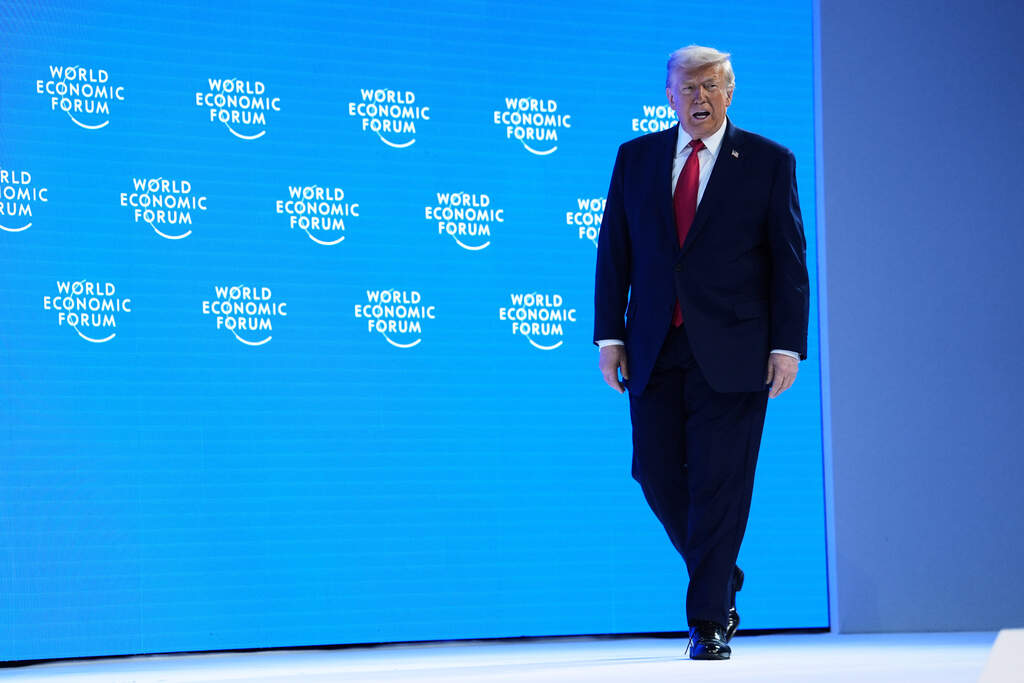
President Donald Trump's fixation on Greenland is alienating some Congressional Republicans and American allies. Has Trump's erratic behavior crossed a line?
Guests
Ambassador John Bolton, former U.S. national security advisor.
Ilya Somin, professor of law at George Mason University. B. Kenneth Simon Chair in Constitutional Studies at the Cato Institute, a right-leaning think tank.
The version of our broadcast available at the top of this page and via podcast apps is a condensed version of the full show. You can listen to the full, unedited broadcast here:
Part I
MEGHNA CHAKRABARTI: Depending on what headlines you read in Davos, Switzerland yesterday, President Trump either further alarmed European leaders or magnanimously reassured them of his peaceful designs on Greenland. You can pick any five second soundbite you want. So instead, we're going to offer you an extended excerpt of what the president said in context.
DONALD TRUMP: We probably won't get anything unless I decide to use excessive strength and force where we would be, frankly, unstoppable. But I won't do that. Okay. Now everyone's saying, Oh, good. That's probably the biggest statement I made. Because people thought I would use force. I don't have to use force. I don't want to use force; I won't use force.
All the United States is asking for is a place called Greenland. Where we already had it as a trustee, but respectfully returned it back to Denmark not long ago, after we defeated the Germans, the Japanese, the Italians and others in World War II. We gave it back to them.
CHAKRABARTI: Now, of course, the headline there is that Trump, for the first time said he does not want to use force to take Greenland, but as is common with the Trumpian verbal train, his most important statement was then followed immediately by a justification, which was based on fantasy. The United States did not and has never possessed Greenland. There was nothing for the U.S. to give back to Denmark after World War II, as Denmark's colonization of Greenland dates back to the 1720s.
Well, undeterred, Trump called Greenland, quote, ungrateful. And demanded, quote, immediate negotiations on the U.S. acquiring the territory. Or as he referred to it:
TRUMP: Big, beautiful piece of ice. It's hard to call it land. It's a big piece of ice.
CHAKRABARTI: And also, at least four times in his speech, Trump confused Greenland for Iceland, like in this section where he again complained about NATO.
TRUMP: With all of the money we expend, with all of the blood, sweat, and tears, I don't know that they'd be there for us. They're not there for us on Iceland. That I can tell you. I mean, our stock market took the first dip yesterday because of Iceland. So Iceland's already cost us a lot of money.
CHAKRABARTI: And then there was this one.
TRUMP: I'm helping Europe, I'm helping NATO. And I've, until the last few days when I told 'em about Iceland, they loved me.
They called me daddy, right? The last time. Very smart man. Said, He's our daddy. He's running it. I was like running it. I went from running it to being a terrible human being.
CHAKRABARTI: Now the British newspaper, the Guardian reports that NATO Secretary General Mark Rutte did refer to Trump as, quote, 'daddy' at a summit in June.
Trump reportedly compared Israel and Iran to two kids in a school yard fighting, and then Rutte equipped that, quote: "Daddy has to sometimes use strong language." End quote.
Well, in fact, at the beginning of this week, Trump infuriated virtually all of Europe when he used strong language in a message to Norway's president. Trump complained in the message about not receiving the Nobel Peace Prize. Saying: "I no longer feel an obligation to think purely of peace."
End quote. He questioned Denmark's rule over Greenland: "There are no written documents. It's only that a boat landed there hundreds of years ago." And he finished off the letter with, quote: "The world is not secure unless we have complete and total control of Greenland. Thank you! President DJT." End quote.
Well, in the past two weeks, European leaders and leading politicians and analysts here in the United States have been saying repeatedly that if Trump tries to take Greenland, it would signal the end of NATO, America's longest standing alliance. Trump has long been disdainful of NATO, and even in the face of such warnings at Davos yesterday, the president did not budge from that view.
TRUMP: It's a NATO alliance. The United States is treated very unfairly by NATO. I want to tell you that, and when you think about it, nobody can dispute it. We give so much and we get so little in return. And I've been a critic of NATO for many years, and yet I've done more to help NATO than any other president by far, than any other person.
CHAKRABARTI: As a whole, Trump's speech was rife with tangents and digressions. For example, he veered for a while into talking about windmills.
TRUMP: There are windmills all over Europe. There are windmills all over the place, and they are losers. One thing I've noticed is that the more windmills a country has, the more money that country loses and the worse that country is doing.
China makes almost all of the windmills. And yet I haven't been able to find any wind farms in China. Did you ever think of that? That's a good way of looking at it. They're smart. China's very smart. They make 'em, they sell 'em for a fortune. They sell 'em to the stupid people that buy 'em.
CHAKRABARTI: The president is wrong.
China has deployed more wind turbines than any other country in the world, and it definitely does use them to provide about 10% of China's electricity. But back to Greenland. The president has also threatened to impose escalating tariffs on eight NATO members beginning in February, until "such time as a deal is reached for the complete and total purchase of Greenland." End quote.
But yesterday at Davos, he dropped that threat. Now Trump says that he and NATO Secretary Mark Rutte have a Greenland deal, or at least in Trump's words, quote: "The framework of a future deal." End quote. Here's Trump on CNBC.
TRUMP: Well, we have a concept of a deal. I think it's going to be a very good deal for the United States, also for them.
And we're going to work together on something having to do with the Arctic as a whole, but also Greenland. And it has to do with the security, great security, strong security and other things.
CHAKRABARTI: And here's what the president said to reporters about the deal.
REPORTER: Does it still include the United States having ownership of Greenland?
Like you've said you wanted?
TRUMP: It's a long-term deal. It's the ultimate long-term deal, and I think it puts everybody in a really good position, especially as it pertains to security and minerals and everything else.
REPORTER: How long would the deal be Mr. President?
TRUMP: Infinite.
CHAKRABARTI: Now there are no more concrete details of this alleged deal.
In fact, on Fox News yesterday, NATO Secretary General Mark Rutte said that the issue of the U.S. taking control of Greenland, quote, "did not come up in my conversations with the president." End quote. The talks, Rutte said, were focused on the Arctic region as a whole.
Now if this introduction today seems confusing and not capable of following a logical path, that is because we've tried to present the events of the past 24 hours in exactly the way President Trump has uttered them, and after his Davos speech, at a reception with business leaders, Trump said this.
TRUMP: We had a good speech; we got great reviews. I can't believe it. We got good reviews in that speech. Usually, they say, he's a horrible dictator type person. I'm a dictator, but sometimes you need a dictator.
CHAKRABARTI: As the President careens from one threat to another, today European leaders are gathering for a summit in Brussels to discuss transatlantic ties.
A Greenland politician says that Trump's statements have caused "total confusion." End quote. And a U.S. strategist told CNBC that Trump's credibility and that of the U.S. is already permanently damaged in Europe. David Roche said, quote: "Nobody is going to believe him anymore." End quote. So how can European leaders deal with Trump?
How can Trump's own advisors, or more importantly, Republican members of Congress who are voicing their concerns about Greenland a little bit louder every day? How can they deal with the president? Well, joining us now is Ambassador John Bolton. He's a former U.S. National Security Advisor. He served in the first Trump administration from 2018 to 2019, also in a number of other roles in various administrations, including as U.S. Ambassador to the UN from 2005 to 2006.
Ambassador Bolton, welcome to On Point.
JOHN BOLTON: Glad to be with you. Thanks for having me.
CHAKRABARTI: Do you think the terms of the relationship between the United States and Europe maybe cooled off, or stepped back from the brink yesterday with what the president said at Davos?
BOLTON: I think he made two amazing reversals. First saying he would not use force and then withdrawing the threat of tariffs.
And I think we obviously don't know very much about the specifics of what Trump and NATO Secretary General Mark Rutte talked about, but it sounds to me very much like what we could have gotten through the 1951 Defense of Greenland Treaty between the U.S. and Denmark without all the fuss and bother.
And that this unfortunately was an exercise that caused a lot of tension, I think a lot of damage to the Transatlantic Alliance that was totally unnecessary.
This unfortunately was an exercise that caused a lot of tension, I think a lot of damage to the Transatlantic Alliance that was totally unnecessary.
John Bolton
CHAKRABARTI: There's some reporting, or let's say some presumptions that really what made the president blink is the facts that the markets were signaling that going down this path is, it would be devastating for the U.S.
BOLTON: Well, the markets went down, but it wasn't a catastrophe.
The bottom didn't fall out. I think it was a factor. I think he also was hearing increasingly reports that Republicans in Congress were expressing dissent, and he was worried about actually an overt revolt at some point. And I think also he wasn't seeing any signs that that he was about to get his way. And that he figured this was a way to retreat tactically and incur the minimum political damage from his personal point of view. Which is what I think essentially motivates Trump almost all the time.
CHAKRABBARTI: You know you had said previously in other interviews that even on a good day, President Trump is, quote, indifferent to NATO. I'm wondering if, that he realizes, even though he stepped back from the brink yesterday, if you think he realizes the damage he has done with our NATO allies in pursuing, he's still pursuing this idea of controlling Greenland.
BOLTON: Well, I don't think he cares about it that much. But I think in general, he simply doesn't understand that what he says and how he acts and the kinds of performance he engages in, has consequences. People do take the President of the United States seriously. And he and his supporters say, well, this is all just how Trump bargains.
[Trump] simply doesn't understand that what he says and how he acts and the kinds of performance he engages in, has consequences.
John Bolton
And maybe that's how they bargain in New York real estate deals. But when you're dealing with an alliance like this, people expect that you're going to treat each other in a dignified way. And you're not going to abuse your own friends. There's a distinction between, and for most people in normal life, between being a friend and being an adversary, Trump can't seem to see that distinction.
And he doesn't understand that his behavior damages the intangibles of good faith and reliance and trust that we've built up with allies over decades of effort. Which he is now shredding because he doesn't, he just doesn't understand it. That doesn't quantify in dollars and cents terms, and I just don't think it's something he understands.
Part II
CHAKRABARTI: Ambassador Bolton, I just would like to quote back to you something that you said just a couple of days ago to the outlet Euronews. And I want to ask you this because even though the president has stepped back, at least for today, on his threats of possibly using force to take Greenland, you had said back on, excuse me, January 14th, that quote, I think just the talk of using military force is costing the U.S. in terms you can't even calculate in terms of trust and good faith and our reputation.
Now that alongside what you just said to us about the president can't even see the distinction or recognize the impact that his words have. I mean, talk to me a little bit more about what it has already cost the U.S.
BOLTON: Well over a long period of time, U.S. leadership in the NATO alliance and in many other alliances and partnerships around the world has served our interest significantly.
And it served the interest of other members of the Alliance too. This is, NATO is, I think, human history's most successful political military alliance. But you can't quantify that. It's not just a question of how much the members spend on defense. Although I do think that many NATO members have not spent what they should have. That's not an excuse for one partner or another to berate the others in public.
It is something that needs to be worked on. Nobody should underestimate when members are not pulling their fair share. But Trump's approach here which his supporters say is just the art of the deal. You know, you take a maximalist position and then you compromise. That's not bargaining, that's destroying the fabric of the alliance itself.
You can have strong disagreements with somebody without threatening to use military force against them. And what Trump has done is buy this kind of approach. Which, you know, he's a very thin-skinned person when he is criticized, but he feels at liberty to criticize others and then gets surprised when they react to it.
His fundamental misunderstanding is he thinks NATO gives nothing to the United States. That we defend Europe. They don't pay for it. We don't get anything out of it. He has no concept of Winston Churchill's famous admonition, that the only thing worse than fighting without allies, fighting with allies, is not having allies to fight with. Russia and China, which are the two principle threats to American security in the world, essentially don't have allies themselves.
Our allies are not perfect, for sure, but they give us an enormous force multiplier in terms of resources, territory, political support, which Trump just disregards. And I don't think people should be apocalyptic about this, particularly some European leaders.
Our allies are not perfect, for sure, but they give us an enormous force multiplier in terms of resources, territory, political support, which Trump just disregards.
John Bolton
There's no excuse for Trump's behavior. There's no doubt it causes damage, but they need to think of the long term. Trump will be out of office in three years. I understand that sounds like a long time, but the future goes longer than three years and they should not be complicit in what Trump's doing and its damage to NATO and other parts of the partnership.
CHAKRABARTI: Ambassador, I know that I only have you for about five or six more minutes. So there's a bunch of stuff I'd like to hear from you because you have a unique view on this having served this same president in his first administration as a very senior advisor, his thin skin. Did you ever personally run into that while you served in his first term?
BOLTON: Well, it's visible 24/7. I mean, this man has been picked on more than any other American president in our history. More people persecuting, more people are trying to do harm to him. I've never seen anything like it in somebody who is apparently a very successful businessman and got himself elected president two times. You would think that he would feel at the top of his game.
But he's constantly being persecuted.
CHAKRABARTI: Did you, but I mean, in terms of, you said he has very thin skin and that you brought that up, I presume, as an important factor in understanding sort of, you know, how maybe European leaders might deal with him.
I'm really asking when you were in his service as an advisor, did he ever sort of lash out at you at a suggestion perhaps that you made that he didn't necessarily agree with?
I'm trying to get at your inside knowledge of whether the president is persuadable.
BOLTON: Well, he is, and he did lash out. I think for any advisor faced with that, the only thing to do is ignore it and try to focus on the substance. And what we found was the best way to persuade Trump to make certain national security decisions is to play to the aspect of how a particular course of action would benefit him.
He doesn't think in terms of American national security, he thinks in terms of himself. He doesn't have a philosophy. He doesn't do national security grand strategy. So discussing how his particular circumstance is affected is really the best way to persuade him.
CHAKRABARTI: Ambassador, still I find it still very shocking that people with as much experience as you have in Washington are saying quite plainly that the president of the United States does not think in terms of American national security. In your book, in your 2020 memoir, The Room Where It Happened, you said that Trump, you wrote that you think Trump is unfit to be president.
Do you still think that?
BOLTON: I did then and I do now, and that's why I wrote the book, to try in my own way, not interrupted by questions and comments by politicians or newscasters, with all due respect, not being critical of you, but to write a 400-page book that lays out the case.
People can then judge for themselves to hear the whole case presented that way.
CHAKRABARTI: If you believe that he remains unfit to be president, and as you've said today, you've given, you know, pretty deep detail on the damage that even his discussion of taking over Greenland has done to, you know, our nation's longest standing alliance.
Should he remain in the presidency for the next three years?
BOLTON: Well, I think it's inevitable he will remain in the presidency. I don't see him being impeached. I think the first two efforts to impeach him were a mistake. I think the arithmetic under the Constitution is you need two thirds of the Senate to convict.
That was never going to happen, but by impeaching him and then failing to convict, his opponents empowered him, empowered him after the first impeachment, empowered him after the January 2nd impeachment. And helped propel him to the place that he is now. So I wouldn't try it again, but I think it'll happen.
CHAKRABARTI: You wouldn't try it again. But there seems to be a tension here though between saying that the president is unfit and that he doesn't think in terms of U.S. national security, but nevertheless, he should remain in office for the next three years.
BOLTON: You have to find a high crime or misdemeanor.
The fact that he's pursuing decisions that are harmful to the United States are not what I think they contemplated when the framers wrote the phrase high crimes or misdemeanors. We don't have a parliamentary system. We have a system of separated powers. And the president gets four terms.
And if we've made a mistake, we're basically stuck for it for four years.
CHAKRABARTI: Four years, okay. Point taken. And I see some of the members of the Republican party who've been willing to criticize him on Greenland, have drawn a pretty clear line that if U.S. military, if the U.S. military were launched to Greenland, that would be their line.
And we're not there yet. I only have you for one more minute Ambassador Bolton, but I presume you've been in the room with some of these European leaders, right now, or NATO leaders. Again, how would you advise them on dealing with Trump now? Because maybe he's saying he wouldn't use the military now, but his erratic speeches and comments over the past couple of weeks make it hard to believe that he would stick to that promise.
BOLTON: Well, he doesn't stick to anything. Sometimes he makes a decision in the morning and then changes in the afternoon. We always used to say no decision is final until it's final, and then sometimes it's still not final.
What I would urge is that as frustrated and irritated as they may be, they have to think in the long term. They have to think of the mutual security we get from NATO and from the connection and not start saying things like, Okay, this is the end. We have to provide for our own defense entirely. Because they will in effect do what the Soviet Union tried and failed to do during the Cold War, which is to split the west.
That's what our adversaries would like to see. We shouldn't do their work for them.
CHAKRABARTI: Well, Ambassador John Bolton, he has served across multiple administrations as everything from U.S. National Security Advisor to Ambassador to the United Nations. He's author of the 2020 memoir, The Room Where It Happened.
Ambassador Bolton, thank you so much for joining us.
BOLTON: Well, thank you for having me.
CHAKRABARTI: Alright, so I've been asking about European leaders and what they think and what they should do right now. We'll listen to some of what they have been saying. In his speech in Davos earlier this week, France's President Emmanuel Macron said, Europe will not bow to bullies.
We need more growth. We need more stability in this world. But we do prefer respect to bullies and we do prefer rule of law to brutality.
CHAKRABARTI: And here's Ursula von der Leyen and she's president of the European Commission. She has repeatedly said that the sovereignty of Greenland is not up for negotiation.
The sovereignty and integrity of their territory is non-negotiable, so a response will be unflinching, united and proportional.
CHAKRABARTI: Well, joining us now is Peter Goodman. He's in Davos, Switzerland today, and he's regularly attended the World Economic Forum since 2012. Peter's a reporter for the New York Times. Peter, welcome to On Point.
PETER GOODMAN: Thanks, Meghna. Good to be with you.
CHAKRABARTI: Were you in the room yesterday when the president was speaking to Davos attendees?
GOODMAN: I was, it was tough to get in there. It was a little like pressing through New York's Grand Central Station at rush hour, was interesting to see diplomats and corporate executives literally pushing one another. But yes, I got a seat inside the room.
CHAKRABARTI: Okay, because for us, we here in the United States who were watching the president's speech on television, that's all we could really see.
What was the energy like in the room, the responses from the European leaders that were listening to what Trump was saying?
GOODMAN: Well, look, the decorum of Davos is you sit quietly. There was a certain amount of tittering, laughter, disbelief. I mean, I got more of a sense of how people reacted when I talked to them afterwards.
CHAKRABARTI: So yeah, tell us about that. Go ahead.
GOODMAN: Yeah, I spoke to a woman who's a member of the Swiss Parliament, who was just horrified by this story that Trump told that seemed to be off the cuff about how he had decided to put 39% tariffs on Switzerland. And I thought it was really revealing personally, just in terms of how his thought process worked.
He talked about how he'd started at 30% and then he got a call from the Swiss president. He said a woman, she was very repetitive. She's very aggressive. She said, you can't do this. We're a small country. So he hung up and made it 39%. The member of parliament I was speaking to, a woman, said how appalled she was that Switzerland is hosting this conference.
Taxpayers are footing the bill for President Trump's security, you know, from the airport to the conference center. She just felt that it was, you know, in addition to the substance of it, that it was just simply sort of rude and uncouth.
CHAKRABARTI: So were you able to speak to the NATO secretary general? Or anyone from Denmark's government, or Greenland's government?
Because we're hearing like two different signals here. Mark Rutte continues to be extremely diplomatic. Right?
GOODMAN: But I caught him at a panel discussion. I didn't actually talk to him. Yeah. I mean, look, that's his play. I mean, he's clearly been advised that when you're dealing with a bully, I mean, I'm not saying this would necessarily be my advice or your advice.
But his counsel seems to be, don't provoke the bear. You know, stay calm. Use flattery and wait for this to pass. And, you know, that may end up being validated if this backtrack ends up being final. But there are certainly a lot of people amongst European leaders who feel the need for a much stronger response than that.
I had a conversation yesterday, very brief conversation with Christine Lagarde, heads the European Central Bank, and she said, you know, if this, at that point it looked like, you know, Trump was still threatening tariffs on countries that were demanding that the U.S. give up its claims for Greenland.
She said, you know, I really hope that we'll be united. And will hit hard. And I think there is a very widespread sense that the U.S. is an unreliable ally. And whatever happens from here, Europe is going to have to figure out how to hang together and use its inherent power that is often diluted by the fact that it's not very good at unity.
There are a lot of different competing interests. I mean, some of those are industrial. Some of those are geopolitical. And I think there is a, I mean, to the degree to which you can generalize about this giant block of more than two dozen countries, there is a sense that we better figure out how to tap our own strength better than we have.
CHAKRABARTI: Yeah. What a thing it is to think that a factor that might lead to a stronger, more aligned Europe is its mutual distrust now for the United States. I mean, and on that point, Peter, let me ask you, this week has been wild to say the least, right? First --
GOODMAN: What week hasn't been wild.
CHAKRABARTI: True. I'll give you that.
And it actually, that's kind of what I was getting to. Because on Monday or at the top of this week, the president sends this letter to Norway and other European diplomats saying, Hey, you didn't give me the peace prize, so I no longer have to think of peace.
Then here we are on Thursday and Trump says, Well, I don't want to use military force. I'm just wondering if, I don't know if you've been able to ask the Europeans that you've been able to talk to, but in their view, if it's just say, the markets that Trump has always been sensitive to, that he's responding to by saying, I'm not going to use in the military for now.
Well, if you're in Europe and you're in, you know, Paris or Brussels or wherever. Isn't it plausible that you're thinking, well, the markets will change. They might go back up and Trump would put the military back on the table.
GOODMAN: Yeah, I think there is a pretty widespread sense that we're dealing with a president who is erratic, who, you know, as your previous guest said, can make one decision in the morning, change it in the afternoon, and then change it a third time.
And the Europeans have mostly figured that out and that's baked in to their response. I think there is still a sense that, to the extent to which there is a break, it is the market. You know, I caught a panel discussion the day before Trump's speech with Howard Lutnick, the Commerce Secretary, who was very, let's just say, assuring that there would be a negotiated settlement.
He said, you know, there might be tit for tat tariffs for a while, but then Trump will talk to President von der Leyen, the president of the European Commission. And that, you know, they'll work something out and built into that was this idea that, you know, we'll find a way to give him a victory, and this will be over.
And he specifically said at that point he was kind of minimizing the market damage. He called it peanuts, but the fact that he was thinking about the market at all is the reveal that while we're talking about the future of the NATO alliance, the Commerce Secretary and a guy who supposedly, you know, ends every day on the phone with President Trump is thinking about the chyron, you know, moving across CNBC, showing a down red arrow.
And that does still seem to be the thing that gives him pause.
Part III
CHAKRABARTI: Already in today's conversation I've used words describing the president's behavior as erratic or based in fantasy and not necessarily reality, or confusing Iceland and Greenland. You heard Ambassador John Bolton earlier saying that the president has no concept of the consequences of his behavior on American National Security.
So there are some people out there who say it's time to say the quiet part out loud. And here is Congresswoman Alexandria Ocasio-Cortez, a Democrat. Just yesterday she told the MeidasTouch News outlet that she feels there's been a double standard in how the media has covered Trump's erratic behavior compared to former President Joe Biden's.
OCASIO-CORTEZ: We are seeing behavior from Donald Trump that is increasingly erratic and alarming, and everyone's pretending that this is normal for our European partners and for our global partners. I think what they also see is the result of not just one man, right, but also the entire government apparatus and a party that is willing to watch someone decompensate in front of the world and do nothing about it.
CHAKRABARTI: That's Representative Alexandria Ocasio-Cortez, just yesterday. Well, Jonathan Reiner is a physician. And was the physician for the late Vice President Dick Cheney. He was Cheney's cardiologist. He has long been critical of the lack of scrutiny on President Trump's health. And on social media, he has called for a bipartisan congressional inquiry into President Donald Trump's fitness.
Now, Reiner is also a medical correspondent for CNN, where he's previously expressed concerns about Trump's health, such as after a speech the president gave in December of 2025.
JONATHAN REINER: It was delivered in, with a manic cadence, almost a frantic cadence.
You felt like you were listening to a podcast on 2x and that kind of manic delivery was very, very disturbing, very pressurized speech.
TRUMP: One year ago, our country was dead. We were absolutely dead. Our country was ready to fail. Totally failed. Now we're the hottest country anywhere in the world, and that's said by every single leader that I've spoken to over the last five months.
CHAKRABARTI: So that's an excerpt of that December 2025 speech. Dr. Reiner didn't specify what that manic cadence, quote, might indicate from a medical perspective, but he told CNN he also has concerns about the president falling asleep in meetings and other visible changes.
REINER: He has chronic bruise. He had swollen ankles.
He's had these mysterious scans. He mentioned the daytime somnolence, and then last night's speech. I think all of this raises realistic concerns about the health of the president and it would be great if the White House was a little bit more forthcoming about that.
CHAKRABARTI: And then there's also the issue of the president's so-called MRI scan, now, possibly a CT scan and the lack of information around that.
Well, Dr. Jeffrey Coleman, former physician to President Barack Obama, has emphasized the need for cognitive tests for older presidents. Here he is on the podcast Caretalk in July of last year.
JEFFREY COLEMAN: It's a fact of life. It is not questionable that over the age of 60 humans start to have cognitive decline.
It's memory, reasoning, speed of processing, spatial visualization, undeniable, those cognitive declines accelerate.
CHAKRABARTI: The test, Dr. Coleman says, should not just be the kind that screens for dementia, which Trump has bragged about acing. He aced that test in the past.
COLEMAN: The MoCA, the Montreal Cognitive Assessment, you know, two-minute screen, absolutely they're going to do perfect in that because they don't have dementia, they don't have Alzheimer's. My opinion is any national leader over the age of 70 would benefit from periodic, maybe once a year, neurocognitive assessment that checks their memory, reasoning, speed of processing, spatial visualization. You know, it would've helped Dr. O'Connor with President Biden.
It would've helped Dr. Jackson and Dr. Conley with President Trump. So that's Dr. Jeffrey Coleman, former physician to President Barack Obama.
CHAKRABARTI: So that's Dr. Jeffrey Coleman, former physician to President Barack Obama. Well, joining us now is Ilya Somin. He's a professor of law at George Mason University and the B. Kenneth Simon Chair in Constitutional Studies at the Cato Institute, a libertarian think tank.
Professor Somin, welcome to On Point.
ILYA SOMIN: Thank you for having me.
CHAKRABARTI: Now, this issue, let's go jump straight to the issue of fitness and the 25th Amendment to the United States Constitution. It did come up a little bit in Trump's first term. Do you think there are justifiable reasons to raise the issue of the 25th Amendment again now?
SOMIN: I don't know. I'm not a medical specialist and like the previous commentators you quoted it's certainly possible that he's unfit. That said, I think there's a much stronger case that he deserves to be impeached and removed for his evil and illegal behavior on a wide range of issues.
CHAKRABARTI: Okay, so let's talk about that then.
We'll get a medical expert on for a future show on the President's mental health, and we'll dive deep into the 25th Amendment. But you heard, for example, you heard Ambassador Bolton, or if you didn't, he said earlier in this show that he doesn't actually think impeachment would be successful.
Right now that we have members of Congress, for example Senator Thom Tillis, and Congressman Don Bacon, who've also said the word impeachment, but in two different ways. So let's listen to this. This is Thom Tillis, Senator of North Carolina on CNBC.
THOM TILLIS: I'm not going to go to impeachment because I would go to the process of implementing, let's say it was a kinetic action or some sort of increase in military presence that I'd immediately go for a war powers resolution.
I think that we could easily get veto proof majorities. That's why I'm trying to advise the president. I think we need to educate the American people on how this is a waste of taxpayer dollars. It's drama that we don't need, and we can achieve everything that this president rightfully wants.
CHAKRABARTI: That's Republican Senator Thom Tillis of North Carolina, and here's Republican Congressman Don Bacon of Nebraska.
He was on CNN on Sunday.
DON BACON: I think a lot of the stuff about invading Greenland he says, I believe it's really being done for negotiating effect. And just on the weird chance that he's serious about invading Greenland, I wanna let him know it would probably be the end of his presidency. Most Republicans know this is immoral and wrong, and we're gonna stand up against it.
I think it would lead to impeachment. Invading ally to me is a high crime and misdemeanor.
CHAKRABARTI: Congressman Don Bacon, Republican of Nebraska. Professor Somin, you hear Tillis and Bacon there pretty much drawing what their line is, that a high crime and misdemeanor would have been committed by the president if he engages the military in an attack on Greenland.
But I kind of get the sense from you that you think perhaps Trump doesn't even have to come to that line.
SOMIN: So he's already committed a whole bunch of actions that justify impeachment, such as murdering over a hundred people in the Caribbean with zero legal justification. Even John Yoo, one of the leading champions of presidential power and national security agrees that that was illegal.
And there's a whole range of other actions. In his second term, that are also illegal, abuses of power, so amounting to crimes and the like, that therefore justify impeachment. I totally understand that the two thirds majority you need to convict is extraordinarily difficult to get given that you would need a large number of Republican senators to do it.
However, when and if the Democrats have a majority in the House, I think it is worthwhile trying for impeachment, both because it highlights these horrible abuses of power more. And also, it ties up the administration defending against impeachment and therefore makes it less likely that they can instead spend their time doing more illegal and harmful and dangerous actions.
And I think some of his actions would just justify impeachment, such as his massive tariff power grab, imposing illegal tariffs on much of the world and damaging American economy. Might also resonate with the American people whose number one concern according to polls is affordability. If you can tie in affordability to his illegal actions, you can generate more political support for impeachment.
And even if, ultimately, he gets acquitted, highlighting these abuses of power, the way it harms the American people, can damage the administration politically and therefore reduce their ability to do harm, at least at the margin.
CHAKRABARTI: Okay. Point well taken here. And I appreciate your sort of listing of the president's recent actions, but it's all theoretical, isn't it?
I mean, at this point in time, literally nobody is seriously talking about starting impeachment proceedings now. I mean, are you implying that this would have to wait until after November and a, you know, I don't know how much of a chance the Democrats have to gain back some seats.
SOMIN: So most political analysts say there's a very good chance that a Democrat taking control of the House and some members of the Democratic House have already been talking about potential impeachment.
If they do take back the majority, then I think, you know, they have a good chance of being able to proceed with impeachment. Whether they will decide to do that for political reasons or not. Obviously, I'm not one of their political strategists, I don't know, but I do think it should be considered. And I think there is a path by which you can focus on the very real high crimes and misdemeanors and also link them to things that the majority of voters care about.
CHAKRABARTI: But again, I just wonder if again, this will never go beyond the theory level, right? Because even if Democrats gain a majority, it's like in the Senate for example, it's likely to be a very slim majority, if impeachment proceedings were initiated. The ultimate trial happens in the Senate, and even after January 6th, when the president did indeed incite a crowd to invade, physically invade Congress to try and disrupt a legal election.
We had some Republicans, a small handful, voting guilty, but we had others who I keep thinking of a former Senate majority leader, Mitch McConnell, who stood there and said, I know the president incited this crowd. He absolutely did that. He led to one of the worst days in the United States Congress, but that's a matter for the criminal courts.
I'm not voting to convict. I mean, I can't imagine that for a future impeachment proceeding, you would get enough, nearly enough Republicans to vote the president is guilty.
SOMIN: So for reasons I mentioned before, there are potential political and policy and moral advantages to pushing an impeachment on some of these issues, even if it does not result in a conviction.
I would note also that in 2021, many of the Republicans who chose not to convict it is likely that they did so because they thought they would be rid of Trump anyway, that he wouldn't successfully come back. And so why antagonize his base supporters if there's nothing to be gained. This time however, if the president becomes sufficiently unpopular and becomes a millstone around a Republican party, which could happen, his popularity is already dropping, and the impeachment emphasizes issues that resonate with the general public, such as the higher prices.
Resulting from his tariff power grabs, that, you know, that can potentially lead to a different dynamic. If I had to bet, I still think it's more likely you don't get the number of Republican votes need to convict. But as I said before, there could still be benefits to pursuing this path.
Obviously, you can simultaneously pursue other paths such as war powers resolutions, constraining the funding that he has for various illegal operations and so forth.
CHAKRABARTI: Okay, so let me go back to a second to the concept of high crimes and misdemeanors, which are needed to be proven for an impeachment.
Now if memory serves, when that language was written, really the intention was a high crime or misdemeanor against the body politic of the United States. So would you argue that even Trump's threats to invade Greenland, even if he never actually starts a kinetic action, as people have been talking about, that the threats themselves amount to a high crime and misdemeanor, and if so, why?
SOMIN: Yes, because what he has threatened to do is illegal under both U.S. and international law. The U.S. is a signatory to multiple treaties that this would violate like the North Atlantic Treaty, which created NATO. And also a 1917 treaty with Greenland, which recognizes Denmark's, not treaty with Greenland, with Denmark to recognize as Denmark's sovereignty over Greenland.
So to even threaten this is threatening to do something which is illegal for the purpose of getting concessions. It is a kind of international extortion. It is a gross abuse of power. It undermines America's alliances in all the ways that Ambassador Bolton mentioned before, in additional ways besides that.
Therefore, I think it justifies impeachment and it is just one of many acts that he has committed during his second term which would justify impeachment.
CHAKRABARTI: Okay. And war powers resolution, that actually seems perhaps more plausible in Congress. Would that be sufficient you think? If the president decides that he's going to actually, you know, follow a resolution that's put forth by Congress. Do you think that would be sufficient to restrain him for the time being?
SOMIN: I would say two things. One is in some ways impeachment is actually easier in a war powers resolution. Because for impeachment, you just need a majority in the House.
And then two thirds in the Senate, to have a successful resolution that can over trump Trump's veto, you'll need a two thirds majority in both houses. So it's actually more difficult. But assuming you could get that veto proof majority, I think a lot depends on exactly what's in the resolution and how constraining it is.
Ideally it would totally ban the use of U.S. military force against allies such as those in NATO. And perhaps also it would ban him doing things like trying to tariff the allied countries as well.
CHAKRABARTI: So, one more question for you, professor Somin. And this has to do with the United States military itself.
Okay. So for now, the president's taken that off the table regarding Greenland. He is so erratic that he may put it back on the table. There have been some folks out there saying that there may come a time where military generals of this country would have to make a decision of whether or not they would follow the orders of the commander in chief.
If Trump says, you are going to invade Greenland, I'm just wondering what your thought is on that. I mean, from, you know, from the legal standpoint, would you advise a general who did not believe in the legality of the order to refuse the order.
SOMIN: Yes, I would. Generals and other members of the U.S. military have a legal and moral duty to disobey illegal orders and disorder would be blatantly legal for a variety of reasons.
That said, I totally understand. It's easy for me as a commentator to say, well, you should disobey. Because obviously. It's not my career that, you know, that would be at risk. It's not I who might risk court martial or being fired by the president and so on. So while I think legally and morally that would be their duty, I do understand, you know, that there would be a painful, difficult, dangerous decision that the military officers put in that situation would face.
The first draft of this transcript was created by Descript, an AI transcription tool. An On Point producer then thoroughly reviewed, corrected, and reformatted the transcript before publication. The use of this AI tool creates the capacity to provide these transcripts.
This program aired on January 22, 2026.