Support WBUR
Lauren Southern was an alt-right influencer. Now she's finding her 'way back to reality'
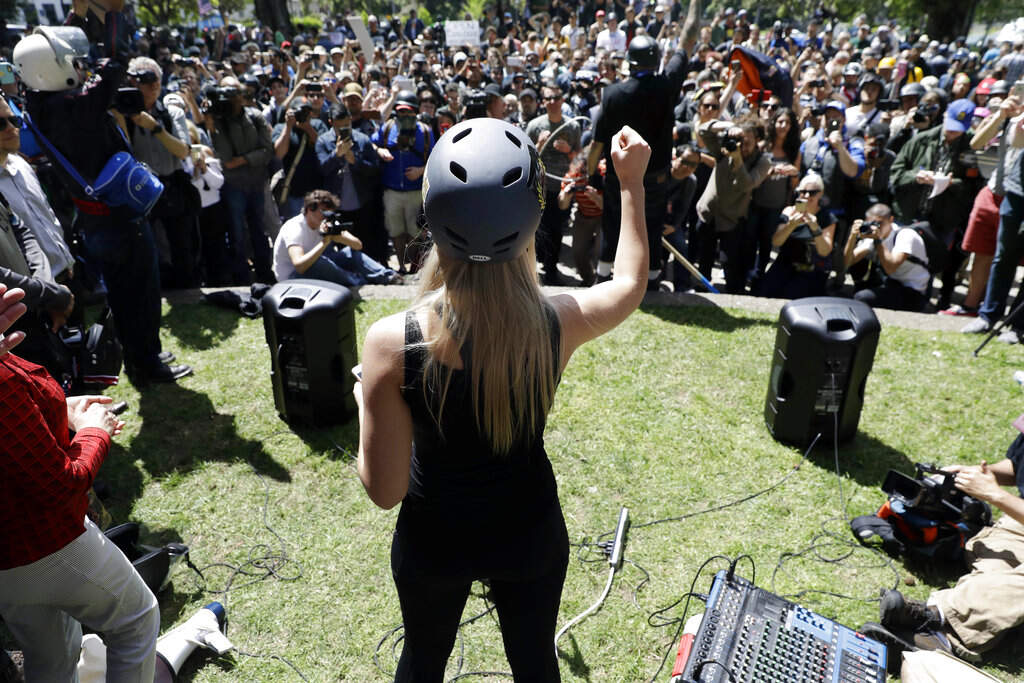
A former right-wing influencer and tradwife tells all in her new memoir, "This is Not Real Life." From meeting with terrorists and neo-Nazis, to arrests, psychotic breaks and addiction, Lauren Southern shares how the life she thought she wanted ended up almost killing her.
Guests
Lauren Southern, a former right-wing influencer, political activist and tradwife. She’s the author of “This is Not Real Life," a memoir.
The version of our broadcast available at the top of this page and via podcast apps is a condensed version of the full show. You can listen to the full, unedited broadcast here:
Transcript
Part I
MEGHNA CHAKRABARTI: If you're listening right now and you happen to be by a computer, or you have your phone in your hand, try Googling this name, Lauren Southern. What you're likely to see are things like alt-right YouTuber, influencer, political activist, conspiracy theorist, tradwife.
In her new memoir, This Is Not Real Life, Lauren tells the story of how she became a right-wing media darling and how that propelled her from one astonishing moment to another, such as cocaine and MDMA binges, and visiting a neo-Nazi bar in Finland, to getting arrested by the Turkish military, getting banned from stepping foot in the UK.
Her memoir, though, is also about her attempts to claw her way back to real life, and all of it is true. As one reader has noted, quote: The reason I know this book is truthful is because nobody would write something this embarrassing and lie about it. Lauren Southern joins us now from Vancouver, BC in Canada.
Lauren, it's great to have you. Welcome to On Point.
LAUREN SOUTHERN: Hi, Meghna. Thanks for having me.
CHAKRABARTI: Honestly, I was thinking there's so much to choose from. Where do we get started? But I actually want to start with this. It's the first sentence, the first two sentences in the first chapter of the book.
And it starts like this. I left my job in right-wing politics and signed up for a late-night art class in Vancouver last month. A reverse Hitler, if you will.
SOUTHERN: (LAUGHS)
CHAKRABARTI: (LAUGHS) You go right there. Yeah, go ahead.
SOUTHERN: Such an absurd story. I wanted to make sure that the hilarity and nonsensical-ness of it all was highlighted from the start.
CHAKRABARTI: Yeah, not to say that I'm laughing about Hitler, but it does give us a sense as to the journey that you take us on in your life. And before we get to the beginnings of this kind of topsy-turvy existence you had for a while, I actually want to jump to the middle and ask you what was the moment, or at least the first moment, where you looked around you, blinked really hard and said, my life is falling apart?
SOUTHERN: There's so many moments I could point to in the book. But I think certainly the first time I found myself incredibly high on drugs surrounded by right-wing figures that I had watched on TV when I was young, thinking this is the pinnacle of saving Western civilization.
These are family people; these are community people. And I don't say that with any judgment towards others. Because I certainly fell down this rabbit hole of fame and drugs and rock and roll lifestyle myself. And found myself in the same position where I'm doing a line of cocaine and tweeting out how we need to save tradition in the west myself.
And you just get this dual identity. And it's not that you're even lying. You want to be the figure that you're portraying yourself online, but your own life and the excitement of it all escapes you. If that makes sense.
CHAKRABARTI: Now you just used a lot of words that have very strong meaning to people, right?
Like saving Western civilization, means different things to different people. So let's go back to, as you said, your growing up, in terms of how that particular worldview became your worldview. You grew up in an evangelical household in Canada?
SOUTHERN: I did. Yeah. And despite being Canadian, Fox News was on the TV every day.
I probably took my first steps listening to Sean Hannity. Every morning, driving to school, it was Michael Savage on the radio, yelling whatever slurs he had on him. Funny guy, but very offensive. And when I became a teenager, that was really the blow up of the blogging era. Tumblr was coming about and even these other forums, like 4Chan and the gaming world.
And I really fell down getting involved in a lot of that stuff. I was on Napster downloading Michael Savage podcasts and Dennis Prager podcasts and listening to that every day as a 13-year-old Canadian, which definitely primes you for some interesting life opinions. And to me, it's not even that every single thing these people said on the radio was wrong.
That's not the position I take. It's that it's the only opinion I was hearing and I was young and hadn't experienced anything else in my life or the world to give context or breadth to these viewpoints. And inevitably, I became a very right-wing individual.
And it didn't help that, I'd say, I graduated in 2013 and in 2012 they started introducing the first social justice courses to Canadian high schools, as it was an elective still, but I took it out of curiosity in the political world.
So I'm reading Anne Coulter and listening to Michael Savage every morning and then going to school and my teacher's talking about white privilege and manspreading and this kind of stuff. And I'm looking at this book in my hand that Anne Coulter's writing and thinking she's a prophet, Oh my goodness.
And what I'm seeing in the schools is exactly what she's writing is going to happen to the world.
CHAKRABARTI: Can I just jump in here for a second, Lauren? Because this is so interesting. I'm listening to you from the point of view actually not just as a reader or an interviewer, but also as a parent.
Okay. So I want to come back to the introduction of the social justice courses in your school in a second, but can we go back to gaming? Because not only did you talk about what was on the radio or the television, but you were already, you were growing up with a digital childhood as well.
Why did you include gaming in that list as one of the influences that really hardened your right-wing beliefs?
SOUTHERN: I don't, the gaming culture is very geared towards being as offensive as possible. And I wouldn't even say that it's like intentionally hateful or anything. That's not the line I'm going down, but it's, part of it is about rage baiting the other players.
I'd wake up in the morning before school, I'd play League of Legends, and half of it is how many offensive comments can you yell at the other team to get them upset so they'll play badly. So this whole idea of not being triggered or not being a snowflake is really intrinsic too the online gaming culture.
So certainly, as a kid, I'm online with all these different people of all different ethnic backgrounds. A lot of men, but me and my sister both played games and we're yelling the most offensive things you can possibly think of at each other, 7 a.m. in the morning in League of Legends on the rip.
And this is just, like it's what all of our friends were doing. And of course that doesn't, I think that's still something that's a part of gaming culture that most people are realizing you have a game world and you have a real life. But that was just a culture I was inundated with, be as offensive as possible.
I was well practiced for digital media.
CHAKRABARTI: And forgive me if I'm not remembering this correctly, but did you also mention Roblox in the book?
SOUTHERN: I mentioned Roblox towards the end of the book because I was in a parliamentary session where they were discussing potentially banning Roblox for hate speech. Of course, the problem being, I'm not sure a lot of these politicians even knew what Roblox was, but yeah, there's, from the time when I was a kid and I'm on these forums discovering, at school as a kid, we're watching like beheading videos on live league. I don't think our parents knew this at the time. Because it was early era of the internet.
I'd probably watched a thousand people die on social media on different video sites by the time I was 14, and really became desensitized to it all. But now it's just on crack, it's 10 times the amount of insane content on the internet. And I really do feel like my generation, I'm the very last of the millennials, born in 1995.
We were the first through the wave of understanding what it means to have a digital childhood, to have every day of our life not only recorded on social media, but to have had our minds developed by the behemoth that the internet is, this collection of the world's thoughts. Not always good ones.
CHAKRABARTI: Yeah. And there's another thing though about gaming that I just want to ask you about, because it also, the way you write about it in the book, it also seemed to be a place that was your initial exposure to like romantic relationships or predatory relationships. You write about how you, like your first relationships led you to cry over men that you met on gaming platforms, but they were pretending to be what, 13-year-old boys?
SOUTHERN: Both my sister and I, the first relationships we ever had were on video games. I had a boyfriend in RuneScape and Gaia Online. Those were my two first real, I couldn't call them real. Those were my first two relationships, and they were extremely, like, it felt like the whole world. I am 12, 13 years old and I have this digital avatar telling me I love you.
And I don't know what love is. I don't understand these concepts well enough yet. And I'm at school thinking about it all day, coming home wondering what darkshadowstorm224 is going to be typing to be next. Hilariously embarrassing to admit now, but that was just the world we lived in as kids.
It was these online avatars and characters and little kingdoms online that we built for ourselves that were so much more exciting than our real day-to-day life. And absolutely, my sister and I laugh about it all the time. I was getting groomed on Minecraft before anyone knew what grooming on Minecraft was.
We had weirdos sending us stuff in the mail, and we're just sending our addresses. Yeah, sure, mail me a pair of underwear, yeah. You're a 13-year-old boy too. No, these were clearly like most likely grown men. Because you don't know who's on the other side of that message box. But obviously we're a lot more aware of that now.
CHAKRABARTI: I definitely understand how humor can be a very powerful defense or weapon against hurt. So I appreciate that you're like, this is hilarious now when you look back on it. But on the other hand, as I was reading the book, Lauren. What I saw was the story of first a girl and then a young woman who was constantly torn or maybe buffeted between trying to develop your own worldview, your own inner life, your own sense of what you believe, and the manipulations that people could do to you because of the digital world. Whether it was directly by 50-year-old dudes propositioning 13-year-old girls on video games, or the manipulation that people directly experience because they go viral on the internet and it feels so good.
So I smile and laugh. But it really actually made me feel a great deal of sorrow for you. Does that sound strange?
SOUTHERN: No. Yeah, I'm aware that I have a gallows humor coping mechanism. Absolutely. And there is this aspect of this, for sure, that I talk about in the book where it took me a long time to realize that my phone was not a one-way looking glass.
It was looking back into me. And especially being 19 years old, going viral, having all of these people comment on who I am and what my identity is. It took me years to realize that was actually shaping who I felt I was. And the decisions that I was making.
Part II
CHAKRABARTI: So Lauren, before we get to your first big viral moment on the internet. I want to go back as I promised to something that you said about school that while you were binging Anne Coulter content, at the same time you took out of, for curiosity's sake, a social justice course.
Now, I might be saying something that some listeners will find unpopular right now. I'm going to say it anyway, but these are two actually extremes. Like I feel like a lot of social justice content until recently or teaching, was also very much situated in absolutes. Just as much as Anne Coulter has her absolutes, like Anne Coulters' are just openly racist and nationalistic. On the social justice side, there's absolutism in terms of some of the greatest social justice evangelists go around saying, if you're white, by virtue of you being born white, you are a racist, right?
Unless you genuflect and apologize for your race and your existence and become actively anti-racist. Now we can debate all of these things, but when I heard you say that, what occurred to me is that you were immersing yourself, both in terms of the content that you chose, and what you were seeing in that class in total extremes.
Was there anywhere in your life when you were in high school where there was a space to think about things or debate ideas, or even just hear from points of view that weren't on the shock value on either side?
SOUTHERN: Yeah, I really don't feel there was. There was this moment in social justice class where, as you said, there were, obviously, there's a reasonable conversation to be had about more progressive ideas, but especially the initial 2012, '13, '14 ideas coming about, they took us out to the lockers and split us by race and gender and various different things and would tell you, if you're on the male side, you're privileged.
If you're on the female side, you are disadvantaged. If you're on the white side, you're privileged. And of course, I know all these people personally, and I'm seeing people I know come from extremely poor families that are living in trailers being put on the privileged side. And this just sent me for a spiral. And a lot of kids my age weren't having political conversations yet.
It wasn't like it is today, where politics has really consumed so much of our culture. So the only places I was able to have these conversations I was extremely curious about, because that was the sea I was swimming in. What I grew up listening to, was largely in this classroom or on the internet, I was on all these different political blogs following a lot of the early commentators.
Steven Crowder and James O'Keefe were just blowing up online on YouTube. These were some of the first kind of people in the online social media sphere. And I was following all of it. I had subscribed to everything. I was one of the first commenters, and this stuff, it wasn't, it was really early days, and I didn't even realize at this point that what, three years later, I would be joining the fray with these commentators that I only knew as characters on the internet.
CHAKRABARTI: Okay. So let's get to that. It was in 2015 and you were just, what, 19 years old at the time? You actually made your first video? And posted it on YouTube and this was called, Why I'm not a feminist. Got over a million views and nearly 40 million on Facebook.
So a million on YouTube and 40 million on Facebook, and we have a clip.
(CLIP PLAYS)
Men are objectified, men are raped, men are mistreated. Men are held to ridiculously high societal standards just like women. Yet feminists continue to place this blanket judgment over all men. That they're all privileged. And all women, that they're all oppressed. Yet, as a woman, I will almost always win custody of children in a divorce case. I will receive less than half the sentence man does for the exact same crime. And actually have my rape and assault accusations taken seriously. And I won't be laughed at for not being manly enough.
CHAKRABARTI: Why'd you decide to make that video?
SOUTHERN: It's not even inaccurate to say there were feminists on the internet at the time that were saying the hashtag #killallmen.
Of course, these were not the more thoughtful feminists. These were not the people writing intellectual books analyzing the life of housewives in the '50s, and the barbiturates they were on. I was in the shock jock media sphere on Tumblr listening to radicals. And I grew up in an evangelical community, going to church with men who were generally really good people.
Like my father is a good man, my male friends that I went to high school with were really good people, and I could not believe the kind of portrayal of men that I was seeing on some of these forums, on the internet, that there was this assumption that they were basically all rapists until proven innocent.
Now, of course, the one-dimensional approach to that video. As I got older and I started traveling the world and meeting different men that weren't from the community that I was a part of, certainly my eyes were opened to a different aspect of life and perhaps the world that some of these women came from that embittered them towards men.
CHAKRABARTI: Let's stick with 2015, because it shows the ramping up of the content that you made, and we'll talk about what it felt like in terms of the responses that you got. But we've got another one here. This is after your first anti quote-unquote anti-feminist video went viral.
You went out into the streets and attended what are called SlutWalk protests in Canada. And excuse me, for anyone who definitely finds that word offensive, but that's what they were called. And they were popular in the mid 2010s, and these were protests that were aimed to actually combat victim blaming.
And so here's a clip of you in June of 2015 at one of those protests.
(CLIP PLAYS)
Hello. It's Lauren Southern here with Rebel, and I just gotten a huge confrontation with the SlutWalk, which we are following right now. Essentially, I held a sign that said we are not living in a rape culture in the West, which we are not.
It is intellectually dishonest to think that we are living in a rape culture. Rapes do happen, but the majority, or the minority, the vast minority of men and women are rapists. And when we do find out they're rapists, they go to prison, they're punished.
CHAKRABARTI: You mentioned Rebel there, first of all, which is what?
Rebel News and, yeah, go ahead.
SOUTHERN: Oh, no, yeah. Rebel Media, they had just launched a YouTube channel that year, 2015, in Canada and asked me to start making videos for them. I believe they are called Rebel News now.
CHAKRABARTI: Okay. So as you've told us, these were things that you believed at the time.
The other part is that you got, the internet being what it is, you got inundated with responses. A lot of them being positive. People liking you, commenting about you, becoming your internet fans. You were still really young at the that time. Tell me about that and how it made you feel.
SOUTHERN: Yeah, for sure. Even listening back to those clips, I think that there's a real crisis online with how we use and interpret language. I can understand exactly what I meant there, right? We don't live in a culture that promotes rape. We don't live in a culture where if we find out you have committed rape, you are suddenly praised or worshiped.
But of course, when feminists use the term rape culture, they're not discussing something overt. And me being young and not, I'm a little spectrumy, sometimes I take things quite literally. I don't think I was being dishonest. I think I was saying what I genuinely believed. I just didn't have a wide enough understanding of what people were using when they used this term rape culture.
So I was very confident in how I was approaching this for Rebel, and there were a lot of people who agreed with me and were very annoyed and frustrated with the upcoming social justice culture at that time. And wow, I did not expect, because I thought maybe my first video I did would be a one hit wonder, one trick pony kind of thing.
Wow. That's a crazy experience, now to get back to university in my life. But these SlutWalk videos I began doing went massively viral as well. Millions of views. And it has to be understood that a million views in 2015 means something entirely different than a million views today, because we don't have, we have a million times the content now.
So when people, and people are watching content all day long. Before, when a video went viral, that was what everyone had watched. They go and they talk about it with all their friends. That's a discussion for a week, two weeks, maybe even a month total. Now there's so many videos going viral 24/7 that it's no longer something that consumes, like, the public consciousness the way it did then.
So I was able to build up this, essentially, yeah, fan base. I was getting tens of thousands of followers on Twitter. The YouTube channel comments, I remember I just sit there in bed flicking through them.
You are a princess. You're a queen. You're going to save the world. Lauren, you're my hero. Please keep doing this. I'm crying right now. I love you. And then the hate. The hate was not, it would never just be, Hey, I think you need to think about this differently, Lauren, or, I don't think that's what people mean by that term.
It was always, I hope you get raped. Sorry. I know that's offensive to say on the radio, but these were the comments I was reading.
CHAKRABARTI: It still happens. Yeah.
SOUTHERN: Yeah. The comments were, I hope you kill yourself. I hope you, and what that does to your brain at 19 is you, of course you're going to go with the group of people cheering you on that are saying you're a hero. And suddenly everyone critiquing me, you're literally demons. I'm getting emails saying, we're gonna find where you live. We're gonna hurt your family. And I had no reason to have goodwill towards anyone that was attacking me at that point.
Certainly not in my mind based on what I was observing.
CHAKRABARTI: Yeah. But what's interesting is that, even that avalanche of hate wasn't enough to dissuade you from being a part of this internet culture. You gave an interview to Compact Magazine and there was a quote that they have from you that I felt was very arresting to me.
You said you felt things in a deeply personal way at the height of your career. Then, quote, when men desired me simply because so many others desired me online. That sounds like a drug.
SOUTHERN: Oh, absolutely. There's, I can't remember who it was, but they talk about how people will go to events now and they're more excited about the pictures later and watching the video back later than they are about actually partaking in the event or said experience.
And that was certainly the life of being an influencer. The going and getting the video itself and the conversations you were having were less important than how they were going to look online the next day and what the reaction was going to be online the next day. That was the big party. That was the big excitement.
Because this is what the entire generation of young millennials were taught to do. A lot of our parents in 2008 were going through a financial crisis, chaos, some people in their houses, divorce or this and that. And we withdrew from the world, and we went on the internet, and that's where we built our little kingdoms, and that's where we had our comfort.
And so to then grow up and be able to build empires on the internet. Whole personalities, whole concepts of who we are as heroes and villains fighting this great war, go viral. There was another joke I wrote in my book is I've seen it online before, a lot of people in my generation are never going to be able to own property just because of the economy and the closest things we'll have to, it is a moderately sized meme page, so it's this is the new frontier.
CHAKRABARTI: So at the beginning of the show when I introduced you, I said a word that people might see if they Google you is tradwife, and we've gotta talk about that. How would you describe what, from people who don't know, to be honest, I'm going to be honest about public radio audiences.
They may, they lean not millennial, if I can just put it that way, a little bit older. What is a tradwife lifestyle? What is it?
SOUTHERN: The trad wife lifestyle, if you've ever seen a Norman Rockwell painting with a woman holding a pie and the little boys with rosy cheeks smiling and the husband in a suit getting back from work that's the quintessential tradwife.
She's a woman who wears a dress, who stays at home, who has 2.5 kids and a white picket fence, and worships her husband and submits to her husband, and typically, yeah, falls into traditional gender roles. Now, I really do feel everyone does have this temptation to want to have a family and have kids.
And I think a lot of young people being raised on the internet and the porn addiction, the thousand different types of relationships we see online, the broken homes, so many of us grew up in, we longed for some structure. A lot of young people longed for structure. What do I do to have a successful life?
What do I do to not grow up in the dysfunction that I've seen around me in my communities? And so a lot of people were tempted to push back towards what was in the past, to revive things that we saw in the past. And I certainly had this temptation myself. I figured if I just followed the manual, certainly after having my crazy experiences in politics, I figured if I just follow the manual of look pretty, wear the right dress, quit my job, have babies, serve my husband, then I will be able to have this happy family life that so many people crave.
But of course, this is, it's not real. It's an idea, it's a concept. It's a nice thing to pretend online. That's a lot more complicated in real life.
CHAKRABARTI: Yeah. I mean that that's one of the things which you're very honest about or candid about, the hypocrisies of being a high profile, politically extreme persona online that folks like that are very often hypocritical. And one of the things I thought is for a person to be embraced truly traditional life, especially as a woman, that should mean they don't have a business. They're not online. They're not famous to millions and millions of people. Like you were supposed to withdraw completely and entirely.
SOUTHERN: Yeah. If I wanted to succeed at the tradwife, I never should have had the career in the first place telling people to be trad wives.
CHAKRABARTI: Did you feel hypocrisy of it at the moment when you were trying to adopt the tradwife lifestyle?
SOUTHERN: Oh, I always had this sense of imposter syndrome, it was the thing that kind of cured it for me. It didn't, it was never cured, but it was subdued. It was the fact that I realized every other commentator around me had the same thing. It was just normalized. Everyone was doing it. Some people did drugs to keep the two images going, and the mask melted on their face.
Other people just had an awareness of, we're promoting an ideal. It's not necessarily perfection or what real life is always, but people have to strive for an ideal. But I think the problem is that the viewers don't realize it's an ideal. The viewers don't realize that the influencers aren't achieving this.
You look at even someone who's not necessarily totally political, but have you heard of Ballerina Farms?
CHAKRABARTI: No.
SOUTHERN: Oh, she's a large kind of trad wife influencer --
CHAKRABARTI: Oh wait, actually, I have heard of her, but only this week did I hear of her.
SOUTHERN: Oh, okay.
CHAKRABARTI: From one of my more plugged in producers.
SOUTHERN: Okay. Okay. That helps. She's got about 40,000 kids and she's baking sourdough every day. And then you look at this and she's got this beautiful farm and horses and how is she living this life? And you find out, her husband's the CEO of JetBlue, so they've got the money to support a life where the wife is essentially LARPing as this traditional living woman. And this is a lot of the case with a lot of the commentators online; they are live action role playing a lifestyle that isn't achievable for the average person who need, you need a two income household to have kids now. It's not realistic, even if you want it.
Part III
CHAKRABARTI: Lauren again, for people who don't actually know the life you had online. I want to just play a couple more examples. You actually went to many dangerous places around the world, many international sites and as your fame grew, I think people, no matter where you went, started confronting you basically on the street when you were talking about things that you were covering.
So this is something from 2016, just a year, just one year after that first video you posted, you were in London talking to people about Brexit and someone came up and confronted you.
SOUTHERN: You're the real fascist. You know that! You don't believe in free speech. You don't believe in our right to be on public property. You're the real fascist. You're covering your face because you're ashamed of what you're doing.
PROTESTOR: We, because our faces, because we end up on racist websites. That's why we covered our faces. Let's go, let go, let's go.
SOUTHERN: No, I'm not leaving. I'm not leaving. I'm not leaving. I'm not leaving because of these people. Because of these fascists.
CHAKRABARTI: Now, on the one hand, Lauren, that actually sounds scary, but on the other hand, were you thinking this is amazing content?
SOUTHERN: Oh, of course. There's this really funny thing that happened. I keep using the word funny, but it's really not that funny. In 2015, 2016, I started getting attacked at some of these rallies. People would grab my microphone or throw things on me, and it's not that I was going out and looking for that. I was looking for an argument and debate, but it certainly became impossible to not notice how many views this would result in, millions of views.
The top conversation on Twitter.com, Lauren Southern, just got attacked. And people used to start going out to these rallies, deliberately looking to provoke people to essentially get attacked to get content. And every time I saw someone looking like they were about to punch me or grab my camera, I'd have a glint in my eye knowing, oh, this is going to be great for Twitter.
And it brings it back to that video game culture when I was younger, right? Half the point of playing the game wasn't just to win, it was to get your opponents mad. Because it showed that they were emotionally unstable. It showed that they were losing and they would make mistakes when they were angry.
CHAKRABARTI: Okay. Here's another one. This is 2016 when you were in Germany, you talked a lot about immigration even from the earliest parts of your online career, and you were in Duisburg, Germany, which has a large Turkish population.
(CLIP PLAYS)
When I was in Europe, one of the most shocking things I saw was the lack of integration from their immigrants. In some German towns, there's more than just cultural conflict. People pledge allegiance to entirely different nations, and it shows. When I was walking through the town, my jaw was dropping. I could not believe what I was seeing, and that I was still in Germany.
There were cars everywhere with Turkish flags, windows with Turkish flags and giant Turkish flags hanging from buildings above stores.
CHAKRABARTI: Lauren, the thing about this one is that what you are saying has actually been said by a lot of people who do not call themselves far right. They're very centrist.
In France, I've spoken to many French analysts there who say, who look at the United States and say, you guys do a great job actually of welcoming people into communities and making them feel more American than the French ever do, for example. So again, there's a really good discussion to be had here.
Yeah. But so if I look at your words on paper, it's one thing. But again, the platform where all this stuff ended up makes it into something else.
SOUTHERN: Yeah, that was something that I didn't realize until later on, when I would have these conversations and certainly they made sense to me because I grew up in Surrey, British Columbia, very high immigration area, and I saw the tension that would happen when there was a lack of integration, right?
When people aren't speaking the same language as you, you can't have a relationship. You can't have a culture and a community together, right? And this upset me. This was something that genuinely I'd look around and say, we have to have some common link and it has to be, at least, if we're living in the same country, the flag we fly.
But certainly, when I was having one conversation, it was getting co-opted in different ways by different parts of the internet who had suddenly decided I was their Nazi queen. I'd be on Twitter and there would be all these edits of me and I actually, I walked into a corner store in Toronto one morning when I had moved there when I was 20 years old, and my face had been edited onto an SS officer with big boobs and big blonde hair, and it was the front cover of this political slop magazine, and it was just a reputation that ended up taking a life of its own.
I was the Nazi queen of the internet. But yeah, if you go back and you actually listen to what I was saying, like you said, it's not, it's actually not very different from anything you'd hear on Fox News today. But I was very young and I wasn't wealthy, so I couldn't sue anyone for defamation. And there was a part of me where I was young and I almost didn't care that there was this lore being built up that I found funny at the time until it started really affecting my life.
CHAKRABARTI: Yeah. Okay. So here, let me be frank. Again, while I read your book and just felt like I was getting a much deeper understanding of you. And I talked, we talked about those vulnerabilities at the top of the show.
You also were essentially, even though that was a parody, you were also essentially truly a Nazi queen to a lot of people who really did believe the most extreme forms of the stuff that you were posting. That's what you were to them, for them. Do you ever take, do you feel like you should, need to take responsibility for that?
SOUTHERN: I don't think that I can take responsibility for other people's ideas of who I am. I can certainly take responsibility for the actions I've made that have been stupid. But I've never come out and said, Hey I'm a Nazi. That's never been an opinion that I've actually held. But it was impossible to not get swept up in some of the crazier aspects of the internet.
At this time, I was all over forums. Every single tweet and post about me was like editing me onto Joan of Arc photos and it made me a little bit of a crazy person. That's undeniable. I remember I couldn't even date at the time because I couldn't have a Tinder profile because there were 10 people pretending to be me on Tinder. I didn't, there was no guidebook for how to deal with this. No, I don't think this experience existed before my life and generation.
Because even traditional fame, you have an agent, you have security, you have people that are making plans for your life. This was e-fame. And it was just coming about when I was 20 years old and I was in the very first sweep of it. And I had no idea what to do, and certainly my identity took on a life of its own. I, sure, I have to take responsibility for being young and enjoying all the attention and not thinking that hard about it that, I can for sure take responsibility for.
CHAKRABARTI: No, I appreciate that and I think in a sense, writing a memoir and being so frank about what your life was like, in a way, the big message I got from the book is beware of the internet, beware of social media. It warps and mutates everyone on it.
You really strongly think that like every, like most politicians, if not all, have some form of mental illness because of how politics and the digital world interact these days, right?
SOUTHERN: Oh, almost certainly. I think it's inevitable. You have to be a little bit crazy to be engaged in this debate online.
And it's not to say I don't really care about some of these people. Some of my best friends are influencers that are still doing this to this day. And it does make you a little crazy, but I know what being a little crazy is. I'm a little crazy myself.
Oh, and also just, I just want to clarify, you were asking, do I feel I need to apologize or this or that? My memoir, one thing I make very clear in it is it's not, I'm not looking to clear my name or come back, or I'm progressive now, or this, it's literally just me being honest. And you don't have to like me at the end of it. That's fine. I'm the villain of my own book in some ways.
It's just, this is what humans do when we are exposed to the internet, this is how we behave. This is how we interact with it. And there is no, there's a joke online about how if a medieval peasant ate a Dorito chip, they might die because they've never had so many flavors in their life.
We've never had so many social interactions as a species. And it inevitably, no matter who you are inputting into it, it's going to make them a little crazy. And I think my brain is entirely rewired to this day in ways that I can't explain.
CHAKRABARTI: Yeah. And what's worse about those social interactions is that they're abstracted social interactions.
They are not face to face in person. We're turning the corner towards the end of the show, of the episode here, Lauren, which I'm really bummed about. Because I wish we had more time, but there's a couple more things that I'd love to hear from you. At the top I mentioned some of the more sort of crazy highlights of your right-wing internet career, like ending up in a Nazi bar in Finland and getting arrested in Turkey.
I'd just briefly love to hear that Turkish story.
SOUTHERN: Yeah, I've got the book right here in front of me and I can read you an excerpt.
CHAKRABARTI: Actually I wish you could, but unfortunately I don't think we have enough time for that.
SOUTHERN:Oh, no worries.
CHAKRABARTI: So give us your, yeah, your TLDR version of it.
SOUTHERN: I was filming a documentary called Borderless and we were trying to get both sides of the adventure, not really an adventure, the crisis.
So there were people that were guarding the borders in Bulgaria that we were filming with. And then we wanted to follow migrants that were trying to sneak into the country and really be embedded with them. So we went over to Turkey. We recorded on the shores ... and then we went up to the Kırklareli province where some people were going into Bulgaria.
And when we were along the border wall taking footage, we had found this hole in the ground and one of my security guards crawled in it and was popping his head out. And we were just making funny videos while getting B roll. And suddenly we see a truck coming towards us in the distance. And it's a military vehicle.
We totally panic. I start shoving SD cards in my bra and socks because we're not even supposed to be doing any journalism at all in Turkey. It's one of the number one countries for jailing and even killing journalists, in some cases. We run back to the car and we get surrounded by Turkish military with guns.
We, my security guard, can't get through to them. They don't speak any English. We're in a really remote part. They take, seize our car, pile us into the back of this vehicle at gunpoint and drive us out 30 minutes to a Gendarmerie post where they then sit us down and bring out their intelligence agents to come talk to us. And tell us we're facing jail and that we're going to be going to court in the morning to potentially be jailed for trespassing on military property.
We didn't even realize filming near that border wall was military property, but certainly my security guard popping out of the hole in the ground probably wasn't very good. But either way, this was not something that I anticipated. I'm on the high of getting millions of views on YouTube.
We're just trying to make a documentary here, and I didn't, it was a bit of reality hitting me of thinking I've taken this too far. Now I am potentially going to jail and going to spend the rest of my twenties in a Turkish prison. If I even make it out, my video crew are gay. I don't even know if they're gonna survive this experience.
Luckily, I can't even, you're going to have to read the book to hear about how we get out. Because that's quite the story. But this was, we were held in 10 hours of questioning, phones taken, downloaded, and this is just one of more than a few experiences of getting arrested and nearly facing my life, destruction during my time in this book.
CHAKRABARTI: There's so many other stories in the book that we haven't touched on. Just again, sadly, do not have the time, including you being sexually assaulted by Andrew Tate. And then also being swept up into the Tenant Media firestorm, which is, for people who don't know, it was when the Department of Justice issued an indictment against several people at Tenant Media for basically being Russian assets for receiving millions of dollars from the Russian to put certain content online.
So Lauren, the book is packed with stories like this, but in the last two-ish minutes that we have, you essentially got out, right? There was a point at which you said, I have to find what reality actually is, and I suppose I wonder not only why, what propelled you to do that, but what you hope for your life now.
SOUTHERN: There's a point, I think, at everyone's life where things, you can either choose to double down, or you can choose to rebuild the pillars that you have if it's not working out. And every single thing in my life had collapsed in some spectacular way, whether it be my career, my marriage, my perception of reality and perception of self.
And it's not easy to restart from scratch and rebuild but I think you will truly become, you will keep going places you don't want to go if you don't. And once again, this isn't a book of me saying I've changed every single idea I've ever had. I don't think that's authentic. Yeah. I think when you see someone suddenly change their ideology overnight, usually it's going to be someone in some massive controversy that's saying, I'm right wing now because I've just got a sexual assault allegation.
Or I'm progressive now because I've just been outed as having an affair or this or that. This isn't that kind of book; I think authentically real life when it contradicts or confronts our ideologies in ways that don't make sense. We need to rebuild our mental model. And you cannot use people on the internet live action role playing as superheroes as your mental model.
You have to look at the real world. You have to look at the people you love around you to build a mental model that makes sense. And that can only happen by people logging off.
CHAKRABARTI: But the thing about the digital age is that this isn't witness protection, right? You cannot pretend that you are someone else entirely.
All someone has to do is Google you and the Lauren Southern of the past is there, still in your present.
SOUTHERN: You can't really, you will never be able to escape that and I'm okay with that. I actually, I love that I'm canceled. I do. I think that everyone I meet that has some wild story where they say, I've been to prison, or I've had my nudes leaked to the internet or something.
I just sit there and I say, tell me about it. Tell me about it. I get you, on some deep intrinsic level. Maybe you don't know me, but I've been canceled a thousand in one ways myself, and I really, I don't think we should be frozen in time as people. I think that's what the internet does to us, and I think it's killing us as a society.
We shouldn't freeze people in time. It's, or ideas or notions. We need to live in reality, which is flowing and changing.
Book Excerpt
© 2025 Lauren Southern. All rights reserved.
No part of this publication may be reproduced, stored in a retrieval system, or transmitted in any form or by any means (electronic, mechanical, photocopying, recording, or otherwise) without the prior written permission of the author, except for brief quotations used in reviews, commentary, academic work, or journalism as permitted by law.
The first draft of this transcript was created by Descript, an AI transcription tool. An On Point producer then thoroughly reviewed, corrected, and reformatted the transcript before publication. The use of this AI tool creates the capacity to provide these transcripts.
This program aired on January 23, 2026.