Support WBUR
Is American architecture destined to be boring?
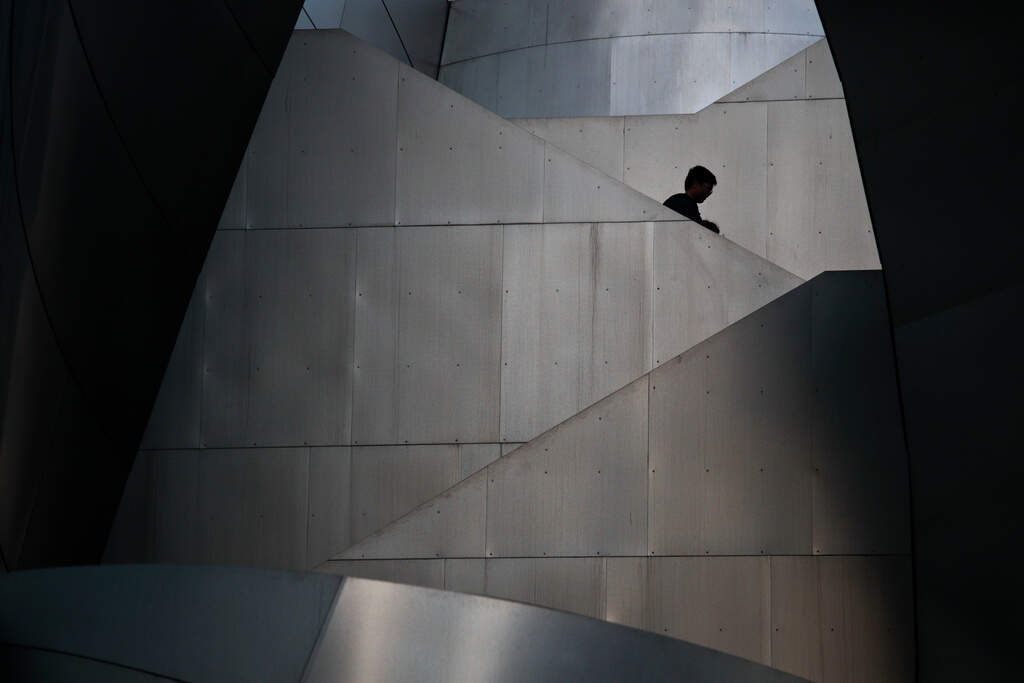
Frank Gehry’s legacy can be seen around the world in the curvaceous and dramatic buildings he designed. How Frank Gehry put awe in American architecture and what we lose without him.
Guests
Christopher Hawthorne, Senior Critic at the Yale School of Architecture. Former Architecture Critic for the Los Angeles Times. Co-Author of The Green House: New Directions in Sustainable Architecture.
Sylvia Lavin, professor of history and theory of architecture at Princeton University. She wrote the introduction to Frank Gehry: The Houses (2009).
Also Featured
Eric Owen Moss, architect.
Nathan J. Robinson, editor of Current Affairs.
The version of our broadcast available at the top of this page and via podcast apps is a condensed version of the full show. You can listen to the full, unedited broadcast here:
Transcript
Part I
MEGHNA CHAKRABARTI: Frank Gehry died last month. For much of his career, he was considered a titan of his field, but that wasn't always the case. In 1978, he dramatically remodeled a Santa Monica, California house. Lots of neighbors thought that house was hideous.
GEHRY [60 Minutes]: The guy from over there came over one day when he saw it finished, and he said he didn't like it.
And I said, why don't you like it? And he said it's just strange.
CHAKRABARTI: That's Gehry in a 60 Minutes interview in 2002. Now, Gehry and his wife bought the house initially, a pink California bungalow in 1977. He thought it was a wonderful opportunity to experiment with building materials, so he wrapped much of the house in a new exterior, made of corrugated metal and chain link fencing, though parts of the pink bungalow still poked out from behind the new industrial facade. He also built huge, tilted glass cube windows, modernist windows that poked out at various angles. Gehry told the American Institute of Architects that some neighbors were perplexed.
They'd never seen anything like it. Others were downright incensed.
GEHRY [60 Minutes]: The lady two doors down was a lawyer and she went to the city and tried to stop me. And the mayor, Donna Swink she came to see what it was all about and she stood in front of the building and started laughing. She said she loved it.
CHAKRABARTI: As he said, Donna was then the mayor of Santa Monica, so with the mayor on his side, Gehry never had to change the house, but he says his goal wasn't to make a huge statement.
He was, in some ways, just trying to use building materials he saw in the neighborhood but in a more interesting way.
GEHRY [60 Minutes]: The house was me trying to find my middle class self in a middle class neighborhood. How do I relate to this? I guess I'm here, I'm with them. They have their cars on the front lawn, they have chain link, they have corrugated metal.
CHAKRABARTI: There, you hear something interesting. Frank Gehry, later, a global architectural superstar was back in 1977 and '78, just trying to find a way to craft a design that connected with the people who lived around it. Now, some of them hated it for sure, but Gehry's initial motivation was there.
Now, he wouldn't become a worldwide sensation for another 30 years, but in that period, from the mid-nineties to the mid aughts, Gehry designed buildings that would be considered works of art in and of themselves, the Guggenheim Museum in Bilbao and the Walt Disney Concert Hall in Los Angeles. Iconic for the way they found curvaceous and organic beauty in ultramodern materials and building techniques. Critic and historian Philip Johnson, known as the Dean of American architecture, said it plainly in 2002.
PHILIP JOHNSON: He's the best architect in the world, simple as that.
CHAKRABARTI: But the Gehry style or approach did not radically transform architecture beyond his own buildings.
Gehry was a Canadian. But broadly in Canada and the United States, there are no practicing architects across North America right now with quite the same power, quite the same influence as Gehry. His titanium worlds, reflective surfaces and unique position within landscapes seem unparalleled in their ability to really elicit some kind of deep feeling from even a casual viewer.
And it's not just feeling. Because I think back to that 1978 remodeling of that Santa Monica pink bungalow, he was looking for buildings that convey a sense of vision while also trying to connect with the people who must live with such statements in their built environments. So we're going to talk about why there isn't more of that approach to modern architecture in North America today.
And Christopher Hawthorne joins us. He is the senior critic at the Yale School of Architecture and former architecture critic at the Los Angeles Times, and he also writes the Architecture newsletter, Punch List. Christopher Hawthorne, welcome to On Point.
CHRISTOPHER HAWTHORNE: Hi. Thanks for having me.
CHAKRABARTI: Now actually, before we talk about more about Frank Gehry himself and his approach and his vision, I'd love to actually talk specifically about one of those iconic buildings because not everyone, the vast majority of people in the world have not been to Bilbao, Spain or even seen the Los Angeles concert hall.
So I've just pulled up a picture of the Guggenheim Bilbao on my computer here. And folks, if you're near a screen of some kind and you can safely do it, just Google Guggenheim Bilbao building and it'll pop up. Christopher, how would you describe this building first of all?
HAWTHORNE: It's an incredibly exuberant, extroverted building that really thrills to the visual and material spatial possibilities of architecture. And that made it in a way perfect, not just for its site, it sits along the Nervión River in Bilbao, but also it made it perfect to be captured in architectural photography. And the nineties were the moment when architecture was beginning to be transmitted digitally around the globe, primarily by photography.
So it also was a building that photographed incredibly beautifully.
CHAKRABARTI: Yeah. So in looking, I've never seen it in person. And looking at it now again, on the screen even, the thing that always captures me when I see images of it is that it's both kind of industrial in its form and attitude, but has this beautiful organic feeling.
All those Gehry-esque curves and the use of, I don't know what techniques or even metals they use to wrap those curves around it. It looks half like a sort of a metal extrusion and half like a, I don't know, like a flower almost. The petals almost opening out.
HAWTHORNE: It is often been compared to a flower.
And to the question about how it was made, this is a moment in the early nineties as that building was being designed and constructed when Gehry's office was making the transition from having done these incredibly complex curves entirely by hand to a digital design process. They were using software that had been developed either for the ship building industry or for the aerospace industry.
And a lot of that industry, of course, is in Southern California aerospace. And they were using it for the first time to design and guide the construction of building. So that was the other thing that that Bilbao represented in terms of a breakthrough was this new way of using this very, what has turned into very powerful design software.
CHAKRABARTI: And of course, the whole purpose of this hour is to not talk about buildings in a vacuum, right? This is a building in Bilbao, which at the time was described as a very kind of urban and industrial area of Bilbao. The museum itself on its own webpage says the design is a spectacular sculpture-like structure.
Perfectly integrated within Bilbao urban pattern. And that's what I want to ask you about. Because this is not a building that you would, it's just not a normal building, right? It is designed to be as eye catching as possible. And it isn't the curves and the angles and the materials are just spectacularly different than anything around it.
And yet, at the same time, it fits in, how is that even possible, Christopher?
HAWTHORNE: I think I described it once as a kind of spaceship that was perfectly designed to land in the spot where it wound up as if the aliens had this understanding of the city. You mentioned the toughness of the building.
It starts with an understanding by Frank and his office as colleagues of Bilbao. Bilbao, roughly speaking, is a sort of Pittsburgh of Spain. It was a post-industrial town that was down on its luck in the eighties and nineties at the moment when the Guggenheim Museum is part of what became a really global expansion building satellites in a number of cities around the world, decided to build a satellite location in Bilbao.
The other thing, many of your listeners will have heard of the Bilbao effect. Which sometimes is meant to suggest the way that building, once it was finished and then published and distributed digitally in all the ways I was talking about. Became the sensation that it did, and it really did radically change architecture culture in 1997 when it opened.
But the Bilbao effect, then drove all of this tourism. And it became that phrase, a shorthand for the idea that if you built an iconic building by a celebrity architect, you could begin to drive tourism to your post-industrial city, whether that was in Bilbao or some other place in the United States, for example.
But there was a lot more to it than that. It actually, Bilbao had been painstakingly and very carefully orchestrating a civic and really a regional renewal. There had been efforts to clean up that river. There had been the extension, the construction of a new subway transit system.
There had been a really comprehensive regional planning effort that then set the stage for this alien looking building that we've been talking about, to be perfectly deposited along this river. That was, as I said, newly cleaned up and the city and the region as a whole were open for the tourist business in a way that the building really capped off rather than inventing out of whole cloth.
CHAKRABARTI: Yeah, I'm seeing here a quote from Gehry on the Guggenheim Bilbao website where they say, he says architecture should speak of its time and place, but yearn for timelessness, which I think is just a really perfect description. He said, I described it as a tough looking building.
I actually feel exactly the opposite. It doesn't look tough. It looks fine to me. And not weak, right? Not delicate, but just beautiful rather than aggressive. And that's just me. But --
HAWTHORNE: Right. No, I was thinking more of Bilbao as a tough.
Oh, as a tough city. A tough town. Okay. Okay. Good. I wanted just make sure about that. But now I'm gonna --
HAWTHORNE: No, I agree with you.
CHAKRABARTI: Total transparency from me, Christopher, right now. I know nothing about architecture other than that I have to live around buildings. So I'm the layman of lay people and I'm excited to learn from you and the other guests we're gonna bring on later.
But at the same time as just a regular person, when I see new buildings or walk around neighborhoods, I am reacting at a very human scale and from pure emotion. Okay. It's like the lizard part of my brain.
HAWTHORNE: Of course.
CHAKRABARTI: I hate, absolutely hate most modern buildings that have gone up, let's say in the past 15, 20 years, despise them.
They make me feel small. The buildings feel oppressive. All I see is the ego of the architect and the person who owns the building. I don't want to walk near them. It they look like they're designed to stand out of their own accord and just be like, look at me. They're all out of scale with the neighborhoods that they're in. I find them obnoxious and gross.
Why, how does Frank Gehry, like how did he avoid doing that?
HAWTHORNE: So you don't think, just to clarify, you don't think of Frank Gehry's work as part of that group of buildings that you have that reaction to?
I'm fascinated by that.
CHAKRABARTI: At least the Gehry buildings that I know. So we talked about Bilbao, we talked about Los Angeles. There's actually one, I live in the Boston area. There's one on the MIT campus in Cambridge. They're not indeterminant opposition to their environments that they elicit the gross barf reaction in me.
But I'll let you hang with that thought for a second, Christopher, and I'll let you answer it when we come back.
Part II
CHAKRABARTI: All right, Christopher, let me have it with my absolute disdain for most modern architecture.
HAWTHORNE: I love this line of questioning actually, because architecture, this is one of the reasons I love being an architecture critic.
Architecture is different from other art forms. If you read a novel and you find it terrible, and the way you've described finding these buildings in your own neighborhood, terrible, you can just stick it on the bottom shelf and forget about it. If you see a film that doesn't sit right with you, you can forget about it and never watch it again. Architecture is different. It imposes itself on us. It's a public art form. And as much as Frank Gehry, for all of his career, but especially early on, was looking to visual artists, he was friendlier with visual artists in the LA scene than fellow architects. Architecture is fundamentally different.
Architecture is different. It imposes itself on us. It's a public art form.
Christopher Hawthorne
And I think he was very sensitive to that. I think one misreading of his work is that critics who just look at the very exuberant and some would say bombastic form making of the most expressionistic buildings. Guggenheim Bilbao or the Walt Disney Concert Hall in Los Angeles miss the fact that there was real humanism at the core of his work. And he really understood what architecture has to do as opposed to those other art forms, which is to create spaces for people and respect and pay attention to human scale. And I think he was more skilled at that than some critics gave him credit for.
And that's really the challenge for an architect, is to mix those two things, to create a building that might look photogenic in two dimensions and that kind of photography I was talking about, but also work at human scale. I think he was very sensitive and attuned to that combination.
CHAKRABARTI: Okay. Human scale. So we're going to come back to that in a little bit, Christopher, but we have some tape here from someone who knew Gehry personally and professionally. He's Eric Owen Moss, an LA based architect, and Moss says that Gehry sent him clients and they discussed the ins and out of the trade. The architecture trade over the decades, and he says that Gehry's work could be characterized by a quote from Gehry himself when he was referencing actually a jazz musician, Wayne Shorter.
And the quote is, you can't rehearse what you ain't invented yet.
ERIC OWEN MOSS: But I think the idea of moving into something which is unrehearsable, would be one way to characterize Frank's work and his aspirations.
CHAKRABARTI: Moss says that he and Gehry spoke a fair amount over the years, talking about everything from practical concerns and client interactions to the theoretical aspiration of architecture and its goals.
And in those interactions, Moss learned that Gehry's first conversation about a project was wit himself, when he wrestled with the potential consequences of creating experimental and unusual work.
MOSS: I think the idea of not being able to anticipate might mean you could stumble or fall short or not achieve, or make a mistake or not see in what you're doing.
A clear version of the aspiration, and you might, it might suggest do it and do it again and remake it and rethink it.
CHAKRABARTI: But Gehry didn't paralyze himself with second guessing. He found his footing with each project again and again, and it's an approach that led to Gehry's most notable successes. We've already talked about them a bit, including the Guggenheim Bilbao.
Moss attended a party to mark that building's opening in 1997, and despite the decades between the experience of seeing the gear, the Gehry building open and Gehry's own death, Moss still remembers being struck by the importance of when Frank Gehry realized his vision.
MOSS: And I remember sitting on a stairway that leads you into the lower level with a couple of friends of mine, good architects.
One a French architect, one a Vietnamese architect. And myself and I remember this, as sitting on the stairs halfway in and halfway out and looking at this thing and thinking in a way, he's covered all of the possibilities like he killed it. He nailed it. He's opened up a new venue, and he's implemented it in the most substantial, convincing way. He's done it.
CHAKRABARTI: To Moss, Gehry's legacy for himself as a practicing architect and for people who find wonder in Gehry buildings is about more than the structure itself Frank Gehry left behind. It's more than insisting upon a building where there was none. It's about how we can provide a vision for the future and for each other.
MOSS: In the end, it's an offering. Maybe that's another way to look at it, not to look at it, which it is so often, as a kind of introverted, maybe vanity. But the opposite of that, a kind of sharing and making available a new insight and a new point of view.
CHAKRABARTI: So that's architect Eric Owen Moss, Christopher Hawthorne.
Let me come back to you here because you hear the way Moss talks about Gehry and his work. And again, it pulls me back to this idea of human scale or humanism in Frank Gehry's designs. Before this period in the nineties and the early aughts where Gehry truly became a global superstar, what would you, or how would you describe architectural norms just before that, seventies and eighties. Was humanism part of how architects felt they had to look at or think about their designs?
HAWTHORE: It's first of all, it's great to hear Eric Owen Moss's voice. I just saw him last week. He happened to be sitting in the row in front of me at a memorial that Gehry's office and the LA Philharmonic put on at Walt Disney Concert Hall last week, which I wrote about in my newsletter.
And there was a kind of hometown pride in the local architect made good globally that you can hear in Eric's comments there. To your question. Architecture in the period when Frank Gehry was establishing himself and to a certain extent remaking his career was at the end of the, really the tail end of the modern movement.
And at the beginning of what became known as the postmodern movement. And Frank really had frustrations with both of those directions and wanted to chart as we've already been talking about a new direction. So late modernism is the last gasp of the international style or mid-century modernism.
Think about I. M. Pei's building for the East Wing of the National Gallery, for example. Still holding onto the idea that architecture should be free from historical or references or ornamental details. And then this burgeoning postmodern movement, which was beginning to quote historical forms or begin tentatively at first to add decorative elements.
Frank didn't see I think he saw dead end in both of those directions, and that's one of the reasons he started looking so carefully and hanging out so much with visual artists. Artists in LA, like Bob Irwin or Larry Bell, Billy Al Bengston, a number of artists who did work that he was in certain ways envious of.
You can hear in the comments from Eric Owen Moss about Frank's interest in process. He was envious of, and this is one of the reasons he hung out with musicians as well. He was interested in the improvisatory qualities of art making or music making, particularly jazz, or the work of an artist like, think about Robert Rauschenberg who could sort, remix and remix things in the moment. And he wanted an architecture that would pursue some of the same ideas. Of course, understanding what the limitations and constraints of architecture are vis-a-vis those other art forms. But he was very interested in an architecture that might show movement, that might reveal process, that might suggest even that it was emotional.
One of the things I heard him say, he said to me a lot over the years, was that the buildings he admired most driving around LA were the ones that were still in construction. The ones that you could just see the wooden frame, and you could see a kind of frank or honest expression of what the building was really made of.
And then they would be slathered with this Spanish colonial red tile or some other ornament, and he just hated that last part of the architectural process. He was really much more excited about what the building looked like when it was still becoming something in movement, as it were.
And he tried to capture that. Even going back to his own house, that's what ripping his own house apart, that Dutch colonial and wrapping it with these new materials was about, at least in part.
CHAKRABARTI: Is that how he achieved the sense of wonder that many people feel about his buildings? Again, just returning to Guggenheim Bilbao. Many people, millions of people, maybe didn't, weren't necessarily intrinsically passionate about seeing what was inside the museum.
The art on the walls. They went for the building. It's a sense of wonder and awe, which I'm not sure many other architects were able to, that they were able to connect with people like that.
HAWTHORNE: This was one of these problems with modernism as it was expressing himself, as expressing itself in the early years of his career in the sixties and seventies, which is that it had become doctrinaire, it had become rigid, it had become humorless.
It had become colorless. It had a very limited repertoire of techniques and palette. And he wanted to break all of that open. So that's bringing in a different kind of form, making a different kind of construction technique, a different kind of shape making that looked, as I was saying, to visual artists, to musicians as much as it looked to architects.
And he was looking, of course, very carefully at architects. The other thing that gets lost sometimes is that Frank was a very sophisticated and careful student of architectural history as well. But he wanted to remix all of those influences in something that could capture a sense of wonder.
And that's one of the reasons that Bilbao had the amazing effect it did. The nineties, this postmodern movement that we had described was whimpering along. Bilbao was a building that changed my own career as well. The nineties were a time when I finished studying architecture when there was very little being built.
There was a bad recession in the middle nineties. The architecture itself had reached a dead end. There was this sense that new paths were especially difficult to find and certainly to execute. And then all of a sudden, this amazing rapture, and as you said, wondrous buildings appear either in magazines and newspapers or for those that made, as it was inevitably described, the pilgrimage to Bilbao.
That was always the word, would come back with this reports of this wondrous building that, and it changed my career because all of a sudden I was living in New York, all of a sudden editors at newspapers and magazines wanted to be covering architecture again or to a degree that they hadn't, and that opened up the field for architecture critics as well as for architects.
CHAKRABARTI: Yeah. Christopher Hawthorne, hang on here for just a second because I wanna bring in Sylvia Lavin into the conversation. She's a professor of history and the theory of architecture at Princeton University, and she wrote the introduction to the book, Frank Gehry: The Houses. Professor Lavin, welcome to On Point.
SLYVIA LAVIN: Hello. Happy to be here.
CHAKRABARTI: So as you've been hearing Christopher and I talk, you already know that my real goal in this hour is to use Gehry as an example of how, around the question of what duty does architecture have to the people who have to live with it. Okay? Not the owners of the building or the architects themselves, but the people who have to live with it.
Do you think that's even a relative, relevant or important question in the world of architecture? Professor Lavin.
LAVIN: It's very important and should be more important, so let's dig into the problem. I think one of the things that could be useful in trying to get at your displeasure with architects is to try to imagine the displeasure that a young student of architecture in the sixties, somebody like Frank Gehry, might have been feeling.
So it was the era leading up to the Watergate scandal, for example, confidence in government was low and government traditionally had been the commissioner of important public buildings. For modern architects, another source of doing good for the people through building had been through the design of workplaces, factories and offices, which is a place where people spend a lot of their time.
By the seventies, the major workplace was the corporate office tower. One of the most dismal kinds of places to be in, no matter who the architect was. The third thing I would say is that everybody then was living in the legacy of what is called urban renewal. The period after the second World War where under the guise of slum clearance, municipalities all over the country displace people with great abandon and even relish moving poor folks around without consequence.
So if those, that was the triumvirate of architectural power, a government in crisis, global corporate finance taking over the world and urban renewal moving people around without consequence.
So it is hard to understand how you could build optimism in a field at that moment. But that's exactly what Gehry did.
CHAKRABARTI: Right. Honestly maybe when you're describing the urban renewal, I think of what replaced those historic neighborhoods, which were, many of them were totally decrepit, but what replaced them were featureless, soulless buildings.
That could be, that were put up quickly and were relatively cost effective. Same thing with corporate buildings, but especially in the corporate building side, like no one ever said they had to be as ugly as they are. Is cost also really a major factor here, to make a building look more beautiful, is it just more expensive?
LAVIN: That's an insider's debate, I would say. Okay. I think Gehry was rightfully very proud of the fact that he worked with budgets as well as anybody else did. So I think his answer would be no. What you need is intelligence. What you need is creativity. What you don't need is more money.
On the other hand, developer logic is a very financial, these corporate headquarters, not only house finance, but they operate according to budgets and ledgers and so forth. So I think that's a very tough domain for architects to be working in.
CHAKRABARTI: So you set up the sort of historical context of when a young Frank Gehry was coming into his own as an architect, and was the purpose of that to say that somehow, he broke through that pessimism?
LAVIN: Yes. I think he committed himself to finding ways through it. I'll give you one example. It was quite shocking to hear Philip Johnson's voice earlier in your segment. You referred to him as the Dean of Architecture, which he was. He was also a major actor in urban renewal in New York City, being one of the key architects involved in the design of Lincoln Center.
So for those, Lincoln Center, for your listeners, is the key performing arts center in the city of New York. And on one side, it opens out to a very fancy neighborhood and paths to the park and so forth. And on the quote backside, there's a giant cliff that leads to public housing.
CHAKRABARTI: Sylvia, hang on for just a second, only because I have to take a quick break.
Part III
CHAKRABARTI: Professor Lavin, I'm so sorry I had to interrupt you to take that break, but I wanted you to go ahead and complete your thought.
LAVIN: I just wanted to compare Lincoln Center in New York, that has a defensive moat protecting, let's call it high culture from the regular neighborhood behind it, and compare that to Disney Concert Hall, which has a path around which anybody can go without a ticket. That path is actually operated as a national park, as a national public park, as part of a concert hall. The difference could not be more extraordinary and more telling in the attitude towards the relationship between architecture and let's call it everyday life and people.
Comparing the 1970s to the work of Gehry and I just really feel it's important to emphasize he worked very hard to figure out how to make that possible against all odds.
CHAKRABARTI: Christopher Hawthorne, let me bring you back in here. Professor Lavin's description is very affecting to me. And this sort of hard work that it takes to actually make these monumental buildings, which stand out in and of themselves, but also welcoming to humans.
Would you say that Gehry's left a lasting legacy there, or not? Because I'm not sure I feel that way about many other buildings.
HAWTHORNE: The legacy is a trickier question if you're suggesting, if you're asking about an emerging or subsequent generation of architects.
But I do think it's really important to pick up where Sylvia left off, which is to say that Disney Concert Hall also, and it does all the things that she just described, it fills a piece of land that had been cleared itself by urban renewal. So the Bunker Hill section of downtown Los Angeles. First built up is a very dense collection of late 19th century Victorian era buildings was one of those neighborhoods that was identified as blighted, needed to be raised, and the entire top of the hill was raised.
And in fact, the hill itself was sliced off at the top to make it more amenable to post-war development. And what had been a very tight, dense collection of buildings, mostly apartment buildings, mostly housing was then remade into these huge mega blocks that required an incredible amount of capital to be brought to bear to fill and Grand Avenue, which runs along the top of Bunker Hill, became, beginning in the sixties, but really accelerating in the eighties, a kind of playground for famous architects from around the world.
So the Museum of Contemporary Art hired Arata Isozaki, the Japanese architect, Rafael Moneo from Spain did a cathedral at the other end of the block. And most of those buildings by those famous architects are disappointing.
They're not examples of those offices best work, I would say. And Frank, among them, really understood the peculiar urban setting. Unlike Isozaki, who was used to working in a very dense, urban context like Tokyo, where to produce a building that operates as a sort of oasis or respite from density is the way to go.
Frank understood that the exact opposite was necessary in this sort of moonscape urbanism of post urban renewal Bunker Hill and he produced a building that sort of radiates its energy out, is extroverted and reaches out into those empty spaces. And also, really did want to be a kind of small d democratic building that would, as Sylvia was saying, be a counter to the kind of temples of high culture like Lincoln Center and welcome people directly off the sidewalk.
CHAKRABARTI: Oh, that's interesting. That is so interesting. So reclaiming the humanism from past terrible urban development decision making.
Okay. You had said that the answer, you asked actually, parsed my question into two, which was really good. What do you think his influence is on subsequent generations of architects? And I'll hear from you, Christopher on that, then Professor Lavin, I'd love to hear your answer to that too, but Christopher, go ahead.
HAWTHORNE: Sure. I think first of all the kind of circumstances that came together to produce the moment that made Bilbao and then Disney Hall so resonant in the culture are not the conditions that exist for younger architects today. So younger architects, though, my students, are much more interested in thinking about what's grouped together in the broad umbrella of adaptive reuse, which is to say how to remake or rethink the buildings we already have.
The kind of circumstances that came together to produce the moment that made Bilbao and then Disney Hall so resonant in the culture are not the conditions that exist for younger architects today.
Christopher Hawthorne
A lot of that has to do with the climate crisis rather than producing this sort of photogenic virtuosity buildings from scratch. So it's just a different set of conditions that architects are engaged by at the moment. I think there's also the particular question of legacy within Frank's own office.
I think the younger architects, I was architecture critic at the LA Times for almost 15 years. I think the younger architects in LA would not always say that Frank was the most supportive, both within his own office or in the broader city. I don't think that was ever intentional on his part.
But I don't think that he's left behind a group of architects who are doing work that is directly inspired by him, except in the larger way that he worked in the way that he wanted to challenge conventional notions. If we agree that those challenges are different now, than maybe the spirit, yeah, the same spirit attends, but there's not like a School of Gehry that is remaking Los Angeles with architects of a younger generation. I wouldn't say.
CHAKRABARTI: First of all, your point about many architects being focused on basically a different type of architecture, right? Reuse, rehabilitation of existing buildings is really important.
I feel like that has far more positives than negatives. But Professor Lavin, let me pick up on the other thing that Christopher just said, which is, okay, so maybe there's no Gehry School, right? Or design approach that a lot of other architects have adopted. But what about, again, the humanism that Christopher mentioned and the sense of trying to bring people into a monumental work that you talked about.
Is that philosophy alive and well in architecture today for monumental buildings or not?
LAVIN: I take a broad view of today. Not just the last five minutes, but a broad view and two examples come to mind that I think most of my colleagues would think me a bit that I had lost my mind.
If I'm going to bring these up as inheritors of some of Gehry's thinking, but I'm going to try anyway. One of them is the Vietnam Memorial by Maya Lin. So first of all, Maya Lin, just like Gehry, seemed to come out of nowhere overnight. Gehry was a very unlikely success story. An immigrant, a Jew, all kinds of things had this, the odds stacked against him, which is also the case with Maya Lin.
The important thing about the Vietnam Memorial is precisely that it brought in a value, a means of valuing the individual in the context of a major monumental work.
So I don't think she would think about it this way. I don't think he would think about it this way. But if you think of big ideas that begin to shift the culture, the idea that architecture has a responsibility down to the level of the individual is something that I think Gehry would've totally endorsed, and I think you see that continuing to be unfolded in different ways through Maya Lin's work. Another example that I think is also counterintuitive, but maybe helps us understand influence and Gehry in a broader sense, is the Highline development in New York.
If you think of the highline, which is to say an unused piece of infrastructure considered to be an eyesore, but everywhere visible, it is exactly like the chain link in corrugated metal that Gehry used to wrap up his house. And instead of being designed for a house, however, it's for a huge new public park.
And we might say the two cities in the United States that have the most unusual new public parks are New York City in the Highline and the Disney Concert Hall park at the same time. So the last thing that I'll say is that both of those projects, the Memorial and the Highline had women at the helm of their designs.
Obviously, collaborators and so forth, but it was not that long ago where there weren't that many women architects. Is that Gehry's responsibility? Absolutely not. But on the other hand, Gehry made the unusual human. It was possible to imagine the non-standard human becoming a successful architect.
And what we mean by non-standard used to be ethnicity, now it's race, gender, and so forth. So maybe with an expanded view of today and an expanded view of influence, we can see Gehry's impact at work in unusual ways.
CHAKRABARTI: I think that's such an interesting point, professor. It makes me think back to again, like the relationship that people who do not have a choice when a building goes up, it's just in their neighborhood.
The relationship they have with those structures. Because like you said, just by the virtue of putting the names of dead Americans on the wall of the Vietnam Memorial, it made it immediately, something deeply personal. It was a stroke of genius by Maya Lin without a doubt.
Without a doubt. And I'm just wondering about that, making things personal to individuals on the skyscrapers that are still gonna go up in cities around the world and in the United States, and how, if people want to, how we can return to that relationship. So for that, we actually briefly spoke with Nathan J. Robinson.
He's editor of Current Affairs Magazine and he's written frequently about architecture. And he says, contemporary architects fail at that human personal relationship because of what has become core architectural tenets.
NATHAN J. ROBINSON: A lot of contemporary architecture with its shunning of ornaments, its shunning of pleasing symmetries.
Its emphasis on dissonant forms. Its emphasis on monumental and iconic forms over usability and comfort and beauty, that these qualities that have come to characterize much of contemporary architecture, they unsettle a lot more people than just me.
CHAKRABARTI: Nathan, I'm so relieved to hear that.
He also says that one of the defining problems with North American architecture is its lack of definition.
ROBINSON: There is a kind of architectural monoculture that has emerged around the world where contemporary architecture in Dubai, in India, in Manhattan all looks like it could be anywhere.
And we've seen the disappearance of local vernacular architecture. To where it's hard to comment on the State of American architecture, in particular because there isn't an American architecture.
Contemporary architecture in Dubai, in India, in Manhattan all looks like it could be anywhere. And we've seen the disappearance of local vernacular architecture.
Nathan J. Robinson
CHAKRABARTI: That's Nathan J. Robinson, editor of Current Affairs Magazine, now Professor Lavin and Christopher Hawthorne.
I will admit that in terms of my personal reaction to most modern architecture, I take responsibility for that. It's also just a highly subjective thing, like any art or design is, and I'll admit, I am dubious about modernism and absolutely hate postmodernism. I want to feel organic beauty and human scale in the built environments that I'm in, those things make me feel happy and at peace.
Whereas the giant faceless, steel and glass structures that go up in a few months in a lot of American cities, make me feel nothing other than how fast can I get out of the shadow of this monstrosity? But I want to end by returning to the primary question that we started with, and just got a minute here.
But Christopher, do you think that regardless of the economics or the clients, that architects who are building these big buildings should be thinking more about the impact they'll have on the people who live around them. And I feel like that's somehow been lost. That's just me.
HAWTHORNE: Of course. Of course.
And I actually, I'm glad we had that bit of tape from Nathan because I think in a lot of ways, just to get back to Disney Concert Hall, that building is a rejoinder to those kinds of criticisms of Frank Gehry's work. That a lot of critics mounted against his projects over the years, that they were wildly out of scale, that they were self-indulgent in terms of their form making, that they neglected human scale, that they neglected what he called local vernacular.
I think the important thing if we're talking about the Vietnam Memorial, and I completely agree with Sylvia about that connection, which is fascinating to think about. The challenge in a place like Disney Hall in a city like Los Angeles is the opposite. It's to take a city that has been fantastic at advancing individual ambition and reinvention and turning it toward the communal. And that building, Disney Hall, is a great, is the great communal space in Los Angeles, which had been a city of individuals. And it has its roots in a very particular Los Angeles design language.
The first draft of this transcript was created by Descript, an AI transcription tool. An On Point producer then thoroughly reviewed, corrected, and reformatted the transcript before publication. The use of this AI tool creates the capacity to provide these transcripts.
This program aired on January 26, 2026.