Support WBUR
'Poorly trained, overwhelmed and inexperienced': Who are the newest ICE agents?
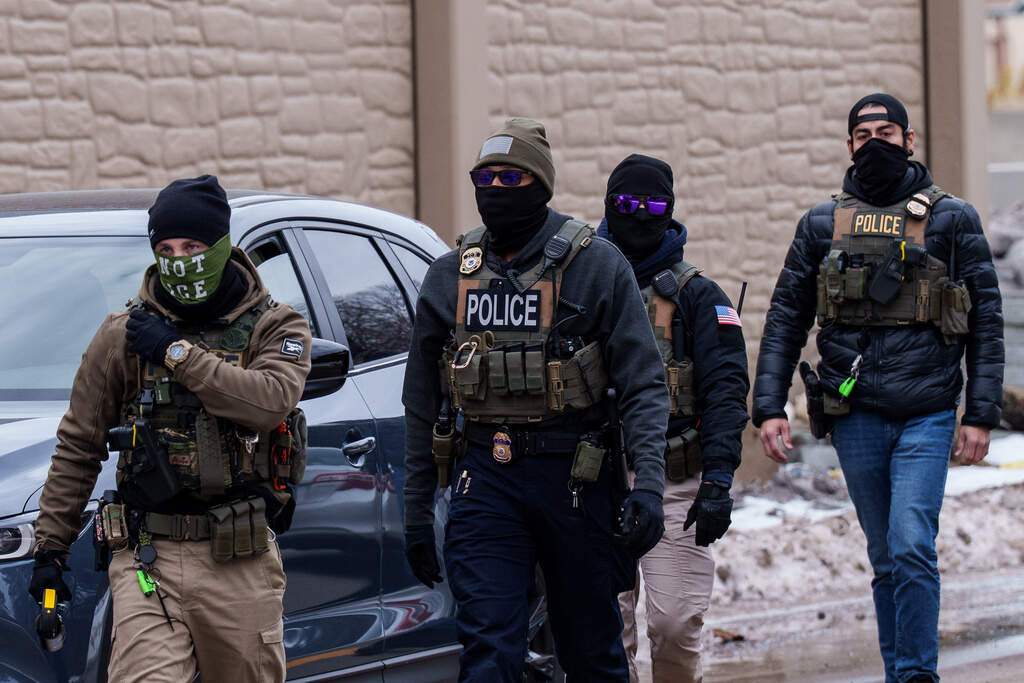
The number of Immigration and Customs Enforcement agents has doubled over the past year — driven by a massive recruitments campaign. Who the new recruits are and how they’re being trained.
Guests
Nick Miroff, staff writer at the Atlantic.
Jason Houser, former chief of staff for U.S. Immigration and Customs Enforcement.
Also Featured
Cengiz Yar, ProPublica photographer and visual editor.
Laura Jedeed, journalist.
The version of our broadcast available at the top of this page and via podcast apps is a condensed version of the full show. You can listen to the full, unedited broadcast here:
Transcript
Part I
MEGHNA CHAKRABARTI: Cengiz Yar is a photographer and visual editor for ProPublica. He's covered conflicts around the world, including in Iraq and Syria. For the past week, he's been in Minneapolis. He arrived just after us. Citizen Renee Goode was shot and killed by ICE agents on January 7th.
This past Saturday morning, a second American, Alex Pretti was gunned down in Minneapolis by federal agents. Cengiz began his morning at breakfast with his family. And a note, the first 30 seconds of the story you're about to hear from Cengiz includes sound of the gunfire that killed Pretti.
CENGIZ YAR: At breakfast, we started seeing the videos of the shooting coming across social media and different chat groups.
And so finished breakfast, and as we were leaving breakfast, my brother had a seizure and I had to take him to the emergency room. I was sitting in the waiting room and on the TV screen, they were playing this video on repeat.
(VIDEO PLAYS)
There were two women sitting next to me and just like overhearing them talk about having to prepare a go bag. It was a really just like jarring moment sitting in an American hospital waiting room, talking about prepping a go bag to get out of here, prepping for the eventualities of what's going to play out here.
Once I got my brother checked in, I jumped in the cab and got to the scene of the shooting. There was gas floating in the air and agents had surrounded the intersection. And they were surrounded by protestors and there were probably 200 or maybe 300 protestors.
There were chants, but there was also just visceral screaming. People furious about what had just happened to their community member and in their neighborhood. And then was trying to get a better vantage point again and backed away.
And as almost as soon as I backed away to move myself agents started dropping tear gas canisters.
And what I think were flash bang grenades. I've covered a lot of protests in the U.S. and often what I see at protests is mainly younger adults, and that is not the case in Minneapolis. The people I've been seeing on the street range from teenagers to 80-year-olds.
A photo I took yesterday was like two people carrying away like an elderly woman who was on the front lines and got gassed.
By the time the gas cleared, my heart rate settled down a little bit, and I walked back to the site of the shooting, talked to a couple people, and went back to my hotel to talk to my editors and file a couple photos and wash the chemicals off me before going back out. And then I went back out that evening.
I feel like there's a lot of similarities to what I've seen in the past in foreign wars with a force that feels like an occupation force, where an unwanted armed unit has come in and is being aggressively confronted by the local population who doesn't want them there. I haven't seen that in the U.S. before, where heavily armored guys are driving around in big trucks.
And getting yelled at by soccer moms and elderly couples and teenagers everywhere they go.
It was like 20 or -20 or -15 last night. It was super, super cold and still there were probably a hundred people out last night surrounding the visual site. Community members had set up tables with food and hot packs for hands, and a local church had opened their doors for people to use the bathroom and was getting coffee out.
And it was, everyone I talked to was expressing both sadness for the events of that day, but also pride in their community for how they'd been reacting. And then also a lot of contempt for federal forces in their community. And a feeling that they're being occupied by the federal government at the moment.
CHAKRABARTI: Cengiz Yar is a photographer and visuals editor for the Pulitzer-Prize winning newsroom, ProPublica. He's in Minneapolis now. Now these recent killings are again raising the questions, and now this time louder than ever, about who these federal agents are and how they are being trained. Earlier this year, President Donald Trump removed several qualifications for potential ICE agents.
He upped signing bonuses. And pushed forward aggressive recruitment campaigns in an attempt to get more boots on the ground as part of his nationwide deportation operation. So today we're going to dig into those details. And joining us now is Nick Miroff. He's a staff writer at The Atlantic. He's been following ICE and Border Patrol for quite some time, and of course, in detail over the course of the events that have been happening in Minneapolis, he joins us from Washington.
Nick, welcome to On Point.
NICK MIROFF: Good to be with you.
CHAKRABARTI: So first of all, I'd actually like to start with a broader view of what we know regarding who the agents are, who are in Minneapolis. Do we know how many of them are relatively recent recruits? How many of them are veterans? How would you describe the men and women of ICE and Border patrol that are in the streets of Minneapolis right now?
MIROFF: Sure. A couple quick points. Alex Pretti was actually killed by a border patrol agent. Those were border patrol agents who were responding in that particular scene. And there have been, in total, somewhere around 3,000 federal agents in Minneapolis, should be noted that is something like five times the size of the Minneapolis Police Department. So that is one reason that so many people report the feel of a kind of an occupied city.
And most of those are ICE officers. But a lot of them have been border patrol agents under the command of Greg Bovino who, you know, Secretary Kristi Noem was using as this kind of commander at large figure.
And as we reported in The Atlantic last night Mr. Bovino has been relieved of his command and is being returned to his old job in El Centro. California. So he is no longer going to be this commander at large figure. And the administration, the White House and the President are sending in Tom Homan, Trump's White House Border czar, who has been at odds with Secretary Noem for months.
And has been, until now, pretty much marginalized by this operation. And he and his team are going into to Minneapolis to try to turn down the temperature and to reassert, and this is important to reassert, ICE's role as the main agency responsible for the interior enforcement.
And that, and we can get into some of the other significance of that. But that's the big news over overnight.
CHAKRABARTI: To be clear, Bovino still has a job though, right? He hasn't been, he has been relieved of duty in Minneapolis, but he's still working for Homeland Security.
MIROFF: Correct. He's still the Chief Border Patrol agent in the El Centro sector of California. Yes. Which is in the Imperial Valley. That is the old job he had before Secretary Noem and Stephen Miller elevated him to this kind of roving position in which he's been so prominent in social media.
Okay. So we will talk about recruitment and training through the remainder of this program. But since you said that Homan's new sort of goal is to turn down the temperature in Minneapolis, it's not just the killings. Those are the most terrible things that have happened in the past couple of weeks.
But media and social media and firsthand accounts from folks in Minneapolis have described all sorts of very extreme tactics being used by these federal agents. Just today I saw a firsthand video of agents in trucks driving by protestors who are just standing on the sidewalk and they're doing drive-by pepper spraying of those protestors.
So what exactly can you see or believe that homeland security means by turning down the temperature? It would, I'm sorry, I'm going on here, Nick, but it just seems turning down the temperature would truthfully mean ending a lot of the tactics we're seeing on a daily basis in Minneapolis.
MIROFF: I think what we have to watch for over the coming days as Homan and his people get on the ground, obviously he's going there to meet with governor Tim Walz and Minneapolis Mayor Jacob Frey, and other Democratic officials who, it should be noted, don't have a lot of political, incentive right now to cut some kind of deal with Tom Homan.
However, the other key thing is going to be, is there a change in tactics? Withdrawing the border patrol from Minneapolis is a big step. Homan has been speaking for months about wanting, believing in the kind of traditional way that ICE has enforced immigration law, which is much less dramatic and is more, what he calls targeted enforcement, where officers do research in advance of who they want to go for and they plan how to take them into custody with minimal confrontation.
That is the way that ICE traditionally operates. And so are they going to go back to those types of tactics? Are they going to, or are they going to just keep doing the same things but without the border patrol? And that is what we need to be looking for over the coming days.
Part II
CHAKRABARTI: In a minute or two, we're going to hear from a former Chief of Staff for ICE. But first, here's DHS Secretary Kristi Noem on October 20th talking to the press about the fact that the Department of Homeland Security has received over 175,000 applications as part of the Trump administration ramping up of their recruiting efforts.
KRISTI NOEM: We had over 175,000 applicants for our 10,000 new ICE agents. We have many of them that are already out on the job. They've completed their training. We also have huge recruitment for not just ICE agents and HSI, but our Secret Service law enforcement officers, our CBP officers, all of those recruitment efforts are through the roof because I think of the individuals that are excited about defending the homeland, protecting this country, and making sure that they have the ability to go out and to do a job that they can be proud of.
CHAKRABARTI: Homeland Security Secretary Kristi Noem on October 20th. Okay, so what is that recruitment like? What are one of the recruiting events like? Here's a little taste.
(FOOTAGE)
Hello.
How are you?
Doing well, how are you?
CHAKRABARTI: Okay, so that is some sound that was recorded by Laura Jedeed. She went to an ICE hiring event at an arena in Arlington, Texas this past August.
JEDEED: I do a lot of reporting on the American far right and when I learned that ICE was doing a hiring expo in Arlington, Texas, and promising same day hires where you could go in, present your resume and potentially walk out with an offer.
I knew I had to go and see what that was like.
CHAKRABARTI: So she went. The interviewer and speakers promised expedited processing for applicants at the event if they had law enforcement experience. They also touted opportunities around the country.
JEDEED: There was no wait to get in. There was like a six person wait for the interview.
That interview took about six minutes. I timed it and this very normal woman took me and sat across from me at this black folding table and asked some very basic questions like my name, date of birth, whether I separated from the Army or retired, where I would like to be stationed. Really basic stuff that you could fill out on any form.
And I thought that was the pre-interview to be honest. And then when it was over, she's okay, we've got you. We'll stay tight. We'll email you with a tentative offer once we process your application. We are processing prior law enforcement experience first. So it may not be today, but just keep an eye out for the next couple days.
We'll get back to you.
CHAKRABARTI: Okay, so a couple important things there. One is you heard Laura talk about how the interviewer asked her if she had, quote, separated from the Army. That is because she is indeed a veteran of the United States military. She also happens to have had military intelligence experience, but the interviewer didn't ask her about that.
She also didn't ask about Jedeed's online presence, which has been very critical of the Trump administration.
JEDEED: It seemed like the question was law enforcement experience or no law enforcement experience. There was a complete lack of curiosity, very much including the seven-year gap on my resume.
CHAKRABARTI: But while the interviewer didn't seem interested in any of Jedeed's potentially applicable skills like her military intelligence experience, or whether she had firearms experience, an officer at the expo Q&A session did say this.
[EXPO TAPE]
CHAKRABARTI: So you're hearing there an officer at this ICE recruitment expo, basically telling applicants that they're going to be issued pepper ball guns, and if protesters are around and not explicitly, he says, quote, bleeping around, if they're bleeping around, to shoot them with the pepper ball guns, or a friend that comes up to assist the protestors.
Back to Jedeed, she actually did get an offer from ICE, a, quote, pending offer. She even got a start date and an assigned duty location.
JEDEED: It's very funny that they almost hired a journalist who doesn't care for them and has been very critical, that's funny. What's not funny though is that this means they're not vetting people, and I think we're seeing the results of that.
CHAKRABARTI: So that's journalist Laura Jedeed. She wrote about this experience going behind the scenes in the agency's hiring practices for Slate. And by the way, very soon after her story was published by Slate, the Department of Homeland Security denied that they had offered her a job. DHS Tweeted, quote, this is such a lazy lie.
This individual was never offered a job at ICE. End quote. But Jedeed responded to DHS with a screenshot from the Homeland Securities own dashboard with documentation welcoming her to ICE. There are check marks that you can see from application status to final offer, green check marks, and in the screenshot, you see her onboarding date was set to September 30th, 2025.
Duty location, New York City. Okay. I'd like to introduce Jason Houser into the conversation now. He's a former Chief of Staff for U.S. Immigration and Customs Enforcement, or ICE. He served in that position from 2021 to 2023 in the Biden administration. Jason Houser, welcome to On Point.
JASON HOUSER: Thanks for having me.
I appreciate it.
CHAKRABARTI: Can you first talk about what recruitment efforts were like during your tenure at ICE?
HOUSER: Yeah, I would say that it was a different environment in that time period where Congress had not appropriated a great deal of funds to expand ICE's staff at that time.
We also, it is a unique space to work, where ICE, in the staff, the personnel numbers that we had at that time, were built for having two to 3 million people on the immigration docket. And most people realize now that there's about 14 million individuals on the immigration document.
And ICE staff does everything from just case management to, of course, enforcement and case oversight and detention management. So hiring was strained at those times, but in those processes, there's always both the DHS policies and procedures for hiring, but also ICE's internal vetting and screening.
That includes everything from comprehensive background checks, drug screening, looking at extremist activity and their past and their social media. It also has to do with their ability to physically carry out the duties. That sort of processing and management is consistent with just government standards.
And that's typical whether in the Defense Department or Department of Homeland Security. It takes a good amount of time and resources for HR human resource processing to move people through that vetting. What I've seen here recently is a collapsing of that and I think we're beginning to see the outcomes of that and some of the personnel that's being brought on board.
CHAKRABARTI: Okay. So by the way, just to be clear, the 14 million number that you referenced is because the Trump administration is doing these mass deportations. Or aiming to do these mass deportations.
HOUSER: Yeah, I would say that the immigration system, we all, I think we all admit, is broken in this country and we've not properly resourced any part of it, whether it's immigration judges or case managers or asylum processing officers, et cetera.
And ICE has had the same issues over time of not having the staff to handle the amount of work that's coming their way.
CHAKRABARTI: Nick, I promise I'll come back to you here in a second. But Jason, tell me more about, you said the, quote, changes that we have been seeing recently.
How do you react to what you're seeing going down in Minnesota?
HOUSER: Well, just what I see in Minnesota is the outcomes of leadership, of direction, of policy, of commander's intent to carry out quota focused arrests. What we're seeing playing out now in our communities, and there's been a turn away and most people are following that, 20 to 25% of federal law enforcement as a whole have been turned off counterterrorism, human smuggling, sex trafficking, drug smuggling.
That mission set. Which is quite frankly, has always historically been about two thirds of the focus of just ICE. And we're pulling the federal law enforcement away from those mission sets and now having them support these on the street civil immigration enforcement operations that are putting both the communities at risk, but also putting the officers at risk.
And I say, the one thing that I see just focused on the training and hiring. Is this sort of front loaded, this fast paced, rapid move, these hires to the front lines as quickly as possible. I'm worried about that in a lot of ways. One, that means that the vetting and screening for these officers is not occurring.
Additionally, this idea that we can just say, Oh, their training has equipped them for this. In two decades of ICE and CBP existing, they've never existed or carried out this specific mission set. So the idea that you can collapse the number of days of training and then even say we're going to complete training on the job, or when you're expanding the risk and sort of putting officers in these intense situations in these communities, training should actually be expanding, not collapsing.
Training should actually be expanding, not collapsing.
Jason Houser
Outside of just pushing people through, collapsing the background checks and the vetting, but also collapsing their training pipeline and preparing them for the environments in which they're going to work. Whether you agree with it or not, or what this administration is doing, it's putting the officers at risk, it's putting the communities at risk, and that should all be reassessed as we reset here.
CHAKRABARTI: Okay, Nick Miroff from The Atlantic. This is where your reporting is critical. Tell us in more detail this collapsing of training that's been happening for new ICE recruits.
MIROFF: Sure. I was at the same job expo in Texas that you described earlier, and that was amid this all-out push by the administration to hire 10,000 deportation officers by the end of last year, basically by this month.
And the funding came from the Big Beautiful Bill and they ended up getting, they claim 220,000 applications. What we were able to determine was that a lot of people were applying for three or four different jobs, but this is, just this unprecedented hiring binge to get as many people in there as possible.
And as Laura Jedeed laid out, they were prioritizing people with previous law enforcement experience or military service, but by the beginning of this month, they were claiming victory and they said that they had hired 120, sorry, 12,000 new people as deportation officers and HSI investigators and legal staff.
And what we have reported is that number is misleading. That the number who are actually ready to deploy, who are considered operational is much lower. They've had very high dropout rates at the academy, and you asked about the condensed training. They've taken the training course for new deportation officers with no prior experience.
From about four to five months down to just 42 days now. And so it's basically a seven-week training course, six days per week. And I was asking about what kind of deescalation training the new officers are getting, and what I heard from my sources is that there are deescalation tactics woven into much of the coursework, but the amount of time they're dedicating to deescalation tactics is only about four hours.
So to think about sending new recruits out into scenarios like the ones we're seeing in Minneapolis is a recipe for disaster. And just one more point you asked earlier, are these new recruits that we're seeing out on the streets of Minneapolis? And I would say by and large, no.
And the key thing here is, the officer, the ICE officer that killed Renee Goode was had 10 years of experience with ICE and previous experience with the border patrol. So he was very experienced and the border patrol agent that killed Alex Pretti was, had been on the force for eight years.
So it's not, these are not new recruits that have been involved in these terrible tragedies.
CHAKRABARTI: Okay, so both of you have said a lot here, and I just want to go through them a little bit more forensically. Jason, let me just pick up with what Nick just said. Okay. In the two cases where U.S. citizens were shot and killed by agents, now we're talking about agents with years of experience.
Do you have, what's a plausible explanation for that?
HOUSER: Let's just say for instance that an officer was hired eight to 10 years ago when they came through the Federal Law Enforcement Training Center and became an agent. What were they being trained for?
And if they were a border patrol agent, they most likely were spending their 12 to 16 weeks in that training pipeline, focused on surveillance working tactics and authorities working along the border. Outwardly looking at national security threats that want to pin, that want to come across and use our border in criminal ways.
Drug smuggling. They weren't focused on civil immigration enforcement in the streets of Minneapolis, in these sort of highly intense, pressurized environments. So you could make a rational argument that an officer that comes from eight to 10 years ago before they were now put into these type of operations, are even at a larger risk. Just because they say someone has been working along the San Diego sector or Tucson sector down along the border, that has been working to deal with asylum seekers that have come across the border.
That's a different job than now someone that's dealing with riot control and carrying out operations where, you know, for instance, in the situation of Minneapolis, saying that they're going after hardened criminals in the streets.
You can see this has become about the visualization in these operations, right? Like we're not seeing, normally as Nick perfectly said earlier, I believe, when ICE goes after a convicted criminal in a community, convicted criminals don't want to be caught.
We do it with surveillance and pre-operational planning. You do it targeted to where the time, the sort of force that's brought to that arrest is proportional to the need, but it's also that it's proportional to protect the community. What we're seeing in Minneapolis is dozens of officers coming down the streets in armored vehicles, more for the show.
And I think that's where the politics of this and the training and the reality have all come together in Minneapolis and it's putting everyone at risk.
CHAKRABARTI: So more for the show though is the opposite of deescalation, right? It is actually provocation. Of the innocent citizens standing on the street exercising their first amendment rights to gather and protest in ostensibly what is a free country.
That makes me want to ask both of you more about, Jason, what you said regarding commanders intent. But we have a break that we have to take in just a second here, so we'll pick that up on the other side of the break.
Part III
CHAKRABARTI: Jason, let me just stick with something you said about Commander's Intent that we may be seeing in places like Minneapolis. And as both of you said, the fact that in these two deadly shootings, it wasn't a new recruit that pulled the trigger.
It was a veteran. Which makes me wonder, and Jason, I'm going to turn this to you. Whether there's something historically within ICE that leads to situations like this. For example, Lila Hassan, who's an investigative reporter for Al Jazeera, she was able to obtain documents over the course of many years regarding ICE training.
And she found, for example, there are many examples in this story, but she found, for example, that part of the train training in a quiz that recruits were given about when should deadly force be applied or how long should an officer wait until using deadly force?
And the answer in the quiz was none. Deadly force can be initiated immediately. There's also another document that she obtained that said, that directed new ICE agents to not use minimal forms of force first, because they claim the use of minimal forms of force could actually put the agent in danger.
So to jump to more significant, more serious forms of force, possibly even deadly force. And these documents are from years ago. So the problem is not new necessarily, Jason.
HOUSER: No, and this is in 2021, as leading ICE and supporting the acting director at that time, we rewrote the ICE Use of Force Handbook.
The actual handbook in which is used to train to in this guidance for the field, and then that was supported by Secretary Mayorkas in 2023, signing a use of force policy for the entire department. I would say we saw those systemic issues with that training. But this goes back to something that I just want to, there is a lot of military examples and comparisons that can be used in this.
And remember, the strategic decision making in the direction from leadership is what's driving this. We're in a place where quota arrests, we're targeting 3,000 a day. We're in a situation where rules of prioritizing those that have convicted criminality or just and taking away, taking into law enforcement's discretion, decide that individuals that have been here for decades are thriving in our communities or don't even have a viable way of being removed, are being targeted to hit this, those sort of directions and commands.
Have quite frankly decimated ICE's leadership over the last year. Dozens of senior leaders and seasoned officers that were running ICE have been removed. Transport demoted. And then when you have these situations where this idea that you can just walk down the streets of Minneapolis or Chicago and find convicted criminal migrants, it's not real.
It's fake. And what we have is a situation where ICE officers, deportation officers specifically, 80% of their work historically has been placing detainers or transferring individuals from other law enforcement agencies across the country into ICE custody. It's not traditionally in these at large, on the street operations, and we're beginning to see that as the stress point, with all those things combining together, that's creating these environment to where we have to get back to reasonable immigration enforcement that meets the needs of our communities.
And I think when it comes to the use of force, it needs to be proportional to the threat to protect the community and the law enforcement officer. But there's no reason why. And that's the thing about what's happening around the streets of Minneapolis.
Why are we there? What is the public safety outcome? What is the intent of leadership? That's where it's being blended with the politics. The idea, even if I was to put on, and think and direct like Stephen Miller has, that there should be 3,000 arrests a day. Why? And exponentially increasing the number of removals. Why would I be on the streets of Minneapolis? Where should resources be placed?
CHAKRABARTI: As you say, this is not, flooding the streets of Minneapolis is not how you execute a lawful and effective immigration arrest. So the intent is and they know it.
The intent is what we have seen on the streets of Minneapolis, is to terrorize regular citizens. And to somehow, it's not just use of force. It's a show of force. And Nick, let me ask you something though, because Jason said something else interesting. There's a lot of military aspect to this.
Okay. In terms of the behaviors, maybe. But I would argue that members of the military, first of all, the streets of Minneapolis are not a place for the United States military, period. Second of all, even members of the military have more training than it seems many of these new recruits do. So you said that went down from four to five months, which would be a maximum of 150 days, down to 45 or 47 days.
A third of the amount.
MIROFF: 42.
CHAKRABARTI: 42.
MIROFF: So it's even lower. Yeah, getting back to Jason's excellent point. This is about politics and this is the use of a federal law enforcement as an instrument of politics. And so the spectacle that is being produced here is crucial.
The optics that they are going for in terms of this kind of deployment are what Stephen Miller and others who are with him in this view as both important to the president's base and way to keep the fires of the president's movement hot. And we're seeing now the possible limits of that.
This is the use of a federal law enforcement as an instrument of politics. And so the spectacle that is being produced here is crucial.
It's too early to tell if Alex Pretti's death is going to be a turning point, but it does appear that the president is getting cold feet about how far to take this. And your point about the military is interesting. One thing that I have perceived, and I don't know if Jason would agree, is like, whenever the National Guard has been called, I was in Los Angeles, where they were brought out, the National Guard troops tend to be much more cool headed.
Much less inclined to use force. And the protestors too generally don't view the guard troops as the agents of aggression or oppression here. And so ironically, they have often had a calming presence at some of the places I've been.
CHAKRABARTI: Yeah. So let me just make an observation here. That we are at a point right now in this country where we are saying out loud that perhaps not even the death of two American citizens at the hands of federal agents is enough to give the president of the United States pause about his national goal of this migrant eradication from this country. And again, I come back to what Jason said about commander's intent all the way up to the president of the United States.
Because this links to, again, thinking about new recruits, like who these new recruits are, and as Laura Jedeed told us earlier, yeah, she had that military experience, which maybe bumped her up higher to near the top of the list for potential new ICE agents. But she doesn't get a sense that they Googled her at all.
To find any other information about her. Now, this doesn't seem to me to be normal or let alone effective protocol when you're trying to hire people for a very serious and challenging position like becoming a federal agent. And I'll add this, I think we know what kind of person that the Department of Homeland Security believes is the right kind of person to carry out the intent of the President of the United States.
Because multiple social media accounts that DHS has have used a particular song in their recruiting efforts. It's called We'll Have Our Home Again, and just take a quick listen to this.
(SONG PLAYS)
CHAKRABARTI: That was, we actually got that one from an online recruitment campaign that went back as far as last August. We'll Have Our Home Again, it's a song associated with white nationalism. The Proud Boys have even put out a recording of it. Jason, it seems that presidential intent or leadership intent here when linked to this kind of recruiting effort tells you who they want on the streets as new ICE agents.
HOUSER: I would say a few things. I came into working at ICE and after the January 6th riots, and it was a bipartisan view on the hill and direction in the administration, we revetted all employees for left or right-leaning extremist views, and this idea that you're recruiting this rapidly, this quickly, without the proper assurance that these folks or individual are equipped or have this, not just the demeanor, the sort of the background and the capability to carry out these really, these extremely important tasks, with great, full Title 8 immigration enforcement is broad and it's extremely powerful.
And to put it into the hands of individuals that may not have the temperament and viewpoints to carry those out in the humane, just way, that all Americans expect, is very dangerous. And I would say just to make this where it hits home, let's say this was another part of the government.
Full Title 8 immigration enforcement is broad and it's extremely powerful. And to put it into the hands of individuals that may not have the temperament and viewpoints to carry those out in the humane, just way, that all Americans expect, is very dangerous.
Jason Houser
What if we weren't vetting the doctors that are working at the VA? What if we weren't vetting our military personnel and screening them. And that is not just to protect the public, that's protect other law enforcement agents. You're putting everyone in harm's way in that regard, and it needs to, it doesn't need to be rushed.
This idea that we're going to rush 10,000 new immigration deportation officers out into the streets to do arrests, when the rest of the immigration system itself has not been built to that capacity. And additionally, many of the individuals that are being targeted now are here legally. They came through vetting and screening programs along the border and have entered pathways and now being targeted by unskilled staff.
And I must admit to the point that I said earlier. We're putting ICE officers and border patrol agents in new environments; their old jobs and responsibilities are not going to change. So training should be expanding, not collapsing.
CHAKRABARTI: Let me turn back to you, Nick, here, because then there's also the fact, again, I'm looking straight at your reporting that even though standards have been eased in the academy where potential ICE officers get trained in order so they can get more recruits. You had said earlier that even then, a huge number of these recruits aren't passing the training requirements. And why is that?
MIROFF: Most of them who are dropping out are failing the physical fitness tests.
They require them to do pretty basic things. The main, I'm told that the biggest challenge for the new recruits has been running I believe it's a mile and a half. And some classes have seen attrition rates as they call them of about 50%. And that kind of failure rate has been widely mocked, but it's not like a joke to the veteran ICE officers who are going to have to work alongside these new recruits and who have been telling me for months that they're not comfortable. They don't want to be sent out on the streets with people that they don't think are qualified, who wouldn't have passed muster, in previous years.
And this is one more factor that is contributing to this low morale.
CHAKRABARTI: Yeah, one ICE official also told you that in addition to being unable to pass the fitness tests that some of the recruits drop out of the academy because they flunk exams on immigration law, or exams on knowing the Fourth Amendment's limits on an office's search authority.
So it sounds like even basic understanding of what the Constitution allows and doesn't allow is questionable.
MIROFF: And my understanding is that a lot of those exams are open book, so they have an open book, and they have to be able to accurately state what the law is.
They have books right there and they're not able to pass. Jason would probably know better about that, but it sounds pretty bad.
CHAKRABARTI: Are they open book, Jason?
HOUSER: Some of them are open book and some of them are multiple choice and other things. I think the one thing about all of this is the idea that over the last few months that dozens of senior leaders, those are all, have been fired from ICE, that have carried out this mission for decades. These are the folks that provide this training and oversight and accountability, and the loss of that is extreme.
And I must also say that these are the same officers that 48 months ago, that we were asking in the Biden administration for when I was detailing thousands of officers to the border, to humanely remove migrants that were in be Del Rio, Texas, for instance. And the directions there were, and we will have no loss of life. We will properly vet and screen individuals that are coming here and we'll make sure that they get through the proper process.
Those were the same officers. Now we have this juxtaposition of what they're being asked to do and bringing on these staff that are less seasoned and trained. It worries me for the future, that as we continue to have an immigration system that's just broken systemically, these officers are going to be called upon in five years, 10 years, 15 years to do other types of mission.
And what kind of workforce are we building? And it can't be myopically focused on the fact that we want to carry out punitive arrests on the streets in blue states. That cannot be what it's about. It has to be about the needs of our communities.
CHAKRABARTI: That long-term implication is something that I hadn't heard discussed before. So I'm grateful that you brought it up here. I have less than a minute. And Nick, if you forgive me, I want to ask Jason the final question. And you were the chief of staff for ICE for a couple of years, so if you were in that job today and you were deployed and you went to Minneapolis. What specific orders would you give to change that Commander's Intent? What specific changes would you make to reduce the temperature, to stop U.S. citizens from getting sprayed at point blank range with pepper spray or shot in the back?
HOUSER: The first thing that you would do is you would prioritize enforcement. You would give clear guidance that we were going to be targeting those that have final orders of removal, and we would be targeting those that have convicted criminality that we believe could be out hurting our communities. And you would proportionally place staff in Minneapolis.
That's proportional to the amount of migrants that we need to oversee and do case management, but also for those, the amount of staff that we need and the resources. My thing with Minneapolis is there's about 130,000 migrants in that country when actually in Florida and Texas there's 1.2 and 1.7 million.
The first draft of this transcript was created by Descript, an AI transcription tool. An On Point producer then thoroughly reviewed, corrected, and reformatted the transcript before publication. The use of this AI tool creates the capacity to provide these transcripts.
This program aired on January 27, 2026.