Support WBUR
A pattern of denial at the Department of Homeland Security
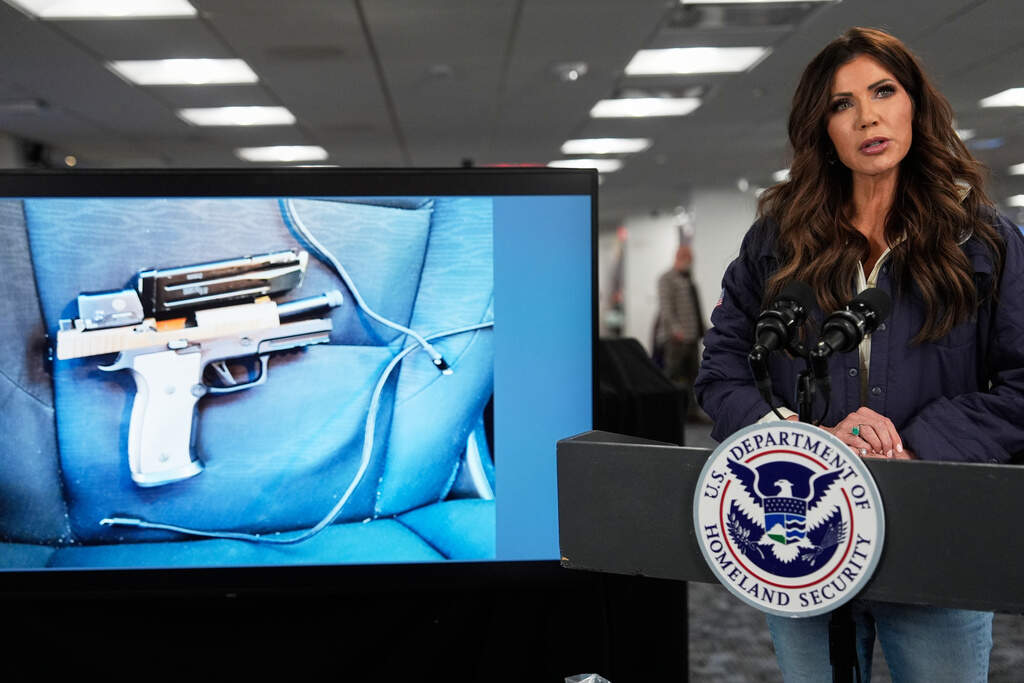
Homeland Security Secretary Kristi Noem said Minneapolis nurse Alex Pretti planned to “inflict maximum damage on individuals and to kill law enforcement.” But that’s not what eyewitnesses say and videos show. How can Americans trust an agency that disputes what we see with our own eyes?
Guests
Stephanie "Sam" Martin, associate professor of public affairs at Boise State University. Author of the recent article in The Conversation titled “Repeated government lying, warned Hannah Arendt, makes it impossible for citizens to think and to judge.”
Daniel Altman, executive director at U.S. Customs and Border Protection Office of Professional Responsibility from 2019-2025.
Also Featured
C.J. Ciaramella, criminal justice reporter at the libertarian magazine Reason.
Eric O'Denius, worked as a deportation officer with U.S. Immigration and Customs Enforcement for 24 years.
The version of our broadcast available at the top of this page and via podcast apps is a condensed version of the full show. You can listen to the full, unedited broadcast here:
Transcript
Part I
MEGHNA CHAKRABARTI: On Saturday, January 24, Alex Pretti was shot and killed by federal Border Patrol agents in Minneapolis. Cell phone videos now seen around the world have allowed forensics experts and multiple journalism organizations to create moment by moment analyses of the shooting. The audio timeline you're about to hear contains sounds of gunshots.
(SOUND OF WHISTLES)
At approximately 9 a.m., civilians, including Pretti, gather on Nicollet Avenue in Minneapolis. Pretti is in the middle of the street holding up a cell phone, apparently recording federal agents. An agent puts his hand on Pretti's chest and pushes him backwards to the sidewalk. Bystander video from across the street captures Pretti saying, "Do not touch me." The agent says, "Get out of the traffic.: Pretti responds, "I am out of the traffic. You are blocking the street."
(SOUND FROM BYSTANDER VIDEO)
Thirty seconds later, another officer throws a nearby civilian face-down onto the street. Pretti takes two steps towards them and then steps back, saying, "Leave her alone. We are back. We are back."
(SOUND FROM VIDEO)
Less than a minute later, Pretti walks toward the middle of the street, directing a car to move safely past him. His cell phone is still raised in his right hand. There is nothing in his left hand. An officer approaches another apparent observer in a brown coat and pushes her. She moves to Pretti and holds him by the waist. He puts his arm around her.
A second woman with an orange backpack walks over. The officer pushes her to the ground and then sprays Pretti with a chemical irritant. Pretti raises his left hand to block the spray. Pretti and the first woman then move to the other woman who was knocked down. The officer continues to spray the irritant at them.
Several more officers arrive. They grab Pretti and pull him to the ground. An observer a few yards away yells at the officers.
OBSERVER IN VIDEO [Tape]: Hey! That is police brutality! They are hitting that observer! They are kicking them in the face!
CHAKRABARTI: Agents pummel and press Pretti to the ground for about 20 seconds. He's on his knees. His shirt gets yanked up at his waist when agents discover a gun.
(SHOUTING FROM VIDEO) A gun, a gun!
CHAKRABARTI: Minnesota officials later confirmed that Pretti had a license to carry. An officer in a gray jacket bends down. Here's CBS News.
CBS NEWS ANCHOR [Tape]: In this video obtained by CBS News, you can clearly see the gun being removed from Pretti's waist by the officer.
CHAKRABARTI: The agent in gray quickly steps away with the gun. The first shot is fired one second later.
(GUNSHOT)
CHAKRABARTI: All the officers move back and at least one keeps firing.
(GUNSHOTS) (SCREAMING)
BYSTANDER: The (EXPLETIVE) did you just do?! What the (EXPLETIVE) did you just do?!
CHAKRABARTI: The agents fire at Pretti approximately 10 times.
BYSTANDER 1: They have just shot a man!
BYSTANDER 2: They shot that guy. Oh my God.
BYSTANDER 1: I know. They have shot a legal observer! Call 911. Call 911.
BYSTANDER 2: They just shot somebody. They just shot somebody.
BYSTANDER 1: Call 911.
BYSTANDER 2: I'm calling 911.
CHAKRABARTI: It is just before 9:03 a.m. A little more than three minutes have elapsed between the moment an officer first pushed Alex Pretti to the sidewalk to the moment he lay motionless on the street.
Alex Pretti was pronounced dead at 9:32 a.m. Central Time. Two hours later, the Department of Homeland Security released its story on social media.
The statement on X begins, quote, "At 9:05 a.m. Central Time, as DHS law enforcement officers were conducting a --"
GREG BOVINO [Tape]: At 9:05 a.m. Central Standard Time, as DHS --
KRISTI NOEM: At 9:05 a.m. Central Time, the Department of Homeland Security, law enforcement officials, and --
CHAKRABARTI: Border chief Greg Bovino spoke to the press just after 1 p.m. DHS Secretary Kristi Noem also held a press conference three hours later.
They did not deviate from the earlier DHS statement, which said, quote, "an individual approached U.S. Border Patrol officers..."
NOEM: An individual approached U.S. Border Patrol officers with a nine millimeter semi-automatic handgun.
BOVINO: ...With a nine millimeter semi-automatic handgun.
NOEM: The officers attempted to disarm this individual. But the armed man reacted violently. Fearing for his life and for the lives of his fellow officers around him, an agent fired defensive shots. This looks like a situation where an individual arrived at the scene to inflict maximum damage on individuals and to kill law enforcement.
BOVINO: The officers attempted to disarm this individual. But he violently resisted. Fearing for his life and the lives of his fellow officers, a Border Patrol agent fired defensive shots. This looks like a situation where an individual wanted to do maximum damage and massacre law enforcement.
CHAKRABARTI: By the time Bovino and Noem spoke to the press, videos of Pretti's killing had already been posted on the internet. That prompted CNN's Dana Bash to ask Bovino.
DANA BASH [Tape]: With respect, it feels as though in some ways you're blaming the victim here.
BOVINO: The victims are the Border Patrol agents. I'm not blaming the Border Patrol agents. The victim are the Border Patrol agents.
CHAKRABARTI: At Noem's press conference, a reporter asked the secretary why she claimed that Pretti posed a threat to law enforcement.
NOEM: That is no claim. It is the facts, the facts of this situation. This individual showed up with weapons and ammunition to stop a law enforcement operation of federal law enforcement officers, committed an act of domestic terrorism. That's the facts.
CHAKRABARTI: Except in the case of Alex Pretti, citizen video proved that it's not.
C.J. CIARAMELLA: There's sort of a dam breaking with media and other politicians, Republicans as well, noting that DHS is putting out statements that are clearly not true.
CHAKRABARTI: C.J. Ciaramella is the criminal justice reporter for the libertarian-leaning Reason Magazine. He's been following DHS for years. He says that under Secretary Noem, there's a distinct and new pattern of lies coming out of the agency.
Ciaramella identifies three incidents that all took place just this past October. First, in Chicago, October 10.
CIARAMELLA: There was a WGN-TV employee, Debbie Brockman, who was out on the street and she was arrested by Border Patrol agents. And there was only a video showing her being thrown to the ground and handcuffed.
(SOUND FROM VIDEO)
BYSTANDER: What's your name?
DEBBIE BROCKMAN: Debbie Brockman. I work for WGN. Let them know!
BYSTANDER: I got you.
CHAKRABARTI: The video shows Border Patrol agents loading Brockman into a silver minivan before pulling away from the scene so quickly that they ripped the rear bumper off a nearby black SUV.
(SOUND FROM VIDEO)
CIARAMELLA: The account that DHS gave me said that as agents were driving away, Deborah Brockman, a U.S. citizen, threw objects at a Border Patrol's car.
CHAKRABARTI: Ciaramella says the inconsistencies between the agency's statement and the videos were immediately apparent.
CIARAMELLA: She was already in the van that drove away. She was already under arrest at that point. You know, and I asked them about that and they just never responded.
CHAKRABARTI: Ciaramella likens DHS' statements to the agency trying to convince the public that the sky is not blue — so obviously not true that the agency risks losing deference from the media and the public's respect. And he says it's happening across the country, in case after case.
On October 1, Ciaramella reported on a story in Alabama. Leo Garcia Venegas was detained twice by federal agents in separate raids on private construction sites.
Venegas is a U.S. citizen. And he had a valid state ID on him both times.
CIARAMELLA: And not just a a valid state ID, a REAL ID, which is the new requirement from the federal government that you're supposed to have to be able to fly or, you know, get other important stuff.
CHAKRABARTI: It's meant to make it quicker and easier for government officials to verify that you are a U.S. citizen or lawful resident.
In a lawsuit, Venegas claims that the agents did not accept his REAL ID. Instead, they detained him and ran him through their own systems before confirming he is a citizen and releasing him — only to be arrested again.
So Ciaramella followed up.
CIARAMELLA: Asking, well, if there's no indiscriminate stops and you're using reasonable suspicion, then why did you detain the U.S. citizen? And they did not have a response for that. I later wrote another story about the REAL ID issue because they submitted a declaration in court in that same lawsuit. And it said, REAL ID can be unreliable to confirm U.S. citizenship.
CHAKRABARTI: DHS' claim goes against the entire purpose of REAL ID. Whether you are a U.S. citizen or not, REAL ID proves you are in the country legally.
The third October case is back in Chicago.
On October 4, Marimar Martinez, a U.S. citizen, was driving to her church when she encountered federal agents on patrol. She began streaming on Facebook live, warning people that immigration agents were in the neighborhood.
(SOUND FROM VIDEO) (SPANISH)
CHAKRABARTI: DHS says Martinez rammed the SUV and that the agents feared for their lives. Martinez says they rammed her. She drove her car around the agent's vehicle, and it was then that agent Charles Exum opened fire, shooting Martinez five times.
She spoke with 60 Minutes.
MARIMAR MARTINEZ [Tape]: I just looked out and I looked at my hand and it was full of blood. That's when I realized like (GASP) I actually got shot.
CHAKRABARTI: The FBI later arrested Martinez on charges of assaulting federal officers. A DHS statement claimed that the agents were boxed in by 10 other vehicles when Martinez rammed them and could not escape.
But like in the other cases we've discussed, video evidence quickly undercut that claim. Martinez's lawyer, Chris Parente, obtained the video.
CHRIS PARENTE [Tape]: I don't see 10 people and I certainly don't see anybody in the lane in front of him. Why can he not go forward?
CHAKRABARTI: There are two striking similarities between what happened to Marimar Martinez and Alex Pretti in Minneapolis. A DHS statement called Martinez, a, quote, "domestic terrorist," just as you heard Secretary Kristi Noem say earlier about Pretti.
And, like Pretti, Martinez also had a gun in her purse, which she was legally licensed to carry, and never brandished it in front of officers.
Again, Reason Magazine's C.J. Ciaramella.
CIARAMELLA: You know, this was another case where a lawful gun owner was shot by a Border Patrol agent, and the fact that she was exercising her lawful Second Amendment rights even though she never brandished the gun, they used that fact in these statements against her.
CHAKRABARTI: So three separate incidents all in one month. Each time, DHS issues statements full of lies that are immediately contradicted by video evidence.
For Ciaramella, it's not the lies or even the frequency of the lies that are so concerning.
CIARAMELLA: This is not a new development by any means. The Biden administration lied. The Obama administration lied. Going back as far as you want to go in history, basically.
CHAKRABARTI: Ciaramella says what we're seeing now are not the typical political lies customary of any administration. Ciaramella says the real danger is whom the Department of Homeland Security is aggressively lying about.
CIARAMELLA: These are statements that are being put out on U.S. citizens who are not in the political arena, and who are being subjected to government violence and even deadly force. And that's the most extreme measure of government force, you know, is the ability to detain, arrest and even kill someone. For the government to say things that are not true about that is a very serious matter.
Part II
CHAKRABARTI: Today we're talking about the Department of Homeland Security under Secretary Kristi Noem and President Donald Trump and the dangers when governments lie not only to their citizens, but also about their citizens.
So let's take a moment to listen to Hannah Arendt. She's of course the political philosopher. She was a Jewish refugee who fled Nazi Germany in 1933 because of the real possibility that she could have been deported and sent to a concentration camp. And her writing since then has become very critical in understanding the strengths and weaknesses of democracy.
Now, in a 1972 lecture she gave at Carleton College, Hannah Arendt explained her view about why some political leaders lie.
HANNAH ARENDT [Tape:] Delight not so much for their country, certainly not for their country's survival, which was never at stake, as for its image. In spite of their undoubted intelligence, they also believe that politics is but a variety of public relations, and we are taken in by all the bizarre psychological premises underlying disbelief.
CHAKRABARTI: Well, joining us now is Stephanie Martin. She's an associate professor of public affairs at Boise State University, focusing on political storytelling and civic identity.
Professor Martin, welcome to On Point.
STEPHANIE MARTIN: Thanks. It's lovely to be here. I appreciate it.
CHAKRABARTI: In fact, you recently wrote an article in The Conversation that was headlined "Repeated government lying, warned Hannah Arendt, makes it impossible for citizens to think and to judge." And let me ask you, in your essay, you talk about why Arendt wasn't so interested in why or trying to explain the fact that governments or political leaders lie, she just accepted that as a fact, but the purpose behind the lies.
MARTIN: Mm-hmm.
CHAKRABARTI: Can you talk to me about that a little bit?
MARTIN: Well, so I think what your question, what your question gets at is that when government doesn't tell the truth or government, sorry, obfuscates, it isn't just bad messaging, right? For Arendt, it was a democratic systems problem.
And so I think in the clip that you had there and in the essay that I used for the article, I wrote for The Conversation, she's writing in response to the Pentagon Papers and she's saying that politics can actually survive disagreement and it can survive spin. But what it can't survive is the erosion of a factual reality as a shared baseline. And so for Arendt, facts are the common world we all stand in while we argue about what those facts mean and what values we want to privilege or not privilege because of that.
And so I guess I just stop by saying when officials like, when they deny, when they deny quickly, like we've seen in the Minneapolis situation, when they deny, quickly speak evasively or flood the zone with shifting claims, I don't think, and I don't think Arendt thought that they're trying to win the day's headline.
CHAKRABARTI: Mm.
MARTIN: What they're trying to do is shape the conditions under which later evidence will be received. They're trying to set the narrative so that they can live inside the narrative that they like, rather than what may or may not turn out to be what actually happened.
CHAKRABARTI: It's so interesting because that's exactly what that Arendt clip that we just played gets at. That the lies don't come, because of, you know, for the country's survival, lying in order to keep America going, for example. But that Arendt mentions that politics is a spread of a variety of public relations and that turns into this bizarre psychological set of premises which create the basis for disbelief.
And I feel like that is exactly what we're seeing here. And to the point that was made by C.J. Ciaramella in the previous segment, the disbelief and the bizarre premises are now being, you know, targeted on just regular citizens, let alone, you know, other politicians or political beliefs.
MARTIN: Yeah, I agree with that. I think that the harm is not simply that the public becomes misled or that the public can't track exactly what's happening. I think that the greater harm is that citizens, the people, lose the ability to do the basic work that democracy requires, which Arendt said was to judge.
And what she meant when she used the word judge was like to engage in reasoning that is crucial and active and to determine right from wrong, and beautiful from ugly, and true from false, and not be relying on pre-established rules or universal formulas, right? For Arendt, the work of democracy is really critical self-examination and public examination.
And so to her, she would say, you know, we can tolerate disagreement, we can tolerate debate, we can even tolerate political spin, political messaging, but a democracy cannot survive, it cannot tolerate not knowing what is real.
CHAKRABARTI: Mm.
MARTIN: And so this kind of hiding or shifting the lens, I think is especially corrosive, because it turns the relationship between the state and the public into their — it's like they're having a tug of war.
And so instead of saying what happened and letting the public argue about what that means, officials muddy the factual record itself and they delay clarity. They speak in evasions, they release partial stories that, like I said, shape perception before the evidence can catch up. And that is how I think contested narratives become the story, sometimes in ways where official counts are later contradicted, but the story's already out there. And it's hard to, it's hard to catch up with.
CHAKRABARTI: Yeah. So let's talk a little bit more about the fact that in your piece, you're discussing a moment in time where Arendt is actually talking about the Pentagon Papers.
And of course, for those are the what, 1971 papers that were published by the New York Times and the Washington Post. They were classified Defense Department documents, many of them that pretty clearly proved that the history of U.S. decision making in Vietnam was not so great. And in fact, that political and military leaders knew that the U.S. was losing in Vietnam.
And you write that she saw the Pentagon Papers as more than just a Vietnam-specific story. That it was something that she called an evidence of image-making. Can you tell me more about that?
MARTIN: Yeah. So in the Pentagon Papers, Arendt is trying to extend the conversation to show how what was happening with the Pentagon Papers was worse than like a single lie or a single goal by the government to mislead the public.
And she's saying that our democracy is becoming a process that includes deception. It includes self-deception, she would've said. And she uses this word "defactualization." And what she meant by defactualization is that a state in which public life trains people to stop insisting on a shared world. And that's the danger she really is asking her audience to see, that idea that hiding and evasion make it so that citizens can't have a shared factual world.
And the end state of that is not just that citizens believe things that aren't true or believe false things. It is that citizens can no longer orient themselves in reality. And so that thinking and that judging, that engaging in active political life, it becomes much harder, if not impossible.
And so Arendt's gonna tell us, you know, factual truth has a stubborn quality that has to be acknowledged. We can't treat facts as optional. Because as we protect facts, we end up in a situation where political disagreement is actually meaningful in how citizens solve problems.
CHAKRABARTI: And this is back in the early seventies when she's talking about this. And of course even prior to that, her writing on Nazi Germany and the trial of Adolf Eichmann have become, you know, iconic in understanding the impacts of factual manipulation on people to the point that it can lead to genocide.
But I wonder what would Arendt make of what's happening right now? Because on the one hand it's like, well, lies happen, they're dangerous. But the republic survived, right? The United States survived the Pentagon Papers.
And yet here we have a different situation and I would argue possibly even more insidious. Because, on the one hand, on the good side, reality still seems to be, you know, it's clinging onto its last stand. Because in the face of all the almost instantaneously available video from these killings in Minneapolis, people are reacting to a degree that we've at least seen the theater of change coming from the Trump administration.
But on the other hand, I wonder if Arendt would focus on the fact that even with all the video, you know, we put those three examples forward in the previous segment, the administration, Kristi Noem, President Trump, continue to brazenly lie in the face of instantaneously available evidence. That seems different from the 1970s.
MARTIN: Yeah. I mean, I think maybe in some ways. But I would say that Arendt's claim, really, I just, I can't emphasize it enough. She just really wants to elevate the conversation about what we now call misinformation as being about more than a single lie or a falsehood or even a political spin. She is really worried, and I think that this is really resonant for where we're at right now, is that the public loses confidence that it's even possible to know what the truth is. That truth can even be verified at all.
And so you get these high volume falsehoods that have like a security framing on top of institutional pressure. And the effect, Arendt would say, is to make shared reality feel just completely unavailable. And when shared reality is unavailable, then what we might think of as tribal loyalty has to fill in that gap.
And so, you know, Arendt, ultimately, what I think she is hoping that folks will realize when they're thinking about democracy and thinking about shared political life is that, you know, cruelty thrives when reality is unstable. Because if citizens can't establish what happened, they can't establish what anyone is owed or what has really happened, and that's an environment where it's just possible to treat some people as lesser humans than others.
CHAKRABARTI: Well, let's return to that 1972 lecture given by Hannah Arendt, the famed political philosopher. She mentioned in that lecture that politicians who lie frequently borrow from the fields of advertising and public relations. They try to sell what feels good. But politicians who are trying to impress an ideology onto people oftentimes have to resort to negative manipulations. Here's what she said:
ARENDT: The only limitation to what the public relations men doubt comes when he discovers that the same people who perhaps can be manipulated to buy a certain kind of soap cannot be manipulated, though of course could be forced by tariff, to buy opinions and political views.
CHAKRABARTI: So what do you think of that, Professor Martin?
MARTIN: Yeah, I appreciate that a lot. I think that you have zeroed in on what is a really key point for understanding Hannah Arendt's work, right? And it's that obfuscation is not just bad communication. Obfuscation, misleading, lying, that is a form of power. And it is trying to make the citizenry and citizens themselves weaker by making reality harder to grasp together.
And so what happens for Arendt is that pervasive lying doesn't just mean we don't trust our leaders. Pervasive lying destabilizes the institutions that depend on public competence, like factual records, right? Like the work that auditors do, journalism and oversight, and what courts do and legislatures.
And when we stop believing as a citizenry what's going on, what Arendt would say is that cynicism takes over. And cynicism is actually not neutral. It is very politically useful to people in power because it offers people or it tells people, encourages them not to bother thinking, not to bother judging, but just to assume they can't figure out what's going on.
CHAKRABARTI: Does that help explain what we've seen in the past shootings and shooting deaths of people? First of all, in not just Minneapolis, but also in that case in Chicago with Marimar Martinez, where instantaneously the Department of Homeland Security went so far as to call Marimar Martinez and Alex Pretti, as we saw, domestic terrorists?
It was as if just, you know, being a protestor wasn't enough. That they somehow had to say, they had to assert that by virtue of these two people who are legal gun owners, simply showing up to a protest or voicing their protest against the government, that you should be afraid of them because that equates to domestic terrorism, which could harm us all?
MARTIN: Yeah. I mean, I think what we're seeing a lot is federal officials defending enforcement tactics before the story has even come in to try to get ahead of a public backlash or try to get ahead of video evidence that, you know, like you said earlier in the show, you know, video evidence, citizen evidence that will contradict official accounts.
And so Arendt's point or what I think we can think of is that a repeated pattern of patently disputable claims, combined with real coercive power, which certainly the federal government or ICE, they certainly have real coercive power, that pressures a people to accept manufactured reality or pay a cost, right?
And in cases like we're seeing now where a cost has been paid by a citizen like Alex Pretti, so significant, it really chills speech. It chills people's willingness to engage in politics because if the cost can be your life, you know, how much do I really wanna worry about democracy?
CHAKRABARTI: This comes at a long-term cost for the democracy itself, as you're saying, because do we just simply lose faith or lose trust in the institutions that are, you know, in charge of keeping the democracy running?
MARTIN: Yeah, I mean, one of the most important moves, or one of the most important things that's worrying me, I would say, is what I call category shifting, right? And that's when facts are not only denied, they get reframed in ways that change what actually counts as a fact, and who is allowed to say what the facts are.
And so a contested event, instead of becoming, you know, a public discussion to try to understand what has happened in the world and how to make the world better, it becomes instead say, a security narrative. Or like you just said, a protest becomes organized political violence. And dissent becomes a threat category. And you know, that, that is extremely dangerous because we live in a complicated world that has complicated problems and when the narratives get simplified through that category shifting, it's really highly concerning.
CHAKRABARTI: I mean, do you think that it could continue going in that extreme direction? Because I'm just wondering what, without being stopped or without some kind of, whether it be from citizen or fellow politicians, some kind of internal regulatory force, it seems like the trajectory is into continued abuse of the truth in the service of power.
I mean, could we get to the point where, for example, the Department of Homeland Security is saying, "Well, just because you don't believe us when we say Alex Pretti is a domestic terrorist, well, we're gonna put our eye on you because of that?"
MARTIN: Well, trust, I think should not mean that we have faith in our leaders. And so it is not really about the leaders themselves. Trust, I think, should mean confidence in the idea that reality is checkable. In principle, reality is checkable.
And that kind of trust grows out of clarity and transparency because clarity makes accountability possible. So if I had to imagine a better approach, I would say it's one where officials whether we're talking about, you know, people in Homeland Security or the president or our state government or whomever, we want our officials to speak with evidence and with evidentiary discipline. And we want them to distinguish what is known from what is suspected. We want a good leadership that allows the people to be to sovereign, is one where our officials are committed to public records and they're committed to correcting themselves quickly and visibly when they make mistakes.
CHAKRABARTI: I see. That's why you write in your Conversation piece, "If people are taught that truth is always contingent and always tactical, the harm goes beyond misinformation."
Part III
CHAKRABARTI: So let's listen to more from Arendt herself. She wrote frequently about the power of political lies. And I'm gonna go back to that 1972 lecture she gave at Carleton College where she noted that lies are often successful for political leaders because they have what she called the privilege of advanced knowledge.
ARENDT: Lies are often much more plausible, more appealing to reason than reality. Since a liar has the great advantage of knowing beforehand what the audience wishes or expects to hear.
CHAKRABARTI: So politicians who lie, their worst enemy is the truth. And sometimes, as we have seen recently, the truth refuses to be kept out. It will barge in.
So here's Senator Rand Paul, Republican of Kentucky, chairman of the Senate Committee on Homeland Security and Government Affairs. And just a couple of days ago he said that he has doubts to say the least about the story regarding Alex Pretti that was first provided by the Department of Homeland Security.
SENATOR RAND PAUL: I think for people to have confidence in government and confidence in the law enforcement, we have to be very honest. And I don't think it's honest us to say he brandished a weapon. I don't think it's honest to say he assaulted officers.
Every American' seen this video now or most have. It's snowed. Everybody was snowed in for three days. A lot of people have seen this video. At every point in the video he retreats.
CHAKRABARTI: Well, I'd like to bring Daniel Altman into the conversation. He served as Executive Director at U.S. Customs and Border Protection in the Office of Professional Responsibility from 2019 to 2025.
Mr. Altman, welcome to On Point.
DANIEL ALTMAN: Hi, Meghna. Thanks for having me.
CHAKRABARTI: First of all, in, you know, we're talking about truth and lies and how a government treats both. Here's a case where investigations are, as citizens see them, supposed to be the accountability tool where we do get to the truth. So in a case like the death of Alex Pretti, what would the first step be in pursuing a believable investigation?
ALTMAN: Yeah. So first of all, I just wanted to kind of balance off of something that professor Martin said, which is that reality is checkable. And so whatever process we have to conduct an investigation to an incident of this type, which I'll talk about, at the end of that process, it has to be checkable and the public has to believe that the investigation was credible and the results are believable. So I'll sort of begin with the ending, which is a high level of transparency.
But let me go back to the beginning. And these things are really complex. So I think the first thing is that when you have a very high profile law enforcement use of force incident, these things tend to be emotional. They tend to get a lot of public attention. You tend to get politicians speaking early, which really makes it a difficult environment in which to investigate.
To keep things at a high level, when an incident like this happens, you're gonna have several different investigations that begin at the same time, and they each have a slightly different purpose. And there is a sort of predictable pattern. When the predictable pattern is followed, the right evidence is collected, we can get to that checkable reality.
CHAKRABARTI: Mm-hmm.
ALTMAN: And that's why the process is so important. So first, immediately following an incident of this nature, you're gonna have the agency that employs the individuals that used force will come in and they're gonna have some sort of an internal investigative body that will review the actions of the personnel to determine if they were compliant with agency policy.
And in the case of U.S. Customs and Border Protection, which is the agency that employed both of the individuals that discharged their weapons in the most recent incident, just in the last five years, in the time that I was responsible, Congress on a fairly bipartisan basis, invested a tremendous amount of resources in bringing over, building a workforce of over 550 special agents just to look at incidents like this.
And there's a tremendous amount of transparency that's available if the process is followed. At the same time, you'd want to see another agency, usually the FBI conduct a civil rights inquiry. And that's a criminal investigation to determine whether or not the individuals who used force may have violated the constitutional rights of the person on which the force was used.
CHAKRABARTI: Okay, so lemme just jump in right there. Because there's two very, very important things. I just wanna remind folks that you used to run the Office of Professional Responsibility at Customs and Border Protection all the way until, I presume, January of last year.
And so right now, in terms of reality being checkable, it seems that we are already seeing efforts by the administration to prevent those checks from happening. Because let me just get right to it, at this point in time, the internal investigation into the shooting of Alex Pretti is, at least for now, still being led by the very office that you once used to run, right? It's being led by the Office of Professional Responsibility at CBP.
They sent their first report on the shooting to Congress just a couple of days ago on Tuesday, and they told, you know, sources told places like CNN that the office has been unable to access evidence that they have requested from the Department of Homeland Security's own investigative agency. How much of a departure is that from normal practice?
ALTMAN: Yeah, so Meghna, I just wanna make sure that so our reality is checkable on this show, I wanna make sure I kind of explain the current situation correctly. So what's been announced publicly is that Homeland Security Investigations is leading the investigation of this incident.
CHAKRABARTI: Okay.
ALTMAN: That's what the Department of Homeland Security announced. That's what the White House even announced. And Homeland Security Investigations is the investigative arm of Immigration and Customs Enforcement. They did mention that the Office of Professional Responsibility, the office that I used to run, was also involved in the investigation and that the FBI was assisting Homeland Security Investigations.
So first and foremost, there is an established process and protocol. And that is that U.S. Customs and Border Protection's Internal Affairs Unit, the Office of Professional Responsibility, would do the review. And there are mandated transparency checkpoints. And because Homeland Security Investigations is running it, that is not the established procedure.
And not only is it not the established procedure, but Homeland Security Investigations does not have a mandate, and their personnel aren't trained to conduct shooting investigations, use of force investigations. They do a tremendous number of different types of investigations that isn't one of them. So the first thing that's really disconcerting is that the office that has been put in charge is not the one that's supposed to be in charge.
But then the other thing that's really concerning, as I mentioned earlier, we'd really wanna see the FBI doing a civil rights review. They are the premier agency in our government that does civil rights investigations. For right now, the FBI is assisting.
CHAKRABARTI: So is that normal?
ALTMAN: No. Well, it's not normal for HSI to conduct a use of force review. That's just not the process.
CHAKRABARTI: Or for DOJ to wait?
ALTMAN: It's not normal. Well, first it's not normal for HSI to do the review at all, and if you look at the last 50 shootings that CBP had, there's not a single instance where HSI did the use of force review. But the thing that's a little complicated about DOJ is that they handle these things on essentially in a case by case basis.
But what we'd like to see in this case given the high profile nature of the incident, given the grave public concern, and frankly given the fact that both the people that used force and the person on which the force was used have grave constitutional concerns, this is a wholly appropriate case for the FBI to be handling as a civil rights investigation.
CHAKRABARTI: Okay, so hang on here for just a second, because I wanna bring professor Martin back in. So professor Martin, what's your take on or your analysis of, again, if reality is checkable, and it is, and yet we're seeing these, let's call it unusual departures from the investigatory norms that people in a democracy we're supposed to rely on in order to produce those checks. I mean, it seems like yet another example of the very kind of thing that, that Arendt had been talking about.
MARTIN: Yeah. The word that comes to my mind is tactical. And when the state, when the government, when the Department of Homeland Security, when they treat the truth as tactical, what happens is the public learns to treat reality as tribal, as something that truth depends on which side I'm on. And that is an extremely sick civic ecology. It's really bad.
And the other thing is that it happens so fast. The first story comes out immediately and frames the public debate, and then the correcting of it or the actual investigation takes a lot longer. And when that happens, the first story becomes a frame that facts struggle to dislodge. Right? I don't exactly know how the first story in Minneapolis is gonna get dislodged.
And so even if the record gets corrected later, a correction only does so much and only travels so far. And it almost never carries the same psychological force as the first claim. We're never gonna have the same sort of rapt attention as happened on Saturday when news of the shooting from Minneapolis came onto our phones or our television screens or whatever.
CHAKRABARTI: Oh, okay. That's a really interesting point. With that in mind, Daniel Altman, let me turn back to you because, yeah, even in a perfect investigation, the time that it takes to be thorough and precise, does, as professor Martin says, sort of hamper the public's, you know, appetite or the power that the investigation might have.
But again, here we have roadblocks being put up by the administration. I mean, it's quite remarkable. You know this, Daniel Altman, a federal judge in Minnesota, had to grant a temporary restraining order to block federal agencies from destroying or altering evidence related to the shooting death of Alex Pretti. I mean, even just saying that out loud seems rather astonishing.
ALTMAN: Yeah. I think that the other thing I just, I kind of wanted to say was that I think there are some bright spots here. One of which is that we're having this discussion. The public I think is become increasingly aware of sort of the disconnect here. And so there's a really strong interest I think right now in getting things back on track.
And so I don't think that all is lost. I think that the next couple days are pivotal. They're either gonna put this thing on the track where it is gonna be investigated objectively by the right people, and then eventually we'll get a checkable reality and we'll be able to look back at this and at least have a better understanding of what occurred.
And I think the good news is you still have people at FBI, you still have people at CBP, you still have people at the Department of Justice that are ready, willing, and able to execute their function properly, you know, if given the opportunity. So I haven't, I haven't completely, you know, given up on the process yet.
But what I would say is that it's really important that these things be straightened out quickly. And before the investigators are left to do their work, there has to be an absolute commitment to transparency on the backside. And having responded to and investigated a number of things like this that were extremely controversial and were led off with, you know, this type of sort of craziness at the front end, it's really important that on the back end, the public can actually look at and interrogate the investigative work that was done, understand it, and reach their own conclusions on whether it was objective or not. And so that's really hopefully what will kick in here in the next couple of days.
I think there's interest in the public. I think there's interest in Congress. I think there'll be a lot of pressure in the coming days to get things on track properly, as I hope there is. I know there's good folks out there that could get us to where we need to be if they're given the opportunity.
CHAKRABARTI: What do you make of the fact that federal agencies were not being cooperative with local law enforcement in their attempt to do, you know, their local investigations? Because, I mean, the Minnesota State Bureau of Criminal Apprehension has said that federal investigators have not shared any information with Minnesota BCA agents.
Now, that might change because of a phone call that Governor Tim Walz had with President Trump and Walz said that the President agreed he would talk to his Department of Homeland Security about ensuring that Minnesota BCA is able to conduct an independent investigation. But just briefly, Daniel, is that kind of state and federal friction in law enforcement common?
ALTMAN: So, Meghna, one of the things that's really sometimes surprising to people is that there's no established consistent protocol used across the country for an incident of this nature between state and local and federal law enforcement.
So each time that you have a use of force by a federal law enforcement officer, there's sort of a negotiation that takes place between the state and local agencies and the federal agencies, to make sure that that the matter is investigated properly. It is absolutely the fact that the federal government, because of the supremacy clause of the Constitution, is not obligated to share every bit of information with the state and local authorities, but there is a established process, establishing regulation and law of exactly how the state and local governments can request that information.
The overall lack of collaboration I think is reflective of the overall environment, which is not productive for anybody. And so what we'd like to see, again, is the temperature turned down and to let the investigators do what they normally do, which is sit down together and begin to share information at least informally very early, and then figure out the formal information sharing a little bit later in the process.
And a great example is body-worn cameras. You can show somebody body-worn camera footage, let them look at it 10 times, let them understand it without actually giving it to them, understanding that it may take four or five days to give it to them, but as many times as they wanna watch it up into that point, they can see it. And that's what good collaboration looks like. And right now we're not there. So that's kind of a leadership issue.
CHAKRABARTI: Right.
ALTMAN: And hopefully that collaboration will kick in.
CHAKRABARTI: Well, Daniel Altman is former executive director of the U.S. Customs and Border Protection Office of Personnel, excuse me, Professional Responsibility. Thank you so much for joining us today.
ALTMAN: Yeah, my pleasure. Thank you for having me.
CHAKRABARTI: Professor Martin, last question for you. What can citizens do to be a force within their own democracy to advance those reality checks that we've been talking about?
MARTIN: (LAUGHS) You saved the hardest question for last.
I would say that a healthy public commons, let's remember that it's not one where everyone agrees. A healthy public commons is one where disagreement is anchored in a shared world. And so when the shared world fractures, when politics becomes less about persuasion and more about allegiance, when people start asking whose story helps my side, the healthiest thing any of us can do for democracy is stop asking, does this help my side? And instead say, what happened? I want to know.
CHAKRABARTI: Well, Sam Martin is an associate professor of public Aaffairs at Boise State University.
Professor Martin, it's been a great pleasure. Thank you so much.
MARTIN: Thanks for having me on.
The first draft of this transcript was created by Descript, an AI transcription tool. An On Point producer then thoroughly reviewed, corrected, and reformatted the transcript before publication. The use of this AI tool creates the capacity to provide these transcripts.
This program aired on January 30, 2026.