Support WBUR
Does America's new national security strategy actually put 'America First'?
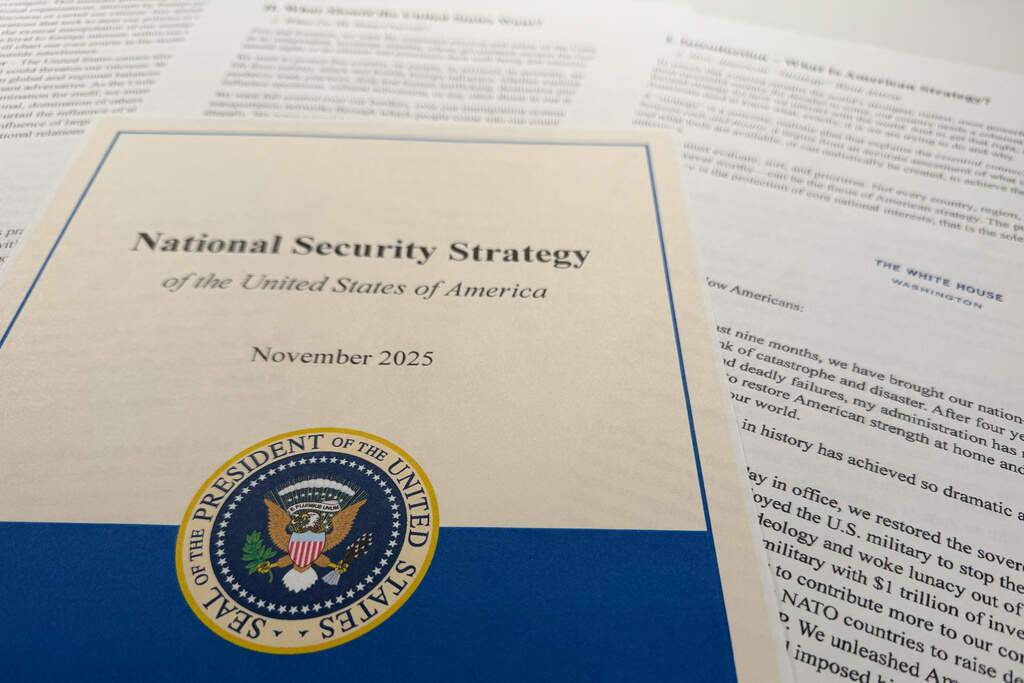
The Trump Administration has now published its National Security Strategy and its National Defense Strategy. They present an ideological shift in U.S. foreign policy that deprioritizes defending Europe and dilutes focus on China.
Guests
Col. Mark Cancian, Senior advisor in the Defense and Security Department at the Center for Strategic and International Studies (CSIS), a non-partisan D.C. think tank focused on national security.
Michael Leigh, Former senior EU official and professor at Johns Hopkins University School for Advanced International Studies in Europe.
Luis Rubio, An analyst and columnist in Mexico City. He is the chairman of the think tank México Evalúa. He writes a weekly column in the newspaper Reforma.
Oriana Skylar Mastro, Center Fellow and Director of the Indo-Pacific Policy Lab at the Freeman Spogli Institute for International Studies at Stanford University.
The version of our broadcast available at the top of this page and via podcast apps is a condensed version of the full show. You can listen to the full, unedited broadcast here:
Transcript
Part I
MEGHNA CHAKRABARTI: The Trump administration has outlined its national defense and security goals for the next three years. They are spelled out clearly in two separate 30 plus page documents called the National Security Strategy and the National Defense Strategy. Now, these documents have been released for some time in some form by every presidential administration since the 1980s.
But not only is the current Trump administration's security and defense policies a shift from many past American presidents, it's also an ideological shift from Trump's first administration. These documents are bolder in their discarding of alliances, sharper in their focus on the Western hemisphere.
So will these crucial changes actually keep America more secure? Let's start today with Col. Mark Cancian. He's the Senior advisor in the Defense and Security Department at the Center for Strategic and International Studies at CSIS, nonpartisan Washington think tank focused on national security.
Colonel Cancian also served for more than 30 years in the U.S. Marine Corps, and he joins us from Washington. Colonel Cancian, welcome back to On Point.
COL. MARK CANCIAN: Thanks for having me on the show.
CHAKRABARTI: So first of all, describe to me broadly how you see the 2026 national
security and defense strategies as being different from the president's first administration.
CANCIAN: Sure. Let me sprint through both documents real quick here. And to give a sense about what's in there. I think we should start with the national security strategy, because it comes from the White House and signed by the president. But one thing you can immediately change from the first administration is the tone.
It adopts that Trump administrations take no prisoners aggressive rhetoric. As one example, the president says in his introduction: After four years of weakness, extremism, and deadly failures, my administration has moved with urgency and historic speed to restore American strength at home and abroad.
The document does focus a lot on economics. This involves gaining advantageous trade relations around the world. They call it balance trade and reindustrialization at home. In this regard, the NSS discusses a variety of domestic policies like tax cuts to accomplish the economic agenda.
But in the national security realm, the strategy makes a major shift to the Western hemisphere, as you noted, giving it priority. This has three parts, the Trump corollary to the Monroe Doctrine, which is aimed at keeping Russia, China, and Iran out, counter drug efforts to protect Americans and securing the borders to reduce illegal immigration.
It also does talk about China mostly in terms of economic competition. The U.S. will work with allies and partners to deter conflict over Europe, and it does, or rather over Taiwan. And it does affirm the principle of no unilateral change in Taiwan's status.
And then with Europe, it's criticized for economic and cultural decline.
The U.S. will enable Europe to stand on its own feet and no more NATO expansion. The Middle East is interesting because it's regarded as less important now because of U.S. energy independence and Iran and its proxies have been beaten down. And Africa is seen as a place for aid, seen as moving from aid to investment consistent with the dismemberment of USAID and the document's emphasis on economics.
And then one last thing is evidence of either improvised policies or rapid flowing events. Depending on your perspective, there's no mention of Greenland, whereas in the NDS, it's mentioned many times.
CHAKRABARTI: There's no mention of Greenland. Maybe because the National Security Strategy document was from November of 2025.
CANCIAN: That's right. And it was published in December. So there was at least six weeks of interval there. And clearly the attitude towards Greenland had changed in the course of six weeks.
CHAKRABARTI: So much can change in such little time. And so, yeah, as you said, the NDS came out more recently. And we'll talk about what's in it in detail throughout the remainder of this show.
But it's pretty much in line with the national security strategy. There isn't much daylight between the two. Correct?
CANCIAN: That's correct. I's almost like they did not want to get out in front of the White House on key issues. So it's really like a second policy document.
It does mention the president 47 times. Unlike the National Defense Strategy in the first Trump administration, which mentioned the president really in passing just once.
CHAKRABARTI: So 47 times, a very specific number that it mentions. The president. Okay. So just so then with this understanding of Western Hemisphere focus, less focus on Europe, almost no mention of the Middle East, keeping China at a distance how does this differ from what we saw in the first Trump administration?
CANCIAN: It's quite different. First the tone. And that's driven partly by the secretaries. In the first administration, the secretary was James Mattis. He had been a military four star. He had Joint commands experience at the senior levels of government, and the current secretary is Hegseth.
He does have military experience, but as a company grade officer and came out of Fox as a commentator. One thing that two of them do agree on is the importance of lethality in a military force. And that's one thing they would agree on. But there are also some big change differences.
The tone, of course, is very different. In the first Trump administration, the NDS was the sort of neutral tone of a policy document. But in terms of the regions, it's also quite different. The first Trump administration saw China as the major threat to the United States, and they talked about it as a threat.
Then Russia and then North Korea, Iran, and terrorism. And they talked about burden sharing with the allies, but also with support for the allies.
And one last thing that's interesting is in the first Trump administration, a large part of the document and one of the three major thrusts, themes was efficiencies.
They believed that they could achieve many savings to pay for the national security initiatives. There's nothing about efficiencies in the current National Defense Strategy, and they don't even mention DOGE, although that could be a reflection of whatever the president's relationship with Musk is this week.
CHAKRABARTI: And in fact, on the efficiency and cost savings side, the president is on record having a wildly opposite view from his first administration.
He wants the Pentagon to have a $1.5 trillion budget. So a lot has changed here. Has the description of what the sort of overarching mission and purpose of the United States military is, has that changed in this second ... National Defense Strategy?
CANCIAN: I wouldn't say that it's changed. But the focus has very clearly changed with the hemisphere having the primary focus and not overseas. And in fact, the NSS talks about avoiding overseas entanglements. Although you don't see as much of that in the National Defense strategy because we've had a lot of overseas entanglements in the last couple of months.
CHAKRABARTI: Okay. Let me start bringing in some voices that can help us focus on particular regions. The regions that you talked about, Colonel Cancian. So I'll start with Michael Leigh. He's a former senior EU official and professor at Johns Hopkins University School for Advanced International studies, and he joins us today from Bologna in Italy.
Michael Leigh, welcome to On Point.
MICHAEL LEIGH: Happy to be with you.
CHAKRABARTI: Okay. The very first paragraph of the Trump Administration's new National Defense Strategy has some interesting language that I'd love to get your response on. So in the first sentence it says, for too long the U.S. government neglected, even rejected putting Americans and their concrete interests first.
And then it goes on and excoriates various efforts that the United States has undertaken over the past half century actually, including squandering our military advantages and lives, goodwill and resources, grandiose nation building projects. Self-congratulatory and self congratulatory pledges to uphold.
And here's the key part. Cloud castle abstractions like the rules based international order. How does that fall on your ears? Michael Leigh?
LEIGH: The rules based international order together with support for democracy, human rights, are pretty much the foundations on which the European Union is based. And they've been supported by the United States now for decades.
So it comes as a shock in Europe to see these principles on which we work together with our American partners for decades being called into question fundamentally in this way.
CHAKRABARTI: Yeah, it's the entire idea that alliances, post-war alliances have been set upon, right?
And to hear the administration, or in this case, the defense department call those ideals, cloud castle abstractions, as if they were never achievable in the first place from the position of Europe. Where does that leave Europe? That the current U.S. president and his Secretary of Defense feel like the rules-based international order was never achievable to begin with.
LEIGH: I think it left people in a state of shock. And you could see that from the reaction of some of the top leaders in Europe, the president of the European Council found this kind of language unacceptable.
And I think what was most of a shock was seeing allies treated very much in the same way or worse than adversaries. This is something that we've never seen before from Washington, and it led the President European Council to say that now it looks as though Europeans must protect themselves, even against their allies.
They didn't point the finger more directly than that. So as Colonel Cancian began by mentioning tone, I think to begin with, it was the tone with regard to allies that came with such a deep shock even before we come to the content.
Part II
CHAKRABARTI: Let's talk about the maybe not just the sort of verbal response from European leaders, but the practical ones we're seeing as well. For some time now European leaders have gotten the message that their defense, their security is going to be more on them. And so therefore it's spurred the growth, small maybe for now, of military capabilities within Europe.
Is this just going to push that further along?
LEIGH: Yes, it will. And one should remember that we've been hearing, if not in this kind of language, the same kind of message from U.S. presidents back at least to Bill Clinton, that Europe had to do more to defend itself, and that has been taken on board completely by Europeans.
Europeans accepted the idea of increasing the goal of the share of military expenditure to go up from 2% to 5% by 2035, which would be a huge jump. All European countries, except Spain accepted that. And we can live with this notion, and it's very much part of the European's own philosophy, of strategic autonomy, reducing our external dependencies.
So it's not so much that in itself. It's more when you come to look at the detail that you begin to ask questions. At the moment, Europeans count on external suppliers for nearly 80% of defense purchases, and of that, the U.S. is getting well over 50% of the total. So this is extremely beneficial to U.S. defense firms.
So in a way, we're getting mixed messages here because if we do, if we take Trump at his word and we do more for our own defense, we try to bring together defense companies in different European countries. We become more independent with regard to procurement, which is our goal and which we accept.
This will not necessarily bring benefits to the U.S., particularly to companies in the U.S. that are producing defense equipment.
CHAKRABARTI: Colonel Cancian, would you like to respond or add to that?
CANCIAN: That's true because the administration has pushed very hard for increased spending, and this has been a theme since the beginning of the NATO alliance, not just the 1990s, but if they do that and build their own industries, then they're going to spend less on U.S. weapons. And that's important for Trump. He regards weapon sales as part of his effort to re industrialize the United States.
CHAKRABARTI: We've mentioned NATO a couple times with the presumption it seems that it will still be there as North Atlantic Alliance in, 2, 5, 10, 20, 20 years.
But Michael Leigh, there's also, you've also talked about how there are some critical non-military changes that this might spur in Europe, and the president cares a lot about trade, et cetera. Like how might the new postures that the U.S. has have an impact on Europe's attitude towards trade or digital security?
LEIGH: Going back to the beginning of our discussion when you mentioned the rules-based international system, particularly regarding trade, this is very important to Europe. And we thought that we had come to an agreement with United States back in July with the discussions at Trump's Scottish golf club, and the president of the European Commission at that time said, now we have certainty and predictability for business on both sides of the Atlantic.
But since then, we've seen this is not true at all, and that entirely separate issues, for example, a digital regulation and possibly digital taxation, might lead this trade agreement to be called into question. So one of the main ways the Europeans have reacted is by accelerating their efforts to build up a network of trade agreements with countries around the world that are still committed to what we call the rules-based international system.
So in fact, just in the last couple of months, probably would never have happened otherwise. The EU concluded a trade agreement with this block in South America led by Brazil and Argentina. We've just inked a major agreement with India. Other negotiations are underway, Indonesia, Japan, and it's being discussed whether Europe might draw closer to the transpacific trade partnership.
Now, all of this would account for a very significant percentage of world trade. So if the U.S. is using, is instrumentalizing, weaponizing trade for other purposes, and we can't rely on the predictability and reliability of trade agreements with the United States, the reaction is to try and strengthen our network of trade agreements with countries who do seem to share the basic principles that are governed trade for most of the post-World War II period.
CHAKRABARTI: Michael Leigh, former Senior EU Official, and Professor at Johns Hopkins University. Thank you so much for joining us.
LEIGH: Thank you.
CHAKRABARTI: Colonel Cancian. We're going to shift our view to the Western hemisphere in just a minute, but there's two questions that come to mind in listening to Michael Leigh.
Actually, the first is, as you pointed out, economic security is in Trump's national security strategy. Because obviously if the U.S. is economically vulnerable, that's a direct impact on our overall security. But hearing Michael Leigh say right now Europe is in in progress in terms of strengthening trade agreements elsewhere, I wonder if in the long run that could potentially have a negative impact on U.S. economic security.
CANCIAN: It will. This isn't what the Trump administration had expected. They thought that they would impose tariffs and that would bring in a lot of money and change the balance of trade. But what they've seen is that it's also engendered the rise of blocks that are countering the United States.
And we heard about the EU here also. And of course, China will be trying to do that also. It may have some very counterproductive aspects.
CHAKRABARTI: And we also actually haven't talked about Russia really clearly yet. I know lots of European voices, including Michael Leigh, think that the downplaying of Russia as a focus of American national security efforts, actually it imagines a world where what Russia doesn't have an impact on the United States.
Are we in that world, could we get to that world?
CANCIAN: The documents, both documents are very clear that the Europeans should take primary responsibility. And primary responsibility means that the United States will be a backstop, but they will deter and face Russia in all areas except nuclear and some other areas like anti-ballistic missile.
You look at the documents, Russia's rarely mentioned and certainly not at the level that it was even in the first Trump administration, where although China was seen as the primary competitor, Russia was also seen as a serious competitor.
CHAKRABARTI: Okay let's turn our attention now to the Western Hemisphere, and joining us is Luis Rubio.
He's an analyst and columnist in Mexico City and the chairman of the think tank México Evalúa, and he writes a weekly column in the newspaper Reforma. Luis Rubio, welcome to On Point.
LUIS RUBIO: Thank you very much.
CHAKRABARTI: Now, of course over the past weeks and months, we have seen viscerally how the Trump administration is hyper-focused on the Western hemisphere.
What's the response from there in Mexico and Latin America overall to how that value is articulated in both the national security strategy and the national defense strategy?
RUBIO: I think put simply the U.S. is trying to redefine the role of the U.S. in the western hemisphere. It's coming back in through the front door.
It wants the Latin American governments to be aligned with the U.S. and there may be several definitions, and the duration of what this might mean, but we can see it in terms of ports, telecoms, specific policy issues. But most importantly, we've seen in Venezuela and potentially Cuba and the statements by President Trump about Mexican drug cartels.
There is a new activism, and the U.S. wants to establish new rules. They may be disappearing in Europe, but they are appearing very strongly in Latin America.
CHAKRABARTI: I suppose the argument from the Trump administration is by greater American influence activity, let's put it that way, mildly in the Western hemisphere would lead to a more stable Western hemisphere. Do you agree with that or do you see the possibility that really what's happening could destabilize Latin America?
Being a little facetious, that was the idea in Iraq and other places, so one has to be careful --
CHAKRABARTI: You don't have to be facetious about that. I mean, that's a fact.
RUBIO: One has to be careful about what wants to accomplish. There are things that I think that the U.S. has played its cards pretty smartly in the case of Venezuela. It may not bring about democracy as the rhetoric at the beginning at least suggested, but it has maintained, it has avoided the regime collapsing.
And that's not necessarily a bad thing. Though it can, I don't think it's sustainable the way it is today. Same goes for Cuba. Cuba and Mexico are particularly relevant because the U.S. would suffer the consequences of a mistaken policy or pushing too hard. So those questions have to be incorporated into decision making process inside Washington.
CHAKRABARTI: Now I'm looking at the National Defense Strategy here, and there's a sentence that says, We will actively and fearlessly defend America's interest throughout the Western Hemisphere. We will guarantee U.S. military and commercial access to key terrain, especially the Panama Canal. They call it the Gulf of America in the document, but the Gulf of Mexico, and Greenland.
I'm wondering also, there's extensive discussion in these documents about counter narcotics operations being central to U.S. national security, how are folks in Latin America responding to that?
RUBIO: The first thing that one has to look at is that the enormous weakness of the security forces in most countries in Latin America, especially in Central America, the Caribbean, and Mexico, which are the transit points, sometimes the origin points of drugs towards the U.S.
Unilateral action by the U.S. would mean weakening further those forces. What should happen is working together in order to strengthen those forces and therefore diminishing the role or the impact of organized crime at large, not only drug-related. There's a lot of extortion, kidnapping and other things that are happening in this region that are important to be addressed if we are going to have a much more participatory society and better economic linkages along this, in the region, throughout the region.
CHAKRABARTI: Oh, Colonel Cancian, once again, jump in here with your thoughts on the focus, or the, excuse me, it's already been a long day, but your thoughts on the focus on drugs in both of these strategies.
CANCIAN: Counter drug is a bipartisan effort in the United States. Both parties have followed aggressive counter drug policies. The difference is the use of the military, and particularly the use of the military with lethal force. The Navy had been involved in some counter drug activities through the years, but had always followed a law enforcement approach like the Coast Guard, not this destruction of drug boats.
We've also seen an increase in U.S. military presence in the Caribbean. That's likely to be long-term, although it's not that large compared to the total U.S. forces for the Navy. It's fairly substantial. But the number of forces in the Caribbean is running about 15,000 and this is out of active-duty military of 1.3 million.
CHAKRABARTI: Luis Rubio, let me turn back to you. Again, in both of these documents, the celebration of the 19th century Monroe Doctrine comes up over and over again. When people in Mexico or Latin America more broadly hear that, what do they think? Having been on the receiving end of the original Monroe Doctrine.
RUBIO: To begin with, there is no such thing as Latin America. There are many countries that are very different.
The southern part of the continent is much more tied economically to China than it is to the U.S. They export minerals, natural produce, grains, meat, and the like. The northern part is tied to the U.S. through trade, everybody realizes that the U.S. is the big powerful factor. The 800-pound gorilla in the room. So everybody wants to align in order to keep the economy of each one of these nations working. And that is not surprising. The fact that the U.S. is reenacting the Monroe Doctrine reminds people of military action.
I hope that's not what President Trump is thinking, because the era and everything's breakable along these lines in the region. Something that didn't happen in the 19th or early 20th centuries.
CHAKRABARTI: Luis Rubio, analyst and columnist in Mexico City, chairman of the think tank, México Evalúa, thank you so much for joining us today.
RUBIO: Thank you for the opportunity.
CHAKRABARTI: Colonel Cancian, we have a minute before our next break. And speaking of this Trump corollary to the Monroe Doctrine, in the National Defense Strategy, there's a breakout section there that defines what secretary Hegseth sees it as, and it includes this line.
We will also deny adversary's ability to position forces or other threatening capabilities in our hemisphere. In my mind, the first example that jumps to mind is Cuba. Is that what this NDS is talking about?
CANCIAN: I don't think it's about Cuba. I think it's about Russia and China and Iran.
Now, it would cover Cuba if they brought Russian forces in, which has happened in the past. But this is aimed at countries from outside the hemisphere. I think what the Latin American countries worry about is the '20s and '30s when the United States intervened in their internal policies.
Part III
CHAKRABARTI: I want to bring in Oriana Skylar Mastro. Now she's a center fellow and director of the Indo-Pacific Policy Lab at the Freeman Spogli Institute for International Studies at Stanford University.
Also, the author of Upstart: How China Became a Great Power. Oriana Skylar Mastro, welcome back to On Point.
ORIANA SKYLAR MASTRO: Thank you for having me.
CHAKRABARTI: So if you're Xi Jinping and you're reading this document, let's focus on the NDS because it's the most recent one. What's your reaction?
MASTRO: I think it's a bit twofold. On one hand, a lot of the information coming out of China suggests that they're happy with the direction the administration is taking.
A lot of the information coming out of China suggests that they're happy with the direction the administration is taking.
Oriana Skylar Mastro
In terms of the fact that we are being distracted away from the Indo-Pacific. The Chinese referred to the 10 years after 9/11, for example, as a window of strategic opportunity because they thought we would come to the conclusion that they were the primary threat much sooner. Now that the United States had come to that conclusion under the first Trump administration.
Then under the Biden administration, they are pleased to see that we are distracted again with the Western Hemisphere in other areas. But on the other hand, they are concerned because historically they think in their mind declining powers like the United States become very aggressive. And become irrational.
So they are also worried, hey, maybe this is a sign that the United States has taken that pathway that wouldn't bode well for China.
CHAKRABARTI: Really? Because of the way I read the China section, it actually strikes me as being quite different than, let's say, the Western Hemisphere section because the Western hemisphere section is clearly a maximalist Trumpian strategy for the United States interactions with Mexico, Central America and South America. But I wonder if one could read the China section, line of effort No. 2: Deter China in the Indo-Pacific through strength, not confrontation, as actually a realist statement about acknowledging the power of China and that direct confrontation.
We had you on a show a while ago talking about Taiwan, and if there were to be a war over Taiwan, you said it would be a bloodbath. Because it would be the worst conflict that the United States had been in since the Second World War. I read this section on China as saying, yes, we know that is true.
We want to stay secure. So we'll have some military strategy there, but there have to be other ways to engage with China.
MASTRO: So on the surface it sounds more conciliatory, right? But the bottom line is it does say, first of all, that the main focus is to deter China. And from the Chinese perspective, they do not want to be deterred.
They see deterrence as something that they want to expand into the South China Sea. They want full control over Taiwan and they want the United States to step out of the way. Now the National Defense Strategy, I think is pretty clear that we're not going to step out of the way. It does say that we're not going to unnecessarily provoke China, and I think that is referring more to actions in the first Trump administration and even in the Biden administration, that were more political support for Taiwan.
So the document doesn't really mention Taiwan by name, but it does say the United States wants the ability to have a denial capability in the First Island Chain. ... Now, what that means for those that don't study military operations, it simply means the United States wants to be able to prevent China from landing on the island of Taiwan.
So that's still a problem from the Chinese perspective. If we were going to accept the sort of quote-unquote status quo, the view is from China that they dominate that area now. And that we should just accept that dominance is the new status quo. But instead, the National Defense Strategy does say that it's the United States' primary goal to regain that dominant position that we've lost.
CHAKRABARTI: To regain that dominant position?
MASTRO: Correct. To be able to have that dominant position in the First Island Chain, which is something that the United States hasn't had for some time.
CHAKRABARTI: Okay. So then thinking about Colonel Cancian's analysis about where these 2026 documents differ from the first Trump administration or every other administration before it, this one almost sounds like it is mostly status quo regarding the U.S. posture towards China.
Or correct me if I'm wrong.
MASTRO: I think that's correct. What's really changed, and it's hard to look at U.S.-China relations outside of the context of the world.
Because it's great power competition, where China stands, where we stand largely has to do with our relationship with the rest of the world.
So while the document does suggest that they basically want a stable relationship, bilateral relationship with China, other things are happening at the same time. China is trying to become the leader of the developing world. And in that context, the fact the United States has stopped USAID, for example, is something that the Chinese see as beneficial, but it also can be destabilizing for that if the United States is engaging in military activity and actions in other places in the world like Venezuela.
So I think they are looking at how is the United States going to approach the international world order. As was previously mentioned, the Chinese have been trying to create wedges between the United States and allies for some time, and now we have been doing that job for them by threatening our NATO allies and other allies with actions telling countries that they have to take care of their own defense.
So I think it's a mixed bag for China here. I think they're happy that they're not called out as the primary threat so much. The focus isn't on them so much and that they are able maybe to have another strategic window of opportunity where they can continue to build power while the United States is distracted.
CHAKRABARTI: Okay. Interesting. Colonel Cancian, what's your take here?
CANCIAN: I certainly agree. The one thing that I think makes many people nervous is the fact that for the in the Biden administration, China was portrayed as the pacing threat, even in the first Trump administration. And in late Obama, China was still a major competitor challenge.
And, you know, that rhetoric isn't in this document. Although as we heard, there is a lot of discussion about the importance of deterrence in Taiwan. The other thing is that something that makes people nervous is the possibility that the Trump administration might make some economic deal with China, with Taiwan as a bargaining chip. Now we haven't seen that yet, you could see that possibility in the document.
CHAKRABATI: Oriana, how would you respond to that?
MASTRO: I just see no prospect of a deal because the bottom line is, what is that deal going to look like?
The Chinese want full control over Taiwan, and I just don't see the United States conceding that because we're conceding our position in Asia. So, and the Chinese themselves have often looked at President Trump as an unreliable partner. In the first administration, they thought things were going well.
Xi Jinping hosted President Trump and then President Trump went back to the States and put tariffs on China, and they say it was personally embarrassing for Xi Jinping. So I don't see the Chinese wanting to take the risk at trying to negotiate with Trump and unless the United States is fully willing to concede the dominant position in Asia to China, I don't really see what kind of deal we would come out with.
CHAKRABARTI: Okay. Oriana, you had said earlier that obviously you can't look at U.S.-China without looking at the context of the world, but also specifically, there's a slightly smaller context, but I would say just almost just as important in terms of Asia Pacific as a whole. And I'm looking at Colonel Cancian's analysis that was published on the CSIS website and he notes that North Korea is still seen as a threat, but mainly to South Korea and Japan.
And the Trump administration's focus on North Korea would be missile defense, essentially, on increasing capabilities that North Korea might have that could strike the U.S. homeland. What do you think about that?
MASTRO: I wish the United States didn't have to worry about North Korea anymore, and that we could rely on our allies and partners to deal with that threat.
But the bottom line is you can't even look at North Korea in a vacuum. China-Russia relations have gotten closer and closer. I'm currently writing a book about the military alignment between those two countries. We've seen the Russians, Putin went to North Korea, has a special relationship with Kim. The North Korean sent troops into Ukraine.
They didn't do that without asking for something in return, and so we're no longer talking about the North Korean threat. We're talking about the North Koreans in conjunction with the Chinese and the Russians, and I just don't see how we can ask South Korea to deal with the Chinese, the Russians, and North Korea on their own.
When that's something that we can hardly do. And so it seems to me a bit wishful thinking. Every president that comes in tries to turn the other eye to not worry about North Korea. But I do fear that it will be very difficult for the United States when we're thinking about forced posture in the Indo-Pacific, not to continue to include a consideration over the ability to fight and win on the Korean peninsula.
CHAKRABARTI: You can tell me if the question I'm about to ask is just my own facile analysis, but both documents seem to be shot through with this undercurrent of stuff happens over there and we don't need to care except if nukes are fired at the United States. That might be too of an extreme of a read, but do you get a little bit of those vibes, Oriana, from these documents?
MASTRO: I think that isolationist view, the view of, and we've seen ebbs and flows of this in U.S. policy, right? That the United States doesn't have to be physically present somewhere. We just have to protect the homeland. But the problem is we have also learned historically two things. The first is while deterrence is costly, it's a lot cheaper than war.
And the reason that these countries have not engaged in major war, we haven't seen major war in Asia, for example, is because the U.S. military is there. This is very clear in Chinese writings that they would behave very differently if we were not proactively present and hosted there through allies and partners.
And so I think the first thing is just to understand that United States being physically present overseas in terms of military presence is allowing peace and security and the economic prosperity that we all enjoy. I also think that in the lowest level, on your most basic day-to-day level, most Americans don't understand how our lives are affected by the fact that we live in the most powerful country in the world.
From everything from our ability to travel with the confidence that if anything happens, our government will take care of us, to, for example, my ability as a scholar to write and publish what I want without fear of retribution by foreign powers. This is all because we are Americans, right? Because when China gets upset, even with the United States, they don't detain Americans, right?
They detain Canadians, they detain Japanese, and this is all about power. So to protect ourselves, even from coercion from foreign powers. It's really important for the United States to maintain an influential role in the world. And that's what China is trying to take from us to a great degree.
And I think it's something that shouldn't be conceited without pushing back.
CHAKRABARTI: ... We're headed towards the end of this conversation, and I want to return to what the central animating, the animating theme of today's episode is, and in fact it's written right in the document, in the national security strategy.
There is this line clearly that says, in everything we do, we are putting America First. I'll start with you, Colonel Cancian. Do you see that in both of these documents, is there evidence that these things would put America first, or in another way of putting it, would actually increase American security?
CANCIAN: Those are two different questions because it does put America first in the sense that as the Trump administration defines it, that is that they want transactional relationships where the U.S. has benefit, they want like allies to do more. So the United States doesn't have to do as much, they want to pull back from some areas which they regard as less important.
The problem is that as we just heard, that it's like a Jenga game, if you pull one piece out, it's not that everything stays where it is, but everything else can collapse. And if confidence in the United States collapses among our all friends and allies, then we're going to see coalitions building up against the United States.
And so I don't think it will increase our security, but it does make changes that in the Trump's administration's view are putting America first.
CHAKRABARTI: Okay. Oriana Mastro, same question to you.
MASTRO: So on the positive side, to say something positive about these documents, I do appreciate the strategic discipline.
It's been far too long that leaders in the United States, when I have asked for guidance, what is more important, what do we prioritize? They say everything and all of the above, and that's just not possible. So we need to have some strategic discipline to be able to say, Ukraine is not the priority.
Taiwan is, but on the other hand, for me, as someone who studies the Indo-Pacific, it's more clear than ever that really should be the priority region. That I believe dominance of the Western Hemisphere is also very important, but we have not lost that, and there is no risk of losing that.
And so the focus really still needs to be on the Indo-Pacific, and I think it's a bit of wishful thinking or rosey-eyed thinking to think that we have those alliances and those partnerships for the sake of our allies and partners. The truth is that those were established for us. To be able to protect U.S. interests at a far cheaper cost than colonialization that happened before.
So interacting in international institutions, having an overseas military presence allows the United States to promote its own interests in a much cheaper and more effective manner than Great Powers had done so before. So we have to have the discipline not to be involved in foreign wars everywhere, because that is extremely costly and not only necessary.
But to pull back from these types of diplomatic and political relationships, we're really leaving something on the table there.
CHAKRABARTI: So I guess TLDR is, it may not improve U.S. security in the long run.
MASTRO: I think especially when it comes to how our allies and partners are reacting to it, everything is more costly and more difficult if you have to force countries to do what you want them to do.
It's always better if it's something that they want to do. So I think in the long run, it does make us less safe if it means that we are losing ground in international institutions. I would just say as a rule of thumb for our listeners, even if you don't know a certain issue area. You don't know what an international institution is or what it does.
If you see that the Chinese are heavily invested in it, it suggests at the very least that they think it is a firm foundation of power, and that should tell us something and at least give us pause before we abandon those mechanisms.
CHAKRABARTI: Okay. Last question for both of you, Colonel Cancian, if there was one thing you could add to these documents, what would it be?
CANCIAN: I'd like to know what the U.S. force posture is going to look like. In other words, where are the forces going to be and how large are they going to be? The emphasis on the hemisphere is interesting, but so far those have not taken a lot of military forces. And even the ones in the United States for border security, encountered drug have not been very large. So it may be that this is important from a policy perspective, but the demand for military forces is not that great.
CHAKRABARTI: And Oriana, just quickly, what would you add?
MASTRO: I agree with that. I also would've liked to see something about the South China Sea.
The first draft of this transcript was created by Descript, an AI transcription tool. An On Point producer then thoroughly reviewed, corrected, and reformatted the transcript before publication. The use of this AI tool creates the capacity to provide these transcripts.
This program aired on February 4, 2026.