Support WBUR
Brainwaves: How does a brain stay healthy?
This is the fifth episode in 'Brainwaves: Mysteries of the human brain.'
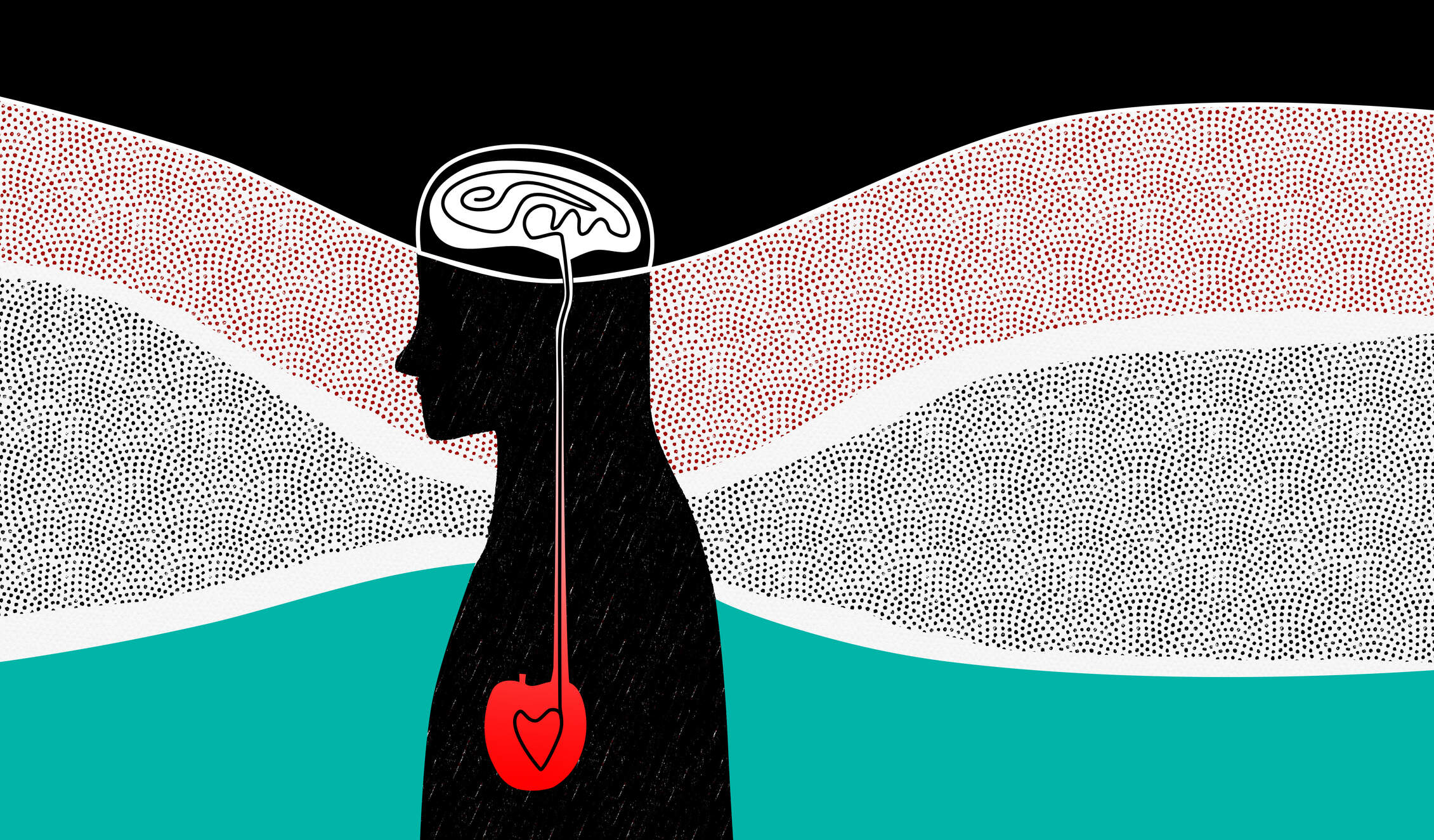
You might think a healthy brain starts and ends in your head – but there are miles and miles of neuron fibers that connect your brain with nearly every corner of your body. Why a healthy brain needs a healthy body.
Guests
Jacob Harth, neuroscientist in the College of Public Health at the University of Georgia.
Also Featured
Polina Anikeeva, director, K. Lisa Yang Brain-Body Center at MIT.
Dr. Brad Kuo, chief of gastroenterology at Columbia University and New York Presbyterian hospital.
Dr. Kevin Volpp, scientific lead of the American Heart Association's Health Care by Food Initiative.
The version of our broadcast available at the top of this page and via podcast apps is a condensed version of the full show. You can listen to the full, unedited broadcast here:
Transcript
Part I
MEGHNA CHAKRABARTI: We're at the final episode of Brainwaves. It's our special week looking at the wonderful mystery that is the human brain. And we're going to wrap up the week today with the question that's probably the most pertinent to us all. How do you keep your brain healthy?
Especially as we age. Now, the truth is there's no one magic formula that works for every single person. However, the overall approach actually is quite simple. So then maybe the deeper question for Americans might be, why is keeping our brains healthy getting harder? For example, take dementia. The lifetime dementia risk for American men is as high as 14%.
For women, it's much higher, almost 25%. That's one in four American women. Now, those numbers are from the National Institutes of Health. By the way, NIH also found in a January 2025 study that for all Americans above the age of 55, the risk of developing dementia in a person's lifetime has risen to 42%.
But as they always do, those broad and aggregate numbers are actually hiding something because the risk is not evenly spread across the United States. There are stark regional differences in this country. So if you live in the southeastern U.S, the incidence of dementia is 25% higher than what we see in the Mid-Atlantic.
So to be more clear, if you're in, say, Georgia or Mississippi or Tennessee, the dementia rate is significantly higher than in, say, Virginia. Same goes for the Northwest and Rocky Mountain states. Both of those areas have a 23% higher dementia rate than in Mid-Atlantic states. That's according to a study released just this past summer by the University of California, San Francisco.
Which makes me wonder, not only what can we do as individuals to keep our brains healthy, but what more can we do as a country? Jacob Harth joins us today. He's a neuroscientist at the University of Georgia's Institute of Gerontology, and he joins us from WUGA in Athens, Georgia. Jacob Harth, welcome to On Point.
JACOB HARTH: Thank you. I'm delighted to be here.
CHAKRABARTI Okay, let's, first off, start off with, how do we define what a healthy brain is? What does it look like? What should it feel like?
HARTH: That's a fantastic question. A healthy brain looks and feels, it can be different for everyone, but it's mostly based on functionality, and we can measure that through behavior.
A healthy brain should be clear thinking and should have steady mood. Should have the ability to attend to things and have strong social engagement. It's not just good memory. There's not one way of measuring or defining brain health. It can be different both across individuals and across the lifespan.
A healthy brain should be clear thinking and should have steady mood.
Jacob Harth
CHAKRABARTI: So is it essentially that your brain is capable of letting you do the things you want to do in life, whatever those might be?
HARTH: Certainly. That's a large component of it. Is being able to maintain functional behaviors and have a quality of life that we're looking for.
CHAKRABARTI: So if that's a large component, what are the other components?
We want the whole picture here, Jack.
HARTH: Absolutely. The whole picture, we can get down to minute details about efficiency and connectivity in the brain, but you can also zoom out. And from my perspective in my research, we're often looking at functionality and behavior, and that is oftentimes the main way that we can measure and to track brain health.
CHAKRABARTI: Okay, so give me an example then more specifically of a measure of, let's say, functionality.
HARTH: Certainly. A very common way of measuring functionality is the Montreal Cognitive Assessment, and that's used in neuropsychology to track functionality in daily function.
Ask people about what they can and can't do. But there's also specific measures and things that I can implement in my laboratory that can allow us to look at more specific functions. Things like the efficiency of your processing and specifically how well you can process and how quickly you can process visual information.
CHAKRABARTI: You know what's great about the fact that we have a full hour to discuss things is we can go into a lot of details, so don't be afraid.
HARTH: Absolutely. Alright. Wonderful. Wonderful.
CHAKRABARTI: Yeah don't be afraid. Let's just kick back here and take me inside your lab. So what would be, like what does the actual test look like for the visual processing efficiency you were talking about?
HARTH: That is a great question and I'm very excited to talk about this. I could talk all day.
CHAKRABARTI: Let's go.
HARTH: We've got a whole hour. In my laboratory we measure something called your critical flicker fusion threshold, or CFF is how we often talk about it. And that will tell us about how quickly you can process visual information.
A really good example of this is the screens that are likely in front of us right now. If you're looking at your phone screen or a TV screen or a computer screen, those lights on there are flickering all the time. Our brain can only process flicker at a certain rate.
So have you ever noticed a light bulb starts to die, you start to notice a little bit of flicker.
CHAKRABARTI: Yeah.
HARTH: Or have you taken a video of a phone or a different computer screen.
CHAKRABARTI: And there's a flicker.
HARTH: That's exactly right.
CHAKRABARTI: That you can't see when you're looking at the screen itself.
HARTH: That's exactly right.
CHAKRABARTI: It's the reason movies work, isn't it?
HARTH: That is, because the visual system is sampling over time and it's averaging together the inputs.
So it's giving us this nice, solid, smooth impression of the world. But in reality, there's flicker when we're looking at those screens, those lights, those LEDs are turning on and off at rapid paces. There is some threshold, though, at which point a flickering light starts to look solid to your brain.
And that's what we measure in the laboratory. So we'll take a flickering light and we increase it and increase it until the person tells us, the participant tells us it looks solid to me. And then we'll do the opposite, and that will give us, start off very fast and as soon as they start to notice that flicker again, we'll take that measurement as well. And we'll do that several times and that'll give us an average that will represent that participant's threshold for flicker and that tells us about that flickering threshold.
Your perceptual how fast you can see, how quickly your brain can process visual information.
CHAKRABARTI: Okay. So let me see if I understand this correctly. So then if someone reports that their threshold is actually lower than average, what does that actually mean?
HARTH: That can mean many things, specifically on a day-to-day basis if my flicker threshold is lower than it is on a normal basis, I could just be tired. Maybe it's early in the morning, maybe I've been, maybe it's late in the day, I've been paying attention all day and my brain's gotten tired and I'm losing the ability to focus and to process that visual information.
So it could be a little bit lower, it could vary throughout the day, but if an individual's flicker threshold is much lower than normal that could indicate a lack of efficiency in processing the brain, and that's something that naturally happens throughout the lifespan. There are small decreases in your visual processing speed throughout the lifespan, but if there are sharp or significant decreases in that visual processing speed, that could indicate some greater deficit or issue.
CHAKRABARTI: Okay. Okay. So that's one example of measuring a certain aspect of brain health. And ... we'll get to more aspects throughout the remainder of the show, but I just also wanted to create a baseline here for the discussion regarding what unhealthy brains are like, because of course there's many potential causes. One is just brain injury, which for the purposes of this conversation, even though it's a really important subject, I'm actually going to put brain injury aside. Because that can be sudden and acute.
HARTH: Yes.
CHAKRABARTI: And really instead, over the course of the conversation, what I propose, and you can tell me if this is a terrible idea or not. But I propose on us focusing on degenerative brain diseases and chronic illness ... just because it mostly, it just has an impact on a lot more people.
HARTH: Absolutely. Absolutely.
CHAKRABARTI: But if there's anything that we could learn from brain injuries in the conversation, let me know and we can bring them in.
HARTH: Certainly.
CHAKRABARTI: Oh, go ahead, if I might. Brain injuries, you're absolutely right. They are acute and they have massive impact on long-term brain health.
And we should do everything we can to avoid brain injury, but sometimes we can't. We can really just do our best, wear a helmet when we're in scenarios where we're at higher risk for brain injury, but it's sometimes unavoidable and oftentimes not the fault of the individual.
CHAKRABARTI: Yeah. I just wanted to make that clear. Because I know that many listeners out there either have suffered brain injuries themselves or know someone who has, and I don't want folks to think that, like, we're just ignoring that.
It's just, it's such a big topic in and of itself that I wouldn't be able to give it it's due in the course of our conversation.
HARTH: Absolutely.
CHAKRABARTI: Okay then we just have a couple of minutes before our first break, we're going to talk about the effects of chronic disease. We're going to talk about degenerative brain disease, but when we talk about quote-unquote healthy brains, is the baseline of what a healthy brain is, does it change over time? Meaning as we get older, should we just reevaluate what we define as a healthy brain?
HARTH: That's a great question. As we age, there are some normative declines in things like efficiency of functioning, how fast we can see that flicker threshold does decrease, and there are some normative declines in things like memory as well. And what's happening in the brain as we age, is we go from very localized processing, where specific brain regions are accomplishing these specific tasks, to more distributed processing.
Areas in the brain are supporting one another. We have more areas working together to accomplish that same function, that same task. And that can slow things down in some ways and make that processing less efficient. But that's a normal part of aging. And as long as the function and the behavior and the things that we want to do in our life, as long as that remains, it's still a part of normal processing. Oftentimes people will think of cognitive decline or mild cognitive impairment or things like dementia as inevitable, but that's not at all the case. Normal brain aging is healthy brain aging.
Normal brain aging is healthy brain aging.
Jack Harth
Part II
CHAKRABARTI: So Jack, from what I have gleaned in my many years of thinking about trying to keep my own brain healthy and reading various studies, that at the most sort of macro level, here's the sort of general recipe for good brain health.
Okay. And correct me or add anything if is needed.
HARTH: Alright.
CHAKRABARTI: So first of all, sleep enough.
HARTH: Yes.
CHAKRABARTI: Get enough sleep. Exercise is proving to have a very positive impact on the brain.
HARTH: Yes.
CHAKRABARTI: What you eat and trying to reduce stress and keeping your brain socially, keeping social connections strong.
HARTH: Absolutely. Absolutely.
CHAKRABARTI: Would you add anything?
HARTH: I completely agree and I really like those and I want to talk specifically about those things and the ways we can support brain health. And I've actually got an acronym. May I share?
CHAKRABARTI: Yes.
HARTH: A story.
CHAKRABARTI: Yeah, absolutely.
HARTH: So my mom is a high school science teacher, a middle school science teacher. For years and years, she's taught middle schoolers, eighth graders. And in her classroom at the start of the year, make a sign, it hangs up in the classroom the whole year. It says Be SWEET. S-W-E-E-T.
And this is a great way to remember the ways in which we can take care of our brain and promote brain health as we develop and as we age throughout our whole lifespan. But SWEET is our acronym, and it's important in the classroom and in our lives because if we're not taking care of our brains, we can't do anything else. So this is really the foundation for a healthy life. And SWEET. The acronym is S is sleep. That's exactly right. Sleep is not optional. This is the time in which our brain cleans up from the activity of the day and encodes those memories. And that is not optional.
If you're feeling tired, always get as much sleep as you can. ... The W is water, so proper hydration. It's critical to go along with that first E, which is eating and proper nutrition. Whole foods, things like fruits and vegetables. Also, healthy fats, things that make up the lipids in our brain and those lipid membranes in our brain.
Also eating other healthy foods, whole foods, whole grain, things, fruits and vegetables specifically. That's part of my expertise that I'm excited to talk about. Those are effective antioxidants that can help reduce inflammation and stress in the brain. So there's SWE, the second E is exercise.
You're absolutely right. That's aerobic exercise. Getting out, getting oxygen into our brain and into our circulatory system. What's good for the heart is often good for the brain. And that's not just aerobic exercise, but mental exercise as well. And learning things, trying new skills, novelty and putting effort into brain growth and brain learning is really good for the brain as well.
What's good for the heart is often good for the brain.
Jacob Harth
And another form of exercise that you mentioned as well is that social exercise, sometimes for introverts like me, it can be difficult to get out and to have that social interaction, but it's very well established that this is a risk for developing cognitive decline later in life, is social isolation.
And the final thing, the T in SWEET is time. Because that doesn't happen overnight. None of these things can happen in a day or a week or a year. This is a lifelong process and each opportunity, each behavior change we make, it takes time and it takes effort. So that is the acronym to 'Be SWEET' to yourself and 'Be SWEET' to your brain.
CHAKRABARTI: Jack, I'm so glad you're in Athens, Georgia right now, but you cannot see the grimace on my face. I think out of the five, I got four strikes.
HARTH: That is quite all right.
CHAKRABARTI: (LAUGHS)
HARTH: And this is other thing that I want to really emphasize, is I'm human and I can preach this all day. I can say take care of your brain, but I fall short as well, a hundred percent.
And making these behavioral changes, eating salads every day and drinking enough water and getting enough sleep. Believe me, I'm often sleep deprived, but these things, they take effort, they take time, and we fall short. We really just have to do what we can and every step, every step. And even the small ones, even me standing up from my desk more often.
Me trying to walk a little bit more instead of driving or taking the bus, every single step is a meaningful step in the right direction towards brain health.
CHAKRABARTI: So folks, I think this is one of the most useful things to actually have come out of On Point in recent memory. Write this down, SWEET. Sleep, water, eating healthy or healthily, exercise, both mental, physical, mental, social and time. And by the way, I think it just makes perfect sense that this wonderful encapsulation came from not only a teacher but a mom as well. Teacher moms are the best. (LAUGHS)
HARTH: Absolutely. I've learned all the most important things.
That's exactly right.
CHAKRABARTI: Okay, so here's the thing. Obviously, the SWEET acronym and this, look at what it takes to keep a healthy brain. It's intrinsically connected to the rest of your body, right?
HARTH: Absolutely.
CHAKRABARTI: So we're not talking about brain health as in you can achieve it if your brain's just in a jar.
If your overall body is not healthy, then your brain won't be healthy either.
HARTH: That's right.
CHAKRABARTI: So can we possibly think of like when we think of the overall brain function, that we really need to think also in terms of how the brain is maybe even physically connected to other body systems?
HARTH: Absolutely. That's a great point.
The brain doesn't operate in isolation. The brain doesn't work in isolation. It needs the rest of the body to operate. And one of the most important things you can do to reduce risk for cognitive decline is to prioritize heart health and cardiovascular health. So that all the things we just talked about within that SWEET acronym, those strategies, they promote bodily and systemic health as well.
But having good blood flow and oxygen delivery to your brain is essential for long-term brain health and to reduce risk for cognitive decline.
CHAKRABARTI: This is to me, as a layperson, one of the most exciting sort of areas of emerging understanding in brain science. And that is how much the rest of the body is really critical in maintaining strong cognitive health.
Because it turns out and just listen along with me, because we went deep on this particular part of the hour. Because it was so interesting, Jack.
So it turns out that the brain is actually also physically wired to other organ systems. That makes sense. We have a nervous system, but that you actually, as you said, you can think of those other organ systems as essentially other parts of your brain overall that just live outside of your skull.
And one of the most important areas of those neural connections is in your gut. It's the gastrointestinal system for every human being. So we talked to a bunch of people about this. One of them is Polina Anikeeva. She's a director of MIT's K. Lisa Yang Brain-Body Center, and her team is developing minimally invasive devices that give researchers the ability to record and manipulate neural activity throughout the body to better understand that brain-body connection.
POLINA ANIKEEVA: Everyone is well aware that our brain encompasses approximately 90 billion neurons, but people don't always think about the rest of the nervous system within our body.
In fact, every organ within our body, nearly every organ is innervated, and the human GI tract has approximately 200 million neurons. This is a lot of neurons. To give you a sense of scale, it's about equivalent to the size of a cat or dog's brain. Now the question is what is this really massive nervous system doing, and how is this really massive nervous system communicating to our central nervous system, to our brain?
And of course, we can think about functions that we normally associate with the gastrointestinal tract, such as digestion, peristalsis, motility, and in fact, more and more we now learn that it not only receives the signals from the brain, but also sends signals to the brain.
And ultimately those signals can be processed subliminally and determine some of the processes that we often would associate with our higher-level brain functions.
CHAKRABARTI: Man, you are what you eat has never been truer than it is now with this new research. Now Paulina's device uses sensors as thin as a strand of hair to explore connections between the brain and the GI system.
ANIKEEVA: Using these types of technologies, what we've been able to do is we could stimulate, for example, nerve endings in the gut, and then simultaneously record image activity in the brain.
We can start with simple experiments. So for instance, you potentially are familiar with this feeling of reward or happiness from eating chocolate or sweet things, right? So this is a really familiar phenomenon. There's two components to this phenomenon. Of course, you can taste it and people study this sensation of taste perception.
However, it is actually possible to completely bypass all the taste system if we directly introduce sugar into our brain region that is responsible for reward, where the dopamine neurons are, where dopamine, the happiness neurotransmitter gets produced, will light up. In fact, we'll start seeing neural activity.
It's not just the taste, it's also what our gut is sensing and sending that signal straight to the brain. And it turns out we can actually achieve this sensation of reward or happiness without any food signal. And now it gives us opportunity to think about in future, is there a way for us to tap into these gut-brain connections to start treating conditions such as effective conditions, mood disorders, not by manipulating our brain, but maybe tapping into this power of gut-brain connection.
CHAKRABARTI: So what this means is that a better understanding of the gut's connection to the brain means that conditions that we have traditionally treated as just strictly gastrointestinal conditions or strictly neurological conditions, they actually may have much more overlap than we thought before. And that means there's the potential for entirely new methods of treatment.
Dr. Brad Kuo is the chief of gastroenterology at Columbia University and New York Presbyterian in New York City, and he's been thinking about new ways to harness the brain-gut access in clinical settings.
DR. BRAD KUO: So at one fundamental level, the stomach seems separate physically from the brain.
In fact, the density of nerve endings, the GI tract is immense and rivals the brain in terms of density of nerve endings, even though you think about the brain as being the highest concentration of nerve endings.
And so as a result, you got two very dense nerve ending centers that then talk to each other through a complex network, through the spinal cord, through the autonomic nervous system and the vagus nerve system to interact with each other.
For the longest time, the GI tract was doing its own thing. People thought the brain certainly had some control over this, but had a lot of separate functions.
And then we began to understand much better how the complex nerve endings begin to interact with each other. And that came from several fundamental observations, like the concept of better understanding irritable bowel syndrome, a condition where people suffer from abdominal pain with ultra bowel habits.
But over a series of experiments and studies, we clearly showed that the brain in these types of patients is very different than a normal healthy brain in the way it responds to gut stimulation, in the way it feels and perceives things, in the way that external cues shape the way the brain perceives that information and transmits those signals down to the gut and how it functions.
CHAKRABARTI: Inflammation in the digestive system, even on a mild scale over a period of time, can actually change the nerve endings that are in your gut, and that change in your gut can have a massive effect on the rest of the nervous system and on your brain.
KUO: One interesting area of thinking about that is Parkinson's disease.
It's originally thought that Parkinson's disease is a disease of the brain, abnormalities with your chemistry with dopamine that end up leading to these classic neurological findings of movement disorders and elements of Parkinson's, alterations in brain thought and process and how they interact with the world.
But so interestingly, there is now an evolving theory called a brox hypothesis, where Parkinson's may actually come from the gut. That the gut is the exposure through diet or microbiome or other sorts of things, this gets transmitted through the vagus nerve or through nerve, through the gut, and then that eventually feeds into the brain and then causes these changes in the brain that we characterize as Parkinson's disease.
That's intriguing to think that a brain disorder as severe as Parkinson's is actually coming from the gut.
CHAKRABARTI: Once again, that's an evolving theory, but an exciting one, nevertheless, that was Dr. Brad Kuo at Columbia University and a little earlier we heard from Polina Anikeeva at MIT. Okay, so Jack, let's connect this deeper understanding of sort of the brain-gut axis with what you were talking about specifically earlier, like visual processing. Are there foods that we can eat that would have an impact on our visual processing?
HARTH: What a great question. That falls into part of my interests and expertise in what I study, specifically leafy greens and other fruits and vegetables, but things like spinach and kale and collards.
They have these yellow pigments in them called lutein and zeaxanthin, but they called macular pigment because the more of these things we eat in our diet, the more they can concentrate in the back of our eye, in the retina. So in the very center of our retina and there, they act like a built-in pair of blue light filtering glasses, so they filter out blue light and they're really effective antioxidants.
This can help protect your eyes against age-related disease, but the amount that we can measure in your eye just through a simple 10-minute non-invasive test, where we ask you questions about what you see, that tells us about the amount of these effective antioxidants throughout your brain as a whole.
People with higher amounts of these macular pigments in their eye. Higher density, more blue light filtration in the back actually have been demonstrated to have more efficient sensory processing as well.
CHAKRABARTI: Wow. There's another quick word that was mentioned almost in passing with our other two scientists, but we need to focus on it a little bit more. Because it's the microbiome, right?
Your gut microbiome. Because it's not just like the food that you're eating, that its nutrients are then passing through your blood system and making your brain healthier. That's a part of it. But the microbiome itself, these trillions and trillions of bacteria, essentially.
Healthy bacteria. How, look, we have only have a few seconds before our next break, but how are they having an impact on brain health?
HARTH: That's a fantastic question. It gets a bit outside of my expertise. But we do know that it can be used to, the microbiome can support healthy brain function in a variety of ways.
So a healthy microbiome with diversity often is related to healthy and efficient brain functioning as well.
Part III
CHAKRABARTI: I just wanted to share a quick piece of sound from Dr. Kevin Volpp, who is the scientific lead for the American Heart Association's Health Care by Food Initiative, and he talked with us about the microbiome and how it can really have an impact on your actual decision making.
And if you don't have a healthy microbiome, how that can create a vicious cycle.
KEVIN VOLPP: It's important to realize that just how well we feel and how well we function is really influenced by what we eat.
So we can think about fibers and foods, fermented foods like yogurt. There's a reason why they help you feel better because they support microbes on that are linked to better mood and stress resilience. We also know poor diets cause gut inflammation, which affects systemic inflammation and mood, cognition and memory.
So there's a lot of linkages between our brains and what we eat that are influenced by your gut microbiome that really affect cognition and mood. And this really matters from a behavioral standpoint because your diet affects your cognitive capacity. How you make decisions, which of course create feedback loops that influence the behavior, which might influence what you eat in the first place.
CHAKRABARTI: That's Dr. Kevin Volpp, Scientific Lead at the American Heart Association's Health Care by Food Initiative. Jack, we've been talking a lot about important ways to keep your brain healthy and we'll close on that idea too, but I should ask you, if we're not able to get enough sleep, drink enough water, eat the right foods, exercise, et cetera, scientifically what is happening in the brain that leads to the reduced critical functions that we talked about at the top of the show.
HARTH: That's a great question. And the brain, when we don't meet these goals and when we do fall short, many things can happen. And the ways that, like what he was just talking about, the ways that can be mirrored in the brain is through things like inflammation and stress and when we don't get enough sleep, then we don't have the cells that go through and clean up the synapses and the areas between the cells where those signals are sent.
So if we aren't getting enough sleep, then our brain has a buildup of debris and material that can prevent efficient transmission of information. And the same thing with inflammation or oxidative stress in the brain that can reduce the efficiency and the quality of that information as it transfers through the brain.
CHAKRABARTI: I see. Okay. And also, I have to say, I understand that I asked you a really big question because I imagine there's a lot of things that contribute to rising dementia rates as we've been seeing. But the point is that we know that there's a connection between how we live our lives and the physical health of our brains.
So with that in mind though, we asked On Point listeners what are they doing to keep their brains as healthy as possible, and here's just a taste of what they said.
Tai Chi and meditation. I meditate daily and I practice Tai Chi three to five times a week. Both practices I find have improved my memory, focus and concentration.
What's something I've done to help make my brain healthier? Become acquainted with transpersonal psychology. You can measure a brainwave, but you can't measure the dream I had last night and remember and have feelings about.
I was looking at the world with one eye, and I started wearing only my one pair of prescription reading glasses for reading. And wearing my seeing glasses around the house outside, walking and everywhere, and it's just amazing.
CHAKRABARTI: So you heard Michelle in Albuquerque, New Mexico, James in Syracuse, New York, and Nancy in Buffalo, New York. Now the reason why that's interesting to me Jack, is everyone has their sort of individual recipe for the things that they're trying on their own to keep their brains healthy.
Then there's also the SWEET acronym again about sleep and hydration, eating, exercise and time. What I really am going to strenuously avoid today is asking you like, okay, how many cups of water should people be drinking? Like, how many servings of yogurt? What time of day should you be eating your kale? I'm not gonna do any of that because really.
Folks, just see your doctor if you want that kind of specific advice for you, your brain and your body. But what I did wanna talk about with you Jack, is as I'm thinking about this really simple overall rubric for brain health, and then I think back to the statistics I was digging through last night about the increase in dementia in this country.
And moreover, the regional differences in dementia, and now obviously we have gender differences, and now for example, there's racial differences. One of the fastest growing groups of dementia sufferers in this country are Black Americans. It got me thinking. Are we as a country and the way Americans live, whether it's our food system or how much stress people are under poverty, et cetera, are those things actually the impediments to getting better brain health, that it's not necessarily what we can do as individuals, but if you don't live in a place where you have access to fresh and healthy yogurt, you're already behind the eight ball.
HARTH: That's absolutely right. There are many things that are out of our control. It's not just the brain injuries, but it's access to healthy foods and access to water, and the ability and the luxury of being able to get enough sleep. Those things really do have an impact on our ability to maintain brain health and to reduce our risk for brain health decline or cognitive decline.
But everything that we can do, every small step that we can do makes a meaningful difference. So even if we aren't meeting every goal perfectly, any small effort that we make makes a meaningful difference. And small efforts not just on a large behavioral a brain health standpoint, but small efforts, things like getting your vision corrected.
Brain health is body health. Sensory health is brain health. Gut health, digestive health is brain health. All of these things. Anything that we do to improve the input into the brain, improves the function of a brain as a whole.
CHAKRABARTI: I'm asking about this from a public health standpoint, right?
Because there seems to be some strong correlations. I'm not saying causation, but strong correlations to obviously genetic factors. Some people have a higher genetic predisposition to eventually suffer from dementia. But also I'm seeing here, high rates of hypertension, diabetes, obesity, unhealthy diets, these things that we talked about that also can contribute to the decline of brain function.
Now the hypertension, diabetes, and obesity, these are chronic diseases that are growing in America. Can we say with confidence that they are also contributing to the rising rates of dementia in this country?
HARTH: My expertise is not necessarily in epidemiology. But these are factors that certainly can contribute and increase risk.
And on an individual level, the best we can do is reduce risk in every way that we can and put effort into modifying our risk as a whole. Cognitive decline, even if we have genetic predisposition or environmental predisposition is not necessarily inevitable. And the way we talk about it in gerontology and in cognitive aging is all about reducing risk.
To promote brain health, to promote that longevity and quality of life and functionality and comfort. We're doing what we can and we're putting the effort that we can into it. We're taking what we have. And doing the best we can.
CHAKRABARTI: Yeah, no, I appreciate that you're not necessarily an epidemiologist, but I personally cannot help but to see connections.
Again, I'm not saying causation, connections with the increasing rate of chronic disease in this country. And especially those regional differences. In the United States, right? Because I think if we superimposed a map of percent of folks under the poverty line, on that map of dementia risk or percentage of people living in food deserts, I think there would be some pretty strong correlations there.
And I just I know you're not an epidemiologist, but let's get creative here with me for a second. If you were to suggest like a policy change of some kind that might reduce the risk of these other things, hypertension, diabetes, obesity, and therefore also might help people have healthier brains for a longer time.
What would your dream be?
HARTH: My dream would be any policy that's going to help people to meet those simple, actionable brain goals, to meet their need to 'Be SWEET' to their brain. If we could reduce the amount of time that people work each day, then they could have more time to sleep.
If we can increase the availability of healthy foods, if we could subsidize local farmers and increasing accessibility to healthy foods, if we can improve access and the cleanliness of the water that we're drinking. If we can improve the ability for people to get exercise and to exercise their brains and to be in social environments, all of these things could contribute to reducing and modifying that risk for cognitive decline.
CHAKRABARTI: That is a perfect wish list. If only we could actually ... act on that as a nation. So I want to spend the last couple of minutes talking with you a little bit more about the gerontology side of things, right? Because as lifespans increase, especially for women, because not only do they live longer, but they have the higher risk of dementia overall.
I just know that some people still want like specific guidance from you. Would you be willing to offer any advice on things that people can do, at home to keep their brains sharply. Beyond the fundamental SWEET acronym.
HARTH: Certainly, those are the things that will really lay the foundation for a healthy brain. And I want to avoid giving any specific medical advice. Not a medical doctor. My advice would be to do whatever you can. Changing behavior is really hard and there's not one perfect formula set at the beginning.
There's no magic formula, right? There's no secret formula or miracle cure. There's not one pill that we can take or one behavior that we can change, but changing our behaviors, making these behavioral changes in our life is really difficult and it takes effort and it takes time. So my greatest piece of advice would be to do what you can and every day, even one small step in the right direction.
One more vegetable in your diet. One more walk around the building. One more time that you stand up or one thing that you learn each day that contributes to your overall brain health.
CHAKRABARTI: I wonder if you'll forgive me for asking how your own personal experience, because I understand that you actually did suffer from a brain injury at one time.
HARTH: I did, and I'm happy to talk about it. I'm happy to bring both my expertise and my experiences to every opportunity that I have to share with people and to help them to use these principles and to prioritize their own brain health. So I was 20 years old. I was struck by a car by an unlicensed driver and had a severe, a really bad brain injury.
And that led to cognitive deficits. And I was in the midst of college. I was studying neuroscience and psychology, and I used the principles that I was learning, these things that can promote brain health to aid in my recovery. In the context of the damage that I sustained, I had difficulty regulating emotions and making decisions, and my memory was damaged.
And seven years later I'm still struggling with some of those deficits, but I've used these principles and going back to school and continuing to learn and continuing to put effort into it. Each little step, every day has enabled me to return to where I am and to return to cognitive function.
Now I can use strategies to help to mitigate those deficits and just doing what I can each day and to the people who are experiencing things like cognitive decline or brain injury. And you can feel different, your brain is the basis of all of your experiences and your thoughts, and it's a very scary feeling.
But really, we can only control what we can control, and we do what we can.
The first draft of this transcript was created by Descript, an AI transcription tool. An On Point producer then thoroughly reviewed, corrected, and reformatted the transcript before publication. The use of this AI tool creates the capacity to provide these transcripts.
This program aired on February 13, 2026.