Support WBUR
The Epstein files' lingering questions
Three million documents were released from the DOJ’s investigation into Jeffrey Epstein. The release identifies numerous rich and powerful men as Epstein associates. But critics say the release is simply not enough.
Guests
Vicky Ward, former CNN senior reporter. Documentary host and New York Times bestselling author. She co-produced the docuseries “Chasing Ghislaine” (2021). She published the article “The Talented Mr. Epstein” in Vanity Fair in 2003.
Arick Fudali, partner and managing attorney at The Bloom Firm in the New York City office. He represents multiple survivors of Jeffrey Epstein and Ghislaine Maxwell’s sexual abuse.
The version of our broadcast available at the top of this page and via podcast apps is a condensed version of the full show. You can listen to the full, unedited broadcast here:
Transcript
Part I
AMORY SIVERTSON: Last week, attorney General Pam Bondi sat before the House Judiciary Committee and refused to apologize to the hundreds of women who were abused by convicted sex offender and alleged child sex trafficker Jeffrey Epstein.
Behind Bondi stood a line of survivors who all raised their hands indicating that they had not been able to meet with the Justice Department to discuss the handling of the case.
Democratic representative Pramila Jayapal pressed Bondi on the matter.
PRAMILA JAYAPAL: Attorney General Bondi. You apologized to the survivors in your opening statement for what they went through at the hands of Jeffrey Epstein. Will you turn to them now and apologize for what your Department of Justice has put them through with the absolutely unacceptable release of the Epstein files and their information?
PAM BONDI: Congresswoman, you sat before, Merrick Garland sat in this chair twice.
JAYAPAL: Attorney General Bondi.
BONDI: Can I finish my answer?
JAYAPAL: No.
SIVERTSON: Bondi had been called before the committee to testify on the Justice Department's latest release of documents in the Epstein investigation, which contains upwards of 3 million documents and is riddled with issues according to critics like Epstein survivor Annie Farmer.
ANNIE FARMER: It feels like weaponized incompetence. If you see some of these documents where there will be a list of 50 names and one is redacted, there's just no explanation for how it could have been done so poorly.
SIVERTSON: Bondi started the hearing, praising the Department before settling into a defensive position, sparring with Jayapal.
[CROSSTALK PLAYS]
SIVERTSON: And combating one of the administration's harshest critics when it comes to the handling of the case. Kentucky Republican Representative Thomas Massie wanted the AG to explain how her department released survivors names, but redacted the names of people listed in an FBI email as potential co-conspirators of Epstein.
THOMAS MASSIE: Who's responsible? Are you able to track who in your organization that made this massive failure and released the victim's names? Are you able to track who it was that obscured Les Wexner's name as a co-conspirator in an FBI document? Do you have that kind of accountability?
BONDI: I believe Wexner's name was listed more than 4,000 times, about I had --
MASSIE: Yeah, I already told you that. This is where he is listed as a co-conspiritor.
BONDI: Can I finish my answer? Come on, let me finish my answer.
SIVERTSON: The release of this latest installment of documents was announced by the Deputy Attorney General Todd Blanche in compliance with the Epstein Files Transparency Act, which was signed into law last November.
During a press conference, Blanche said the public should not expect to see additional documents in the future.
TODD BLANCHE: Today's release marks the end of a very comprehensive document identification and review process to ensure transparency to the American people. And compliance with the act. The department has engaged in an unprecedented and extensive effort to do after submitting the final report to Congress as required under the act and publishing the written justifications for redactions in the Federal Register, the Department's obligations under the Act will be completed.
SIVERTSON: Bondi echoed this position, but survivors of Epstein's abuse and their advocates say, this isn't the end of the fight.
... Today, the search for accountability, transparency, and Justice in the Jeffrey Epstein investigation. Joining me now is Vicky Ward. She's a former senior reporter at CNN and co-producer of the podcast series "Chasing Ghislaine" which was made in 2021. She's been covering Jeffrey Epstein since she profiled him for the article "The Talented Mr. Epstein," which appeared in Vanity Fair in 2003. Vicky Ward, welcome to On Point.
VICKY WARD: Thank you for having me, Amory.
SIVERTSON: So I want to start with just your general reaction to that hearing that we heard, Attorney General Pam Bondi's hearing last week with the House Judiciary Committee.
What were some of the takeaways for you?
WARD: I wrote about this in my Substack. I thought it was appalling and needlessly appalling because what would it have cost Pam Bondi, politically, to have just turned around to the survivors behind her and said to them, I hear you. I feel you, and we are releasing these documents because we never want this kind of abuse and perversion of justice to ever happen again.
It would've cost her nothing. Instead, she ignored them and looked at her binder, which was clearly full of opposition research on the Democratic members of Congress she was speaking to. And the whole thing felt like this was her performance. And it was a performance, was pre-choreographed and it was done for the benefit of an audience of one.
And that audience of one would of course be the president, Donald Trump, who's made no secret of the fact that he's not thrilled with the amount of time and energy that the Epstein Files release has taken. He can't, to me it feels like this has become a runaway train for him. Because the story of Jeffrey Epstein, regardless of the fact that he's dead, is bigger than anything on Trump's agenda, and he can't stand that.
SIVERTSON: So 3 million documents in this latest installment that's released, it is impossible for us to get into everything in them, but can you give us a sense of what kinds of things are in these documents, where they came from?
WARD: I think part of the reason there was a delay in rolling them out was to do with the fact that the Southern District of New York, which is where both Jeffrey Epstein and Ghislaine Maxwell were indicted and in Ghislaine Maxwell's case, convicted of sex trafficking.
Sexual abuse of minors and perjury. In her case, obviously, Jeffrey Epstein died. Astonishingly, shortly before Christmas, the Southern District stuck their hands up and said, Oh, whoops. We found millions of pages that we haven't handed over to the Justice Department, which in itself was mind boggling.
But those pages were pretty important. And so what we're supposed to have in this record is every record of any investigations, criminal investigations, FBI interviews, emails from Epstein's laptop, emails, presumably, from Maxwell's laptop. Anything that law enforcement investigators collected over the years while they went about not just the most recent investigation of Jeffrey Epstein, the first time around when the FBI spent years investigating him in the 2000s, only to have all their work shelved when, instead of, when Jeffrey Epstein did a plea deal with the state.
And agreed to go to jail for this cushy one-year sentence for two charges instead of. And so behind the victim's back, the much more serious federal investigation into wide scale abuse of hundreds of underage girls was completely shelved and hidden darkness.
And so one of the things that we are supposed to see in these documents is the details of that investigation. And also, I think we're supposed to see, I don't think we have seen completely why it got buried.
SIVERTSON: Yeah. And the paper trail here is astonishing. That these are not just what you would expect to see in your run of the mill case file or legal documents in general.
There are a lot of personal emails and business emails and notes and emails that Epstein sent to himself. What do you make of just the volume and the specifics of what's in here?
WARD: I think that what's emerged and that sort of stunned people is something that I have been trying to emphasize, and I tried to emphasize in the podcast series, in the documentary "Chasing Ghislaine," which is the breadth of his intimate relations he had with the global elite. Because if he hadn't been so entwined with so many powerful, wealthy people in a really intimate way and a really transactional way, and we see all that in these emails, he couldn't have committed the sex crimes. There's no evidence that I've ever found that Jeffrey Epstein abused minors in the 1980s.
It was only when he got into the 1990s when he suddenly acquired a vast amount of wealth. He acquired his island. He acquired his massive townhouse in New York, a ranch in New Mexico, the plane, and so on. Only then did he become this mysterious, reclusive figure. And he sent Ghislaine Maxwell out to find all these girls for him, and he created this pyramid scheme behind, within his private castles, as it were.
And all of this was sanctioned. And paid for, if you will, by this global network. And I think the thing that most people actually been astonished by in the latest branch of emails is Epstein's transactions around the world that have actually now put all sorts of people in public office, in countries ranging from, my native Britain, there are now police investigations into a former politician, Peter Mandelson, who was recently the UK ambassador to the U.S. ... Not about sex, but about money. You also, you've had high ranking diplomats in Norway had to step down. You've had politician in Poland.
You've had people here, the General Counsel of Goldman Sachs, Kathy Ruemmler stepped down. ... It goes on.
Part II
SIVERTSON: Joining us now is Arick Fudali. He's an attorney at the Bloom Firm in New York City, and he's representing 11 survivors in the Epstein case. Arick Fudali, welcome to On Point.
ARICK FUDALI: Thanks for having me Amory.
SIVERTSON: So first, given that you represent survivors of Epstein's abuse, I'm curious to know what their reactions were to last week's hearing with Attorney General Pam Bondi.
FUDALI: I would go as far to say it was almost revictimizing. Pam Bondi acted like a petulant child and refuse to even acknowledge the survivors.
And that's what's so profound and jarring about all this. Is again, it would've been so easy. It would've been so easy to even just look at them. But what's so strange about this is this administration, Pam Bondi and Trump and the DOJ have taken like an anti-victim stance here, which is just so baffling.
It's almost like they're pro secrecy of Epstein files. Pro secrecy of the co-conspirators and anti-Epstein victim, and that's really mind boggling to me because this is such a bipartisan supported issue. The progressive left, the MAGA right. Everyone wants to see these Epstein files, but these, day after day, we keep seeing this sort of anti-victim mentality, and it's just really revictimizing and it's really just, it's cruel. I would go as far to say.
SIVERTSON: When you're talking about an anti-victim stance as you've called it, I know the redactions or lack thereof have been a point of real contention. And this most recent installment of documents was supposed to be released on December 19th.
It was released several weeks late, in part because of the amount of redactions that they said needed to be done. Here's Deputy Attorney General Todd Blanche speaking to this.
TODD BLANCHE: There is extensive redactions to images and videos. To protect victims, we redacted every woman depicted in any image or video, with the exception of Ms. Maxwell.
SIVERTSON: Every woman they say they redacted. And yet Arick, some of your clients' names and photos were not properly redacted.
FUDALI: That's exactly right. And that's an understatement. One of my clients, victims of Jeffrey Epstein was named unredacted over 500 times. And the latest dump of 3 million documents.
Another one of my clients was listed five times, once would've been too many, twice, three times. But the vast amount, 500 times. And this, I've heard other stories from other survivors who I don't represent. Some of them had their driver's license posted, some of them had nude photographs of them released that you could see their identity.
I've been struggling. I've been going back and forth as to whether this is intentional, whether this is just pure incompetence. The one thing I'm confident in at this point, is that it's a complete disregard for the wellbeing of the survivors of Jeffrey Epstein. And that's really what it all comes down to.
The focus and the impetus I think behind the Department of Justice and this administration, the way they've handled all of this has been to seemingly protect the accused, protect the potential coconspirators, exonerate Donald Trump and all of this at the expense of the victims and the survivors who they showed zero regard for.
SIVERTSON: Yeah. You used the words incompetence. This is a phrase that Annie Farmer and other survivor of Jeffrey Epstein's abuse has used as well. She's called it weaponized incompetence. These failures to redact. Vicky Ward I'm curious to hear your thoughts on that phrasing, that framing of weaponized incompetence on the part of the DOJ?
WARD: Yeah. I've known Annie Farmer for a long time. She and her sister Maria were the two sisters I stumbled across in the fall of 2002. When they told me their stories about Jeffrey Epstein and Ghislaine Maxwell. Unfortunately, those allegations were ultimately cut from the piece.
But she, Annie Farmer has always been a very smart person, and I think it's a brilliant description of what's happened. Because, you know, right from the get-go, despite the fact that, Dan Bongino, Kash Patel, people on Trump's world campaigned on this issue of releasing these files.
Despite all of that, Pam Bondi has seemed to be totally uncaring about the victims and reckless and going back to when she, at the very beginning, earlier this year, said, oh yes, I'll be releasing them. I've got the Epstein files on my desk. We know she couldn't possibly have had the Epstein files on her desk.
That there's no desk in the world that I know of that is big enough to contain the Epstein files. So why misspeak? Knowing how painful that's going to be for so many victims. It just is, it's mind boggling. And I think weaponized incompetence is actually, I can't think of better wording than that to describe it.
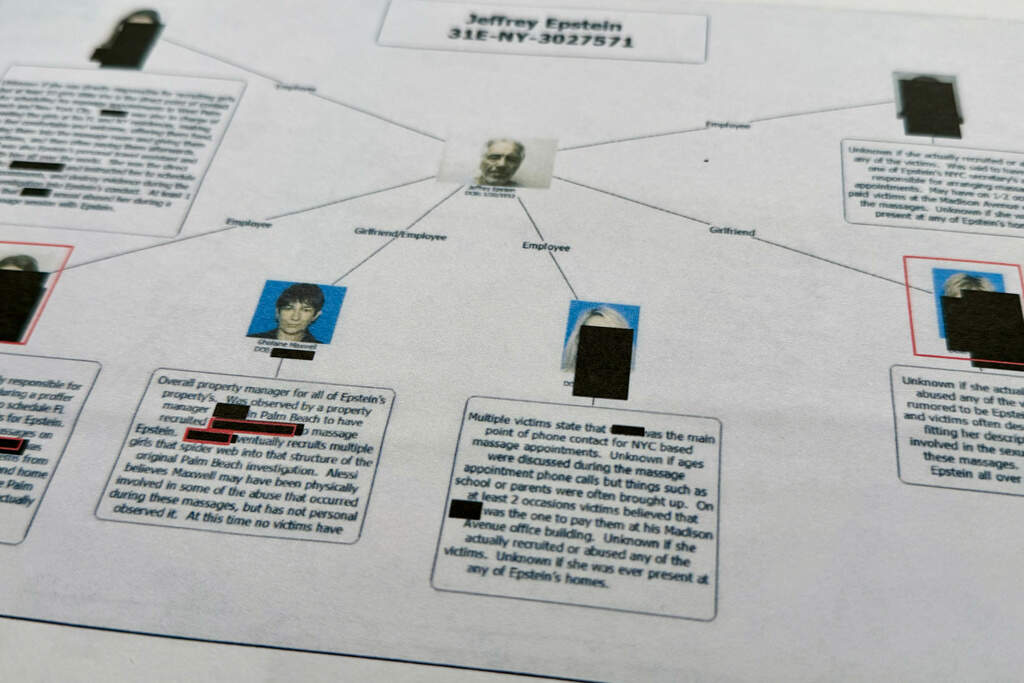
SIVERTSON: In contrast to that so called weaponized incompetence, there's the installment of files here includes some redactions that have raised some eyebrows, including a diagram of Epstein's inner circle that names people like his lawyer, Darren Indyke, his accountant, and Richard Kahn, his financial advisor, but it redacts the names and photos of several other people listed as employees of Epstein's.
There's also a news photo of President Trump with a black box over his face, which has led some to wonder if Donald Trump's image has been redacted in other parts of the files. What questions are these redactions raising for you, Arick?
FUDALI: It goes back to what I was saying before is that this is almost like, this seems to be just a campaign, a coverup campaign, and it's just, they're clearly protecting the powerful. And what's the problem with this is really, this is bigger than Epstein for me.
As someone who represents the victims of sexual abuse, often against very high-profile individuals. This is just the message to the public from the highest power in the land, that if you are a powerful person or you are friends with the President, you will be fine. Do whatever you want. There will be no accountability.
We will protect you. That's the message here. Remember, it's important to remember that no one other than Ghislaine Maxwell, in the 30–40-year saga of Jeffrey Epstein's abuse has ever been brought to justice. Every single person has gotten away with it. And Jeffrey Epstein continues to get special treatment beyond the grave courtesy of this administration.
Jeffrey Epstein continues to get special treatment beyond the grave courtesy of this administration.
Arick Fudali
So there's at this point, and like I said before, I've gone back and forth between intent and incompetence. And I also agree weaponized incompetence is a perfect phrase. But at this point, given how much they seem to be redacting and how much they seem to be intentionally withholding.
I don't know that I have any other reasonable explanation other than this is a concerted effort to cover up and conceal.
SIVERTSON: Deputy Attorney General Todd Blanche has also said that the White House had nothing to do with vetting the documents that have been released. He said they had no oversight. They did not tell the Justice Department how to do our review and what to look for, what to redact or not.
Arick, it sounds like you do not buy that. If I'm understanding correctly. Vicky, what do you make of this claim.
WARD: Look, let me be clear about something. I have never heard from any of the survivors I've spoken to, any of them claim that Donald Trump was, had anything to do with the sexual abuse they've suffered.
I've heard other names. I've not heard his name in that regard. But I think what's complicated for Trump around this story is that his narrative, his telling of it over the years has shifted and is inconsistent, right? We know that he and Jeffrey Epstein were great friends and palled around in what we now know is a sort of very seedy at a time, while Epstein certainly was doing, was abusing underage girls in plain sight.
It now appears in these files from an FBI document that Donald Trump in 2006 phoned the Palm Beach police chief and said, yeah, go get Jeffrey Epstein. He's bad. And he called Ghislaine Maxwell, quote-unquote, evil. Now this ironically puts Donald Trump on the right side of history on this particular issue, but it clashes with other things he said more recently, which was that he said recently, Oh, I had no idea what he was up to.
I thought he was a creep, but of course I had no idea what was going on, and that's why I think this is complicated for Trump, or it's one reason, another reason maybe. He told, reportedly, he told Marjorie Taylor Greene who has now split with him over this issue that he didn't, he wasn't behind the releasing all of these files because he knew that it would hurt some of his quote-unquote friends.
And that is a deeply troubling thing to hear.
SIVERTSON: Yeah. Arick, I'm curious about just the presentation of these files. We've heard that they are not organized. I'm sure you are relatively at the beginning of going through them, but from what you've seen thus far, does this offer any clarity into how the DOJ has gone about investigating Jeffrey Epstein?
FUDALI: That's a great question and it offers a bit of clarity but certainly not enough and there's still just too many documents missing to really get the full breadth of what happened here. For instance, the 2008 deal with Alex Acosta that ultimately allowed Jeffrey Epstein to continue to abuse for the next decade or so.
I would like to see, and I am demanding to see those documents. Prosecution memos, internal communications about that deal. Emails with deposing, with Jeffrey Epstein's attorneys and Alex Acosta and the other prosecutors notes of meetings between the prosecutors when they're deciding what plea deal to give Jeffrey Epstein and allegedly ignore 50 to 60 victims.
I'd like to see the emails where Alex Acosta purportedly told other prosecutors not to let the victims know about the plea deal. So there's so much missing. It's almost impossible to glean what's here and what isn't. And the other thing is there's so many redacted important names.
For instance, there's an email referring to victim where an emailer to Jeffrey Epstein literally refers to women as victims. That name is redacted. There are so many redactions. And then what they did recently, the DOJ, is they released this list of 300 names, popular, famous people mentioned in the Epstein files.
But most of these people were nonsensically mentioned, Kurt Cobain, Elvis, these people were mentioned because they happened to be like in an article or something that was sent to Jeffrey Epstein. To include those types of names to someone who was so clearly actually, Jean-Luc Brunel, who was actually sex trafficked women to Jeffrey Epstein is it's almost intended to confuse, intended to dilute the actual impact and the actual nefarious of what so many people in Jeffrey Epstein's circle did.
SIVERTSON: So I want to hear a little bit more from Annie Farmer here who raises similar questions about just how the investigation was done. Here she is.
ANNIE FARMER: What is not clear is what was done to investigate. I think we see that there was a very strong case in 2006 that was the Feds were trying to put together, and we know obviously with that sweetheart deal, it didn't unfold the way anyone believes it should have. But even after that, you can see records of people sharing information.
And that nothing was done for so long, I think is extremely problematic.
SIVERTSON: So she's speaking there a bit to this plea deal that you're referencing that that Alex Acosta gave Epstein back in 2008. ... Given that this is an investigation that technically has been going on for decades, and we're not just talking about the current Trump administration when we talk about holding Jeffrey Epstein to account. So Vicky, as someone who has covered this for now decades, what frustrations do you have in terms of how this has been handled, not just here in 2026, but in 2006?
In 2008, in the 2010s?
WARD: Yeah, I think Annie Farmer, once again, is right on the money. Her sister Maria has been completely vindicated in these files. Because we see that she did go to the FBI in 1996 to log her complaints about abuse at the hands of Jeffrey Epstein and Ghislaine Maxwell.
What we don't see is why the FBI didn't do anything about it. And I think that is a massive vacuum in these files. What we do see about the 2008 plea deal that I've stumbled across, and again, you know, you've talked about the volume, we still haven't got the full picture. It may be in there, but we don't know yet.
There is this communication I found in 2011 between two Justice Department officials whose names are redacted discussing how they need to dig in and protect their position against Brad Edwards, the Florida lawyer, who is now representing the victims of Jeffrey Epstein in a class action suit and fighting to overturn that plea deal on the grounds that it was done behind their backs and therefore was illegal.
And you see this correspondence between these two unnamed people saying we need to dig in and protect. It was our position. It was totally legal to strike that agreement behind the backs of these victims. We didn't need to go to them. Regardless, one of them says, of what we actually think of the deal.
The terms of the deal. So in other words they knew. They knew. I think the other thing that's interesting is you do also see chummy emails between Alex Acosta back in 2007, 2008, and Jay Lefkowitz, who was one of Epstein's lawyers, very clever of Epstein, to have hired Jay Lefkowitz. Because what does Alex Acosta do after he leaves the government when he steps down from being a U.S. attorney?
He goes into private practice with Jay Lefkowitz. And so I think again, you begin to see this is how the world works. And Jeffrey Epstein understood that and used it to his advantage to evade justice for years and years. I will say one thing. You do also see in the emails, that Epstein was very nervous about a book that was being put together by actually now my co-author James Patterson. And a guy called John Connolly, who's sadly dead, retired New York City cop who was at Vanity Fair back in the day with me and together with another guy, Tim Malloy.
They wrote a book. That came out in 2000, I think, 2016, called Filthy Rich, where a lot of the victims did speak to James Patterson and Connolly. But they didn't, they weren't comfortable in giving their names, but they did speak for that book, they went to the networks. The networks wouldn't put, wouldn't air it, which tells you that you needed the culture to change. In order for justice to be brought.
Part III
SIVERTSON: It occurs to me that when we think about accountability, part of the problem here is that we don't know what we don't know in the files currently. Not just because there are so many pages of documents, but also members of Congress are able to see an unredacted version of these millions of pages but not the public.
So Arick, how does this work? Who is able to see what?
FUDALI: The short answer is not enough people are able to see anything. It sounds like Congress has been able to see some of the unredacted files and there's so many redactions. It's almost impossible, so much times it's just like a full page, fully redacted.
So it's almost impossible for someone like myself who doesn't have access to what Congress has access to really glean much information from a lot of it. There's so many names blocked out, there's so many pages completely redacted. And then there's just so much information missing. And we speak about accountability.
You have started to see some, what I refer to as societal accountability. You've seen some people resign. You've seen companies getting sold, you've seen people fired, you've seen parliament in the UK, and turmoil. There has been some accountability, but not nearly enough.
Especially for those who enabled, facilitated Jeffrey Epstein, for those who co-conspired with Jeffrey Epstein, or perhaps even for those who accuse Jeffrey Epstein. But I think even more importantly, we have to look at those, go back to what, you know, Vicky was saying before, is those who allowed Jeffrey Epstein to continue to abuse, like Alex Acosta.
There's nothing in there. There's not nearly enough information, and there are some very suspicious emails like the ones that were referenced about that plea deal, about what happened in 2008, about why Alex Acosta purportedly ignored so many victims, made this deal without, made this plea deal without notifying the victims, and to go back to Alex Acosta and Donald Trump for just a second.
There was a discussion of that '06 email that Donald Trump sent where he apparently wanted, I'm paraphrasing, to stop Jeffrey Epstein, but if that was true, why did then Donald Trump appoint the person who was most responsible for not stopping Jeffrey Epstein? Alex Acosta.
Why did he then appoint that person to, as a Secretary of Labor in 2016? It just doesn't really add up. And again, that's why we need more and more emails and more and more information, and there's really just no reason for anything to be redacted. There's no privilege, there's no attorney-client privilege in any of these redactions that I can see.
There's no work product privilege that would stand up to any of these documents, I can see. We need to see the entire volume of documents completely unredacted, other than, of course, the names of the victims or the identities of the victims. And I can assure you, my client, the survivors and the other survivors I spoke to myself are not going to quit.
We're not going to stop fighting until that's done, and we can actually see true accountability because you can't have closure. You can't have, unless you have accountability. And you can't have accountability unless you get the exposure of the people who enabled and facilitated and co-conspire with Jeffrey Epstein, and that's all the survivors want.
Exposure, accountability, and then eventually true closure. So what paths are you pursuing, Arick, you and the survivors you represent, pursuing to try to get more documents and to try to have more of this broken open? What can you do?
FUDALI: Yeah, so there's been a few efforts. So one thing that's been done is the congressmen have asked the judge to appoint a special master to oversee this, oversee the Department of Justice.
In the way that they are providing the documents, what the master would do, or it's a judge really would oversee, would look at all the documents, say okay. This can be redacted. This can't, this has, this is privilege. This is not that. Those efforts have stalled. The other thing we're looking at is really just a lawsuit against Department of Justice.
We are looking at lawsuits against district attorney's offices. We're looking at every possible lawsuit. Everything we can do. The problem is for the government; the federal government gets to write the laws as to how the federal government gets sued. And there's a lot of red tape, there's a lot of yellow tape.
It's not so simple to sue the federal government. There's immunity issues, there's procedural issues of notices of claim, and I could go on and on. So really, we're going to pursue every avenue we can, but really it should just be up to the Department of Justice to do the right thing here.
Congress has some sway. There can be contempt hearings. We're certainly advocating for that, they could seek court intervention. We're really, the short answer is we're looking at every possible avenue of justice to hold these people accountable. Not just to get the documents released and to get full document and full exposure, but also, we're looking into lawsuits and researching and investigating lawsuits for the failures.
As was mentioned, Maria Farmer's email to the FBI in the nineties, the failures of the District Attorney's office in 2008, the continued failures, administration after administration, Department of Justice after Department of Justice, we're right now considering and looking into lawsuits, each one of those avenues.
SIVERTSON: Okay. Earlier in the show, Vicky, you were talking about some of the big names that have appeared in the file. People in power, people like Commerce Secretary Howard Lutnick, he's there a number of times. He testified at a Senate hearing on the matter last week and said he, quote, barely had anything to do with that person. Referring to Epstein, but that didn't stop him from wondering about the most recent document release.
HOWARD LUTNICK: I looked through the millions of documents for my name, just like everybody else.
SIVERTSON: Just like everybody else. Vicky, what are your thoughts on that?
WARD: I think that there has been a shudder felt among the global 0.001% on this. And Howard Lutnick's embarrassment on this hasn't been to do with sex so much as he was caught in a lie. He gave an interview not so long ago saying, that he took one look, one step inside Epstein's house and thought something was so off that he and his wife decided they'd never, never wanted to see him again.
It turns out that's not quite true according to the files, he and his wife and their young children and nannies and another family and young children asked if they could come and pop over and have lunch with Epstein on that island. All together. And furthermore, he and Epstein, it seems were in talks about some sort of investing together in a fund. Nothing criminal in that, but it shows he told, he lied essentially, and he is in the cabinet.
And what do voters make of that? Why should they now trust a word that comes out of our Commerce Secretary's mouth. And that's, I think, he's not the only person to have come a cropper, so to speak, in the files like this. Kathryn Ruemmler who was until the end of last week, the General Council of Goldman Sachs.
And back in the day was Obama's White House Counsel, clearly shows in the emails that she makes jokes about Jeffrey Epstein's reputation as a convicted pedophile. At one point, she even talks about dealing with one of his victims and says to him, she's got a way that he could catch her in a quote-unquote perjury trap.
Another point he says that he's a rich guy where she's interviewing for a job. Ken Griffin of Citadel is looking for a girlfriend and she responds to him. Oh, so you mean you're going to give him one of your Russians so that I can get paid some comp? You know how the idea that this woman could have stayed as the general council of Goldman Sachs is extraordinary, but there are all sorts of people who've been caught like this.
And what it shows is that at that level, if these people were perfectly willing to be complicit, to exercise what I would call willful blindness about Jeffrey Epstein's sex crimes, as long as he was doing something useful for them. And normally that had to do with money or introductions or giving them some kind of edge in the world.
And that, of course, has reaffirmed, I think, the fears of people on both sides of the aisle politically, that there's a two-tier justice system in this country. That it's one set of rules for most people and no rules at all for the very rich and the very powerful, and that is why this story will not die.
SIVERTSON: Yeah. What we've seen in the files certainly does introduce new questions to some of these large figures, but it's still so unclear what consequences, if there will be any sort of legal consequences faced by any of them. Businessman Les Wexner will be deposed. We know former president Bill Clinton will be deposed as well, but it is not clear what, if anything, can come from this in terms of legal accountability.
Arick, what are your thoughts on where any of those depositions could go, what they could lead to?
FUDALI: I actually, I want to go back to something Vicky said, which is right on that topic, the two tiers of justice. I would submit that there's really, in this country, what this has revealed is there's really three tiers of justice.
There is justice for the poor, there's justice for the rich, and then there's justice for those who are in Donald Trump's circle, and that seems to be the most exonerating tier of justice, the most ridiculous tier of justice, where there seems to be no accountability. If you were friends with Donald Trump, you were in his circle, which appears a lot of these people in the Epstein files, were. Looking forward to, what these depositions might lie, what they might reveal, how they might lead to accountability.
It is of course not a crime to be mentioned in the Epstein files, for instance. My name is in the Epstein files over 30 times. Of course, all of it is legal correspondence dating back to 2015 because I've been pursuing justice for victims of Jeffrey Epstein since, for over a decade.
However, it's important to remember as it's been pointed out, that in 2008, despite my sort of very robust criticism of Alex Acosta, one thing he did do is he forced Jeffrey Epstein to be a registered sex offender. And that was public knowledge. It is, I do think that some of these people who are going to be deposed, some of these people who continue to closely associate with Jeffrey Epstein, people who continue to spend time at his mansion, people who continue to ask Epstein about parties and women, people who continue to spend a lot of time at the island and talk about girls and this sort of thing with Jeffrey Epstein.
After 2008, I think it requires some very strict scrutiny, some very difficult questions as to why. Why they knowingly, presumably, knowingly interacted and socialized and spent so much time interacting with a registered sex offender who was also constantly surrounded by young women even once he was actually became a registered sex offender.
I think they're require, and that's just not the people who are being deposed. I think a lot of the people in the Epstein files have a lot of questions to answer. As far as real justice and accountability. I hope these depositions are not the end. They're the first step, for myself and my clients and my survivor clients.
We're looking at all this reveal as a very early step in our efforts to hold, get true accountability for everyone. I think the Department of Justice, this administration hopes this is the end, right? These depositions will end it. For us, it's the beginning and based on what's gleaned during these depositions, based on information we continue to get, that continues to be revealed in these files.
And we continue to push for, we're just getting going on where we are going to pursue, at the very least, civil accountability. But I hope that this Department of Justice can at least pursue some semblance of criminal liability for those who deserve to be investigated and pursued.
SIVERTSON: Yeah, President Trump told CNN, we've gotta move on. We've got, it's time to move on from the documents. At the same time that you are saying you are taking your first steps. And even just with this latest tranche, 3 million documents, as we've said, is a lot to go through.
It's gonna take months to read it all. It's gonna take even longer to connect whatever dots can be connected. So other than demanding more documents and hoping for some legal action that can come from what's in there. Is there anything Vicky, that people can do to make sure that there is the kind of microscopic attention paid to the documents that are there to make sure that we don't miss out on things that could lead to greater accountability?
WARD: I don't want to lose sight in all of this, that, you know, that the survivors of Jeffrey Epstein have come a very long way. And I think the fact of the matter is, the Justice Department may have let them down, but through their advocacy, through the fact that they have found their voices and they have fought back so powerfully, they do have Congress on their side, which is no small thing.
And I just, and I think that Congress doesn't show signs, I think, of wanting to back off. And I think, I have certainly have so many questions for Les Wexner and Epstein's accountant and lawyer, and I think, as Arick said, that is gonna be the beginning, not the end of many more questions and more people who need to be deposed.
I would put Leon Black on that list. And I think given that the survivors do have the support on Congress on this we've just gotta keep the pressure going.
SIVERTSON: Vicky, looking back on your coverage of Jeffrey Epstein, you know, this started for you with that profile for Vanity Fair back in 2003. You mentioned Annie and Maria Farmer coming to you back then.
Their allegations of sexual abuse were not included in your piece, when you look back and think about how long it's taken for us to get to this point. Is there anything that you wish that you had done differently or that you could have done differently in helping the abuse come to light sooner than it did?
WARD: It's funny, I've seen in these files, I actually stumbled across a new document that I hadn't seen last night. Jeffrey Epstein admissive to Graydon Carter, my boss at the time outlining how he thought my piece should go, complaining bitterly about me. Basic, doing all the things that I feared went on behind my back, which is why the Farmer sister allegations were cut.
I don't think I could have done anything against what I called the good old boys club. Back then. I've spoken a lot to Julie Brown. The great journalist at the Miami Herald whose journalistic work did make a difference. Her series in the Miami Herald, Perversion of Justice, did get the attention of Congress and the Justice Department. And she would say she would, that #MeToo was very helpful.
The first draft of this transcript was created by Descript, an AI transcription tool. An On Point producer then thoroughly reviewed, corrected, and reformatted the transcript before publication. The use of this AI tool creates the capacity to provide these transcripts.
This program aired on February 17, 2026.