Support WBUR
Inside PragerU’s conservative push into American classrooms
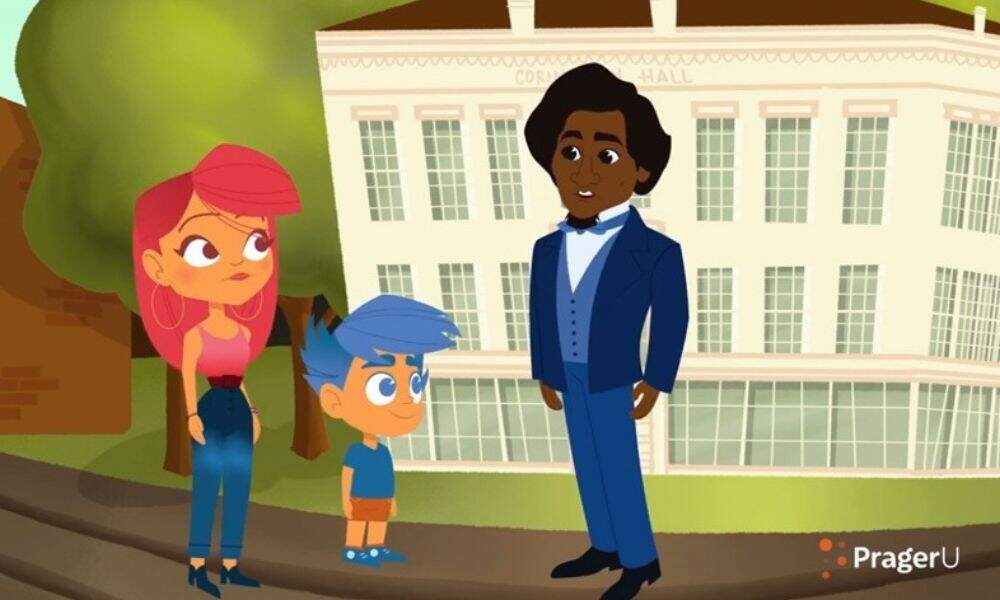
PragerU is a conservative video giant. It’s produced more than 2,000 videos that it says promote American and Judeo-Christian values. Now its content is approved in 10 states’ school systems.
Guests
Sarah Schwartz, reporter at Education Week, where she covers curriculum and instruction in K-12 schools.
Adam Laats, professor of education and history at Binghamton University.
Also Featured
Jill Simonian, director of outreach at PragerU and co-creator of PragerU Kids.
The version of our broadcast available at the top of this page and via podcast apps is a condensed version of the full show. You can listen to the full, unedited broadcast here:
Transcript
Part I
AMORY SIVERTSON: I'm Amory Sivertson. And this --
BEN SHAPIRO: According to the left, all inequality in America is due to victimization.
SIVERTSON: Is right wing commentator Ben Shapiro in a video from 2017 titled, Facts Don't Care about Your Feelings.
SHAPIRO: But what if you haven't actually been victimized by anybody? That doesn't matter to the left.
So long as you feel victimized, you're a victim.
SIVERTSON: This was produced by the conservative video giant PragerU, which has made some 6,000 other videos for YouTube and other social media like this one from October 2025 with the headline, Do Women Belong in Combat? It features Michelle Thibeau, who says she served in the U.S. Army Special Operations Command in Afghanistan.
MICHELLE THIBEAU: I'm proud of my military service. There are many roles in the armed forces that women can and should fill, but combat is not one of them. The principle that combat is a male burden has been nearly universal across civilizations. And common sense tells us a society that places women, the bearers of new life on the front lines is not prioritizing its future.
SIVERTSON: PragerU says its videos are designed to promote what it calls American and Judeo-Christian values. And despite the U in its name, PragerU is not a university. The nonprofit organization was founded in 2009 by conservative talk radio host Dennis Prager. On its website, PragerU claims that one in three Americans has seen a PragerU video and that 30 million unique viewers watch its videos on YouTube every quarter.
Now, PragerU wants to put its content in American classrooms. Here's part of a video the organization posted earlier this month called the PragerU Mission.
[VIDEO PLAYS]
PragerU videos help people of all ages think and live better. These are the shows that are changing minds around the world.
PragerU Kids offers entertaining educational shows, books and magazines for students in kindergarten through 12th grade.
SIVERTSON: PragerU's content aimed at younger audiences is called PragerU Kids. One PragerU Kids video series is called Leo and Layla's History Adventures. In it, two cartoon siblings travel back in time to visit historical figures.
And in one episode, after traveling to the year 1852, Leo and Layla ask a cartoon version of American abolitionist Frederick Douglass about slavery.
LAYLA: How can there be slavery in America when the founding fathers said that all men are created equal?
LEO: Yeah. And I've heard that some of those founding fathers owned slaves.
What about that?
DOUGLASS: Children, our founding fathers knew that slavery was evil and wrong. And they knew that it would do terrible harm to the nation. They wanted it to end, but their first priority was getting all 13 colonies to unite as one country.
LAYLA: Are you okay with that?
DOUGLASS: I'm certainly not okay with slavery, but the founding fathers made a compromise to achieve something great, the making of the United States.
SIVERTSON: So for the record, many U.S. founding fathers were slave holders. We're gonna talk more about that Frederick Douglass video a little later in the show. 11 U.S. states have approved PragerU's content for use in their public schools. That's according to Jill Simonian. She's PragerU's Director of Outreach and co-creator of PragerU Kids.
JILL SIMONIAN: What I noticed as a mother and what many credentialed educators who happen to work here in-house now, creating these materials, also happened to notice is that there was a severe tilt towards radicalized ideologies being put into schools, and the unfortunate expense of that was that there was not, we wanted to return to basics, to supply educators, parents or teachers with options that included cultural literacy, American history, appreciation for our country through our faults.
SIVERTSON: Right now, Simonian says the list of approved states includes Alaska, Arizona, Florida, Idaho, Louisiana, Montana, New Hampshire, Oklahoma, South Carolina, Texas, and Utah.
SIMONIAN: In the last two years, we've earned partnerships with 11 different states.
So I'm going to go ahead and say with the utmost hope and gratitude for what we do in the next five years, 50 states, that's the goal.
SIVERTSON: All 50 states. Okay. So what does PragerU's expansion mean for America Schools? Well, joining us now is Sarah Schwartz. She's a reporter at Education Week, where she covers curriculum and instruction in K-12 schools.
Sarah, welcome to On Point.
SARAH SCHWARTZ: Thanks so much for having me.
SIVERTSON: It's great to have you. So I guess first I just want to better understand what PragerU is.
SCHWARTZ: Yeah, so as you mentioned, PragerU is a media company founded by Dennis Prager. Prager became famous as a talk radio host in the 1980s and 1990s. And his shows are somewhat of a preview for what PragerU would become.
He covered a wide range of current events with a focus on morality, ethics, values, a lot of that grounded in his Jewish faith. He has described himself in the past as a passionate centrist, but he has espoused pretty socially conservative views. He's spoken out against same-sex marriage, for example.
And PragerU has a pretty uniformly conservative political bent. Like you mentioned, they were founded in 2009.
SIVERTSON: It looks like we've lost Sarah, so I'm gonna bring another voice into this conversation and we'll see if we can get Sarah back. Adam Laats is a professor of education and history at Binghamton University.
ADAM LAATS: Hi. Yeah, I am. I'm right here.
SIVERTSON: Hi. Welcome to On Point.
LAATS: Thank you. Happy to be here.
SIVERTSON: It's great to have you. So we were just starting to hear from Sarah Schwartz there about the origins of PragerU and about Dennis Prager. What can you tell us about the founding of PragerU and what its purpose was supposed to be?
LAATS: Right. Well, as I understand it, you know, he, Dennis Prager himself had a, you know, healthy audience as a radio host. They, he and some of his colleagues in the early 2000s talked briefly about trying to present an actual educational institution. Hillsdale was the college that in Michigan was what they thought of a real university.
But looking at that, they realized how expensive it was and they decided to go with their strength, which is to produce content, make it available, and hope to use that as the lever to sort of push American culture to the right.
SIVERTSON: Okay. And so at the center of PragerU'S work now are these educational videos that cover a range of topics, what kinds of things are they focusing on in these videos?
LAATS: Well, they have a lot of content, as you mentioned, I'm a historian, so the ones that I've spent the most time with are the ones that teach kids, especially the PragerU Kids videos about U.S. history, but they have financial literacy. They have, you know, why climate change is not a problem.
You know, they have a range of topics. They also have a lot of like celebrity more than cameos celebrities. We heard Ben Shapiro, Charlie Kirk was on, has been on there. Kevin Sorbo, you know, they have the sort of bench of conservative media personalities that have participated in making this content.
SIVERTSON: Yeah. And some of these conservative commentators like Ben Shapiro are involved in PragerU'S leadership. Right? What else do we know about who is running PragerU?
LAATS: Right. Well, Dennis Prager himself, unfortunately had some, you know, some health issues. I think he's still out of the picture.
He was paralyzed for a while. I don't know if there's any updates, but I think he is no longer actively running. But Marissa Streit is the, I don't know what her title is, but CEO or main leader of the organization. And then they have a lot of connections. Ryan Walters is no longer the superintendent in Oklahoma, but he was very closely connected from the outside with the leadership of especially getting PragerU content into schools.
SIVERTSON: Okay. Alright. I understand. So now getting content into schools, this is an interesting piece that we're gonna be focusing a lot more on here. Because the process that was taken of getting this content into schools is a little mysterious to me. What can you tell me about when PragerU's educational videos started intersecting with school curricula?
LAATS: Right. Well, the quest among right-wing activists to get their content into public schools is a really old one. It goes all the way back and a hundred, full hundred years ago the Ku Klux Klan made a history textbook because they thought the mainstream textbooks back then were too, you know, what today's conservatives would call woke.
And it's just been a constant of, you know, conservative media, of people trying to get in and onto approved list of what counts as school appropriate material. PragerU has had a lot of success especially because of our current political climate. You have politicians in many states who are scrambling to prove their, you know, their Make America Great Again credentials.
So you have people like in Oklahoma, Ryan Walters, who are eager to demonstrate that they are making their schools more conservative, more in line with President Trump's version of conservatism. And so, as you mentioned earlier, several states have put these materials on their approved list. That doesn't mean that, you know, schools are giving them out, or schools are necessarily making children watch this content.
It just means that teachers can, without, you know, fear of having to have something, you know, approved by their department chair or their principal. They can confidently, teachers can confidently use this material in their classes and with their students.
Part II
SIVERTSON: Sarah, let's turn back to you. We're starting to talk about how these videos made their way into schools, these videos that PragerU produces, but, you know, schools and kids were not necessarily the initial target audience of PragerU. Is that right?
SCHWARTZ: That's right. Their first target audience was teens and young adults.
They were trying to figure out a way to make conservative policy positions, conservative values accessible to Gen Z and enticing to Gen Z.
SIVERTSON: Okay, so there's PragerU, and then there's PragerU Kids. How are these videos different? How are they produced and thought about differently?
SCHWARTZ: So the PragerU sort of main set of videos, their kind of flagship product is the five-minute videos, which are more at that high school or college age level.
And they're focused on free market economics. They are anti diversity, equity and inclusion initiatives. Some oppose gender affirming care for transgender people. They tend to have a bit more of potentially inflammatory titles. They're a little bit kind of slickly produced. The videos that are targeted toward kids are less perhaps overtly partisan.
They have, for example, a story time show called Otto's Tales, that's about American figures and holidays. That's for young students. K, 1 and 2. But they still come from a conservative political perspective. They emphasize personal responsibility. They extol the virtues of free market capitalism.
They encourage girls to embrace traditional femininity, traditional gender roles.
SIVERTSON: Okay, so I want to hear a clip of one of these videos. Now we're going to stick with the point of history here first. This is from a PragerU Kids video series called Leo and Layla's History Adventures. There are cartoon siblings, Leo ... and Layla, excuse me.
And in this clip they're asking abolitionist Frederick Douglass about slavery.
LAYLA: What's taking the southern states so long to do what's right?
DOUGLASS: Great streams are not easily turned from channels worn deep in the course of ages.
LEO & LAYLA: Huh?
DOUGLASS: What I mean is sometimes things are more complicated than they might seem, and complicated problems take time to solve.
There was no real movement anywhere in the world to abolish slavery before the American founding. Slavery was part of life all over the world. It was America that began the conversation to end it.
SIVERTSON: Okay. As a historian, Adam Laats, I'm very eager to hear your thoughts on this particular video.
LAATS: Right.
Well, I'm just sitting here cringing hearing it again because it's really so similar to what Creationists were cranking out in the 1980s and '90s. Where they try to appeal to young people with something that sounds like, you know, a factual, reasoned, evidence-based true depiction of the past.
But it is really super twisted from what the real history would say. You know, the idea that Frederick Douglass would be boosting the founders, specifically the founders of the United States. As, you know, the real abolitionist is absolutely a false representation of what the real Frederick Douglass would have told, you know, any time traveling children.
To my mind, this is the definition of propaganda. It's an intentional attempt to misrepresent facts in order to push children in a political direction.
This is the definition of propaganda. It's an intentional attempt to misrepresent facts in order to push children in a political direction.
Adam Laats
SIVERTSON: Hmm. Okay. And yeah, and we should note, you know, that this is claiming that there was no real movement anywhere in the world to abolish slavery before America took, led that charge.
But before America was founded, there were movements to abolish slavery all over the world. And it had been partially or fully abolished in several countries already, including the Philippines and Russia, Lithuania, Japan, and Portugal. So we asked Jill Simonian from PragerU about the making of this video in particular.
Here's what she said.
SIMONIAN: It was written by a few people, one of them being a credentialed high school history teacher here who has a master's in history, and what they do for every single video is they go to the original source documents. That Frederick Douglass video used Frederick Douglass's 1852 speech, What To the Slave is The 4th of July? And it also used direct quotes from Frederick Douglass's speech of 1860.
SIVERTSON: So Adam, what would you say Jill is missing here or getting wrong?
LAATS: Well, I'd say the point. She is taking some truth. So Frederick Douglass, for example, for people who aren't, you know, up to their eyeballs in U.S. history, Frederick Douglass really did criticize his fellow abolitionists for attacking the U.S. Constitution, calling it a pact with the devil as some abolitionists at the time were doing.
And the PragerU video takes that true fact. And twists it, it twists it into a position that Frederick Douglass never had. And it's not hard for kids or for any of us to understand how someone who is an abolitionist would have criticized other abolitionists without therefore somehow supporting the slave holding class.
But this video, you know, either the makers of it aren't aware of the real history, or they are aware of it, and they are twisting it intentionally. Either way, it's not what children in school or out of school should be exposed to.
SIVERTSON: Okay. Sarah Schwartz, do we have any sense of whether or not a video like the one we just heard featuring Frederick Douglass, this fictionalized portrayal of Frederick Douglass?
If a video like that is already being used in schools in the 11 states that have approved the use of PragerU content.
SCHWARTZ: Yeah, so it's actually pretty hard to know. And this isn't just the case with PragerU materials, it's the case with most educational materials in the United States. We don't have any kind of national database that says what students are using, what teachers are using in schools.
That being said, there are some sources of data that we can look to for clues. So PragerU says that they have 2 million Kids subscribers. That counts both parents and educators. But on the other hand, when you look at what teachers are actually using across the country resources, like PragerU are not top of the list.
So the American Historical Association, they did a survey of U.S. high school history teachers a couple of years ago. They found that the vast majority are kind of mixing and matching resources and pulling from supplemental materials, but the most popular sources are things like federal archives, museums, institutions like the Smithsonian, the National Archives, the Library of Congress.
PBS is also very popular. They don't have data on PragerU, but there is some data on explicitly conservative resources that shows that they're just not as popular. The Hillsdale college which we were talking about earlier, they have a 1776 curriculum that only 4% of teachers said that they were using.
SIVERTSON: Okay. So I want to shift gears here a little bit from the historical, which Adam, I know it's tempting. We could spend the rest of the show just talking about history video clips here. But I want to go from the historical to something else that you mentioned. Something a little bit more cultural.
We have a clip of a video designed for younger audiences that's called How to Embrace Your Femininity.
Number one, don't get caught up in stereotypes. If you want to wear pink, wear pink. If you want to dress up in a girly dress, do it. Make yourself pretty. Master the art of makeup, practice good hygiene.
Embrace the idea of being a wife or a mother, and allow yourself to stay at home, to raise your children. If it's the right choice for you and your family, it's a wonderful opportunity.
SIVERTSON: Okay, Sarah, I would love to hear your thoughts on this video.
SCHWARTZ: So this video aligns pretty closely with one of the major things that PragerU says that its mission is.
I'm pulling some pieces directly from their 2023 annual report where they say that the left has brainwashed America's young people by making up its own truth. And that they're trying to counter that by instructing teachers and young people to reject woke culture. So this, I think, kind of falls directly in line with that piece of their mission, which as you said does go beyond their interpretation of American history.
SIVERTSON: Yeah. And do we have a sense of whether a clip like this would be used in schools' history? You know, it makes sense that there's going to be a history curriculum of some sort, but if we're looking at a, you know, a topic like gender identity, embracing your femininity, are there any sort of, you know, guardrails around the types of content, the themes of content that can be used in schools?
SCHWARTZ: So there are some states that in their partnership with PragerU or their approval of the resources that students can use, they have put some guardrails on what that can look like in classrooms.
So for example, in New Hampshire and Alaska and Utah their partnerships are focused squarely on the financial literacy materials that PragerU develops.
And then in Idaho and in South Carolina the states have curated some materials that are available and some that aren't. I'm not sure about that specific video or the specifics of some of the information about gender identity. But there is --
SIVERTSON: Oh, Sarah, it sounds like we might have lost you again.
I do wanna go to another clip here of Jill Simonian. She, again, is the Director of Outreach at PragerU. She's also the creator of PragerU Kids. And, you know, she says that she's excited about PragerU's materials being approved in more states. Let's listen.
SIMONIAN: I would get DMs all the time in my social media accounts from teachers saying, Thank you for your books about American holidays.
I am reading them in my kindergarten classroom. Thank you for your videos about, you know, what it means to vote and what capitalism is. I've been using it in my classrooms because we don't have any materials that teach, you know, about the Constitution or the Bill of Rights, and I'll tell you the process for each states' Education Department has really been unique.
All of our materials have been standards aligned, national and statewide educational standards. And that is something that we started doing, you know, quickly when we realized that there really was hunger for this type of content.
SIVERTSON: Okay, Adam Laats, standard aligned content.
Jill says, do you have a sense of what she means by that? You were a teacher at one point in middle school grades, middle and high school grades. What is standards aligned content?
LAATS: Yeah, I was, and I get to work with great teachers now and teachers, Sarah mentioned the American Historical Association Survey.
That's what teachers do. Teachers are out prowling for good, trustworthy content, especially middle school and high school teachers. And the existence of this material on an approved list implies that in these states, PragerU counts as trustworthy. So certainly, what teachers want is material that they can rely on to be accurate. And, you know, not about pushing any one idea, but rather about delivering the kind of content that we, as history teachers, English teachers, science teachers need to cover.
Every state decides on what their standards are. So in New York, 11th grade teaches U.S. history, so 11th grade teachers are out there looking for solid, trustworthy, reliable, non-propagandistic content. And that's, I think the real danger of this is when teachers might not, you know, look any harder than their approved list and say, well, this must be trustworthy because it's on that state approved list.
SIVERTSON: Hmm. Okay. I want to play one more clip here of PragerU Kids content. This is a theme that, you know, to be honest, I don't remember when this was introduced in my own education. This is the characters Leo and Layla again, they pay a visit to a cartoon version of Adam Smith, who's often called the father of capitalism.
Here's that.
LAYLA: Who decides who gets to make more money or less money?
ADAM SMITH: Excellent question, Layla. No person decides, and certainly no government does. Fairness is determined by what I call the invisible hand of the markets.
LAYLA: Yikes, invisible hand.
SMITH: I know it sounds spooky, but it just means that the economy runs best when costs and wages are determined naturally by the market.
That's when people can negotiate freely about what to charge and what to pay.
LEO: So no one should force you to pay more than what you want.
SMITH: That's right, Leo. No.
SIVERTSON: Okay, so Sarah Schwartz, I wanna turn this back to you. Because, you know, when we're thinking about history and the representation or misrepresentation of history, that feels more concrete, what about content like this that is introducing the institution of capitalism to a younger audience?
SCHWARTZ: As in where it could be, where it could be introduced in a school curriculum?
SIVERTSON: Yeah. Where it would be introduced in a school curriculum, but also what are the, you know, have you heard any concerns over the introduction of content about topics like capitalism being introduced in schools in this particular way?
SCHWARTZ: Mm-hmm. Yeah. So I think when I've talked to historians and academics about the potential issues with some of these materials, the concern isn't necessarily that they come from one part of the political spectrum, but rather that the materials present themselves as a source of truth rather than a source with a particular perspective.
So they really kind of, PragerU really kind of presents their materials as this is the voice of clarity and reason, we're cutting through all of the noise. And when I've talked to educational experts about this, they say that that framing can make it harder for students and teachers to consume this content with a critical eye.
SIVERTSON: Okay, Adam, turning that back to you. What, you know, thinking about a topic like capitalism as a teacher, what concerns or questions do you have about how this content might be used?
LAATS: Right. Well, excuse me. I think the fundamental flaw at the heart of not just the PragerU efforts, but all of these efforts going back for a hundred years, is that people on the right who are interested in school curriculum, they tend to assume that there's this vast left-wing conspiracy that is absolutely not the case. Teachers are people, and we want the best for our kids. Teachers are conservative. Teachers are liberal. Teachers are moderate. Teachers are just Americans, not conspiracists.
Part III
SCHWARTZ: I want to underscore what Adam was saying right before the break, which is that this idea that there is some kind of vast left-wing conspiracy in schools, the data really doesn't bear that out. I want to go back to that American Historical Association report that I mentioned earlier.
They asked a lot of questions of the teachers about what are your priorities in history, education, and how do you see the subject? And the vast, vast majority all said that they try to present issues from multiple perspectives, that they want to teach students how to think, not what to think. And as we've been reporting here on some of the laws that states started to pass in 2021, 2022, banning conversation around divisive concepts in the classroom. Just time and time again, we've heard from teachers that the issues that were targeted in those laws, it's just not really the way that they're behaving in the classroom.
SIVERTSON: Okay. So we asked Jill Simonian, PragerU's Director of Outreach more about this, about presenting whether she thinks PragerU Kids is presenting the kind of biased information that it accuses the left wing of presenting in schools, just from a conservative perspective.
SIMONIAN: PragerU Kids in every single one of our videos, whether we're talking about self-reliance through financial literacy, why we celebrate holidays like Memorial Day, you know, every single thing we do.
The overarching theme is to try and remind everyone we're united as Americans. Even though we all have our little differences, we're united as Americans, whereas many of these other, I'll say, radicalized initiatives want to divide and separate students to make them see what their differences are first.
SIVERTSON: Adam, what are your thoughts on what we just heard Jill say?
LAATS: I think Ms. Simonian is tapping into a very powerful streak in American culture, but it's also a very fundamentally flawed streak. You know, we might call it, you know, the get off my lawn streak, where there are some Americans, a lot of Americans, who see, correctly see that younger Americans in every generation are more anti-racist, are more open to inclusivity and culture.
Are more relaxed about things like gender norms that, you know, have been a traditional part of American culture. And people like that, people like Ms. Simonian, and she has a lot of company, they see those changes in young people and they can't bear to acknowledge the truth, which is this is just a cultural change that is happening and has happened for a long time now.
And instead, they need to find a red under the bed. They need to find someone to blame for brainwashing their children into thinking this thing that the people like Ms. Simonian really don't think is true. So they, in this case, they look to schools, they look to teachers and they say falsely, as Sarah pointed out, teachers are not, you know, left wing radicals.
They say it must be the schools. It must be the colleges. It must be the textbooks. In every case, that's just not a match for what schools, textbooks, and colleges are really doing.
SIVERTSON: Hmm. Well, yeah, and you're sort of tracing the history here of this goes back to debate over what textbooks should be used in school and, you know, curriculum are criticized all the time and have been criticized all the time for one reason or another.
What makes the debate over the use of PragerU in schools feel different to you? Adam?
LAATS: Well, the biggest and most obvious difference it's not the level of anger. You know, right here in Binghamton and across the country during World War II, we had book burnings of history books that people thought were too woke.
What would they call woke today? We've had school firebombings in the seventies about textbook selection. So it's not the anger. There's a lot of anger, but there's always been a lot of anger. There is a humongous difference right now, and that is that PragerU is able to team up with state leaders and especially the Oval Office.
There has never before been a time when this kind of message was coming out of the Oval Office and not just giving the stamp of a state school board, but the stamp of the presidency that is brand new and that really changes the game.
SIVERTSON: Yeah. Sarah Schwartz, PragerU, as Adam was saying, has developed a relationship with the White House under the Trump administration.
How did that relationship come about?
SCHWARTZ: Yeah, so they're a part of the White House's Freedom 250 Initiative, which commemorates the 250th anniversary of the United States. The White House launched a founder's museum exhibit designed by PragerU. And there's also an online version that features AI generated videos of the founding fathers speaking.
And then the other piece of this partnership is this mobile museum exhibit that's called the Freedom Track. And that is traveling around the country and making stops in different states.
SIVERTSON: Hmm. Okay. So you mentioned these AI generated videos that PragerU created in partnership with the White House for its founder's museum exhibit.
We have a clip of one of them. This is their take on John Adams.
It called me obnoxious and disliked. I call it telling the truth. Facts, all stubborn things. And whatever may be our wishes or inclinations, they cannot alter the state of facts. In other words, friend, facts do not care about our feelings.
SIVERTSON: Okay, so John Adams in that clip is responding, the fictional John Adams, of course, is responding to a description of him by a fictionalized Benjamin Franklin in the musical film 1776. But that film quote is from 1972. Which is 182 years after Ben Franklin died. Adam, your thoughts on these AI generated founding fathers videos?
LAATS: Well on a lot of levels, they're just really disturbing. If you haven't seen them, the founders come out of their guilt frames with this sort of hostage video stare. They give like Thomas Jefferson's for example, he gives this wide-eyed black-eyed stare at you as he tells about his, the PragerU friendly version of his vision of himself and history.
I mean, I really think, and this is more me as someone who works with a lot of teenagers in high schools and high school teachers, this is a roadmap to make children hate museums again. They're so hokey, the videos, and they are so slanted. If I can, one of them, the Battle of Brooklyn, which isn't one of the founders, but literally in this Battle of Brooklyn AI video, they explained that the colonist side, the Patriot side won the battle because they were saved by Jesus.
We, you know, history teachers spend all our time trying to help students sort through this blizzard of disinformation and misinformation. And it's infuriating to see this coming from the highest offices in the land as another load of this false and, you know, also aesthetically terrible propaganda.
SIVERTSON: Well, we put this to Jill Simonian and with PragerU about just why the organization decided to use AI to portray the founding fathers in this way. And Simonian says that she personally wasn't involved in designing or writing the Founder's Museum exhibit, but she does admire it.
SIMONIAN: I think our team did an incredible job in making the founding fathers images come to life in a way that truly is rooted in historically what they thought, what they wrote, while also adding in bits that make it current for young audiences now, make it a little zeitgeisty, you know, make it interesting for people to discuss and talk about and debate.
SIVERTSON: Making it current, making it zeitgeisty which just makes me think, you know, how information is presented matters. You know, you're talking about that Adam a little bit here. It matters and it matters in the digital age where attention spans are short and digital is king. So, Sarah, I wonder, how do you think educators and people who create educational materials need to be thinking about the packaging of things like the history of our founding fathers?
Are there maybe helpful takeaways from the approach that we're seeing PragerU take?
SCHWARTZ: So I think the combining of primary source information, what the founders actually said, with more commentary is something that when I've read what experts are saying about this and spoken to experts in this space.
They say that that can be pretty dangerous. Because it blurs the line between what is fact and what is interpretation. And so I think that perhaps might be a takeaway for educators that it's really important to draw distinctions between those, those two things. Interpretation isn't necessarily bad.
It's just important to know the difference between what is historical interpretation and what is a primary source document.
SIVERTSON: Okay. And you know, PragerU, we've talked about videos that they made first for teens, then for kids. Now they're partnering with the White House. They have this, the Freedom Truck that is literally meeting the audience where it is, bringing a museum to people.
And PragerU now is actually trying to put the actual university into PragerU. They've developed a course at Southeastern University in Florida called American History Through Presidential Biographies that people will be able to get college credit for, and they say that's gonna be available at 13 different colleges around the country soon.
Adam, I'm curious, you know, as we think about an institution like PragerU and the impact of an institution like PragerU. What do you want ... other educators to know about how we consider the materials that they're putting together? How we maybe, is there a way to put the brakes on the expansion of something like PragerU to maybe take a step back and have more oversight of the materials or does a partnership with the White House legitimize it in a way that makes this expansion hard to slow down?
LAATS: Yeah. It's a great question and a central question to this kind of thing. I take solace, I'm optimistic. When I look back at the last a hundred years, there has been, you know, Americans haven't and don't agree on a lot of things, but one thing that a lot overwhelming majorities of us do and have agreed on is that, and it's obvious, we all want the best knowledge for our children and everybody's children in our public schools.
Now, we don't agree always on how to define the best, but I think the, you know, the wild flaws and inaccuracies and misrepresentations in this content are enough for people who are, you know, historians, people who are history teachers, people who are parents, to say this is coming from a place that is trying to push content into schools with a specific ideological intent.
You know, that by itself is a red flag. And then when historians can point out how many inaccuracies and not little details here or there, but profound ones like the one we've been talking about during this segment. Profound inaccuracies of who Frederick Douglass was, or, you know, what gender has to mean or what Adam Smith would tell you.
That's enough for conservative parents, progressive parents, to agree that this should not be part of school curriculum. We all agree that our children deserve the best. This is not the best.
SIVERTSON: Sarah, on the one hand, we hear PragerU saying they want to be in all 50 states within the next five years.
On the other, is there an argument to be made that all of the attention and the fretting over, you know, PragerU right now is a little over. We're getting ahead of ourselves. That, you know, we don't know how many teachers are using this content. We don't know how many students they're reaching.
We don't know how it's being used. Are we just getting a little too worked up about PragerU in this moment?
SCHWARTZ: I think if we can think about this in two ways. So yes, when it comes to evidence about whether these materials are actually in classrooms. We don't have that much. And the data that we do have would suggest that they're not the most popular.
Or they're not, you know, catching on like wildfire across America schools. But on the other hand, and I think this speaks to something that Adam has been talking about as well, is that when states approve use of materials and make an announcement about that, and kind of make a statement about that.
They're sending a message to teachers about what perspectives, what content is acceptable in the classroom and is encouraged by state leaders. Now, whether teachers. You know, want to take those resources and use them. That's a separate question, but I do think it does send a message and sets a tone from the top.
The first draft of this transcript was created by Descript, an AI transcription tool. An On Point producer then thoroughly reviewed, corrected, and reformatted the transcript before publication. The use of this AI tool creates the capacity to provide these transcripts.
This program aired on February 18, 2026.