Support WBUR
What really happened to Amelia Earhart?
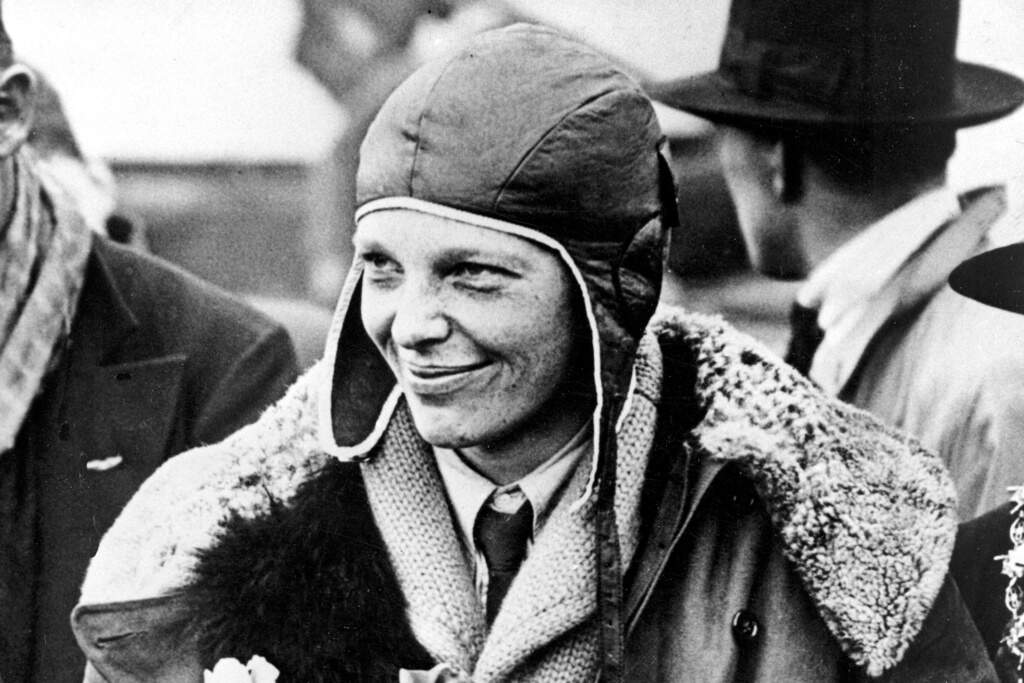
Legendary aviator Amelia Earhart and her plane vanished in 1937. Today, explorers are still venturing into the unknown to solve the mystery of her disappearance.
Guests
Rachel Hartigan, journalist and writer. Former editor at National Geographic. Author of a new book, out March 3, called “Lost: Amelia Earhart's Three Mysterious Deaths and One Extraordinary Life.”
Also Featured
David Jourdan, co-founder and president of Nauticos, a deep ocean exploration company.
The version of our broadcast available at the top of this page and via podcast apps is a condensed version of the full show. You can listen to the full, unedited broadcast here:
Transcript
Part I
MEGHNA CHAKRABARTI: In the early morning of July 2nd, 1937, Amelia Earhart was flying over the Pacific Ocean, near the equator. All around her, nothing but water.
The famous aviator was near the end of her planned flight around the world. Earhart had flown more than 22,000 miles in one month. She had less than 7,000 to go. In the back of her plane, a Lockheed Electra 10-E, sat her navigator Fred Noonan. Earhart and Noonan had taken off from the city of Lae, New Guinea, some 18 hours earlier.
They were heading to their next refueling stop, a tiny island called Howland. And they thought they were almost there. Amelia Earhart radioed the U.S. Coast Guard ship that was supposed to guide her Howland landing, she said, quote:
We must be on you but cannot see you. Gas is running low, been unable to reach you by radio. We are flying at 1,000 feet.
Some 15 minutes later, Earhart radioed the ship again.
We are circling but cannot hear you. Go ahead on 7,500 either now or on the scheduled time on half hour.
And once more. Quote:
We are on the line of position 157-337. We will repeat this message on 6,210 kilocycles. Wait. We are running north and south.
CHAKRABARTI: Then Amelia Earhart disappeared.
NEWS BRIEF: Good afternoon, ladies and gentlemen. My voice is reaching you from Honolulu, Hawaii. We're in the same little room off the main studios of KGMB, from which, almost continuously since Saturday night, we have set out messages of instruction to the Earhart plane.
This search must go forward on the assumption that the plane was able to reach the surface of the water safely or to make an emergency landing upon some small island or reef in the Pacific. We simply cannot allow ourselves to think for one minute that the plane and its two occupants are not safe.
Somewhere every minute is packed with expectancy. Surely the word will come, the word that the whole world is anxious to hear.
CHAKRABARTI: But the word did not come.
NEWS BRIEF: Only a short time ago, Amelia Earhart checked over every detail of her $80,000 flying laboratory in preparation for her round the world flight. This was to have been her greatest achievement, then to a waiting world came news of disaster as the plane failed to reach tiny Howland Island in mid Pacific.
NEWS BRIEF: The Battleship Colorado sent its aircraft out to search several thousand square miles of ocean around Howland Island. Weeks of search activities produce no clues.
CHAKRABARTI: Amelia Earhart, Fred Noonan and their plane have been missing for nearly 90 years. No one has been able to find any definitive evidence of what happened to them, but that has not stopped people from looking. Rachel Hartigan writes about all of this in her new book. It's called Lost: Amelia Earhart's Three Mysterious Deaths and One Extraordinary Life.
She's a journalist and writer, and also a former editor at National Geographic. Rachel, welcome to On Point.
RACHEL HARTIGAN: Thanks for having me.
CHAKRABARTI: Let's continue with a little bit of the play by play that we started the hour with on regarding Earhart's last flight, because you actually begin the book describing what that route was supposed to be and those final radio transmissions.
Tell us more, walk us through that a little bit more.
HARTIGAN: When they took off on July 2nd from Lae, they had already been delayed for a few days because Fred No. And the navigator needed to set his time signals because in order to navigate by the stars, which is what he did, you have to have the exact time.
So I think they were already a little bit frazzled, so to speak, from being towards the end of this round the world flight and having to wait and then having to make the longest flight to the smallest target that they were aiming for in their whole trip around the world. And we really don't know what happened during the flight beyond her radio messages. She was in contact with the radio station at Lae and everything seemed to be going well. She did mention that there was a storm ahead at one point, so she probably had to go up higher. And then the Atca, the Coast Guard ship that was waiting for her at Howland Island heard her pretty well.
Around 2 a.m. in the morning, 2:45 in the morning. They heard some static but they didn't expect to hear anymore. Then they started to hear her more clearly and more clearly yet, and by the time they got to the message that we are circling but cannot hear you, one of the radio men, the message was so loud that one of the radio man ran out on deck. Because he thought that he would be able to see her.
So she was close. But she didn't get there.
CHAKRABARTI: You know what, before we go much further, Rachel, I wonder if you might take a minute with me to just remember what flying was actually like back in1937. Because Claire, our producer and I, we've been talking for several days about how it's actually difficult to remember from our 2026 mindset that flying actually in 1937 was a high-risk endeavor.
The planes were basically metal skins with not even any heat inside of them. And you talked about radio transmissions and having to navigate by the stars. When you think about it, no satellites, no ability to know exactly where you are except for human navigation. Even just or the sun during the daytime. Describe to me like what a feat it was to even fly. She'd already gone, she'd already made history in multiple ways, but just the act of flying any distance in 1937.
HARTIGAN: Yeah. You really have to think that all these, this equipment is new, so she, by 1937, people had been flying for three decades or so, but there wasn't really commercial travel.
In fact, Earhart was involved with luxury airline that failed because two of its planes crashed, killing all on board. You didn't have great navigation. She was supposed to have, she did have a direction finder on her plane, but she had never used one before. So when it didn't work, she didn't pay attention.
And it was a, basically a prototype. It's not like she had a manual where she could flip through and say, A-ha, this is how I use this thing. It was all just very DIY to a certain extent. The industry was building up, but it still wasn't regulated in the same way that flight is now, or even regularized, where you knew what to expect.
Everybody was trying new things, trying new methods, and there was no, Earhart always used the term air minded, and by that she meant that the country was set up for air travel, the world wasn't set up for air travel yet. There wasn't the air traffic control to talk you in.
At one point, early in her career, she was flying over the states and the only way, only navigation she had was a roadmap that she pinned to her shirt, and at some point, it blew away, so she had to follow roads. It was really all ad hoc. So she was even more brave than you'd think.
CHAKRABARTI: I'm so glad you said that because it regrounds us into the risks that aviators, of course, including Amelia Earhart were taking at the time. Just recently I was in Washington where you are at the Air and Space Museum. And I was absolutely captivated by the outfits that they have from those early aviators are in the museum.
They've got Charles Lindbergh and his wife's outfits and I just, I didn't realize until that point that there's no heat inside these airplanes, they're just wearing like layer after layer. And there was another aviator who was a high-altitude flyer and he basically wore.
His face was completely covered and he still got frostbite because it was, the plane was so cold. So I'm just bringing this up. Because again, from our 2026 set of eyes, it's like how could they get lost? But tell me about why they decided to do the refueling at Howland. Because as you write in the book, it is a like a little, just like a tiny little dot in nothing but water.
It seems like an odd place to aim for.
HARTIGAN: There really wasn't anywhere else. She really, if she had decided to have floats on her plane, she could have landed in Guam or any of the places where Pan Am was flying. But she'd had a really bad experience with floats on her first flight across the Atlantic.
They're really hard to take off. They can stick to the water in a way. So she didn't want that and I don't think at that point there was any plane that had the capacity to fly all the way across the Pacific without refueling. She tried, she thought about flying to Tokyo or she and initially her plan was to fly west rather than east.
So she was thinking, I could fly from Hawaii to Tokyo or maybe to the Philippines, but that was just too far and too risky. And the United States had already claimed this little island. There was a bit of jockeying for power in the Pacific between Japan and Britain and the U.S. So the U.S., the island is so small, it's not like you could do that much with it, but there was room to put runways.
So they decided, we can help aviation and help America's sweetheart by building some runways here.
CHAKRABARTI: One more thing about how ad hoc these high-risk efforts were. You write about how on July 1st, right, the day before they did their, they started their Howland leg of this around the world trip.
They basically left a lot of stuff behind. Why? And what did they leave behind and why?
HARTIGAN: They left things like a signal gun. They left a bunch of charts behind. What else did they leave? I think they left an actual gun behind too. But it was all about weight. They had to, this was the heaviest flight that she would be making because they needed so much fuel.
And in fact, when she took off the runway in Lae, ended in kind of a cliff over a bay and the plane, got air right at the end and then dipped down below the cliff and then made a little splash and then went all the way up. But it was just all about you're choosing between how much fuel you have and whether, you know, your favorite elephant bracelet.
Goes with you, which she also left behind, so.
CHAKRABARTI: I did not know until I read your book that her good luck bracelet was an elephant hoof bracelet.
HARTIGAN: Yeah, probably not acceptable these days.
CHAKRABARTI: Definitely a sign of the time.
Part II
CHAKRABARTI: Before we get to the deeper story that you write about in the book about Amelia Earhart's life and then our modern-day absolute fascination, not only with her, but finding what happened to her. Can we just stick with that last day for another minute or two?
HARTIGAN: Sure.
CHAKRABARTI: Because from what I read in your book, people listening for her radio signals near Howland, as you said a little earlier, actually did hear her. Correct me if I'm wrong about that and if I'm not, does that mean that she got close to the island?
What do we know?
HARTIGAN: We think, well people think different things, but it did, based on her radio signals, she did get close to the island. Because they just, they got stronger. And by around the 7:58 a.m. signal when she's saying we are circling but cannot hear you, she's so close that they think they can see her.
The only reason that she might not have seen them was she was lost or there were clouds covering the island. There were clouds off to the northeast, so she may have been among that cloud cover. And also, these islands are really hard to see. A shadow from a cloud looks like an island, so that might have been part of it.
CHAKRABARTI: Oh, interesting. Because as you report, she also said that she was, they were flying at only a thousand feet for a while. Trying to get lower just to see.
HARTIGAN: Yeah. They were looking, but there were some issues where they might not have been where they thought they were.
So I don't know if you want me to get into all the various errors that seem to --
CHAKRABARTI: Oh, yes, I do. (LAUGHS)
HARTIGAN: Okay. One is that the charts that Fred Noonan and her navigator had were wrong. Not through any fault of his own, but just because they hadn't been updated. The last time Howland had been mapped was in the late 19th century.
His charts had Howland almost six miles east of where it actually was. So that's one error. Another error is that there was a stronger headwind than they expected. But not strong enough that they could tell that it was there based on white caps on the waves. And then in terms of communication, that was just a mess. They had set it up through a game of telephone. Earhart is contacting her contact with the Coast Guard and they're contacting one of the ships.
And through all those contacts, they, or this game of telephone, they got confused about time zones. They were on different time zones. And Earhart was on a time zone that was, she used the clock of Greenwich Mean Time, just so that it was easier to tell how long she'd traveled. This ship was on Greenwich Mean Time, 11 and a half, plus 11 and a half hours. So they were a half hour off from what she was. So when they set up a schedule for speaking, they were half an hour off.
So when she wanted to speak, they were, the radio men on the Itasca were speaking, and when she wanted to listen, they were listening for her. So yeah, it's such a simple mistake, but it was a problem.
CHAKRABARTI: We can say that it's a simple mistake, but again, given the complexities of flying there.
HARTIGAN: Exactly. Yeah.
But there were, it seems like there was a domino effect of mistakes that led to the last transmission that they heard from her as you write in the book at 8:44 a.m. and then after that, when she says, we're running both north and south can you explain that a little bit?
HARTIGAN: What she said she was on a line of position, 157-337, and that was just basically a line angling 157 degrees Southeast and 337 degrees Northwest. She didn't say what point the line was going in, because I could be on that line right now here in Washington, D.C. But the assumption is that Noonan had determined that line crossed Howland and that they were going up and down that line to see if they could find Howland.
CHAKRABARTI: Oh, I see. Okay. So for all we know, she may have come close, but we can't be sure. There's a confusion between the strength of a radio signal at some time, but then I guess the men on the Itasca not being able to hear her ship, to hear her plane to take a bearing on where she is. There's just so much going on here.
And now, what, almost 90 years later, we still have people who are obsessed with Amelia Earhart, would you call yourself one of the newly obsessed?
HARTIGAN: No, not in the same way. I'm fascinated by her and I'm fascinated by that time, and I'm fascinated by why people have devoted so much of their time to looking for her.
But I'm not, yeah, I'm not totally obsessed. I have a little bit of distance.
CHAKRABARTI: I suppose there's quite a gap between the people who are truly devoted. Let's put it that way. And others who still maintain parts of their lives. Okay. So let's listen to Earhart herself, because, again, this is something I want to talk to you about, like who she was before she became an aviator, and the fact that also in the '30s. We have the rise of like superstardom via media as well. So here is a clip of Amelia Earhart speaking in 1932, August after she landed at Newark Airport and became the first woman pilot to complete a nonstop transcontinental flight.
And she spoke to reporters afterwards. And this clip is from a PBS documentary.
EARHART: Yesterday I hopped off from Los Angeles about noontime and landed in Newark this morning after a nonstop transcontinental trip.
REPORTER: And what did you carry on the trip?
EARHART: You mean to eat?
REPORTER: Yeah. To eat and drink.
EARHART: I carried some water, of course, because my cockpit is very warm, and I carried a sandwich in case, I didn't eat it though. I carried some hot chocolate and the all reliable tomato juice.
REPORTER: What kind of a sandwich was it?
EARHART: Chicken sandwich. (LAUGHS)
CHAKRABARTI: For everyone who drinks tomato juice on airplanes today, you have something in common with Amelia Earhart. Rachel, tell me a little bit more about who she was before she became one of the world's most famous aviators.
HARTIGAN: You can hear in that clip sort of her educated accent. And she was from a prosperous family in Atchison, Kansas. Her grandparents were prosperous, but her father always struggled. And he was an alcoholic, which led to him losing jobs. He was a lawyer for the railroad companies.
So they moved around a lot, and they were always struggling both with money and with handling him. So that led her to have a foot in both camps that kind of understand instability, but also be able to present herself really well to the public. She learned to fly in 1920 in Los Angeles.
Which was booming in terms of aviation, mostly because of the weather. But it was very expensive to keep flying. So when she moved back east to be with her mother and sister, she sold her plane and she had to give it up and ended up working. And what she eventually thought was her life calling at a settlement house, which is a house that was set up in poorer neighborhoods where middle-class people would live and teach English, coach basketball teams, a community center kind of place.
CHAKRABARTI: How unusual was it at the time for a woman to be a pilot anyway?
HARTIGAN: It was unusual, but it was unusual for lots of people to be pilots. And I think she and the other women who became pilots did have an opportunity in the early days of aviation, because it was new, there weren't really any rules.
So you could, if you can put together a plane or the money to buy a plane, then you could do it. It actually became much harder after World War I. When a lot of men had been trained as pilots because that was the first war where aviation was used.
CHAKRABARTI: Interesting. This is a little bit of a tangent, but she was unconventional, to say the least of a woman, very possessed with knowing what her own desires and goals were.
And there's been a lot of discussion around, or theorizing around her sexuality, right? Because she had this very unconventional marriage, I think when she was in her early thirties with George Putnam. Can you talk about that?
HARTIGAN: Yeah. She'd actually been engaged before to this guy that she loved named Sam Chapman, who was an engineer.
But Sam was fairly traditional and thought he would be the breadwinner, and Amelia would stay home and take care of the kids, and she wanted no part of that. So she kept the engagement going, but eventually after her first flight across the Atlantic, she ended it. And Putnam was the man who made that first flight possible.
He was also married to the Crayola heiress who was a really interesting woman in her own right. But he and Amelia became friendlier and eventually and Putnam's wife was having her own dalliance. So they ended up getting divorced and Amelia and George got closer and closer.
He asked her to marry him several times. She kept saying no, and when she finally said yes and they were going to get married at his mother's house, she wrote him a letter saying that, let's give it a year. We don't really know how this is going to go. We might meet other people. We'll just, let's just give it a year and make sure you let me have my space if I need it, because I need my space.
And he accepted that letter and they were married until she disappeared.
CHAKRABARTI: Wow. Is this a letter in which she wrote that she refused to be bound by a medieval code of faithfulness?
HARTIGAN: Yes. Good line.
CHAKRABARTI: (LAUGHS) And they had separate bank accounts and everything. It suddenly occurs to me that maybe her sexuality is beside the point.
The actual point is that here was a very driven woman who valued her independence above all. So how did that aspect of her personality play into where she decided to try to fly to, how she planned it, who she worked with?
HARTIGAN: I think it boils down to a phrase, a couple of phrases that she would use when she was asked why she was doing something.
She was, somebody asked her why are you making this transcontinental flight? Or Why are you flying from Hawaii to California? She would say, for the fun of it, or because I want to, she never tried to explain herself. She figured that men did what they wanted to do, so she was going to do what she wanted to do.
And it may led to her becoming a role model. It also led her to want to just work with people who would accept that and who respected her. She was a decent mechanic. She wasn't the best pilot in the world, but she was the one who had the, I guess the kids call it riz these days. I'm probably late on that already. But she just had this self-possession that she was going to do what she wanted to do, and that's rare even today.
She just had this self-possession that she was going to do what she wanted to do, and that's rare even today.
CHAKRABARTI: Let's listen to Amelia Earhart once again, herself. You talked about her trans-Atlantic solo flight. That was in 1932. She became the second woman, excuse me, the second person, but the first woman to fly across the Atlantic solo. She left from Newfoundland, Canada and landed in a pasture in Northern Ireland.
That's a story in and of itself, as she explained afterwards in this interview in London.
EARHART: I took off the famous Harbour Grace Runway at dusk. I flew for a couple of hours while sunset lasted, and then two more hours as the moon came up over a bank of clouds. Then I ran into a storm, which was one of the most severe I have ever been in and with difficulty kept my course. I had been troubled with my exhaust manifold, burning through all night. I decided to come down anyway in the best available pasture. I got down without any trouble and taxied to the front door. I was surprised. Farmer, cottage.
CHAKRABARTI: I can just only imagine what the farmer was thinking. Okay, so that was in 1932.
She made history there. Then just a couple of years later, she went across the Pacific. This is from January 1935. It's a universal newsreel clip where Amelia Earhart talks about her trip after she landed in Oakland, California from Hawaii.
[NEWS CAST PLAYS]
Roaring into the Oakland airport she brings to a triumphant finish her 2,400-mile hop from Hawaii. After 18 hours in the air. 10,000 cheer the end of the flight. As the Lady Lindy slides into a perfect landing with two records, the first woman to fly the Pacific, and the first person to fly it solo. How does it feel to fly both oceans, Miss Earhart?
EARHART: It was very interesting to me to fly in southern waters rather than in the north. On the Atlantic flight, I had ice conditions and general storm on this flight really no bad weather at all, except a few little rain squalls.
CHAKRABARTI: You heard the newscaster there, by the way. Call her Lady Lindy, a nickname she had that, of course, referenced Charles Lindbergh. Rachel, do you wanna talk about a little bit more about these two really historic flights?
HARTIGAN: Yeah. Are you talking about the California one?
CHAKRABARTI: Pick whichever one you want.
HARTIGAN: The one across the Atlantic sounds like a nightmare because not only was her exhaust manifold, she could see the welding broke and she could see the flame, but she had fuel dripping on her, and her altimeter broke, so she didn't know how high she was.
So she in a storm, her wings iced up. She went down to take care of it. But she didn't know how far she could go, so that was a nightmare. And then the one from Hawaii to California was interesting. Because that was the first time where the public turned a little bit against her. Because just before she took off, another group had attempted a flight, and they disappeared and there'd been a huge, expensive search for them. And also her flight was funded by what they called sugar men. The people on the island who ran the sugar and were trying to influence a bill that Congress had. So she usually stayed out of all those things.
But this was the first time where it revealed money playing a role in what she was doing.
CHAKRABARTI: Were they hoping that by paying for her flight, it would help them with the bill in Congress?
HARTIGAN: I think they were trying to get good publicity for Hawaii.
Part III
CHAKRABARTI: Let's get to some of the theories of how or why Amelia Earhart disappeared.
And here's one of them.
[CLIP PLAYS]
NAVY ADMIRAL: From Lae, New Guinea, you'll take off on the transpacific part of your flight. Somewhere between New Guinea and the Hawaiian Islands, you'll get yourself in trouble. Your radio distress call, that'll be flashed across every front page in the world. You'll admit that your calculations are off, your gasoline is running low.
Another frantic call for help, and then silence. As far as the world knows, you are lost. There'll be a widespread search for you. That search will include the Japanese mandated islands, and Japan won't dare to interfere because we are looking for you. The world's greatest woman flyer.
CHAKRABARTI: Intriguing. Except that this is fiction.
This is from 1943. It's a movie called Flight for Freedom. So seven years, six years after Earhart actually disappeared, and of course, 1943, putting it in the middle of the Second World War. And in the movie actress Rosalind Russell played Tonie Carter, a female aviator and a U.S. Navy admiral played by Walter Kingsford, asks her to disappear her plane on purpose. So that Americans can spy on islands owned by the Japanese. Interesting. So Rachel, this gets to the she was captured by the Japanese theory. Tell us about that.
HARTIGAN: Yeah, that's a great clip. Yeah, there was a theory that, let me back up a little bit just so people understand the context.
At the time, Japan had control of a good part of Micronesia as part of a League of Nations mandate. It's called the South Seas Mandate, and they didn't let a lot of foreigners in. So other countries were a little suspicious and wanted to know what was going on there. So that was the frame, the context in 1937.
The theory is that she, and there's many permutations of this, she either got lost, she and Noonan got lost and ended up on Saipan, or they were captured by the Japanese and executed or died of dysentery or of their injuries. Or they were indeed spies and were flying over Saipan to see if there was military buildup or flying over another island to see if there was military buildup there, and then on their way to Howland, got lost, crashed, captured by the Japanese.
And there are many other crazier permutations.
CHAKRABARTI: What's interesting to me about this movie is that six years after Earhart disappears, this is clearly Hollywood using that disappearance as basically pro-war propaganda in the film. Politics never really escaped or she never really escaped politics. But there is actually, at least, there was one woman who said that when she was a young girl, she had seen a white female pilot in 1937 on the island of Saipan. So we're going to play a clip here of Josephine Blanco Akiyama. She's the woman who said she saw someone who fit Earhart's description when she was 11.
Now Rachel, as you had said, Saipan it's now part of the Northern Mariana Islands, but again, back then controlled by the Japanese.
So here's Josephine Blanco Akiyama, in a 2017 news report from the Today Show.
AKIYAMA: I don't even know it's a woman, I thought it's a man. Everybody's talking about her, but they're talking in Japanese.
That's why I know that she's a woman. They're talking about a woman flyer.
CHAKRABARTI: So Rachel, beyond this testimony from Josephine Blanco Akiyama, is there anything else to give even a little bit of credence to the, she was captured by the Japanese theory?
HARTIGAN: There's a lot of things that can't really be verified.
There are other people who say that they saw a white woman. There are soldiers who, you know, as the U.S. military was marching east through all the islands and capturing them. Who said they found things like a photo album filled with pictures of Earhart or a suitcase full of women's effects, or the 10-year diary of Amelia Earhart.
And in all these cases, they gave the item to their commanding officer, and it disappeared and has not shown up in archives or anywhere else. So there isn't anything beyond supposition and people's testimony that they saw her, but a lot of the testimony conflicts, so you can't even back one person up with another person.
CHAKRABARTI: Yeah. Unfortunate how that happens, but it does. Okay, so that was theory number one, captured by the Japanese. Theory number two. Let's set that up with listening to Rick Gillespie, the executive director of the International Group for Historic Aircraft Recovery, or that Gillespie and his team have focused their search for Amelia Earhart and her plane around the island of Nikumaroro.
Did I say that right, Rachel?
HARTIGAN: You did.
CHAKRABARTI: I did. Okay, thank goodness. Yes, Nikumaroro. It used to be known as Gardner Island, and so here's Gillespie on CBS News in 2018.
She apparently reached another island, landed safely, called for help for nights. The airplane was lost to the sea by rising tides and surf, and she died as a castaway on Gardner Island.
CHAKRABARTI: So Rachel, you actually went on an expedition to this island.
HARTIGAN: I went on two expeditions to that island. Yes.
CHAKRABARTI: (LAUGHS) Do tell. What was that like?
HARTIGAN: Oh, it was wonderful and also a little bit terrifying, just not because it was a scary place, but because it is so far out in the middle of the ocean, there is nothing around.
So that was a little unsettling. But it's a coral atoll, so it's an island with a lagoon in the middle and then a coral reef around the edge, which makes it hard to land on the island. But the idea is that Earhart and Noonan were flying south, and they saw this reef that looked relatively flat, and it could have been low tide, so it wouldn't have been covered with water.
They landed the plane there and didn't have enough fuel to take off again, or their landing equipment was damaged by the reef and they died there as castaways.
CHAKRABARTI: Did you find any evidence of that on your two expeditions?
HARTIGAN: There isn't, again, there isn't anything that can be directly tied to her.
There have been some items found from the '30s, like a zipper pole and cosmetics, mirror, some glass jars. But the most interesting thing is that the year after Earhart disappeared, the island was colonized by the British and people there found bones, they found 13 bones near what looked like an old campsite.
And they sent them off to Fiji, to the home colonial office to be analyzed and a doctor there, not a forensic expert, but just a regular doctor measured them and the people at TIGHAR found the measurements, but the bones have not been found. And if 13 bones were found on the island, that means there are other bones because we don't just have 13 bones.
So the first expedition I went on brought human remains detection dogs to sniff around a campsite that the TIGHAR folks had found to see if there was any sign of human remains. And the dogs all alerted at this campsite, which means they all sat very solidly and looked at their trainers and said, there's something here.
And what they were sniffing for was VOCs, which are emitted from human body deterioration. So they found something, somebody had died there. But when we started digging, we didn't find anything. And part of the problem is that it's a coral atoll, so the foundation of the island is coral, which looks a lot like bones.
So it was very frustrating.
CHAKRABARTI: Wow. Okay. So the idea that there's this almost like effervescent signature of maybe Amelia Earhart on the island is quite alluring. Okay. So nothing definitive on that island. So here's the third theory that you write about and in order to introduce us to that, we're going to turn to David Jourdan because he has been looking for Amelia Earhart's plane for more than 20 years.
Now, as we said earlier, the plane is a Lockheed Electra 10-E, often referred to as just the Electra. And David Jourdan thinks it's just at the bottom of the ocean around Howland Island.
DAVID JOURDAN: We've so far covered an area about the size of the state of Connecticut at one meter resolution. More than good enough to find the plane and it's not there.
CHAKRABARTI: Jourdan leads a deep ocean exploration company called Nauticos. They've done three search expeditions for Earhart's plane so far. They are planning a fourth and to determine where to look. He says Nauticos has studied Earhart's final radio transmissions.
They tell us a couple of things. They tell us what she was doing, and they tell us how far away she was because of the strength of those signals. In terms of what she was doing, she was rather vague. She said, I'm flying north and south on 157-337, a line of bearing. Ms. Amelia, are you going north or south right now? It makes a difference and so we have to explore both of those assumptions.
CHAKRABARTI: Jourdan says his team has figured out roughly where Earhart was at 8:00 a.m. on the day of her disappearance, though they haven't publicly shared that location.
We asked, trust us, he says that's narrowed their search area, but once they're out in the Pacific, it's a big place, so it's not easy.
JOURDAN: It's 1,600 nautical miles from Honolulu. Takes a week to get there by research vessel. It's 18,000 feet deep in that area. And the ocean, as you may know, is completely opaque to any kind of radio signals, GPS.
And so we're relying entirely on sonar to map the bottom. We can detect something like the Electra. It should really stand out, but it's small, so we have to use a smaller microscope to be able to see it than if we were looking for the Titanic, say.
CHAKRABARTI: In the old days, Jourdan and his team used a big sonar device tethered to their boat with a 13-ton cable.
Now he says they've switched to autonomous underwater vehicles that map the ocean floor and take pictures.
JOURDAN: One of the cool things about these expeditions is we're the first humans to see the sea floor in this area, and as the Caldera and sea mounts appear, it's fascinating to watch them appear on your screens.
The Electra is a particularly hard object. It's made of metal and it has very sharp edges, which tend to reflect the sound very strongly, so it should shine out like a beacon.
CHAKRABARTI: Jourdan says Nauticos is looking to raise between $6 and $10 million for its forthcoming expedition, and hopes to take that trip as early as this year.
JOURDAN: I think if we get out there and search again, we'll find it. If I can't, I won't consider my career a failure, but it would be an awfully nice legacy to have.
CHAKRABARTI: So that's David Jourdan, president of the Ocean Exploration Company at Nauticos. Rachel, I have to say that just by sheer sort of mathematical probability, the idea that Amelia Earhart ran out of fuel and crashed into the vast Pacific Ocean seems to be the most likely.
HARTIGAN: Yeah. There's a lot more water out there than there is places to land.
... People ask me all the time what I think and I just want to stress, I don't know. And nobody knows. But that seems the most likely, that's the simplest explanation. And you have to make the fewest leaps of faith to accept it.
CHAKRABARTI: But it's interesting because even while it might be the simplest, in order to confirm it or find The Electra, David described it's the hardest, right? Because you're searching in 18,000 feet of water. I was like, wow, it's more than three miles of water. And even though he says the Electra should be easy to see with sonar, just the vastness of the area makes it a kind of a daunting task, I think.
HARTIGAN: Yeah. And you can see even with sonar it's not totally clear because there was the company Deep Sea Vision who in 2024 said, oh, it looks like we found the plane. But when they went back there. Then they looked with high res cameras, they saw that the plane was actually a rock formation.
CHAKRABARTI: Oh, wow.
HARTIGAN: So it is tricky.
CHAKRABARTI: Yeah. In the last minute or so that we have Rachel, what do you think it is about Amelia Earhart that makes her just this unending source of fascination and even passion for so many people? What is it about her that you found most enduring. In who she was and why people still care.
HARTIGAN: She seemed so free and modern, she didn't seem restrict. She had more restrictions on her than you and I do now, and she just shrugged them off and she really wanted to bring other women along with her, whether they were going to be pilots or whether they just wanted some other career.
I don't know. She just would seem like such a forward thinking, optimistic kind of person. That I don't know. Again, she had the riz.
CHAKRABARTI: She had the riz, and she was trying something that very few people at that time would even dare to think of. So I think just that courageousness and the mystery of her disappearance, those are the only two ingredients you really need for a mystery that just people stay really interested in.
Do you think you want to try and go on another expedition? Maybe on this one with David Jourdan?
HARTIGAN: Oh, I don't know. It's a long way away, but I love going to the island, but being on ship that long is. But it would be fun to see the plane.
The first draft of this transcript was created by Descript, an AI transcription tool. An On Point producer then thoroughly reviewed, corrected, and reformatted the transcript before publication. The use of this AI tool creates the capacity to provide these transcripts.
This program aired on February 27, 2026.