Support WBUR
Why regime change in Iran isn't so simple
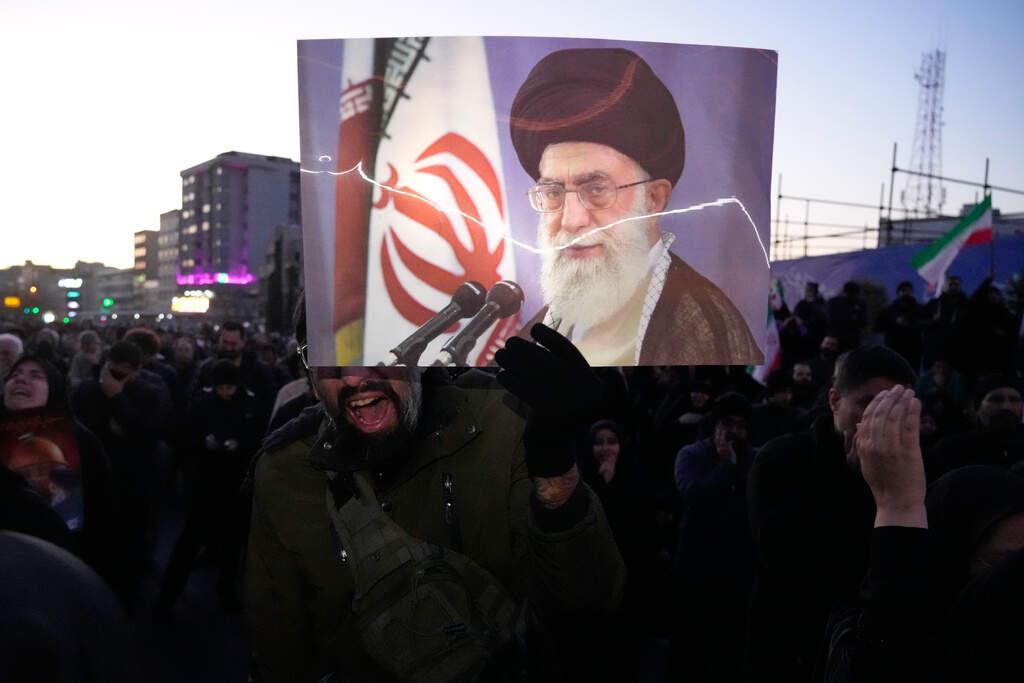
U.S. and Israeli strikes killed Iran’s Supreme Leader along with other top Iranian security officials. But Iran experts say that the Islamic Republic will not fall so quickly. What to know about the deep-rooted infrastructure of the Iranian regime.
Guests
Kian Tajbakhsh, professor of International Relations at New York University. He’s also a Columbia University fellow at the Committee on Global Thought.
Fatemeh Jamalpour, Iranian journalist in exile. She was banned from working in Iran by the Ministry of Intelligence. She’s also the co-author of the book, “For The Sun After Long Nights,” which she wrote with fellow journalist Nilo Tabrizy.
The version of our broadcast available at the top of this page and via podcast apps is a condensed version of the full show. You can listen to the full, unedited broadcast here:
Transcript
Part I
MEGHNA CHAKRABARTI: In early February, the U.S. and Iran were talking. February 6th in Oman, Geneva on the 17th and again in Geneva on the 26th.
DONALD TRUMP: And we thought we had a deal, but then they backed out and they came back and we thought we had a deal and they backed out. I said, you can't deal with these people, you gotta do it the right way.
Trump says Iran backed out. But on Friday, February 27th, Oman's Foreign Minister Badr bin Hamad Al Busaidi made a rare appearance on U.S. media. He was a key third party mediator in the talks. He appeared on CBS with Margaret Brennan imploring President Trump for patience.
AL BUSAIDI: Really, I can see that a peace deal is within our reach.
BRENNAN: A peace deal?
AL BUSAIDI: Yes, is within our reach if we just allow the diplomacy, the space it needs to get there.
CHAKRABARTI: Trump ignored Al Busaidi. The next day, the U.S. and Israel began bombing Iran in the subsequent week. The president has offered many different timelines and many different goals for starting the war with Iran.
TRUMP: First, we're destroying Iran's missile capabilities, and that happening on an hourly basis and their capacity to produce brand new ones and pretty good ones, they make. Second, we're annihilating their Navy. We've knocked out already 10 ships. They're at the bottom of the sea. Third, we're ensuring that the world's number one sponsor of terror can never obtain a nuclear weapon. Never going to have a nuclear weapon. I said that from the beginning. They're never going to have a nuclear weapon. They were on the road to getting one through a deal that was signed foolishly by our country. And finally, we are ensuring that the Iranian regime cannot continue to arm, fund and direct terrorist armies outside of their borders.
CHAKRABARTI: And though the president won the 2016 election promising he would never start another foreign war and railing against the folly of attempted regime change by the administrations of George W. Bush and Barack Obama. Trump too seems to have succumbed to the same belief. That regime change delivered via the might of the U.S. military can be swift and clean, and with the cooperation of the peoples of the targeted nation.
TRUMP: Finally, to the great proud people of Iran.
I say tonight that the hour of your freedom is at hand. Stay sheltered. Don't leave your home. It's very dangerous outside. Bombs will be dropping everywhere. When we are finished, take over your government. It will be yours to take. This will be probably your only chance for generations. For many years, you have asked for America's help, but you never got it.
No president was willing to do what I am willing to do tonight. Now you have a president who is giving you what you want. So let's see how you respond. America is backing you with overwhelming strength and devastating force. Now is the time to seize control of your destiny and to unleash the prosperous and glorious future that is close within your reach.
This is the moment for action. Do not let it pass.
CHAKRABARTI: It was a sentiment echoed enthusiastically by Israeli Prime Minister Benjamin Netanyahu.
NETANYAHU: Now, of course, it's up to the people of Iran in the final count to change the government, but we are creating, America and Israel together are creating the conditions for them to do.
CHAKRABARTI: The U.S. and Israeli attacks did kill Iran's supreme leader, Ayatollah Ali Khamenei. And many Iranians took to the streets in celebration, but can an almost 50-year-old regime that is built for resilience, one that is deeply rooted and made up of a complex, layered leadership apparatus, can it really fall so easily?
Let's go back to Trump in 2016.
TRUMP: Our current strategy of nation building and regime change is a proven absolute failure.
CHAKRABARTI: Now Iran is not Iraq. The differences are vast. So today we want to take a look in detail at exactly how deep the political infrastructure of the Islamic Republic of Iran goes into the lives of the Iranian people and how that reality might dictate what happens next.
Regardless of what President Trump or Prime Minister Netanyahu wish for.
Now joining me is Kian Tajbakhsh. He's a professor of international relations at New York University. He's also a Columbia University fellow at the Committee on Global Thought. He represented the Open Society Foundations in Iran in the 2000s, launching initiatives to bolster democracy, women's rights, and the role of NGOs in various Iranian sectors.
Those efforts led to his arrest during Iran's Green Movement protests in 2009. He spent about a year and a half in Tehran's Evin Prison, including almost eight months in solitary confinement, followed by years of house arrest. He was released in 2016 as part of that U.S.-Iran nuclear deal. Professor Tajbakhsh, welcome to On Point.
KIAN TAJBAKHSH: Thank you for having me, Meghna.
CHAKRABARTI: I wonder if you can start with your own story, because I think the outline that I just gave to people is an example of how the structure of the Islamic Republic really courses into the lives of Iranians. Can you tell me what you think it is or how the apparatus operated that led to your arrest in 2009?
TAJBAKHSH: Sure. Let me start by responding to your first part of your question, which was my experience and how that informs the way I analyze the situation currently. So I was born in Iran. I did my studies in the UK, and I emigrated to the United States in 1984.
And I never was able to go back to Iran for 20 years, but I did so in the late 1990s when there was an opening of a potential for a democratic opening, a more liberal government under the then reform movement led by President Khatami. I then ended up leaving academia in the United States and living in Iran.
And as you mentioned, I continued my work in democracy promotion and working for human rights in working for a range of organizations, including the Open of society, institute in bolstering up civil society, women's groups, human rights groups, other kinds of independent NGOs that would push for greater civil society in Iran.
In terms of what kept me there was that I also realized that Iran was embarking on probably the most substantive and expansive reconstruction of their state system in 1999. And that was the creation of a elected local councils in over a thousand cities and over 30,000 villages.
And I thought, wow, this is like a very important initiative of the reform movement. It's gonna create the institutions for people to participate more in their everyday life. How to run their towns, their villages, and in their cities. And it would create a space, a kind of free space in the local areas that would allow opposition, or let's say alternative voices to be able to run, have a voice in governance against the central authorities in Tehran.
This came to naught by the end of, by 2009. As you mentioned, I was arrested in the Green Movement protest of 2009. And that was a time when the whole reform movement was crushed. And although --
CHAKRABARTI: Can, may I just interrupt right there because these are like very important inflection points that I don't want us to not give enough attention to.
So the reform movement was crushed and this was what, after a decade? It sounds, if you're describing what was at first seemed to be quite a development of the civic and political infrastructure. Was the regime working on crushing the reform movement from the start, or did something change that led to the sort of this swift action against reform?
TAJBAKHSH: Yeah, that's a really good question. Think about it this way. In 1979, the revolution happened. A year later, the Iran-Iraq war started, and that went on for a decade. In 1988, two important things happened. Inflection points, as you say. One was the end of the Iran-Iraq war, and so the country could begin breathing and starting reconstruction.
The other important inflection point was the death of Ayatollah Khomeini, right? The charismatic leader. And what that did is that it created a space in which a lot of people, including intellectuals, even including some of the original revolutionaries, had begun to rethink how to reintegrate Iran into the international arena.
How to soften the totalitarian and Islamist rule, and that's how it flowered in the 1990s and its political expression was the election of Mohammad Khatami, I should say, in the five years before that, the intellectual fervor within Iran, I can safely say, and scholars have said this, it was probably the widest and deepest reform, rethinking of how to connect Islam and Islamic rule with human rights and democracy.
So yes, there was a flowering. Within a couple of years though, the regime decided that this was going too far and they began the backlash. And the backlash began in around 2000 when Ayatollah, who was just assassinated, made an important speech around 2000, 2001, in which he said, I can see these Western ideas.
And also, Western people. And he was looking at me, I guess, people like me and saying, they're coming here and they're going to contaminate our pure Islamic ideology and our regime and we're going to push back. They pushed back. And the some of your listeners may remember Mahmoud Ahmadinejad.
Who was the Holocaust denying president, who was also, by the way, assassinated a week ago. When he came into power in 2004, that marked essentially the backlash of the regime. They pushed the reform politicians to the side. They were slowly marginalized. Many were imprisoned; many were killed.
Many left the country and were exiled. And by 2009, that whole reform movement came to a head when millions of people, including me, were in the streets, clamoring for greater political accountability. But the regime decided that was it, and it was crushed.
And I was one of them that was put in prison.
Part II
CHAKRABARTI: The background that you just gave us was very important because to me it shows that the repressive Iranian regime of the Islamic state of the Islamic Republic does what many repressive regimes do. There are periods of time in history where they allow for some reform when there's a sense that there's a massive amount of discontent amongst people, but then when the reform reaches a certain line, the regime snaps back almost immediately.
So when that snapping back happened to you and you were arrested and thrown into Evin Prison. Can you tell us what that reveals to us about how deep the sort of fingers of the Republic's apparatus go into the lives of Iranian people? How were you tracked down? When were you arrested?
How did that happen?
TAJBAKHSH: Meghna, that's a long story. And I'm happy to talk about it, but I'm happy to talk about it. Okay. Let's start with this. First of all. It is a security state, it's a police state. The IRGC, the Islamic Revolutionary Guard Corps and the Ministry of Intelligence are the backbone of this regime.
Scholars have compared the IRGC to, and I know it sounds maybe an exaggeration, but they compare them to the Gestapo and the SS under the Nazi regime and the KGB under the Soviet regime. In other words, it is the military muscle arm of a totalitarian regime. So they have, their goal is total penetration and total control. As far as I was concerned, people were surprised at the time that I, you know, the way I was going about doing this and the history is yet to be fully told, and I hope to do it in a memoir soon.
But it turned out that when I started working for George Soros's organization. I was actually introduced to the former foreign minister Javad Zarif in New York where we went and we had meetings in which the discussions were that there could be some cross. There's a joint project between Western NGOs and universities and some universities and NGOs inside Iran.
When I told people that I was having this discussion, they were astonished. But they did say that's an expression of this kind of space that had opened up between that the reform movement had opened up. And it was a risk. But we took the chance. Now I'm just saying this is because obviously when I was in the office of essentially the second most important person in the Iranian government, essentially the American, the Iranian ambassador to the U.S., all our conversations were being recorded and surveyed by the intelligence services.
So when I got to Iran, they knew what I was doing. They were just curious about how far we were going and what the reform elements within the regime were up to. And so the way they work, and this is how I've discovered, is that they will start surveillance. They will begin following you, they will begin questioning people you work with.
And as it gets to a sort of critical point, then they decide that the security of Iran is being too threatened and then they crack down. And it began one day when I came back from a trip to home, and I noticed that my computer, that I went into my office at home, my computer was open.
It was in the middle of the room. The back was open; the cable was out. It was a very clear sign. We're here, we're looking at you. And I think the signal was, go away. Leave. Before we do something to you, I went to a friend of mine and I said, this has happened.
He said, look, something bad is going to happen. You either escape right away. But the point was that I had gone to Iran. I had settled there. I had married my wife. We were about to have a child. And I had moved to Iran to settle, and I didn't move fast enough, let's put it that way.
And I was arrested and I'm happy to talk about what I saw when I was in prison up close and personal with senior members of the IRGC.
CHAKRABARTI: Oh, this is too tempting. Why don't you go ahead and do that? Because I can't say no to that. And with the request that also when you do write this all out in a memoir, please do come back.
So we can spend much more time on this very important story. But give us a little bit of what you saw with the, again, you were in the same room, you were being imprisoned by the IRGC. What did you see?
TAJBAKHSH: First of all. I'll make a couple of points that I think it would be important for listeners to understand the current context. And when we talk about the regime in Iran, what it exactly it is we're referring to.
First of all, before I was arrested, I had a conversation as a result of these meetings that I had, and these more or less official permissions to continue these projects, which in the end turned out to be maybe kind of ways to get me trapped. But I spoke with a deputy foreign minister, a very senior member in the foreign ministry, who was semi sympathetic to these projects.
But he said to me, you are an Iranian American. You have to understand something very clearly. He said, in this building, and what he meant by that is the entire foreign ministry, the government of Iran, which represents the regime of Iran, we believe we are at war with the United States. He said it's a cold war, but it's a war.
Nonetheless, he was warning me. He was warning me that I represented as an Iranian American working for American organizations. And they knew, obviously, that I was having meetings in the State Departments and even in the White House. Not, I wasn't a very senior person, but as part of a delegation, I had been involved in coordinating some of our activities with the administration in the 2000s, that was the Bush administration.
They essentially were warning me that we see you as an enemy. So that was a big warning shot. And in a sense, took the risk because the reformists that were working with me and that were inviting me, were saying, Iran is undergoing a struggle for its soul, the soul of the revolution.
We are pulling this way. They're pulling that way. That turned out to be an analytical mistake on my part, to believe them, by the way, because it wasn't a tug of war for the soul of the regime. We were actually undertaking what was essentially an assault on a very established, consolidated, authoritarian Islamist regime.
In other words, it wasn't as if that everything was in play and that it could have gone this way, it could have gone that way. That's what I believed in a bit of my naivete, but it wasn't the case. Yeah, so in other words, I was viewed as a direct, sharp point of the arrow of the enemy, which by the way, at the time.
And so I'll tell you the second point, which was really important, is that the IRGC officer, a guard officer who was my liaison, and he was the one that I saw all the time. So I was taken to Evin Prison, I was taken into the high security wing of the IRGC. I had been arrested once in 2007, and I was held in the wing of the Ministry of Intelligence.
The Intelligence Ministry, and in 2009. And just the listeners may be wondering, in 2007 when I was arrested, I was held for four months in solitary confinement. When I came out, I scrambled to leave the country with my baby daughter and my wife. But it took time for us to get our act together, find a job in the States, and we were about to leave the country when the Green Movement hit in the summer of 2009. And I became exhibit number A in the first mass trial that was held on public television in Iran. I should say, they didn't warn my wife. She had actually turned on the TV and there it was.
I was being accused by the state prosecutor and by the IRGC of treason against Iran, and they called for capital punishment. And my wife, at the time, said she almost fainted. So in other words what they told me, what that IRGC officer told me was we are ready to fight.
We are itching for a fight. Because I told him, in a moment where I took a little bit of a risk, because you don't want to be, you don't want to have levity with your IRGC interrogator in the middle of the night. But occasionally I got tired and I would say, I talk with him.
I said, you are picking a fight with a big dog, the U.S. And they said, We don't care. And he did something very strange, which I always remember in my mind's eye. He like shook his shoulders, he like shuttered his body. And he said, we are itching for that fight. Now what does that tell me?
He was, this is the IRGC officer that I could see all of his senior bosses, I never saw, I was blindfolded. They stood behind me, warned me never to turn around, but he's the one I saw. Now, what does that tell me? That tells me that low level, middle level IRGC officers are deeply pious, deeply committed, even fanatical.
And once he looked me in the eye, Meghna, and he said, Dr. Tajbakhsh, very polite in Iranian culture. He said, Dr. Tajbakhsh, I'm very polite to you and we have a civil kind of connection. And he was polite, he said, but, and he looked me straight in the eye, and he said, but don't ever make a mistake.
I will do anything for this regime. And what he meant is, I will kill and I will kill you too, if necessary. And just another point about understanding this regime, once I asked him, are you a officer of the Ministry of Intelligence or the IRGC. All these things that in the West we try to parse, right, Meghna.
We try to understand. And he told me something which was very telling, and I think is deeply valuable to know. He said, he smiled. He said it doesn't make any difference. We're all the same.
CHAKRABARTI: I was wondering about that. That's right. Okay. So I want to just tell all listeners right now that this is one of the most sort of delicious dilemmas that a host of a live program has. Because quite frankly, part of me really wants to just keep getting these like very kind of just revealing details from you about what happened to you personally. But the other part of me also wants to connect this to the bigger picture. So if I sort of land in an awkward in-between area that satisfies nobody, forgive me in advance.
No problem. You'll have to invite me back for --
CHAKRABARTI: Multiple times it sounds. But just let me bring in another voice here. Because this is the perfect moment.
I'd like to bring Fatemeh Jamalpour back into the conversation. She is an Iranian journalist in exile. She's been banned from Iran by the Ministry of Intelligence. We had her on the show not that long ago for her wonderful book For the Sun After Long Nights. She coauthored that book. Fatemeh, welcome back to On Point.
FATEMEH JAMALPOUR: Hi, Meghna. Thank you for having me.
CHAKRABARTI: Okay, so your experience in Iran, obviously has a lot of overlap with what Kian was talking about. You'd been arrested for your journalism multiple times, and now you can't even go back to the country. Obviously not now after the beginning of the bombing, but prior to that.
What I'd love to hear from you is all of these things that Kian was describing to us, that the IRGC has total penetration and total control within vast amounts of the Iranian people's daily lives. And also, how he said that even, at the low-level officer, at the level of on the ground officers, there's this unshakeable piety of belief in the regime and that there really isn't a practical difference between different parts of the regime. Okay. This is all important background for the question that I wanted to ask you, Fatemeh, which is I'm hearing a lot of people in the West, the president of the United States, obviously the Prime Minister of Israel, even some more hawkish analysts from the U.S., for example.
Here's Neil Ferguson. I'm quoting him. He says: The goal is to decapitate the Islamic Republic's political structure and leave the Iranians to take their freedom. Is it that simple, Fatemeh?
JAMALPOUR: No, seriously. No, not at all. So during, just one month ago, during the January protest, IRGC and Security forces killed more than 30,000 protestors in two days.
And we know that by bombing them, they cannot unarm 1 million IRGC armed forces. So what I'm hearing from Iranian inside Iran, they are afraid, they're scared that what happened after bombing and if the U.S. and Israel going to leave them with this armed, angry forces it would be the worst nightmare.
And when they said yes, it's now only chance of Iranian people and their destiny in their hand. How? These people are civilian, unarmed civilian, and they try hard. We have many protests. As Kian mentioned in 2009, in 2017, in 2018, in 2019, in Women, Life, Freedom in 2022 and recent, and just the state killed more people and more people.
Like in 2009, it was 100. In 2019, it reached out to 1,500. And the point that I want to bring is that they never put the human right execution, all of this issue on the negotiation table, right? They only talk about the nuclear power and energy and ballistic missile with the Islamic Republic, and it just led the regime to kill more and more civilian. And now the situation is just, people are scared. People are scared that they will left them after bombing the IRGC and the new Supreme leader.
CHAKRABARTI: You said there were one, there are 1 million IRGC armed forces in Iran.
JAMALPOUR: Yes.
CHAKRABARTI: So one out of every nine Iranians.
Oh sorry. One out of every 90 Iranians, sorry, 90. I can do math, trust me, but one out of every 90, that's a huge percent. That's a huge number.
JAMALPOUR: Yeah. That's a huge number. And they don't have any mercy. They killed many kills and teenage and young people last month and they, yeah, they don't care.
They just kill and they want to just this regime survive.
Part III
CHAKRABARTI: Fatemeh, you wanted to make another point about the current fear that the Iranian people are experiencing.
JAMALPOUR: Yeah, sure. Like in the last day, we see the footage of Tehran.
When people just cheering for supreme leader, the IRGC shoot out the window. And it's a new level of brutality and it's happening there. So my people are being killing by the IRGC state and they are under bombing. And the situation I want to highlight is that they don't have internet.
Iranian regime shut down the internet. Iranian people are now totally defenseless. They don't have anything, they don't have any shelter, and even whenever the Israel army send alarm about like this neighbor who should be evacuated, people wouldn't hear that because they don't have internet.
Iranian regime shut down the internet. Iranian people are now totally defenseless.
Fatemeh Jamalpour
To realize that the neighborhood going to be bombed. Yeah. And that's so unfortunate because since 2009, the U.S. and international community were talking about providing internet for Iranian people and they never take any action. I think more than bomb, my people need internet these days.
CHAKRABARTI: Yes. The power of information, to keep themselves alive. I really hear you Fatemeh. Okay, so Kian, let me turn back to you. From what both of you are saying, I'm reading again, this is just voices that are in the public, in the United States, political pundits, analysts, et cetera, and there's a lot of talk, about just decapitation and then allowing the Iranian people to take the next steps.
But it sounds to me like the death of Khomeini, the death of all the other senior leaders in the bombings over the past week. It doesn't make actually a functional difference in terms of how the regime operates, that it can almost go on autopilot for some time. Is that an overstatement Kian?
TAJBAKHSH: It's not an overstatement. It's not an overstatement. It is part of my, part of my research and I spent 20 years, I published a book a few years ago, which recorded and analyzed 20 years in detail of the institutional reform that I mentioned earlier. I tracked what I called the rise and fall of the attempt to create local democracy in Iran.
And what I did, what I argued was that in 1999 that new set of institutions that were supposed to be a new vessel to be filled with the content of democratic participation by people throughout thousands of villages and towns and cities across the country.
They did come into existence, but what happened is that over time, those institutions were co-opted and then weaponized by the regime to be an instrument of control of the people on the ground. So instead of a local council or elected council, or mayors being a voice from the grassroots, speaking up to the central power, very much like we think about in the United States, rather than that, which was the goal of the reform movement, and it was the goal of many secular people who worked with the reform movement, over time, they were weaponized, co-opted.
And used as an instrument of authoritarian rule rather than becoming an instrument of democratic opening. So what that showed me was the astonishing ability of this Islamist totalitarian model to engage in what I often recognize as what I use, a term, institutional saturation. Once I went this is the same when you look at Hezbollah in Lebanon.
Once I went for a study trip. I went for a conference to Beirut and there one of our colleagues had been studying the Hezbollah neighborhood and how they engaged in community planning, how they organized their neighborhoods in the Hezbollah controlled region.
And it was amazing, actually, that we actually, when we went into the Hezbollah like community center in the south of Beirut, the entire office was designed exactly like a government office inside Iran. There were pictures of the Iran Supreme leader and other clerics. Not the president, not the reform president.
And it was just an extension of Iran, and it was the way in which Hezbollah in Lebanon has, controls all these institutions, of welfare, of local administration, of charities, of traditional NGOs and so on and so forth. They're very good at that everywhere. And they did that in Iran. So to speak to your point, yes, the regime is deeply entrenched. Could I just say one point just to for listeners, maybe just to get a better sense of what when they hear Iranian society ... what they should be thinking about. Okay. Just to make it as simple as possible. Iran is a huge country, 92, 93 million population.
To understand it, let's just in an easy way, let's just separate the population into three groups. The core ideological base of the regime. I would estimate that around 10% or 15% of the population, maximum 20% of the population, that's one fifth of the population, 30% of the population, like many other places in the world, are people who just want to make ends meet.
They are apolitical. They don't vote, they don't follow news, they just want to be safe and have livelihoods. So they don't, they're like apolitical. That leaves about 50% of the population that wants some kind of change in this regime. So what we're talking about is, as you mentioned about the numbers before that Fatemeh was speaking, about you have essentially 10 million people holding 80 million people hostage.
That's what the Iranian situation is. Those 10, it's like someone who goes into a bank, right? They have a gun, they're committed, and they can hold 10 people hostage. One person with a gun can hold 10 people hostage. And so that is the situation essentially in Iran. Those people who are the people who want a different life, they want a different government.
You have essentially 10 million people holding 80 million people hostage. That's what the Iranian situation is.
Kian Tajbakhsh
They have no guns. They have no organization. They have no newspapers. They have no access to broadcast. They have no ability to assemble or have political parties. They are totally immobilized and atomized, and as Fatemeh mentioned, they will be brutalized. They will be shot and killed. So we do have this situation of a bad balance of power between those who want to maintain this regime and who have ideology and guns.
And on the other side you have people who don't have guns and don't have this Islamist ideology.
CHAKRABARTI: Okay. So Fatemeh, let me ask you. Over the almost 50 years of the current regime. As we've been talking, there have been multiple times where a critical mass of Iranian people have tried to make change through the work that Kian had been doing, for example, through just popular mass protest, et cetera.
It hasn't worked. Does that mean that there needs to be something more, some more like external from Iran intervention in order to truly make, like to completely end the regime of the Islamic Republic, or can it be done from within Iran?
JAMALPOUR: So that's a really good question.
During all these years, the regime tried to just weaken the civic society, like what they did with Kian. ... And many activists, many political activists and those who can make the future of Iran.
Unfortunately, in all of these last years, the international community and the U.S. did nothing to connect with civic society in Iran, inside Iran, and to empower them, all because of regime restriction and having the other priority. So despite all of this, I want to mention another thing.
So the differences between Iran and Afghanistan is that the majority of Iranian society are not practical Muslim anymore. The society moved towards secularism.
And is the optimistic things, we see during the funeral of all of these killed protestors. The family didn't let any Islamic customs to hold no parade, no shouting Allahu Akbar. They dance. And dance is for forbidden in Islam, all of these things shows that the society moving towards secularism and these people demanding a Democrat against this secular government and regime.
I hope, I seriously hope that the U.S. and the Israel having planned to help civic society and people within, inside Iran after bombing the regime, otherwise it wouldn't happen. The regime change wouldn't happen with people with empty hat.
CHAKRABARTI: Okay. This is so important. Kian.
TAJBAKHSH: Can I go.
CHAKRABARTI: Please go ahead.
TAJBAKHSH: Can I make a comment on that? I have a slightly more let's say hardnosed analysis shaped by my perspective as someone who was, spent many years in prison. And so Fatemeh mentions that they hope the U.S. helps civic society. We tried that. We tried that and it ended up most of the people in prison, crushed.
And I think that if someone was to ask me to give me your answer. Is it only external force can possibly dislodge this regime? I am currently forced to the conclusion that yes.
CHAKRABARTI: Are you saying boots on the ground?
TAJBAKHSH: I'm not saying boots on the ground. In fact, I think that, I think and we haven't had a conversation today yet about the wisdom or the coherence of the Trump administration's strategy, but I tend to see it actually as much more coherent than many other people I speak to. That is to say President Trump has learned the lessons of Iraq, that we cannot change. We cannot enter into nation building, but what we can do is change regime behavior.
I'm not even sure that the Trump administration really is interested in regime change in the sense of changing the personnel. I don't think they care. If they're looking for a Delcy Rodríguez, that would be fine with them. As long as whoever is in power in Iran compromises or capitulates on the three demands that the Trump administration has made. And that is enrichment, missiles and proxies, they don't care who's in charge. And of course, someone in Iran might say, okay, I'm going to become a leader and I will do what do what the Americans want.
CHAKRABARTI: But let me just step in here because you said something interesting that learning the lesson. And we've only got a few minutes left, so forgive me.
But learning the lesson that maybe regime change, not a good idea, but changing regime behavior. Now call me, now I'm gonna be the skeptical one and say from everything that you and Fatemeh have described, changing regime behavior seems to be not impossible for as long as the belief in what the regime stands for still runs so deeply in all of the Iranian people who are part of this giant political and civic apparatus.
TAJBAKHSH: Correct. But the issue is that you may not be able to change a fanatic mindset, but you can disarm him. So that's the point, so the U.S. feels its national interest and its partner's interest in the region from Israel to the Arab countries are threatened by these three military capabilities and threats of Iran.
That's all the U.S. is really interested in, is defanging the ability for them to get a nuclear weapon, to cap and limit their ballistic missiles so they don't attack, like they're doing. And to stop creating mayhem in the region. Otherwise, if you want to keep a fanatic in Tehran, as far as the Americans are concerned, they say, I'm sorry, we can't put boots on the ground.
We can't change the way Iran is governed inside. And they'll just have to try to do things like help with Starlink. Because something otherwise. That's all it seems that is reasonable to be done with the lessons of Iraq and Afghanistan.
CHAKRABARTI: None of this seems to make a positive difference in the lives of the Iranian people.
The U.S. may walk away with what it wanted, and it could have received, could have gotten through negotiation, I have to say. But that's for another conversation.
TAJBAKHSH: I don't think that was, I don't think that was possible.
CHAKRABARTI: Okay. We can I actually would love to have you back to have that conversation. But even if it got those three things now, for example, what ... we've been focusing on for this hour is. The lie, what's happening within Iran. It doesn't sound like it would change the repressiveness of the regime in Iran.
TAJBAKHSH: It might. It might, you have a repressive apparatus if they're killed, if all their bases are shot, if their Navy is, what happens is that they will be weakened, they won't be eliminated.
The besiege will be there. The arms will be there, but they will be weakened. And what you quoted before, what President Trump said, seems to me to be an understandable and reasonable position. That is to say, look, we're going to pave the way for you. We're doing what you want to do, which is shoot at these people, we're going to destroy them.
That's the best we can do. And we're going to really pummel them. And we're going to pummel not just the nuclear sites, we're going to pummel all the besiege sites, the IRGC sites, their bases, their bicycles, their batons, all the stuff that they use. And we are going to just try to weaken them as much as we can.
That's all the U.S. can do.
CHAKRABARTI: I wanna give Fatemeh, you get the last word today. Unfortunately, we only have about 40 seconds. What do you want to happen have happened next?
Not only me, I think 80 million of Iranian people once regime change, I think the next few weeks will be so critical.
I really hope they have a plan to help Iranian prepared to pass this ... regime, because otherwise it would be nightmare, as I said.
The first draft of this transcript was created by Descript, an AI transcription tool. An On Point producer then thoroughly reviewed, corrected, and reformatted the transcript before publication. The use of this AI tool creates the capacity to provide these transcripts.
This program aired on March 4, 2026.