Support WBUR
Why 'KPop Demon Hunters' is everywhere
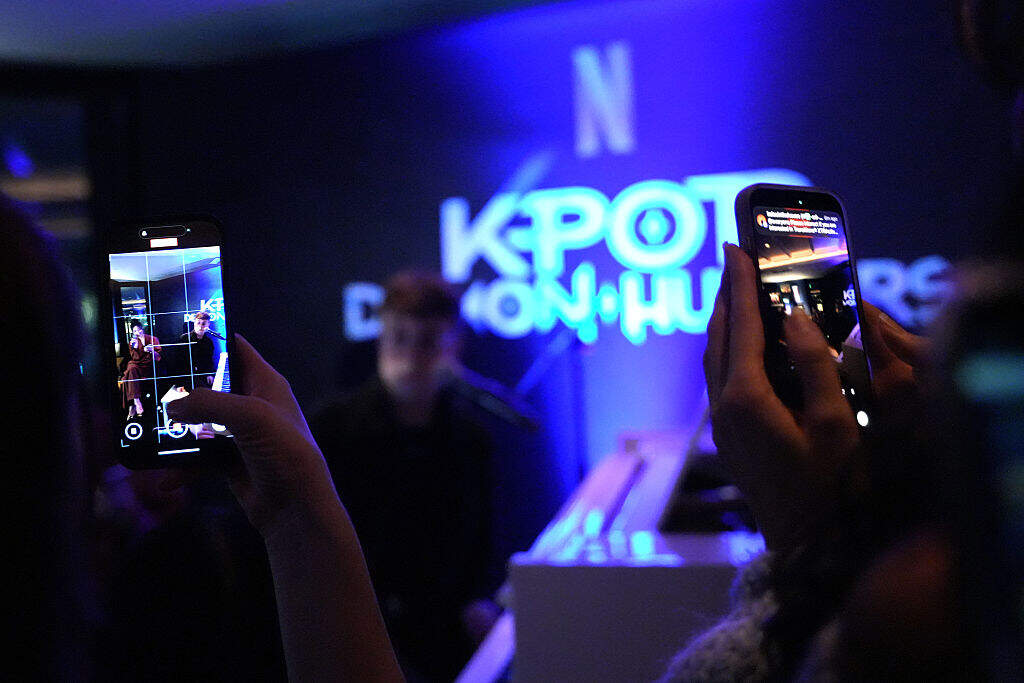
'KPop Demon Hunters' is one of the biggest movies on Netflix. It’s also an Oscar nominee that’s spawned chart-topping singles. How K-pop and K-culture became an irresistible global phenomenon.
Guests
Kevin Power, associate professor of English at Trinity College Dublin. His essay “Promo Time” was published in The New York Review of Books in February.
Donna Lee Kwon, professor of ethnomusicology at the University of Kentucky. Author of "Music in Korea: Experiencing Music, Expressing Culture."
Also Featured
Ray Seol, associate professor in the Professional Music Department at Berklee College of Music.
The version of our broadcast available at the top of this page and via podcast apps is a condensed version of the full show. You can listen to the full, unedited broadcast here:
Transcript
Part I
MEGHNA CHAKRABARTI: We're about to play a song from last year. But you know it, okay. Or if you don't know it, I guarantee that either your kids, your nieces, your nephews, your kids' friends, one of your neighbors, maybe even your own friends, someone in your life knows this song.
('GOLDEN' FROM 'KPOP DEMON HUNTERS' PLAYS)
CHAKRABARTI: Okay, we've got heads nodding to the beat in the control room. You are probably singing this out loud, belting it out at home right now. I resisted the urge to do that here in front of this microphone because my kids would disown me if I did. But that song is most definitely Golden, the hit single from the movie, KPop Demon Hunters.
Now this movie is a worldwide phenom, but it took creator Maggie Kang seven years to get the project off the ground.
MAGGIE KANG: For years, I waited for a project like this to come along that I could contribute to, but it never came. And so by the time I felt like I had developed my skills enough, my writing skills, my comedy skills, my storyboarding skills, my filmmaking skills and I was, I felt confident to step into the directing role.
I thought I guess nobody has done this yet. Maybe I have to take it on myself to make something for our culture.
CHAKRABARTI: Culture being Korean culture, which itself has become a massive global influence. Kang's, co-director, Chris Appelhans says K-culture pulled him in during the COVID-19 pandemic because he and Maggie would watch virtual performances from K-pop superstars, BTS.
CHRIS APPELHANS: The world was pretty, in a pretty dark place, and BTS were doing these like virtual concerts, and you could see like the sense of connection and hope and humanity that was stirring up with everybody stuck in their living rooms. And it felt okay then the idea that music can be a force that fights against the darker feelings in the world. It can bring us together. It's real. It's a true thing.
CHAKRABARTI: Little did they know that when 'KPop Demon Hunters' came out, it would become the juggernaut that it is today, the movie is the single most streamed film on Netflix. The song that we heard at the top Golden, topped the Billboard Hot 100 List for eight weeks.
It won a Grammy for Best Song Written for Visual Media, and it's up for an Oscar for Best Original Song as well. And if you have any doubt about this movie's staying power, just listen to these fans at a live theatrical, sing-along event.
(CLIP PLAYS)
CHAKRABARTI: 'KPop Demon Hunters' isn't just an expression of Korean culture. It's also the perfect crystallization of the overall export power of Korean culture and how the country has so skillfully blended art and commerce for mass global appeal. Now as an example of just how far Korean culture reaches, let's turn to Kevin Power. He joins us from Dublin in Ireland. He's an author, critic, and professor at Trinity College and last month he published an article titled Promo Time in the New York Review of Books, which talks about 'KPop Demon Hunters.' Kevin Power, welcome to On Point.
KEVIN POWER: Hi Meghna. Thank you so much for having me.
So you're an associate professor of English at the much heralded and an ancient bastion of high education called Trinity College. Did you ever think you'd be writing about 'KPop Demon Hunters'?
POWER: No, I didn't. Trinity seems to occupy the same space in the popular imagination as Hogwarts for some reason.
I'm not entirely sure why that is. And it is in some ways quite like Hogwarts, but that's probably a story for another day. Yeah. How did I end up writing about 'KPop Demon Hunters'? Especially because I am very far from an expert on K-pop or Korean culture or anything of that kind. And yet I have found myself becoming a kind of world authority on 'KPop Demon Hunters.' Because I have a 7-year-old daughter and therefore I have seen 'KPop Demon Hunters' more times, almost certainly than any other movie in my life.
And I was complaining about this to my, jokingly complaining about this to my editor at the New York Review of Books, who also, Jana Prikryl, who also has a small child and is familiar with the kind of fevered quality, the obsessive quality that with which kids attach themselves to artworks.
And so she said, would you write about this for us? And the first thing I thought was, I can't write about this. I don't know anything about it. All I know about it is the movie itself inside out. But I'd started thinking about it and I thought, yeah, okay, I can write about this. Because certain things had struck me about the film that seemed worth saying and that I hadn't seen said anywhere else, even though there's been such a vast amount of writing and commentary on this film.
CHAKRABARTI: Okay. I just want to say that I was looking yesterday at your CV [LAUGHS] and I'm not laughing at your CV, it's actually quite impressive, it's very impressive. Expert on 20th, 21st Century American literature and film, contemporary Irish literature. I just love the juxtaposition of that area of expertise against the fact that your 7-year-old has pulled you into the joyful maelstrom that is K-pop and K-culture. Can you first tell me, before we get into your deeper analysis here, tell me a little bit about your 7-year-old and your child's sort of relationship with this movie. What does this movie, how does it transform your child?
POWER: Aside from the amount of time she spends going around the house singing the songs from 'KPop Demon Hunters,' which are, which have become my favorite songs, of course, I can't even remember the existence of any other songs because these are the songs that I hear the most often. But she's, the music is a huge part of it.
And the songs, they're great songs. They are. There's no two ways about it. But what happened initially was that I got in trouble a little bit because she was nagging me to watch 'KPop Demon Hunters,' because some of her friends had seen it and they had become obsessed with it and she hadn't.
And I said, Oh, what's the harm? I put it on one morning. And then I watched it out of the corner of my eye, and I thought, Oh, there's sort of stuff in here that maybe, she was six at the time. I think she had just turned seven. She was quite young. And I thought, Oh, maybe there's elements here that she should probably be a bit older before she encounters.
But in the end, we were defeated by the juggernaut that is 'KPop Demon Hunters.' And we all became fans of 'KPop Demon Hunters.' We all go around singing the songs. And so to the extent that, as a piece of entertainment that sweeps people up, and sweeps, I guess, kids, but especially young girls up into its world, it has a lot to be said for it.
It's empowering in a kind of old school feminist way. Here are, it is a movie that is about, that centers three young women. That doesn't, it doesn't sexualize them, in fact goes out of its way not to portray them in any kind of sexualized way.
And that is good. What we were mostly troubled with was the violence, myself and my wife. But again, it's heavily stylized and often actually quite beautiful if you look at it from a slightly more adult or distanced point of view. But yeah, the idea that Rumi is a kind of a figure worthy of emulation by small girls.
Yeah, I think there's a lot to be said for that. A lot to be said in the movie's favor.
CHAKRABARTI: Okay. So then, we are going to bring on another guest in a few minutes to give us a really knowledgeable insider's look in terms of how the movie very intentionally reflects aspects of Korean culture.
So I'll hold on that for a moment. But you bring up another interesting issue, Kevin. And one is that the movie has something, maybe it's ineffable, I don't know. But something that becomes this much of a global phenomenon, it cannot be exclusively marketing. I don't think it can because something can be marketed to the ends of the earth, but if it's bad, people won't take it up.
I still hold on to that belief. But on the other hand, what you write about is how this is the distillation of what you call a closed loop, right? Between art and commerce. So tell me about this closed loop.
POWER: Yeah, the market rewards not so much talent as timing, I think is probably true in almost all cases.
Although I do, I agree with you. I think if something is bad then it won't, generally speaking, reach this level of kind of phenomenal success. So the degree of quality has to be there. But yeah, what struck me, once I started to think about the film rather than just passively and endlessly absorbing it in the background of my life, I started to notice that it was strangely, the story of the film is also the story in a way of the making and reception of the film. It is a film about the creation and maintenance and reception of a global phenomenon. That's what Huntrix, the band in the movie is, they're Taylor Swift scale superstars with hordes of fans globally.
The kind of global reach of their fame is sort of implied in the movie is set very much in South Korea, but the fact that they spend the whole movie engaged in essentially kind of promotion of their brand. I thought, this is very interesting. This is a movie that in some ways expresses its own making and the set of anxieties around the making of a movie like this.
And its release into the marketplace as it's currently constituted and its possible fates in that marketplace. It's a movie that's, at every moment, deeply anxious about what the fans will think. And that's both true of the girls in Huntrix and their management. And the kind of the commercial enterprise that's propping them up.
And it's obviously true of the makers of the movie as well. I'm sure that they experienced a great deal of anxiety and acted on that anxiety to engineer a film that would be acceptable in the contemporary marketplace.
Part II
CHAKRABARTI; I'd like to bring Donna Lee Kwon into the conversation now.
She's a professor of ethnomusicology at the University of Kentucky, an author of Music in Korea: Experiencing Music, Expressing Culture. And she's with us from Lexington, Kentucky. Professor Kwon, welcome to On Point.
DONNA LEE KWON: Hi, Meghna. Thank you so much for having me.
CHAKRABARTI: Okay, so I want to spend quite a bit of time talking about the plot of 'KPop Demon Hunters' and the actual cultural references in the movie.
The broadest description of the plot I can give is that there is a world-renowned K-pop girl band, and they secretly protect the world from demons using music and dance. So right there, just even in that description, what aspect of whether it's Korean tradition, Korean spirituality or culture, do we see even just in the one-line descriptor of this movie?
KWON: Actually, from the very beginning there's a montage where they talk about the power of voices. And right after that you see the lineage of Huntrix before in earlier iterations. And the first one actually are three women dressed in Korean traditional costume. And most people believe that they're representing Korean mudang or shamans.
And within Korean shamanism there is a tradition of rituals, songs that are meant to block bad spirits, demons, et cetera. ... Yeah, there is definitely traditional basis for that. Although this idea of Gwi-Ma, the character Gwi-Ma is not really a traditional like God or that kind of thing, although the name itself is drawing from Korean traditional words. Gwi means ghost.
CHAKRABARTI: Oh, okay. Interesting. Now there, the main battle in the movie is between Rumi, Mira and Zoey and the Saja boys who are demons in disguise.
The name there is significant.
KWON: Yes, definitely.
CHAKRABARTI: Tell me, go ahead and tell me more. Yeah.
KWON: Yeah, so yeah, in terms of the demons. So yeah, in Korean Buddhism, Korean shamanism, there is like this hierarchy of demons and demon figures, and you might see the manifestation of these, like in statues and things like this. And yeah, it definitely exists in Korean culture. It's not quite the same Satan, God, sort of duality that you might see in Christianity and Western culture. But yeah, it is something that does stem from Korean culture.
CHAKRABARTI: Okay. We don't want it to be the same, right?
The fact is that it emerges from Korean culture and I thought. And forgive me if I'm wrong, but that the name the Saja Boys also, was that drawing specifically from Korean culture?
KWON: No, not really. Saja, I think it can mean a couple different things, but it also means lion.
CHAKRABARTI: Okay, good. I just, I didn't want to read where we shouldn't. Okay. So tell me as a whole though, what a lot of people are saying is that this movie is, I don't know if it's the best representation or maybe a very powerful representation of aspects of Korean culture that maintain their Koreanness while also being very accessible to a worldwide audience.
What do you think about that?
KWON: Yeah, I was really delighted by the way they brought in aspects of Korean culture. I think just little things like the woman on the mountain who is like selling bracelets that are using like a weaving style that's a Korean weaving style. And then of course the characters, my favorite are the characters of the tiger and the magpie. Those definitely stem from Korean mythology. There's a lot of stories about tigers in Korea and magpies of course, too. And there's a whole tradition of art. But the way that they're depicted where the tiger is a little bit, not the smartest tiger in the world.
So that I think was just so fun. And it's not something that's really expected or cliche, like they really must have done their research to find some really interesting things to include.
CHAKRABARTI: Okay. So what do you think then, and Professor Power, I'm going to bring you back in here. But Professor Kwon, what do you think then of this idea that Kevin Power puts forth in his New York Review of Books essay, saying that really what 'KPop Demon Hunters' has done is shown how South Korea has become exquisite in its ability to create a perceived sort of closed loop between the culture and entertainment that it exports around the world, and the fans that enjoy that culture and entertainment.
KWON: I totally agree that K-pop includes, fandom is a very important part of K-pop and there's a lot of energy that is put into that relationship and the relationship between the fan and the idol. So certainly, I completely agree with that. And actually, I will say that I did survey my students earlier this semester. Because I'm teaching a K-pop class and I asked them what do they like the most about this movie?
And they were like, actually, we like the way the fans are depicted because they have such a huge role in the film. So even though they are maybe not so individualized, they're this big mass of fans, they still have a pretty large presence in the movie. I totally agree with that.
In terms of it being a closed loop, I don't know if I would agree with that. I do think that in reality there's a lot, it's much more messy. It's a lot more complicated. A lot of people do choose to exit the fandom for various reasons. There's a lot of back and forth. So sometimes if things, the companies do things that the fans do not like, like not protecting the idols, or if the idols themselves do things that the fans don't like, like date, or things of that nature, then fans do often either protest, there's like this tradition of protest trucks that they will put in front of the companies and so a lot of different things happen.
Sometimes they protest and it's successful and the companies will actually change their behavior.
CHAKRABARTI: Fans are fickle. That's not news, right? In the music industry. But Professor Power, here's what you write. Here's what you write in the New York Review. You write that this movie makes visible a general truth.
Mass entertainment products now seek to create the illusion of an unmediated connection between fans and idols, a frictionless vision of the perfected market.
And you go on to say:
It's a dream of a perfect neoliberal order.
Explain.
POWER: Yeah. It's very fascinating to hear Donna talk about the ways in which this is consciously managed by K-pop, by the K-pop industry in Korea.
That's not something I know a huge amount about. I automatically read 'KPop Demon Hunters' and forgive me, as an American movie in a sense. While obviously it draws quite richly on Korean visual culture and traditions and mythology. It seemed to me much more immediately a product built in and for the kind of the neoliberal, the global neoliberal marketplace.
And that it was familiarly structured according to superhero movie lines. And that in its kind of heart, it was a movie that sort of used some of the cultural trappings as almost as a kind of USP, rather than being distinctively Korean in ways that other kind of recent kind of breakthrough Korean movies like Parasite, say, have felt much more Korean to me, which is whatever my view is worth coming from Ireland.
But yeah, to talk about this idea that the movie creates the illusion or tells us that what we are often now given is the illusion of an unmediated relationship between fans and idols. I think this is something we must live with in the age of the internet. Is the internet has both kind of given people the idea for this and then facilitated it so you can create the illusion via social media of an unmediated relationship with your idol, or if you are an idol with your fans. Of course, it's not unmediated, it's intensely mediated in various ways.
But one of the things that struck me about 'KPop Demon Hunters' was the way in which it literally keeps putting the girls of Huntrix in contact with their fans, and that there is a kind of responsibility, the movie is built on their responsibility to their fans. But also, the movie wants you to forget about the fact that is a commercial relationship.
They're doing this for money. They live in a very nice penthouse.
CHAKRABARTI: Professor Power. I gotta just jump in here. I actually really appreciate your analysis. I really do, because we should be thinking critically of anything that sweeps across planet Earth in the way that 'KPop Demon Hunters' has, but also, I'm like, it's a movie.
Are we overthinking this? Why would an animated film want to like remind 7-year-old girls that there's a giant corporation and in the case of K-culture, and its export from Korea, like also a government that's really working hard to spread this soft power of Korea around the world.
That's a buzz kill. Like we don't, we shouldn't expect that in a film.
POWER: But the job of the critic is to be the buzz kill. Is that not what we're for?
CHAKRABARTI: Fair point. That's probably the perfect response to my question.
But Professor Kwon, I do want to say something in response to what Professor Power just said. I think Maggie Kang herself, the creator of this film is an embodiment of the moment that that Korean culture is in now. She is Korean, she is also Canadian. She is an artist, a writer, director, an animator, and has worked for DreamWorks for quite some time. So obviously, a Korean woman, but who's well steeped in the business and marketing demands of creating a big budget animated film.
So the fact that it occurred, it struck Kevin as a product tinge with Americanness doesn't surprise me whatsoever, but what I want.
KWON: Yeah. I would agree with that.
CHAKRABARTI: Yeah. Go ahead.
KWON: Oh, yeah, I would agree with that as well. I think it is not a fully a Korean production at all.
And I was just saying that it was drawing, you asked me what Korean elements were there, so I tried to respond to that. But I do agree that it is a very American production, even though so many of the creators behind the scenes were either Korean, Canadian, Korean American. So I think there is a connection there.
CHAKRABARTI: Yeah. And I actually, I don't think it has to be one or the other, right? For cultural soft power to work, the whole point of it is to make cultural traditions or cultural norms in the exporting country palatable and even popular to people everywhere else in the world.
And in this sense, I would say Korea is following the playbook created by the United States in terms of how we export and have, so for generations, American cultural power through things like movies, but Professor Kwon, let me ask you, I do want to spend a few minutes talking about how this actually happens in Korea and can we focus on just K-pop for a moment? Because it has been long supported by the Korean government.
KWON: I wouldn't say that actually.
CHAKRABARTI: Oh, okay. Tell me more.
KWON: Yeah, yeah, I think that's a little bit of a misconception. I'm not going to say that it's not true, but I would say in the '90s and earlier the Ministry of Culture and the Korean government, they were actually more concerned with a preserving traditional Korean culture through what's called the Intangible Cultural Asset System.
And they were supporting a lot of Korean traditional musicians and folk crafters and people like that quite a bit. And they still do, but in the 2000s we do see a shift. And there was the creation of the Korea Creative Content Agency that did work to promote entertainment industries, film, drama, television and K-pop. And so the Ministry of Culture has supported, I think, like in the allocated 500 million with the aim to build a 10 billion cultural industry, export industry by 2019. So they have supported it, but I wouldn't say that they've done it all along.
And yeah.
CHAKRABARTI: Okay. So they haven't done it all along, but it does seem as if in recent years, or even the past many years, it's been quite well supported by the Korean government. I was just looking at a something from this past summer that President Lee Jae Myung said that that they want to make South Korea, quote, a big five soft power and want to export some 50 trillion Won or $36 billion worth of soft power culture by 2030.
And then said: But we can't just leave it up to individual companies. Actually, said this on a talk show with Maggie Kang. And also, President Lee added: The government will play a role in laying a strong foundation and it starts now.
I'm only bringing this up, I'm not saying it's wrong.
Again, I keep looking to the United States. It's like we created this playbook. I'm just saying that it's worth understanding that this is a project of South Korea as a nation.
KWON: Yeah, I agree. I think it also changes with the presidents who are in power. So I think Lee Jae Myung, now that he has transitioned into, I think he's very much embracing popular culture.
Whereas the previous president, some presidents tend to be a little bit more wary, I think, so I think we're seeing a bit of a shift there from the previous administration to the current one.
CHAKRABARTI: So Kevin Power, let me turn back to you. How does this question of a government wanting to develop its cultural soft power, how do you see that playing into the 'KPop Demon Hunters' analysis that you had? Buzz killy as it may be.
POWER: Yeah, no, you're making me feel bad about ruin --
CHAKRABARTI: I'm just having some fun. Look, the recent shows that we have done have not been fun, so I'm just trying to find the joy in life again, but continue.
POWER: Okay, let's try and find some joy. Yeah, as I think you're absolutely right to say that it, this is something I don't know a great deal about and it's fascinating to learn about it, but I think you're absolutely right to say that this is following the kind of post-war American playbook.
This is something that's, I don't know if people who live in the United States are as fully aware of it as people who live in English speaking countries who receive American culture. But it is, American soft power is one of the most visible presences in all of our lives.
And I think it's only an enrichment to have a Korean inflection to that or to have a rival kind of soft power culture out there. I think that's only an enrichment. My daughter, for instance, now wants to go to Korea. And this is fantastic, so we're going to have to try and make that happen.
But it's at the same time, American soft power has always had, let's call it an ulterior motive or a series of ulterior motives, a series of changing ulterior motives. And it's always best to be slightly cautious when governments start to get involved in that wonderful word, intangible, cultural product because maybe it's an old-fashioned liberal view, but the autonomy of the creative artist, I think it should be very, it should be respected and defended from government, too much government intervention.
Part III
CHAKRABARTI: I was really fascinated by not just the music, right, of K-pop or the culture that's represented in 'KPop Demon Hunters,' but again, this deeper story of how the phenom now, the years long phenom of Korean culture and Korean popular music has spread around the world.
For that we turned to Ray Seol. He's an associate professor in the professional music department at Berklee College of Music, and there he teaches an experiential learning class called K-Pop and Beyond: The Rise of a Global Sensation. And in the class, Professor Seol has his students replicate the music making model of the K-pop system.
RAY SEOL: Creating an idol group is like really daunting and holistic process. It involves research, like reference research, concept development, narrative building, a casting, training, production. All of that even include the fan marketing too.
CHAKRABARTI: Like actual K-pop producers, Seol's students have to look at the history of the medium.
They have to survey the field and think of a new musical product. And once the students have perfected a concept, they go through a final round of decision making.
SEOL: At the end of the course students act as a fictional K-pop label and they pitch their ideas to the class, and everyone votes to choose the most compelling project.
Fortunately, in 2024, we selected one of those projects and developed it further as an extracurricular activity, and those two groups are Exchange. And B-girls.
CHAKRABARTI: Now, students who are in the initial group called Exchange, they've graduated, but B-girls the second group are still around.
SEOL: The idea was trying to create a very cute, the girl group that is very typical and traditional way, but there sounds very modern because they're trying to actually create something that Gen Z can actually react to.
CHAKRABARTI: Like any other group going through K-pop training, they still get together to rehearse, singing and dancing. And the B-girls record music. Recently, three members of the group, Hyeri Han, Bernie Wu, Sofia Pargas put out a song called "Love me like I do." And in doing so, they tried to hit that split between fans of traditional K-pop girl groups and a broader audience.
SEOL: The concept from the writers, songwriters, they actually trying to create very light touch, dance oriented, soft pop track with English lyrics so that the global audience can actually hear, and they create a choreography too, so it's all original from them. Those storylines, really pure, innocent, the girl is in love, and that was the concept and it came up pretty nice.
CHAKRABARTI: Okay, so we're going to let you decide what you think of the song because B-girls were kind enough to share "Love me like I do" with us and here it is.
('LOVE ME LIKE I DO' PLAYS)
Credits:
B-Girls - Kitties
"Love me like I do"Artist:
Hyeri Han
Bernie Wu
Sofia PargasWriting & Arrangement:
Hyeri Han - Composer • Lyricist
Peter Chen - Composer LyricistProduction & Engineering:
Peter Chen - Producer
Jennifer Wang - Recording Engineer
CHAKRABARTI: So that's Love me like I do by B-Girls. It's a K-pop group developed as an extension of a class called K-Pop and Beyond: The Rise of a Global Sensation. It's taught by Ray Seol, associate professor in the professional music department at Berkelee College of Music. Donna Lee Kwon, what do you think?
KWON: Yeah, that was so amazing.
I really am excited that there is a program like that and that somebody's teaching students to do this type of work, so that's great.
CHAKRABARTI: So the fact that they can create a program, look I share Professor Power's ultimate like foundational cynicism about music as a business, that it's always been a product and there have always been sort of music making factories.
The hit factories of the United States are well known and well documented, so that's not unusual in and of itself. But do you think that there's something different in terms of how a K-pop band is created now that separates it from past sort of music making factories in other countries?
KWON: That's a good question.
Yeah, Korea, they didn't just make the system out of scratch. So they were influenced by J-Pop and Japanese idol pop as well as Motown and systems in the U.S. I would just say that I think K-pop just increased the intensity of it. And the skill level is very high.
So if like you compare it to the Japanese Idol pop system, oftentimes with the Japanese idols, they're seen more as like the girl next door. They start off at a slightly more approachable level I guess. And then they're expected, you grow with them as they improve. Whereas in K-pop, like when you debut, you have to be like a very high level. And so I think the skill level, the choreography, the synchronization, all of these things I think are just at a, I don't know, I don't want to say higher standard, but they're at a certain standard that is very high.
I think that's one of the big differences. The hours that they put in are insane. The expectations, I've heard stories when people are in a schedule where they're debuting a song or something like that. They literally get no sleep because they have to get to the show, like, at 3 a.m., 4 a.m. and then they're rehearsing the night before all the way till 12 a.m., 2 a.m., you know, that kind of thing. So it's very intense.
CHAKRABARTI: Yeah. It, it is because, and I think that's one of the reasons why when the bands are debuted, many of them just leap to the top of the charts quite quickly.
But Kevin Power here, look, I've laid the groundwork to welcome back in your cynicism. No. because on this point I share it. This is not like to throw shade on K-pop as a music phenomenon, but I think it's, once again, to remind us that your core thesis from your article is in fact true that really successful cultural corporatism.
What it does is that it in the minds of fans, it erases the fact or completely eliminates the fact that what we're having here is fundamentally, it's a fandom transaction, but it's also a business transaction, professor.
POWER: Yeah. Well put, I wish I thought of putting it that way myself when I wrote the article.
What I'm hearing there, that was all fascinating, but what I'm hearing on one level is the total triumph of the market. Where any sort of an older liberal or romantic idea about creativity or spontaneity or authenticity, these things, they don't even kind of register anymore.
I'm the kind of Gen X sort of kid in some ways --
CHAKRABARTI: (LAUGHS) That explains so much.
POWER: Right?
KWON: I am too.
CHAKRABARTI: So am I.
POWER: Good. Good. Solidarity. So what strikes me is that the idea that we had in the '90s that there was such a thing as selling out, that if these corporate suits came along and monetized your art that this was a kind of disaster.
That this was a kind of fatal threat to your authenticity and that the most noble thing to do was to do what Kurt Cobain did. And that was viewed itself as a sort of act of ultimate authenticity. Now, I'm not saying we should go that far. Far from it.
But it strikes me as amazing that there's been a complete dethroning of the idea that selling out, it can even be something you should worry about. You are sold out before you start and you begin, you enter into this culture defined by, entirely by the hustle.
Where you're literally sacrificing your health and your time, in order to achieve a kind of specific kind of commercial, corporate, commercial success. So that's a heavy dose of cynicism for me. But there you go.
CHAKRABARTI: I would say that maybe what we're having, what we're seeing now is a return to the fundamentals of popular music, right? Because I keep thinking, yes. Of our generation and maybe even the one before, there was this sense of you don't sell out to the man. But the truth is, in the United States, especially in the '50s and '60s, there were literally hit factories that you'd have in New York City, you'd have buildings of people sitting down writing pop music, and then people, producers looking for the singer that could make it into a hit. And that's literally what's happening here in Korea. They're just doing it in a 21st century context and doing it exquisitely. So it's like returning to fundamentals almost.
KWON: I feel like it's always been a bit of an illusion, even in our generation of the '90s. Because bands like they were assigned by major labels. And the companies have been involved, maybe not quite to the extent, but just this idea that there's this authenticity with creativity coming from the individual artist. I feel like we're still hanging onto that idea in the West, I think, but I think it's been long gone for a while. I think the industry's often, we talk about these industry plants and things like that and people being surprised about it, but I think it's been, it's always been there.
CHAKRABARTI: I agree. So whose fans are actually diluted?
Is it the K-Pop fans? I don't think so, because they actually know that this is where the music comes from. Or is it us, me, Professor Power, who were like, yeah, don't sell yourself out to the man. But Professor Kwon, let me ask you actually one thing which I would love to hear from you is, how is this music, I'm just thinking about the title of your book, Experiencing Music and Expressing Culture, or the subtitle, how is it received in Korea?
KWON: Oh. Yeah, Korea is a diverse country. And there are people who really don't like K-pop. It's actually aging populations. So there are older genres now that are in some ways more popular ... older ballads and things like that. So if you look at like the top 10 charts in Korea, they're very different from what is popular in terms of K-pop globally.
And we're seeing like a split, a bifurcation of like domestic K-pop versus what is more global facing K-pop, which is really interesting. But yeah, there are a lot of people who actually look down on K-pop fans, right? Like you would be almost ashamed to admit that you are a K-pop fan for in some circles.
And it's almost seen as there's a lot of derogatory terms for K-pop fans and things like that. So it's actually not as huge of a component of the music listening audience in Korea, as you would think.
You would think, like people go to Korea thinking, oh, everybody listens to K-pop, but that's actually not true.
CHAKRABARTI: Interesting and heartening as well. But I understand that, and please do correct me if I'm wrong, but that K-pop in some way also featured in political upheavals that South Korea has seen not that long ago. Is that right?
KWON: Yeah, actually that's like the one positive I did want to mention from all of this.
Because all this, the K-pop industry things like shake out in very unexpected ways sometimes, especially during these political upheavals. So one big component of the recent protest against former president Yoon Suk Yeol, that a lot of young women came out to protest. And this is like during the winter of 2024.
It was super freezing and people were out like all night long protesting during the intense periods of it. And they, a lot of women brought their light sticks, their K-pop fan light sticks, and because they just have this great visual impact. And they were listening to the various artists who were performing or they're chanting and things like that, participating in these mass rallies.
And yeah, it was a huge phenomenon and there were a lot of like chants. They were adapted to K-pop songs. Aespa's "Whiplash," I think was my favorite one.
CHAKRABARTI: Professor Power, I'm turning back to you. Because consider me humbled. I'm thinking about your line in the New York Review where you say the movie 'KPop Demon Hunters' features no state actors, no cops, no government officials.
But here, Professor Kwon is telling us, in fact the music did help inspire or motivate people demonstrating against the corruption in their own government in Korea. That's fantastic.
POWER: That is absolutely fantastic. And I had not known that, this is absolutely wonderful to hear.
Yeah. Yeah. The thing about 'KPop Demon Hunters,' that certainly, yeah. The kind of, the neoliberal dream is to get rid of state actors, or at least to pretend that they're not there. Or to denigrate them or defund them as much as possible in favor of a kind of perfectly, regulated, self-regulating market system.
And in a weird way, the movie is a parable of that, it's never, it simply doesn't come up that they might go to the state authorities for help or that the state authorities might have something to say about the mass hypnosis event or the attacks by demons or the crashing of a train or all of this kind of stuff that's going on.
CHAKRABARTI: Because they have no faith in those state actors, and I wouldn't believe them.
POWER: They have no faith. There you go. There you go. So, yeah it always, it does strike me as untrue, as fundamentally an untrue picture of the world. And that's why I think it does give you almost neoliberalism's fantasy story of itself.
CHAKRABARTI: And then of course, again, I think that's not unexpected, given that what underlies all of this, and not just in terms of the celebration of parts of Korean cultures, people want to make money, but Professor Kwon. I want to give you the last word here. How would you, what do you think about the truth that Korean culture of all kinds, not just K-pop or K-movies, there's K-drama, K-beauty, Korean food. It is so pervasive and actually widespread and influential around the world right now. That's quite something.
KWON: Yeah, it is really surprising. It's sometimes I wonder whether, because my Netflix queue is like pretty much all taken over by mostly Korean content now, but sometimes I wonder is this what other people are seeing or is this just customized to me?
But yeah, it is fairly astounding and surreal to be witnessing this moment and seeing so much content out there and K-beauty. Yeah, it is inescapable.
The first draft of this transcript was created by Descript, an AI transcription tool. An On Point producer then thoroughly reviewed, corrected, and reformatted the transcript before publication. The use of this AI tool creates the capacity to provide these transcripts.
This program aired on March 6, 2026.