Support WBUR
Iran's new leader: 'His father on steroids'
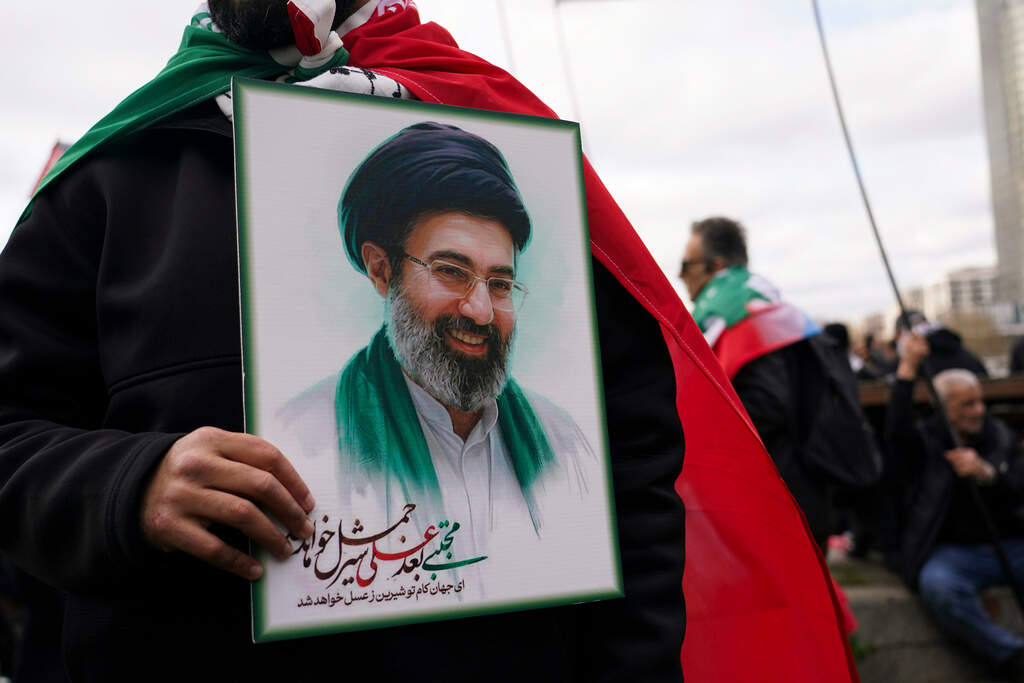
Iran’s new supreme leader Mojtaba Khamenei took control after his father's assassination. What we know about the elusive new leader and his vision for Iran.
Guests
Kasra Aarabi, director of the Islamic Revolutionary Guard Corps (IRGC) research at the United Against Nuclear Iran – a nonprofit non-partisan policy organization. Co-author of the report "United Against Nuclear Iran (Report): Unmasking the Bayt: Inside the Supreme Leader’s Office, the Hidden Nerve Center of the Islamic Republic."
The version of our broadcast available at the top of this page and via podcast apps is a condensed version of the full show. You can listen to the full, unedited broadcast here:
Transcript
Part I
MEGHNA CHAKRABARTI: On March 3rd, just days after Iran's Ayatollah Ali Khamenei was killed by U.S.-Israeli airstrikes, the Islamic Republic met to pick Iran's next supreme leader. Now under Iran's constitution, the Assembly of Experts, an 88-member body of senior clerics, is charged with appointing the Supreme leader. This would be only the third time it has done so since 1979.
After several secret meetings and deliberations, on March 8th, shortly before midnight, the assembly of experts announced that the previous Supreme leader's 59-year-old son, Mojtaba Khamenei, would take over. He received 59 of the 88 votes securing the necessary two-thirds majority.
Although Khamenei's father had ruled Iran for 37 years, Mojtaba, the son has never held public office in the country. In fact, he's rarely made any public appearances or speeches. So who is Mojtaba Khamenei? How does he think? And what does that tell us about what kind of supreme leader he will be in Iran?
Joining me today is Kasra Aarabi. He's the director of the Islamic Revolutionary Guard Corps Research Group at the at United Against Nuclear Iran. That's a non-profit, non-partisan policy organization, and he specializes in research on the Iranian military security affairs and Shia extremism. He has followed Mojtaba Khamenei for many years and he joins us from London.
Kasra Aarabi, welcome to On Point.
KASRA AARABI: Thank you very much.
CHAKRABARTI: So I'd actually like to start at the beginning of what, you know, of the Islamic Republic of Iran, 1979. Mojtaba Khamenei would've been, what, around 12 years old at the time. How do you think the fact of the Iranian Revolution and growing up at that time has impacted the man he became?
AARABI: Sure. So Mojtaba, during those primitive years of the Islamic Republic, the Islamic Revolution would've been surrounded by his father, Ali Khamenei, the late Supreme Leader who was eliminated on March 1st. And Ali Khamenei, his father's fellow, colleagues. Now, to put this into context, Ali Khamenei was a militant cleric.
He was a militant. He always held a gun, even when he was Supreme Leader, he was always firmly holding his rifle. This is an individual who played a leading role in commanding and controlling the IRGC. That's the Islamic Revolutionary Guard, that's the regimes ideological armed force, a prescribed terrorist organization in many countries in the West, including the United States.
Ali Khamenei was very close to Ayatollah Khomeini, the founder of the Islamic Republic and the Islamic Revolution. So Mojtaba's view from a very early age would've been shaped by an ideology that can only be described as violent, Islamist and extremist, and anti-Semitic to its core. His father also became chairman of the Defense Council during the Iran-Iraq war, particularly, he was given rule, an authority over the Ramazan headquarters. The Ramazan headquarters became the nucleus to recruit and radicalize foreign nationals, deploy them into militias and send them abroad to export the Islamic revolutions. So the Ramazan headquarters effectively founded Hezbollah. His father was personally selected by Khomeini.
To be Khomeini's personal representative to Hezbollah. So I'm trying to give a picture here of a young boy, turning on teenager, surrounded by conflict, surrounded by an ideology that is violent, Islamist extremist, that welcomes death, martyrdom, or the concept of martyrdom is central to this ideology.
And is deeply antisemitic to its core, and that's just from the early ages and obviously towards the end of that war at 17, Mojtaba himself joins the IRGC. And is deployed on the battlefield.
CHAKRABARTI: Okay. So is this also, or maybe this is after the time where he was, I suppose, in an Islamic militant school.
Can you tell me a little bit about his formal education?
AARABI: So this was before, so the age of 17.
CHAKRABARTI: This is before, okay.
AARABI: At the age of 17, Mojtaba joins the IRGC. Now he joins a particularly notorious ideological unit in the IRGC, and this is important context for your listeners. Mojtaba joins the 27th Mohammad Rasulullah Division.
This brigade was founded. The first commander of this brigade was Ahmad Motevaselian. Ahmad Motevaselian was one of the founders of Hezbollah in Lebanon, at a time when Hezbollah was conducting terrorist attacks against U.S. citizens and U.S. troops. Mojtaba also specifically was part of the notoriously radical Habib Battalion within the Mohammad Rasulullah brigade.
This battalion was made up of some of the most ideological Islamist extremists in the IRGC, who by the way later would occupy key positions of power in the military and security apparatus of the regime, involved in suppression at home and terror plots abroad.
CHAKRABARTI: Okay. Actually, you know, that makes me think, let's take a step back for a moment because over the past several weeks I have mentioned on this show the IRGC multiple times and will continue to do, but since we are in deep learning mode here I would actually like you to describe. What the IRGC is, how and why it was created and then it's broader purpose within Iran.
AARABI: The IRGC is the Islamic Revolutionary Guard Corps. It views itself as an Islamist army, not an army to protect Iran.
Its commanders have said Iran isn't even in our name. We are the Islamic Revolutionary Guard Corps. The IRGC was formed out of several armed militias, Islamist militias that helped the clergy seize power in post-revolutionary Iran in 1979. Effectively, they operated as the clerics' bodyguards, personal bodyguards to begin with.
They formed in 1979, in April 1979 and established themselves as the Islamic Revolutionary Guard Corps. They had a mandate and continue to have a mandate to preserve the Islamic Revolution at home. So that's uphold the regime and export an ideological mission of Jihad in God's way to spread Sharia across the world and prepare for Mahdi, the Hidden Imams' global revolution.
That was a direct quote, by the way, from the 1979 Constitution of the Islamic Republic, which is still in play today. So this is an ideological armed force, a militant Islamist force. If you look at the way it behaves, it operates no differently still to armed Islamist organizations, despite the fact that it expanded.
It expanded after the Iran-Iraq war to effectively become the deep state. And Khamenei, the former Supreme leader, so Mojtaba's father divested a lot of authority to the IRGC to tighten his grip on power. He always referred to the IRGC as the main pillar of the revolution ... in Farsi. So the IRGC though through the way it operates, it still operates no differently to groups like Hezbollah, which it founded, and even Salafi-jihadi groups like ISIS and Al-Qaeda.
Why do I say that? For example, the IRGC has a formal program of ideological indoctrination. Ideological indoctrination makes up for more than 50% of training in the IRGC, the recruits based on the internal documents, these internal training manuals, are being taught to wage, quote, armed jihad against Jews, Christians, and Zoroastrians and Atheists on the basis that they have, quote, unacceptable faith and must either convert to Islam or be killed. And for Iranians who oppose the regime, the IRGC's indoctrination material describes these people as moharebehs, as waging war against God, and it calls on its members not only to kill these Iranians who oppose the regime, but torture them prior to their death.
If you look at the modus operandi of the IRGC also, it includes terrorism, hijackings, hostage takings, militancy. It is an asymmetric force, but it is an asymmetric force that operates today as really the hidden power structure. Not really hidden anymore, but the core power structure of the regime only beneath the Supreme Leader and his office.
CHAKRABARTI: And now the two are very closely intertwined.
AARABI: Absolutely. And they have been closely intertwined. Particularly after Ali Khamenei, Mojtaba's father occupied the Supreme Leadership in 1989. So similar to Mojtaba, when Ali Khamenei was appointed to Supreme Leader in 1989, he didn't have the credentials to occupy the Supreme leadership. He didn't have the religious credentials.
And he didn't have a strong social base. The only social base Ali Khamenei really had was in the IRGC, particularly the Ramazan headquarters, which I mentioned earlier on, the unit, that contingent. So what did Ali Khamenei do? He gave more power and authority to the IRGC to have their backing, to tighten his grip on control to the point where the IRGC was able to monopolize pretty much every aspect of power in the regime, but with the full blessing of the Supreme Leader, Mojtaba will likely have to do the same.
Part II
CHAKRABARTI: I just want to play the only known recording, at least public recording of Mojtaba Khamenei's voice and we'll talk about why it's the only known one in just a minute. But I remember last week when we were speaking to Vali Nasr, he said that Mojtaba Khamenei is the best known, least known person in Iran. And the only public video of him speaking is one of him talking about leaving his seminary school where he was a religious lecturer for 13 years.
So here's a clip from that video. It's from September 2024.
And he says:
At the moment, even my honorable father is not aware of the issue I'm sharing with you. Only two people, a friend and a relative were aware of my decision. This might be permanent or temporary. For now, it is unknown to me.
CHAKRABARTI: Just wanted to play that to hear what he sounds like. But Kasra, let's talk a little bit more about his religious education. Where did he get a formal Islamist education?
AARABI: Sure. So Mojtaba in 1999 entered the seminary, the Shia Seminary in Qom. And this is really a really important point. Who supervised Mojtaba at his seminary, at the Seminary in Qom. It was none other than Ayatollah Mesbah-Yazdi. Ayatollah Mesbah-Yazdi was probably the most extremist, Islamist cleric known to the Islamic Republic.
He was a very close friend of Ayatollah Khamenei, so Mojtaba's father, and he personally oversaw Mojtaba's education as his supervisor in the seminary. Mesbah-Yazdi was always regarded as the ideological forefather of the IRGC, the Islamic Revolutionary Guard Corps, the ideological armed force that is a prescribed terrorist organization in many Western countries, including the United States.
To give you a bit of a picture as to who this extremist cleric was and how extreme he was. Mesbah-Yazdi issued many fatwas when he was alive, including against young men and women. Young women who were not appropriately, according to his own words, wearing the compulsory hijab.
He issued a fatwa calling on Islamists to take matters into their own hands and to confront women who were not appropriately wearing the compulsory veil, the compulsory hijab in Iran. What did that result in? That resulted in acid attacks and murders, a string of murders against women, targeting women who weren't observing the compulsory veil. And that was endorsed by Ayatollah Mesbah-Yazdi, who was supervising Mojtaba at the Qom seminary. In fact, this only took place a few years after Mojtaba joined this seminary. So that's the kind of character. Mesbah-Yazdi was.
Mojtaba, though, if we take a step back, he's had a very insular upbringing. He's been brought up in effectively in like his own ideological bubble, deliberately, of course.
Mojtaba ... he's had a very insular upbringing. He's been brought up in effectively in like his own ideological bubble.
When he went to conduct his further studies equivalent to a PhD in seminary studies, he chose to do that in his father's office. He didn't choose to do it at another seminary. He actually chose to do it at the office of Supreme Leader alongside his father, under his father's guidance.
So this is an individual has, as we know according to publicly available documents, hasn't left Iran, has had a very insular upbringing and has surrounded himself with some of the most extremist Islamists known to this regime.
CHAKRABARTI: Okay, let me just go back to something that has recently emerged also from Khamenei's time in Qom.
And this comes from reporting in the Atlantic where an Atlantic reporter spoke in depth with a gentleman named Jaber Rajabi, who was actually Khamenei's study partner in that seminary. And I just want to read a quick little paragraph for you because my overall question right now is how extreme, how manifestly extreme is Mojtaba Khamenei's Islamist beliefs? Because so here's what Rajabi says, that Mojtaba was apocalypse obsessed.
He thinks there are milestones on the path to the end of the world, and he himself will have a special part in hastening humanity down that path.
And then Rajabi goes on to tell The Atlantic that Mojtaba kept a house near the Jamkaran Mosque. And there he updated corkboards and diagrams, mapping out the places and events that, according to prophecy, stand between the end times and today.
What do you think?
AARABI: Absolutely, and this goes back to Ayatollah Mesbah-Yazdi, one of the founding theorists of the militaristic and apocalyptic doctrine of Mahdism. According to this doctrine, which became the main focal point, by the way, for indoctrination in the IRGC from 2009 onwards. According to this doctrine, the Hidden Imam, Mahdi was withdrawn into a miraculous state of disappearance in 874 AD.
By God and one day he will reappear. And in doing so, will wage an apocalyptic war. And as a preamble to that, this apocalyptic war will result in the deaths of the Jewish population. According to sheer historic narration, there'll be rivers of blood and after which justice will prevail, and the world will be divided into 313 provinces.
Now, according to this doctrine, the militaristic doctrine. And you referred to Mojtaba feeling, though, as if he has a personal part to play to removing the obstacles to the return of Mahdi. From 2009 onwards, the focal point of the IRGC was, as part of its indoctrination, was that the IRGC was the militaristic vehicle to remove the barriers to the return of the Hidden Imam.
So this view, this doctrine, which became grounded and deepened, stated that there were barriers to the return of the Hidden Imam and that the IRGC and the Supreme Leader who formally operates as the Naʾib Imam, he has the official title of the Imam's deputy, has to remove these barriers.
Now, what are these barriers? According to the IRGC's indoctrination material and Mojtaba's late supervisor at the Qom seminar, as well as his close colleagues and friends in the Habib Circle, which I'll elaborate on shortly. The biggest barrier to the return of Mahdi is the existence of the state of Israel. So the October 7th terrorist attacks on the state of Israel.
For followers of this apocalyptic and militaristic doctrine was viewed as the beginning of the end of Israel, and a sign that we are close to Mahdi's return. The current conflict with the United States is viewed by this cult of Mahdism, is how I would describe it. This cult of Mahdism view it as a sign of the nearing of Mahdi's return.
Why? Because according to sheer historic narration, destruction, apocalyptic scenes, including in Iran are a sign of Mahdi's arrival. This is a cult that was established and formed in the IRGC, particularly amongst the younger generations of the IRGC. Currently the third and the fourth generation. The third generation joined after 2000.
The fourth generation joined after 2010. Khamenei, Mojtaba's dad, deliberately called on the indoctrination lecturers at the IRGC to double down on this doctrine of Mahdism, which his son follows. To make the younger generations more radical and ideologically compliant and he succeeded in doing so. Notably here, those younger generations that I mentioned who are part of this cult of Mahdism, this apocalyptic and militaristic cult of Mahdism, they are the ones who support Mojtaba the most. Mojtaba's support base right now is amongst the younger radicals of the IRGC.
CHAKRABARTI: Okay. So many questions to ask you, are there, how would you describe Mojtaba Khameini's current relationship with the IRGC?
AARABI: Mojtaba has a very strong relationship with the IRGC, and he has been personally involved in IRGC operations.
For example, if we just take a step back as well, what can we take, when we are putting together what we can make of Mojtaba, it's a bit like putting together pieces of a puzzle, as you mentioned, rightly, that Mojtaba hasn't had a public facing role. He hasn't been in the public domain, but there are pieces of evidence and leaked intelligence that you can bring together to put together a picture of as to what Mojtaba believes in, what he represents, his views, his background, his friends, his close circle of friends.
Part of that is a strong relationship with the IRGC. Mojtaba has been deeply involved in the IRGC, and we can tell that he has this thirst for power. Even behind the scenes in his father's office, the Beit-e Rahbari, Supreme Leader's Office, which isn't just an office. It's an extensive apparatus. As we revealed 12 days before Ali Khamenei was killed, made up of more than 44,000 affiliates.
Mojtaba has been deeply involved in the IRGC, and we can tell that he has this thirst for power.
This is the core power structure, the hidden power structure that Ali Khamenei created to ensure that should he be eliminated, there would be continuation and consistency rather than any change. Mojtaba in his father's office operated as a mini supreme leader, so he already had this megalomaniac tendency, he always had to have a tight control over power.
And going back to the IRGC, there is leaked intelligence. There are reports that during protests, Mojtaba would personally order IRGC commanders to bring the command and control center to a location where he personally can give orders for suppression. He's also part of, he created this informal military intelligence network, arguably the most senior informal military intelligence network in the regime.
It's called the Habib Circle. Habib Circle is made up of Mojtaba's colleagues in the IRGC who were part of the Habib Battalion. As I said at the start of this interview, he was part of the most extreme battalion in the IRGC. The Habib Battalion. Mojtaba brought his friends from the Habib Battalion, created the Habib Circle, this informal military intelligence network made up of these IRGC commanders to carry out suppression at home and terror plots abroad. What I'm trying to state is Mojtaba's hands have been deeply entrenched within the IRGC, not just the IRGC'S identity, but he's been personally involved in spearheading suppression in Iran and terror abroad.
CHAKRABARTI: Okay, so let me ask you, would, absent this war, the elder Khamenei was in his eighties, wasn't going to live forever.
Was it a guarantee that Mojtaba Khamenei would have been the next Supreme Leader or not?
AARABI: All the signs indicate that Khamenei, Ali Khamenei, Mojtaba's father was grooming his son to become Supreme Leader. We see that in 2019, Ali Khamenei, Mojtaba's father published arguably the most important document, a manifesto, that he's ever published.
It was called the Second Phase of the Islamic Revolution. ... This was effectively a manifesto, to quote, purify the system, to ensure the continuation of Khamenei's legacy, should he die or be eliminated. Who was put in charge of spearheading this manifesto? His son, Mojtaba. What this resulted this purification process, it saw Mojtaba replace the heads of the key conventional and unconventional apparatus of the state.
With his own allies. He was installing his own allies, his own friends, those who are loyal to him across key positions of power, not just in the conventional state, but also the unconventional apparatus and the IRGC, the military security intelligence apparatus too. That indicates that Mojtaba was preparing the grounds for to succeed his father.
By the way, this took place with his full father's backing. This wasn't just Mojtaba going rogue. Also, Mojtaba, as I said, was operating as a mini–Supreme Leader in his father's office, Beit-e Rahbari. In addition to that, much like his father, overnight, he was awarded artificially the title of Ayatollah, which was viewed as a requisite, prerequisite to assuming the Supreme leadership.
Mojtaba hasn't carried out the effective studies, hasn't completed his studies to acquire the title Ayatollah, but he was given this overnight, effectively by his father and his father's circle. By the way, Ali Khamenei, the same thing happened to him when he assumed the Supreme leadership. So the path was being cleared for Mojtaba Khamenei to assume the Supreme leadership.
The only real contender to Mojtaba was Ebrahim Raisi, who was killed in a helicopter crash shortly after the regime attacked Israel in April 2024. There were rumors circulating at the time that maybe, perhaps Mojtaba had ordered the killing of Raisi. Raisi also was being groomed by Ali Khamenei, Mojtaba's father, but when Raisi was eliminated, the only viable candidate realistically based off the pattern of actions was Mojtaba Khamenei.
Part III
CHAKRABARTI: As you probably well know, there's some supposition going on amongst analysts, at least here in the United States or I should say analysts who are also critics of the U.S. and Israel's war on Iran right now, who are saying that because the Iranian regime had to choose a new Supreme Leader in the midst of a war, that when bombs are reigning down upon people, they very naturally choose the most extreme next leader in order to defend them.
And therefore, that paved the way for Mojtaba to become the new supreme leader of Iran, the implication there, or the inference there being that if there was a more sort of natural succession that had happened, absent a war, that maybe there would've been a little bit of possibility for a less extremist leader to come in.
Are you saying that's just folly, that belief?
AARABI: It's completely false. And I unfortunately believe that those putting that out, A, haven't been studying Mojtaba. As I said, the research that we have published on Mojtaba has been over the years, many years, that clearly revealed what kind of character Mojtaba and is.
Unfortunately, I believe that they are letting their disdain for the military operation or their disdain for the U.S. President or their disdain for Israel cloud their judgment, the facts speak for themselves. If you analyze Mojtaba's upbringing, his background, his close circle of friends, which I'd love to unpack with you today. Although they do say judge a man by the company he keeps, as well as his vision and his role.
In the past few years, it becomes very clear as to who Mojtaba was, but also how his father, through this purification project, had gone out of his way to ensure that his son would always succeed him. The only other contender, as I said that could succeed Ali Khamenei was Ebrahim Raisi. Who again, Ali Khamenei was grooming much like his son.
Raisi was killed in a helicopter crash in April of 2024 that led open, that cleared the path for Mojtaba to secure the leadership. If you look at and assess and engage with the experts who have been focused on Mojtaba for several years, this hasn't emerged overnight that Mojtaba was always destined to succeed his father. All the evidence was there and when he was declared Supreme Leader, I wasn't surprised at all. The only thing had the military operation not started and Ali Khamenei had died a natural death, Ali Khamenei may have put in an interim leader to not put Mojtaba in the firing line straight away, because Mojtaba has his own enemies, of course.
And he may have, this is a theory, again, it's hard to prove, but a theory that Ali Khamenei would've put a very elderly cleric, one of his close allies, equally as hard line, as an interim leader. So the regime stabilized and then put his son. But he didn't feel, the regime didn't feel the need to do that.
All the signs indicated that Mojtaba was being groomed to become Supreme Leader and surprise, he became Supreme Leader.
CHAKRABARTI: Okay, here's why I asked this because just yesterday in the New York Times, Farnaz Fassihi put out a very interesting report that was headlined, Intrigue, Power Plays, and Rivalries Inside the Rise of Mojtaba Khamenei.
And in it, she writes this, it's pretty much the opposite of what you're saying, so I'd love to get clarity here. Her report says, by all accounts, Mojtaba most likely would not have risen if his father had died a natural death. Ayatollah Ali Khamenei had given his close advisors three names as potential successors.
His son was not among them. How do you explain that?
AARABI: It's a fabricated claim, unfortunately, and I believe, I can't speak on behalf of the New York Times' correspondent, but based off the particular article that she had written, it seems as though, again, hostility towards the military operation again was clouding judgment and analysis.
If we take a step back. And we assess what Ali Khamenei, Mojtaba's father was doing as part of that purification project. As I mentioned, Ali Khamenei and the IRGC, together with Mojtaba went out of their way to ensure that whoever succeeds Khamenei senior would be part of Khamenei senior's cult, would be no different to Ali Khamenei.
They did this for example, by ensuring that the Assembly of Experts was completely engineered and manufactured to ensure that any form of dissent against Khamenei or Mojtaba was ousted. In fact, they disqualified candidates who had supported, for example, Hassan Rouhani, the former president of the regime, even Sadeq Larijani, Ali Larijani's brother who wanted, was flirting with the idea of putting himself forward for Supreme leadership. Ali rejected Sadeq Larijani, and even rejected Ali Larijani's presidential candidacy because he didn't want to be in a scenario where Ali Larijani, who was eliminated today, could help his brother become supreme leader if and when Khamenei dies.
If you dig deep and analyze what Mojtaba's father was doing through this purification project, we see that Khamenei senior installed a cult of personality loyal only to himself and his son, Mojtaba. There is zero evidence. In fact, all the evidence points in the opposite direction to say that Khamenei was preparing the grounds to have a more moderate supreme leader succeed him, it was always going to his son.
CHAKRABARTI: Okay, can I just jump in here? Kasra, forgive me for interrupting you, but this is a very complex but highly important web to understand, first of all, as you mentioned Ali Larijani, who was killed overnight in a strike in Tehran and was essentially until Mojtaba was named, he was, defacto leader of Iran, but he was Iran's top security official. Okay. Dead now, but --
AARABI: I wouldn't say he was defacto leader of Iran. Again, that's a misrepresentation by the West mainstream media. The hidden power structure that was calling the shots, you've got the visible state in Iran.
And you've got the invisible state. It's the invisible state that was calling the shots. That's the officer Supreme Leader, the hidden power structure. Ali Khamenei left behind to ensure continuity. Should he be eliminated or should he die. And the IRGC, they were the two power structures calling the shots.
What we were seeing, Larijani was part of the visible state, but it was this invisible state that was really calling the shots to power.
CHAKRABARTI: Okay, so maybe this actually makes, it's making what we've read in the New York Times actually makes a little bit more sense, versus a visible state.
Versus invisible state. Because again, I'm just reading from this report from yesterday. It really caught me off guard. Because it says, quote, opposition to Khamenei surfaced from unexpected corners. Ali Larijani, the head of Iran's National Security Council told some members of the Assembly of experts that he believed the country needed a moderate and unifying leader, and that Khamenei would be a polarizing figure. President Masoud Pezeshkian, a moderate, and several senior officials and clerics also joined the naysayers according to senior officials who spoke to the New York Times. Are you saying that this is the visible but largely irrelevant state speaking to the media here?
AARABI: There's a few points to unpack there from the offset.
Make it absolutely clear to your listeners, these are not moderates. They are all Islamists.
CHAKRABARTI: Right? I was confused by Larijani being cast as a moderate.
AARABI: As a moderate. Yeah. Unfortunately, this is the hardliner-reformist dichotomy that keeps reappearing, even though the Iranian people have made it clear, there are no such things as a reformist in this regime. To put this into context, to add substance, the key word being substance, let's make substantive claims. Let's back our claims with substantive evidence. Masoud who has been described as a moderate, just oversaw the most brutal massacre of the Iranian people in the January protest.
As many as 40,000 unarmed civilians were killed. These are no moderates. They are, think of this, think of them as the regime is a kleptocratic Islamist dictatorship with different oligarchies, competing, jostling to earn a greater slice of the pie. Power is absolute in the hands of the Supreme Leader.
Now, the Supreme Leader was eliminated, so a power, you would expect a power vacuum to emerge, but actually Khamenei, even though he died, he left behind a hidden power structure to ensure that there was no power vacuum to ensure continuity and not change. Ali Larijani, and if these reports are correct, if he opposed Mojtaba becoming Supreme leader.
That would've been because he was jostling, perhaps to push forward his brother Sadeq, who, as I said, was flirting with the idea of putting himself forward. So I wouldn't pay too much attention to reports based off unnamed sources. Don't forget, we are in a conflict right now with this regime, and the regime is trying to exploit Western media as a means to put forward its propaganda to make out that actually had this military operation not begun, things would've been very rosy in the regime and there would be moderates around.
Let's debunk that once and for all. Just a month ago, 40,000 unarmed Iranian civilians were massacred in the most unprecedented scenes of violence that we've seen in Iran.
Unprecedented scenes of violence, even for the standards of the Middle East. So this jostling of power may have taken place, but it would've been taking place, not because anyone was moderate, but purely through personal interest. But actually, if you take a step back. All the signs indicated in the years leading up to this moment that Mojtaba was being groomed to succeed his father.
All the signs indicated in the years leading up to this moment that Mojtaba was being groomed to succeed his father.
CHAKRABARTI: Yes. Okay. Kasra, we only have barely four minutes left and forgive me, but there are two things that I'd like to cover in that limited time. One is you wanted to talk, again, briefly about the friends that are surrounding Mojtaba, because that also gives us some insight. So go ahead and do that and just leave me a little bit of time to ask you the last question I also have, but go ahead.
AARABI: Sure. Very important. They always say, as I said, the saying goes, you judge a man by the company he keeps.
Mojtaba's close circle. His close circle involves, as I said, those individuals from the Habib Circle, the Habib ring. These includes Saeid Qassemi, one of the most extremist IRGC commanders, who has been on record saying that he has personally trained members of Al-Qaeda. Hossein Yekta, an individual who again fought in the same battalion as Mojtaba Khamenei.
Hossein Yekta, an IRGC plainclothes commander who just last month on tele, on television in Iran, on state TV, made, issued a clear warning to Iranian parents saying, do not let your children protest on the streets. If you do, they will face bullets. Others, including Alireza Panahian, a hardline IRGC affiliated cleric served in the IRGC in the same battalion as Mojtaba.
A close friend of Mojtaba, Alireza Panahian is one of the main theorists for this apocalyptic doctrine of Mahdism. He's effectively assumed the mantle for this doctrine. After the death of Ayatollah Mesbah-Yazdi, another individual. Ali Fazli, a senior IRGC commander, used to be the commander of the Thala headquarters.
That's the most important suppressive headquarters in Iran, he has been involved in the most horrific human rights violations. This group I've mentioned, not only does it have blood on its hands in Iran, but it has been plotting terror, involved in terror plots abroad, including against Western targets.
So judge a man by the company he keeps, and if we do that with Mojtaba. It's extremely violent, Islamist extremist, and antisemitic to its core.
CHAKRABARTI: Okay, so my last question that I have for today, at least, Kasra, is that what you're describing is an Iranian leadership now that is more radical, more apocalyptic, has a great deal of wealth.
We didn't even get to that. And a man who helped create the cult of personality around his own father and now is coming into being the head of that same cult. And at the same time in the United States, we have an erratic, uncontrollable president who hasn't even presented a good reasoning to the American people for this war and who's very unlikely to back down.
Does this mean that, at least in the very, in the near future, or maybe even for the time being, that there is no hope for any kind of off ramp to the current hostilities, let alone in the future?
AARABI: I don't think we can compare Mojtaba with a democratically elected U.S. president. I think the U.S. had a very clear justification for a military operation against this regime.
This regime declared war on the United States in 1979. Its official slogan has been Marg bar Âmrikâ, which is Death to America. It has been plotting terror against U.S. nationals on U.S. soil, including against senior policymakers, including against the president himself. President Trump had given the regime a clear warning, negotiate, no nuclear weapons, or you will face military force.
The regime doubled down. And ignored.
The first draft of this transcript was created by Descript, an AI transcription tool. An On Point producer then thoroughly reviewed, corrected, and reformatted the transcript before publication. The use of this AI tool creates the capacity to provide these transcripts.
This program aired on March 17, 2026.