Support WBUR
Iran's complex revolutionary history
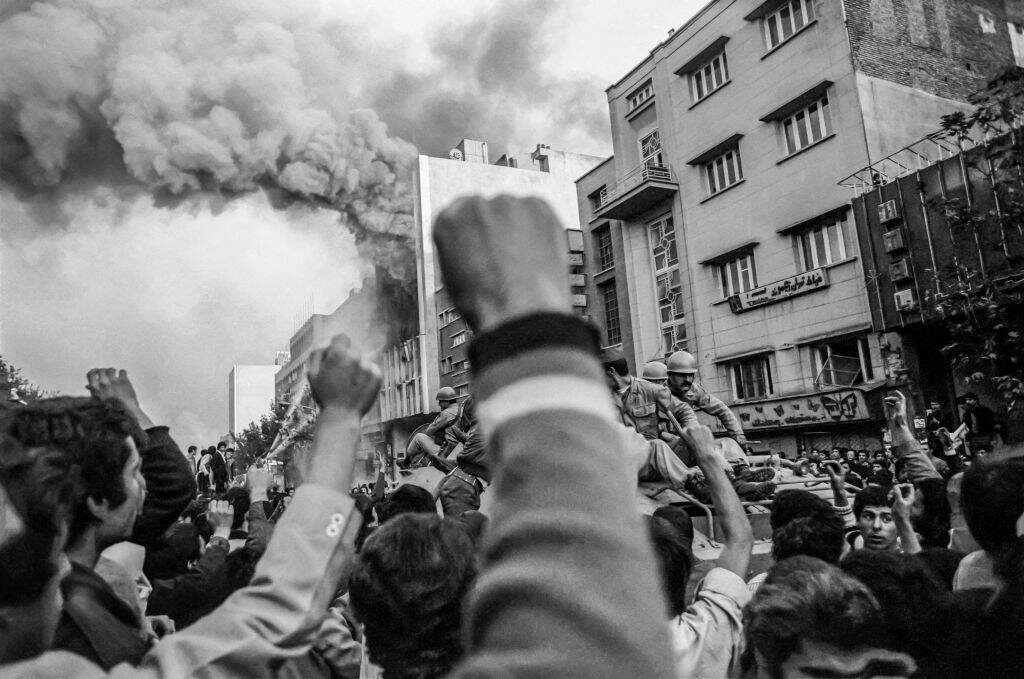
Many in the West see Iran as a nation defined by a revolution. It’s also one of the world's oldest continuous civilizations that’s withstood centuries of struggle.
How Iran’s history affects what’s happening today.
Guests
Abbas Amanat, professor emeritus of history at Yale University. Author of several books on Iran including, “Iran: A Modern History.”
Kourosh Ziabari, freelance journalist and media studies researcher. Contributor to New Lines Magazine.
Also Featured
Fatemeh Jamalpour, Iranian journalist in exile. She was banned from working in Iran by the Ministry of Intelligence. She’s also the co-author of the book, “For The Sun After Long Nights,” which she wrote with fellow journalist Nilo Tabrizy.
The version of our broadcast available at the top of this page and via podcast apps is a condensed version of the full show. You can listen to the full, unedited broadcast here:
Transcript
Part I
DEBORAH BECKER: As the war with Iran continues to shake the Middle East and the global economy, we want to spend the next hour looking back, partly because you've asked us to examine some of Iran's history to help better understand the context behind President Trump's decision to join Israel in attacking Iran last month.
DONALD TRUMP: Today the United States military continues to carry out large scale combat operations in Iran to eliminate the grave threats posed to America by this terrible terrorist regime.
BECKER: Many say this latest conflict is another phase in hostilities that started decades ago and has affected at least eight American presidents, perhaps most notably Jimmy Carter, who was in office during the Iranian Revolution in 1979, and the taking of 52 American hostages for 444 days.
JIMMY CARTER: We are facing a horrible example of international terrorism. The holding of innocent people as kidnapped victims supported by and condoned by the government of Iran.
BECKER: Also, many may recall President George W. Bush, who in his 2002 State of the Union address said Iran, along with Iraq and North Korea, represented a, quote, axis of evil that threatened the world with terrorism and weapons of mass destruction.
GEORGE W. BUSH: Iran aggressively pursues these weapons and exports terror. While an unelected few repressed the Iranian people's hope for freedom.
BECKER: And in 2013 then President Barack Obama announced an interim deal with Iran over its nuclear program. It was called the first high level contact between the U.S. and Iranian leaders since the 1979 Revolution.
BARACK OBAMA: Iran, like any nation, should be able to access peaceful nuclear energy. But because of its record of violating its obligations, Iran must accept ... on its nuclear program that make it impossible to develop a nuclear weapon. In these negotiations, nothing will be agreed to unless everything is agreed to. The burden is on Iran to prove to the world that its nuclear program will be exclusively for peaceful purposes.
BECKER: That interim deal led to the 2015 limiting of Iran's nuclear program that deal, by the way, President Trump withdrew from in 2018. These moments of the U.S. relationship with Iran represent just a sliver of the country's vast, complex history that many of you told us you wanted to learn more about.
So we're bringing your questions to the experts this hour as we take a look at the long thread of this conflict in Iran. Joining me first is Abbas Amanat, professor emeritus of History at Yale University and author of the book Iran: A Modern History. Professor, welcome.
ABBAS AMANAT: Thank you very much for having me.
BECKER: So I guess I would like to start broadly, what would you say are some of the main threads, one or two main threads from Iran's history that you think people should be aware of as this war continues?
AMANAT: It's worth remembering that Iran, as you have just mentioned in your introduction, is one of the oldest countries that survived on the world map, going back to the ancient times. And has a certain sense of resilience that culturally to some extent, politically, survived up to the modern times. So it is a wrong impression, it seems to me the way that it was characterized often, by mostly American politicians as a land of bigots and fanatics.
That may be to some extent applicable to the current regime in power, but certainly to when we are talking about the population of 19 million and more, majority of that population really are very different. Particularly since the latter part of the 20th century, we are dealing with the population which is highly educated, highly westernized and certainly are not in line with many of the radical statements or the radical policies that has been implemented by the Islamic regime ever since 1979.
BECKER: Yeah. We'll get to 1979. As we said, we wanna take some listener questions. We got a question from Kathleen in Austin, Texas, and she says she wants to go back to the 1950s really. And the leadership of Mohammad Mosaddegh, he was a democratically elected prime minister of Iran, ousted in a coup in 1953 that was reportedly orchestrated by the U.S. and the UK.
Was that sort of a main turning point for Iran and certainly for Iranian and U.S. relations, would you say?
AMANAT: To some extent that is true. Although there is a level of exaggeration about the significance of 1953 coup. But it is important to remember that ever since the early decades of the 20th century, Iran experienced a period of a relatively powerful, very modernizing regime that is the dynasty that ruled over Iran ever since 1925.
And this is a period which Iran extensively modernized. It turned from an empire that it used to be, at least since the 16th century, if not earlier, into a nation state, to a modern nation state, and experienced a period of democratization, of the rule of law. But at the same time, there was a contrast between that tendency towards a greater democracy and emergence of a autocratic regime ... modernizing regime. Now, what happened in '53? After the second World War when Iran was occupied by the allies, during the period between 1942 and 1945 there was an interlude of democratization. There was an interlude when political parties emerged, when there was, particularly in the agenda, a desire for nationalization of oil industry, which was the most important source of income as far as the Iranian state was concerned.
The British government, and particularly the Anglo British oil company, Anglo Iranian oil company in the period ever since 1910s had control over the Iranian oil resources. And there was a tendency through the Iranian Parliament led by Mohammad Mosaddegh and his allies in the national front to try to nationalize the oil industry that was very strongly resisted by the British government.
As a result of that, Iranian oil was boycotted. There were sanctions that was imposed in the early 1950s, and eventually that led to a confrontation that brought about the involvement of the British intelligence along with the American central intelligence that is CIA. And as a result of that, there was a military coup that brought back Mohammad Reza Shah from exile back into power.
Although it's an important episode, but one should remember that there are all kinds of intricacies. There are all kinds of complexities associated with it. Yes, the British and the Americans played a very important part in reestablishing, reinstating Mohammad Reza Shah in power that survived up to 1979, but that does not mean that the entire course of modern Iranian history was determined by that.
The process continued. Iran further secularized, Iran further modernized and as if you can compare Iran to many of the countries in the region that is whole of the West Asia or what is usually referred to as the Middle East, would find it as a very different country in terms of its populous, in terms of its resources, in terms of, it's a general direction. Majority of the Iranian population were greatly supportive of westernization. They were, and at one stage in the 1960s and the early '70s the largest population of foreign students in the United States were Iranians.
And most of these Iranians went back to Iran. Most of these Iranians became engaged in Iranian development during the 1960s and '70s.
BECKER: So explain then, what happened from the 1953 to the 1979 revolution, but we have a just briefly, what was the main theme there then?
How did it get to the revolutionary point in 1979?
AMANAT: Exactly. Once you remember that. That like many other societies, as Iran developed, as Iran became more modernized, sectors of the population remained less modernized, then remained, clinged more into their own traditional Islamic practices, particularly Shia Islam, which is the religion, the official creed of Iran, and they were basically led by the religious establishment that more or less ever since 1920s were sent back into their seminaries and were isolated from the process of modernization in the process in the 1930s, '40s, '50s and '60s, they became more radicalized.
They adopted certain elements from the rhetoric of the left. That once in Iran was very powerful during the 1950s.
Part II
Professor, you were talking about how sort of religious groups became radicalized in the 1960s and '70s and how that led up to the Islamic Revolution. We said, we're answering listener questions this hour, and one question that we got from a listener was about how Islamists took control of the revolution and what Ayatollah Khomeini's return from exile signified for the country's political and cultural climate.
How would you answer that question, professor?
AMANAT: Sure. As I was saying, the religious establishment, although was isolated and was left out of the political process in the country. They had managed to in a sense even broaden their support within the traditional sectors of the Iranian society, particularly in the bazaari, in the lower income neighborhoods in the cities.
And as such, since during the ... period, unfortunately, because of the lack of any other form of political freedoms and expressions, political expressions, political parties, free press, we see that there is a kind of greater attraction, greater appeal of religious establishment in the mosques.
And that gradually over the course of the 1970s grew, even members of the middle classes had a certain nostalgic interest for this kind of an Islam, radical Islam that tend to emerge from the religious establishment Ayatollah Khomeini, who was in exile for quite a long period of time ever since 1963.
Maintained a place, a position for himself among many of its supporters, a network of the clergy in Iran, and once he returned to Iran, he was looked upon as some kind of a prophetic figure. Some kind of a messianic prophetic figure that would be able to change Iran back into its authenticity, whatever that authenticity meant.
And as such, we can see there was a kind of a popular revolutionary mass support for him at the time of the revolution between 1979 to 1981, but almost immediately at the same time, we witness the gravitation towards an anti-westernism that becomes part and parcel of this radical ideology, Islamic ideology that dominated Iran.
With the United States as being defined, as being portrayed as the Great Satan. That is the term that the Ayatollah Khomeini used with reference to the United States, and that is not something new. That was part of the radical left portrayal of the United States in non-West, ever since the Vietnam War, there was nothing new about it, but the way that it was fused to an Islamic identity of Iran, that was something novel.
And that was something quite actually appealing, particularly to the population who felt that all the weaknesses and that all the problems that comes with any kind of a modernization process is because of the great powers, is because of the superpower like the United States that imposes on Iran its will.
Yes, the United States was a great ally of the Pahlavi regime. It had a privileged position in Iran, but I don't think that, if you look at the figures, the United States basically exploiting Iran in any particular fashion, Iran was growing. It was selling its oil in the market. It was developing its country, and this was very different.
From the way that it was portrayed by the revolutionaries from '79 onwards, and more and more, it was used by Khomeini and his supporters in order to, in a sense, create a new hostile other to the Islamic Revolution and the course of the events unfortunately supported, helped them, most significantly the Iran-Iraq War, most significantly, the hostage crisis that was completely manufactured in order to benefit from the creation of this nemesis, this kind of hostile force against Islam as it was portrayed, against the true Islam as it was portrayed by Khomeini.
BECKER: But why do that? Why create this bad guy?
What was the point there?
AMANAT: One reason for that being that the tradition, the religious establishment, or at least a large sector of the religious establishment, was highly conservative, totally against many of the values of modernization or modernity as we know it today. The role of the women in public life, very important part of it.
The society not observing any more the strict religious demands of she Islam. That's another part of it, allowing a greater degree of equality among all Iranians. Despite the fact or contrary to the way that the religious establishment, but also to see its own position in the society as privileged.
That was another factor. All of this together helped portray the West, and particularly the United States, as an alien, as a hostile, as a corrupting force in the society. Prior to that, even among the Iranian intellectuals, you could see this kind of a sense of portrayal of the West as an evil, as a foreign, as a force that transformed the Iranian society.
It transformed towards not the better but worse portrayal that we can imagine.
BECKER: Yeah. You mentioned women and the role of women and how women were treated. And we spoke with exiled journalist Fatemeh Jamalpour about this. She's been on our show before.
She's the co-author of the book “For The Sun After Long Nights." ... We talked to her just before today's conversation and we asked her to tell us about some of the roots of the woman's movement in Iran. And she said before the 1979 Revolution, women in Iran had a lot more legal protections and were very active.
But afterward, things dramatically changed for women.
FATEMEH JAMALPOUR: Despite the huge attendance of the women during the 1979 Islamic Revolution. And found their promises about women could be free, the hijab would not be obligatory and other empty promises. After the Islamic Republic the founder of Islamic Republic announced that hijab is [mandated].
So mostly women lost many of the achievement which we have fought for decades after '97 Revolution.
BECKER: And several world political leaders have said that protecting women and girls in Iran has been an objective really of Western intervention. We asked Fatemeh if women in Iran would agree with that, that they needed intervention.
JAMALPOUR: I don't think so, because what we saw in Afghanistan, showing us that the U.S. doesn't have a good will for women because during all these years that Taliban to recover in Afghanistan and to free women from the school and education. No one understand beside women. It's all about empty promises and we don't believe in empty promises, and I don't think that the war and aggression will bring freedom for anyone.
Especially women.
BECKER: That was journalist and author Fatemeh Jamalpour. With me now is Yale Professor Emeritus, Abbas Amanat. Professor, can you talk a little bit about the role of women especially after the 1979 revolution and also a look at the U.S. military's actions and other areas of the world and how the women in Iran might be thinking about that today?
AMANAT: About the position of women, there was a drastic change that came about with the Revolution of 1979, particularly with a one might say symbolic reposition of the hijab. And this is not the facial hijab; this is just the basically covering the hair. And the appearance attire of the women being very modest colors, modest designs, and so forth.
That was very strictly basically imposed by the Islamic regime. One can look at it as a matter of fact, more as a symbol. Of the kind of Islam that the religious establishment and its allies, because once you remember that after 1979, it was not just the religious establishment, it was not just the clergy, but it was a fair number of the people who were recruited into the revolutionary guards.
Into the paramilitary forces, that the Islamic government created, that were supporters of the same kind of a treatment of women. They were also, as far as the position in the society, were more restricted. They were not allowed to, for instance, enter into the job market without the support of their either male members of their family, the husband, the father, et cetera.
And generally, there was a tendency toward sending back women into the interiors of their household. However, that is a great irony of the Islamic Revolution, that in the course of the period after the revolution, the 47 years that we are witnessing today, we see that women in Iran, quite contrary to the social engineering of the Islamic Republic, I could, I should call it actually socio religious engineering of the Islamic Republic, gained a much greater presence in the society of today, today's Iran, Fatemeh that you've talked with is a good example of that. These are people who were educated. The number of, as it has time and again been mentioned, the number of women who were educated in Iran in the university's higher education, in the universities is larger than men.
And they are now engaged much more actively in public life as even if you compare it ... of course it could be much better. There is no doubt about it, that women os a potential force for transforming Iran. They're already transforming Iran in the protest movement.
Two, three years ago, the ... "Women, Freedom, Life" that you would see, they were in the forefront of the change. And right now, if you look at today's Iran, that women are no longer abiding by that strict rules that Islamic Republic has imposed upon them. It is changing society, women appearing in the different attire, without a headscarf, and they basically are much more visible.
Much more vocal than one would've expected as Fatemeh mentioned, compared, for instance, to Afghanistan or for that matter, to the whole region. So in that respect, this is one of the areas that the Islamic Republic policies, social policies, cultural policies, religious policies, misfired.
And created a society very different from what they expected. That is why we see in today's Iran, there is such a clash between the general public and the religious establishment and the supporters of the Islamic Republic, who are acting so brutally as they, as a matter of fact, did massive killing of the Iranians in the early January of this year.
BECKER: Professor I want to just move briefly. I know we have a lot of history here and an hour is not nearly enough time, but as we go chronologically through what's happened in Iran and you say women are more visible and there certainly has been some movement there.
But I want to go back a little bit to where we were before. We talked about the revolution. We talked about how religion shaped things after the revolution. And really there was this anti-Western sentiment that was strengthened throughout Iran and created deliberately, you said. And then we got to the 1990s and I seem to remember that there was some movement to reconcile with the West at that point.
Did that change anything at all in terms of relations between the U.S. and Iran?
AMANAT: As far as the hardcore of the Islamic Republic's leadership is concerned, no. Under Ayatollah, I actually hesitate even to use the term Ayatollah because these titles are very questionable. We can see that there was a consistent resistance to any improvement in the relations, even under Obama, which was probably the best.
And therefore, of course one should also remember, one should be rather fair in that regard. The nuclear agreement that was achieved between the Europeans and the United States with the Iranian government was a breakthrough. And that could have, in due course, led to a change in the environment.
It could have removed some of the sanctions, it could have removed the greater prosperity for the ordinary Iranians, better economy that was not coming about because of the sanctions. And that was a trend. But at the same time, the religious establishment did have an ideological position that could not abandon even up to today.
Part III
BECKER: Before the break, we were talking about nuclear weapons and we understand, professor, that Iran has pursued a nuclear program since at least 1957. With varying degrees of success. I'm just wondering how exactly these nuclear ambitions of Iran are looked at within Iran. And then you talked about the nuclear deal with President Obama, the joint comprehensive plan of action, that nuclear deal that the U.S. has since withdrawn from, how that has affected things and whether you think there might be some kind of compromise that's even reachable here.
AMANAT: Perhaps if I, and start by the very end of the point that you have raised, if there has been a possibility to return to that agreement and try to develop a peaceful nuclear program in Iran without any defense or security components to it. That seems to me with the recent aggression by the United States and Israel came to an end, now I can see that the religious stuff, that the Islamic Republic in Iran is going to be much more adamant in its creation of some kind of a nuclear shield, in order to protect itself against further future aggressions, like the one that we are witnessing.
Let me make it very clear that whatever the nature of the Iranian regime is, whatever the nature of the Islamic Republic is, to the extent that you can see in the rhetoric, anti-Western, anti-American, anti-Israeli rhetoric, I don't think these creates any ground whatsoever for a legitimate immoral aggression upon Iran.
In such a way that we are witnessing today, that is virtually bringing Iran to the point of destruction. This is not only military targets, but in a sense, it's an attack upon the Iranian infrastructure, upon the Iranian country as a whole, a country that went through a process of modernization for a century and a half, and now it's very basis of that foundation of its modernity is now being attacked and it being turned into, basically, a failed state. Unfortunately. That is I think is one of the greatest strategies that we are witnessing, and unfortunately the United States, it's a perpetrator. Israel is the one which is manipulating the circumstances for the purpose of its own whatever the strategic demands and ambitions for that country, but Iran is turning into a victim.
Over the past 47 years, I'm not here trying to be a supporter or apologizing for the Islamic Republic that has committed enormous amount of crimes of its own, but it is not under any international law, it doesn't seem to me that a country like Iran could be the subject, could be the target of the kind of a brutal attack that we are witnessing today.
This is not the Islamic Republic; this is Iran that is being destroyed. And I don't think that it's in the future, that is going to go down in history in any favorable terms for the United States. What I can see is that the United States has being basically used for the purpose of creating Iran or forcing Iran back to a very miserable state, that I'm sure we don't hear much because we don't know what's going on inside Iran.
But once that's become more clear, my fear is that the blows that Iran has suffered is going to actually make it much more difficult to come back and remain a reasonably good surviving country.
I hope it does. I hope that ... Iran would go back to becoming a country that is more concerned with the prosperity and the survival and the development of its own people, rather than creating proxy regimes in the region.
And adventurism that comes with it.
BECKER: So you think really this has almost created like a danger zone. We're not talking about the end of the Islamic Republic here.
AMANAT: No, I don't think so. Unfortunately, that's another misunderstanding that was like many other instances in the past, if you would ask historians, they would have numerous examples to tell you in the past that this kind of an imperial ambitions that they would be able to bring a regime to total submission in the past has never worked, it only made the superpower more engaged, more involved.
We've heard from the first day of the Trump administration that it did not want to get engaged into, involved in any kind of a military engagement abroad. And here we are, less than a year, less than 15 months. We'll see that it has now talking about sending troops into the Iranian territory.
These are the kind of stories that we've heard in the past. In one way or another, ever since the 1960s in the United States with the Vietnam War, and we are witnessing it again, the British in the course of the 19th century British Empire, the Russians in the course of the 19th and the 20th centuries, the latest of each of which being Ukraine, are the other examples of how these superpowers behaving.
And in this case, I think the victim, unfortunately, are the people of Iran, not only the Islamic regime would survive. In my opinion, the chances, of course I don't have, I cannot predict what's going to happen tomorrow or future or in a week time. But it seems to me it's going to survive.
BECKER: I want to take a moment here to bring someone into the conversation. Kourosh Ziabari. A New York based journalist, a media researcher, and contributor to New Lines Magazine. I wanna talk with Kourosh for a moment about what's happening right now on the ground and how exiled residents of Iran are feeling about this as well.
Kourosh, welcome to On Point.
KOUROSH ZIABARI: Hi, Deborah. Thanks very much for having me. It's a pleasure to join you today.
BECKER: Yeah. Can you talk about how descent is really affecting folks within Iran and outside of Iran who are watching right now?
ZIABARI: So I guess opposition domestically to the Iranian government and its policies, it's cracked down on the free press, and its violation of women's rights and other forms of human rights violations has been going on for decades.
And in the recent years, it has gained momentum, starting in 2009, the Green Movement really demonstrated the resilience and bravery of Iranian people defying their own government. And its authoritarianism. This is something that has been somewhat belatedly acknowledged by the international community.
There have been two Nobel Peace Prize laureates from Iran, both of them women. One of them is actually behind bars at this moment, still trying to raise the voices of Iranians inside the country. There are major forces who have actually for years tried hard at great personal cost in order to advocate improved Iran.
BECKER: Oh, I think we lost you. Are you with us? I think we may have lost our connection, unfortunately.
ZIABARI: I'm here.
BECKER: Oh, there you are. Okay. Okay. I'm sorry. You can go ahead.
ZIABARI: Sure. Yes. Basically my argument is that for years members of Iran Civil Society have been trying their best to push the boundaries and resist authoritarianism both at home and abroad. Inside Iran we have one Nobel Peace Prize Laureate who is behind bars. A woman named Narges Mohammadi who is at this time raising her voice both against foreign aggression and also against domestic authoritarianism.
Iran Civil Society has been dynamic, resilient, and this has been somewhat belatedly acknowledged. Many of these people have been actually working at great personal risk in order to advocate improved Iran-U.S. relations.
BECKER: So would you say that the demonstrators now that there's almost a different opponent than there has been in the past?
ZIABARI: It's quite likely because Iran is not monolithic society. There are multiple elements. The country's made up various ethnic religious groups, people with different political persuasions, ideological convictions. There are of course people who have certain belongings and certain sympathies, some of them pretty much sympathize with Iran's exile monarchies. Some of them believe that the only way to achieve democracy is to organic, is true organic change, and it doesn't happen via foreign intervention assisted or encouraged or acted on by exiled leaders who do not have to actually endure the brunt of destruction being afflicted upon Iran.
What we have seen in the world over the past weeks has not been any remotely, representing any form of targeting establishment in poverty in Iran. Iran's culture sites have been damaged, and people's businesses have been struck. Popular bookstores, bakeries, businesses. Just a few days ago I heard about a major music academy set up by a man and his wife who have been actually borrowing loans and they have to repaid it for the next several years was entirely demolished under a drone strike that was attributed to Israel and U.S.
So that's not certainly going to assist or accelerate Iran civil society. It's not going to further democratic change. It's only going to reverse democratic change because wherever there has been an element of foreign intervention or foreign aggression.
Or the efforts of Iran civil society have been undermined through radical acts such as withdrawing from the JCPA, the 2015 nuclear deal. We have seen the Civil Society taking the first hit. Basically, that achievement was laying the groundwork for the further consolidation of a pro-western base in Iran that was gaining momentum, it was able to assert itself. There was a time in Iran under former President Khatami that even mentioning the idea of normalization of ties with the United States was considered as a taboo. Some publications were simply being closed down for proposing that there should be normalization of relations with the U.S. after several years of animosity.
But after years we saw that things were really changing by the centers of the Islamic Republic in a very unorthodox way. And then then the JCPA withdrawal in 2018. By then President Trump delivered one of the first blows to Iran civil society, laid the groundwork for the coming to power, our president, who was apparently being groomed to become next supreme leader ... who actually was killed in that helicopter crash in 2021.
And then we saw what happened next.
BECKER: Just I wonder very briefly Kourosh, if you could just tell me, how you think perhaps what we know right now is U.S. public opinion is primarily against this action that's taking place in Iran. Does that, and we only have about two minutes left here, does that affect what's happening on the ground?
Does that affect things in Iran at all? Like it did in the past?
ZIABARI: I'm hoping that I'm in opposition to this military action and the war on Iran might somewhat convince the U.S. administration and Donald Trump that what he has decided to start is not generating popularity, is not resonating with his mega base, is not even delivering any transformative change in Iran. I'm not sure if what happens in the next stages of Iran's social development would be promising, in a sense that, of course, this is generating some form of further authoritarians in Iran. But I hope that things will change for the better at some point.
BECKER: Okay. Professor Amanat, last word. Last minute goes to you. And I guess what I wonder is when we look at this, what do you think might be the end game based on the history of Iran? There have been obviously numerous conflicts, revolutions. How has Iran survived that and what's the main lesson there that we might look at going forward?
I tend to agree with much of what Kourosh had said. I tend to agree also with the fact that the future, the near future unfortunately is going to be rather dark. I don't think that the regime that we see in power is going to be weakened. The image of the United States tremendously suffered as a result of the recent aggression and the future for Iran in long term is very hopeful.
The younger generations of Iranians are going to eventually play a very important part in what Iran is going to be in future. And to reach between now and then, ot's going to be a very difficult period of transformation.
The first draft of this transcript was created by Descript, an AI transcription tool. An On Point producer then thoroughly reviewed, corrected, and reformatted the transcript before publication. The use of this AI tool creates the capacity to provide these transcripts.
This program aired on March 27, 2026.