Support WBUR
What veterans want you to know about the war with Iran
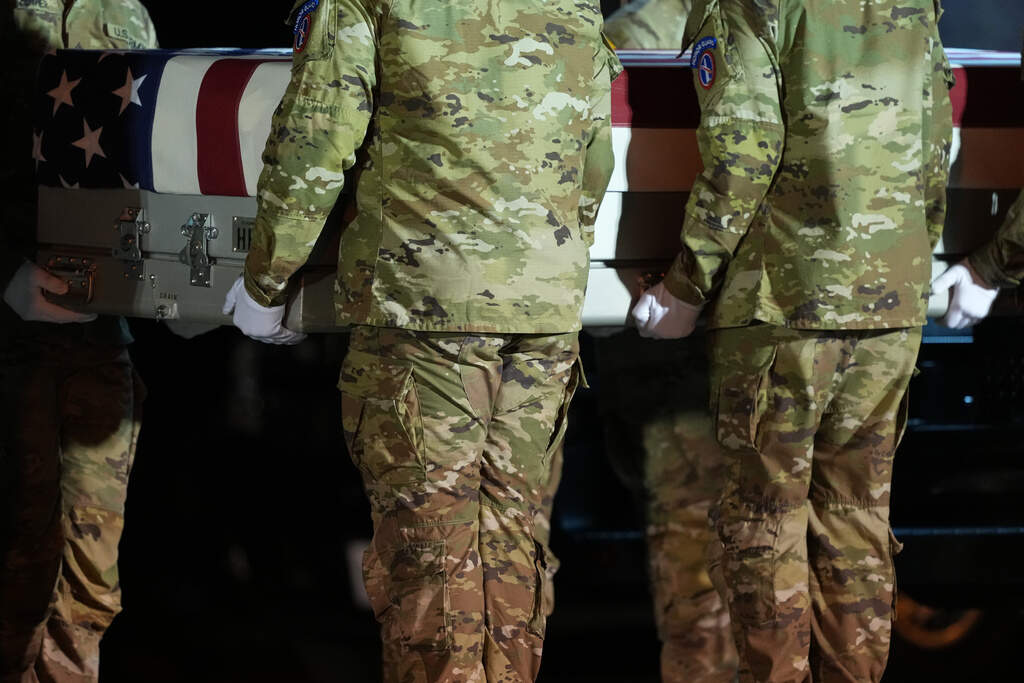
As the war in Iran enters its second month, the Trump Administration is sending U.S. marines to the region. Without a clear goal for the conflict, many veterans are speaking out, while others say it's necessary.
Guests
Elliot Ackerman, Marine veteran. He served five tours of duty in Iraq and Afghanistan. He received the Silver Star, the Bronze Star for Valor, and the Purple Heart. Nonresident senior fellow in the Forward Defense program of the Atlantic Council’s Scowcroft Center for Strategy and Security.
Rebecca Roberts, Organizing Manager of About Face: Veterans Against the War. She joined the NJ Air National Guard in 2012 and was deployed in 2019. She resigned her commission in 2023. Retired held rank of Captain.
Jeremy Harrell, U.S. Army veteran. He was deployed 2003-2004 during the early stages of the Iraq War. Retired from military service as a non-commissioned officer. Founder of the Veteran’s Club.
Editor’s note: Jeremy Harrell is seeking a pardon from President Trump for his 2024 conviction for theft of government benefits. This should have been noted in the conversation.
Also Featured
Chris Sarson, U.S. Army veteran. She joined the military after 9/11 and worked in Iraq as part of the military’s Condolence Payment Program. Retired from military as an Engineer Officer.
Transcript
Part I
ANTHONY BROOKS: As the war in Iran continues, there are signs that President Trump is ready to wind it down or maybe not. He'll address the nation about his latest intentions this evening. And if you're following his statements, you might be feeling a bit of whiplash. In just the last week he's gone from, we're not ready to leave yet.
To, the war is very complete, pretty much. He's called for regime change, but the regime is still there. He's talked about sparking a popular uprising, but that hasn't happened, and he's focused on Iran's nuclear capability, which he claimed last June had been totally obliterated, but apparently not.
Earlier this week, he told reporters in the Oval Office that he's still pursuing that goal.
DONALD TRUMP: I had one goal. They will have no nuclear weapon. And that goal has been attained. They will not have nuclear weapons, but we're finishing the job.
BROOKS: Trump said finishing the job will take maybe two weeks, maybe a couple of days longer.
He said it's possible he'll make a deal with Iran, but if Iran doesn't come to the table, it doesn't matter. Iranian officials said as recently as last night, that there have been no negotiations with the U.S.
Meanwhile, Trump hints, as Trump hints at ending the war, he's also sent us Marines and members of the Army's 82nd airborne to the region for possible deployment.
So yeah, it's confusing and hardly clear what's happening, all of which weighs especially heavily on members of the military and their families. So we wanted to spend this hour hearing from veterans about the war. Some support it, others oppose it. And because of their experiences, they have good reason for feeling the way they do.
So this hour, On Point, the view of the war from those who have served. And joining me first is Elliot Ackerman. He's a marine veteran who served five tours of duty in Iraq and Afghanistan. He received the Silver Star, the Bronze Star for Valor and the Purple Heart, and he's published two memoirs about his military service.
... Elliot, welcome to On Point. Thank you for joining us. We're very grateful to have you.
ELLIOT ACKERMAN: Yeah, thanks for having me, Anthony.
BROOKS: I want to hear about your background and what led you to join the military.
But let me start right off the bat. You have some concerns about this war. Give them, tell me your top one or two concerns about what's happened.
ACKERMAN: I think you touched on it in your introduction, is that since this war has begun, it's been characterized by a degree of strategic incoherence and that the president hasn't really been able to say with clarity to the American people what exactly this war is about.
Is it about the nuclear weapons program? Is it about regime change? Is it about destroying Iran's missile capability? And I think at least what I've seen in the wars I've fought in Iraq and Afghanistan, is that it's very difficult to prosecute a successful war if there is a lack of focus and clarity on what the objectives of that war are.
BROOKS: And why is that? That seems like such an important point, especially hearing it from someone who is served when there isn't that clarity of mission, that clarity, that clear argument for why we go to war. What does that do to the folks on the ground? You are one of those people who is tasked with carrying it out.
ACKERMAN: I think it makes it very difficult for the individuals prosecuting that war to be able to take their energy and apply it to one goal or one very clearly defined set of goals. And so when you have something as large as the U.S. military machine or even the U.S. government, our diplomatic efforts as well, not all operating with a high degree of focus, it makes it very difficult to accomplish anything and it sets the conditions for the U.S. to just muddle around in the region.
BROOKS: Let's back up because I want to hear about your experience in the military. As we mentioned, you're a marine veteran. You served five tours of duty in Iraq and Afghanistan. What prompted you to join the military in the first place?
ACKERMAN: I was a marine officer and I came into the Officer Corps through the ROTC program at Tufts where I went to college.
But I was on that path before September 11th, and I think I just had a vague idea that I wanted to serve, I wanted to do work where I had a lot of responsibility at a young age, and the military certainly offers that. But my journey was that my service, which sort of seemed like hypothetically maybe I'd get able to participate in a mission at some point in the future.
My last year of school, 9/11 happened and I went from joining a peacetime military to joining a wartime one.
BROOKS: You served in Afghanistan; you served in Iraq. What did you see during your multiple deployments? And I know this is a complicated question because I'm sure you saw a lot, but I guess I'm asking you to summarize, if possible, what you saw during your multiple deployments that really shaped how you view the use of American military force.
ACKERMAN: If I had to put a headline on it or a couple headlines, I'd say, first, the U.S. military is really comprised of some of the absolute best of us, young people with incredible focus and dedication. The fact that the U.S. military is capable of waging conventional kinetic wars has been true for a while and was certainly true when I served in Iraq and Afghanistan. I would say another of the headlines that I took away is that it's tough to fight in a war where the objectives, as I said, of the war are not necessarily clear and we don't understand what are the conditions upon which we will be going home necessarily.
Those are two, really, central, I think, tenets of my experience in Iraq and Afghanistan.
BROOKS: Understandable. I want to play a little bit of tape that gives a sort of snapshot of how this debate has been playing out in Washington among veterans. As we know, there hasn't been a huge amount of debate in Washington about this, but here's Arkansas representative Republican, Rick Crawford, he serves as House Intelligence Committee chair. He was briefed about the planned attack on Iran prior to the bombing. He's also an army veteran, and Crawford appeared on CBS evening news shortly after the bombing took place and voiced his support for the war.
RICK CRAWFORD: I think what we're seeing here was there was a sufficient threat.
And a 47-year history that we had reached a point at which we are not going to take anymore. And I think President Trump recognized that this was an opportunity that the timing was perfect and it was surgically precise. And the conditions on the ground are such that the Iranian people needed assistance so they can affect their own self-determination and really take matters into their own hands.
BROOKS: And here's Republican Senator Tom Cotton. He voiced support for the military action in Iran. He's also a former Army officer. And last weekend he told Fox News Sunday that the U.S. has a responsibility to see the war through to an appropriate conclusion.
TOM COTTON: I've said from the beginning, I expect this campaign to last weeks, not months.
And I think that's still a good estimate, but we have to see it to the end. We cannot stop early and allow Iran to have the military capability to continue to terrorize the United States and the rest of the civilized world.
BROOKS: And finally, let's hear from Colorado Representative Jason Crow, a Democrat.
He's a former Army ranger. He spoke to KUSA-TV in Colorado at the beginning of March. He said he doesn't believe Iran should have nuclear weapons, but he asserted that the current war was kicked off without answers to necessary questions.
The question is do we need to do this and do we need to do this now?
So there's a huge leap between saying no, they shouldn't have a nuclear weapon, to now saying, we're gonna bomb the entire country, and then destroy their military and try to take out the regime.
BROOKS: So Elliot Ackerman, I'd love to come back to you and just get your response to what you heard there.
And let me start with what representative Rick Crawford kicked off that segment with. He talked about a 47-year history with Iran and that we just can't take it anymore. And President Trump recognized this and acted, took an opportunity to act. What's wrong with that thinking?
ACKERMAN: Let me back up. You asked me before lessons that I learned from Iraq and Afghanistan. I'd just like to add a third and a very, a third one is that, and I think oftentimes in our conversations in this country around war and peace, we lose sight of this, is that war is politics is fundamentally a political act.
And our military is a tool that can change political conditions, but it's just one tool and oftentimes it is not the right tool and it is not a tool that's able to create certain political conditions. And we saw that in the case of Iraq and Afghanistan. So to go back to the specific question, Anthony.
And the clips that you played, I don't think anyone, nor myself, would argue that, I'm no fan of the Iranian regime. When I fought in Iraq, the Iranian regime was sending in IEDs, explosively foreign penetrators to kill U.S. service members. When I fought in Afghanistan, the IRGC, the Revolutionary Guards Corps, was supporting the Taliban in western Afghanistan where I fought. Indeed, like the infantry battalion I fought in Iraq.
I fought in the Fallujah battle. The battalion I served in was the first battalion of the eighth Marine regiment. Our legacy as a battalion was we were the battalion that was at the airport in Beirut in 1983 when the barracks was bombed and over 200 Marines were killed. So our battalion was on the radio.
We were called Beirut. So the legacy of antipathy between the United States and Iran is very long. And I don't think there's any American politician or leader. And I would also say, I myself would cheer the collapse of the Iranian regime and would hope for the behalf of our country and the Iranian people, they will have something better.
But then it leaves this question, okay, so is this tool we have the U.S. military, is that a tool that we can use to create that better future for our country and for Iran? And if you're the president of the United States, it's incumbent on you to articulate a very clear plan if we're going to put American Service members' lives in jeopardy and spend all of the treasure it's going to take to do this, of how, with a high degree of likelihood.
War is tricky. It's never going to be 100%, but that there's a real plausible pathway to this is how we use force and this is how it affects conditions on the ground to create these policy objectives. A free and stable Iran, or in my war, free and Democratic Iraq, and the administration doesn't like comparing Iran to Iraq and Afghanistan. But I think it bears comparison. In the Iraq war, the plan was we're going to evade Iraq, Saddam Hussein in such a death spot, his regime will collapse, and the Iraqi people will welcome us as liberators. And that wasn't totally unreasonable. There'd been Iraqi uprising, the Shia uprising after the Persian Gulf War in 1991.
But it didn't happen.
Part II
BROOKS: Let's hear from Chris Sarson from Pittsburgh, an Army vet who served in Operation Iraqi Freedom from 2006 to 2007.
During her second deployment, she worked in the Army's condolence program, which compensated Iraqi civilians if their homes or livelihoods had been damaged or destroyed by U.S. military actions. Chris says that's where she became acutely aware of the heavy costs that civilians pay for war.
CHRIS SARSON: They couldn't safely move about the city and go about their daily lives, and I was, I continued to be amazed at the small amounts of money that we would pay out, that people were willing to risk their safety for, to come and get, I can't even imagine the hardships that they were living under.
BROOKS: The Red Cross and Red Crescent Societies say the U.S.-Israeli airstrikes have killed at least 1,900 people and injured 20,000. The war has also spilled across the region, displacing millions more, while costing billions of dollars. Sarson says, because of the suffering that she witnessed in Iraq, she opposes the current war in Iran.
SARSON: I never want to see another mother have to pry a bullet out of her wall to bring it to me to prove that it was American forces that shot up her home. I never want to see another child walking around with an unhealed broken arm. And people laughing about it, because it was so common. And him laughing about it because it just became his new normal.
BROOKS: Sarson says, civilians not only suffered directly from the American military presence in Iraq, they also suffered from the backlash to the American presence. And she says if harm couldn't be traced directly to U.S. forces, she couldn't help the victims.
SARSON: A lot of violence that happened in Iraq was due to the insurgency, which didn't exist before American Forces were there.
And I wasn't able to pay for incidents caused by insurgents. So if I couldn't connect some kind of damage to directly to American actions, I was unable to help people. So I never want to see another woman left walking around with only one eye. Because it wasn't us that did it go apply to ISIS.
BROOKS: Sarson says when it comes to the war in Iran, the U.S. is creating a new generation of anti-American sentiment in Iran and across the region. And she says it's important for Americans to consider the long history of U.S. intervention there.
SARSON: Our interference in the region in the first place is what caused the situation in which the Ayatollah came to power.
And I would like, you know, them to really think about whether this was the appropriate action to remedy that and whether we've really tried everything and used military force, which causes such harmful effects both to service members and to Iranian civilians as a last resort, or whether, we've done it for other reasons.
BROOKS: That was Army veteran Chris Sarson from Pittsburgh. And Elliot Ackerman is still with us. He's a marine veteran. And Elliot, I'd love you to respond in any way you want from what you heard there from that veteran from Chris Sarson. She talked about a number of issues, and I think the first thing that she was most moved by that sort of changed her view of war was its effect on civilians in the area.
And I'm just wondering if that's something you encountered and how it changed you as a soldier and a veteran.
ACKERMAN: Yeah, war is terrible. I don't want, mean that to sound glib, but I think that the war seems to be something that as Americans, we know, we approach more casually, particularly recently.
And I think that's probably the result of our all-volunteer force because war is something that affects a really slim minority of the country in a way it didn't a couple of generations ago, where if there was a draft. Yes, everything she said rings true with me. War is absolutely terrible.
And when we decide to launch a war, it creates echoes of violence that extend out for decades.
BROOKS: Let me introduce Rebecca Roberts, another veteran. She's an Army veteran. She retired her commission as a captain in 2023. She joined the New Jersey Air National Guard in 2012. And she's also an organizing manager of About Face: Veterans Against the War. And Rebecca, good to have you. Thanks for joining us.
REBECCA ROBERTS: Hi Anthony. Thanks for having me.
BROOKS: Let me start with veterans against the war About Face: Veterans Against the War. What is the group? What does it stand for? Tell us something about it.
ROBERTS: Yeah, so About Face: Veterans Against the War is an organization of post 9/11 veterans that was founded back in 2004 after the invasion of Iraq.
And we were originally founded under the name Iraq Veterans Against the War. And so over the last 20 plus years, this community has been organizing to bring light to our experiences as veterans in the military, to expose the lies that we've heard, that we've been told about all of these forever wars that we've been a part of.
BROOKS: And Rebecca, gimme a condensed version of your story, your military service. First, tell me why you joined.
ROBERTS: Yeah, so primarily I joined the military to pay for college. I joined the International Guard, and I came from a pretty low-income family. My mom was an undocumented immigrant and so that was a way for me to really get off my feet, not having a ton of options to make a living or so I felt at the time, and I first enlisted in the Air National Guard in a logistics role before finishing college and commissioning as an infantry officer in the New Jersey Army National Guard after they opened combat arms roles to women. I then deployed as a platoon leader to Djibouti, which is in the Horn of Africa, and eventually as you mentioned, resigned my commission in late 2023.
BROOKS: And tell us about that experience in Djibouti. What did you see during your deployment that shaped how you view the use of American military force?
ROBERTS: Yeah, that's a great question. One of the first things that really struck me was just the footprint that we had, the environmental footprint and the impact on the local community.
That was something that struck me really early on in my military career, was the amount of waste and spending on things that could have been going back into our communities and investing in care. And I really saw that while I was overseas as well. I saw that the real reason that we were there was for economic purposes and for purposes of control, of important trade routes in the region.
And I really didn't see a clear way that it benefited either us as members of the military being there or local communities.
BROOKS: And in terms of this war, as you're watching things unfold as a veteran, what are you thinking? What's your view? And again, how does your experience as someone who was deployed in the American military, how does that lead to how you view this war in Iran today?
ROBERTS: Yeah. One of the things that's been really heavy on my mind as someone who is organizing with veterans and active military is the impact that it's having on our veterans in reactivating and bringing up these deeply rooted traumas from our experiences, in hearing some of the same lies that we heard before with Iraq.
And right now, I'm really thinking about current service members who are being asked to carry out orders that they might not feel good about. And we know that the majority of Americans oppose this war. And that's just to say, I'm thinking that means the majority of Americans support members of the military who have those concerns, and that they're not alone in feeling that way.
It makes total sense why they feel that way. And there are so many of us veterans who have been in their shoes before. At the end of the day, the people who suffer most because of this unnecessary war are both the people of Iran and everyday people in the military in the United States.
BROOKS: Say more about folks being subjected to the same lies as we heard leading up to the war in Iraq. Elliot mentioned that earlier in the hour. What are you referring to in particular?
ROBERTS: Yeah. Just this lie of weapons of mass destruction in Iraq and the justifications that are being given for striking Iran.
Really, from my perspective, it seems unprovoked and I know Elliot mentioned that the military is a political tool, and I think so many of us are asking, is it really necessary to use this as a political tool? I don't see our service members as just a political tool. Those are sons and daughters.
Our brothers and sisters, who are the ones that are being asked to go put their life on the line for this, and for what? I certainly don't see it benefiting us.
BROOKS: Elliot, I want to bring you back into the conversation. What are you hearing from Rebecca here that you want to respond to?
ACKERMAN: Yeah, when I say it's a political tool, I think it's just in the history of war, regardless of the country, oftentimes people are mystified by the fact that a dominant military can't win a war.
And that's because the political conditions on the ground aren't such that military dominance matters. If you look at, for instance, the Vietnam War, we dropped more bombs in North Vietnam than we dropped in all of the second World War. If you look at the wars in Iraq and Afghanistan, the reason those wars didn't go well wasn't because the U.S. military wasn't competent.
We were plenty competent. We just weren't an effective tool. I individually have nothing but in antipathy for the Iranian regime. I hope that it falls. And I hope this effort is successful, but I think what we're seeing is the limits of what any military can affect in terms of change.
And we're seeing the asymmetric ways that the Iranian people or the Iranian regime is fighting against the U.S. military. And I think the Trump administration is quickly learning the limits of the U.S. military as a tool to affect that change. And I think the Trump administration hasn't done a good job of articulating a clear strategy.
Where a logical person might believe that the U.S. military will be able to achieve the objectives that Trump has laid out. And then if the administration doesn't have a strategy, then why are we using military force?
BROOKS: Elliot, it is striking to me the belief and I feel like we trip on this issue again and again over the course of our history and that is this belief in military hardware that is somehow going to magically change the conditions on the ground. And I'm thinking of the bombing campaign. As you said, no shortage of bombs, no shortage of expertise, no shortage of lethality, a word that Pete Hegseth likes to use a lot. But at the end of the day, if the conditions aren't such that they're malleable on the ground, these bombing campaigns just aren't going to work.
I'm just wondering if you can, am I right about that? What's your view on that?
ACKERMAN: I just, I think, listen, if we're trying to dissect and understand the position we're in as a nation right now, it's because military force, the use of military force to quickly solve nagging geopolitical problems is extremely seductive. It's very seductive for a president to believe that if he just launches a bombing campaign, suddenly, the Iranian regime will topple and democracy will replace it, and he will be seen as a great peacemaker. That's seductive.
And I think we've seen this time and again through American history and just world history, that seduction often leads to global leaders making very bad decisions when it comes to the use of military force.
BROOKS: Elliot, Rebecca, standby. I want to bring in another voice. Jeremy Harrell. He's an Army veteran.
He was deployed from 2003 to 2004 during the early stages of the Iraq war. He retired from military service as Sergeant (E-5) training cadre, and he's founder of the Veterans Club, and he joins us from On Point Station WFPL in Louisville, Kentucky. And Jeremy Harrell, great to have you.
Thanks for joining us.
JEREMY HARRELL: Yes, my pleasure.
BROOKS: Now I know you have a different view than what we've been hearing so far, and I know you are in favor of this war. I'd love you to lay out the reasons why.
HARRELL: Yeah. I wouldn't say that I'm in favor of war in its own right, but I am in favor of doing what is necessary to protect our way of life and our safety here in America.
And I firmly believe that this administration is doing just that. War is unfortunate but oftentimes could be necessary. When you have a country who is the biggest sponsor of terrorism in the world, who for 47 years has had a regime who has been oppressive not just to the Iranian people, but to the world.
We need to take action and ensure that we're doing what it takes for us to be safe here at home. But also, even beyond that, it makes the world a safer place to be. No one with that background should ever have nuclear weapon capability. There's not much room for error whenever someone uses nuclear weapons.
And I think this is a preventative measure in hopes that this doesn't become a larger war. And I don't know that it's an actual war. I haven't heard that yet. It seems to be more of an error in naval precision strike situation. We're a month in and there are ground troops in the region.
I understand that, but it's important to note that as we know, there isn't on the ground in Iran at this time. That may change. I'm not sure, but I do believe that this is justified when it comes to the country of Iran.
BROOKS: I'm curious Jeremy, if your perspective would change if troops get involved.
We know that Marines and members of the 82nd Airborne are in the region. Trump has, President Trump has talked about the possibility of deploying ground troops. I know now he's talking about probably unwinding the war. We're going to learn more about that tonight. But when it comes to the deployment of U.S. troops in the region, does that change your view of what's going on in the region?
HARRELL: It doesn't necessarily change the view. Obviously, my hope as someone who has been there and seen the implications of war, and I don't know if there's any winners in that way, but the point is, we only have a small amount of information out here in the general public.
And we have to trust those who have the intel and make the decisions on what we need to do moving forward. My hope is that it doesn't come to that point. I really believe that this administration doesn't want it to get to that point. But at the end of the day, you can't just press pause and leave without finishing what you started. And making sure that the American people are protected, making sure there's no nuclear weapons, dismantling the regime, and also trying to prevent that regime from massacring 30,000 more of their own people.
While it's not ideal and I would hope that it would be the very last resort and no way-out strategy, if that was to happen I would be in support based on the intel that they receive in Washington.
Part III
BROOKS: On Point listener Randy is a Vietnam War veteran. He says the current military action in Iran seems like a similar kind of war, one without a strategy.
The consequences of which leaves a lasting effect on other veterans.
RANDY: It's easy to go in. It's very difficult to get out. So I visit patients at the VA hospital and as we are all aging out, many of them are Vietnam veterans, many of them are still deeply affected by what happened to them in the Vietnam War.
This is what happens to young soldiers who go into combat and have to live with the consequences of that for the rest of their lives. We have no exit strategy in Iran. We had no exit strategy in Vietnam. It's bad, we're in trouble.
BROOKS: And here's On Point listener Randolph. He's an Army veteran who doesn't support the military action in Iran either.
He says, leadership just doesn't seem to have a clear strategy in Washington.
RANDOLPH: There's a lack of intelligence and planning involved in this war, and it shows in leadership from the top and how they're explaining the plans, processes, and future, second, third, and fourth layer effects of a war.
Unfortunately, I don't think leadership is very keen on understanding intelligence, and they have failed basically on it, and it's going to continue to fail.
BROOKS: We're joined by Elliot Ackerman. He's a marine veteran. He served five tours of duty in Iraq and Afghanistan. He received the Silver Star, the Bronze Star for Valor, the Purple Heart.
Rebecca Roberts is with us as well. She's an Army veteran. She retired her commission as captain in 2023, and she's organizing manager of About Face: Veterans Against the War. And Jeremy Harrell is with us. He's an Army veteran and was deployed from 2003 to 2004 in the Iraq war. He's in favor of the current operation in Iran and we were talking with him before the break.
And Jeremy, let me come back to you. And if I may, I want to push back. Just to ask you why you were reluctant to call this a war at this point. And I just think it's important to get this out of the way. When I look at what's happening, we've had a bombing campaign, 17,000 targets, thousands dead, millions displaced.
It's a major movement of military hardware. Sounds like a war to me. Why are you reluctant to use that word?
HARRELL: Yeah, that's a valid concern. The reason why I'm reluctant to use that word is because this is primarily an air and naval campaign. And I hear a lot about the objectives and the strategy and there isn't any.
But I would differ. And the reason is because it's been very clear since the beginning that our main focus was to prevent nuclear weapons and capability with that through the Iranian regime. Also, to dismantle that regime and to neutralize missile and naval threats. I think that is more than enough justification.
Again, when you think about not just what happens in Iran, but the proxy attacks, with the biggest supporter of terrorism, you have Hezbollah, you have these other groups that they've been funding that have harmed us when we were in Iraq, that have harmed us when we were in Afghanistan and they harm us all around the world.
So it's not just what is happening in Iran, it's the residual and the fallout from them being able to continue harming the world in the way they do with terrorism and extremism. And so I believe that this is the right call to action. I believe that we're 47 years too late.
And I just, I'm thankful that we have an administration who is willing to do something now about that, so that we can all be a little safer going forward. And maybe, and the hope is that this prolonged a much larger war. I don't think we're looking to be a nation building war.
So I think all those things combined is what kind of gives me the justification that this is the right thing to do at this moment.
BROOKS: I want to ask you about your deployment to Iraq from 2003 to 2004. What did you see during your deployments that shaped how you view this war, the use of American military force in general?
HARRELL: I worked primarily at an enemy prisoner war camp called Camp Bucca, which was a major U.S. run detention facility and primarily holding insurgents and suspected terrorists and detainees and the point is when you're around these individuals, there's so much hate for the United States.
There's so much desire to harm us, right? And these are the players that create what we see. In fact, Camp Bucca is the birthplace of the ISIS, right? Al Baghdadi was confined there detained there and he created ISIS from that location. We're talking about people who hate us.
We're talking about people who hate everyone else that don't believe the way they do in this world, and who ultimately just wants to kill people because of that. And that really --
BROOKS: But I guess it, yeah, I guess it's a chicken or egg thing because I accept the idea, a lot of hate for the U.S. in that part of the region.
But I have to ask you now, to what extent does waging the kind of war we're waging right now contribute to that hate in the long run?
HARRELL: It's not, hate is an emotion, right? But it's more to prevent continuous or potential attacks to our country whether it's direct or indirect. And it's also to prevent Iran from using nuclear capabilities that can wipe out most of the world here.
And it's deeper than hate, although it just gives you an idea of these folks, they don't want peace, right? And they're dead set on creating turmoil around the world. And if we care about people, then we must do something about that. And so that's why, I believe that we're making the right decision here.
BROOKS: Like I said before the break. I'd really like the three of you to engage with each other. Let me start with you, Elliot, respond to Jeremy's argument here. This is an effort to dismantle a regime, with a 47-year history. You yourself said you've got no, there's no love lost between you and the Iranian regime.
There's a nuclear capability that we've gotta be concerned about. What do you wanna say to Jeremy about his argument?
ACKERMAN: Oh, I'll make my observations, I think what I mean, go back to this idea of is it or is it not a war? I think one of the challenges that this administration has had in waging this war is that it's shown that it has a sort of a slippery relationship with the truth.
In so much as Operation Midnight Hammer, the American people were told right after that those strikes inside of Iran, that their nuclear program had been completely obliterated. And then within six months as a country, were supposed to now believe that it wasn't obliterated, and in fact, that their ability to get a nuclear weapon is so imminent that we have to act right away.
And launched what we've just seen inside of Iran. And I think it makes a lot of Americans, myself uncomfortable, because this is not what we do as a people, like Putin is the type of person who calls a war a special military operation. I won't just call it a war, I won't bring it to Congress.
And I think, with regards to Iraq. Listen, Saddam Hussein was a menace in that region, had brought the U.S. into a war in the Persian Gulf War when he invaded Kuwait. The Taliban the same. I couldn't agree more wholeheartedly that the Iranian regime is a menace.
But what I question is this strategy, one that's being, that doesn't seem to have any type of coherence to it, is that going to make America safer? Or is that going to be yet another instance where we waste a lot of blood and treasure, create heightened antipathies in the region, that eventually come back to haunt us.
And those are my concerns. And if someone could explain to me why that's not going to happen in a way that's convincing, I would be on board. But no one has done that yet.
BROOKS: What do you think, Jeremy? There's a challenge. Explain that to Elliot.
ACKERMAN: Oh, Jeremy, you don't have, you don't have to explain it to me.
Reasonable people can disagree.
BROOKS: Yeah, no, that, that's fine as well. I just wondered if Jeremy wanted to respond to that.
HARRELL: I think just what Elliot said, veterans can disagree. My view comes from my personal experience, when force is used, it must be tied to clear objectives.
I feel like we have those executed decisively. I feel like in an effort to prevent larger conflicts, I feel like we're doing that based on the information that we all receive which isn't directly from the Pentagon or directly from Washington. We're always taking a shot in the dark here based on what we hear and see.
But then it goes back to, I also suffer the same way some of these veterans do in the country with the, still to this day. And we're over 20 years removed from war. And I still have issues because of the experiences that I had there. And I don't want to minimize that and act like that isn't a big deal.
But also want to point out that one thing that I knew when I raised my right hand and I signed up to join, was that there was a good possibility that one day that I would have to go and defend our constitution and our way of life here. And I was prepared to do that, and I understood the cost and unfortunately there is a cost. But this is why it's so important that we have men and women who are brave to stand in that gap and to do what is necessary under the direction of our leadership in this country the best that they can.
And so there's two things that can be true. It can be devastating and hard and create future hardships, but it also can be necessary and a job that we all signed up to do. Knowing that the cost could very well be a real thing.
BROOKS: Rebecca, let me get you back into this conversation.
What are you hearing? And specifically if you want, respond to Jeremy's argument that, you know, this is a regime that you know it's a worthy project to try to dismantle this regime that has sowed so much terror over decades and decades. Nuclear capability. All of the above. What do you say to that?
ROBERTS: Yeah, that's a great question. And my stance really is that it's not our place as people in the United States to be making decisions on other sovereign nations' government, that is on their people to make those critiques. Of course, we can have our own critiques, but I think what's more important here is this question of like, how is this making us safer?
Why are we taking these actions? I hear that we're talking about this question of whether we're calling this a war or not, but at the end of the day, when those bombs are dropped, whether it's bombs being dropped from the air in an air campaign, or if it's boots on the ground, those are human lives at stake there.
And if we're arguing that we're targeting military infrastructure, why are we dropping bombs on schools? We have seen an influx of military members who are contacting us through our encrypted support form, who are really concerned. And that's one of those big inflection points, is over concerns of human rights and potential war crimes.
And there's just a lot of questions here on why are we doing this and who does it really benefit? And I think, like Chris said, it's causing this instability. And really, at the end of the day, I don't think that it makes American people safer at home or around the world.
BROOKS: So I want to end with a question to all three of you.
We mentioned in the intro that President Trump has given a few different justifications for this war. He's also gonna be talking about this tonight. He's hinted that this war might be winding down. Elliot Ackerman, let me start with you. What do you wanna hear from the president? From the commander in chief?
ACKERMAN: I'd like to hear the truth, but I'm skeptical that we'll hear that. I think he will try to sell to the American people why some set of objectives have been met and why those were his objectives all along. But what I'd like to hear is a very honest assessment of what the situation is, in a clear plan of how he's going to go forward.
But I'm skeptical that's what we'll receive.
BROOKS: Do you think there's gonna be a version of essentially he's gonna declare victory and go home?
ACKERMAN: Yes. I think he will declare victory, say this is my plan all along. And now it's time to go home and try to sell the fact that he won this war.
And I think that's very challenging because it doesn't allow a full-throated conversation about the potentially compromised position the region is in now, and the fact that we see this historically too, that when regimes like the Ayatollah or authoritarian regimes are challenged, become even more authoritarian.
We saw this with Sadam Hussein after the Persian Gulf War in 1991. And so I fear this will, if we are leaving, this is certainly not the last we will hear of the Iranian regime.
BROOKS: Jeremy, what do you want to hear from the president?
HARRELL: I would like to hear an update on whether or not we are considering and I think maybe they are but specifically considering having ground troops enter Iran and what that looks like. But also, to hear more about what we've accomplished so far. Again, at the end of the day, veterans don't take war lightly. We understand the cost. The focus should always be on clear objectives and strong leadership and making sure, most importantly, that those who serve are supported long after the mission ends.
But also know that sometimes not acting creates greater instability. And the focus, again, should be targeted, proportional, tight and with a clear outcome. And again, with the key objectives I mentioned earlier, I think it is. Now I think it's ever, it's continuing to expand as we spend more time in this operation.
But for the most part, it's clear.
BROOKS: Rebecca, literally 10 seconds left. I want to give you a chance for a final thought about what you wanna hear from the president.
ROBERTS: Yeah. It's hard to say because when the majority of the population doesn't support this war, I really question why the decision was made in the first place.
The first draft of this transcript was created by Descript, an AI transcription tool. An On Point producer then thoroughly reviewed, corrected, and reformatted the transcript before publication. The use of this AI tool creates the capacity to provide these transcripts.
This program aired on April 1, 2026.