Support WBUR
What happens when religious fundamentalists come to power? (Part One)
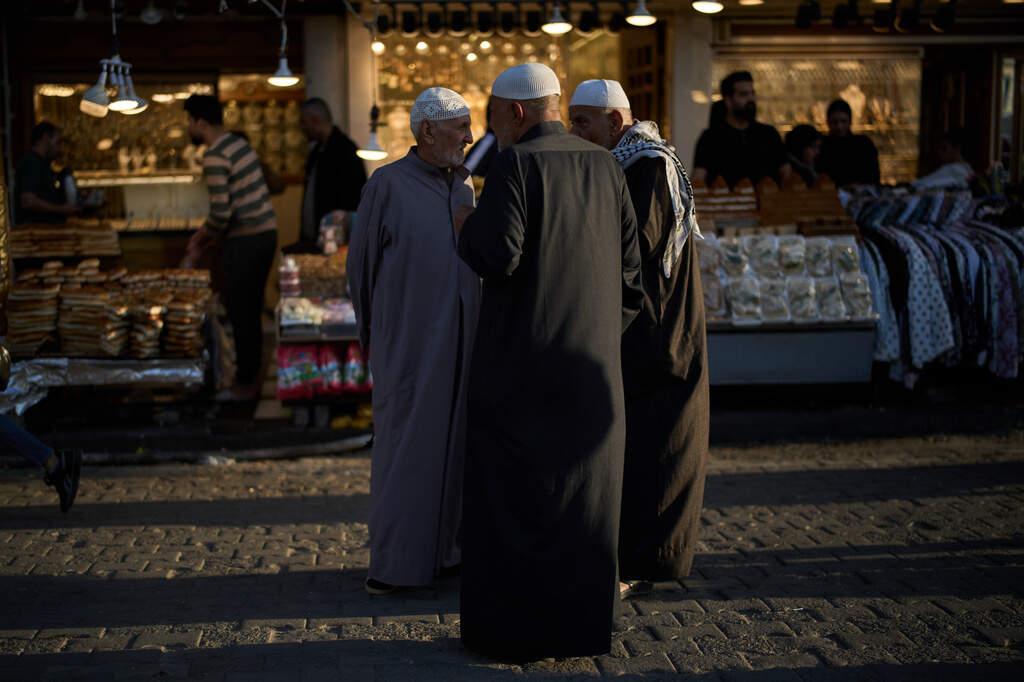
Shia fundamentalism has come to define Iran’s place in the Middle East and the world. And that wasn’t an accident. How Iranian leaders use Shia Islam to exert their power.
Guests
Bernard Haykel, professor of Near Eastern Studies at Princeton University.
Alex Vatanka, Senior Fellow at the Middle East Institute where he is the founding director of the Iran program.
The version of our broadcast available at the top of this page and via podcast apps is a condensed version of the full show. You can listen to the full, unedited broadcast here:
Transcript
Part I
MEGHNA CHAKRABARTI: When we asked you what you want to know about the U.S. and Israel's war with Iran, you sent us many questions that fall into two specific categories. One bunch of you asked for more information about Shia Islam and the religion's role in Iran. For example, here's listener, Paul Steeno from Columbia, Missouri.
I think it would be interesting to hear more about the religion of the Iranian people and the history involved in the region.
CHAKRABARTI: The second group of you asked questions about the rise of Christian nationalism in the U.S. Here's Ronny Hodges from Saint Libory, Nebraska.
I would like more details regarding the history of Christianity and Islam and that back-and-forth battle and how that currently impacts the state that we see with the uprising of white nationalism and Christianity in the United States.
CHAKRABARTI: Now, I would argue that the entire religious history of Iran, or an examination of the centuries-long back and forth between Christianity and Islam, that is the stuff of entire careers, or 10-part documentaries. So I've decided to sharpen things a bit if you'll allow me and instead ask what happens to a nation when religious fundamentalism comes to power.
Now, of course, that happened in Iran with the 1979 Shia takeover of the Iranian Revolution and the formation of the Islamic Republic of Iran. And here in the United States, President Trump has put overt Christian fundamentalists in some of the most powerful positions in the land.
Notably, defense secretary Pete Hegseth. In Iran, Ayatollahs have long led the Death to America chant. And in the U.S. more recently, but increasingly, we have scenes such as two religious leaders at the recent White House Easter prayer, Franklin Graham prayed that God had, quote, raised up President Trump, quote, in a time such as this to defeat Iran's, quote, wicked regime.
Paula White-Cain turned to Trump, who was standing behind her, hands clasped, eyes closed and told the president that quote, no one had paid the price like you have paid the price. It almost cost you your life, she said. And she continued to the president, saying, quote, you were betrayed, arrested, and falsely accused.
End quote. And no, she was not subtle. She directly likened Trump to Jesus saying, quote, because heroes, you rose and because of his victory you will be victorious in all you put your hand to, end quote. Now, even with all that, am I saying that Iran and the U.S. are exactly the same? No. Or that their governments are mirror images?
No. Or that radical Shia Islam and Christian nationalism are through and through Identical? No. But what I am saying is that when you have two nations where the unyielding absolutism of religious fundamentalism becomes the rigid machinery through which critical decisions are made, well then perhaps those two nations have more in common than either care to admit.
So this week we're going to do two shows, one about Shia extremism in Iran, and another about Christian nationalism in the U.S. And as I mentioned, the big question here is what happens to a nation when religious fundamentalism comes to power? And today we're going to start with Iran. And joining me is Bernard Haykel.
He's a professor of Near East Studies at Princeton University, and author of many books and lectures regarding numbers of aspects of religion across the Middle East. Professor Haykel, welcome to On Point.
BERNARD HAYKEL: Hello Meghna. Nice to be here.
CHAKRABARTI: It's great to have you. Now, even though I said I don't necessarily want to spend the whole hour on just discussing religious history in Iran, I think for everyone's mutual understanding it might be helpful to spend several minutes on just the origin of Shia Islam. Because it occurred to me that I don't actually even truly know that story. So can you tell us a little bit about how this sect emerged in the Islamic world?
HAYKEL: Sure. The Shia or the Shiites sometimes referred to are basically a group that emerged in early Islam, not in Iran, in Arabia. And the dispute was over the question of who would succeed after the prophet Muhammad died? Who would succeed in the political and spiritual leadership of the community? And what happened when he died in the year 632 of the common era the community split.
One group went with companions of the prophet; they chose three in succession. And one group said, no, the succession should go to the prophet's cousin and son-in-law. A man called Ali ibn Abu Talib. And the leadership of the community should be confined to the family of the prophet.
So the split between the Sunni, who are the majority of Muslims, some 80%, 85% of all Muslims are Sunnis, argue that, the Sunni argue that the succession correctly took place as it did historically. And the Shia, the 10%, 15% of Muslims say that a grave sin was committed when the succession didn't go to the prophet's family. And cousin. And so that's the split. It's over succession. Then over time, theological differences developed and legal differences developed between the two sects.
Over time, theological differences developed and legal differences developed between the two sects.
Bernard Haykel
CHAKRABARTI: Okay. You actually got to the next question I was going to ask. So in the context of our conversation of trying to understand Iran a little better, what are one or two of the most salient theological, or as you said, legal differences that we should be aware of in Shia Islam? So Iran didn't become Shia until a dynasty in the early 16th century took over Iran.
This is a dynasty called the Safavid Dynasty. And there was a Shah, or a king called Ismail who imposed Shiism as the official religion of the country. Until then, Iran had been Sunni. So Iran is not central to the Shiia story and to Shiia history until the 16th century. Before then, the differences between Sunnis and Shias are quite many.
First, the question of leadership. Who should be the leader of the community? Second, the Shias believe in the mainstream Shias. So the majority of Shias are called Twelvers. Twelvers because they believe in a line of succession after the prophet of 12 descendants of the prophet whom they consider to be the leaders of the community.
The last one of whom disappeared, went into what is called occultation. And so he's with us but not present physically. And he will appear as a messianic figure at the end, in the end times, close to the end times. And so the Shias believe that these leaders are sinless, that they are like the prophet, except they don't receive prophecy.
So the question of what is called ... the doctrine of the leadership of the community is theologically quite distinct from that of Sunnis. And then in law there are many small differences between them. Some small, some big between the two communities. But the scholars in the Shia community also are much more hierarchical in their organization.
The relationship to the laity, to Shia believers is also different from that between Sunni scholars and their laity. So there are quite a few differences in that respect. But the main one is really over the question of the role of the prophets family and the question of political succession over the community.
CHAKRABARTI: Interesting. But this has produced what, a more than 1200-year tension, to say the least, between the Sunni majority and Shia minority in the Islamic world.
HAYKEL: Yes, very, there is a tension. Sometimes that tension has been extremely violent. By and large, the Shia have suffered tremendous persecution at the hand of the Sunni and as a result, over time, developed a doctrine of what is called political quietism. They essentially gave up on the idea of having living ruler take over the Muslim community until the time of the return of the Mahdi or the return of their Messiah figure the 12th Imam.
CHAKRABARTI: Okay. Professor Haykel, I suppose it's so obvious that people are going to be like, no kidding Chakrabarti, but I gotta say, that the idea that there's any separation between religion and the functioning of the state is a very modern one. Prior to, let's say, obviously the 18th, 19th century, can we say that in the Safavid Dynasty that Shia Islam and the governance of the area now known as Iran, that they were completely intertwined.
HAYKEL: Yeah. In the Safavid period, the religious scholars played an important role and they continued to play an important role even after the end of the Safavids. The thing though to keep in mind is that while religion and state are not separate in Islam in the Shia tradition, because the state was by and large mostly led by Sunnis, the Shia have always regarded the state as illegitimate and therefore their doctrine of political belief only emerged very forcefully with the Iranian revolution in 1979, that's when you had a major rupture take place within Shia thought. With the rise of the ideas of Ayatollah Khomeini, who was the leader of the revolution, he developed a new doctrine of politics that was unprecedented in Shia history.
CHAKRABARTI: Okay, now we have about a minute to go before the first break Bernard. But in the early 20th century, and I'm talking before the period of 1951 to 1953 when Mosaddeghwas in power and Iran was formally a democracy. Again, we only have 30 seconds. I'll just get started here. What role did Shia Islam play in Iran in more modern times?
HAYKEL: It played a very important role because the religious scholars were debating questions of constitutional law and politics. And there was a very important constitutional revolution in the early 20th century in Iran.
Part II
CHAKRABARTI: I'd like to focus a little bit more again, on the early 20th century now, because as you mentioned, back in the 16th century, we had the Safavid Dynasty. And then if, and correct me if I'm wrong, but thereafter there was a series of other dynasties that led to the Pahlavi Dynasty in the 1920s in Iran.
Is that correct?
HAYKEL: Yes.
CHAKRABARTI: And so at that time then, Iran was not a quote-unquote formal democracy, but a little later on you said there was a constitution that was written. Did I catch that right?
HAYKEL: Yeah. Yeah. There was a constitutional revolution in the early 20th century where within Iran you had a movement that tried to regulate the authority of the king and his powers.
And there was a split between those who were pro constitution, which would've regulated and organized the different structures of authority and power in the state, and those who were against the revolution against the Constitution. And that period is referred to as the constitutional revolution.
And religious scholars played an important role with those on the side of the constitution, those against.
CHAKRABARTI: Okay. Religious scholars, specifically, what does that mean? Because every time I hear it, Bernard, I think, again, in the modern context, my brain immediately goes to the kind of the Ayatollah.
Is that not what that means in the 1920s, '30s context?
HAYKEL: Yeah. In the Shia tradition you have a development of religious scholars, just like in the Sunni tradition. Except that with the Shia, the religious scholars are educated and ranked in a much more formal hierarchy.
And the top scholar is called an Ayatollah, and ultimately a grand Ayatollah. That's the ultimate source of authority amongst the Shia. And there are two centers of religious education in the Shia world. One in Iraq and one in Iran. ... Iraq. And you have these scholars who are educated, and it takes many years for them to develop knowledge in theology, law, logic, rhetoric, philosophy.
They're beautifully educated in a classical sort of tradition. If anyone wants to read a book about this phenomenon. There's a wonderful book by a late professor from Harvard called Roy Mottahedeh called The Mantle of the Prophet, which describes one such religious cleric, and these clerics play a very important role, especially the Grand Ayatollahs in the Shia tradition.
CHAKRABARTI: Okay, and were those clerics then, you said they were influential in the creation of a constitutional structure to Iran?
HAYKEL: Yes. That's right.
CHAKRABARTI: Sorry. Sorry, Bernard. I didn't mean to interrupt you, but, and so therefore, obviously influential, how? Did they manage to weave in Shia religious belief into that constitution?
HAYKEL: The question was whether Islamic law as understood by the Shia, could be a basis for regulating executive authority. And some argued that it was, and that the king was not an absolute monarch, but rather was someone who had to be guided by certain rules and principles and have restraints placed upon him because of Islamic law.
And so that was the debate at the time. And the Constitution was attempting to do that. Ultimately, though, in the Iranian case, you ended up with the rise of a new dynasty called the Pahlavi Dynasty. And they were absolute monarchs. They didn't feel that they had to be constrained by religious law.
And this created resentment and especially with the last Shah of Iran, who was a modernizer and tried to impose a westernizing set of policies from above, through the state on society. And that provoked and generated a significant amount of resistance from religious scholars. The most important of which was Ayatollah Khomeini.
Who reacted to this enforced westernization and modernization of Iranian society.
CHAKRABARTI: Ah, okay. So this is really interesting because I think it's easy to just presume that Islam, and obviously the Shia sect of Islam as we're talking about has always been completely melded with Iranian leadership, but it's interesting to hear that with the Pahlavi dynasty they didn't feel, as you said, the need to be constrained at all by religious law.
How did that happen?
HAYKEL: Yeah, what happened in the 20th century is that a number of countries in the Middle East felt that they were the leaders of those countries, felt that they were behind civilizationally, industrially, technologically. With respect to the West and that in order to modernize and westernize, you had to get rid of a lot of Islamic tradition, which was argued to be holding back the people.
And so you had this with Mustafa Kemal Atatürk, the leader of Turkey, of Republic of Turkey who imposed also Westernization on his society. He forced people, he changed the alphabet. He forced people to change how they dress, changed the educational system, the legal system. And something similar happened in Iran with the Pahlavi as well.
Not as dramatic as the Turkish example, but also an enforced sort of Westernization with the idea that Iran needed to become modern. And that the pathway to that was through Westernization.
CHAKRABARTI: Which implies, or excuse me, overtly says, as you had just mentioned, that the belief that it was Islam that was holding back the development of Iran.
HAYKEL: Yeah, that's right. That Islamic tradition, that Islamic clerics and their ideas were sort of Luddite ideas. They weren't consistent or with modern ideas and that they kept the society backward. And so they had to be marginalized, if not crushed.
CHAKRABARTI: We did a show a couple of weeks ago that went into profound detail about what happened following the deposition of Mosaddegh, the return of the Shah, and then of course the 1979 revolution. So we won't spend a ton of time on that. Folks, if you missed that show, go to our podcast feed the On Point podcast feed and look for the history of Iran show, and you will get that in detail.
So Bernard, if I can, I'd like to use this opportunity to jump forward just a little bit and then ask, it's fascinating to hear that Iran, for hundreds of years was in fact incidental to Shia Islam. But if I understand correctly, right now, it's considered the heart of Shiism is in the Islamic world.
Is that fair?
HAYKEL: It's the only state where Shiism is part of the official ideology of the state. You don't have that in any other country. Now, the Shia are extremely important in Iraq because many of the principal educational seminaries are in Iraq. But in Iran, first of all, the majority of the population is Shia.
And you have a theocracy as a form of government with a supreme leader who claims to be in his position and to have his authority because he represents a form of power and of authority, and that he is in a way a representative of the hidden Imam, the Mahdi, who is to come.
CHAKRABARTI: Okay. So Professor Haykel, hang on here for just a second because now I want to bring in Alex Vatanka. He's a senior fellow at the Middle East Institute, where he's the founding director of the Iran Program. Alex, welcome to On Point.
ALEX VATANKA: Hi there, Meghna. Great to be with you.
CHAKRABARTI: It's great to have you. Okay. So as you've heard Professor Haykel has really done an extraordinary job of encapsulating several centuries of history.
For us to get a better understanding of the role of Shiism in Iran. I'm wondering if you can help pick up there and describe to me what you think about what was it about the kind of Shiism that the Ayatollahs were pronouncing just prior to 1979 that led to what I understand is the co-opting by the Ayatollah of the student led revolution in 1979.
VATANKA: So Meghna, if I could just take you back quickly to 1979. At the time, the revolution you had basically had an Islamist movement in Iran going back to the early 1950s. They were inspired heavily by Islamist thinkers in places like Egypt, elsewhere in the Arab world. So you had the beginning of what I would call the modern political Islamism.
That you really didn't have any precedent for in Iran before. So it starts in the 1950s. Folks like the last Iranian Supreme leader, Ali Khamenei, they were reading Arab Islamist material, translating into Farsi. But it's really important to notice that this was the focus, the passion of a very small group inside of Iran.
The vast majority of the Shia clerics belonged to what we call the quietest school of thought. They did not believe in this fusion of politics and religion, but this is starting to come into Iran from the 1950s onwards, and people like a Khamenei and others, again, small group, but nonetheless, they turned out to become very influential going forward.
And obviously as we know by 1979, they make the case that there is no such thing as religion without politics and religion go hand in hand. That's their argument. Again, this is the big experiment of Islam or Shia Islam or Islam in general in Iran. And today, if you ask ordinary Iranians, even those who are pious, there's a big question mark whether this experiment worked out or not.
But in 1979, that's where we were.
CHAKRABARTI: So then how did that small group become so influential in the revolution?
VATANKA: Again, very quickly point out the revolution 1979 had many different components to it. The biggest one is leftist. It's not Islamist in many ways. But the Islamists take over because they are so organized.
They're so focused, and they have a leader. The other groups didn't have a character like ATO Khomeini. The leadership mattered. And let's be very blunt about what Khomeini said. Khomeini, since he lied, he said, when I come back to Iran, I will go back to the Jose, to the, on to the seminaries and I'll study the scriptures.
Nobody expected him to become what he became. And the idea of supreme leadership, which didn't exist in Iran before him, or has no precedent in Shia Islam. Was suddenly basically put together quickly and pushed through a referendum in late 1979. And then suddenly the Iranians, once the revolution had succeeded, the Shah was gone.
Were left thinking, my God, what happened? We've just given extraordinary amounts of power to one individual, and over the course of the last 47 years, these two sup Supreme leaders, Ato Khomeini first, and then the guy who followed him, Ali Khomeini, since 1989. They just shape this role, this new function called Supreme Leadership, which is essentially far more political than religious.
And what has happened Meghna, in Iran, which is the irony of all this. They've turned vast majority of Iranians against, nevermind Shia Islam. They've turned people against Islam. And I don't think they ever bargained for that when they began this experiment, but that's where they ended up.
CHAKRABARTI: Bernard, would love to hear your thoughts about this.
HAYKEL: Yes. What Alex just said is absolutely true in that the revolution had different components to it, and that's why it's important also when thinking about Iran today, not to think of it only in religious terms, because you have a nationalist component to its behavior.
You also have with the ideology of the revolution, the co-optation or the adaptation of other ideologies that are not rooted in Islam, such as anti-imperialism, anti-colonialism ideas about social justice from Marxism. So what you have with the modern Islamic Republic is a government that bases its ideas on a hybrid set of an ideology that is hybrid and that draws inspiration from many different sources.
Islam is one of them, and in particular, interpretation of Islam, which as I said earlier, represents a rupture with the Shia tradition, with the notion of a Supreme Leader whose authority cannot be contested. That's all new. In the Shiia tradition.
CHAKRABARTI: Okay. Forgive me for being maybe not the best student in the world.
Because I want to truly understand, I get, I take your point about a hybrid and that there's a lot of spheres of influence that go into the sort of thinking and operation of the Iranian government. But I began this hour with the framing or the question of what happens to a nation when religious extremism comes to power.
We can say or know with confidence and Alex, I'll turn to you on this, that is what happened in 1979, post 1979. A particular form of Shia extremism came to power in Iran.
VATANKA: Yeah. That's pretty much what happened. Obviously that's not how the revolution were sold. But essentially what Khomeini starts doing, and we have to really remember this isn't something they did overnight.
When he's sitting in Paris, Khomeini is giving hundreds of interviews to Western journalists claiming when he goes back to Iran, when the Shah is toppled, there will be democracy in Iran. He famously said things like communists will have a right to vote. Women will have nothing to worry about.
And what does he do when he shows up? He starts very slowly. He arrives in February of 1979. What's the first thing they do that really creates a major backlash? They start; they don't impose the mandatory veil on women. They don't dare doing that, but first they toy with the idea, so they.
Women who work in the government sector should, for the sake of decency, put on the veil, very slowly testing the waters. And that's why the first big anti khomeini movement in Pols sha Iran is by women who are in the streets in the hundreds of thousands saying, nobody is going to impose the veil on me. Again, but then by 1981, when they feel they have neutralized all their opponents, the mandatory veil becomes the rule of the law.
I remember as a child in school in Iran, suddenly our female teachers start showing up with something we hadn't seen before. So this wasn't something that was done overnight, but as the system, as Khomeini gains confidence, they start essentially bulldozing their way through the secular system that the two previous kings Mohammad Za Shah and his father Reza Shah, starting 1921, had put together.
So it was a major pushback against decades of what Khomeini said, decadent Western secularization. But it's really important to remember to start slowly, and they've always taken two steps forward when they could. But if necessary, Dell step. Step back, and today, the year 2026, decades after Khomeini is dead, mandatory veil in Iran is done.
It's not being enforced because the society's now pushing back and the regime is hearing the message and doesn't have it in it to fight the society on this issue.
Part III
CHAKRABARTI: Alex, just before the break, you had talked about how Khomeini, when he returned to Iran, didn't immediately just do a blanket imposition of Shia fundamentalism on Iran, but try to begin a slow drip, let's call it that way.
And we actually have a clip of him speaking to CBS News. This is from January of 1979, and he was asked then about what his role would be in the country's future.
What is your own role in this government that is to come?
I would not have any position in the future government, as such being the president or a Prime Minister. And my job is not to be as such. I will be some sort of supervising their activities. I would give them guidance. And if I see some deviation or some mistake, I will remind him how to correct it. Give the general guidance/
You would be in effect, the strong man of Iran.
You may assume so.
CHAKRABARTI: So he did not deny that was Al Khomeini who returned to exile from exile to Iran in February of '79. By December of that year, he'd been named the Supreme Leader of the country, Alex. So this is of critical importance for us to understand here, because as you heard, I'm trying to frame this whole conversation and the one that we're going to have on Christian nationalism on what happens to a country right when religious fundamentalism comes to power.
So when you said that Khomeini started to the changes very slowly but inexorably, how did he enforce those changes?
VATANKA: Yeah, Meghna, again, when he comes back from years of exile, he had been sent out of the country in 1979 by the Shah, and he comes back. He has to deal with this massive coalition that he has.
Part of it is his followers, Islamists, but a good part of it are leftists and others that wanted the Shah gone but did not ever really bind to the idea of political Islam. Really important for us to remember this is a rainbow coalition of sorts and Khomeini is very good at essentially manipulating himself to the top of the power pyramid, and he stays there. But he does it slowly, step by step. The individual that we just heard in your clip before, who was doing the translation in Paris? His name was Ebrahim Yazdi. He was an American green card holder, married to an American woman.
He was an Islamist of a mild diversion. And he was there in Tehran in 1979. And he lasted for about six months. By end of 1979, folks like Ebrahim who had really genuinely maybe believed that Khomeini is gonna go back to the seminaries as clerics do. These people were suddenly purged throughout.
So what I'm trying to get to Meghna is that this was done systematically, but with patience every step of the way. Khomeini basically makes decisions to consolidate power. He purges individuals he didn't trust who had been helping him to get to power, but he's ruthless. He gets rid of them, and he makes some pretty big decisions in terms of how to shape society in a way that he wanted society to look like.
I mentioned earlier, the mandatory veil, it took a while, but he eventually got there on the issue of the United States. Famously, he said before he went to Iran, there are no issues with the United States. We will deal with the United States like any other country.
But we know what happened in November of 1979, he essentially sanctioned the taking over U.S. Embassy. The reason, by the way he did that had nothing to do with religion, that was pure politics. Anti-Americanism had been something that the left, the communist in Iran had been rallying around for.
Khomeini wanted to take that away from them because he wanted something to hollow out the left with, and he adopts anti-Americanism as an expedient political course going forward. And I think that's the story of this regime. And the word expediency is something we should always keep in mind when we're thinking about how they operate.
CHAKRABARTI: Okay, so the adoption of other sort of political beliefs as a means to consolidate power. Bernard, were there other aspects of how Iran's government was organized post-revolution that allowed the Ayatollah and again, Shia extremism to further infiltrate daily life in Iran. And of course, I'm thinking of the IRGC.
Were other laws changed? I don't really know how Iran's judiciary operated at that time. Tell me more.
HAYKEL: Yeah, what's interesting is if you look at the Constitution that was drafted after the revolution, you have a dual form of government embedded in the Constitution. On the one hand, you have a president and you have a Republican form of government.
That looks very much like a Western style government. And then on the other you have the theocracy with a Supreme Leader and several councils and bodies of religious scholars who essentially have to approve anything that the government pushes forward. And in the clip that you played, it was very clear that Ayatollah Khomeini wasn't concealing, that he would have ultimate authority.
And that is exactly what the Supreme Leader has. He bases this on a doctrine that he develops in 1970 in a book called Islamic Government, and the doctrine is called The Guardianship of the Jurist. Historically, in Shiism, the guardian jurist was responsible for the fate of orphans and widows, but he turns this into a doctrine of actual rule by the supreme religious cleric who is Khomeini himself. And he then becomes the person who decides everything. All laws have to be approved by the religious clerics and every policy also. And he does this not just through a drafting of constitution and the framing of laws, but also through coercion.
This effort at consolidating power involved the imprisoning and torture and killing of many thousands of communists and leftists and nationalists, and even Islamists. People who are allies with him who either turn against them or he finds them no longer useful, he turns against them and either imprisons them, kills them, or exiles them.
So this is not a regime that exists purely in the rule of law framework, but it's also a super coercive regime, and it has bodies that it creates. One of which you mentioned, the Revolutionary Guard Corps. This is a military force that exists for the preservation of the regime, and it has an arm that extends beyond Iran called the Quds Force.
That fights overseas. And they create Hezbollah and Lebanon. They play a crucial role in forming and training and arming the Houthis in Yemen, they play a role with Hamas in the Palestinian Territories and with the Shia militia in Iraq. So this is also a regime that has revolutionary ambitions beyond the territorial state of Iran.
And wants to project this ideology beyond its country.
CHAKRABARTI: So that leads me, Alex, I'm wondering, this consolidation of power around Khomeini, did that also end up having an impact on Shiism itself? Because as Bernard was just describing, the international projection of influence that's coming from Iran, it's well established now, but I'm wondering if it had also an impact on the religious sect that gave rise to Khomeini.
VATANKA: Yeah, so Meghna, basically what happens is when you introduce such a heavy dose of politics into religion, it's a very different religion today in many ways, as certainly as it's been practiced in my grandparents' generation would remember, which is very different. It's also really important to remind --
CHAKRABARTI: Wait, let me just interrupt.
How is it different?
VATANKA: Basically, what you have is an extreme kind of devotion to these practices. In the sense that back before the revolution of '79, religion was something you would do occasionally. Most people, majority of people going to mosque was something you would do as for occasions.
Whereas after 1979, for example, showing up for the Friday prayer was one way of you showing your loyalty to the system. So how you practice your religion, the way you practice your religion. Let me give you a very simple, but I think powerful example after 1979 when a man, because I was talking about the veil before.
Let me give you another version. When a man have beard or not was essentially a political statement. If you didn't have beard, that meant you weren't with the regime, you had beard, you are supporting the regime. Just to give you a sense of how they tried to engineer society to look in a certain way.
And that obviously had an impact in terms of how the religion was practiced. But I also want to go back to a point, this idea that everybody was surprised by what Khomeini did. It is not entirely true. It's true that vast majority of people in 1979 who might have been against the Shah but had no idea what to expect when Khomeini took over.
That I think is largely true. But a lot of folks from Khomeini's own class of people, clerics, warned about what he was talking about. There was a famous case of a grand Ayatollah, in fact, senior to Khomeini himself, not an Ayatollah, but a grand Ayatollah. That's one level above. Who warned, that was Ayatollah Shariatmadari, he said this man is dangerous. He's going to take us down the wrong path and he's going to damage Islam as the way he's pursuing his ideas. And guess what happened with Shariatmadari? Again, a grand Ayatollah unheard of. He was a few years later paraded on national TV and insulted, something you haven't ever seen before or after.
That was the level of hunger for control and domination that Khomeini and his people had. To that extent, no, I would say one of the ironies of Shia Islam as practiced by the Islamic Republic is they turned a country that since the 15th century had lived with Shia Islam, accepted it, wasn't a big issue for vast majority of Iranians.
And then after '79, it becomes a theocracy where Shia Islam is supposed to be the source of everything you do, be the model that you copy in life. And what has happened 47 years later is they've turned people off. Again, I find it so ironic that today, Iran is by most accounts, the most secular country in the Islamic world.
The only theocracy that now sits on top of the most secular population, and the regime is happy that they can go to places like West Africa, convert a few people who happen to be, I don't know, Sunni Muslim Nigerians converted to Shia Islam and declare that as a major victory when they're losing literally millions of people who were supposed to be Shia Muslims, but have abandoned the faith.
That I think speaks for itself.
CHAKRABARTI: Yeah. It's interesting to me though, just as an aside, that a lot of this consolidation that both of you are talking about was either would not have been possible or was made easier by what essentially seems like a cult of personality that was formed around a religious leader, around Khomeini, which leads me to my last set of questions, my last question for both of you. We've got just a couple of minutes to go.
As I keep saying, we're partnering this with an hour that's going to come later this week about Christian nationalism in the United States, and I wonder with that in mind again, yes, these are not identical obviously. But given the story that both of you have told us about how Iran, or what happened to Iran when Shia fundamentalism came to power. Bernard, let me start with you. Are there lessons you think the United States should learn or could draw from Iran's experience?
HAYKEL: So I think Iran and the United States are operating on different time clocks, if you like.
The Iranians, as Alex pointed out, the majority of the population has turned very sour on religion because of the theocratic nature and the practices of repression. And basically, because this government in Iran has failed to deliver on basic goods for its own people, law and order, stability, economic prosperity.
It's failed. It's brought nothing but catastrophe for the Iranian people. And I think therefore in the Iranian case and in the Shia case in general, the option is basically to turn back to this quietest form of religion and to abandon and overt a political manifestation of Shiism, which the Islamic Republic represents.
In the United States, we have a return to religion. So in Iran we have a move away from religion despite the regime still being in power. But in the U.S., it seems like there's a return to religion. And so as I said, we're operating on different sort of timescales here, and I suspect that anyone who looks at the Islamic Republic in Iran and looks at that example, will see that it's a failure. So trying to mix religion with politics is not a recipe for success.
CHAKRABARTI: Alex, same question to you. I'll give you the last word, we have just under a minute.
VATANKA: Sure. No, I'll be very quick. I pretty much echo everything Bernard just said.
I agree with him fully and I think that's the lesson. If I was sitting in United States, let's put aside where people are going in terms of the religious views. Either way is perfectly fine. But I think the lesson certainly, look, in Islamic Republic is the following. If you are a person of religion in terms of it being a member of the clergy and so forth, regardless of which denomination.
Just be aware that the fusion of religion and politics is a very slippery slope, and if you fail in basic governance, it's not just your governance model that's going to be questioned. The fact that your religious background, what you represent in terms of religion, will also be questioned.
And as I said, in the case of Iran, you have so many clerics who today are hating the fact that 1979 revolution happened because Shia Islam today is blamed for all the troubles that the country of Iran's going through. And that's an unfair place to be for them obviously.
The first draft of this transcript was created by Descript, an AI transcription tool. An On Point producer then thoroughly reviewed, corrected, and reformatted the transcript before publication. The use of this AI tool creates the capacity to provide these transcripts.
This program aired on April 6, 2026.