Support WBUR
The real cost of the war with Iran
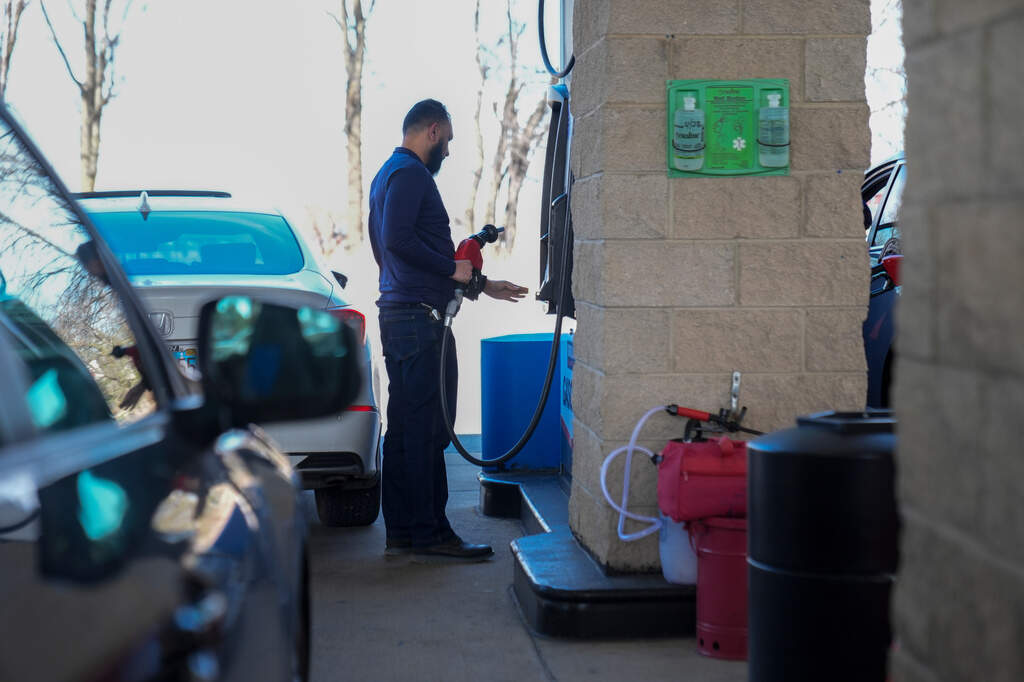
The U.S. has been spending up to $2 billion every day on the war with Iran. But that’s just military expenditure. What’s the real, long-term economic toll?
Guests
Justin Wolfers, economist. Professor of public policy and economics at the University of Michigan.
Linda Bilmes, Daniel Patrick Moynihan Senior Lecturer Chair in Public Policy and Public Finance at Harvard University's Kennedy School.
The version of our broadcast available at the top of this page and via podcast apps is a condensed version of the full show. You can listen to the full, unedited broadcast here:
Transcript
Part I
MEGHNA CHAKRABARTI: Three days before President Dwight D. Eisenhower stepped down from office, he spoke to the American people in what would become his most famous address. On January 17th, 1961, Eisenhower warned of the dangers of the military industrial complex and how a reliance on military might threaten the fundamental balance that must be maintained by any great nation.
EISENHOWER: Balance between our essential requirements as a nation and the duties imposed by the nation upon the individual, balance between actions of the moment and the national welfare of the future.
CHAKRABARTI: Eisenhower closed his speech with the simple formula to keep the nation on track.
EISENHOWER: We, you and I, and our government must avoid the impulse to live only for today. Plundering for our own ease and convenience, the precious resources of tomorrow. We cannot mortgage the material assets of our grandchildren without risking the loss also of their political and spiritual heritage.
CHAKRABARTI: Now, the military industrial complex speech might be Eisenhower's best known, but I would say it's not his best one.
I think that one came eight years earlier. On April 16th, 1953, Eisenhower spoke before the American Society of Newspaper editors. It was his first address to the American people after becoming president just a few months earlier. Eisenhower, of course, had come to the presidency after his own service in the United States military.
He was a decorated general and as Supreme commander of the Allied Expeditionary Force in Europe, he led major actions such as D-Day that helped secure victory over Hitler's Germany. And yet this man who had seen how overwhelming military might saved the world from Nazi darkness, he came away from World War II with a warning.
Now, this speech was called The Chance for Peace.
EISENHOWER: It is fitting, I think that I speak to you, the editors of America, a life of perpetual fear and tension, a burden of arms draining the wealth and labor of all people. A wasting of strength that defies the American system or the Soviet system, or any system to achieve true abundance and happiness for the peoples of this earth.
CHAKRABARTI: Now, in the Chance for Peace speech, Eisenhower carefully enumerated what he saw as the true cost of war.
EISENHOWER: Every gun that is made, every warship launched, every rocket fired signifies, in the final sense, a theft from those who hunger and are not fed, those who are cold and are not clothed. This world in arms is not spending money alone.
It is spending the sweat of its laborers, the genius of its scientists, the hopes of its children. The cost of one modern heavy bomber is this. A modern brick school in more than 30 cities. It is two electric power plants each serving a town of 60,000 populations. It is two fine, fully equipped hospitals. It is some 50 miles of concrete pavement.
We pay for a single fighter plane with a half million bushels a week. We pay for a single destroyer with new homes that could have housed more than 8,000 people. This is, I repeat the best way of life to be found on the road the world has been taking. This is not a way of life at all in any true sense.
CHAKRABARTI: President Dwight D. Eisenhower, in April of 1953.
Exactly 73 years later, President Donald Trump has seemed to say that Eisenhower's sober prediction has come to pass. Just a couple of weeks ago, on April 1st, Trump said that his war with Iran is so expensive the nation cannot afford to pay for desired needs of his own citizens. Trump told an audience that he had directed Russell Vought, director of the Office of Management and Budget not to use federal funding for things like daycare.
TRUMP: And I actually said to them, I said to Russell, don't send any money for daycare because the United States can't take care of daycare. That has to be up to a state. We can't take care of daycare. We're a big country. We have 50 states. We have all these other people. We're fighting wars. We can't take care of daycare.
You gotta let a state take care of daycare and they should pay for it too. They should pay. They have to raise their taxes. But they should pay for it. And we could lower our taxes a little bit to them to make up for, but we, it's not possible for us to take care of daycare, Medicaid, Medicare, all these individual things.
They can do it on a state basis. You can't do it on a federal. We have to take care of one thing, military protection, we have to guard the country. But all these little things, all these little scams that have taken place, you have to let states take care of them, Russell, and you have to do it.
CHAKRABARTI: Daycare, Medicare, Medicaid, in the President's words, little scams that the United States federal government cannot contribute to because it has to take care of, quote, one thing: military protection, but does the president, quote, have to do it? Or is it actually a choice? Beyond the line-item costs of bombs and planes, what is the true economic and opportunity cost of the war with Iran? Now, this is actually a question that many of you sent to us when we asked you a couple of weeks ago, what do you want to know about this war? So today we're going to try to find the answer. And we're going to begin with Justin Wolfers.
He's a professor of Public Policy and Economics at the University of Michigan, and he's been talking a lot publicly about how to understand the true cost of war. Professor Wolfers, welcome to On Point.
JUSTIN WOLFERS: Meghna, happy to be here.
CHAKRABARTI: So first and foremost, I like to actually start with the nitty gritty details and build up to these bigger sort of philosophical questions about how to run a nation.
So let's start with one of the estimates that the Defense Department has given about how much the war would cost. Anywhere from a billion to $2 billion a day. What do you make of that?
WOLFERS: It's a good estimate of what it's trying to estimate, and it says almost nothing about the true cost of war.
What they're doing there is they're counting the costs of guns and bullets and getting soldiers into position. That might sound absurd to you, that we could be spending money like that, but realize that a Tomahawk missile. Look, I'm not in defense procurement, so I don't have the exact price, but the Tomahawk missile costs something around two to $4 million.
So we've launched, I think hundreds of them, and you can see very quickly how just the cost of bombs adds up to being quite a lot. But let me just, I want to try and make sure that your listeners put themselves in the right frame here. One of the most difficult things in all of economics is understanding the differences between millions, billions, and trillions, and keeping these enormous numbers in our head.
They're all confusing and they all, frankly, just sound large. And in some sense, that's what our mind does. It just codes them as large. But actually $2 billion a day is not that much. That's less than 10 bucks per American. The problem is when you start to broaden the lens beyond just counting the cost of bullets, that's when you start to run into much, much bigger numbers.
Numbers that look like hundreds of billions of dollars, or to put it in the language of an everyday person, thousands of dollars per American.
CHAKRABARTI: Thousands of dollars per American, what? Per day, per week, annually.
WOLFERS: In total for the war. Look, it's one of those things where there's no point trying to dazzle you with artificial precision.
I am just trying to figure out how many zeroes are there, and I think the right answer is that an American household should say the excursion into Iran has cost their household thousands and maybe even tens of thousands of dollars. And if you want to go further and say, this is going to lead to a military buildup, and we can dig into that.
That's when it might turn into recurring costs that get bigger and bigger, that come back every year. And so then that would be thousands of dollars per year.
CHAKRABARTI: So we are going to do that a little bit later in the show, but I also wanted to ask you Justin, every estimate is only the best estimate at that time.
It's a snapshot because even as we were trying to prepare for this program you told our producer, Leila, that you would hesitate to talk about on Friday how much the war might cost because everything could change over the weekend, which I guess it did with the president's announcement of the blockade of the blockade. Where would you put your, how would you describe the cost now, just even as it's changed in the past 48 hours?
WOLFERS: So the reason, what a world we live in that I can't forecast on Friday, what I'll think on Monday. Look, coming into the weekend, there was some hope that we might be on the cusp of a ceasefire.
If it was a ceasefire, then this did turn out to be at the upper end of a four-to-six-week war. A lot of the political rhetoric would've been, look, it's behind us. Let's move on. Let's hug it out. We're all set. There's no economic cost. And I think a really important point to make is actually we've already incurred very large economic costs, but a lot of the risks are about, look, if we don't just hug it out this weekend and we didn't, then as we well know from past excursions into the Middle East, a short operation can end up dragging out and taking years. It can rewire America's place in the world, and it can rewire our defense needs. And so those are the sorts of things that start to work out to be thousands of dollars per household.
CHAKRABARTI: Okay, we have a minute before our first break, let me ask you again since I get it. Like putting exact dollar figures on a war is a challenging exercise. But the federal government, let me just say, the Trump White House is actually trying to get more money for the military, right? They have a, what, $200 billion request they'd like to put in front of Congress?
Do we have any understanding about how those numbers get generated?
WOLFERS: Yeah, so this is fascinating. So look, here's I think the broader context of this, which is okay, even if everything ended tomorrow, what's going to happen? We know Iran's going to want to spend a lot more on defense given everything it's just gone through.
We think it's that others in the region will want to do so as well. We get a sense that the United States is not as reliable of a NATO partner as it once was. And our friends in Europe might feel the need to spend some more and gain some military independence. And then we'll discover that the U.S, everyone else in the world is spending more on defense and the U.S. wants to be number one. That just raised the price of being number one, and that's where we've actually seen a request for $500 billion per year in extra defense spending. And we already have a trillion-dollar defense budget.
Part II
CHAKRABARTI: Professor Wolfers, hang on here for just a second because I do wanna observe for a moment what almost every American already knows, that one way to measure the cost of war is the price of gas. Because the national average cost of a gallon of gas is now well over $4 a gallon. That's according to AAA. Diesel is even higher.
And of course, fuel prices, they not only instantly hit American families, they cascade across an entire economy as well. And the thing about fuel prices is that they react almost instantaneously to war because energy markets are very responsive to major disruptions.
And here's the thing: We absolutely have seen this before.
REPORTER (Tape): What's your advice to the average American who is hurting now, facing the prospect of $4 a gallon gasoline? A lot of people facing --
PRESIDENT GEORGE W. BUSH: Wait, what did you just say? You're predicting $4 a gallon gasoline?
REPORTER: A number of analysts are predicting $4 a gallon gasoline this spring when they reformulate.
BUSH: Um, that's interesting. I hadn't heard that.
REPORTER: Yes, sir.
BUSH: I know it's high now.
CHAKRABARTI: Well, that is then President George W. Bush at a briefing on February 28, 2008. he was responding to a question about rising gas prices. Of course, 2007 brought us the subprime mortgage crisis that was already straining the economy. But so was the cost of war.
Because between 2001 and 2007, Congress had already authorized more than $600 billion for military operations in Iraq, Afghanistan, and the War on Terror. And so by mid 2008, prices at the pump continued to climb.
Here's President Bush again. This is July 15, 2008.
REPORTER: Mr. President, in February you were asked about Americans facing the prospect of $4 a gallon gasoline and you said you hadn't heard of that at the time. Gas prices --
BUSH: I’m aware of it now.
REPORTER: Gas prices are now approaching $5 a gallon in some parts of the country. Offshore oil exploration is obviously a long-term approach. What is the short-term advice for Americans? What can you do now to help them?
BUSH: First of all, there is a psychology in the oil market that basically says, supplies are going to stay stagnant while demand rises. And that's reflected somewhat in the price of crude oil. Gasoline prices are reflected — the amount of a gasoline price at the pump is reflected in the price of crude oil.
CHAKRABARTI: Well, gas hit its peak that year in July of 2008, when the highest nationwide average gas price per gallon was $5.10.
But of course, like the question we're asking now, back in 2008, the same question still applied: What is the true cost of war? And in this case, the war with Iraq?
Well, let me introduce someone who has calculated that dollar cost at about $3 trillion.
Linda Bilmes joins us. She's the Daniel Patrick Moynihan Senior Lecturer in Public Policy and Public Finance at Harvard's Kennedy School of Government. Prior to that, she served as Assistant Secretary of Commerce in the administration of President Bill Clinton, and she's also author of the forthcoming "The Ghost Budget: Paying for America's Wars."
Professor Bilmes, welcome to On Point.
LINDA BILMES: Thank you.
CHAKRABARTI: So I love getting into the nitty gritty. And we'll go back to Professor Wolfers here in a few minutes to give us the larger economic analysis. But where do we begin in terms of actually calculating the long-term dollar cost of a war?
BILMES: Well, you start by understanding that the costs fall into three categories. There's an upfront cost, a medium-term cost and a long-term cost. And right now what we're seeing is that the official numbers are focused very narrowly on the upfront operating costs.
CHAKRABARTI: For the Iran war?
BILMES: For the Iran war. I mean, so we've been told that the upfront cost is, the first week was $11.3 billion. So maybe the cost now is like 25, 30 billion. But I mean, in fact, those numbers are actually underestimates, partly because of the way the Pentagon tracks inventory.
CHAKRABARTI: Oh, interesting.
BILMES: So what they are telling us is the cost of the historic value of inventory, but the replacement costs are much higher. So, for example, the tomahawks that we're firing now cost $2 million each, but replacing them cost $3.5 million each. And Patriot missiles and inventories are valued at $1 to 2 million, but the replacements cost $4 to 5 million. So even the upfront costs we see are underestimates.
CHAKRABARTI: By half, given those numbers.
BILMES: Yeah, at least by 50%. For sure.
CHAKRABARTI: Okay. So what I'd love to do is then use this knowledge to help us understand how you came to that $3 trillion figure for Iraq. Because of course there's a war that we were present there for a couple of decades, but do you have a number for the upfront military cost of the Iraq war?
BILMES: Well, when we looked at the Iraq War — and this book with Joe Stiglitz came out in 2008 — we were assuming that the war would be finished by 2015. Of course, it continued in Afghanistan until 2021.
But we looked at the money that had been appropriated. We also looked at the long-term care for veterans, disability benefits, the long-term cost of replenishing and restocking military inventory, as well as economic costs such as depreciation, the cost of removing those who were wounded from the workforce, the related defense department spending, for example, increases in the defense TRICARE system and the cost of we attributed a small amount of the — all of that war was paid for through borrowing, through debt.
CHAKRABARTI: Uh-huh. So the cost of borrowing.
BILMES: We included some of the cost of borrowing.
CHAKRABARTI: You included some? Not all?
BILMES: Well, we only included what we could absolutely track back to what we had already borrowed.
CHAKRABARTI: Okay.
BILMES: Now if you just the $3 trillion that we calculated at that point is up to $4.5, 5 trillion now.
But I think the point is that like in nearly all wars, the administration vastly underestimated this. President Bush and Secretary Rumsfeld thought that it would cost $40 billion and it ended up costing at least 3 trillion. And they actually fired the chief economic advisor, Larry Lindsey, because he said it was gonna cost more than they were saying.
CHAKRABARTI: Okay. So orders of magnitude underestimates come I would say because of, well, obviously overt political reasons. But I can't imagine that the White House or the Defense Department at the time was taking into account all these other things that you said — long-term care for veterans, as you're saying, the cost of lost labor, and, of course, then the cost of borrowing. These are things that in the middle of a hot war, the hot phase of a war, I just don't imagine that political leaders are considering.
BILMES: No, I think they're not considering that at all. I mean, they are considering the absolute tip of the iceberg. They're considering simply the operating costs of the munitions that are being spent. They're not even considering the cost prior to the war in Iran now — the cost of the Houthis' activity, the cost of when you see these numbers, they're not including Operation Midnight Hammer, which was our operations in Iran six months ago.
And they're certainly not including all of the reconstruction of facilities. For example, we have 20 major facilities across the Middle East, 17 of which have been severely damaged. I mean, they're not even taking into account the reconstruction of those facilities, which are gonna take four to five years.
CHAKRABARTI: $5 trillion now for the long-term cost of the Iraq war.
BILMES: Yes.
CHAKRABARTI: Iraq and Afghanistan?
BILMES: I mean, Iraq and Afghanistan wars. And it's difficult to parse them out because a lot of the, the personnel fought in both and a lot of the equipment was used in both. But there are some, including my colleagues at thecostofwar.org, who put the cost at $8 trillion.
CHAKRABARTI: Okay. And you were saying though, that someone in the Bush administration though, alerted them to this?
BILMES: Yes. Lawrence Lindsey, who was the chief economic advisor, he said at the time that they were underestimating the costs and he was fired.
CHAKRABARTI: Wow. Okay, so hang on here for just a second, Professor Bilmes.
Justin Wolfers, let me bring you back in here.
WOLFERS: Yeah.
CHAKRABARTI: First of all, your quick thoughts about all the additional factors that Professor Bilmes is talking about that we really must consider to understand the overall cost of a war?
WOLFERS: Yeah. Look, she's the leading global expert on precisely this question, and so I'm so pleased that your audience had the chance to hear from her directly. What I wanna do is actually underline a really, really important point that she made.
She says that the cost of the Iraq war ended up being roughly 100 times larger than the early forecasts. You can actually hear that a different way. If you remember very early on, Donald Rumsfeld said, "This war might take six days, six weeks, but I doubt six months," and it ended up taking much longer than six years. So what that tells you is that Rumsfeld's forecast was wrong by roughly 365 times.
That, by the way, is a pattern you see time and time again. Countries only enter wars when they think that it's not gonna be so bad. And part of the often when you think that it's because you're wrong. And so when we realized the cost of war could be 100 times larger than we estimate, that suggests a general caution about moving forward.
Now it's, you know, so that I think is a lot of what you're seeing when you see things like financial markets, consumer confidence, and just that pit in the feeling of the stomach that many of us feel right now is it is possible we're only spending $10 or 20 billion, you know, per week on bonds, but it's equally possible that once you start to think about the broader consequences of this, it's just enormously, enormously larger.
CHAKRABARTI: Mm-hmm. So this is one major takeaway from this conversation then, that we have evidence from previous wars that the overall costs would be, could be two orders of magnitude — 100 times, if not more, higher than the bill that people are talking about now.
Professor Bilmes, there's something I wanna dig in a little deeper with you on your analysis here. Of course, the care for veterans is a moral necessity, so, you know, I'm not gonna put any judgment on that. That's a moral necessity. We ask people to sacrifice for this country. We owe them the top amount of healthcare. But how much is that costing? Do we know from Iran and Iraq? Do you have kind of a breakout number for that? I mean, sorry, Iraq and Afghanistan.
BILMES: Right. Well. Let me put this in context. Joe Stiglitz and I had testified early on in the Iraq and Afghanistan war that the cost of caring for veterans was going to be very, very high, an order of magnitude above what was being discussed at the time. And we were pilloried at the time for saying that this was just not possible.
But over the years, the number of veterans who claimed was much higher, the number of conditions for which they claimed was much higher, the stress on the veterans was much higher. And so we now have a shocking number.
If you look at the U.S. financial statements, the United States owes $7.3 trillion, that's money that has already been been promised, but not yet paid to current veterans of previous wars. That's Iraq and Afghanistan and Gulf War veterans mostly, and some Vietnam veterans. It's hard to parse out exactly how much is just Iraq and Afghanistan.
CHAKRABARTI: And this is for healthcare claims?
BILMES: This is just for disability benefits.
CHAKRABARTI: Just disability benefits, more than $7 trillion.
BILMES: More than $7 trillion. Not including medical care.
CHAKRABARTI: And it hasn't been paid to them?
BILMES: And it has not been paid. We have promised it. And we've also not set aside any funds — I have been discussing for years that we should set aside a veterans trust fund — we have not set aside a dime to pay this debt, this sort of deferred compensation that we have already promised.
Now in this war now in Iran, we have 56,000 U.S. troops who are in the region. Many of them have been exposed to toxins, contaminants, benzene, et cetera. And so they will be under the terms of the PACT Act eligible to claim lifetime disability benefits for any medical conditions that arise from this exposure or are aggravated. And that runs the gamut from asthma to cancer.
So we will just, just with what we have already seen, if these veterans claim at the same rate as those from the short 1991 Gulf War, then we can expect 37% of them to receive lifetime benefits, which is already tens of billions of dollars.
CHAKRABARTI: Okay, professor Wolfers, back to you on another one of the major sort of breakout sections of overall costs that Professor Bilmes talked about — the cost of borrowing.
Now this one's very, very interesting to me because of course, we have members of Congress who on the one side of their mouth decry the national debt. They say, you know, it's hampering and shackling our grandchildren and our great-grandchildren. But wars increase that cost. I mean, I think, and professor Bilmes, correct me if I'm wrong, but when the U.S. invaded Iraq in 2003, the federal debt was something like $4ish trillion, and then now it's $31 trillion.
BILMES: Yes. That's debt held by the public.
CHAKRABARTI: By the public, okay. Ascribed to war and tax cuts?
BILMES: A large percentage of this were the two wars and the four tax cuts.
CHAKRABARTI: And the four tax cuts. Okay. So Professor Wolfers, back to you on that. Economically, how do you consider the broader impact of the cost of debt that we accrue from wars?
WOLFERS: I'm gonna give you a really simple shortcut for thinking about this actually. Some people say that there's three ways to pay for a war. You tax, you cut back on spending, or you borrow. Now, I'm gonna say if there are useful ways in which we should cut back our spending, there are probably useful ways we should do it, whether we're at war or not. In which case, that's not a useful way. So we can sort of separate that set of issues.
And so then we can either tax people or we can borrow. But actually borrowing money, given that you have to pay it back, is just money that you therefore have to tax in the future. So there's only one way to fund it, and that's by taxing people. The White House has just asked for a $500 billion per year increase in the defense budget. That works out at roughly $4,000 per American household.
And the thing about this is you start spending like that and all of a sudden defense contractors get fat, they start lobbying for this to stick around, the world actually hasn't gotten quite, you know, wildly dangerous yet. You could even see this going up further. So look, let's say that that sticks around for a decade. If you are paying an extra $4,000 of tax per year for a decade, that's $40,000 right there. To be a little bit graphic about it, think about your suburban family with two cars in the driveway, it's like the president just bombed one of them, and you're gonna get by with one fewer car.
Part III
CHAKRABARTI: Now, professors, if you just hang on here with me, we like to continue to find ways to make tangible these costs that we're talking about.
And I was really quite interested in the fact that so much of this rests on choices, right? How policy makers make choices, how the president makes choices, and now we even have choices made in the private sector. And here's an example, because we like to talk about the airline industry on this show, and of course, it took a very big hit with dramatic increases in jet fuel price prices last month. That's directly due to the war with Iran.
Delta Airlines in particular recently reported that it had to pay an additional $2 billion in fuel costs for the first quarter of this year. So Q1 of 2026. And they just had an earnings call on April 8. And in that earnings call, CEO Ed Bastian was asked if Delta Airlines could reasonably achieve the projected profits they had anticipated for the rest of this year.
ED BASTIAN (Tape:) We do expect, hopefully, that fuel settles down. Now it'll settle down, I think, at a higher level than where we have in the plan. So fuel recapture is gonna be important.
CHAKRABARTI: Okay, so this is an earnings call. I will provide translation. The translation is jet fuel prices might go down, but Bastian does not think that they will return for a while to pre-war costs. So Delta's CEO said they're gonna find a way to quote "recapture" those fuel costs in order to protect profit margins. So how are they gonna do that? Bastian went on.
BASTIAN: The degree to which we can retain any of the pricing strength that we talked about from industry rationalization that will certainly help us boost our margins this year and clearly into next year as well.
CHAKRABARTI: So translation, the airline industry did have to raise ticket prices because of those increased jet fuel costs. That's the so-called "industry rationalization" Bastian mentioned. But then he said Delta is going to keep those higher ticket prices — that's the pricing strength — even after jet fuel prices go down, so Delta can continue boosting those profit margins this year, or at least make the projections that shareholders are expecting.
Now also on Wednesday of last week, Delta reported that their Q1 revenue was $15.9 billion, and most of that was driven by sales of those premium seats, and their huge airline credit card business. But the real bottom line is that after adjusting for what Delta describes as one-off factors and taxes, et cetera, Delta said it had earned a profit of more than $420 million in the first quarter, which is a 45% increase from a year earlier.
So, Justin Wolfers, let me turn to you really quickly here. Again in trying to understand the long-term costs on Americans, this seems to be one of them, sort of the retaining of the pricing strength, as Delta CEO Ed Bastian said there.
WOLFERS: So a big part of this is actually what's gonna happen to oil over the next few years. So when the ceasefire first hit, you saw a lot of celebration, both in financial markets as oil prices fell. And then in the White House, they were like, oh, good. This is all gonna be behind us very quickly. Oil prices will fall, everything's going back to normal.
What you saw instead is if you look at futures markets, where people are literally buying and selling oil for future years, or you could think about this as betting on the future price of oil, those prices went up and they've stayed up pretty much the whole time. This is financial markets effectively saying there is now a new risk premium in global oil markets. You know, markets are not very good at telling stories, but they are saying there's a story out there, or maybe several possible future stories that are going to mean that oil stays high through 2026, 27, 28, and 29.
I'm ineloquent in describing what that story is, but I think most of the listeners could imagine possible futures in which the world doesn't just return to normal and expensive oil, and therefore a less productive economy, becomes part of our future.
CHAKRABARTI: Less productive economy. Okay, so hold that thought because I wanna come back to that.
But Professor Bilmes, if I may, I wanna just return to this question of debt, right? If I understand correctly, right now the United States is paying how much? How much of our national budget is going to debt service?
BILMES: 15%.
CHAKRABARTI: 15%. So if you were a regular household and you kept up that much, that amount of required debt service and then got even more in debt, pretty soon creditors wouldn't be giving you extra credit. I mean, tell me more about your thoughts on the long-term weight of this debt service.
BILMES: So what is really remarkable is that in every previous war prior to the Iraq war, presidents spent a lot of time trying to figure out how to avoid debt. And we raised taxes in the War of 1812, the Civil War, the Spanish-American War, World War I and II, Korean War, Vietnam War — raised taxes a lot. I mean, President Truman raised taxes, top marginal rates to 92% to avoid borrowing and gave 206 speeches about why we should not pass on the cost of the war to our children, to the next generation.
I mean, they all talked about this. And they talked about also the progressive nature of taxation, trying to figure out how to make sure that they evened out among the winners and losers. President Wilson called for what he called a conscription of wealth as well as conscription of men, and he raised corporate taxes from 1% to 12%. So there was this huge amount of effort to sort of think about this issue.
This phenomenon like broke after 2001 where President Bush cut taxes twice as we went into Iraq and Afghanistan. President Trump cut taxes in 2017. He cut taxes again last year. So all of this --
CHAKRABARTI: President Trump did. Yeah.
BILMES: President Trump. Yeah. I mean, all of this cost is being transferred on to you and other young people and to my kids and future generations. And this is really different than what the United States has done in the past.
CHAKRABARTI: Professor Wolfers, how does that future cost burden then translate into — is there a long-term economic cost in terms of the health of the U.S. economy for our children and grandchildren?
WOLFERS: Yeah, sometimes it's easier with fiscal stuff to just simplify, which is, we can ask very big questions like what is the optimal amount of debt and things like that. But underneath all the macroeconomics, there's microeconomics.
CHAKRABARTI: Mm-hmm.
WOLFERS: Which is, if we're gonna spend money on something, are we getting good value for it? So if we build a school, is that gonna make people's lives better off? And do the benefits exceed the costs? All told, that's pretty easy with a lot of things. Dropping bombs in other countries, it's a much less obvious cost-benefit. And I think that's actually the threshold question here, which is Professor Bilmes pointed out that we're spending literally hundreds of billions of dollars, maybe even more, in terms of lost opportunity. And the question is, what are we getting for it?
Some wars are worth fighting, some are profoundly moral. Others less so. And those questions are a big part of the cost and benefit calculations that any one of your listeners is capable of making for themselves.
CHAKRABARTI: Mm-hmm. One more of the sort of aspects of costs that we don't often consider, professor Bilmes, that you mentioned, because I honestly have not heard this mentioned at all outside of probably the circles that you run in, and that's the cost of lost labor. You mentioned that earlier. How did that factor into understanding the overall cost of the Iraq war?
BILMES: Well, in the Iraq war, you had a ground war, so it was somewhat different, but there were thousands, many thousands of service members who were no longer able to work or no longer able to work in the capacity that they had previously. And I mean, that removed people from the labor force and in many cases required spouses or parents to leave the labor force to become caregivers.
And over 20 years of war in Iraq and Afghanistan with a very high level of disabilities. I mean, 54% of all — so more than half — of Iraq and Afghanistan veterans and all veterans going back to the Gulf War have some form of disability. So that does remove a number of able-bodied young people. Obviously not all. But it also means that for many, they could no longer do a particular job and they had to do something else.
Let me ask you though, and all due respect, is that number, is that reduction in available labor significant enough giving given the overall labor force in the United States? Or is it kind of a rounding error?
BILMES: Well, it was significant in the Iraq and Afghanistan wars. I think Justin could comment more on the concept. But I think when we think about human costs, it feels a little bit crass almost to put a number on that loss. But it feels even more crass to not put a number on the loss of human life and the loss of human productive capacity.
CHAKRABARTI: Right. Okay. Well just a minute ago, professor Wolfers talked about the overall economic and opportunity cost of the war, and the question is are Americans getting value for their money when we're paying trillions of dollars for wars of choice? Well, primarily from the Democratic side of the aisle, there are lots of people who have been speaking up about what else that money could have paid for.
SENATOR ELIZABETH WARREN (Tape): What could we do with the $12 billion that the Trump administration spent on just the first week of the war with Iran? Well, we could have provided housing assistance for about a million Americans, or lowered prescription drug costs for millions of people or paid for the entire National Park Service for more than three years.
JON FAVREAU: It could restore Obamacare subsidies for 22 million people for six years, food stamps for 42 million Americans for two years, and school lunches, free school lunches for every kid in America for five years.
REP. ZOE LOFGREN: We could extend the ACA tax credits that they let expire for six years. We could quadruple the amount of funds we're putting into medical research and find cures for diseases that people are dying from. We could wipe out every American's medical debt.
REP. RO KHANNA: For the amount of time we've been in Iran. We could pay for childcare at $10 a day for every middle class family and working class family in America, and pay childcare workers $25 an hour.
CHAKRABARTI: Justin Wolfers, I do wanna point out, these are all Democratic voices, of course. So there's political purposes behind them talking about these things. But at the same time, the stuff that this could have paid for would apply to every American, regardless of if they're a Democrat, Republican or fill in the blank. I mean, are these fair ways to measure opportunity cost or the cost of lost potential development that we could have in the American economy?
WOLFERS: Mate, this is all fair and in fact most of it's understated. This isn't Democrat or Republican. I teach economics 101. I have an introductory economics textbook, the first chapter, and the first thing we talk about on the first day of class, this is standard economics, is always ask yourself, should I do this or what? And that question or what? What am I giving up to do this? That's the question of opportunity cost.
What those talking points you're hearing from those Democratic speakers were talking about, there was an attempt to put it in human terms, but they're actually trying to put the very small numbers from the Pentagon, the $12 billion being spent on bombs in context. If instead you start to think about the much larger numbers that I think professor Bilmes' research would point to, or that I've been pointing to in some of my recent work, you're talking about very real costs on the orders of thousands of dollars per year per American household, and each of us has the imagination to think of useful things we can do with it.
I just want to come back though and and just repeat one really important thing. Sometimes these costs are worth it. If what we get to do is push forward the march for justice, if we get to prevent the march of the Nazis, if we could avoid another Holocaust. These are good and noble things to do. The question that I think everyone should be asking is, is our engagement in Iran likely to make the world a better, freer, more just, more prosperous place? And so far I've not seen much evidence that we've made anyone's life better off.
CHAKRABARTI: Professor Bilmes, your thoughts?
BILMES: Well, I agree with everything that Justin has just said. And the way I tend to think about this is when we think about how we're spending money and how we allocate resources across society, I work with a lot of cities and teach municipal finance. And you look at these numbers, these sort of huge numbers, and I think about what this could do in a lot of the cities where I work.
I mean, we are spending now $400,000 a day to flush the toilets on the USS Gerald Ford because the sewage system has broken down and needs a chemical flush. And it also needs to be repaired. And they had a fire. And I mean, that could fix a lot of potholes in Fitchburg. I mean, even at the very basic level, the way we are allocating resources in this war seems completely flawed and wrong for a war of choice.
And it is highly asymmetrical. The Iranians are spending $35,000 to produce drones. And we are spending $3 million, $4 million to take out each one of these drones. And they have 20 underground drone cities where they can make cheap drones. So it doesn't make sense kind of on any level. Or on any yardstick.
CHAKRABARTI: Well, thanks to both of you, today, I come away with a deeper understanding of how to really make sense of the numbers coming out of the White House and the Pentagon, that really we can estimate that there are hundreds of times less than what the true overall cost of the war is. That $7 trillion that we already owe in disability benefits to veterans from previous wars. And then the opportunity cost of what else we could have done for the United States.
So Linda Bilmes and Justin Wolfers, thank you both so much for being with us today.
The first draft of this transcript was created by Descript, an AI transcription tool. An On Point producer then thoroughly reviewed, corrected, and reformatted the transcript before publication. The use of this AI tool creates the capacity to provide these transcripts.
This program aired on April 13, 2026.