Support WBUR
The 'why' behind how we talk
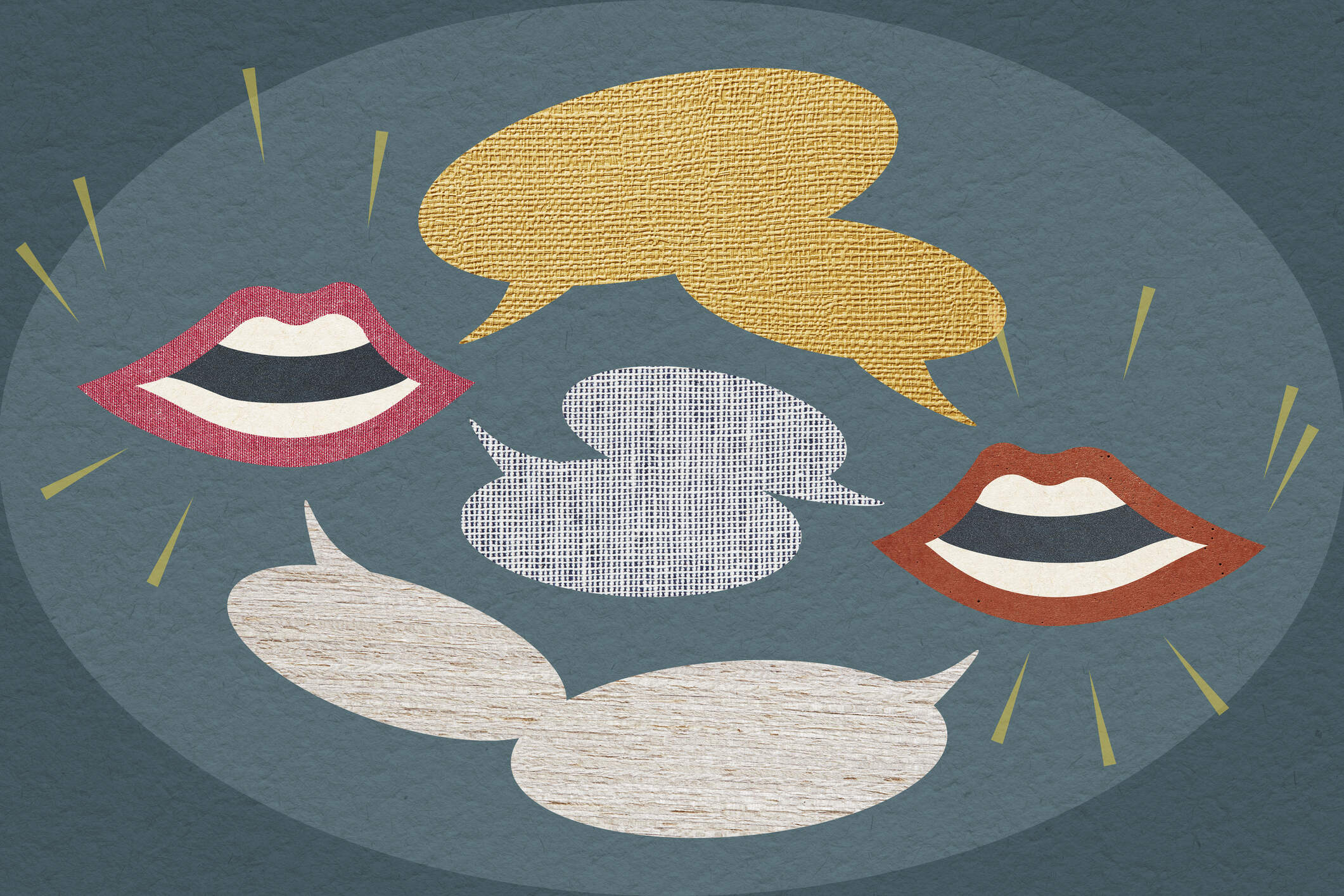
An accent doesn’t just tell someone where you are from – but who you are – your cultural background, race, age and class. How the way we talk tells people more than we think.
Guest
Valerie Fridland, professor of linguistics at the University of Nevada in Reno. Author of several books, including "Like, Literally, Dude: Arguing for the Good" and "Bad English, "and the upcoming book “Why We Talk Funny: The Real Story Behind Our Accents."
The version of our broadcast available at the top of this page and via podcast apps is a condensed version of the full show. You can listen to the full, unedited broadcast here:
Book Excerpt
From Why We Talk Funny by Valerie Fridland, published by Viking Books, an imprint of Penguin Publishing Group, a division of Penguin Random House, LLC. Copyright © 2026 by Valerie Fridland.
Transcript
Part I
MEGHNA CHAKRABARTI: This is On Point. I'm Meghna Chakrabarti, and these are just some of the sounds of America.
(LISTENER MONTAGE)
CHAKRABARTI: That was On Point listeners from the top Ralph Sorrell from West Jefferson, North Carolina, Ricardo Vargas from Milwaukee, Wisconsin, Joe DiBari from Rhode Island, Emily from Minnesota, Julie Cheek from Easley, South Carolina, Didi Herald from Glade Park, Colorado, Chris April from New Orleans, Louisiana, Regina Cox from eastern Kentucky, and Richard Jaenisch from Bemidji, Minnesota.
Now the Irish playwright George Bernard Shaw famously said once that the U.S. and the UK are two nations separated by a common language.
Within the United States, of course, you could say that we're one nation whose internal borders include the invisible divides between some 30 dialects and even more sub-regional accents. And how we talk has always been connected to who we are, and that leads both to the beauty of regional heritage.
And the almost instantaneous negative perceptions that we carry about each other regarding race and class. Making assumptions about people based on how they talk remains unfortunately, an acceptable bias. But why do we talk, how we talk? What factors of history and even biology go into making the gorgeous sounds of American speech?
Valerie Fridland is a professor of linguistics at the University of Nevada in Reno, and she's author of Why We Talk Funny: The Real Story Behind Our Accents. Professor Fridland, welcome to On Point.
VALERIE FRIDLAND: Thank you. I am so excited to be here to talk about those fabulous accents you played.
CHAKRABARTI: Those were just a few.
We put a call out last week for On Point listeners to send us samples of how they talk. We got a lot, so we'll hear more throughout the hour. But can you, would you be willing to play a little game with me first to start off?
FRIDLAND: Oh, oh. Okay. Let's try it. I'm not good at games, especially early.
CHAKRABARTI: Okay. Okay. No, but you'll be good at this one, or at least it'll be instructive. I hope.
FRIDLAND: Okay. Okay.
CHAKRABARTI: Okay. So you're hearing how I talk. You heard how I read and quite frankly, how I talk is how I talk. I don't actually have a separate radio persona from who I am, although maybe --
FRIDLAND: It's your everyday voice.
CHAKRABARTI: I'm a little less emotional on the air, let's put it, than I'm off the air. I don't know if you already know where I'm from. Hopefully you don't. But where would you guess that I'm from? In the United States?
FRIDLAND: Huh? That one's a hard one, but can we play a little game back? Because that might help me narrow it down.
Okay. I'm gonna spell some words.
CHAKRABARTI: Okay.
FRIDLAND: And I want you to say them, and that will help me figure out where you're from.
CHAKRABARTI: Got it.
FRIDLAND: So the first one I'm gonna spell is cot. Okay, and then I'm gonna spell C-A-U-G-H-T.
CHAKRABARTI: Cot.
FRIDLAND: Say them together.
CHAKRABARTI: Cot.
FRIDLAND: Okay. I would hazard to guess that you have a Western origin.
CHAKRABARTI: Oh.
FRIDLAND: On the basis of that alone.
CHAKRABARTI: Really? Yes. That's so good. Yeah. I grew up in Oregon.
FRIDLAND: Yes. There you have what's called the cot-caught merger, or in linguistic circles, the low back vowel merger, which is the biggest marker of Western speech. Now the interesting thing is it's actually spreading, so a lot of southerners have it.
I actually grew up in the south and I have it, but it is an absolute no-no in most parts, Northeast, unless you're from Boston.
CHAKRABARTI: I've been in Boston for a little while now, so maybe those two regions are reinforcing each other. Although, sorry, fellow Bostonians. I still pronounce my Rs.
But Professor Fridland, you said you were from the south?
FRIDLAND: I am. I grew up in Memphis, Tennessee.
CHAKRABARTI: Okay. We're going to get to this a little bit later, but if I hadn't heard you tell me that, I'm not sure I would've been able to identify that in how you talk.
FRIDLAND: There it comes out. I think a lot of people say when they go home their accent comes out and there are certain things I say that people do tag it on, but generally speaking, I'm part of the generation, which is Generation X, for whom regional accents have really, especially from urban areas have really started to die out. And so that's part of the reason I don't sound super southern, is a lot of the people I grew up with don't either.
CHAKRABARTI: I can tell you that so many of our listeners want to talk about exactly that, about why within their own families, accents are seeming to or are going away.
We're gonna hold that for the last part of the show because first we have some more work to do here. Your book is called Why we talk funny. And of course that phrase comes from people who get told, you talk funny. But of course, is there such a thing as a standard American accent?
FRIDLAND: In the American imaginary. Yes. And so a lot of people would say I speak without an accent. And that would be probably what people think of as that standard American sort of Midwestern inspired accent or the broadcast standard. But the reality is there is no such thing as someone who speaks without an accent.
We might be the one speaking without an accent that's highly noticeable in terms of the features it has, so that people would point to them and say, oh, that tags you as being from this place or that place. But every accent, every way we talk says something about our social identity in ways we probably don't realize.
It says something about your age because changes usually come to younger speakers. It says something about often your ethnicity, your nation, your class. And so whether or not you think you speak with an accent. It says something about you and everybody has one.
CHAKRABARTI: This has always been a bugbear of mine because the idea that there's one standard accent has nothing to do with actual speech and everything to do with, I would say, political power.
And historical power. Because as you said, no matter how we talk, that is how we talk. There's no one right way or wrong way unless I don't know, a government or a particular class has decided that they are the OG of speech. And so the fact that maybe not so much today as it was a generation or two ago, but the fact that America does retain so many different regional and even ethnic accents, I would say that's a good thing, that holding onto that form of identity remains important to Americans.
FRIDLAND: It's an incredibly important thing. You lose something when you lose an accent. And just thinking about when you talk about that accent that people think is accentless, the sort of standard American accent people aspire to in their educational systems and things like that. When you think about the type of people that speak that way, they're not the people you wanna go hang out with at a bar after work. The people with the local accents, they're way more fun. It's just, there's that intimacy and a solidarity and a fellowship and a comradery that doesn't exist when you get to the standard kind of forms of speech because they are more formal and they're placeless.
So they don't matter to us in these social ways, the same way local accents do, which really bond us to people and places.
CHAKRABARTI: Accent is a powerful tool of identity and bonding. And also because we can actually control it a little. It's a powerful tool of belonging outside of the groups that we were born into, which is another thing listeners want to talk about, and we'll get to that in a minute. But I want to dig in more into obviously the why of how we talk. In your book, you write about like at what point in time does someone start developing an accent and at does there come an age in which it becomes baked in? No matter what we would try to do to, to change how we talk.
FRIDLAND: Absolutely.
I think we don't realize when we are judging people on their accents or asking people to do things like switch accents and not speak a certain way anymore, that your accents come very young. You're children when you get your accent, so babies as early as five months old, start to notice the accents around them.
So obviously they don't comment on them and they're probably not very judgy about them like we are later. But if you are having two speakers in a room with a baby and someone sounds more like the accent that they have at home, they are more likely to turn towards that person or a little older, like at 10 months, they're more likely to take a toy from that person.
So clearly there's a salience to accent very early on, and by age two to four we find that mothers in particular are starting to model some of the local accent forms to their children, and we see that by age five children have already started to move away from the parent system and move towards those way cooler people known as peers in kindergarten.
So your accent starts really young. And even at five we find that children will pick someone of a similar accent to be their friend more often than someone of a different accent. So the social bonding of accents comes very early, and then by the time you reach adulthood, it is baked in. So you are not going to be able to change that accent in the same way you could, say, if you moved someplace when you were eight, where you could pick up local features.
Really what we're doing as adults, when we move to a new area and we try to get aspects of that accent, is we're doing this mismatch, blended, where we pick up a few superficial features of that accent. If I move to the south, I might start saying pen and pen more alike, but I probably don't know that the same vowel needs to merge in words like sense and sense.
So I wouldn't do it in the natural pattern.
Part II
CHAKRABARTI: Let's let our On Point listeners, once again here, or let them in here to show us how they talk. And many of them told us that not only do they have an accent obviously when they speak, but they are also very cognizant or sensitive to how other people hear them.
(MONTAGE PLAYS)
CHAKRABARTI: So again, from the top, that was On Point listeners Megan Calhoun from Columbus, Ohio, Adam from Arlington, Massachusetts, Karen Mule Brown from New York, Sarah Hudnell from Wimberley, Texas, May Hitchings from Athens, Georgia, John Austin Gregory from Chatham, Virginia, Steve from Massachusetts, Mary Coker from Waynesville, North Carolina, and Emeka Ofobike, Jr from Austin, Texas.
So Professor Fridland, I want to get more into the sort of the how behind how we talk, but let's just address the issue that listeners brought up there. While accent, as you were saying earlier, is one of the most powerful bonding mechanisms between people.
It's also a very exclusionary one. And I think one of the things that makes it particularly interesting is that it's one of the indicators of origin in class that with work we can actually erase about ourselves. Can you talk about how it became such a strong, a strong analog for not only where we're from, but what socioeconomic or even education level we have.
FRIDLAND: Absolutely. And I think it's an interesting thing about accents that they're so valuable to us in terms of our own identities and how we talk. Is something that we use to relate to other people, but we are also very aware of how we're judged on the basis of how we talk. And there's very little in life you do where you don't speak.
So it's hard when you come from an accent background that you might be proud of and it might identify you with people that you love and cherish, but at the same time, you know that people are judging you for it. And this has actually been a problem for centuries, but it's pretty recent actually, that it's a marker of class to the degree that we see it today.
Very few other things are not legislated, but accent is something where it's still okay to judge people on the basis of that. Social characteristics you associate with it. And what is during the earlier eras of English back in Britain. Pre 1600s, 1700s.
There were certainly differences in the way people spoke. Massive ones, depending on whether you were a commoner or someone in the royal family or aristocrat, but you really couldn't move. There was no such thing as class in that sense, because there was rank, there was title, there was standing, so you either were in the higher classes.
Or you weren't born to it, so there was no movement. So maybe people noticed the way others talk, but it wasn't used as such a strong determinant of where people could move to. But with the industrial revolution, that really revolutionized the way that people could move in class. They could become wealthy.
They could buy titles, they could buy land, they could be your next-door neighbor all of a sudden. But one thing that they couldn't do is buy a new accent. Even though they did try, and actually when you look at the 18th century, that's where we get a flood of elocution handbooks, of usage guides, of dictionaries.
And they were all really marketed towards these people that were the nouveau riche, so to speak, that wanted to try to get rid of that last marker that held them apart in society. And that's where we see the strong sort of accent complaint culture come to play that we still see today. And of course, when you come to the United States where class is not so salient as it is back in Britain, and as it was at that point where sort of the class divides have melded somewhat, what is this sort of democratized English in the sense that everybody should then have this better accent.
That was the Noah Webster view of English. And then that actually backfired in some ways. Because it also made people feel like an accent that they didn't have to begin with was attainable. And it's not always that way. And this idea that there's a good accent and a bad accent really grew out of that experience.
CHAKRABARTI: Right.
Meaning we still haven't overcome the presumption, right? That how we talk is indicative of how intelligent we are. I was listening to the On Point listener who said she feels really horrible that she's internalized this thought that if she speaks in her natural accent, it means to everyone around her that she's not smart. Which is, it's such a damning judgment that we pass on people that actually has no correlation whatsoever to education level, intelligence, even just wherewithal, there's something so sticky about accents that we still accept that as a bias.
FRIDLAND: It's crazy that we think that somehow a linguistic feature can have any meaning at all, right? Yeah. Exactly. If we drop the R in New York, it's low class. If you drop the R in London, it's high class. So that alone should tell you it can't possibly be the feature. But what happens is accents are triggers for social stereotypes.
Accents are triggers for social stereotypes.
And so when we hear someone that belongs to a group that their accent ties them to, whatever stereotypes we have about that group, that they're lazy, that they're uneducated or that they're smart, but untouchable and unpleasant, whatever that activation is gets attached to the sounds in their speech and it's not fair.
But it's unfortunately what we do and we do it innately. We just go and it triggers it and we have to work hard to get over that.
CHAKRABARTI: So there's the class-based bias that we attach to accents, and then of course there's a race bias as well. And we actually had a really interesting caller talk about this.
This is Emeka Ofobike Jr., and Emeka was born in Nigeria, but moved to the United States when he was four years old, and he shares a story with us about when he was 17 and someone called his house to conduct a phone survey.
EMEKA OFOBIKE JR.: And at the end she got to the demographic part of the survey and she asked my age.
I told her, and when she asked my race, I told her I was Black. And I remember she started laughing. And after she stopped laughing, I was like, what? And that's when she realized I was serious and that I was Black. And that's when it occurred to me that this girl had been thinking she'd been talking to a white person the entire time and had no idea based on how I spoke, that I was Black.
CHAKRABARTI: Professor Fridland, respond to that.
FRIDLAND: Yes. Race is one of the big things that we take from hearing someone talk and it's one of those funny things that a lot of times in courtrooms, for example, if people are asked about the race of someone they might have overheard. A lot of times that's ruled as inadmissible.
But in real life, when we get on the phone or we run into someone, we often will associate ethnic cues with the way they talk. And so that is a problem for people that don't have those accents. So a lot of times people have had that same experience where there is no such thing as a white accent or a Black accent.
In reality, it's just who you spend time with and where you grow up and the people that talk around you as a child. That's the accent you get. But we do have these very strong associations with race and sounds that in even saying hello, a lot of times people will say, they can tell the race of the speaker.
So obviously that person in that clip was surrounded by people that didn't sound traditionally Black. And so when someone heard them as white, they just couldn't believe that they were in fact African American, and I don't think they're alone. In fact, there's a famous case of a Stanford professor who is African American who does not sound traditionally African American in terms of the sort of traditional ethnic markers.
And he was trying to find a house in Palo Alto, and he was calling to get rentals to see rentals and when they heard him, they thought he was white and they said the room was available or the house was available. When he went to show up to see it, they all of a sudden had it rented because they realized he was a Black man. So this is a real problem.
CHAKRABARTI: Yeah. The same question that we asked about, it seems kind of ridiculous that accent would even, we would believe that has any association with intelligence. Why is it that basically the same presumption is applied when we hear people of different ethnicities talk?
Let me put it this way. How is it that different ethnic accents, if I can put it that way. It might be really just a clumsy way of putting it, evolved in the United States.
FRIDLAND: The African American English accent is probably the most well-known one. And the one that's also most knocked for sounding uneducated or all these sort of negative stereotypes being put on it.
But the fascinating thing is the history of that accent or that dialect is incredibly old and in some ways it's a colonial accent. And so this idea that somehow, it's based on standard English that we speak today, and it's somehow a bastardized form of it is completely historically inaccurate.
But the reason that people think that they put it on that is because, again, the stereotypes about African Americans have long been negative. So then speech that identifies them as sounding Black gets those same stereotypes loaded on them. But of course, there's also the really positive, beautiful solidarity, fellowship, shared experience, shared struggle that it represents for speakers with that accent.
CHAKRABARTI: Yeah. So I want to get down to some elemental aspects of why we even have accents, thinking about human evolution overall. On the one hand, in terms of the fact that there are so many different languages over millions of years of human development. That makes sense to me. As we spread out from Africa as a species and people became more regionally isolated.
Maybe that's one of the ways that different language classes form, but within one language, why would accents form, especially if originally the speakers of those languages maybe didn't mix that up that much with other speakers of different languages?
FRIDLAND: For the very same reason those first accents and languages form.
So if you think about, we have 7,000 languages or so today. We probably had more like 10,000, 5,000 years ago. So we're not at our apex of language diversity now. But all of those languages really probably started in some primordial language. About 50,000 years ago, there was probably just a few languages that had come, maybe a hundred thousand years from one language.
And those were accents; those started as accents where people were speaking the same language and they spread out. And anytime we're not talking to each other, natural linguistic tendencies of mouth and mind. So just the way that our brains work and preferences we have in speech and also the way our mouths work when sounds come together naturally lead to variation.
So language is inherently variable. That's the nature of the beast. But when I'm in group A over here and you're in group B over there, and we're no longer talking to each other, then the path those subtle variations take will be different over time, eventually leading to completely different languages if we never have contact with each other.
But the intermediary stage is accent. So as people in group A start to have differences, so maybe class differences or one group settles on one side of the horse tracks. The other one's there, they don't talk to each other as often. And really the bread and butter of accent is interaction. The more you interact with each other and the more different ways you interact with each other, and the more fulfilling those interactions are, the more you do something called speech accommodation, which is a natural tendency to start mimicking each other's types of speech.
And we do that every day when we meet somebody. But when you're living together intensely, you do it even more. And so your speech will be more and more like those you spend a lot of time with. And more and more not like those you're not talking to as often. So even in the same place, differences in social space, so differences by age, differences by race differences even by gender, depending on the culture, those will separate us in terms of who we're talking to, and those lead to these small variations over time becoming meaningful.
CHAKRABARTI: Okay. And so then getting back to how we form the accents, and you said really, it's when we're young, that's the formative period, but why can't we, or why do we have a much harder time changing our accents when we're older?
It's not just a matter of neurological habit, does something about even just the way our mouths work change.
FRIDLAND: Absolutely. There is some neurological basis to it as well. We seem to have more elastic brains. Our brains haven't lateralized as children, so we probably also have that going for us as kids.
This more cognitive advantage to pick up languages. But the fundamental difference between a child and an adult is that a child has a blank slate when they're born. They don't have another language system competing with one that they're learning. But as an adult, once you're old enough to do tequila shots and vote, you also are able to talk about it.
And so that's a problem because whatever system you already have set in becomes interference for whatever new system or new sounds you're trying to pick up. So it's also about that. Accents are not just without meaning. They are really valuable to us in many ways. And so it's also about motivation and identity.
And sometimes, depending on who you are, if you move to a new place, you might also be denied interaction, genuine, relatable interaction that would allow you to pick up those features. Because it's all about what we can observe in the patterns of speech around us.
CHAKRABARTI: You said that even when kindergartners are first in a classroom together, they tend to want to gravitate with people who speak similarly to them, which was mind blowing to me.
But how fast do we make judgments about each other when we first meet each other through the vehicle of accents?
FRIDLAND: About 400 milliseconds into a conversation, we're already getting some pretty quick down and dirty assessments of that person. Depending on what aspects you're looking at, we have seen really interesting experiments that even in speech played backwards, people could recognize whether they were listening to a foreign accented or native accented speaker. And there was one experiment that had American listeners listen to French speakers or American English speakers. And on the basis of one sound, either a T or a U vowel say whether they were native or not, and they were spot on within 30 seconds.
Part III
CHAKRABARTI: We heard from a lot of On Point listeners who are worried about the future of their accents and the community that it represents.
And there was one woman in particular who sent us some very moving thoughts. She's SaraVard Von Gruenigen. She lives in Kentucky. She's from Central Kentucky actually, specifically Lancaster.
SARAVARD VON GRUENIGEN: I'm an eighth generation Kentuckian. All branches of my family have been in this state before it was even established as Kentucky.
They came across the Cumberland Gap as settlers and have been here since.
CHAKRABARTI: Her husband and his family are also from Kentucky.
VON GRUENIGEN: My husband has lived in central Kentucky, a couple generations in, but his family came from eastern Kentucky in the forties to where we are now, and he has a much stronger accent than me.
CHAKRABARTI: So same state, but they don't sound alike.
It's very interesting that you can go into different pockets of our state and find different nuances of what would be considered a Southern Appalachian accent.
CHAKRABARTI: Like many Americans, there are times where SaraVard is very conscious of how she talks.
VON GRUENIGEN: Even when I began this video, I noticed myself initially wanting to reign in my accent because that's just what I do when something feels professional. Obviously, there's a thing here where at some point in my life I understood that my accent could be at a disadvantage and I could be considered ignorant.
CHAKRABARTI: However, SaraVard knows and loves exactly what her accent, the way she sounds to herself and to others, what that really means. Because when people hear her, she says they're hearing her ties to a place, a history, and a heritage.
VON GRUENIGEN: My accent is a homage to my ancestors, where they came from, their traditions. It's such an easy way for us to indicate where we're from, the rituals and the lifestyle that we know, and we should be proud of where we came from and what our accent stands for.
My accent is a homage to my ancestors, where they came from, their traditions.
CHAKRABARTI: And they are proud, but things are changing and so many listeners, as I've said, so many listeners have told us this, that around them, they hear their accents disappearing and it's happening within their own families.
SaraVard has a 12-year-old son.
He has virtually no accent, and that bothers me a lot. My concern is future generations, my son and beyond, that if they don't carry on the accent in any capacity, like they're not doing, because he doesn't code switch at all.
He just doesn't have an accent. What does that mean for the memories and the culture that we've had and the generations prior? There'll be a couple generations deep that they won't even remember people that had accents like us.
CHAKRABARTI: That was On Point listener SaraVard Von Gruenigen in Lancaster, Kentucky.
Now, Professor Fridland, you had said earlier that you as a Gen Xer, me also, are the first generation of people where we hear this precipitous kind of of drop off in the strength of regional accents and with SaraVard, her 12-year-old son, she says he doesn't have one at all. My first, the first culprit I point to is mass media.
Because if we are doing sort of accent accommodation, as you said earlier, when we mix with other people, mass media is a giant mixing machine. Is that what's causing this?
FRIDLAND: That's an easy scapegoat. And I think yes, we can blame it somewhat, the internet in particular, but it really didn't start there because with Generation X, which is our generation now that I've outed myself age wise.
We didn't really grow up with the internet, so since formatively accents are something from childhood, they're not something we inherited at 18. If you didn't have it when you were growing up, it probably isn't responsible for the movement away for our generation. Which is really the first generation we see.
CHAKRABARTI: Is television.
FRIDLAND: Television has not been found to be that big of a influence on changing your accent or forming your accent. It's really more about elevating certain accents. So when we see the impact of TV it's more about which accents get heard on television, and so often it elevates one accent type over the other, but its impact is actually pretty minimal.
The internet has certainly been a stronger impact, but what really happened is after World War II, there were political, economic, social, and demographic changes that came into play. And over the decades, things like suburbanization, the dying of industry and the Rust Belt, the relocation of industries to the Sunbelt and particularly the South with the mass introduction of air conditioning where businesses now thought, oh, this is a good place and it's much cheaper and lower regulations. Let's move down there. All of those things really started with Generation X. That was the first generation for whom all those changes were interactive in their social circles and in who they came in contact with. And that's what fundamentally started us down this path.
And then the internet came in.
CHAKRABARTI: Okay. Hang on. But explain this to me. The spread of suburbia. After the second World War, and as you said, maybe relocation of industry. Draw the line for me.
FRIDLAND: Draw the line. Okay.
CHAKRABARTI: How did that lead to a reduction of regional accents?
FRIDLAND: There's two separate things going on there with a suburbanization in many cases was an essentially a white flight out of ... ethnic enclaves in urban centers after the great migration.
And so a lot of white parents took their, the Boomer parents, took their Gen X babies and moved to the suburbs. And what we see is it's in the baby boomer era that we see a lot of distinctions growing. So that regional accents were actually increasing. We get some vowel changes that were coming in, and a lot of that seems to be a linguistic white flight of sorts.
But their children, which is Generation X, they didn't have that kind of racial disharmony in the same degree as their parents. And in fact, the Civil Rights era really brought sort of awareness of this, this sort of cleave in the relations. And so that was one aspect. So their speech didn't reflect those sort of ethnically divided inner city versus outer city kinds of traits.
But on top of that, you had industries that were redefining the way they did hiring. So they moved away from local hiring to more external hiring practices. They also, a lot of times, just disrupted the industry in that area, so people would have to move away. And whenever you have a change in who you interact with, either people coming into your industry or you're having to leave for a job and go talk to other people in other places, that will change the type of accent your kids are going to have.
And it's really going to be your children, which were Generation X, that have that first kind of impact of those changes.
CHAKRABARTI: Let me ask you another thing. Earlier you talked about a class and how that has been very determinative of accent, especially because there's not much interclass mixing, especially in generations past.
But after the second World War, we also have the sort of largest period of growth for the American middle class. Many more people come into the middle class, and I'm wondering if that growth of middle class has actually contributed also.
FRIDLAND: Absolutely. Absolutely. That is another big impact.
It was massive. I think, prior to World War II, it was like 20% of people could be classified as middle or upper class, and it's 60 or 70% in the growth period after that. It's massive, that shift in class structure and that does change who you interact with and also the types of things that motivate you, in terms of the dialects you might want to model yourself after.
So a lot of people that want to leave their communities, which whenever you see class mobility, a lot of times you also seem more just general mobility. When you plan to leave your community, we find that impacts as a child how much of a local accent you get. And so all of those factors are absolutely at work.
CHAKRABARTI: So in a sense, even though we are lamenting, and I really understand all the people who called us and said, look, how I talk is going away. And therefore, that you heard SaraVard say that automatic intrinsic connection to place and heritage seems to be loosening. So there's heartache there, but at the same time, the causes for these, the reduction in regional accents, it's not the worst thing in the world.
So how do you read the emotional reaction people are having?
FRIDLAND: It's absolutely understandable, and I think SaraVard said it so beautifully that accents are ties to who we are and who we came from and where we came from and the heritage and the history behind it. And really, accents are the story of humanity.
And so when we lose them, we lose part of that story, and that's one of the reasons this book was so important to me. Because it captures this idea that there's a great history in the way we talk, that we sometimes ignore. And the accents that are most salient are the ones that tell the biggest stories.
And so I do feel it's a loss and I absolutely empathize with those that are mourning it in their own children. We're not losing accents, so I don't want to give the false sense that accents are dying. Regional, local, regional accents might be dying to some degree. But there are many other accents that we still are having come in formation.
And also, the internet gives access to some accents that I think weren't really widespread in visibility before. So the internet does play a big role, especially with Gen Z. So Gen X, it wasn't the internet, but Gen Z and Gen Alpha, absolutely. This sort of more pan regional view they're getting in their social circles from being on the internet all the time.
Even if they're sitting at the same table, they're often on the internet. That actually is really moving them away from local accents in a way that I think even Gen X didn't do. But what it's also doing is giving a visibility to other subcultures of speech that perhaps we didn't see so much before.
And so African American English is one of those subcultures where the accent divides actually for African American English speakers have increased, and the attraction of a sort of white young speakers from the burbs to that accent has really increased because of social media, but also political divides are now shaping our speech.
So accents are there and they will always be there, but it's going to be new forms of accents and maybe not local, regional ones so much.
CHAKRABARTI: Hang on. Political divides shaping our speech. Explain that one to me a little bit more.
FRIDLAND: If we look at patterns of interaction as being the driving force of accents and also the fact that we have this speech accommodation instinct, especially with those we want to mirror and be more like, and maybe move away from those that we don't, then any divide that's coming in between us in terms of interaction is going to impact our speech.
And one of the things that's been really interesting in some recent research is that whether we are conservative leaning or liberal leaning might actually be impacting the types of accents that we are attracted to. So particularly in the south when we do perception studies, we find that people that hear strong southern accents are more likely to hear those people that have them as being conservative and having views on things like gun control and abortion that are conservative leaning.
And in the north, we also find that people who are participating in what's called the northern city shift, which are some vowel changes that are very north, northern where you'd say something like bad, more like bad. Those are actually also heard as more liberal leaning. What we find is that maybe people are picking up more southern features when they live in the south, if they happen to be conservative. And that some of the movement away from southern accents in urban areas in the south is actually not a movement away from the history of the south or the culture of the south, but maybe the conservatism of the south, so that we're having all these really interesting interactions with other ways we were united or divided.
CHAKRABARTI: Wow. Okay. So America's political tribalism now ingraining itself in our speech. Wow. Okay. I just want to play a couple more contributions from On Point listeners because they were just so insightful and delightful. So this is Mike, who grew up in Wisconsin but has since moved to Idaho, and that's where he met his wife.
And Mike says there are a pair of words that show that the accents are different between him and his wife. And one of them is Dawn, like the beginning of the day, and Don as in the man's name.
MIKE: I pronounce them dawn for the morning and Don for the man. But my Idaho wife pronounces those words exactly the same.
Sort of a dawn, I can't even do it. And I learned later on that this is because there are large swaths of America that have actually lost a vowel sound. It's the sound I use in dawn. They actually can't say it. So in Idaho, they made fun of me because I talk funny, but I can make fun of them because they have lost a vowel that I still have.
CHAKRABARTI: So that's Mike in Idaho, by way of Wisconsin. Now here's Jim in Austin, Texas. His father is Italian born, and Jim says his dad really did not like it when people who weren't Italian put on an Italian accent. So much so that Jim's father didn't even enjoy classic movies like The Godfather.
Jim's father also did not like answering machines.
JIM: So one day I knew my father would be calling me, and rather than pick up the phone, I left a new greeting on my answering machine. Said, Buongiorno this is Jim.
At the moment, I'm not able to answer the phone, so please out the tone, leave your name, a telephone number, and a message. Gracie. To my surprise, my father left a message. He said, Hey, Jim, shut up.
CHAKRABARTI: Jim from Austin, Texas. Oh, thank you. By the way, to every listener who sent us a comment, there were so many more than we had time for.
But professor Fridland, let me ask you. I'm still taken by this dual role that accents play and they have since the beginning of time for humanity, right? This almost instantaneous way to measure whether or not we're of the same group, whether we can survive together, thrive together, work together.
And at the same time that same instant judgment produces sometimes impenetrable walls. So I'm just wondering for you as a linguist, how does this help you understand where we are as a country now, the political part, just really, that's a big question, but it got me thinking.
FRIDLAND: I think if we look back in history, what we'll find is accents divides have always been there. In fact, with the Revolutionary War, that changed speech so that people wanted to move away from Britain, and that was part of the reason why our fullness of American speech was embraced because it really set us apart from those people back in particularly London, who were dropping their R's.
So it was a revolutionary sound to use. And then, with the Civil War, we saw also big divides in speech. In fact, the Southern accent that we think of, the one that SaraVard was lamenting being lost, it really came about after the Civil War. People think that difference in speech regionally is centuries old, but it actually really is a fairly new accent.
And it was because of the divide brought by the Civil War between the North and the South. So accents have always been there as mirrors for who we're talking to and that will never change. But I think what we need to fundamentally realize is that they're also about what we have in common.
The first draft of this transcript was created by Descript, an AI transcription tool. An On Point producer then thoroughly reviewed, corrected, and reformatted the transcript before publication. The use of this AI tool creates the capacity to provide these transcripts.
This program aired on April 17, 2026.