Support WBUR
Trump vs. the Pope
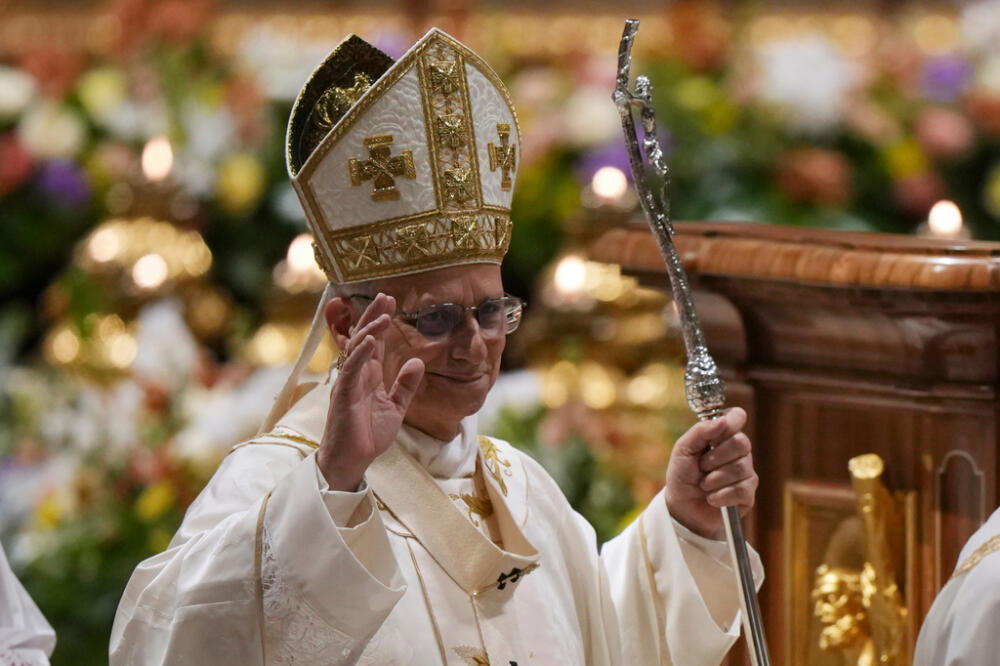
President Donald Trump is no stranger to an internet feud. But now, he’s taken on a whole new adversary: the Catholic Church. What impact will it have on the country’s Catholic electorate?
Guest
Michele Dillon, dean of the College of Liberal Arts at the University of New Hampshire of Sociology.
Massimo Faggioli, professor in ecclesiology at the Loyola Institute at Trinity College Dublin.
Brian Fraga, staff reporter at National Catholic Reporter.
The version of our broadcast available at the top of this page and via podcast apps is a condensed version of the full show. You can listen to the full, unedited broadcast here:
Transcript
Part I
DEBORAH BECKER: The dispute between President Trump and Pope Leo the 14th intensified recently with increasingly sharp remarks between the leader of the United States and the head of the world's Catholics. Over the weekend, both sides downplayed the spat, which has been going on for the past few weeks.
It was Easter Sunday, April 6th when President Trump wrote an expletive filled post on Truth Social about the Iran War, threatening to blow up Iran's infrastructure the next day. The president posted again. This time writing, quote, a whole civilization will die if Iran didn't comply with U.S. demands. Pope Leo said that threat is unacceptable.
He then held a prayer service calling on both sides to negotiate. Trump posted on Truth Social again this time directly about the Pope Trump wrote that Pope Leo is quote weak on crime and should focus on being the Pope and not a politician. Two days later, Pope Leo responded by telling reporters he's not afraid of the Trump administration.
POPE LEO: And I will continue to speak out loud against war, looking to promote peace, promoting dialogue and multilateral relationships among the states to look for just solutions to problems. Too many people are suffering in the world today. Too many innocent people are being killed, and I think someone has to stand up and say, there's a better way to put this.
I have no fear. Neither the Trump administration are speaking out loudly about the message in the gospel.
BECKER: And soon after that, vice President, JD Vance, a Catholic convert, said at a Turning Point USA event in Georgia that the Pope should not be getting involved.
JD VANCE: In the same way that it's important for the Vice President of the United States to be careful when I talk about matters of public policy, I think it's very important for the Pope to be careful when he talks about matters of theology.
BECKER: President Trump doubled down cutting $11 million in federal funding from Catholic charities in Miami. President Trump says he doesn't have a problem with the Pope.
They just don't agree about the war in Iran. Here's Trump speaking with reporters on April 16th.
TRUMP: I have no disagreement with the fact the Pope can say what he wants and I want him to say what he wants, but I can disagree. I think that Iran could not have a nuclear weapon. If they do, the whole world would be at jeopardy.
The Middle East will be blown up and the whole world will be at jeopardy. We're very close to making a deal. That'll be a great thing. The Pope has to understand, Iran has killed more than 42,000 people over the last few months. Think of it, protestors without guns, without anything, there were totally unarmed protestors.
The Pope has to understand that. This is the real world. It's a nasty world.
BECKER: And in a visit to Cameroon last week, the Pope used uncharacteristically strong language to emphasize his anti-war message, and criticized the use of religious language and symbolism to help justify the war.
POPE LEO: The masters of war pretended not to know that it takes only a moment to destroy, yet often a lifetime is often not enough to rebuild.
They turn a blind eye to the fact that billions of dollars are spent on killing, on devastation, yet the resources needed for healing, education and restoration are nowhere to be found. Jesus told us blessed are the peacemakers, but woe to those who manipulate religion in the very name of God for their own military, economic, or political gain.
Dragging that which is sacred into darkness and filth.
BECKER: But over the weekend, the Pope said those comments, those were about peace. They were not directed at President Trump.
POPE LEO: It was looked at as if I was trying to debate again the president, which is not in my interest at all.
BECKER: And also, over the weekend, Vice President Vance said he was grateful for those comments from the Pope. Vance said of the Pope quote, he will be in our prayers, and I hope that will be in his. ... We're talking about the President and the Pope and what this public spat might mean to voters. I'm joined by Michele Dillon, Dean of the College of Liberal Arts at the University of New Hampshire, and an expert on the authority of the Catholic Church.
Welcome to On Point.
MICHELE DILLON: Thank you Deborah. Happy to be here.
BECKER: Also with this is Massimo Faggioli, professor of Ecclesiology at the Loyola Institute at Trinity College in Dublin, Ireland. He's an historian and expert on the Vatican. Hello.
MASSIMO FAGGIOLI: Thank you, Deborah. Thank you for having me.
BECKER: So I want to hear from each of you here on what you make of this back and forth between the President and the Pope.
We'll get to history in a minute, but I'm wondering if you can tell me if you think that this is a really unprecedented disagreement between these two leaders. I wonder, Professor Dillon, can we start with you?
DILLON: Thanks, Deborah. Yes. I would say that first of all. It has gotten a lot of attention in the media for all kinds of reasons that we all understand, but I think we have to keep in mind that even though we're emphasizing and the splicing of all the various quotations you started the program with really shows this conflict.
Ultimately, when the Pope is speaking, he's not speaking in terms of his own personal opinion, he's really conveying what is longstanding Catholic Church teaching on peace and war and the importance of peace and everything that everyone does, whether their church leaders are political leaders, and of course in the context of the Iran War and the context of the fact of the Pope Leo being an American himself, there is more attention to his words strictly in the U.S. context.
And so I think that has just added a lot of extra attention to the dialogue, if we want to call it a dialogue, to the back and forth that has happened. But as Pope himself said the other day, he had his remarks for holy, he was in Cameroon, but also his Easter Sunday ceremony, his sermon on Easter Sunday.
Those would've been prepared long before anything had to do with Iran. And popes in general talk a lot about peace. And so I think we can't lose sight of that, because otherwise it just really adds intensity to making more of this back and forth than probably it ultimately really should be given.
BECKER: But so this is to you, is just a disagreement about foreign policy.
DILLON: I wouldn't say it's just a disagreement about foreign policy. It very much captures the very different worldviews of the Pope and of Catholic Church teaching relative to secular governments and in particular, recognition of the importance, while the Pope as a leader of its own of the Holy See, for example, is a diplomatic actor, he understands real politics and the complexities of the world. The Catholic Church has been a transnational actor for a long time, even before we think of lots of other countries coming to the sort of the table of international politics.
So church leaders and this pope in particular, because he's so well-traveled, fully understands and grasps the complexities of the world. But nonetheless, it's his job really, not only as a pastor, but as a moral leader and as a theological leader and as leader of the universal church to emphasize the importance of finding pathways that seek to avoid war and conflict and try to find a meaningful path to peace. So that's, I think, just very important to keep that in mind, that it's a different set of priorities that any Pope brings to these conversations. Very much different from what a political leader, and of course, especially any president of the U.S.
BECKER: Right. Massimo, what do you say about this disagreement and how significant you think it is?
FAGGIOLI: I think it's very significant because there are two main things that are different from the past. The first is that not just what President Trump said about Pope Leo, but also the response of Pope Leo.
It was in terms that are never used by the Vatican when dealing with these kind of things, meaning when Pope Leo appealed to the U.S. citizens to call the representatives to the congressmen.
BECKER: We actually have a clip of that. I'd like to play what the Pope said here, because I do think that this was key to the question of is this a bigger debate, a different debate, and did the Pope potentially cross a line?
Let's listen.
POPE LEO: Contact the authorities, political leaders, congressmen, to ask them, tell them to work for peace and to reject war.
BECKER: And that's Pope Leo talking amid this dispute with President Trump about comments on the war and Iran, sorry to interrupt you, Massimo, but I wanted to make sure that people could actually hear the Pope saying that.
So you say that this is different because of those comments from Pope Leo?
FAGGIOLI: Yes, because this intervention came because the Vatican was afraid that the nuclear option was on the table. And in response, Pope Leo used their own, the Vatican nuclear option, meaning appealing directly to voters, which implies a certain undermining of the political authority of the elected leaders of the democracy.
So we have a president here, the Cuban Missile Crisis of October 1962. Where there is an appeal of the Pope John XXIII, but it's an appeal to the political leaders, not to the citizens. And so this is new. I think this is different.
And the second different thing is this, is that we have, coming from the Trump administration, the White House, the Secretary of Defense a narrative that frames this war in religious terms, right? And this is something that the Vatican is very afraid of, because that could have long-term consequences in the relations between religions, nations.
So this is a different level from a disagreement on policies, but it's about the legitimacy of using a certain language.
BECKER: So basically, because the Trump administration has used religious language, religious symbolism in describing this war, and also there was the AI generated image on social media, in which the president appeared to be like Jesus, even though he says that's not what he intended, and the post has since been deleted. So you would say that part of this is broader concerns on the part of the Vatican that religious symbolism is being used to justify military action?
FAGGIOLI: I think so. I think this is part of the worries that are not just for the sake of the Catholic Church, of Catholics, but in terms of the future of the coexistence between different religions and so here, clearly, the Vatican needs America to make peace in the world, and so there is no anti-American policy coming from the Vatican, but they have been very clear in these last few weeks that they consider the use of the symbolism very dangerous and it must be avoided completely.
Part II
BECKER: We were talking before the break about where you think the Pope may have crossed the line and asking people to contact their political representatives and tell them that they are opposed to this. But when you hear someone like Cardinal Tobin say that the Pope, it is the Pope's responsibility to do things like this.
How do you square that?
FAGGIOLI: I square that because I do think Pope Leo crossed the line, and I do think he was right, because when there is the nuclear option on the table and there's a threat to use that, I think it's always been part of the job description of the Pope to take care and to of the one human family.
He's not speaking on behalf of for the sake of Christians or Catholics, but just as a defender of humanity. And so I don't think these two things are in convictions. ... But I think that was historically very significant.
It was not, so if we go back to 2003, the Iraq War, we had a totally different dynamic because we had the Pope and the papal diplomats talking to the White House of George W. Bush, but there was nothing like that. And so here, there is a historical salience of this moment that I think is much deeper than a policy disagreement between two world leaders.
It's something that I think could redefine the scrimmage line between church and state and religion and politics.
It's something that I think could redefine the scrimmage line between church and state and religion and politics.
Massimo Faggioli
BECKER: Would you say that Pope Leo is considered a more conservative pope or a more liberal pope, in the line of his predecessor, Pope Francis?
FAGGIOLI: I think Pope Leo is on many issues, far more cautious than Pope Francis. On same sex themes, on the themes of gender and of transgender, we have a much more cautious pope also because he's an Augustinian and not the Jesuit. So I don't think it's fair to characterize Pop Leo as a liberal, as a progressive. The peace and justice theme is by default something that is transideological.
And so it's very hard to label one church leader as liberal or conservative depending on what he says on just war because we have a history of very conservative church leaders who are totally pacifist, but they were incredibly conservative on doctrinal issues. ... And so I think that he's a pope who's really saying something on this particular war.
On the ideological religious framing on of this war. And on the world situation of these last four months since January, because this is when a new dynamic between the Vatican and the U.S. started building up.
BECKER: And Michelle Dillon. I wonder how consequential do you think it is for the Pope to be talking about foreign policy?
Among how consequential is it among Catholic voters in the United States? Do you think that they feel that they should be following the Pope in this regard?
DILLON: I think a lot of people are paying attention because of all the press coverage it's receiving, and it is quite unusual. I think though, for the most part, as we know in all kinds of issues, a lot of Catholics don't necessarily follow or adhere to the church's teachings, whether it's on war, whether it's on social justice, whether it's on sex and gender issues.
So that's well established. I think though, what's often forgotten though is that even when people disagree and Catholics have been disagreeing with Popes for many decades, that even when they disagree with what a Pope says, they also have actually a lot of respect and affection for the office of the Papacy.
And so I think that's an extra sort of nuance in this current debate that some people who are very strong, conservative Republicans who totally agree with President Trump and what he's saying, nonetheless, feel he shouldn't be about the war, shouldn't be calling out and disagreeing and making fun, if you will or like the AI generated meme of him as Pope.
And so I think that opens up some new conversation pieces there. But we know that even when people adore a pope, like a lot of Americans were very fond of John Paul II, but they didn't necessarily agree with his views on all kinds of issues, including on issues of war and peace. To that point, going back, we talk about it is somewhat unprecedented for a Pope to talk off the cuff to say people should have called their legislators.
But the Catholic Church, including John Paul II, was very gentle and active in terms of motivating solidarity actions in Poland, for example. And we forget that in the current moment and as significant he was to not only behind the scenes, but also quite publicly in terms of contributing to the decline really of the Soviet Union and eventually to the major changes there.
And that was very much in tandem with American political leaders at the time. So I think at the current moment, some of this gets maybe exaggerated or just gets more attention because it is such a constant 24/7, not just news cycle, but on social media. And I think while American Catholics who, most American Catholics, particularly white American Catholics, are Republican.
That they're Republican voters and have been actually for, at least since 2000, when basically 50% of white Catholics voted for George Bush. President Trump has received more of the white Catholic vote, and the vote of Hispanic and Black Catholics, and so that's interesting in the last election.
Now, presumably he might lose some of those voters, but by the time the next election comes around, or the midterms come later this year. I think for the most part, people will make up their mind on other issues, maybe about the war in general, maybe about inflation or some other issue.
But I think most voters, whether they're Catholic or not Catholic, are not single-issue voters. They're not going to be so insulted by one thing or so concerned by one major thing that they put other issues aside. And so I think there can be a blip in public opinion when something is currently happening and it's in the news, but maybe in a month from now, a similar poll would find that actually we've gone back to the status quo before this event happened.
BECKER: Massimo, I wonder what you think about the sort of big tent of Catholicism and how different it might be in terms of one particular faction being very conservative and maybe another being very liberal. How do you describe that when folks are trying to consider how this war of words between the pope and the president might affect Catholics and especially Catholic voters?
FAGGIOLI: This is something that in these last few days or weeks has pleased Democrats who are Catholics and has upset the other side. But I think Democrats, Catholics who vote for Democratic Party, they should be nervous as well, because we don't know what's going to be the next intervention of the pope, who knows.
And so this is a precedent that might say something on how this American pope sees his role in American politics. And so there is this split screen that now favors one narrative. But we will see what happens when the other party is in power and they might legislate on something considered apocalyptic, like on AI or something like that.
But there's something deeper, I think, on the right side of the spectrum, which is that this incident and the allegations made by President Trump against Pope Leo, it's revealing I think that there is a growing rift within the Trump coalition between old religious right of which Catholic conservatives were fully part of.
And there is a new right wing ideology called the techno or the techno bros, which has a very different relationship with the religion, not just the Pope or the Catholic Church, but religion.
BECKER: Is that the vice president? Would you include him?
FAGGIOLI: I would say Vice President Vance is one body in two souls in it because he's a very conservative Catholic, but he's also a creature of Silicon Valley, of Peter Thiel.
So that's how he started. And so that's why I think it's so difficult for Vice President Vance to articulate a position as a Catholic and as a vice president on this incident, Because he has to reconcile two very different kinds of right-wing cultures that are ideologically very distant when it's about human nature, the future of the planet, all of these things.
And so there is something emerging from this and I think some on the right side of the spectrum might see this with a certain suspicion that Trumpism is morphing into something else, more distant from the religious right and closer to Peter Thiel or Elon Musk. Cavalier attitude towards technology, AI in warfare, destroying civilizations to rebuild a future planet.
That's what I think this incident is revealing also.
BECKER: As Professor Dillon pointed out, a lot of Catholics, there used to be a term cafeteria, Catholics, right? That, that Catholics would just pick and choose the certain policies that they felt applied to them. And it wasn't necessarily a wholesale faith that was guiding your politics, right? That you could distinguish when you were talking about political matters, are you suggesting that also something different is at play here in terms of prioritizing faith?
FAGGIOLI: I think there's something different for a few reasons. The first one is that you always, in these last 50 years at least, you always have at cafeteria Catholics.
But this time, the arbiter, the referee. He is an American, and this is different from having a German pope saying abortion is immoral. So you have an American Pope, and this can be seen differently by these cafeteria dynamics, right? And secondly is that we are in the midst of a technological revolution.
AI is very much in the concerns of the Vatican, what this might mean for the future of being human. I think this war is very much, has been called the first AI war, and the Vatican of Pope Leo is so concerned about this because they see a new warring dawn in the history of humankind.
And so I think the relations between religion and politics are being reframed because now it's much more a relation between religion and technology. And politics follows technology. That's very much a concern of the church that is I think pushing them to be more proactive. Because once you had a head of state, president who you knew was the real leader, now you really don't know who's really driving the game of war. And so this is very much part of the reading of the Vatican and of the situation.
BECKER: I just want to bring something up because I know you said that you feel that Pope Leo crossed the line when he asked people to contact the representatives in Congress and tell them that they're opposed to the war if they are, but Popes have also been criticized for not taking a strong enough stance. Certainly, in World War II, the Pope was criticized for not condemning Hitler. So I guess I wonder, has the line changed for a Pope? When is a Pope supposed to comment and it's okay.
DILLON: I would say the Pope is always supposed to comment because the Catholic Church is a public church, and this goes to Vice President Vance's comment that the Vatican should stick to matters of what's going on in the church. That's ultimately not a Catholic position because the Catholic Church sees itself as articulating values and ethics for the whole of humanity.
And that goes also related to what Massimo said about AI. And the Vatican is very concerned about AI, but the core is concern for the dignity of each and every person. For the common good and all the things that go into allowing individuals, families, and communities live a flourishing life. And so therefore, anything that threatens that, including war, and that of course destabilizes the international order as well, which is very important to the Vatican.
That really is top priority for the Vatican, regardless of who is Pope to speak out on. And as you point out, sometimes the church has turned the blind eye or has been slow to speak out. And so I think it really is for the Vatican, its duty now, it doesn't mean it's not asking for its policies to be implemented.
It would advocate that this is the right approach. It's not, it totally respects the separation of church and state very much, but it also both as a church, as an institution, and it expects ordinary Catholics to speak out in the role as Catholic informed citizens. And so I think that's one of the tensions.
If you will, on issues, we talk about the separation between religion and politics, church and state. People cannot just go to mass on Sunday and then on Monday act as if their Catholicism is really meaningless in terms of how they form a moral conscience on whatever the set of issues are.
And then in that regard, and this certainly goes to American politics, in fact, most American Catholics are quite moderate, but Catholic social teaching and Catholic moral teaching doesn't align in any, a neat way at all, whether it's democratic politics or Republican politics and so that's the complexity is paying attention to what the church is saying, what the Pope is saying on this issue or some other issue, but recognizing that really is how the church understands its own role as a public church in the world, not just as talking to American audiences, but to a transnational world of Catholics and non-Catholics alike.
Part III
BECKER: Here is Brian Fraga, staff reporter at the National Catholic Reporter, who has covered the intersection of Catholicism and politics. Welcome to On Point, Brian.
BRIAN FRAGA: Hi. Hello.
BECKER: So tell me a little bit about how you think this spat between the Pope and President Trump may be affecting Catholic voters right now.
We've heard a lot about some divisions, different factions of Catholicism or the way that faith might affect voters. What's your take on how, where voters might take this?
FRAGA: From what I can tell in the course of my own reporting, in speaking with Catholics across the ideological spectrum, the vast majority of them, even the more conservative pro-Trump Catholics were disappointed with the president's choice of words in how he went after Pope Leo on social media.
They thought it was inappropriate. They didn't like it. At all. And even among, again, speaking with pro-Trump Catholics, they are very concerned that this could have an effect come the midterm elections in November. And especially since some recent polling indicates that President Trump has been, had been losing support among Catholics about a slight majority of Catholic voters. Now, according to some recent polling, have unfavorable opinions of President Trump, and that's mainly, it appears to be because of the lacking economy and President Trump's his foreign policy and wars in Iran.
Come November, the midterm elections, like it's a long ways away, but there is definite concern among Republicans and conservative Catholics that, you know, that this could further weaken his base of support among Catholics.
BECKER: Yeah, we should say Trump, has won over Catholics before. Most recently, most recent election, right?
55% of the Catholic vote compared with former Vice President Harris's 43%. Those were some numbers I saw from Pew Research Service and even higher number of Catholics supported Trump than Biden, a fellow Catholic in 2020. So Trump has enjoyed support from Catholic voters before.
Do you think that this particular disagreement with the Pope could affect those numbers in the future?
I know we talked about the fact that there appears to be concern right now, but it's a long time coming before people have to go to the ballot box. Do you think that folks will remember this?
FRAGA: Exactly. November is seven months away and that is an eternity in politics. So chances are, I think, you know that this probably won't matter too much come time for voters to appear at the polls. What is going to be more probably a lasting impact will be like the state of the economy or whether the conflict in the Middle East are still happening.
That seems to be what will, more issues that will really determine what happens in the midterm elections. But again, even so, speaking with conservative Catholics and others, like we have seen like a splintering of this Catholic base a little bit in terms of the foreign policy, we've seen Catholic, right wing Catholic commentators like Candace Owens and Taylor Marshall expressing very strong disapproval regarding Trump's foreign policy and war in Iran. And again, like President Trump's support among Catholics, like there is evidence that it has been slipping in recent months.
Despite the fact that he won with significant majorities of Catholics in the 2016 and 2024 elections, and that he even did well among Catholics against Joe Biden in 2020. So it's not something that, it's not something that President Trump can completely disregard.
I'd say it's something that he still has to be very concerned about.
BECKER: Yeah. Professor Dillon is with us as well, Dean of the College of Liberal Arts at the University of New Hampshire. And I wonder, Professor Dillon, what do you think about non-Catholic voters who might think, this isn't my religion, it doesn't really concern me.
Do you think it could, this could have implications beyond those who are Catholic in the U.S.?
DILLON: I think it's a great question. I think it'll mainly perhaps reinforce their own political preferences in the first place. And say, here's more evidence. Those who already disagree with President Trump and say, here's more evidence as to why he shouldn't be president.
I think that can have that effect, but it's really reinforcing what already is their viewpoint. Just as with, I think, the Catholics that Brian has been mentioning who are now a little disaffected with President Trump, who normally would vote for him. I think perhaps though their disaffection is not because he has been critical of the Pope, but it's because he has gone to war in the first place when that was such a strong plank that both Vice President Vance, for example, and many others in the MAGA movement wanted, a president who would not go to foreign wars, who would put America first.
So I think we have to be careful in trying to parse out when people say what they believe about either a political position or about any some issue. It's really most likely and most of the time coming from their own political, ideological and partisan views, including the fractions within political parties, rather than because of a particular religious or non-religious background.
I think increasingly, religion, no matter how strong it is in any individual's life, takes second seat really to the driver of political ideology and partisanship.
BECKER: Professor Massimo Faggioli, who's also with us from the Loyola Institute at Trinity College in Dublin, I wonder if you could just give us a little bit of insight of how you think the international community is responding to this as well.
Is it different? Somewhat in terms of, you know, how folks view these comments between President Trump and Pope Leo?
FAGGIOLI: Looking at my own country of birth, Italy. So we have seen that the attack by President Trump against Pope Leo has helped prime Minister Meloni to take distance from President Trump.
She said that those comments were unacceptable, and that was really helpful for her because I think she was already looking for a way to take distance from an administration that is becoming less popular in Italy. I think, and in Europe overall. And so there's a win that is shifting in Europe in a certain direction.
We saw that the election in Hungary were, Viktor Orbán, a great ally of administration, lost. And so this has been a moment where you could see that, so there's been a confluence of Pop Leo becoming more visible on the global stage than in his first year. And President Trump, the popularity, feel a certain crisis also because this war is affecting many around the world. If you're an academic and you have to have people at the conference coming from Australia, it's a big problem now. Because they don't know if they can travel, for example. And so there's a confluence of a rising popularity of Pope Leo and of a certain stalling.
Or very serious doubts on the political future of President Trump.
BECKER: If the president apologized, do you think it would make a difference? I'd like to ask both of you this, first you, Professor Faggioli. I'm just wondering if perhaps these comments are really about the war itself and not necessarily papal comments or blasphemy or anything like that. But really, folks said, that's the last straw. I'm against this war, and these comments are really what did it for me. What do you think about that? Do you think an apology would even make a difference?
FAGGIOLI: I think it would've made a difference because it would've helped those Catholics in the Trump cabinet and administration not to take Trump's position and defend President Trump against Pope Leo, and so that would've made a difference for them. The Vatican has no interest in deepen this crisis, and so they're not looking for a humiliation in any possible terms of the administration. I think it would've made the life of those around Trump and in the Republican party easier.
I think this was bigger than just a personal spat or the instinct of the moment, there's something new in the ideological makeup of the Trump Coalition. That's why this crisis has been dragged on for years, sorry, for days or weeks. Yeah.
There's something new in the ideological makeup of the Trump Coalition.
Massimo Faggioli
BECKER: And I wonder, Professor Dillon, what do you think of that?
Do you think an apology would make a difference in, do you think the comments that we heard over the weekend from both the White House and from the Pope saying, look, there's no debate here. We're grateful that the Pope doesn't wanna get into a debate with us. We don't wanna debate either.
Let's pray for each other. That was essentially the message from the White House. Is it over, are they quashing all of this now or trying to anyway?
DILLON: I think so, in many ways, let's pray for each other, that ultimately just papers over something.
Yes, people can be sincere that they want to pray for somebody. I think, if President Trump was to apologize. I think that would be quite an amazing act for him. Just from everything else we know about President Trump. But I think, I don't think it would make any difference, even if he did.
And also, among politic, among the public, people are so skeptical of these public apologies these days. Because so many people go through the ritual of a public apology, even though they don't really necessarily feel it sincerely, that I think at this stage it probably wouldn't make much difference.
And I think the Pope has said, the fact that he gave clarifying remarks after Cameroon, that was merely stating the truth. I think we have to remember that, that he was not engaging or wanting to engage in some kind of a debate with President Trump or American Foreign Policy in the first instance.
He was simply emphasizing what is Catholic teaching on war and peace and yes, of course, it got sharper edges than we might have expected. So I think basically we'll see a movement ahead. We just keep moving on. But nonetheless, if the war continues and if all the uncertainty, and this goes back to the church's concern with the common good.
I emphasize the search for peace, but it's the disruption that this is closing near the humanitarian impacts of any war. Any war, the church has always been very concerned about that. Any war, any famine, any natural disaster, but then how it destabilizes the whole world, regions, of course, and particularly the Middle East, but also destabilizing the whole world.
So that's a major concern for the Vatican, and it'll have to continue. The pope will have to continue to speak out on this issue without necessarily trying to engage President Trump or any other American politician.
BECKER: And Professor Faggioli. Just wonder in our last moment or so here, do you think this reflects a permanent change in the relationship between the U.S. and the papacy?
FAGGIOLI: That's a very good question. I think that the election of the first Pope from the U.S. has broken a taboo, and Americans have been proud of that and rightfully, but this could have more consequences than we expect. And because there is on the one side a less Italian and more English-speaking Vatican, but also there is an American Catholicism that is much less English speaking and much, much more global.
And so these are entities that are shifting quite rapidly at the same time. And so we will have to calculate the distance between them, looking at both of them changing.
BECKER: And just briefly, the question that I asked Professor Dillon, would an apology make a difference?
FAGGIOLI: It would've made a difference because it would've shown a side of President Trump that we don't know.
I think it would've made a difference because it could have been interpreted as the incident of one moment. But I think that there were consequences after that showed that it was not just incident of one moment.
The first draft of this transcript was created by Descript, an AI transcription tool. An On Point producer then thoroughly reviewed, corrected, and reformatted the transcript before publication. The use of this AI tool creates the capacity to provide these transcripts.
This program aired on April 20, 2026.