Support WBUR
The 'how' behind the sub-two hour marathon
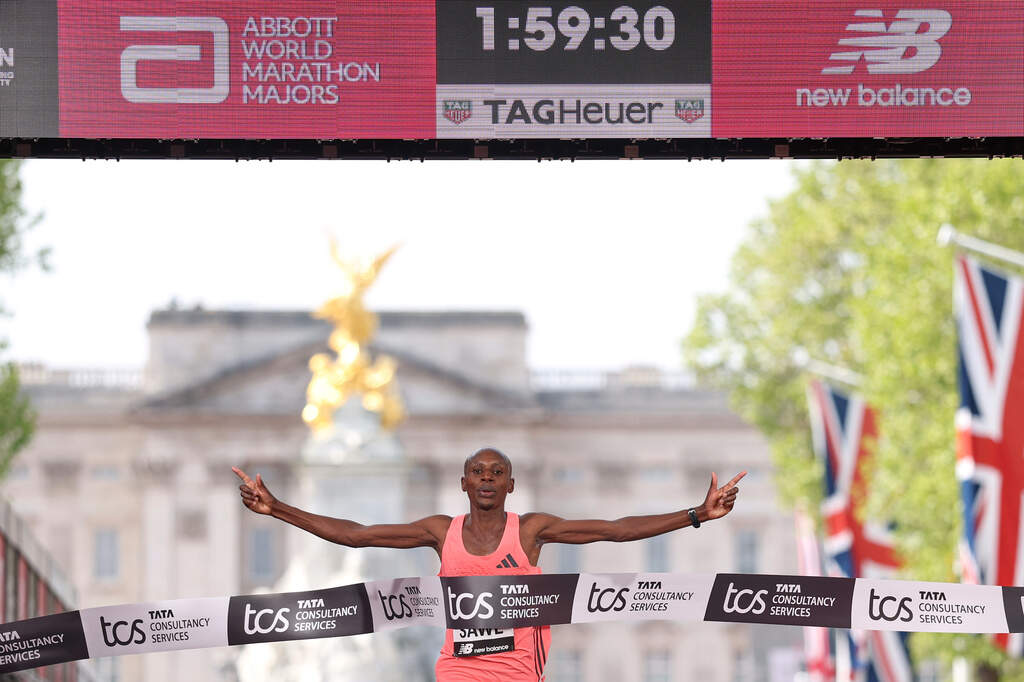
History was made in this year’s London marathon when two runners broke the iconic two-hour barrier. Was it the shoes? The nutrition? The training? These specific elite athletes?
Guest
Robert Johnson, co-founder of LetsRun – an online news website and internet forum all about running. Former men’s distance coach at Cornell University from 2002 to 2012.
Alex Hutchinson, sports science writer for Outside Magazine. He writes the “Sweat Science” column for the magazine, which focuses on endurance research and outdoor sports.
Also Featured
Patrick Nava, Adidas' general manager of running.
Josh Rowe, head of sports tech at Maurten.
Brad Wilkins, director of the Oregon Performance Research Lab at the University of Oregon.
Transcript
Part I
MEGHNA CHAKRABARTI: On April 26th, 2026, just a couple of days ago, athletes broke what had been considered an unbreakable barrier. They ran 26.2 miles in under two hours. That breaks down to an average of four minutes and 34 seconds per mile for 26.2 miles, essentially running under their own power at 13 miles per hour.
It is unbelievably fast, world record fast, in fact, and it's never been done before, and it happened at this year's London Marathon just over a week ago, and not one, but two men did it.
Kenya's Sebastian Sawe crossed the line at one hour, 59 minutes and 30 seconds. Ethiopia's Yomif Kejelcha was just 11 seconds behind and finished in one hour, 59 minutes and 41 seconds.
Many in the running world are calling it the greatest marathon of all time. But I don't know, if you're like me and you're not necessarily a runner, I just keep wondering, how? How did they do this? Let's turn to Robert Johnson. He's the co-founder of LetsRun. It's an online news website and internet forum for all things running, and Robert is also the former men's distance coach at Cornell University.
He was in that position for a decade, and he joins us from Baltimore, Maryland. Robert, welcome to On Point.
ROBERT JOHNSON: Thanks for having me.
CHAKRABARTI: Okay. So you're sitting down, ready to watch the London Marathon, thinking, "Yeah, this is going to be a pretty good race." Did any part of you imagine even for a moment that you would see the kind of astonishing finish that we did?
JOHNSON: Not really. That's what made it so special. And made it so good to have gotten up at 4 a.m. to watch it, you know, here on the East Coast because as my friend Sean Ingle at The Guardian wrote, "Sunday's race was not only unexpected, it was dramatic and historic," because London always has the best fields and the best marathoners.
We were expecting a really great three-way race for the win. But there wasn't really talk of a world record or sub-two, and it was just so refreshing that it came at the end of this epic race. It was really just almost out of nowhere.
CHAKRABARTI: We'll talk about the end. Because the end was super exciting obviously not just for the one sub-two hour marathon, but for two of them.
But let's do like a almost a mile-by-mile analysis here, but we're going to put the first 13 miles all in one big chunk. What do you think was notable during the first half of the race?
JOHNSON: To be honest, not a whole lot. It's what you always get in the marathon in London, a fast early pace, but they said they were going to run 2:01 flat pace and that's what they did. Like I actually, the race is so early on the East Coast, it starts at 4 a.m. I actually set my alarm at 5 a.m. Because I'm like, I don't really need to. There's not that much going on in the first half.
It's just, are they on pace? You wake up, you find the weather's good, and they're right on pace.
CHAKRABARTI: And so what was that pace at the time?
JOHNSON: They were just right on pace for two hours and one minute even.
CHAKRABARTI: Okay. Honestly, to me, that still seems astonishingly fast, but it's not under that two-hour mark.
Okay. So then we get to about an hour and 35 minutes into the race, and we have Jacob Kiplimo, who was a Ugandan long-distance runner and a world record holder.
He actually starts to, was it drift away from the lead pack? What's happening there?
JOHNSON: Yeah. Kiplimo, he was second last year and just there was three guys up front, and he started to fade off a little bit.
But you could still see him in the back of the screen, and he was, like, 15 or 20 meters Behind. And that's why I was so surprised that by the time at the end of the race, because you knew, okay, maybe they're gonna set a course record. But it didn't look like, it didn't seem like something crazy was happening.
And the reason why I thought that in my mind was that I'm like, the third place guy is still hanging on there. He's not getting dropped. He's hanging in there with everybody else.
CHAKRABARTI: Okay, so here's, by the way, we actually have the call from the race. So here's that moment where Kiplimo begins to drift back from the lead pace.
ANNOUNCER 1: These two look as though they've got this to themselves. Look at Kiplimo. Missed the break at the wrong time, and just cannot, could not get back to them.
ANNOUNCER 2: Yeah, so he's working away hard, sticking to the task, but these two now do look as though certainly amongst themselves they will now at this point have discounted Jacob Kiplimo.
CHAKRABARTI: Okay, so these two the announcers are talking about are Sawe and Yomif Kejelcha. And so here is basically the call of what happens then. The two of them actually keep getting faster and faster. Here they are at mile 24.
ANNOUNCER 1: It's now about records. A 4:12, wow. Wow.
ANNOUNCER 2: This race, London Marathon, we know it's one of the most prestigious road races in the world. People say stuff, it's harder to win the London Marathon than win the Olympics, or it's as hard. But it's also, it's not renowned as being a super fast course. We've got the likes of Valencia, Berlin, of Chicago, that's where you go to chase records. But today Sebastian Sawe and Yomif Kejelcha are challenging the fastest time ever.
ANNOUNCER 1: How is he looking so relaxed? How does he look this relaxed?
CHAKRABARTI: So what's actually going on there, Robert?
JOHNSON: You heard it in their voice, and I had the same reaction. Just the wow. It didn't make any sense. You're like, what? 4:12 in a marathon?
That's crazy.
CHAKRABARTI: Again, just to remind folks, you're talking about four minutes and 12 seconds as the pace being at that time, right?
JOHNSON: It's all fast. But at that level, they're averaging four minutes and 33 seconds. But when I was competing, and actually my claim to fame was pacing Catherine Ndereba to the world record in 2001.
But when I was in my peak fitness, if you were running five minutes and 15 seconds a mile, if you just increased that even four or five seconds a mile, you could feel it so drastically. And these people had allegedly dropped 20 seconds a mile. Now, it ended up being that the mile marker was a little bit in the wrong spot on the course.
So that mile marker was, it wasn't probably actually a 4:12. It was about a 4:20. And I had known that in the women's race. Because the women's 24th mile was reported to be 5:04, and the 25th mile was 5:48. The two together were right, but the individual miles were wrong. So I was wondering wait a minute, 4:12?
This doesn't make any sense. So I just stopped typing, stopped writing my article, and just stared at the screen, and it was like watching an art form. Like honestly. It was just, it was crazy. You looked at him, and you're like, yes, it may not have been 4:12, but it looked like one of my college milers just running a mile.
It was so beautiful to watch, and he was just flying. When they would do the side angle of him running, it was like watching a movie.
CHAKRABARTI: Wow. So it looked like one of your college milers running a mile, but that person would've been doing it on fresh legs, and these guys were at almost at the end of their race.
So let's hear what happens next, and this is the moment where the pair look like they're on pace to break that two-hour marathon barrier.
ANNOUNCER: Yeah, I'm desperate. Oh, my word. They are absolutely flying. They are not just inside world record time, they're inside two hours, sub-two hour territory. Not just, we thought if this was ever going to happen, it'll be one athlete on their own, completely in their own world.
We're seeing two athletes, and Sawe is still pushing. He is trying, he's trying to win this race, and he is on sub-two-hour pace. And Kejelcha is not letting up. I literally cannot believe what I'm seeing right now.
CHAKRABARTI: I keep having to remind myself that these two men are running full tilt, and it's near the end of a 26.2-mile race, and they are really racing with each other.
And by the way it was Kejelcha's debut marathon, and he's still neck and neck with Sawe almost until the very end. And so here is the last little bit of that race.
ANNOUNCER 1: You are watching the best marathon race we've ever seen in the world. Sebastian Sawe operating at under two-hour pace. Yomif Kejelcha on his debut, just in the final few stages having to give way to Sawe.
We talk about this elastic between athletes. You can just stretch that elastic band, and at some point it snaps. I think it's about to snap for Yomif Kejelcha, but you can excuse the Ethiopian for not being able to live with Sebastian Sawe.
CHAKRABARTI: Okay, so Robert, talk about this elastic, because they really were neck and neck for quite a bit of time.
JOHNSON: Yeah, and then once, once you fade off just even a little bit it's normally over. You don't really see them come back. But Yomif Kejelcha, that was part of the thing that made it so fun. This was his debut marathon. This is a guy that he used to be the indoor mile world record holder, so he was a great track runner, but how could he be good at 26.2 miles?
So you didn't quite give up on him, because you thought he's got amazing speed. Could he come back at the end? But generally, it's not about who's the fastest, it's just who's got the most in the tank, and he just didn't quite have it. And he always has a habit of finishing second, like he's always pushing the pace and always making these historic races, and then he'll break the Ethiopian national record, but somebody else somehow will win the race.
CHAKRABARTI: Yeah. I also can't believe that he ran, Kejelcha ran a sub-two hour mile but came in second. So here is the finish.
ANNOUNCER 1: And today, Sebastian Sawe has taken London Marathon by the scruff of the neck, and he is sprinting away from a world-class field. It's Sawe versus the clock. He's gonna do it. We are gonna see a legal sub-two hour marathon to Sebastian Sawe.
It's the world record by nearly a minute. Wow. And just behind him-
ANNOUNCER 2: What are we seeing?
ANNOUNCER 1: ... Yomif Kejelcha, could we possibly see him under two hours? It's gonna be mighty close. It is sub-two hours for Yomif Kejelcha. That is the fastest debut ever. That doesn't matter. It's the fastest, second-fastest time ever. I don't care-
ANNOUNCER 2: He finished second. He's broken two and finished second. What have we just witnessed?
CHAKRABARTI: Okay. Robert, we're about 30 seconds away from our break. When that moment happened, were you also thinking, "What did I just see?"
JOHNSON: It was absolutely unreal. And my favorite part of that, honestly, was the sportsmanship at the finish.
It was absolutely unreal. And my favorite part of that, honestly, was the sportsmanship at the finish.
Robert Johnson
This is a Kenyan and an Ethiopian, the rivals, and Kejelcha just gave Sawe a hug. It was just so classy, so sportsmanship, and he lost, but he was ... afterwards, he was happy. History of humanity, no one's broken two. He's the only human who's run a marathon and never run over two.
So he was proud to finish second in that race. It was just amazing.
Part II
CHAKRABARTI: Let's listen to the winner of the London Marathon. This is Kenyan Sebastian Sawe. And by the way, this is a back-to-back win.
He ran, he won in London last year as well, and right after the race this year, he was asked how was he feeling about his historic sub two-hour marathon.
SEBASTIAN SAWE: I'm so happy today in London running a world record. I'm so excited. I didn't believe, but I was well prepared, and the training I've done, the results have come now.
CHAKRABARTI: That's Sebastian Sawe right after he ran one hour, 59 minutes and 30 seconds over 26.2 miles. Let's bring in Alex Hutchinson into the conversation. He's a sports science writer for Outside Magazine. He writes the Sweat Science column for Outside, which focuses on endurance research and outdoor sports.
He's also author of Endure: Mind, Body, and the Curiously Elastic Limits of Human Performance. Alex, welcome to On Point.
ALEX HUTCHINSON: Great to be here, Meghna.
CHAKRABARTI: Okay. So as I already told Robert, because I just want to be completely transparent, I am not a runner. The only way I'd run is to chase after a ball. So this weekend, just to kind of understand more about physically what Sawe and Kejelcha actually accomplished, I looked at a treadmill, I'll admit, and I set it to the pace they had on average over 26.2 miles, and I looked down at how fast the treadmill, the tread was going, and I just thought, "There's no way in heck. No way."
So tell me a little bit, Alex, about how much sports science has evolved, let's say in the past decade, that helped these two men break this barrier.
HUTCHINSON: Yeah. First of all, I'd say you have a really good treadmill, because a lot of treadmills don't even go that fast. They only go down to five minutes a mile.
If you're trying to train at that level, it's very hard to find a treadmill.
CHAKRABARTI: I maxed it out ... that's that pace. So I'm not sure if it was actually their pace, but I maxed it out and I was still terrified.
HUTCHINSON: Yeah. No. Look, I spent decades of my life trying to run as fast as I could and I look at how fast that pace is, and it's, man, I could only keep up with that for a few seconds now. It's an amazing pace. But yeah, in terms of sports science, I think there have been advances, a lot of advances in the last decade. There have been advances over the past century, so it's not just that progress started 10 years ago. But the benchmark I would say is I wrote a big article in 2014 for Runner's World magazine, where I spent about 10 pages pontificating about the prospects, could humans ever run a sub-two hour marathon? And at the end of the article, I said I thought it could happen in 2075.
Things have changed between now and then, obviously. Obviously I'm a bad predictor. But also there's been a lot of progress in learning how to run a marathon and also the science and technology around it.
There's been a lot of progress in learning how to run a marathon and also the science and technology around it.
Alex Hutchinson
CHAKRABARTI: Okay. So we're gonna really kinda talk about three major aspects of that science and technology, but before we do, Robert, can I just turn back to you?
Because I don't want to come across as intimating that it was just optimal training and material science and nutrition science that helped cross this two-hour barrier, because Sawe and Kejelcha themselves, we have to honor their commitment, their focus, their discipline, their incredible hard work as athletes here.
JOHNSON: Without a doubt. I think that they're just amazing, the dedication and the talent level. His coach, Claudio Berardelli, this is what struck me. This was prior to London last year. He said, "I've done this job for 24 years. I'm not sure I've ever coached a guy like him, in a very holistic perspective. He's probably the best guy I've ever coached for the marathon." And this is someone who he's coached Martin Lel and Vincent Kipruto, the first guy to ever win Chicago, New York, all the three major American marathons and Boston. And just the way he handles things, even from a mental point of view, he's always very much in control.
So it's just, they are, I'm glad you said that, because I think that sometimes we think, oh, the Kenyan athletes, the Ethiopian athletes, like they're this, just this group of people. They're all individual people. He grew up without electricity in Kenya, and has now risen to the top of the world.
And I thought it was so cool. This is, track and field fans, I wasn't alive when the first sub-four-minute mile was broken 72 years ago, but people are saying, "This is our Bannister moment." And I do think this is the Bannister moment for the 21st century, in the sense of when Bannister was doing it, running was an elite sport.
People had jobs, it was amateur. Only the rich really could run. And now we have a guy growing up without electricity. Who has run a one hour and 59 minute and 30 second marathon, and just he's broken the barrier of our time. And I'm glad that you are, it he deserves the praise, Kejelcha deserves the praise, because we are gonna spend a lot of the next 30 minutes talking about so do some shoe designers and nutrition people as well.
CHAKRABARTI: I also just for folks who don't remember, it's Roger Bannister, right? Robert, I just wanna be sure.
JOHNSON: Yeah.
CHAKRABARTI: Roger Bannister the sub, the four-minute mile. Yeah. Okay. So yes, we are gonna talk a little bit about the science and the tech, and you mentioned shoes because that is part one in understanding, let's say the non-human elements that went into helping break this barrier.
So we gotta look down at their feet.
PATRICK NAVA: The idea was to develop basically the Formula One of marathon race shoes.
CHAKRABARTI: That is Patrick Nava, general manager of running at Adidas. Both Sawe and Kejelcha were running in the Adidas Adizero Adios Pro Evo 3. It's Adidas's super shoe. By the way, the fourth and fifth place finishers in London were also wearing it, and it was worn by the top finisher in the women's race as well.
That's Tigst Assefa. Now, it was the Evo 3 as a shoe in a professional race or a long-distance marathon, it was its debut, the shoe's own debut. And when Nava says that Adidas was designing it, they had one goal in mind, combine minimalism with optimization.
NAVA: The way we design it, as the name of the franchise already says, which is Adizero, is reduced to zero.
The philosophy behind it is that only the ingredients that enhance the performance of the shoe make it into the final design. Everything else is stripped out. So you really try to reduce to the minimum while maximizing the performance.
CHAKRABARTI: So that final design includes four key factors. One, a paper thin rubber bottom.
Two, the upper uses a woven material similar to what's used in kite surfing that makes it super thin, light, but also durable.
But the biggest change is in what Nava calls the engine of the shoe, or the midsole.
NAVA: Marathon super shoe trainers, you have stiffening elements, which in Adidas history was first a stiffening element made out of five fingers to mirror the bone structure of your foot.
We discovered that by taking away the middle three, we were ending up in a almost closed ring construction that maximized the amount of foam that you had under your foot, which allowed to have even higher amount of cushioning and higher amount of energy return with the same amount of stiffness that you had with the previous energy rods.
CHAKRABARTI: The Evo 3 is also a full ounce lighter than the previous model, the Evo 2. At 3.4 ounces for a men's size nine, it's the lightest marathon shoe ever, and to compare it to your average running shoe, it's half the weight.
NAVA: When we first started handing over the Evo 3s to the athletes and they were in a box, so we went to hand over the box to the athletes, and the athletes thought it was a joke.
They thought the box was empty, and then they would open the box and be like, "Oh, wow, there's a shoe in here. I can't believe it." Yeah, it's like almost like holding a pair of socks as a Styrofoam cup.
CHAKRABARTI: Wow. Now, super shoes also need two other key things: special gas-injected foam that gives runners cushioning but also bounce.
There's also a stiffening element, normally a carbon fiber plate or a rod, or what Adidas uses these days, that U-shaped rim that Nava referred to earlier.
NAVA: And that kind of works like a, imagine a catapult in the shoe, so it allows for the shoe to remain relatively stiff. The moment you transition on your toes, it basically catapults your foot forward, and that allows you to go much faster over a longer distance for a longer amount of time.
CHAKRABARTI: Now, running shoes are regulated by the international governing body for sports athletics, or World Athletics, which covers track, road races, and mountain running. Nava says the Evo 3 follows all the regulations.
NAVA: There's a limitation on the stack height, so basically how high your midsole can be, which is 40 millimeters, and then it also has to be a single stiffening element throughout the midsole.
CHAKRABARTI: And World Athletics, by the way, approved the Evo 3 weeks before the London Marathon.
NAVA: Rules are made by World Athletics, and we operate within those limits. Our job is, of course, to try to give the best possible equipment to athletes. I think that has been the idea behind any sportswear company since there have been sportswear companies.
So that's basically all I can say about it.
CHAKRABARTI: World Athletics President Sebastian Coe told BBC Sport Africa that his organization will not, quote, "strangle innovation," that they will not do that. He added that their role is to balance innovation with regulation, and at the moment, Coe believes, quote, "We're on the right side of it."
And according to Nava, Adidas is not done innovating.
NAVA: We're definitely not stopping here. This is not a, it's not a finish line by any means. We're already working on the next two or three iterations on this, and I'm actually quite excited to see where it can go.
CHAKRABARTI: So that's Patrick Nava, general manager of running at Adidas.
Okay, Alex, I don't know, have you ever had a chance to try any model in the sort of super shoe category? Because I've been reading people who have, who say you can actually really feel, almost feel the energy return coming back to your foot in the shoe.
Is that right?
HUTCHINSON: Yeah. I've tried a few of them, and the very first one was actually about exactly 10 years ago, and I remember putting it on for the first time.
It was the Nike Vaporfly, and it's very... What I found, it was immediately noticeable. It was hard to stand still. You're standing there, and you just feel like you have to move forward because you've got this carbon fiber plate that's trying to catapult you forward. So yeah it was a step change in how shoes feel that nothing before.
CHAKRABARTI: Okay, so tell me more about then the development of these shoes and specifically how it changes what an elite runner can do.
HUTCHINSON: Yeah, look, every year since time immemorial, shoe companies announce they've got a new model of shoe that's gonna change the world and it's gonna be faster and better.
That was really never true until 2016, 2017. Nike introduced this Vaporfly, and it turned out they were right. It really did make runners a couple percent faster. And basically, you heard Patrick explain that you've got this resilient, squishy, almost trampoline-y foam in the heel, and it's engineered in just such a way that you squish the foam down when you land, and it springs back and pushes you forward as you take off.
And so the very first iteration of super shoes meant you'd get about a 4% benefit, meaning that you would, to run at a given pace, it would take you 4% less energy because the shoe was storing and returning that much energy.
CHAKRABARTI: That much? Wow. Okay. Did you want to say more?
HUTCHINSON: Yeah, I was just gonna say that it doesn't mean you're 4% faster, but a 4% boost means you're maybe 3% faster, and then the shoes have advanced since then, although we don't know how much more.
CHAKRABARTI: Okay, 'cause I've been seeing here that in the past dozen plus years, marathon times have jumped by, what, 3.3-ish percent in terms of world record time. That's quite a lot, but we haven't been seeing the same change or dramatic change on the track.
Robert, can I ask you about that? Because these shoes, I understand these super shoes are not allowed on in track events. Is that right?
JOHNSON: Correct, and I'm glad Alex fessed up to not predicting the sub two. In 2013, I also said, people started talking about sub two, and I'm like, "We're nowhere close to sub two."
It took 36 years for it to go from 2:10 to 2:05. We only got the first sub 2:05 in 2003. I was thinking, yeah, like 2050, 2070, something like that. And then the new shoes, the super shoes came out in 2016, and the marathon times immediately started to drop. And they decided not to let them wear these super stacked shoes on the track, and the track times haven't budged.
That's why I think it's pretty obvious, because a lot of people I think see this world record and think people always get faster. That's just human nature. But the track times, Usain Bolt's world record is still there. The 800-meter world record is still there. It hasn't moved at all in the last 15 years.
But these marathon times have just come way, way down.
CHAKRABARTI: And Alex, why are these shoes not allowed on the track?
HUTCHINSON: You heard Sebastian Coe talk about the balance of innovation, and they have to decide what's allowed where, but I think one of the reasons is that when you've got a shoe with a 40-millimeter heel, going around the sharp corners of a track, it starts to create risks that you're going to be, just it's like wearing high heels on a slippery surface. So they made a shorter limit for the track. I think it's 25 millimeters. It might be going down to 20. And so you can get some of these foams in the heels of track shoes, but I think just a road is different from the track, so they've made a different limit, and so there isn't quite as much room for these big springs on your feet.
CHAKRABARTI: Okay. Now, a shoe that is so precisely designed and engineered, I'm thinking about the kite surfing-like material on the upper.
I can't imagine they're designed to be worn more than once, Alex.
HUTCHINSON: Yeah, I would imagine you could get maybe two wears out of those. So the ones that they wore in London, these are designed really just for professional runners. And they have to make them available for the public, but I think they sold 200 pairs at $500 U.S. a pair.
So they're making them, squeezing it to squeeze out the extra bit of energy, they're making them not durable at all. So the ones you can buy for $250 will be slightly less, not quite as advanced, but you'll get a little more life out of them.
CHAKRABARTI: Yeah. Robert, I understand that I think the Evo 3, Adidas is gonna release more of them maybe even later this month, and at the price that Alex talked about, a cool $500 bucks a pair.
Are you gonna pre-order yours now, Robert?
JOHNSON: Probably not. Try to get a used one. But I do think it's hard for the average person to understand what these feel like, and I just wanna share an anecdote. Good friend of mine from college, you know, she's got four kids. She hasn't been running for the last decade, and I bought her just a pair of, I didn't buy her the actual, the racing marathon shoes, but they have these super training shoes, it's about a $200 pair shoes, like I got it on sale for $120.
There's some defect in it supposedly. And I had her put it on, and she was just absolutely blown away. She's "Now I understand what it was like to be alive and go from the horse and buggy to the car." Maybe that's a slight, a slight exaggeration because you're still running and it's maybe only impacting you five seconds a mile if you're a professional runner, but it feels so dramatically different, and the shoe is so light.
People hear 40 milliliter meters and all this stuff. Think of it this way. Like, when I was racing marathons, I would try to get the lightest shoe possible. Because I wanted to ... you're racing. Your normal shoe weighs 12 ounces, your normal trainer, and then the old racing shoes used to be, like, eight ounces, a little bit lighter.
In 2016, they got a shoe that was even lighter than that, like six or seven ounces, and but they put a huge cushioning, like it's an inch and a half in the back. Your average running shoe has about one inch, so it's 50% more cushioning, those huge heel heights. And it was a little bit lighter.
And we're like, "Oh, nothing else can be done." Somehow this Adidas shoe is cutting the weight in half from there.
Part III
CHAKRABARTI: So now let's turn our attention, gentlemen, to another sort of major area of development, and that is nutrition, because obviously in endurance sports, nutrition has always been a major part of the overall training regimen for any athlete.
Now, recommendations for how to optimally fuel yourself in endurance sports have changed quite a bit. For instance, prior to 2011, the recommended carbohydrate intake was about 30 to 60 grams per hour of high-intensity activity. Today, it's up to about 90 grams, so two to three times more. But the problem is that's a lot of carbs, and for many long-distance runners, they just can't keep them down.
JOSH ROWE: So a lot of the kind of the running recommendations were coming from cycling research, and when we tried to apply that to runners, it was really difficult. A lot of runners, they struggled with GI issues and stomach upset. If we go back to the early, say pre-2016, a lot of major marathons, they would have like sick buckets at the finishing lines.
CHAKRABARTI: So that's Josh Rowe, head of sports tech at Maurten, a Swedish sports nutrition company. In 2015, they started to make a safer way to deliver carbs to athletes without those GI issues, using a hydrogel.
ROWE: The Maurten hydrogel, it's not new technology in the sense of it came from the medical industry, so dates back from the 1980s.
But what Maurten have been really successful in doing is being able to harness that technology within a sporting context. And what the hydrogel technology is very much like it's classed as a drug delivery system. And the reason for that is because it's designed to able to kind of transport nutrients through the GI tract and get it delivered more optimally.
CHAKRABARTI: Or in simpler terms.
ROWE: The best way to really describe it is how the Kenyans and they really say is they just call it the disappearing drink.
CHAKRABARTI: Being able to tolerate the high carb intake meant that elite runners could now start using the regimen during training and not just in actual races.
Maurten is deeply involved in Sebastian Sawe's fueling protocol, and for years Josh Rowe and other experts traveled to Kenya to optimize Sawe's nutrition and, quote-unquote, "Train his gut so that he could take the maximum amount of carbs for race day and during training." So for London back in 2025, Sawe took in about 95 grams of carbohydrates per hour.
Now remember, this is while he's running the race. In Berlin in the fall of 2025, it was 105 grams, but the team felt like he could take in more, so they ran some tests.
ROWE: Sebastian will ingest the tracer drink, and then what we do is we capture his expired breath. So he'll breathe into small bags during the runs.
And what that allows us to do is evaluate how much of the carbohydrates he's ingested in the drinks, how much his body is actually metabolizing and oxidizing and using whilst running. And what we found during kind of the buildup to London this year is that we still hadn't really reached his kind of threshold.
He still had capacity to ingest more carbohydrates.
CHAKRABARTI: So in this year's London Marathon, Sebastian Sawe took 115 grams per hour of carbs of this hydrogel while running. That's 230 grams in total. It's the equivalent, if he was just eating carbs regularly through regular food, of about 18 slices of bread or five cups of cooked rice or pasta, all while running.
Now, Rowe says today most elite marathoners are following a high carb nutritional training plan, and it might seem like a ton of carbs to consume in a short period of time, but of course, these runners are burning a massive amount of energy. So without carbo-loading like this, Rowe says their bodies will just take that needed energy from elsewhere.
ROWE: When you get to 18 to 22 miles, that tends to be that transitional period where the body's gone from utilizing predominantly carbohydrates as a fuel source to then transition to utilizing fats as a fuel source. And why kind of people say you're feeling like you're hitting the wall is because at that point, if you want to sustain the same kind of running pace or the same intensity, the body needs to work harder to break down the fats to then allow it to produce the same energy output.
Athletes now get to 30K, and previously they were very much going into survival mode, whereas now they're going into attack.
CHAKRABARTI: Pushing as hard as they can until they cross the line. So that was Josh Rowe, head of sports tech at Maurten. Alex Hutchinson, again your take on the impact of these new nutrition delivery methods on elite running.
HUTCHINSON: Yeah, I think it's big. The difference between it and ... with shoes, you can put people on a treadmill and test them, and you know right away, wow, they're 4% more efficient. With this sort of the Maurten hydrogel, it's very hard. You can't run like a randomized trial of six marathons and see how many, how much each person pukes or whatever.
So it's a much hazier thing. But the anecdotal reports, the runners are like, "Oh, yeah, I can handle it." And it's... the world has changed in terms of what runners expect to do. In the '90s or '80s, I knew world-class marathoners who took basically nothing during marathons, and now people are taking quadruple what they were taking a decade or two ago.
So I think it's had a big impact.
CHAKRABARTI: Robert, can you describe to us, for people who aren't, we're talking marathon length runners, before there was this more efficient and less GI impactful way of carb loading during a race, what did it feel like at the end of a marathon when you were just carb depleted, your muscles were maxed out?
What did it feel like in the body?
JOHNSON: Not good. I used to feel like I had also a brain fog. You're so tired your brain is tired, too. And I think that some of this really helps your brain feel good now. I think that the nutrition goes with the shoes.
It's a combo effect because you're taking 22,000 steps in a race, and two to three times your body weight's coming down every step. So your legs feel much better, and then you're not out of fuel. And the word that Josh used was that they're attacking the last 10K of these marathons.
It used to be get to 30K and then hang on for the final 10K, and now it's get to 30K and let's just hammer it home. And this year, Paris, Boston, and London, all the marathons, they've had the four fastest closes in the history of marathoning. And Sawe ran a, he was running 2:01 pace for the first 32K.
That's 20 miles. And then he closed in 27:21 for the final 10K. Only four American men ran that time in all of 2025. It's like he's not even tired after a 20-mile warm-up. So it's really, it's just, they're full of life, and that's why the time, the world record caught us so off guard because they were showing the women's race.
We didn't realize he was running this fast. He just, he was just warming up.
CHAKRABARTI: Wow. Okay. Now, both of you have mentioned I think another major project that has been going on for some time to actually accelerate when human beings would be able to break that two-hour barrier in marathon running.
And for someone like Brad Wilkins, who's a physiologist, he has also been thinking about this for years, specifically since 2012.
BRAD WILKINS: What happened was that there was a group of people that started to have a conversation about would this be possible. Would it be possible for a human to run 26.2 miles in under two hours?
At the time, we were working with a lot of mathematical models of performance outcomes, especially endurance performance.
CHAKRABARTI: Now, back then, the fastest marathon was run at two hours, three minutes, and 38 seconds, so we're talking about shaving off three minutes and more than 38 seconds. That means eight seconds per mile, really, over the average of an entire marathon.
So Brad Wilkins, who you just heard, he's the director of the Oregon Performance Research Lab at the University of Oregon, and crunching numbers is his thing. So according to him, those numbers actually looked good.
WILKINS: I came to the group and said, "Hey, we believe this is possible.
Here's the math. And the science that says that this is possible or suggests that this is possible, and that all that would need to happen would be for somebody to truly go after it and treat the marathon like a time trial. And we believe that if we did that, and we created the right circumstances and the right environment, that a human is physiologically capable of doing this.
CHAKRABARTI: Professor Wilkins knew that it would take a lot of planning to pull it off, and a lot of money. And given that he's in Oregon, which also happens to be the home of one of the world's largest shoe companies, in comes Nike. In 2016, Nike's Breaking2 project was born. First step, finding the right athletes.
And Professor Wilkins led a science team for the project, or the science team for the project, and according to his research, the athletes all had to have three things to be physiologically capable of running under two hours. First, a high maximum capacity for exercise.
WILKINS: It's known as VO2 max, or what is the maximum volume of oxygen that you can consume every minute.
And this dictates your capacity to work, right? Your body's physiological capacity to work.
CHAKRABARTI: So simply the higher VO2 max you have, the fitter you are. So the second factor was the runners needed a good running economy.
WILKINS: What that means is how economical or how energetically efficient are you to run a kilometer or run a mile.
So you want that to be super low, right? You want less energy per kilometer, means that you're going to conserve energy and you're not gonna burn through energy that is wasted, right? You want to keep that energy cost per kilometer super low.
CHAKRABARTI: That often comes down to biomechanics, which can be improved with form and strength training.
The third factor is endurance.
WILKINS: What percentage of that VO2 max can you sustain for long periods of time? So what is that, 80%, 90%? If you think about it, if you can sustain 90% of your max capacity and conserve a lot of energy while you're doing that, then you have the physiological capability to run that far that fast.
CHAKRABARTI: A high percentage means that a person can keep a very fast pace for a long time. So athletes needed good scores in all three of these factors to be able to be mathematically able to run faster than two hours for 26.2 miles. The Nike team tested about 20 elite runners and found that only three of them met that criteria.
WILKINS: And it turns out that these values exist in a lot of different people, but the optimal values of all three of those things are actually pretty rare.
CHAKRABARTI: So the team found those three folks. They had the right athletes. Now they had to create the perfect environment for the runners to make breaking this barrier possible.
That included the right weather, not too hot, not too cold, the right location. So they chose a Formula 1 racetrack. So again, this is not an actual marathon like London or Boston. This is on a racetrack, and then they had to find the right shoes.
WILKINS: There had been a team that had been working on this idea of what if we could increase running economy by just 4%.
It's actually a decrease, a 4% better running economy, which is a decrease in energy cost. Then that's the difference between the current world record and two hours. So independently, there was this footwear team that was working on this.
CHAKRABARTI: That was when the super shoe was born, and you heard our guest mention it earlier.
That's Nike's Vaporfly. So now the team had all the elements, and on May 6th, 2017, the three runners that were part of this project toed the start line on a 54-degree day and tried to make history.
With the pacers still encouraging him to dig deep, and he's trying. He's trying to sprint here, which is incredible.
CHAKRABARTI: So they didn't quite make it, but two years later, on October 12th, 2019, Eliud Kipchoge tried again.
ANNOUNCER: A barrier once thought impossible is now broken. Eliud Kipchoge is the first sub-two-hour marathoner.
CHAKRABARTI: Okay, so technically speaking, someone did run sub-two back in 2019, but Alex, that was, again, under very controlled circumstances, and that's why it wasn't technically a legal sub-two, right?
HUTCHINSON: Yeah. They broke some of the rules that you have to obey for a world record. For instance, for a world record, everyone has to start the race at the same time, and in the Breaking2 race, they had pacemakers who were blocking the wind who were rotating in and out. So there were a few different rules that were violated.
So it was a proof of principle, but it wasn't a real race.
CHAKRABARTI: Okay. Proof of principle is important because there's always been the question about just can a human being do it? Now it's been done under legal circumstances in an actual marathon. Robert, I wanted to ask both of you, I'll turn this to you, but for another really important thing.
Whenever a just astonishing feat of athleticism occurs, sports given what they are these days, people are constantly worried about doping, and I understand that Sebastian Sawe especially he and his team were concerned about that accusation that he actually was, like very regularly tested long before he actually ran on the day in London.
Is that right?
JOHNSON: Yes, I'm really glad that you brought that up. Look, you never know in sport. There's cheats in all walks of life, taxes, marital cheats, sports cheats. It's unfortunate, but so you never know who's clean and who's cheating. But he's done more, he's done everything you possibly can do to prove that he's clean.
You can never prove a negative, but his team has paid $50,000 a year and said and given it to the independent drug testers and said, "Test me as much as you can." And he did this because the last time on the women's side when the world record was set, Ruth Chepng'etich in 2024 Chicago ran 2:09 in the marathon.
And the time seemed so preposterous that I even asked her at the press conference, I said, "What are you gonna do to say to people who think this time is too good to be true?" And then 13 members of parliament didn't like that question and said I needed to apologize to Ruth. I didn't accuse her of doping, but I just said, "People are gonna have these questions."
And then guess what? You know, six months later she did test positive. So I just want to make it clear to everyone, I think this guy is 100% clean. I don't know that for a fact, but you can't do any more than he's done. He has been drug tested. They're spending $50,000 a year, Adidas and them, they know that this is the greatest talent they've ever had, and he's so hardworking, he's so dedicated, and he knows that other people have cheated.
And he's "I'm trying to prove that I'm clean." So I don't know what else he could do than that.
CHAKRABARTI: Yeah. Alex, we've only got 30 seconds left, and I just wanted your take as a lover of running. Because I'm thinking about, I'm sitting here in Boston, and I watch 30,000 people run down the road once a year.
Only a very tiny number of them are in that elite class, but there are tens of thousands of people who love, who run for the love of it, and I'm just wondering what the sub-two-hour marathon means for folks like that.
HUTCHINSON: Yeah, I watched the race and there was just this feeling of lightness.
As Robert said, actually knowing that this is almost certainly clean was wonderful, and then the idea that something that I thought was literally going to take 50 years just a decade ago has happened. I think it should encourage everyone to set big goals and even if it takes 10 years to get there, you'll make progress.
The first draft of this transcript was created by Descript, an AI transcription tool. An On Point producer then thoroughly reviewed, corrected, and reformatted the transcript before publication. The use of this AI tool creates the capacity to provide these transcripts.
This program aired on May 5, 2026.