Support WBUR
Roundup transformed farming in the U.S. Could it change regulation too?
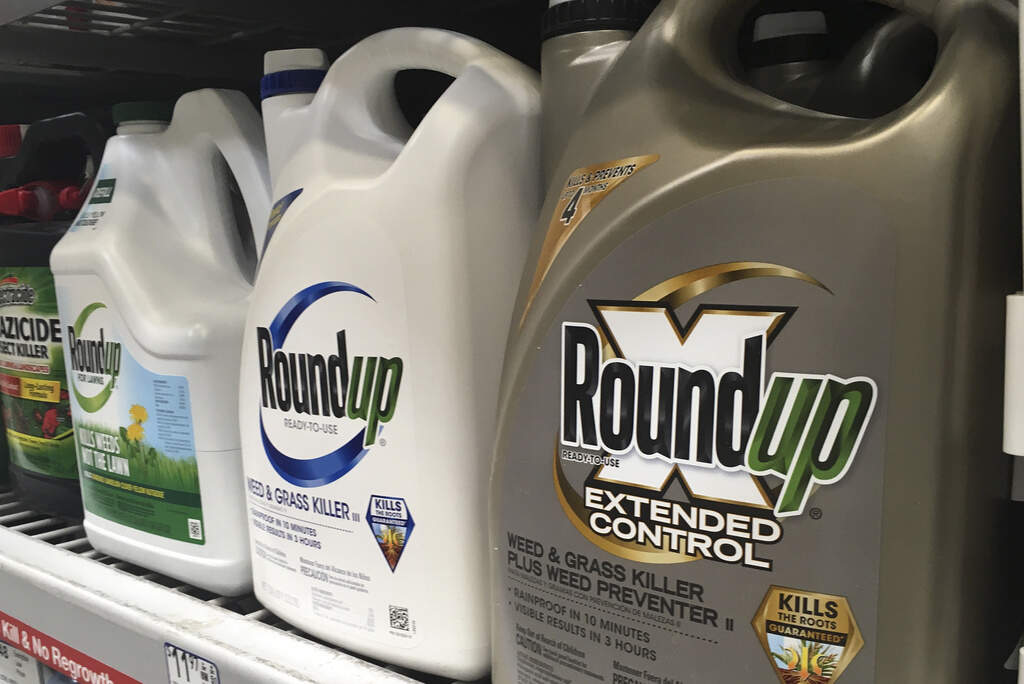
The Supreme Court will soon rule on who gets to decide when a product needs a cancer warning – and who can sue if they’ve been exposed. At the center of the highly politicized debate is America’s most successful weedkiller, Roundup.
Guest
Carey Gillam, editor-in-chief of The New Lede and contributor at The Guardian.
Ben Felder, editor-in-chief, Investigate Midwest.
Also Featured
Bill Billings, Iowa resident and cancer survivor.
Melissa Perry, epidemiologist and dean of the College of Public Health at George Mason University.
Dennis Weisenburger, professor emeritus of hematopathology at University of Nebraska Medical Center’s Department of Pathology, Microbiology and Immunology.
The version of our broadcast available at the top of this page and via podcast apps is a condensed version of the full show. You can listen to the full, unedited broadcast here:
Transcript
Part I
MEGHNA CHAKRABARTI: In 1974, the Monsanto Company introduced a new product that quickly became one of the most widely used herbicides in the world. It's been sprayed on lawns and yards across the United States and on millions of acres of American farmland.
ADVERTISEMENT: Roundup herbicide by Monsanto. There's never been a herbicide like it before. Applied to actively growing weeds at the proper stage of growth, Roundup translocates down and throughout the entire plant. In a matter of days, Roundup controls many of the toughest grasses and weeds, including their underground root systems. Roundup, the herbicide that gets to the root of the problem.
CHAKRABARTI: That is an early commercial for Roundup. By 2009, half of Monsanto's revenue came from the Roundup product line alone. The company made almost $12 billion in sales that year. Now, it's hard to achieve those numbers with residential consumers alone, and Roundup was never meant for your lawn exclusively.
From the beginning, Monsanto marketed the herbicide to farmers, not just because it kills unwanted plants that threaten crops, but because Monsanto promised Roundup would revolutionize how farmers worked their land.
(ROUNDUP AD PLAYS)
CHAKRABARTI: ... Roundup is based on a chemical called glyphosate. Monsanto patented it in 1971. Glyphosate selectively targets unwanted plants, so for farmers, that means they don't have to till the soil as much. Tilling mechanically kills unwanted plants by pulling them out, but the trade-off is that machine-intense farming disturbs soil structure and can speed up erosion.
Blake Hurst, a farmer in Westboro, Missouri, told CNBC how Roundup transformed his farm.
HURST: When glyphosate was introduced, it was a miracle. It truly was. Before that time, we had to till the ground twice. It changed our lives in a very good way. We are no-till farmers, meaning we don't control the weeds mechanically.
We don't till the soil, which saves soil, which cuts down on erosion, and also cuts down our use of fossil fuel products. We can lose up to 30 to 40% of our production if we don't control weeds, so it's a big challenge.
CHAKRABARTI: This is On Point. I'm Meghna Chakrabarti. Roundup was revolutionary, but tens of thousands of Americans say that revolution cost them their health, and their lives.
RICKY McCOMBS: Roundup is like a slow lifetime death sentence. Because that's what it does is it takes your life slowly, little at a time.
CHAKRABARTI: Georgia farmer Ricky McCombs spoke to local station WJXT in 2019. He began using Roundup in 1993, mixing two-to-300-gallon barrels at a time to clear the weeds off his farm with an industrial sprayer hitched to the back of his tractor.
A few years later, McCombs was diagnosed with non-Hodgkin's lymphoma.
McCOMBS: So after '93 spraying it, '94 spraying it, and '96 is when I was diagnosed.
INTERVIEWER: There's no doubt in your mind that-
McCOMBS: There's no doubt. And I was so healthy. Even my doctor said whenever I was first seeing him that I was the healthiest person he ever seen with cancer.
CHAKRABARTI: McCombs weighed just 95 pounds when he spoke with WJXT. In 2017, he sued Monsanto, alleging that glyphosate had caused his cancer. Tens of thousands of other lawsuits allege the same thing. By some estimates, more than 100,000 lawsuits have been filed against Monsanto. There is no warning label on Roundup.
The EPA has repeatedly said that glyphosate is safe. Its most recent decision in 2020 said, quote, "EPA found that there are no risks of concern to human health when glyphosate is used in accordance with its current label. EPA also found that glyphosate is unlikely to be a human carcinogen," end quote.
However, other independent studies come to the opposite conclusion. In 2018, German pharma giant Bayer bought Monsanto for $63 billion, creating a global agricultural behemoth. Bayer also acquired Monsanto's legal liabilities and has been vigorously fighting those lawsuits with its own research and with ads like this one.
ADVERTISEMENT: The litigation industry is suing Roundup, the most widely tested and trusted herbicide in the world.
The litigation industry says Roundup isn't safe, and they try to keep juries from hearing the whole story by preventing scientific analysis that demonstrates the safety of Roundup from being shown. Why should you care? Because if the litigation efforts continue, it would mean smaller harvests here and higher prices here.
CHAKRABARTI: Now things have come to a head at the United States Supreme Court. The court is currently considering a case that could bring those tens of thousands of lawsuits to a complete halt. So today we're going to look back at how Roundup changed American agriculture, changed tens of thousands of lives, they say for the worst, and could now also change agricultural practice once again if Bayer loses, and it could change key regulations in this country if the plaintiffs win.
Carey Gillam joins us. She's editor-in-chief at The New Lead and author of two books on this issue. One of them is called The Monsanto Papers: Deadly Secrets, Corporate Corruption, and One Man's Search for Justice. The other is called Whitewash: The Story of a Weed Killer, Cancer, and the Corruption of Science.
Carey, welcome to On Point.
CAREY GILLAM: Hi. Thanks for having me.
CHAKRABARTI: So first of all, take us back to actually when you first got interested in this story and how you came across, what you later discovered and published in your book about what Monsanto knows or claimed it didn't know about glyphosate.
GILLAM: Oh, sure. It was 1998 actually, when I started covering this industry. I was assigned, I worked for Reuters at the time, and was assigned to move to Kansas City just down the road from Monsanto's headquarters in St. Louis and start reporting on this company and the industry overall, which Monsanto was leading really a revolution in agricultural practices.
Monsanto was leading really a revolution in agricultural practices.
Carey Gillam
At the time, they had just introduced their new genetically engineered crops, soybeans and corn and cotton and canola and sugar beets, and they were rolling these out, and they had this fantastic new herbicide that was gaining in popularity as they rolled out these genetically engineered crops that were designed to tolerate glyphosate and to be sprayed directly with it and not to die.
And it really was a remarkable time in agriculture. Farmers were embracing this new GMO technology, and they were using more and more glyphosate. So, you know, it was part of my job to investigate and research and understand not only the technology and what it was doing for farming and food production, but also the impacts and the questions and concerns that were being raised by scientists and environmentalists.
And it certainly wasn't anything that wasn't my idea ... I guess to jump into it. I was assigned to it. But certainly, have learned a lot over the years.
CHAKRABARTI: Oh, yeah. So tell us about your early reporting on, that led you to start thinking that there was actually something going on, that the farmers talking about how their health changed after they started using glyphosate or Roundup extensively.
What were they telling you? What did you learn?
GILLAM: Yeah. As I said initially, farmers really did embrace this new technology. And of course, Monsanto was marketing this as so much safer than other herbicides, other chemicals that were being used. The first signs really were coming in the concerns from environmental studies and research, who were seeing how widespread use of this chemical was impacting the environment and deteriorating the health of the soil and impacting pollinators and crucial species.
And of course, then the scientists were examining the health of farmers, and you're seeing epidemiology studies, and you're also seeing more toxicology studies come out. So concerns are being raised about cancer and other impacts. But of course, we had Monsanto telling us all along, no, those scientists are wrong.
Don't worry about that study. That study's not right. The studies we're pointing you to that show it's safe, those are the ones you should pay attention to. It was really this tension point that has just been growing and growing over the years amid this scientific debate really over the health of this chemical.
CHAKRABARTI: Yeah. So in your first book, Whitewash you begin to expose to readers, I think a debate's kind of a gentle word, Carey. Because you do talk about in your book about Monsanto was, you allege he was, they were strong-arming scientists or even state level regulators to conceal something about Roundup. Tell me more.
GILLAM: And so as the years developed and we started to get more information through freedom of information, internal corporate records and you saw how they really were. That's a very good word, strong-arming, trying to silence, harass scientists, academics, journalists, anyone who was raising the red flag or pointing to potential harm associated with the chemical, they came for you, us, them.
They came for me. They came for other people, tried to really ruin careers at the time.
CHAKRABARTI: Let me just jump in, Carey. They came for you how?
GILLAM: They came for me. They internal documents that have been obtained through discovery and litigation show that they tried to get me fired from Reuters. They tried to get my first book, Whitewash, annihilated in reviews.
They had—they were trolling me online. They had people show up at book talks. They had a whole Carey Gillam book plan with line items and spreadsheets and a way to take me down. They came for me at The Guardian where I also write now. But again, I was one little person, and we saw it over and over, and as you read about in my book, scientists, world-renowned cancer scientists, top people in their field, they really trying to ruin their careers because of the science independently that was coming out about the health harms of this chemical.
CHAKRABARTI: And how did that independent science differ from studies that was related to Monsanto?
GILLAM: What we've seen are, over time, Monsanto developed a whole literature packed safety analysis of all of these different studies, that the company both generated on its own and like we knew that they came from Monsanto, but also a lot of studies that were ghostwritten that were designed to look like they came from independent scientists.
And we know this again through discovery documents, FOIAs, all of information that's come out over the years, where they essentially lied and attempted to deceive regulators and consumers and farmers.
Part II
CHAKRABARTI: And Carey, before the break, I'm sorry I had to cut you off there, but you were talking about what various studies showed about glyphosate and what Monsanto actually knew about the chemical. So continue, please.
GILLAM: Sure. So you have the company sponsored studies. You have a number of ghostwritten studies that have come out. A very important one was recently retracted because there has been so much evidence of the deception behind it. On the independent side, you have a number of studies that have been done by academics all around the world who have found that there is a link to cancer and also reproductive health problems, an array of other issues and health concerns associated with exposure to glyphosate.
A number of studies that have been done by academics ... have found that there is a link to cancer and also reproductive health problems.
Carey Gillam
The company has always maintained that all of those independent studies are invalid. The International Agency for Research on Cancer in 2015 reviewed the entire body of literature that existed at that time, published peer-reviewed literature, and determined glyphosate was probably a human carcinogen, was their classification.
The U.S. EPA and many other regulatory agencies around the world have chosen to rely more on the science that Monsanto has presented to them and continue to say that they do not see sufficient evidence of carcinogenicity to rein in the use or exposure of this chemical. You have a number of lawsuits out there.
The regulatory environment really is a dicey one. You have some of their own scientific advisors to the EPA telling them they're doing the science wrong. But they continue to maintain.
CHAKRABARTI: Since you brought up EPA, again, let me just be clear. As you're saying, Carey, EPA has repeatedly said Roundup is safe for human use.
And I think part of that is because EPA's bar is pretty specific and pretty high, right? There has to be a, like, repeated evidence or repeated research that shows a causal relationship between exposure to a certain compound and incidence of cancer. And you were talking about how other studies have shown that there's a link, but has there ever been conclusive evidence that it's causal, Carey?
GILLAM: And this is, you get into all of this, it's the weight of science. So you have mechanistic data, you have toxicology data, you have epidemiology data. [Epidemiology] is much harder, the study of real-world exposures, real humans at time, much more difficult for scientists to discern that causal because we're not lab rats, and they don't put people in cages and limit their diets and their exposures.
And so we're all exposed to so many different things, and scientists will tell you it's very difficult to say one thing caused one cancer in one person and have that translate to an entire population, right? So but when it comes to the EPA, it's not necessarily that their standards are more rigorous.
It's actually, the Ninth Circuit recently threw out the U.S. EPA health assessment of glyphosate because they didn't follow their own scientific standards in reviewing these studies. And again, they have relied, and it's been shown, more heavily on studies provided them by Monsanto than they have on studies provided by independent scientists.
So again, much debate over whether or not the EPA is doing its job. And of course, we have a number of internal emails as well that I've written about that are in my book, showing Monsanto basically telling the EPA what to do on glyphosate, sending talking points to the EPA, telling them to help quash a review of glyphosate safety by another federal agency, referring to an internal EPA scientist as a friend who can help them defend glyphosate.
So a lot of questions, a lot of concerns about the EPA.
CHAKRABARTI: Yeah. And by the way, I should note that this is over the course of years and multiple administrations as well, right?
GILLAM: Exactly. Exactly.
CHAKRABARTI: Okay, in a few minutes we're going to bring in a reporter from the Midwest. Because he's done a lot of investigation ... in terms of, like, how much correlation there is between intensity of Roundup use and cancer incidents in various counties and states across the Midwest.
But before we get there Carey, we could spend literal hours talking about all the things that you reported on in both of your books, in terms of how involved Monsanto was in shaping the public perception around glyphosate. But I did just want to get a quick taste about another way in which glyphosate really changed, as I said earlier, American agriculture. Because you had mentioned that there are these seeds, right?
And when farmers spray Roundup everywhere, it does kind of, it kills a lot of stuff. And so Monsanto then develops this genetically modified set of seeds for various crops that are able to withstand Roundup. Okay, those are patented. And so on the one hand, it allows farmers to use even more Roundup with these Roundup-safe seeds.
But on the other hand, how did using-those seeds have an impact on farmers? What did it tie them into?
GILLAM: Oh yes, because these are patented seeds because Monsanto has tweaked the DNA in a way that never can occur naturally in nature, and these are patented seed technologies. The farmers then are bound every year to relicense, to pay a licensing fee and buy new seed, where in the past, farmers would save seed from their crops and could use it over and over again.
So now, under this Roundup-ready system that they called, farmers were on the hook for a lot more money. Of course, Monsanto made the case to them that you'll save money, because you won't have to hand-weed fields or bring in, you won't have to till, your life will be easier and better, and crops will grow easier.
And many farmers bought into that, and now they are trapped in this cycle, many of them say, of dependence on these seeds and on these chemicals, which we should also note are not nearly as effective. Glyphosate has lost effectiveness over the decades. And farmers are now using many more pesticides, and we now have other crops that tolerate dicamba and 2,4-D and so you're just, it's this pesticide treadmill of GMO crops and chemicals on them.
CHAKRABARTI: Yeah, nature has a way of evolving past our strongest dose, ways of trying to fight back against her. But so then, but there was also ... I remember from your books there was this almost like this culture of fear that farmers couldn't speak out about this?
GILLAM: Oh my goodness.
Yes. Monsanto at one time had, investigators who would go out and track farmers and investigate their fields and go into their fields and see if, did they have a license? Do they have some of our GMO crop that they haven't paid us for this year? And they sued farmers and really, yeah, it was a culture of fear, very much still is to a degree in many places. Since Bayer bought Monsanto in 2018, you've seen less of that sort of aggressive behavior by the company.
But it certainly was known that you didn't mess with Monsanto.
CHAKRABARTI: One last question for you, Carey. In the documents and the papers that you were able to report on, is there any evidence at all that Monsanto had even an inkling that glyphosate could potentially be harmful to human health?
GILLAM: So I've said this many times, contrary to with other companies, and I have never seen a document in which Monsanto says, "We know this causes cancer and we don't care." Never have seen that. What you have seen is, "We know there are a lot of concerns out there that it could cause cancer, and we're going to shut that down."
You don't see them say, "We should investigate it further. We should maybe put more warnings on our product." You say, "We're shutting it down. We're going after them."
CHAKRABARTI: Okay, so Carey, hang on here for just a second. Because now I want to bring in Ben Felder. He's editor-in-chief at Investigate Midwest, and they too have been looking very deeply into glyphosate, AKA Roundup, and how it's had an impact on American farmers.
So Ben, welcome to On Point.
BEN FELDER: Hello. Thank you for having me.
CHAKRABARTI: Tell me a little bit about your reporting. You looked at local cancer data and also intensity of pesticide use. Tell me about what you looked at specifically and what you found.
FELDER: Yeah. As Carey had said, there's been a lot of scientific research on pesticide use and the health impacts on humans, and what we wanted to do is not necessarily rehash those scientific studies.
We're not scientists, but as journalists, we wanted to take a look at pesticide rates and cancer rates at the local level, really to help specific communities identify where they fall in this story. There's numerous cancer clusters across the Midwest, and so we wanted to arm farmers and residents of these communities with more information.
And so what we did is we took a look at the top pesticide counties, top pesticide counties in America, they largely look like the corn and soybean belts of America. You're looking at the upper Midwest, like Iowa, Minnesota, and Illinois, along the Mississippi River. And then we wanted to take a look at cancer rates in those local counties.
And what we found is that, for example, of the top 500 counties in pesticide usage, 60% had cancer rates above the national average, and some extremely higher, much higher than the national average. In fact, if you take that county map perspective and you lay cancer rates across America, the corn and soybean belts really jump out.
They really scream like an alarm. And so what we did is we wanted to identify these cancer clusters and then start doing some on the ground reporting to really find out what's the sense of people who live in those communities and what's been the impact to those who have contracted cancer.
CHAKRABARTI: Okay, so before we talk about that, when you say pesticides, was it all pesticides and herbicides that were used?
FELDER: We did look at the top. It was more than just glyphosate. Of course, glyphosate was the most widely used, but it was the top several highly used pesticides and herbicides.
CHAKRABARTI: Oh, okay. And then from just your experience as a reporter, investigative reporter in the Midwest, I just want to get a big picture answer from you as well about that how much did the introduction of Roundup, and its early effectiveness, how much did it change how farming was done in the Midwest?
FELDER: Oh, it's changed it incredibly. I know you guys have already got into some of those big changes earlier on in the program, but the way that it's allowed crop production to boom in the U.S. has just been incredible. And I think what's an important thing to realize is that a lot of times, the agrichemical companies will push back on this narrative to say "Listen, what's at risk here is feeding the world."
But I think that's a faulty narrative because the majority of the soybean crop and the corn crop that's being grown is not going to feed humans. It's going to feed animals. With corn. A lot of it is going to fuel. And so it's allowed the U.S. to become a crop producing power, but not necessarily a food producing power in the way that it's sometimes presented as.
It's allowed the U.S. to become a crop producing power, but not necessarily a food producing power in the way that it's sometimes presented as.
Ben Felder
CHAKRABARTI: Okay. So tell me then a little bit more about what you found on the ground from the farming families that you talked to in these very high cancer incidence areas.
FELDER: Yeah. What's interesting is when you went to some of these specific communities with the highest cancer rates and the highest pesticide rates it wasn't like they didn't know it.
Remember one person in a town in Iowa telling me, like, everyone just assumes you're going to get cancer. For whatever reason that is, that's just the assumption that everyone has. And I think a lot of people said that pesticides and herbicides were seen as a likely cause, but there wasn't really, they weren't really sure what to do. And in fact, I'll tell you one of the hardest things about this reporting was getting farmers to actually talk about it. Because there was a sense of shame, and I don't think that was right. I don't think that shame was something that they should have been feeling.
But a feeling of, am I doing this to my family? Am I doing this to my neighbors? Should I have known better? But as you spoke about with Carey earlier, she used the term treadmill, and that's exactly what it is. Farmers are on this kind of treadmill cycle of dependency where they have to buy the seeds, and they have to use the agrichemicals.
Even if you wanted to do something different than your neighbor, the risk of growing a crop and then having that herbicide drift from a glyphosate-based herbicide come over and damage your crop, it's too big of a risk. And so there's a lot of concern in these farming communities, and they're very aware of what's going on.
And I think that's evident when you see the pushback at the state level against some of these liability shield laws that companies like Bayer have tried to push. But they're not really sure what to do. A lot of these farming communities just feel like they're just stuck, and they're not sure what they're supposed to do.
CHAKRABARTI: Carey, did you want to comment on that?
GILLAM: No, yes, and Ben is exactly right on all of that. And I would just say that our U.S. government policies and the insurance mechanism that is set up for farmers and our subsidy systems are all set up now to encourage farmers to stay on this treadmill. We really are not providing them the money and the support to seek other alternatives or to try to protect themselves and improve the environment.
It's a system pushed by the agrichemical industry and it's hard to get off of it.
CHAKRABARTI: Ben, were you able to talk to any farmers or farming families who are part of this giant pool, tens of thousands, maybe more than 100,000 lawsuits against Monsanto/Bayer?
FELDER: Yeah, I spoke with some who've already sued, some that are contemplating suing, waiting to see what the Supreme Court case, how that falls.
But yeah for a lot of them, like I said, they feel stuck because they're not sure what to do. They're not sure they can change their practices, but they feel like the courts are their only avenue of some kind of correcting the situation in some way. And I think Iowa's a really interesting case because the corporate ag has been such a powerful force in Iowa. And it was really interesting last year; Bayer is pushing these liability shield laws that would prevent residents in these states from suing them over cancer claims. And the bill came close, but it failed in Iowa.
And that was surprising to a lot of people because it felt like for the first time in a long time the corporate ag community didn't get its way. And I think a lot of that had to do with the advocacy of farmers that were going to the capital. Farmers are often used as an example by corporate ag of you need to do what we're asking you to do because if you don't, you're going to harm the local farmer.
But what you had is local farmers who went to the state capital and said actually, we're here to tell you that we don't know what to do with the system that's been created, but if you take away our ability to sue these companies, you're taking away one of the only tools we have to bring some kind of recourse after developing cancer.
And so I think that was a really powerful statement and a lot of these families said that if the Supreme Court decision were to go against them, then they would be completely stuck. There would be no option for them.
CHAKRABARTI: Yeah. So in the last section of the show, we're going to talk in detail about what's at stake in the Supreme Court.
But Ben, let me ask you another follow-up about this, the treadmill, as Carey so eloquently put it. Because another trend that's been happening contemporaneously with the Roundup revolution is that corporate farming has gotten bigger. Family farming has gotten smaller- right? And does it make it even harder then for farmers to get off this treadmill of using patented, using Roundup, using glyphosate, using those glyphosate seeds? What other alternatives do they have?
FELDER: There aren't very many alternatives, and I think you're right to say that this is a part of the larger story of the growth of industrial farming and large-scale farming in America.
You're right. We've seen the number of farmers in America is going down. The number of farms is going down. The average size is going up. And there's a lot of reasons for that. It's not just the use of agrichemicals, but it plays a part in this growing industrial farming revolution that we're continuing to experience.
Part III
CHAKRABARTI: Now, of course, really at the very bottom line, one of the most important questions here is, as we've talked about, does glyphosate cause cancer?
BILL BILLINGS: My name is Bill Billings, and I am from Red Oak, Iowa, and I am a health care administrator who was exposed to glyphosate over a number of years in using it not only in my own yard, but also I live in a very rural farm area where there's a lot of aerial spraying and a lot of large scale crop production.
I was diagnosed with large B-cell lymphoma in December of 2025 and underwent very aggressive chemotherapy for the next six months. It was my oncology and hematology team that made the connection. They literally put into my medical records that the source or the cause of my cancer was exposure to the very specific use of Roundup and agricultural chemicals.
They literally put into my medical records that the source or the cause of my cancer was exposure to the very specific use of Roundup and agricultural chemicals.
Bill Billings
CHAKRABARTI: So Bill's medical team may have put that in his records, but of course, as we've been discussing, that does not mean that glyphosate has been officially recognized in this country as a human carcinogen because, yeah, that is a long and difficult process with a specific scientific bar.
Melissa Perry is an epidemiologist and dean of the College of Public Health at George Mason University, and she has been studying glyphosate and the health risks faced by farmers for years.
MELISSA PERRY: One of the most recent studies that we published demonstrated what happens when rats are exposed to low levels of glyphosate at doses that are designed to be relevant to how humans are exposed over a long period of time. And our study actually evaluated what happened when we provided those low levels of exposure that were long-term and also cumulative.
And what we found was that rats developed a variety of different benign and also malignant tumors, and it was a real, a very strong demonstration that at environmentally relevant doses, glyphosate can induce cancer.
Now, this one study is not definitive to say that, in fact, this is proof that glyphosate is carcinogenic.
It's really difficult to prove that one chemical causes cancer in humans because cancer develops slowly over time, but it is an important contribution to the scientific evidence.
CHAKRABARTI: That's an important caveat that Professor Perry just offered. Because, as we mentioned, EPA last reviewed glyphosate in 2020 and once again concluded it is an unlikely human carcinogen.
And by the way, EPA's rubric for the bar that a chemical has to cross includes if it's going to be a probably carcinogenic to humans, that's an EPA classification, the chemical would have to have sufficient evidence indicative of a causal relationship from animal data and limited human evidence.
So that's just a bigger picture there. Perry, though, says it's also not that simple.
PERRY: Cancer develops over long periods of time. There's a very long latency, and also humans are exposed to a variety of different chemicals and exposure every day just by living our daily lives. And so the ability to pin down one chemical causing cancer becomes challenging.
What's important is to evaluate animal studies, to evaluate mechanisms and biological pathways for cancer, and also to understand human studies over time, and looking at that convergence can better inform the probability that any one chemical is causing cancer.
CHAKRABARTI: And as you heard Carey Gillam say earlier, there are studies that have shown that glyphosate has been specifically linked to a type of cancer called non-Hodgkin's lymphoma in humans.
Dennis Weisenburger is a emeritus professor in the Department of Pathology, Microbiology, and Immunology at the University of Nebraska. He's also studied glyphosate's impact on humans for years.
DENNIS WEISENBURGER: I obtained information, statistical information on the use of various classes of pesticides, as well as things like corn production and fertilizer usage by county in eastern Nebraska.
I correlated that with the incidence of non-Hodgkin's lymphoma in those counties, and what I found was that in general, the counties with the highest use of pesticides or the highest corn production, for example, they seem to be the counties with a higher incidence of non-Hodgkin's lymphoma.
CHAKRABARTI: Now, careful listeners out there, that'll sound familiar to you because that's exactly what Ben Felder and his team found in his recent, in their recent investigative reporting.
Now, apart from the scientific difficulty of really showing a causal relationship between one single chemical and human cancer incidence, Weisenburger says there's also been a concerted effort to keep glyphosate classified as safe.
WEINSENBURGER: There's been I guess I would say, an informational war that's occurred between people who are studying this subject scientifically and the pesticide industry, which denies everything and anything that could happen with regard to glyphosate.
CHAKRABARTI: I want to go back to Bill Billings quickly because he's the one whose doctors put in his record that they think his cancer was caused by Roundup. When Bill started treatment, he found out that some of the drugs he was on for his cancer treatment were made by Bayer, which as of 2018, bought Monsanto.
Now he won't even buy bread unless he knows the wheat was grown on a farm that doesn't use glyphosate.
BILLINGS: Cancer is non-discriminative, and the products that cause cancer that we're aware of, that we continue to use, simply make a statement that the companies that are using them, the companies that manufacture them, and anybody who supports the use of them is absolutely making a statement, in my opinion, that says they don't care.
They absolutely don't care what the ramifications of this product is. They don't care who it affects.
CHAKRABARTI: So Carey Gillam, let me go back to you because what's interesting is that this, the profound really human question that people care about is this pesticide, is this herbicide causing cancer in thousands of people, that's actually not what's at stake at the Supreme Court.
In fact, it seems like the court is looking at something of a technicality, right? In the cases Monsanto v. Durnell, and the question they're looking at is can federal law preempt state laws that allow people to sue companies when they believe those companies have failed to warn consumers if a product potentially causes cancer.
It's a labeling question. What's the significance of that, Carey?
GILLAM: Yeah, and it's good of you to point that out. I think so many people do think that the Supreme Court is going to weigh in on the safety or not of this chemical. And it really, even though the lawyers did get into those issues, it really is very specific and a very narrow question that the Supreme Court agreed to address. And it's whether or not this federal law, Federal Insecticide, Fungicide, and Rodenticide Act, known as FIFRA, preempts state action to require companies to warn of a risk if the EPA has not already found that risk exists and required such a warning.
So it's really, can they make the company warn of something that the EPA has not required the company to warn of? And there's been decades of arguments and debate on this. We have precedent law set in 2005 in a case with some peanut farmers who were suing Dow AgroSciences. And in that case, it was found the Supreme Court found that no, FIFRA does not preempt such warning requirements.
Other appellate courts have agreed. So there's much more precedent against Monsanto on this question. The Biden administration had shut down Monsanto when they tried to go to the Supreme Court on this during the Biden administration and say, "No, it does not preempt." We have a new makeup of the Supreme Court.
We have a new political environment. We have new arguments from the company. So you know people are saying it's too close to call how the Supreme Court will rule on this.
CHAKRABARTI: And is this what most, many of these, tens of thousands of cases are alleging, that people were not warned? Are they not saying that glyphosate caused their cancer directly?
GILLAM: No, they are. There's probably roughly 170,000 people that sued in the U.S. Many of those cases are, have already been resolved. There's still about 60,000 remaining. They all do have the allegation that Monsanto's glyphosate-based products caused their cancer. And that the company failed to warn of the risk that these people faced when using it.
So then let's hypothesize here. If the court finds in favor, basically issues a ruling that says federal law does preempt state law on this, then what is the likely impact going to be? I keep reading that this could bring all those cases to a halt. Why is that? The company, certainly this is their reason and their stated, it's part of their strategy to put an end to the litigation, is to get a Supreme Court ruling in their favor.
They think that this would significantly reign in the litigation. It certainly would wipe out failure to warn claims. Of course, there are other claims in the lawsuits. There's design defect and other sorts of fraud and et cetera, and general causation, specific causation. So some legal experts say, yes, these cases could survive, but they would be substantially weakened.
It would make it much more difficult to get a favorable verdict. So would lawyers even want to take on the cases? Bayer certainly thinks that this would be a big feather in its cap to curtailing the litigation, but of course, they're also trying to pass laws at the federal and state levels to preempt, and of course, they're pursuing another class action settlement.
They really want this litigation to come to an end.
CHAKRABARTI: Okay. So Ben again, thinking about farming families and American farmers as a whole, and how pervasive Roundup has become. Again, hypothesize with me, if, for example, if the Court found the other way and found that federal law doesn't preempt state laws and the litigation continues forward, 170,000 total cases is a huge amount.
What impact could that have? Or what has Bayer been saying about maybe this might not make it worth it for us to even produce or sell Roundup?
FELDER: Yeah, who knows if how much of that is a real threat. There probably would have to be some changes on their end, just as financially.
But I think it would, it would still allow the, like I said, the one tool that many farmers and agrochemical users feel like they do have. I also would have to think that it would go a long way in giving that side some momentum, especially as Bayer and other companies are trying to pass these liability shield laws at the state level.
They've been successful in two states North Dakota and Georgia. But they're trying in many agriculture states and are going to continue going forward. And I would think that if the Supreme Court were to rule against the company, that would give some momentum to the side that's trying to prevent those liability shield laws.
CHAKRABARTI: Yeah. In Carey's book, she talks about how Monsanto, this is before Bayer bought it, was had pretty cozy relationships with some state regulators, right? Getting the regulators to even sign off on approvals when there wasn't adequate documentation, for example.
I don't know if you've been able to report on this, Ben, but how would you describe what the relationship is like now between Bayer and some folks at the state level?
FELDER: I think it's still cozy. It's definitely cozy at the federal level. There's lots of former agrochemical executives and crop association executives that work for the EPA.
I think what's interesting at the state level, and obviously we're coming to the end here, don't have time to get into it too much, but I think the Make America Healthy Again kind of coalition, which has taken the side against Bayer on this issue, has had some momentum at the state level.
Especially in Republican agricultural states, where there has been a big push against widespread pesticide and herbicide use and other chemicals and other environmental issues that I think have thrown the traditional dichotomies, the partisan dichotomies on their head a little bit.
And I think that's one reason why you've seen some of these liability shield laws not be as successful at the state level. But yes, no, there's definitely a push by these companies to lobby and influence at the state level as well.
CHAKRABARTI: Yeah. So Carey, we've got about a minute left here, and I'd like to hear from you on the relationship between Bayer and the federal level EPA now.
Because you actually reported about this some time ago, but Representative Alexandria Ocasio-Cortez brought it up in a House hearing not that long ago. How would you describe what the relationship is?
GILLAM: Oh, yeah. Super cozy. Always has been throughout the decades. But yeah, recently emails that we've reported on and that AOC brought to light in that hearing shows that cozy relationship continues.
Bayer sat down with EPA's Lee Zeldin last year and wanted to talk about the Supreme Court and making sure glyphosate was going to continue to not be considered a carcinogen, and wanted to offer some thanks to the EPA. And yeah, it's gone on for decades.
The first draft of this transcript was created by Descript, an AI transcription tool. An On Point producer then thoroughly reviewed, corrected, and reformatted the transcript before publication. The use of this AI tool creates the capacity to provide these transcripts.
This program aired on May 6, 2026.