Support WBUR
Why authoritarians put their faces on everything
Dictators and authoritarian leaders often plaster their faces across the country they control. Is this happening in the United States?
Guests
Gal Beckerman, staff writer at The Atlantic. Author of the article “Trump’s Face is All Over D.C.”
Jason Stanley, chair in American Studies in the Munk School of Global Affairs & Public Policy at the University of Toronto.
Also Featured
Jeffery Patterson, lecturer at University of Texas at Austin.
The version of our broadcast available at the top of this page and via podcast apps is a condensed version of the full show. You can listen to the full, unedited broadcast here:
Transcript
Part I
MEGHNA CHAKRABARTI: Since January 20th, 2025, President Donald Trump has put his face or his name on the following.
A federal arts commission has approved the design for a 24-karat gold coin bearing President Donald Trump's image.
The Trump administration yesterday launched a website in an effort to help patients buy prescription drugs at a discounted rate. It's called Trump Rx.
President Trump's name now on the Kennedy Center.
Crews installed signage on the now Donald J. Trump U.S. Institute of Peace this morning.
The America the Beautiful pass features side-by-side portraits of George Washington and President Trump. Some park goers have responded by covering Trump's face with protest stickers.
An auspicious beginning for the Trump Gold Card, which the president announced to great fanfare. In February 2025, it would be a $1 million way to get permanent legal residency in the United States.
It's almost impossible to miss the new banner bearing President Trump's face that just went up here at the Justice Department.
It's the U.S. Department of Labor, and it's Donald Trump on one side and Teddy Roosevelt on the other, as if the two belong in the same sentence.
This went up in Washington, D.C., a giant banner with Donald Trump's official portrait hanging in front of the headquarters of the Department of Agriculture, along with a similar banner featuring Abraham Lincoln.
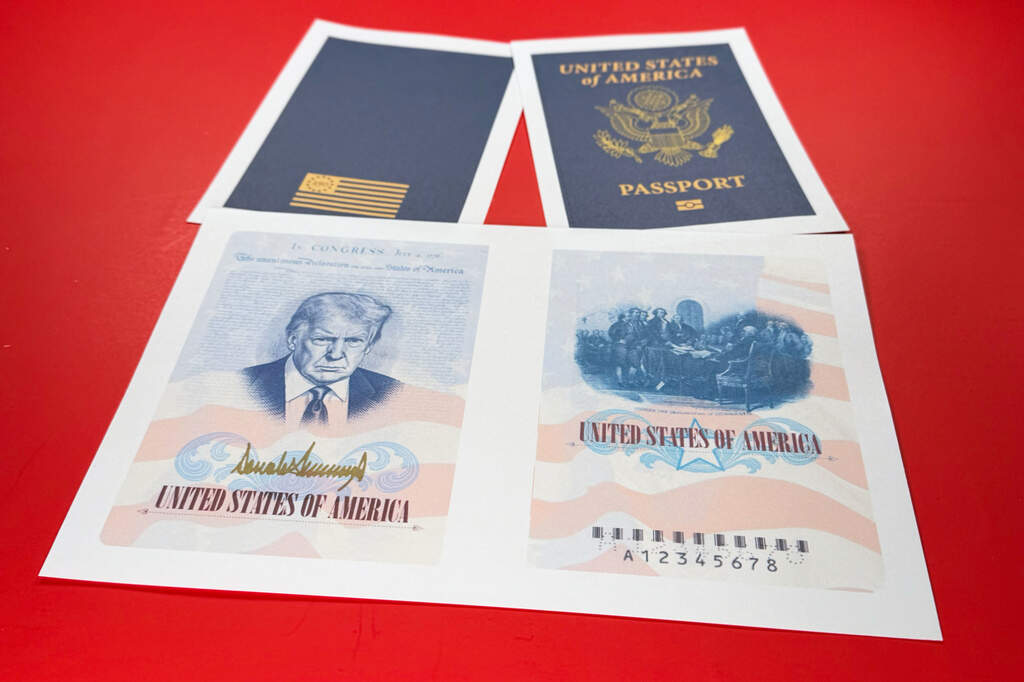
Take a look at this. New limited edition U.S. passports featuring President Donald Trump are rolling out to commemorate the 250th anniversary of American independence.
CHAKRABARTI: And on Monday of this week, Palm Beach, Florida County Commissioners approved a trademark deal allowing the renaming of the Palm Beach International Airport, which will now be known as the President Donald J. Trump International Airport.
Back in March, Governor Ron DeSantis signed legislation requiring the airport's rebranding, and that followed the renaming of a four-mile stretch of what was formerly known as Southern Boulevard in Palm Beach County to President Donald J. Trump Boulevard. As for the airport's new logo, The Palm Beach Post reported that with the headline, quote, "The soon to be renamed Donald Trump Airport has a logo, and it's gold."
We Americans, frankly, we're like any other nation. We love to venerate our great men and women of history, but it's the 'of history' part which is key here. Plastering the currently serving president's face everywhere he can is just not part of American political iconographic tradition. That's the stuff of monarchs, dictators, and autocrats.
Sure, let's be honest, fans of President Obama, they wore shirts, flew banners, put up posters of his face everywhere they could. It's not all that different from Trump's supporters. The difference, though, is that Obama never named anything after himself. He didn't do it — and especially didn't do it while he was in office.
Neither did Biden or Bush W or Bush H.W. or Clinton or Reagan, et cetera, et cetera, et cetera. But President Trump is doing it, and he's doing it on federal properties, which since they belong to the federal government, technically they belong to you. So why do autocrats, dictators, and monarchs put their faces on everything?
And how does the ubiquity of that face change how the nation looks at itself? Gal Beckerman is a staff writer at The Atlantic, and he recently wrote an article about this titled Trump's Giant Face Is Everywhere. He's also author of How to Be a Dissident. Gal, welcome to On Point.
GAL BECKERMAN: Oh, thanks for having me.
CHAKRABARTI: Okay, so you're in New York now, but your article's all about Washington, D.C. And if you walk around the governmental part, the federal heart of D.C., for those who haven't been there in a while, what do you see?
BECKERMAN: Trump. Trump's face looming over you from buildings like the Department of Labor, the Department of Justice, his name on many buildings that we heard about in your intro.
And it is a real shift away from something that historically Americans never really did. When I was researching for this article, I even found that on the centennial of George Washington's birth there was a statue that was created that had him posing like Zeus in a toga and everything.
And it was distasteful to members of Congress that they couldn't figure out what to do with this sculpture. It ended up sitting in a shed on a lawn in front of the Capitol building. So it really breaks with American tradition.
CHAKRABARTI: So we have the, let's stick with the banners here for a second.
When you walk by, let's say, the USDA building or the Department of Labor as you said, and how large are these banners?
BECKERMAN: I think if I remember correctly, they're about 30 feet long. And it's a pretty tight close-up of his face, the official portrait that we all know.
CHAKRABARTI: And so as a viewer, how does it feel? What's your response to it?
BECKERMAN: I think something interesting is going on in this particular photo of Trump. The look on his face, the look on his, what is happening with his mouth, to be very analytical about it, almost art historian about it, is something that reminds me a little bit of Mona Lisa.
It's halfway between a scowl and a smile, or depending on your feelings about the president, you might see a smile or a scowl, and I think this is deliberate. There is something about these sort of looming pictures or images of strong men. And we can talk about the long tradition of other authoritarian leaders doing things like this. That we want to inspire almost a kind of a father, a fatherly, a father figure kind of feeling in the people that are viewing it. Something between a person who could be beneficent or could be harsh, whose approval you want, who's always watching you.
That is the feeling that I get when I look at this particular picture of Trump that you see everywhere.
CHAKRABARTI: To me it's Big Brother's face. The reason, look, I don't... George Orwell is my absolute favorite political writer, and so I don't bring him into this conversation willy-nilly, but there's a reason why in 1984, that the imagery of Big Brother being everywhere serves a real purpose.
It's to remind Winston and everyone who lives in the 1984 world that they are under the gaze of this almost like ubiquitous but invisible state which is embodied in Big Brother.
BECKERMAN: No doubt that it's supposed to inspire, the best case to make is it's supposed to inspire awe and reverence.
But you could also say that it's meant to inspire a kind of fear or intimidation, a sense that you're never far away from the eyes of the government, which are personified by Trump. I'll say that in this, in my close reading of this photo, if his mouth is up for interpretation, his eyes definitely seem like they're glaring down at whoever's walking by.
That's the feeling that you get.
CHAKRABARTI: Yeah, but for Trump himself, I imagine, and definitely for his most fervent supporters, that particular image, and I'm glad that you raised the fact, Gal, that it's this picture of the president's face that seems to be everywhere, and I think they believe, they've said it projects a sense of strength, right?
Because it's almost, here is the person who is protecting us, and you see his seriousness in that gaze, but also, in a sense, because you said he's almost smiling a little, it's both serious, protective, and like a father figure.
BECKERMAN: Yeah. I think in that sense it really does tie up to the way past authoritarian leaders have used images like this.
And you don't need to believe that Trump is like Stalin or Mao to see a kind of a lineage here. And when you think about how Stalin used his image, all over the Soviet Union, it really had that ubiquity that you're talking about, but it became almost like a religious object in the sense that it was meant to remind you that the leader was always there, always watching.
When I did a little bit of research into how people related to these images and they really were everywhere, not just in public spaces in the Soviet Union, but people had what were called red corners in their house, where you would put up a picture of Stalin. I came across an interesting kind of telling, illustrative story, which was a bunch of veterans who had just, had been in World War II, were sharing a dorm room together and wanted to talk about their war experience actually in critical ways, and the picture of Stalin was there on the wall.
And what they did was they turned it around so it wouldn't be facing them. So it just shows you the kind of almost mystical, pervasive feeling that can be inspired by a leader's image when it really finds its way into every literal corner of people's lives.
CHAKRABARTI: So what about all the folks listening right now who are like, "Meghna, you are reading way too much into this," because all this is President Trump continuing his lifelong habit as a businessman, of a businessman, of using his brand, right? Long before he was president, one thing that he excelled at, that Trump excelled at, was creating an aura around the brand of Trump itself, whether or not those businesses succeeded or failed.
And so it's no big deal. It's just who he is and what he's doing now as president. We're overreading it.
BECKERMAN: I think that's certainly an aspect of what's going on in terms of Trump's motivation. There is not just that tendency to brand and we know about Trump Steaks and Trump University and the whole, the long list throughout his career, in which he's used his name in this way.
That is both a business model, as you say. It clearly feeds some kind of psychological need, and I'm not a therapist, so I'm not going to go in that direction. But it clearly does something for him in terms of projecting himself.
But the thing is and this, actually mentioning brand consultants is an interesting element to bring in here, because the one thing that brand consultants will tell you is that if you want to get people to think that the soap or the cereal that they are using is the only one that they could ever possibly use, the thing to do is to make it ubiquitous in that way, to hear the jingle everywhere, to see the commercial everywhere, to see the billboard everywhere, with the same image, and soon it seems, becomes unthinkable, that you would choose a different kind of soap or cereal.
And so the branding might come from this personal impulse on the part of Trump to project himself in this way, but the effect, and I think this is what is dangerous for democracy, is to create this impression that this is the once and forever leader that we could possibly have.
Part II
CHAKRABARTI: I'd like to introduce Jason Stanley into the conversation. He's chair of American Studies at the Munk School of Global Affairs and Public Policy at the University of Toronto, and author of many books, including Erasing History: How Fascists Rewrite the Past to Control the Future. Professor Stanley, welcome to On Point.
JASON STANLEY: Thank you so much.
CHAKRABARTI: I want to actually first play for both of you a clip from an August 2025 cabinet meeting, because it's not just President Trump we're talking about, it's the fact that everyone surrounding him in his cabinet and in his administration that seem fully on board with his imagery being in many places.
So this is August 2025, and you'll hear then Labor Secretary Lori Chavez-DeRemer, who was really lauding the president during a cabinet meeting, and this one happened to run for more than two hours, but we'll give you a small taste of what she said.
If you all haven't stopped by the Department of Labor, Mr. President, I invite you to see your big, beautiful face on a banner in front of the Department of Labor, because you are really the transformational president of the American worker, along with the American flag and President Roosevelt, because we're bringing business and labor together, and I was so honored to unveil that yesterday, and everybody is taking note of that.
CHAKRABARTI: Professor Stanley, what do you hear in that?
STANLEY: I hear, of course, subservience to authority, the failure to make a distinction between an advisor and an authoritarian leader. But I do want to provide some counterbalance to the earlier conversation. You started out by saying, like any other nation, we venerate our great men.
Now, I live in Canada and that's just not true. America's kind of distinctive in this sort of cult of its founders. Not necessarily distinctive, but it's part of our American exceptionalism. And when Hitler in Mein Kampf talks about how to set up the kind of racial nation he wants to build up, he says "The education system has to focus around veneration of the great men of the race."
And then I'll note that you said the great men, so that element of patriarchy.
CHAKRABARTI: So I think we have to, I did include and women, although I acknowledge that we don't do it as often, for the great women of American history.
STANLEY: Yeah, but I think it is part of our exceptionalist narrative that sets this up.
So of course, Trump wants to put his face on Mount Rushmore. I don't think this is as un-American as we think. I think we have the antecedents of this. We've set up this narrative of the worshipful, worship white men of the nation. And Trump wants to join that, but he wants to join it right now.
And of course, There's also this, of course, element of personalist dictatorship that it is part of our history to reject, George Washington being the first to reject it.
So I see this as part of our history set up by our history but also a very disturbing element.
CHAKRABARTI: Gal, did you want to add to that or respond to that?
BECKERMAN: I think there's certainly a history in America of looking at American presidents, and venerating them in this way. But I do think that the doing it in your lifetime while you hold power and while you can use that imagery in order to accentuate and grow your power, or to grow that sense of, what I was saying earlier, almost like a naturalness to your power, that it's meant to be because, look, my face and my name are everywhere.
That feels, that does feel unprecedented to me. And I did look to see if there were American presidents who in their lifetime, built statues to themselves, worked to put their names on things and there really isn't a record of that.
CHAKRABARTI: Jason, go ahead. You go, feel free to discuss, both of you.
STANLEY: No, I agree. So we've got this issue of in their lifetimes versus not in their lifetimes. I think when we return, if and when we return to post-Trump era, we've got to change our earlier practices of venerating great men so as to avoid this happening again. But I agree with Gal, in their lifetime is part of an ideology of personalism and ideology of dictatorship.
What I'm saying is this veneration of the great men of the past enabled this, and so we can't do that again. But an ideology is a set of practices and representations, and obviously the practices of the Trump regime are just kleptocratic. The foreign policy of the Trump regime is there to benefit the Trump family.
We're meant to think that America, to benefit America is to benefit the wealth of the Trump family. And so these representations are meant to justify those practices.
BECKERMAN: I do agree with Jason that this sort of personalization of the great men and women is something that Trump really cares about and wants to project.
If you think about something like his project of the great sculpture garden that he wants to build which is supposed to be 250 individual sculptures of Americans who he thinks are important including some, there's some strange inclusions in this list.
But the idea is to go up to these heroes and venerate them as representing America as opposed to thinking about the values and the concepts that are supposed to underpin the country.
CHAKRABARTI: Yeah. Jason, let me ask you something else. I was reading an article written by someone who was giving an aesthetic critique of President Trump's overall design style actually and the thing that jumped out to me is when she wrote that it's very sort of Louis XIV, Versailles, with all the gold and the very sort of detailed filigree packed to the rafters.
Louis XIV, if memory serves, happens to also be the French monarch who famously said, "I am the state." So there's very, there is something very much about imposing the individuality of Trump onto how he wants us to see the country, is there not?
STANLEY: Oh, of course. Yeah. Of course. And again, Trump is about make, it looks, he's enriched himself by conservative estimates are still over a billion dollars in his second term. It's about enriching himself, and the foreign policy of the United States, the connections to the Gulf Arab states.
If you think that Trump is America, and the wealth of Trump is the wealth of America, that's what we're being encouraged to think by this symbolism. So there are, this is the corruption is not corruption. Corruption in the mouths, as I say in How Fascism Works about this very topic, corruption in the mouths of dictators means the wrong person is getting the money.
So here, since Trump is America, the foreign policy should be there to benefit him and his family.
CHAKRABARTI: Gal, again, both of you, feel free to jump in at any time, but let me ask you both another question. To be perfectly fair to the president himself, he claimed, and has claimed multiple times, that it was these, the fact that his face is showing up everywhere, it's not his idea, right?
He claims that in terms of his face on the Department of Labor building, on that banner, for example, or specifically those Trump Rx accounts, he said in the past, quote, "Nobody believes me, but I did not name it." And then in reference to the Trump Gold Card, he said, "I didn't name that one either, by the way," end quote.
BECKERMAN: That could very well be true on the face of it, but it seems to me that if you're working for Trump, you very quickly understand that the thing that most gains his approval is when you give him adulation. And so I think it's not hard to believe that this is a virtuous cycle as far as Trump is concerned, that the more he makes clear that he likes this kind of thing, the more people in government who work for him and want to maintain their positions come to him with ideas for putting his face and name on things.
He can't say that he named it himself. The whole structure of the system says that he is America, so other people have to praise him. Even if he did name it himself, he couldn't say that he named it himself. It's inconsistent with the ideology.
CHAKRABARTI: So Jason, earlier Gal talked about Stalinism, and I'd love to hear more from you about other regimes of the past that used this, again, ubiquity of the face of the leader.
And let's just keep going with the how did this stuff all get everywhere in Washington or even on American money soon, U.S. passport, et cetera. Is it as simple as the people surrounding the leader saying I can curry favor with him if I approve this statue to show up in the town square of where I live?"
Is that part of how this, the system perpetuates itself, Jason?
STANLEY: No, the ideology is Trump is America, so that's the accepted ideology. So the whole regime is suffused by that. So that's going to, since that's the ideology, Trump doesn't even have to say it so that's going to appear as the public face of the regime.
So what we're seeing is the public, is this highly personalist public face, it's not just personalist, it's also, as Hitler says in Mein Kampf, "Put the great Aryan men of the nation up." So it's also supposed to reflect the whiteness, the great men are white. So it's that aspect as well, but it's highly personalist.
And in Berlin where my father was growing up in Berlin in the 1930s, in every street there were, was Nazi insignia, swastikas. So it wasn't just Hitler's image, it was the image of the imagery of Nazism, which was the ideology. And I want to say something about the advertising point you made. Trump as advertising. In many languages, the word for propaganda is the same as the word for advertising. Bernays is both the father of propaganda and the father of advertising. There is no theoretically speaking as someone who's written a book on propaganda, there is no distinction between advertising and propaganda.
Propaganda is advertising for a leader or a party.
Propaganda is advertising for a leader or a party.
Jason Stanley
CHAKRABARTI: So do leaders do this in order to not just advance their own egos, but to truly try and change the conception of the people of the nation, of what their own nation should stand for, Jason?
STANLEY: Yeah, their own nation stands for Trump now.
And that justifies the practices of the Trump regime. And I think it's part of this as Gal said, this structure of veneration of great men that history, people like Howard Zinn tried to undermine, tried to say we should tell histories from below, because that's more democratic.
It's not democratic to venerate the great men of the nation. And so Trump is just pushing that to the extreme. So, as Gal noted, he's saying the ideology is worship great individuals. And then this nation is just the worship of Trump.
CHAKRABARTI: Gal, go ahead.
BECKERMAN: No, I think the other thing here is that the ubiquity, the everywhereness of it Jason mentioned, the swastika on every corner the everywhere you turn you see the same face.
There is something also that sort of is meant to instill this feeling of, I used this word before, but a kind of a naturalness. This is the accepted, the understood meant to be order of things. And why should we think that? Because look around you. It's everywhere.
In a way, it's not a very sophisticated form of advertising, to just plaster the same thing all over the place. But I think it has a deep psychological effect because it can take people away from feeling that they are citizens with multiple choices that they can make about who their leaders are, and put them in a place where they begin to feel overwhelmed by the sense that there is one leader.
And if you have any questions about that, just look around you.
CHAKRABARTI: Jason, let me ask you something else that a different version of what I asked Gal earlier, and that is, again, most people hearing this are far outside of Washington, D.C., right? And other than Trump's signature showing up on the currency sometime soon, and if you get a U.S. passport this year from the Washington office then you'll get Trump's face plastered over the Declaration of Independence in that passport.
But most other people are just, they're not actually surrounded by this visual ubiquity of the president's face beyond what they see on their televisions or their screens. So are we truly just overreacting to it as being, East Coast, me, and Gal being East Coast media types?
STANLEY: I think Washington, D.C. reminds me of the 1930s in Berlin, except that it's just Trump's face.
So I think it's really startling when you're in D.C., especially if you've been at the Topography of Terror Museum in Berlin, where they have an exhibition outside that shows you the changes in the streets of Berlin over time, and that's what D.C. looks like to me. It looks like that, those pictures of the changes in D.C., in Berlin from Hitler's assumption of the chancellery to the dictatorship of just symbols everywhere of the regime.
So I don't think ... and that is going to creep outwards, right? Because of the Mount Rushmore thing, the passports. And again, I think it's there to justify the corruption.
CHAKRABARTI: And I would say maybe that the ubiquity of the imagery in D.C. is significant enough that we have to think of the impact that it has on people who live and work in Washington. Because many of those people are the folks who serve in the United States government.
And maybe we'll talk about this on the other side of the break because I do wonder, even if you live in Iowa or Oklahoma or New Mexico, and you never see Trump's face beyond what you have on the television, the people who are working in government for you in Washington are, and I wonder what impact that has on them.
Part III
CHAKRABARTI: Professor Stanley, you had said earlier, and I appreciated your pushback earlier that have venerating political leaders is part of American exceptionalism, and it's not as common maybe in other democracies. Point well taken, but I would also add, though, that again, the key thing for me is that we at least tended to wait until that person was out of office or dead.
So why that is a question that we turned to Jeffery Patterson. He's a lecturer at the University of Texas at Austin, and he focuses on how a nation's collective memory of political leaders is crafted. And Patterson tells us that Trump putting his name and face in so many places, he believes it actually goes against American tradition.
JEFFERY PATTERSON: In the United States, historically, when we use coinage or buildings or naming rights over public buildings, it's very rare for it to be a sitting president or even someone in a leadership role who is still alive. Generally speaking, these are venerations that we do after the person has either passed on or at least is no longer in office.
CHAKRABARTI: And Patterson says there's a reason why we wait until that person is no longer in power. It goes to the core of the idea of what this nation should truly be about.
PATTERSON: There is an idea within the United States ever since our founding, the idea that this is a government of the people and by the people and for the people, and so we give a reverence to the public sphere as a collective, not as an individual.
Whereas in other countries, certainly naming public structures after leaders, often it's authoritarian leaders because it helped convert political power into symbolic permanence.
CHAKRABARTI: Historically, Americans have expected their elected leaders to reflect the nation's founding democratic ideas, which means that it's the office that the person holds which we have traditionally valued, not exclusively the individual him or herself.
PATTERSON: They're usually temporary leaders that we look back for in history for lessons and for examples, but not necessarily something that continues on and on over the history.
CHAKRABARTI: This is why Patterson says that Trump impressing his brand on America's governmental spaces, he thinks it could have an impact long after Trump's presidency ends.
PATTERSON: These monuments and names are attempt to shape how the future generations remember the regimes or the political office holder.
He's not presented as a temporary figure, but as someone who's with the nation's historical destiny. And so that naming infrastructure after them reinforces the idea of the country and the leader being really inseparable in some values or aspects. In terms of authoritarian structures, usually they do this because physical infrastructure outlasts propaganda or social media.
Authoritarian systems usually lack reliable permanence in the public sphere.
CHAKRABARTI: That's Jeffrey Patterson. He's a lecturer at the University of Texas at Austin. Jason Stanley, give me your response.
STANLEY: Yeah, so I agree with some of that, and I disagree with other aspects. Mount Rushmore is a federation of greatness.
So I think, I reiterate this because I think we've got to address this eventually if we're ever going to prevent this from happening again. I think the temporality point is important and significant. It obviously is. And I think it's there; it's connected to corruption.
An ideology is a culture, as you said. This is in D.C.; there's all these government workers walking around. They're learning that America is Trump, and so they should do everything he says. They shouldn't police his corruption. The corruption is happening now during his lifetime.
So that I think is why the temporality is there. Because it's there to justify the corruption. And I agree with Gal's comment earlier that it represents this as natural. And this is an old point in the theory of ideology. Althusser makes it. Althusser says, "Ideology has no history."
And what he means by that is you think it's always been there. And so that's my worry about what's going to happen going forward. Because we have now created a culture where the president is a dictator who can enrich himself with the presidency, get billions and billions of dollars. And if that is our new, if ideology has no history, the next generation is going to think this is how it's always been.
CHAKRABARTI: Yeah. Actually, can I, Gal, I'll let you respond to that in just a second, but Jason, let me stick with this the corruption and self-enrichment point. Because to me, this gets to the recent deal of changing Palm Beach Airport's name to President Donald J. Trump International Airport.
That's happened within the state of Florida, but part of the deal is that I think if memory serves, part of the deal is that items sold within the airport can only be sold there if they're approved by the Trump organization or are in fact products sold by the Trump organization.
And I don't know, my view of the Emoluments Clause finds that to be flat-out illegal.
STANLEY: There's no Emoluments Clause anymore. And that's, again, ideology is now the next president. You can make now billions off the presidency, and what are they going to do? The next president, why can't the next president do it?
It's a conundrum, right? If the next president can't do it, you are saying Trump is special and great. You might think the next president should do it. Trump has shown this is the new culture. The president is the dictator, and you get billions and billions of dollars from the presidency.
Again, we built up to this. Because our previous presidents all left with $100 million, $80 million, $200 million. But this is just this to the nth extreme.
CHAKRABARTI: Gal, go ahead.
BECKERMAN: I would just, I think that this notion of permanence is something that seems very much on Trump's mind, and not just in these projections of his name and his image everywhere. Think about the projects that really seem to capture his imagination, building this enormous arch in D.C., creating the ballroom. These, this seems to be where his passion lies.
And, I do wonder often about what it means for future presidents. Will this become a competition of permanence? Which would very much undermine those American values that, you know, that we talked about before, the democratic values we talked about before.
Or is this a uniquely Trump phenomena that's a projection of one man's enormous ego or need to project his ego in this way?
STANLEY: That's the conundrum.
CHAKRABARTI: Yeah, and I'm thinking that reaching or believing in permanence through changing the physical landscape is, I understand people of great ego definitely try to do that a lot, but it's also never truly permanent.
Because I'm thinking of the considerable controversy there's been over the past many years about statues in the Southern United States celebrating Confederate soldiers and generals, right? They were put up initially as a demonstration by those Southern states of "This is still part of our culture. This is still part of what we venerate and celebrate."
And then in more recent times, many of them have been taken down as a demonstration of, "No, this is not part of American history which we believe is worthy of celebration any longer," meaning they are not permanent.
BECKERMAN: And I would make even an additional point to that, which is when you think about when dictators fall in countries in the world, authoritarian countries in the world, what's one of the first things that people do when they rush out into the street?
They topple the sculptures. They topple the monuments to those leaders as personifications of their rule. So I think for the people, as well, they represent this sense of somebody trying to tower over their individuality of somebody trying to take something away from them. Because they symbolize that, it's almost the first thing that people want to get rid of when they finally find themselves free.
CHAKRABARTI: Jason, do you wanna jump in?
STANLEY: Yeah, Meghna, I just wanted to take issue with something you said.
CHAKRABARTI: Sure.
STANLEY: You said that the statues were put up by the Southern states to show that this was part of their culture.
I disagree with that.
CHAKRABARTI: Okay.
STANLEY: I think they were put up to justify the Jim Crow regime. The symbols and the laws, again, ideology is a set of practices, and representations are there to justify the practices. The practice was white supremacy. The practice was embedded in the laws, as critical race theory says.
The laws reflected ideology. The statues were there to represent the Jim Crow regime. As Gal just said, the statues of Stalin were there to represent the Soviet Union's laws. You take them down, you take the representations down because they're there to justify a set of laws and practices that you no longer wanna have.
And now the restoration of them goes along with the elimination of the Voting Rights Act. Because we've now returned to Jim Crow.
CHAKRABARTI: Yeah. I actually don't disagree with that, and I appreciate that sort of elaboration of the point of these statues. There's something else about how Trump impresses himself, his view of the world, even his style, not just on the pictures that we're talking about, or the signatures, or his name, but even in the way he dresses and the way he's asking other people to dress.
And this, and I wanna bring this up because, again, it's about how is he molding and shaping the psychology of Washington, D.C.? Because I'm gonna borrow something from Keith Richburg, who wrote about this in The Washington Post. He said, "A personality cult is a way to demand fealty through fear, and a theatrical way to enforce conformity.
When everyone is expected to wear a Kim lapel pin, not wearing one can cost you your head. Iraqi military commanders sported the same Saddam Hussein-style mustache in obsequious imitation, terrified to do otherwise. Forced public praise to the point of idiotic excess also makes it impossible for collaborators to later claim they were dissenters all along."
Now, we talked about what the cabinet has said about the president, but in terms of even what you wear, I was thinking about those Florsheim shoes. That the president has been, he's "I know your shoe size. I'm gonna send you some Florsheims." And all of a sudden, everyone's wearing the same style of shoe, whether it fits or not.
BECKERMAN: Yes. It reminds me of and Jason will know this reference, but Václav Havel in his Power of the Powerless book he has a story about a greengrocer who puts up a sign in his window saying, "People of the world, workers of the world unite," which is of course the ideology of the Communist Party there.
And Havel really thinks deeply about, why is he putting this up? He doesn't, he might not even believe in the ideology, but he just doesn't wanna be bothered. He doesn't want ... he wants to conform. He doesn't want to stand out or make himself different. He just wants to do what he has to do to keep his head down in a way.
But in doing that, he's reinforcing the ideology and creating that kind of surround sound that makes it difficult for anybody to break with it.
CHAKRABARTI: Jason, I'd love to hear you on this. Yeah, go ahead.
STANLEY: Yeah, I think there's an extra element as well. The greengrocer point is well taken, but the extra element is humiliation.
Trump needs to be the only one, and he wants to humiliate those around him because he is the only leader ever. And so this element of humiliation is very present here. It's very present in the structure that we're seeing. The people around him can't be leaders. We're supposed to think JD Vance is his successor, but JD Vance has been so humiliated. So with this sort of culture of humiliation comes a kind of scarlet letter forever really, and once you do that, then you have to go along with the corruption and everything else that this regime is about.
CHAKRABARTI: That's the culture of humiliation and then also the willing self-abasement, I think, that people --
STANLEY: Exactly.
CHAKRABARTI: People surrounding Trump have allowed themselves to, to go through. It guarantees that at least for the duration of this administration, there isn't going to really be any sort of return to respecting of the office of the presidency over the man who's currently occupying it. But I do wonder, gentlemen, I'll admit that I am fundamentally an American optimist, very much and people sneer at me about that in this day and age.
But I'm gonna hold onto that American optimism. And I do think that there is something at the core of how we look at what our government is supposed to be that does believe that respect for the office is more important in the long run than the personality or the ideology of the person occupying it.
And so even though I'm wide-eyed at the ubiquity of Trump imagery everywhere, I also don't think it's going to last. Do you guys agree, or do you think I'm full of it.
STANLEY: I think we have a mixed heritage, right? Because we have this veneration of great white men, this structure. When we go on about America, well, America's also about white supremacy.
And that's what we're seeing again. And I'm an American optimist, too. I believe that America's had these powerful social movements that have challenged the idea that change happens with just great men. The Civil Rights Movement is not the story of Martin Luther King, or only partially. It's the story of the giant mass of people who were out there and supported and planned it.
We've had labor movements. We have movements for women's rights. We had abolition. Those are social movements that are not represented by one person, and that's the America I believe in. And that's the America that I think we should see is important to elevate in the future.
CHAKRABARTI: Gal, you get the last word. Go ahead.
BECKERMAN: Yeah, I wanted to jump in, both to say amen to what Jason just said, but also that is our dissident history. As somebody who's just written a book about how to be a dissident and how to push back against situations where we feel overwhelmed by these exercises of executive power.
When I thought about this particular instance, one of the elements that came to mind was humor. You can really upend the way Trump thinks about himself by making fun of him. And it's telling that the people who he feels most threatened by are the comedians.
The first draft of this transcript was created by Descript, an AI transcription tool. An On Point producer then thoroughly reviewed, corrected, and reformatted the transcript before publication. The use of this AI tool creates the capacity to provide these transcripts.
This program aired on May 7, 2026.