Support WBUR
When thinking ‘inside the box’ is better
You’ve heard the phrase "think outside the box." But what if constraints and limitations actually make us happier and more creative?
Guest
David Epstein, journalist. His new book is “Inside the Box: How Constraints Make Us Better."
The version of our broadcast available at the top of this page and via podcast apps is a condensed version of the full show. You can listen to the full, unedited broadcast here:
Transcript
Part I
MEGHNA CHAKRABARTI: Welcome to On Point, David.
DAVID EPSTEIN: Thank you for having me.
CHAKRABARTI: I wanna start, we'll talk about your book in a second, but I wanna start it with a story that comes out of your book, which I promise you I will give its full introduction in just a moment.
But it's a story about something that happened in 1960 when Theodor Geisel, better known as Dr. Seuss.
EPSTEIN: Dr. Seuss.
CHAKRABARTI: Exactly. He made a bet with his publisher. What was that bet?
EPSTEIN: Yeah, the publisher brought the bet to him, and it was that he couldn't write a book using only 50 words. And that became Green Eggs and Ham.
Because he couldn't use expansive vocabulary, he was forced to experiment with rhythm and develop this rollicking rhythm, and that actually came in psychology to be called the Green Eggs and Ham effect, the idea that when you block a familiar solution, people experiment in really creative ways.
CHAKRABARTI: Okay, I want to get more deeply into this one example, though. So do we know why, first of all, his publisher was like, "Hey, I bet you can't write a book that's 50 words or fewer"?
EPSTEIN: So before that, we do. So before that, he had been asked to make a children's book. This is a time when children's literature was super literal and boring.
Johnny and Jane walk to school kind of thing. And he was asked if he could make something more interesting using a vocabulary list for kids, but could he pick about 200 words, or 220 words in the list, and use only those? And at first, he looks at the list, and he sees there are basically no adjectives --
And he starts complaining to his wife. He says, "It's like trying to make a strudel with no strudels," right? Very Seussian thing to say. And then he throws up his hands and says, "You know what? I'm just going to take the first two rhyming words on the list and make a book out of it." And the first two rhyming words were cat and hat.
CHAKRABARTI: No way.
EPSTEIN: And that changed children's literature. So it was based on that this famous publisher named Bennett Cerf went to him and said, "Bet you couldn't do it with 50 words."
CHAKRABARTI: Okay. And so then maybe because of the success of Cat in the Hat, was Dr. Seuss thinking, "Yeah, maybe I can do this"?
EPSTEIN: I think it was more that he was, that Bennett Cerf said, "I bet you can't."
And he said, "I bet you can't," because then he co-founded a whole imprint that was based on giving authors certain constraints of vocabulary and saying, "All of our illustrations have to be continuous two pages," and all these other rules. And if they didn't like it, he said then you're not part of our imprint.
And that was Beginner Books, which exploded and changed children's literature.
CHAKRABARTI: Oh, that's interesting. Okay, so first of all, let me give your book its proper introduction. David is author of a new book called Inside the Box: How Constraints Make Us Better. And just because every, Dr. Seuss is so beloved, I want to still stick with this a little bit.
So about the Beginner Books imprint, you were saying that some of the constraints were every sentence or each sort of double page spread had to be continuous from one page to the next?
EPSTEIN: That's right. Continuous picture across both pages. Nothing which should be pictured that wasn't actively described in the text.
There were vocabulary limits. There were often color limits. If you go back and look at The Cat in the Hat, it's very, it's basically blue and red and black. And so all of these sort of limits that he put on the authors.
CHAKRABARTI: Oh, interesting. Okay, so back to Green Eggs and Ham.
Yeah. So Dr. Seuss is "Yeah, I'm not a man to step back from a bet."
EPSTEIN: Pretty much. Yeah. And he had just done it successfully, right?
CHAKRABARTI: Yeah, so do we know what happened next in terms of how then Green Eggs and Ham came into being?
EPSTEIN: Yeah, he actually made a list of the words that he would use.
He made a checklist and started seeing, what, again, using basically single syllable words essentially because he knew he had to focus on rhythm and experiment with rhythm in a way. And so he looked for single syllable words that he could use repeatedly over and over, and so he wrote it on this list.
And you can see in his notes, he's checking off the number of words as he's using it to make sure he's only using 50, and he's using them all repeatedly over and over. So he was looking for words that, he had this system where he would write down some rhymes that he would play with and then make those the core.
He called it his boneyard. It was this experimentation that he did within constraints to find the core of his rhythm.
CHAKRABARTI: And then we have the literally unforgettable lines like, "I will not eat green eggs and ham. I will not eat them," Sam-I-Am. Sam-I-Am.
EPSTEIN: It's all single syllable, right?
Because it was, he was totally focused on rhythm.
CHAKRABARTI: I will not eat them with a goat. Will not eat them in a boat. Obviously wildly effective since I think the last time I actually read the book was to my kids, so probably a decade ago, and I still have those lines in-
EPSTEIN: And it's wild how much of a change it was from the literature before that.
We grew up in the Dr. Seuss world, right? And but it was very different before him.
CHAKRABARTI: And so your argument is that this couldn't have happened if Dr. Seuss hadn't had those, that 50-word constraint.
EPSTEIN: That's right. That's right. So our brains as the cognitive scientist Daniel Willingham has put it, you may think your brain's made for thinking, but it's actually made for preventing you from having to think whenever possible, because thinking is energetically costly. And so you will go down what cognitive psychologists call the path of least resistance if you have a ton of freedom, meaning the easy, it's almost like your brain is a browser with cookies on it. It will go where it's gone before because that's easy or familiar.
And so it's almost required to make someone think creatively to block whatever that familiar solution is, and it launches them into productive experimentation.
CHAKRABARTI: Okay, so that is then the definition of constraint that you're offering.
EPSTEIN: I would say, constraint, something that blocks the first convenient path that you would turn to, right?
So it means it's often inconvenient, but it spurs new ways of thinking, new ways of focusing, all those sorts of things.
CHAKRABARTI: So constraints are things that block our brain's path of least resistance.
EPSTEIN: They block the path of least resistance. And that goes for creativity. It also goes for mindless scrolling.
That's another category. But blocking the thing that is very easy to do.
CHAKRABARTI: I would say that mindless scrolling is probably the definition of path of least resistance in our modern world.
EPSTEIN: Absolutely.
CHAKRABARTI: Yeah. I think even in the social media world, they have an acronym. Someone told me about it one time.
It was about thumb something content. Like, when your thumb just can't stop scrolling.
EPSTEIN: It's doing its own thing.
CHAKRABARTI: Doing its own thing.
EPSTEIN: Yeah. And amazingly, since the introduction of infinite scrolling, people have been getting more bored, which is wild, right? And it turns out there are these studies to follow up on that, that would give people, say, a set of 20 videos, and other people just one video from that set of 20. And the people with 20 are more bored because just the idea that they could be looking at something else spoils the experience of the thing you're trying to be immersed in.
CHAKRABARTI: Amazing. Okay. Yeah. That makes a lot of sense. Okay, so your book, again, it's called Inside the Box: How Constraints Make Us Better. Now we have a definition of, let's call it a productive constraint, okay? Then what do those constraints do that actually lead to more creativity?
EPSTEIN: Yeah, there are two main things that I would say that useful constraints do.
Obviously, constraints can be too restrictive. If you get in a situation where you say, "Could I still surprise myself?" and the answer is no, then you've gone overboard. But the two main useful things constraints can do is force you to clarify your priorities ruthlessly. What am I working on? What am I doing?
What should I be doing? And force you to experiment in productive ways. So in creativity it can be both, but it's very often this launching you into exploration. So the history of artistic innovation, for example, is one of constraints.
There's a psychologist named Patricia Stokes who studied this, who studied the history of artistic innovation as the history of constraints to give an easy example, like Claude Monet, who at the time he was painting, painters were using light and dark shades of color to convey different sensations of light, basically. And he said, "You know what? That's the status quo. I'm gonna block that." Called a preclude constraint. You preclude the status quo solution. "I'm not gonna use light and dark at all.
Instead, I'm gonna use pure color just in close proximity to one another, like a mosaic of color, and see if I can give the viewer any impression of light doing that."
So this is called preclude one thing and then promote another. So it's called paired constraints. You block one solution, and then you put something else new in its place, and that gave rise to impressionism.
Monet had banished black so thoroughly, because you could use black to darken colors, that at his funeral when there was a black shroud put over his coffin, one of his friends started yelling, "No, no black for Monet," and went and got a floral tablecloth and put it over the coffin.
CHAKRABARTI: Amazing.
EPSTEIN: But that was a classic case of learning the status quo, which he did, blocking it, and saying, "Here's the thing I'm going to force myself to use in its place."
CHAKRABARTI: Okay. I want to go back to one of the other useful things that you said about constraint, and that is it clarifies priorities. And I think that's really important because it's the opposite of, we'll get to what our culture values the most now a bit later.
But clarifying priorities is the opposite of looking around and saying, "Ah there are infinite possibilities, so what shall I do?"
EPSTEIN: Yeah. And, if we think about, and this is ancient wisdom. We didn't need modern cognitive psychology to tell us this. But the stoic philosophers, for example, had this idea memento mori, which is remember your mortality, and the idea is you wake up every morning remembering that your time is very limited, and the whole idea is that it forces you to say, "Oh what should my priorities be then, given that I have this limited time?"
In Buddhism, maranasati is a similar thing. But it can be more practical, not that conceptual, right? For example there's an important character in the book who was a co-founder of Nest, the smart thermostat company, and he was obsessed with constraints. And so he forced his team to work inside a literal box where he said, "We're gonna prototype the box, the packaging, before we make the product because that will force us to clarify what are the things that we need to communicate to the end user, and if we can't fit it on that box, it's not a priority right now.
CHAKRABARTI: We're going to talk about that story in depth in in a couple of minutes because there's a lot of prelude to that point. Okay. Of the box and communicating to the end user of the box. But you know what I really, what kept occurring to me as I was reading the book, is that this is actually quite empowering, right?
Because there's a cultural assumption right now that really creative people, they're just kinda, it's innate. They just can see the world and see something that needs to be there that wasn't. Or Monet just was able to put paint on canvas in a way that nobody else could.
But what you're saying here is that by actually putting some limits or some lines around what our priorities are, and maybe what we want to focus on, that we can actually make ourselves, anyone, more creative.
EPSTEIN: Absolutely. And that idea that you were talking about that these lightning strikes of inspiration is how creativity happens. First of all, it's an incredibly common idea. There was a survey of international psychologists about the most popular creativity myths in different cultures. So things we know from research are not true, and people are most creative when they are most free was the top one.
And but that idea of just the special people who have inspiration, it wasn't even a thing until really the late 18th century and the Romantic movement, which was rebelling against the Enlightenment, and they wanted to build up creators as if they were touched by the heavens and these ideas just came into their head.
But it's actually not true at all. There's still a lot of that myth-making now, even with some of the people who run tech companies. That it's like, "Oh, they're so super special. Their brains are just so different." But it's really not the case, and in fact, you can make anyone more creative by forcing them to use restricted means.
CHAKRABARTI: I love this. And in fact you could make the argument that as you said, we've known this for multiple millennia because there's that phrase that necessity is the mother of invention.
EPSTEIN: That's right.
CHAKRABARTI: It's not that wild creativity just happens. That's not the aphorism.
Part II
CHAKRABARTI: Now, David, you have a ton of great examples of how this process works, in the brain and practically speaking. We'll get to more of those. But will you humor me with an experiment right now?
EPSTEIN: I don't think I have a choice.
CHAKRABARTI: (LAUGHS) A live experiment. I wanted to do this to just see okay, how quickly can we apply the lessons from your book about constraints.
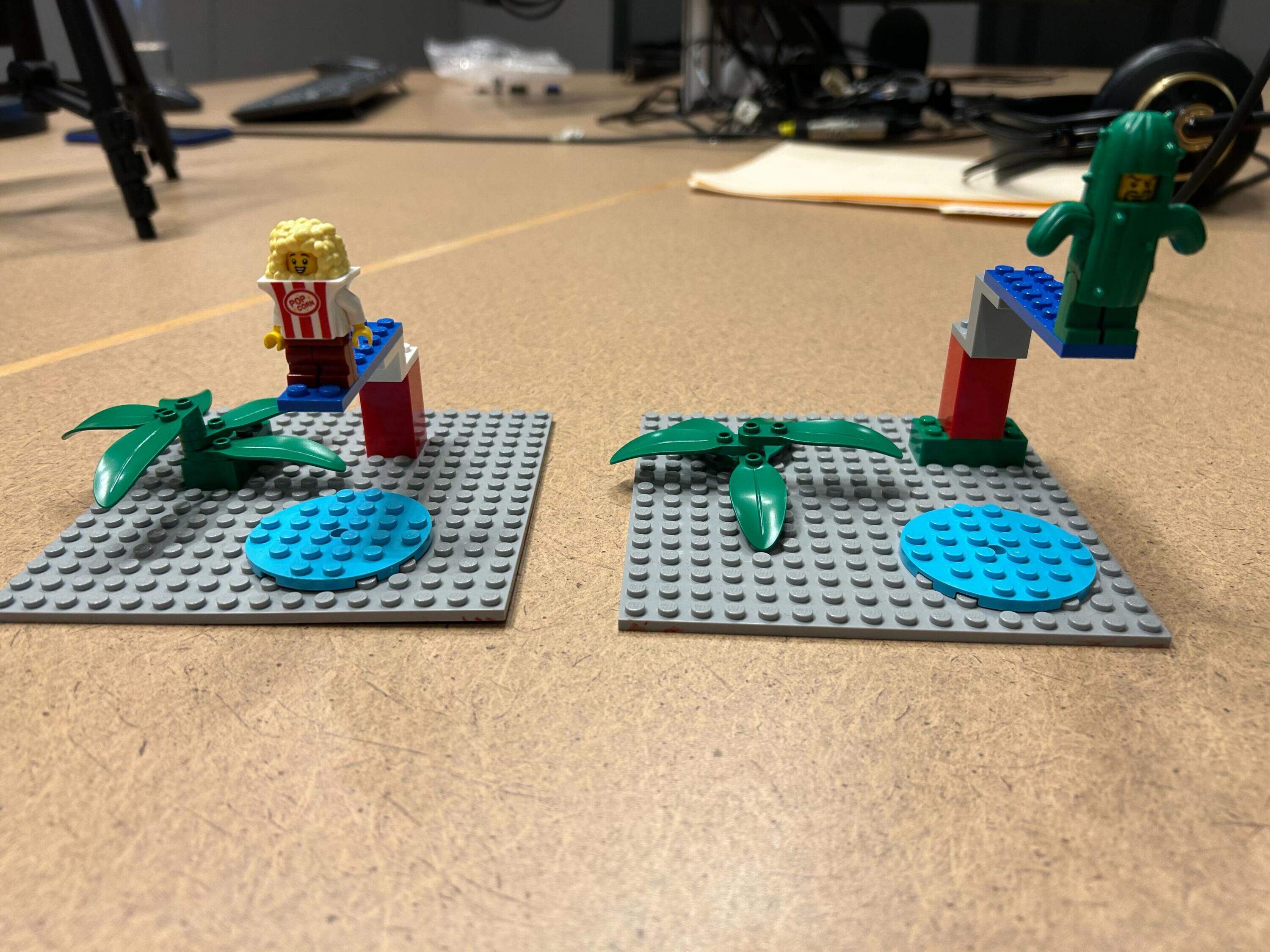
So here's the experiment. I am the coach of my son's Lego robotics team, so I have 10 million Lego pieces at home. And so what we have in front of you, David, is something that was built. I don't actually know what it is because someone else built it, and it's ... I don't know, actually, I do know how many pieces of Lego it is.
It's one, two, three, four, five, six, seven, eight, nine, 10, 11, 12. Okay?
EPSTEIN: 12 pieces in front of me.
CHAKRABARTI: 12 pieces in front of you. Okay. I actually have the identical pieces in front of me. Yeah. So they're all the same. And so here's the constraint, or here's the goal. This is actually a pretty common team-building exercise at least for kids. So we're gonna have one of our constraints is time. We're gonna have 90 seconds. And what you have to do is you have to describe the already built Legos that are in front of you. I can't see them 'cause they're behind a folder.
EPSTEIN: Okay.
CHAKRABARTI: You have to describe them in a way so that I can rebuild it with my pieces.
EPSTEIN: Got it.
CHAKRABARTI: In 90 seconds. So time is one of the constraints, and I'm gonna make it even harder because I thought this might be too easy for you. The other constraint is color. I'm not gonna let you say, we can't say what color the piece is
EPSTEIN: I can't say any colors? Okay. Got it.
CHAKRABARTI: You cannot.
So 90 seconds, and you cannot say the color.
EPSTEIN: Okay.
CHAKRABARTI: And so we will try to rebuild the little build that you have. I'll try to rebuild it using your information.
EPSTEIN: Do you have a clock here? Let's see. Or I'll just guess.
CHAKRABARTI: I'm going to put this clock here. This is my phone. Okay. I'm not supposed to have it active in the studio, but I will.
And it'll chime.
EPSTEIN: Okay, no color, 90 seconds. Yes. Okay? Ready? Here we go. In three, two, one.
CHAKRABARTI: Okay, start.
EPSTEIN: Okay, put down the square piece and envision it as four quadrants in front of you. Okay. In the lower right quadrant, put the circle, circular piece. Okay. In the upper left quadrant, put the plant-like pieces fanning out.
CHAKRABARTI: Plant-like pieces fanning out. Fanning out- Okay ...
EPSTEIN: In a circular, like a palm treetop.
CHAKRABARTI: Okay. You would think I'd be able to get this circular piece on. Okay, let's just pretend it's there. Okay. Plant-like pieces --
EPSTEIN: Fanning out almost like a spinning helicopter rotor.
CHAKRABARTI: Okay, so that's 30 seconds gone.
EPSTEIN: Top of a palm tree.
CHAKRABARTI: Okay, spinning helicopter rotor palm. Okay, and where do I put that again?
EPSTEIN: Put that in the upper left quadrant, about the middle of it, pretty close to the upper left quadrant to the horizontal axis, but in the upper left quadrant. And now you're going to take bricks and build a diving board.
And that's going to be to the right of the plant life. Okay. And up the square of the circle. So, as if the person who goes off the diving board would go into the circle of water.
You're building a diving board.
CHAKRABARTI: So which one of the bricks do I take?
EPSTEIN: Use let me see if I can see them.
I might have to move away from the mic for a sec. So there are rectangular bricks that are all similar. Stack those up. And I can't say the color.
CHAKRABARTI: Rectangular. Okay. I guess.
EPSTEIN: And then make, on top of those rectangular, using the thin layer pieces, make a Z. And then put the long piece sticking out as a diving board.
Okay. And then put the figure at the end of the diving board.
CHAKRABARTI: Oh, you made it. Okay, time. Okay, let's just, let's give ourselves that additional, those five seconds. Figure, the minifig, I have a cactus minifig, cactus guy. Okay. Here's my thing. Is it close?
EPSTEIN: It's fantastic. Look.
CHAKRABARTI: Oh, except we got one...
Oh, that's actually really good, except we got one little, oh, looks like the, oh, this green two-by-four brick was supposed to go underneath the-
EPSTEIN: I couldn't see the green two-by-four brick until I just turned it because I was trying to stay in front of the mic. So I actually didn't know that green brick was there.
CHAKRABARTI: Oh, you put another constraint on yourself which doesn't exist. You could have picked it up.
EPSTEIN: Okay, so from this, because from this angle I couldn't see that piece.
CHAKRABARTI: Okay.
EPSTEIN: But these look really similar.
CHAKRABARTI: These are good.
EPSTEIN: No, they're great.
CHAKRABARTI: Okay. This is not bad. I have to say, this is better than I thought it would -
EPSTEIN: Wait, look at those.
That's really good. This is, especially because the one piece that's out of place I couldn't see.
CHAKRABARTI: You couldn't see it, yeah. Now, we could be really nitpicky and say were these, was the diving board at exactly the same location in that quadrant.
EPSTEIN: But I think we had 90 seconds, and so describing the exact coordinates on the quadrant would have taken too much time for us with 90 seconds. So I decided not to do that.
CHAKRABARTI: Tell me, what did you do immediately given those two, the time and the color constraint?
EPSTEIN: Broke the base up into a way where I could describe it to you. So I said, "Just picture these quadrants," right?
Because I knew that location would be really hard. Like you were saying, if I had to say, go three dots up and four over, there's no chance in 90 seconds. So breaking it into a really quick way, what's the simplest way that I could communicate spatial relationships, was the first thing that I did.
CHAKRABARTI: So this is really important, actually, because I think a lot of people, and this is one of the reasons why I love Lego, it's so analogous to life. A lot of people would have done exactly that. They would've said, "Okay, count one, two, three, four, five, six, seven, eight, nine studs from the left and move in one, two-"
They would have wanted it to be exact from the start. But you actually went for a more simplified spatial orientation knowing that it would maybe not be exact, but it would be faster.
EPSTEIN: Oh, I knew in 90 seconds, I knew there was no chance that we were going to get exact, so we were going for a simplest possible prototype, basically.
What were the things I could simplify most easily? And location sections were the thing I figured that I could simplify most quickly.
CHAKRABARTI: And then you went to shapes as well.
EPSTEIN: That's right.
CHAKRABARTI: Okay. Yeah. So this is great because here, really the goal was clear and quick communication given these constraints.
Yes. And you did it. Although I have to, yeah. I'd say my cactus guy minifig looks like he's diving off a 10-meter board rather than a three-meter board, but that's okay.
EPSTIEN: That was the one piece. But again, that one piece I couldn't see before because of the angle of it, but otherwise these are almost identical.
CHAKRABARTI: They are almost identical. It's really good. This is much better than I thought it would be. So yay for constraints.
EPSTEIN: Good work, us.
CHAKRABARTI: Okay, good job. David, thank you for indulging me.
EPSTEIN: Oh, that was fun.
CHAKRABARTI: On that. Okay. So then let's talk about using, now this exercise in mind, I'd like to go back to the story that you were saying about the box and the product and how the engineer or the head of that company said, "If we can't deliver, if we can't communicate what's in this, supposed to be in this box, we're not going to build it."
But go back to the beginning of that story.
EPSTEIN: The origins of Tony Fadell, the founder of Nest. So he initially worked, his first job out of college was at a place called General Magic, which I think of as like the most important company nobody's ever heard of. And General Magic was such a visionary company that Goldman Sachs took them public in the mid-'90s in the first concept IPO, meaning they went public with a vision, without a product, just with an idea.
It was founded by three former Apple employees, two of whom designed the original Apple Macintosh, one who was a complete visionary. His job at Apple was seeing the future of technology, basically, which he did. I read his PhD dissertation in the '70s at Stanford, and he coined the term information economy and he with eerie accuracy predicted the next 50 years of what was to come. Not just the promise of tech, but also problems with misinformation, rising inequality, all these sorts of things. And in 1989, that guy, his name is Marc Porat, is sketching in a notebook a thin glass rectangle with no protruding buttons and a touchscreen that has rectangular apps on it.
No internet. The internet doesn't exist at the time. 15% of American households have computers, but he's got the vision, and so money pours in, partners pour in. They have so many international, they're basically building the iPhone, way early. So many partners, they have to start their meetings with an antitrust lawyer saying all the things they're not allowed to discuss.
And Porat said years later his goal in raising so much money was to give engineers complete freedom, like limited only by their imagination, and he said, "What more could anyone ask for?" The answer, it turned out, was less freedom, because since they could do anything, they did do anything, and projects just grew and grew.
Every time someone had an idea, they just did it, and it would grow and grow. And when they finally created a product, first they missed tons of deadlines. It wasn't clear who they were working for. They called their customer Joe Sixpack. Turned out nobody really knew who that was. And so when it came out, it had a 200-page manual, and it was confusing.
People weren't really sure what to do with it, and it was a disaster of a company. There's actually one kind of emblematic interview, I think. All these employees would tell me they couldn't figure out what not to do, but one guy who was charged, named Steve Perlman, was charged with building a calendar app, and he built it to go from 1904 to 2096, and he checks it in, said, "I'm done."
Then one of the leaders comes to him and says, "Steve, someone might build historical apps. You gotta make this thing bigger." So he builds it to go from year one to the future.
CHAKRABARTI: Year one. Okay.
EPSTEIN: Checks it in. Then another team comes to him and says, "Steve, why are you tying it into this arbitrary religious context?
You should make it go back to the beginning of astronomical time." So he opens it up again and builds a calendar app to go from the Big Bang to the future, right? Where if it had stuck with 1904 to 2096, it would've been four lines of code, and instead it dragged on for months, and that's how everything at General Magic was.
Because they had the money, because they had the talent, they could do anything, and so they did do anything, and it became an epic disaster. Stock price doubled the first day, and then it's basically worthless two years later. And Tony Fadell came out of that culture. The young people that were there for that disaster were scarred and learned these lessons about the need to put boundary; they did all kinds of amazing things. One woman went on to become the chief technology officer of the U.S. under Barack Obama. They developed, they founded LinkedIn, eBay, Android, led Google Maps, all these things, and they all came out with these lessons about the importance of constraints.
So Tony Fadell, who then went on to build the iPod, said I'm giving us nine months to ship this thing. Just weeks to make a first prototype. And that forced the team to borrow technology. And so the famous scroll wheel on the iPod actually came from when a team member brought in a Danish cordless phone that had a wheel, and they were like, "What can we steal?
What can we adapt?" And then at Nest, he continued with his, what he calls his ultra constraint-based things that slow people down but force them to think hard, and that's when he forced the team to make the box. So this very much came out of this scarring experience where he saw what too much freedom did, where people couldn't figure out what not to do.
CHAKRABARTI: So that, you've said that phrase twice now. And it's really important. Could not understanding what we shouldn't do. That actually, in some cases it, for other people it leads to almost, instead of this surfeit of useless creativity, it leads to paralysis.
EPSTEIN: Yeah. Absolutely.
And we see this, so there are ... I think this is especially topical issue, because I think it has never been easier to do too much than it is now. And this gets into the AI age, where it's frictionless to start a million different things. And I've seen this with, for the last year, as I've been trying to learn about AI and how it's being implemented, I've spent a bunch of time with a company that helps other companies implement AI.
And they're often doing it in this sprawling way where it's, "We need it. We need it everywhere." So they're starting a million different initiatives with AI, and it's resulting in what researchers are starting to call work slop. Where it's just producing this incredible volume of stuff that nobody's sure what to do with because it's getting rid of the hard work of deciding what you shouldn't be doing in the first place.
And so I think it's incumbent upon us to start to really be thoughtful about putting limits on ourselves. Because the cost of starting a million things that you'll never finish or that aren't worth doing has never been lower.
CHAKRABARTI: Yeah, that AI work slop, we just did a show I think you know about this, about tokenmaxxing in Silicon Valley, and that was one of the things that came up, that there was actually more being produced, but then human beings had to go back and essentially cull all the code that they wouldn't ever end up using anyway. So more volume being produced, but really not as actually ultimately as productive in a meaningful way for the businesses.
EPSTEIN: Totally.
CHAKRABARTI: Okay, so it's so fascinating to me. I could go down this moralistic road of, wow the successful Silicon Valley companies are the ones that actually put constraints on them, but they're trying to build a frictionless world for the rest of us, where we can ostensibly do anything, but I won't do that.
Let me just ask on the other side of the glory of constraints and creativity, you had said this earlier. There still can also be such a thing as too many constraints. So but how do we know when we've crossed that line?
EPSTEIN: That's a great question. And I would say, the word constraints is practically synonymous with something that's frustrating, something that we don't want.
And if we look at, again, sticking with creativity, like research where, say there are sets of pieces for people to make mechanical inventions, and if there's 100 pieces, people are actually more creative when they're told okay, you have to make a piece of furniture, given a category of something they have to make, and you can only use these 20 pieces, than if they're told, "You can make anything and you can use all 100 pieces."
But if they're told, "You can only use these 20 pieces, and you specifically have to make a chair or something, then that's when the creativity starts to dip. If someone is told what to do and how to do it. So again, there's no room for them to surprise themself, that's where you see that curve actually start to go again in the wrong direction.
CHAKRABARTI: So avoid being told what to do and how to do it.
EPSTEIN: Yeah. So if you're, whether you're leading yourself or other people, if you can be really thoughtful about setting those boundaries but making sure that people have room to maneuver in it, because what you wanna do is spur their ingenuity. And if you're being too prescriptive about what should be done, then you're not really leaving room for that.
CHAKRABARTI: Yeah. Before the show, you and I were talking about our mutual passion for all things space. Yes. I'm wearing my NASA Johnson Space Center shirt here.
EPSTEIN: Yes, we both went to space camp.
CHAKRABARTI: One of my favorite examples of the perfect amount of constraints unleashing creativity, first of all, I think space exploration of any kind, by the way, is the definition of a constraint driven ingenuity. You know where I'm going.
EPSTEIN: I know where you're going.
CHAKRABARTI: Apollo 13.
EPSTEIN: I knew it, the scene where they have to put the square peg in the round hole scene. I knew it. I've got a good one for you though.
CHAKRABARTI: Okay.
EPSTEIN: So one of the first readers of this book was a guy named Ed Hoffman, who was NASA's first chief knowledge officer. It's like a position for a psychologist who makes sure that there's institutional memory from lessons.
And as he was reading it, he said, "I have to tell you about this mission called LCROSS that I had never heard of. And he says, "The engineers, they were, had to build a probe, and they ended up with about half the time and budget roughly that they were expecting. And so what do they do? They complain first."
"And then they say if we were going to get it done anyway, how would we do it?' And they ended up realizing they couldn't build from scratch. They'd have to borrow technology, just like the iPod team. And so they took imaging equipment straight out of Army tanks. And they took engine temperature sensors straight out of NASCAR and built a probe that confirmed water on a part of the Moon."
And so it became this sort of touchstone for, all right, there's obviously a point at which the budget would make it impossible. But even that thought experiment of if we were going to get it done, how would we do it, led them to this borrowing of technology that then became a more important part of the things that they do.
CHAKRABARTI: The Ingenuity helicopter on Mars is the same. It's all off-the-shelf parts. And they're flying a helicopter on Mars. Yeah. It's amazing. By the way, for people who don't know, just first of all, if you haven't seen Apollo 13, what are you doing? Go out and just watch it right now.
EPSTEIN: What are you doing with your life?
CHAKRABARTI: But the scene that we're talking about is that there's a scene where I think- I know, ... there's a-
EPSTEIN: We just assumed everybody was like us.
CHAKRABARTI: Yeah. Is it an air scrubber, or there's something that fails on the Apollo 13 capsule, and back in mission control, all they have is a box full of the identical parts that are on the capsule. And they just put the box down on the table in front of the engineers, and they're like-
EPSTEIN: And say, "You have to fit this into this into that." And one's like a square and one's round, and they get to work and they do it.
CHAKRABARTI: And if you don't, they will die.
EPSTEIN: And you have eh, whatever the time, it was like a really short timeline too.
Part III
CHAKRABARTI: David, we actually asked On Point listeners a few days ago about examples in their lives when constraints actually helped them out.
And let's just, they're some great stories, so let's just listen to them. Yeah. This is Amy Johnson. She's in Durham, Maine, and she told us one of her favorite examples.
AMY JOHNSON: When I would ground my son and send him to his room, he learned to juggle, and he's fantastic at it today.
CHAKRABARTI: The literal constraints of being grounded unleashing a juggling skill.
Okay, here's another one. This is Sharon in Portland, Oregon, and she had an experience in a college painting class about four decades ago where the assignment was to make a painting using, oh, this is very Monet-ish, like the opposite, using only three colors, red, black, and white.
SHARON: My instinct was to hate this assignment, but it took me only a few minutes to discover the amazing and infinite array of reds, blacks, whites, grays, and pinks at my disposal, from fire engine red to deep dark cherry, from snow white to dark ash.
I could exercise all of my painting chops, shading, dimension, foreground, background, et cetera. This painting exercise has served as my touchstone and reminder during the pandemic, during a bout of cancer, whenever I catch myself overwhelmed or paralyzed by seductive and endless possibilities.
CHAKRABARTI: Beautifully put, Sharon.
EPSTEIN: That was beautiful. Yeah. Lovely.
CHAKRABARTI: We're going to hear one more in just a second but let's just jump off of what she said here about her first instinct was to hate the limits.
EPSTEIN: Yeah. Because in the abstract, we overvalue complete freedom in all kinds of ways. There's all sorts of studies that show people prefer reversible decisions, for example, even though they are less happy with reversible decisions because it prevents them from feeling committed to whatever they end up choosing.
Or in surveys, about two-thirds of people say if they got cancer, she mentioned having been a cancer survivor, that if they get cancer, they would want to be involved in choosing their own treatment, whereas of people who are actually diagnosed, it's only 12% of people who want that.
So it's that freedom seems better in the abstract, or we talked about people being more bored since infinite scrolling. Of course it seems like more choice would be better but it's not. In investment plans, like retirement plans, when choice sets get large, people get paralyzed, and they just don't participate.
Which doesn't make any sense, right? But that's the reality of it. But these are what ... these constraints are often what psychologists call desirable difficulties. It does make it difficult because she can't use those other colors, but that's also what makes you grow and what makes it feel valuable.
CHAKRABARTI: And it aids in progress away from that paralysis. Are you a parent, by the way?
EPSTEIN: Yes, I am.
CHAKRABARTI: Yeah. Okay. Same here, and I've found, learned the hard way. And with my kids, initially, I was like, "Oh what do you want to do?" Yeah. Just pick the things that you wanna do this afternoon, for example.
And they would be like, "Ah, I don't know," right? Yeah. But when I say, "Okay, here's the three things that we could do," so put that constraint. You choose one of three. It's like the decisions were quickly made. We all had more fun.
EPSTEIN: You do the thing instead of spending. It's what Mihaly Csikszentmihalyi the psychologist who coined the term flow for the feeling of immersion in an activity.
Said, "Make a decision, and then you save all your energy from wondering what else you could be doing, and you spend it on doing the thing." And as a parent, my son is seven, and I've seen around holidays or his birthday when a bunch of gifts will pour in from relatives and everything, and it's almost like he'll bounce between them, taking inventory.
And this goes to the first woman who said her son learned to juggle when he was grounded. Then if I take him out in the woods and say, "Here's a stick and a rock. You have to figure out something," then he starts exploring, "What can I really do with these things? What affordances does this environment give me?"
And he's much more creative than when he's just bouncing between all the stuff he just accumulated.
CHAKRABARTI: 100%. All they need is a cardboard box. Okay, so let's listen to one more On Point listener. This is Leah. She's in Mount Holly, Vermont, and she is an artist who makes quilts.
LEAH: Often as I was working, my first ideas were constrained by not having enough of a particular fabric.
That was always very frustrating, but it forced me to alter my design ideas, and it usually led to something better. I'm currently building a tiny house using found architectural salvage old doors, reclaimed windows, gingerbread trim. It feels very much like a quilt in wood. I continue to be constrained by the unique vintage pieces I can find to work with, and I've learned to really embrace those limitations.
It's more challenging and creative to use just what's available to me rather than new, unlimited materials.
CHAKRABARTI: So those are just three of the great messages we got from listeners. They're terrific. Okay, so how do we apply this now finding the right amount of constraints in our lives?
It's one thing to be able to tell kids, "You can only choose three things. Here they are." But let's start with, for adults, how do we decide what not to do?
EPSTEIN: Yeah, I think one useful exercise, and I write about this in the context of some teams at labs basically, is to make all of your current commitments visible.
That can be Post-Its on a wall, for example. And usually what happens when people do that is they see that there is more already there than they could get done even in a best case scenario, depending on the timeline. And so do that, and then say, "If I had to cut one thing out in the next 90 days, what would it be?"
Even if you don't end up doing that, the exercise will force you to clarify what really is the most important thing here? And I think it's important to do regularly. It's called a subtraction audit because humans are actually hardwired to add things, to solve problems. So we have something called additive bias, and its cousin, subtraction neglect bias.
We overlook solutions that involves taking things away. And so we will always get more tools and more dashboards and more commitments and more messaging systems if we don't regularly do these subtraction audits, where we say, "What are the things I have going on?" Really visualizing them can be very helpful.
And saying, "If I had to force myself to take something away to make sure that I can focus on the most important ones, what would it be?" I do that exercise regularly because then you go back to accumulating, and so you have to keep pulling back and back.
CHAKRABARTI: Okay, so a subtraction audit, first and foremost.
And then, look, I'm in the world of radio, so you see I keep looking at the clock, does it also help to essentially create deadlines to be a to create time constraints?
EPSTEIN: Yeah, deadlines so when it comes to creativity specifically, deadlines can be good or bad.And it depends how people end up using them.
If they say, "Oh, I'm in a hurry," and they start rushing to multitask, that actually hurts everything. It's stressful. Productivity is worse, all these things. But if they, if it forces them into monotasking, then they become much more creative. So as Duke Ellington used to say, "I don't need time.
What I need is a deadline, because that's the only time he could focus, or Frank Lloyd Wright famously had a bunch of time to make Fallingwater and didn't do anything until the client said I'm a few hours away. I'm gonna drive over. I wanna see the progress. And then rushed into his office, and his assistants couldn't sharpen pencils fast enough, and he did Fallingwater, in that two hours.
So if it forces you to monotask, then deadlines are really useful.
CHAKRABARTI: Monotask, is that a phrase you coined?
EPSTEIN: That's not a phrase I coined. Maybe I use it quite a bit, but it's really important. I'm not sure who coined monotask, but I'm pretty sure it wasn't me.
CHAKRABARTI: Okay. So monotasking is essentially the opposite of multitasking. It's doing one thing with focus.
EPSTEIN: Yeah, and this is another really important thing that people should do. So our focus is being trained in a certain way by algorithms and all these things. So let's say a lot of this comes from the work of a psychologist named Gloria Mark, who studies people at work and has been for 25 years.
And about 25 years ago, people would switch tasks every three minutes on average. And then by 2012, it was every 75 seconds, and now it's more like every 45 seconds.
CHAKRABARTI: We're switching like significantly between tasks?
EPSTEIN: Yeah, so going from email to writing or whatever it is. And in fact, she found in offices people check email on average 77 different times a day.
That's not 77 emails, 77 different checks. And every time you toggle, there's a cost, because you can't really multitask. Your brain has to drop the rules for one task and switch to the other. And she describes the brain as like a whiteboard, where you have to erase when you switch, but there's a residue.
And that builds up over the day until you have time to rest, and it makes you less available for everything you're doing. And now we know it really raises your stress. So you can basically predict someone's stress from the number of tasks they toggled between by the end of the day. And the scariest part of her research, I think, was on self-interruptions, that found that once you've gotten trained to toggle all day and have notifications and everything, if you say now I'm going to focus, you will self-interrupt with intrusive thoughts at the rate to which you've become accustomed, as if you have some kind of internal distraction barometer.
Say, "Oh, I should have checked that. What is this thing I left undone?" That will keep that cadence up. So if you want to be able to focus and lower your stress, you have to start trying to do what's called batching, where you have blocks of monotasking through the day. Maybe you need to answer all those emails.
But can you do it in one or two or three or four or five blocks where you're just doing email in that block, and then you're not doing email and only doing the next thing in the next block?
CHAKRABARTI: This sounds terrible.
EPSTEIN: It's not good. And there's an army of designers and psychologists that are training things to capture our attention.
And so if we're not structuring our own attention now, it is being structured for us by people who have financial incentives in making us very distracted essentially.
CHAKRABARTI: Yeah. But you're saying it can be undone.
EPSTEIN: It can be undone, and actually it doesn't take that long to start doing it. So if you can even start with a 15 or 30-minute block where you put your phone outside the room's best.
We know now in cognitive tasks, people that are really phone-dependent will score worse even if they can't touch the phone, but it's visible. If it's visible, right? And so just starting with these short blocks, and put a pad next to you where when the intrusive thoughts pop in, that almost physical urge to check, write it down to get it out of your working memory, called cognitive outsourcing, and try to make those blocks a little longer and a little longer. And even in a few days you start to notice a difference. So the good news is you can retrain yourself fairly quickly and it, again, it makes you more productive, but I think some of the most interesting emerging research is that it really lowers your stress as well.
CHAKRABARTI: Yeah. Okay. This is terrific. Okay, so let's telescope this outward or zoom out to let's say larger organizations because you had mentioned AI earlier, but I'm also thinking that the entire way, let's say our economy is structured, especially in publicly traded companies, it's always about growth more.
And if you're a manager of people, how do you resist the urge to present to your board "Here's all the 50 other things that we're doing right now." Hint, we may not be doing them well. Bbut it's more stuff.
EPSTEIN: Yeah, that's a great question. Because there was, I saw a study in the UK recently that showed all these startups that were applying for AI funding. Only half of them were really using AI in any real way. So there's also this drive to say you're doing all sorts of things that you're not. And I think that's a real challenge, right?
Because you can pitch all these fancy things, but I think organizations that are successful kind of know what their priorities are, and they know how to say no to certain things. I was actually just talking about this, and someone from the innovation team at Amazon Web Services who I don't know just sent me a note through LinkedIn and basically said, "We already had this problem."
I see this in entrepreneurs all the time, and now it's exploding with AI, where they cannot say no to anything because these tools give you the illusion of the idea that you can actually get everything done. And tons of, pre-AI, tons of productivity tools and hacks are like that. They're giving you the illusion that if you just had the right system, you could actually get it all done, when in fact what you have to do is face up to your limited attention and limited time on this earth and say, "What are the things I should really be doing?"
CHAKRABARTI: Yeah, so it's a difference between I can or we can versus we should.
EPSTEIN: And you will not get it, and this is very clear, is when there are too many things in process, you will get less done. You will get less done.
So this, one of the labs I mentioned that had to, was having too much work going on, actually at the Broad Institute, the MIT Harvard Biomedical Research Center. When they were a world leader and they started having too many projects in going at once, and so work started getting sloppy. And so they did this prioritization, Post-Its on a wall, saw that they had twice as much going as they could even get done in a best-case scenario, and made a funnel, and said, "Okay, nothing, no new projects are allowed to go in the top of the funnel until something else comes out the bottom."
Stop starting, start finishing. And it increased massively the number of projects they actually got done, because that feeling of having a million things in progress may be a feeling of productivity, but it actually prevents you from getting most of them done.
CHAKRABARTI: It's such a, just like a mirage.
Completely. Okay. We have been talking a lot about how constraints, wise constraints can really apply, obviously tech, engineering, science, art, even business. But one thing which I was really interested in is that you also say that wise constraints give rise to things like better social systems, better political systems, a predictable body of law.
How?
EPSTEIN: Yeah, so this is from the work, I was focused, when I was writing about this, I was focusing on the work of a Nobel laureate economist named Douglass North. And what North showed was that the say like the paradigm in his field was that shared prosperity is all built on technological innovation.
That's what it is. And what he showed was actually no, preceding technological innovation in all these eras were changing social norms and political structures that, one, made strangers' behavior more predictable to one another, because in the past, people only did business with their kinship network or their neighborhood basically, or sometimes their religious network.
And so norms that made strangers more predictable so that the constraints on their behavior so that they would start to collaborate, and constraints that reined in people with excessive power. So all the, most of the legal systems in the world, we, we inherited the British system, which was created because basically a merchant class wanted to constrain the Crown so they would know they would get paid back for their loans.
And the Crown thought that's going to impoverish us if I have to pay back the loans. But actually, it made the kingdom wealthier because then people were willing to lend money if there were constraints. So you see economic growth wherever parliaments became strong in Europe. In France, another part of, most of the world that doesn't have the British system inherited the French system, which was local magnates putting constraints on one another because they feared one another more than the Crown.
So this putting constraints on people with excessive power actually made society more predictable and allowed other people to start participating in much greater numbers, and that's what led to shared prosperity. And I actually, I think some of those things are challenged right now, and I think we're starting to see some of the results of that.
So it was actually just a, as we break down some of our social norms and constraints for public decorum, as well as seeing some of the rules not apply to some of the elite sectors of society, there was just a Pew survey showing that America is now the only country where a majority of adults, it was a small majority, but say other people have bad morals.
And that's really bad because GDP per capita is tightly tied to trust between strangers.
The first draft of this transcript was created by Descript, an AI transcription tool. An On Point producer then thoroughly reviewed, corrected, and reformatted the transcript before publication. The use of this AI tool creates the capacity to provide these transcripts.
This program aired on May 8, 2026.