Support WBUR
The hidden chemistry at the heart of the Milky Way
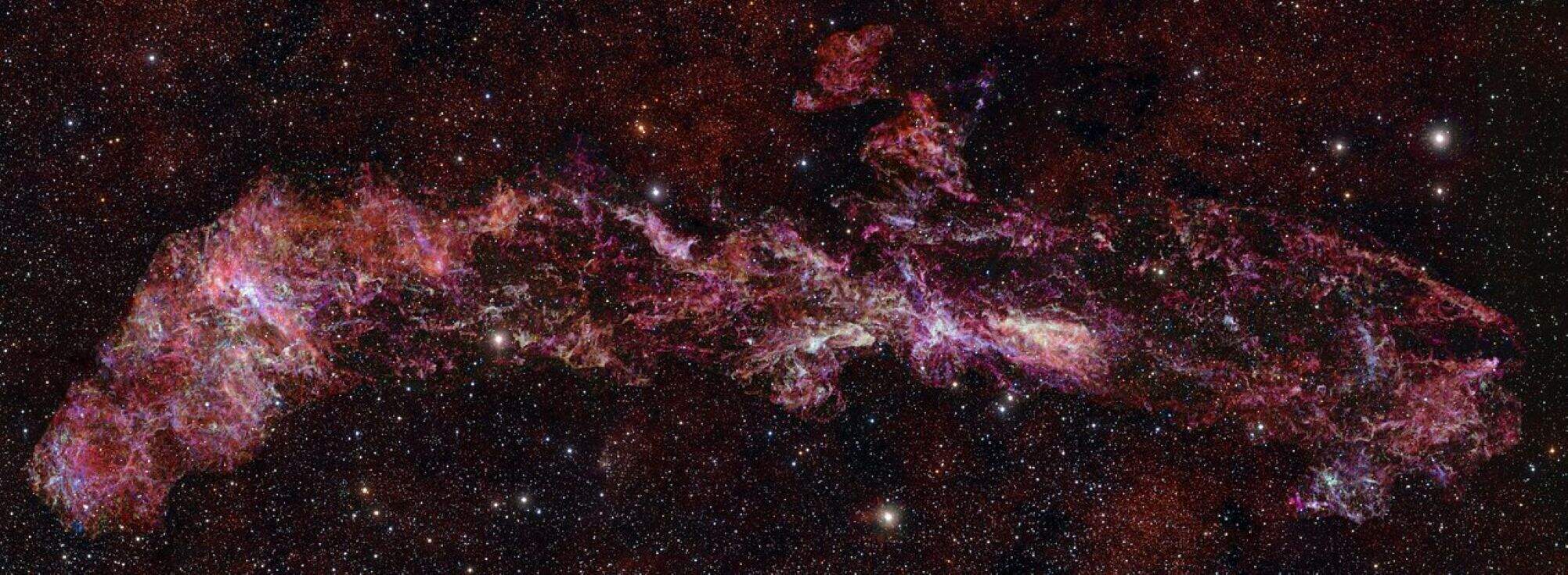
Scientists have taken the largest ever image of the Milky Way. The image shows spectacular detail of our home in the universe, and offers scientists a color-coded guide to some of the most mysterious corners of our galaxy.
Guest
Steven Longmore, professor of astrophysics, Liverpool John Moores University. Principal investigator for the ALMA CMZ Exploration Survey.
Adam Ginsburg, associate professor of astronomy, University of Florida. Astrophysicist for the ALMA CMZ Exploration Survey.
The version of our broadcast available at the top of this page and via podcast apps is a condensed version of the full show. You can listen to the full, unedited broadcast here:
Transcript
Part I
1965 NEWS BRIEF: Here on Mount Hamilton, some 70 miles south of San Francisco, Lick Observatory astronomers entered a new era of heavenly exploration, probing deeper than ever before into the secrets of space. Their tool was this towering telescope with its 36-inch lens, truly a giant in its day. Looking through the eyepiece, astronomers have studied mysteries of the universe that stirred the awe and imagination of men for centuries.
MEGHNA CHAKRABARTI: A 1965 newsreel describing the Lick Observatory in California. Built in the 1880s, for decades it was the largest refracting telescope in the world. There are also, of course, reflecting telescopes, and for many decades more, optical telescopes would get better and more powerful. But they were still on Earth.
The planet's atmospheric veil, moonlight, and human light pollution all limited how far and how clearly these telescopes could see. Then came the Hubble Space Telescope in 1990.
3, 2, 1, and liftoff of the Space Shuttle Discovery with the Hubble Space Telescope, our window on the universe.
CHAKRABARTI: And astronomers could finally see space from space, a massive step forward.
Now, there's also the James Webb Space Telescope. That one is a million miles away from Earth and capable of capturing even more staggering images. But light is not the only language of the universe.
This is the sound of Venus. NASA's Parker Solar Probe flew through Venus' upper atmosphere in July of 2020, and it discovered a natural low-frequency radio emission that NASA scientists were able to convert into a sonic frequency humans can hear. And this is the sound of a black hole.
Another clip released by NASA, this one of sounds emanating from the enormous black hole at the center of the Perseus galaxy cluster. And here's one more.
Any guesses? That is the metronome-like ticking of a pulsar, though of course many pulsars tick much, much, much faster. They're all different examples of the power of radio astronomy. In 1932, Karl Jansky, a young engineer at Bell Labs, was trying to figure out why so much noisy static was interfering with shortwave radio transmissions across the Atlantic Ocean.
And he tracked the source of these interferences for months, and he found that the source was actually shifting across the sky. Very strange. So he consulted with an astronomer and learned that a cloud of cosmic dust laid in the direction of his moving target. Jansky had just discovered something in the middle of the Milky Way, and in 1933, he published a paper titled Radio Waves from Outside the Solar System.
It laid the foundation for the science of radio astronomy. Recently, radio astronomers revealed the magnificence of the Milky Way once again. Scientists using the Atacama Large Millimeter/Submillimeter Array, or ALMA, have taken the largest and most detailed image of our galaxy ever, and it is astonishing.
Now, ALMA is a radio telescope composed of 66 high-precision antennas, and together they created a mosaic of images which in raw form really isn't a picture at all. It's the culmination of years of data collection and research into a cosmic map that could be revelatory. And Steve Longmore is the principal investigator for the project and a professor of astrophysics at Liverpool John Moores University in the United Kingdom, and he joins us now.
Professor Longmore, welcome to On Point.
STEVE LONGMORE: Hi, Meghan. Meghna. Sorry. Great to be here.
CHAKRABARTI: It's quite all right. So before we talk about the how of how this staggering image of the heart of the Milky Way was produced, let's talk about what we're actually seeing. I have it here, right here in front of me.
How would you describe this image?
LONGMORE: It's a swirling ball of gas. It's many filaments, many very compact objects all spread over a large area. There's a structure on all the different size scales that you're looking at. The different colors are bright in different regions. It's really, it's a beautiful mosaic of swirling gas.
It's a beautiful mosaic of swirling gas.
Steve Longmore
CHAKRABARTI: Yeah, I have it here in front of me and it's absolutely gorgeous. It's this miasmic arc across the image of the picture. And there's as you say, the swirling gas, which has been colorized, and we'll talk about what each of those colors mean. But there's pinks and purples and brighter spites of spots of white.
What makes this image different than other images of the Milky Way that we've captured either from optical or radio telescopes?
LONGMORE: So there's several things. So we're zooming in right to the very center of our galaxy, so that's one of the most extreme regions in the nearby universe.
The level of detail is unprecedented. So we're able to see the structures at a level of detail that we've never been able to before, and over an incredibly large region. So it's a combination of those two things. The level of detail and the size of the image, and also the different colors that you were talking about imprint different properties of the chemicals that are floating around in the gas.
So the combination of the morphology of the image, the way it looks, and the different colors, how they vary, tell us really intrinsically fundamental details about this important region of our galaxy.
CHAKRABARTI: We're going to have a link to the image at our website, onpointradio.org. But again, just I keep staring at it here in front of me Professor, and I can't stop thinking of like a giant beautiful cosmic albatross, because it just looks like a bird with its wings spread out.
LONGMORE: (LAUGHS) That's a great description. Yes.
CHAKRABARTI: This sort of this gossamer cosmic albatross is what it looks like.
LONGMORE: That's a great description.
CHAKRABARTI: To me. It's really gorgeous. Okay, so I know that very keen-eared listeners right now will be telling me Meghna, you're talking about a visual image from radio telescopes.
So how did this happen?
LONGMORE: Yeah, so when you think of radio, you think of something you listen to. But these are just long wavelength light rays, and we can make an image of that in the same, end up with a picture that you would take with your camera. But we have to use a different technique where we combine, we have individual radio antennas or big versions of satellite dishes that you'll have be familiar with.
And we have a large array of those, and in a clever way, in a technique called interferometry, we join the signals from all these different antennas and combine them to make a single image. So that's how we turn radio waves into an image.
CHAKRABARTI: Okay, so let's talk more about the facility that created this mosaic, the ALMA radio astronomy facility.
What's special about ALMA that allowed you to make this image?
LONGMORE: Okay look, the first thing is that it's in a very special location. So it sits in Chile on the Chajnantor plateaus, and it's at about 5,000 meters above sea level. So it's above the atmosphere, and that removes effectively the twinkle of the stars.
So it means we get a very clear view of the night sky and above the water vapor that can block out the emission that we're trying to see. So first of all, it's very high up. It's a great site for observing. Secondly, we have lots of different, lots of dishes. So we have about 50 different antenna, radio antenna spread over this large plateau, and they're spread out in such a way that when they're combined, we create these images that have exquisite detail.
And that has never been done before. It's a worldwide effort to make this really groundbreaking facility.
CHAKRABARTI: I understand that the ALMA array was actually designed to study specifically colder and darker portions of the universe. Looking at the information from the National Radio Astronomy Observatory.
What's unique about those portions of the of the cosmos that could give us a ton of information that we didn't know before?
LONGMORE: Yeah, these coldest sort of densest parts of the universe, it's the history of our own origins. That's where we came from. So the material that eventually formed the sun and the planets, our own solar system, started out as a very cold, dense gas cloud sitting in between the stars.
And that collapsed under its own gravity to form what we, you look out your window, all of that was started from this very cold gas cloud. And before ALMA, we didn't have a way to find those and peer inside them at the level of detail where now we can actually see solar systems that are forming at the present day.
Before ALMA, we didn't have a way to ... peer inside [the darkest parts of the universe] ... where now we can actually see solar systems that are forming at the present day.
Steve Longmore
We can follow that gas as these dark clouds, as the gas is collapsing and spinning under gravity. And that, ALMA has really revolutionized our ability to do that.
CHAKRABARTI: Okay, so maybe you just answered the question I was going to ask, but what are the things in this image, and again, we'll talk a little bit later about the sort of the computation that goes into turning these, the radio receptions into visual images. But what are the things that are producing the radio emissions?
LONGMORE: Yeah, so it's gas. So there's lots of stars in the center of the galaxy, but what we're looking at here is gas, and it's molecular gas. So these are molecules like some of which we have here on Earth.
In fact, most of them exist on Earth. And they have, each molecule has its own fingerprint. So if you were to look at the light coming from a particular molecule, it emits at a very particular frequency. And if we tune our radio telescope to that frequency, we can tell that it might be a molecule coming from something like methanol or carbon monoxide or each molecule has its own fingerprints. So when we're looking at, we can take that, we know it's coming from a carbon monoxide or methane or methanol, and we can then give that a color in the image. So we can look at how the carbon monoxide is spread across the center of the galaxy.
We can give that a color blue, for example. We could give methanol a color pink. And so when we make our image, and what you're looking at when you look at this image, the different colors are telling you how much of these different chemicals there are spread out across this region.
Part II
CHAKRABARTI: I'd like to now bring in Adam Ginsburg. He's an associate professor of astronomy at the University of Florida and an astrophysicist on the project as well. Professor Ginsburg, welcome to On Point.
ADAM GINSBURG: Hi, Meghna. Thanks for having me.
CHAKRABARTI: Okay. Before we get more into the nitty-gritty of the science, I just wanna take a step back and allow all of us to be more human about this.
So Professor Ginsburg, when you first saw, again, the visual image that was rendered from the data coming into the radio telescopes, just as a person, what was your first reaction to it?
GINSBURG: I'm just really super pleased that we're able to put it together, because the way I saw this, I didn't get to see it all at once until I'd seen every individual piece, every little speck of data, I had to inspect painstakingly before I put it all together.
So when I finally got it together into this one giant mosaic, it was just really thrilling to see how good it turned out. It really ended up being a beautiful piece after all the work to put the 45 individual sub-mosaics together.
CHAKRABARTI: Professor Longmore, when I look at this image, it often reminds me of how human beings, we're so biased towards our own senses, right?
Particularly the visual sense. And so we just default to thinking that what we can see with our eyes is the limit to what's out there. Now granted, you had to convert this image from radio astronomy data to photographic data, but at the same time, I realize that what I'm seeing here, I could not see with my own eyes.
Telling me that, or telling us that maybe, as human beings, we're only privy to a fraction of a fraction of what's actually out there.
LONGMORE: You're absolutely spot on. Our eye is only sensitive to a minute part of the whole electromagnetic spectrum. The radio wavelengths are at a much, much longer wavelength than we can see, but there's also the other direction, a much more high energy photon like X-rays and thank goodness that we're not bombarded by those.
Because that would be rather short-lived. So we, and our eye is tuned to that because that's the wavelength where the sun is at its peak. So we've developed because that made evolutionary sense. But you're absolutely right, is that we are blind to most of the light in the universe.
CHAKRABARTI: It's so astonishing to me. It's one of those, yet another reason why the study of the universe makes me feel delightfully tiny.
LONGMORE: Me too.
CHAKRABARTI: Okay, so Professor Ginsburg, let's turn to, let's turn back to the actual science that's revealed here in this image. So the millimeter and sub-millimeter wavelengths that the ALMA array can see, why is that significant in terms of understanding sort of the birth of the galaxy or the birth of the stars that make up our galaxy?
GINSBURG: Yeah, so what we're seeing at these millimeter wavelengths is the stuff between the stars. We call it the interstellar medium, and that is the stuff that's going to form new stars and came into our galaxy by being accreted, drawn into the galaxy from the cosmic web. And so what we're looking at is we get to see the gas that's going to form into new stars and even new planetary systems, and it's something we don't get to see at other wavelengths.
In particular with ALMA, when we're looking at these different molecules, we can actually see how the gas is moving. So we can see the velocity of the gas. We measure its Doppler shift, and we can measure how it moves under the force of gravity, how it gets drawn in and collapses to form the next generation of stars.
So with ALMA, we see all the stuff that's going to become new stars.
CHAKRABARTI: But this happened a long time ago, right? How far away is the center of our galaxy?
GINSBURG: So it's about 25,000 light-years, that's telling you 25,000 years ago is when the light came to us.
But that's short on astronomical time scales. Even though it's a very long time on human time scales, the stars that were forming 25,000 years ago are still forming today. It takes, of order, half a million years for a new star to be born out of its parent gas cloud.
CHAKRABARTI: Okay, so tell me more about the significance, or why we need to understand, as you said, the motion of these gases, the turbulence of the gases, and how that helps determine the birth of a star, perhaps even what kind of star it's going to be.
GINSBURG: Yeah. So the big question is what kind of star. And the main thing that we worry about is the mass of the star, how big it is. So a star like the sun is a middling star. There are some that are way more massive and some that are much smaller, and one of the fundamental questions we're trying to answer is, what controls whether we form a big star or a small star?
What determines whether we're gonna form a star system that has planets around it versus a star system where the star's gonna go supernova in a couple million years? That's the big question we're trying to answer, and watching how the gas flows and how it moves and figuring out how much is where is how we do that.
And in particular, when we're looking at the center of our galaxy we get to see conditions, an environment that's really different from where the sun is right now. Right now, the sun is traveling through a really low density, like an empty part of the galaxy, and in the center of our galaxy, that's where all the stuff is.
There's a lot of action happening right now in the image that we're showing. Every pixel is full of something.
CHAKRABARTI: Every pixel is full of something. Okay, Professor Longmore, did you want to add to that?
LONGMORE: Yeah, I think it's really exciting for exactly that reason. And what particularly draws me to study this region is that it's more extreme as compared to where we are in the galaxy in the solar neighborhood.
But it turns out that this is an amazing laboratory for understanding how typical stars in the universe form. Stars like our own sun and our own solar system that formed four and a half billion years ago, the universe was very different. The gas was hotter, it was denser, higher pressure. And nature's given us this amazing laboratory in our own backyard, at least cosmologically speaking, that those conditions we're looking at where stars are forming now in the center of the galaxy, we think are very reminiscent of our own origins, of how our own solar system formed.
That's why I'm drawn to studying this, and I think as a team, understanding how it's collapsing and forming stars and planets there gives us a window back to how most stars in the universe are formed.
CHAKRABARTI: It was Carl Sagan who I think famously said that we're all made of stardust eventually.
LONGMORE: Absolutely.
CHAKRABARTI: Would you draw that line that helping to understand this formation of stars does in some way contribute to understanding the emergence of life on our planet?
LONGMORE: Absolutely. I think it's completely interconnected. The conditions that we found ourselves in four and a half billion years ago must have played a key role in determining the ultimate structure of the planets within the solar system, the amount of raw material that was available, the kind of stars that were forming nearby.
Conditions that we found ourselves in 4.5 billion years ago must have played a key role in determining the ultimate structure of the planets within the solar system.
Steve Longmore
For example, Adam mentioned that it makes a big difference if you form stars of low mass or high mass, and we think we probably form next to some very high mass stars that went supernova early in our own formation history. And so that means that the environment in which we were forming was important.
CHAKRABARTI: Okay. So Professor Ginsburg then, I'm looking back at the image once more, and Professor Longmore did a really good job of explaining the fingerprints, as they call it, the molecular fingerprints from different types of gases and assigning them colors, and that's how we see this beautiful miasma, as I've been describing it, of swirling gases.
So which ones are the ones that you find most compelling or most interesting? What are the gases that we should be paying attention to here? And you're not allowed to say all of them.
GINSBURG: Okay. All right. Not quite all of them. Fair enough. But the complex molecules are in some ways the most interesting.
One of the directions we're pushing in astrochemistry is figuring out what the most complex molecules are that we can form in space. And within this image is a region that we call Sagittarius B2, a boring name, but it's the site where we've discovered more than half of all molecules we found in space.
And every time we look, we find more and more complex molecules. So it raised the question, or we're probing the question, how advanced can chemistry get in space? Because it may be that the molecules that occur in the space between stars are the seeds for life.
These are the molecules that end up in planetary systems, in comets and we can compare what we see in places like the Galactic Center where we're detecting really big molecules to things like comets that go through our solar system.
CHAKRABARTI: That is so interesting. Okay, so it's not just hydrogen and then the new molecules emerging from stars burning essentially.
What are some of the bigger, more complex molecules that have been discovered recently?
GINSBURG: So I can't actually name these molecules. They've got some long names. But in our own, I can name out the different atoms. We have H-N-C-O, which is hydrogen, nitrogen, carbon, oxygen.
Those are all just lined up together. That's one of the molecules in our survey. There are some really big molecules that are these benzene rings with other stuff attached to them and things like polycyclic aromatic hydrocarbons, which is like the stuff you burn when you're grilling.
We see these in space. We can detect them, and we can identify them, many of them in this very image.
CHAKRABARTI: So you're talking about some of the foundational molecules of organic chemistry.
GINSBURG: Absolutely, yes.
CHAKRABARTI: When I was in college, I once did a summer internship at the Scripps Institution in La Jolla, California.
It was, like, the greatest summer of my life, and my project was to actually break down carbonaceous meteorites and just do a college-level study of the molecules within these sample carbonaceous meteorites. And as I was doing it, over and over again, I could not help but to think, there has to be something to this theory that, you know, some of the fundamental building blocks of life were seeded on planet Earth by interstellar travelers, like you said, of comets, meteorites, even gases just in our neighborhood of the solar system, Professor Ginsburg?
GINSBURG: Absolutely, yeah. And so when we look in these images, we see a lot of dust. And the dust is very important here. Because the dust is where the molecules, the atoms and molecules freeze out onto dust. They get stuck on the dust surface. So you think of dust like sand grains, and then chemistry is actually happening on the surface of those grains.
So really tiny mini planets that are doing this extra chemistry. That's where all the molecules are coming from, is this mix where they go from gas to dust and back. And this is all happening as it's collapsing, as the star and the planet systems are forming. So you're doing all this chemistry while you're forming the baby star systems.
CHAKRABARTI: Yeah. Professor Longmore, I should have asked this earlier. You're the principal investigator of quite a large team. There's, what, 160 or so scientists involved in this project? But I understand that you're also the instigator of the project. What was your inspiration of trying to take a look deep into the heart of the Milky Way and craft this really detailed mosaic?
LONGMORE: So I'd say this is, I was one of the initiators. There was a lot of people who got together and decided. So this really is a team effort. That's one of the things I love best about it is that you've got people that are all interested. We're basically interested in understanding our own origins.
And we come together and we designed a project that we think is going to have a legacy to make a fundamental step forward in understanding where we are in the universe. And I think what drew us together is trying to answer where we came from. How did our solar system get here? And that's what drew us together.
CHAKRABARTI: Yeah. Professor Ginsburg, when I think of the idea of understanding the birthplace of stars better, honestly, the first thing that jumps to mind is I think that your massively famous image from Hubble of Eagle Nebula, I believe The Pillars of Creation. I hope it's Eagle Nebula.
Someone's going to correct me here. But that's an optical image. It's a pure optical image. So can you tell me a little bit more about what the data from these radio emissions tell us that Hubble's optical imagery does not?
GINSBURG: Yeah, absolutely. So that, you got it right, that Eagle Nebula, M16, Pillars of Creation.
There actually is an analog to that in the galactic center. It's called The Sickle, and if you look right in the center, you can actually see it in one of the images. But so what we see with ALMA is the cold stuff, the dust that is, that blocks out the starlight. Part of the reason Hubble couldn't look at the galactic center is because there's so much of this dust blocking out the optical photons, we can't see it at all.
But on the other hand, there are some things they see in common. So the Eagle Nebula, what we are seeing is this plasma along the outskirts of a dusty pillar. And the dusty pillar, excuse me, is where stars, the new stars are forming. The outside is this plasma that's getting lit up. So you mentioned in the opening of this that Karl Jansky detected the galaxy in the galactic center.
What he was seeing was this plasma, the ionized gas, very hot gas, right on the edge of this very cold material. And so we're seeing both of those things with ALMA, and we're seeing how they interact, how the hot stuff pushes the cold stuff. The cold stuff collapses and forms the next generation of stars that are then going to go on to heat up the hot stuff.
CHAKRABARTI: Got it. Okay. I would, I'd like to once again take a step back and talk a little bit about the how in the creating of this image. So Professor Longmore, when ALMA is receiving these radio emissions from space, what form does that arrive in terms of all this information's being dumped into computers.
Is it just numbers essentially? Or what is it?
LONGMORE: The electromagnetic radiation comes in, and it gets focused down to what we call a receiver, and that measures the electromagnetic signal. So each of the radio antennas has a receiver that measures the electromagnetic signal, and the smart bit is the way that's then combined.
So the taking those electromagnetic signals converted to an electrical signal, and then the electrical signal is combined in a way that mimics having a single very large dish.
CHAKRABARTI: Okay. And then what happens?
LONGMORE: Then I think Adam's really best. So Adam has spent a long time working on this. And I think he's best placed to answer this question.
CHAKRABARTI: Yeah so Professor Ginsburg, then what happens?
GINSBURG: Yeah, okay. So we have the signal, it comes into the telescope, goes into the receiver, it gets recorded, and then they get, the signals all get mixed together. So we take the signals from the 66 different dishes and we actually split it out a little bit here and there, but then we combine it together with a specialized bit of hardware, a computer hardware called a correlator.
And what that does is creates a data on our hard disks that is the interferometer image. So what it is unfortunately very technical. We have to, it's the Fourier transform of the sky. So we have an image of the sky that looks nothing like the sky, and then we take it through the computer and we do the Fourier transform on it, and it turns into an image.
So we take all those signals, comes in, we combine them in different ways, then throw them through the computer using actually very standard techniques at this point, but very advanced math techniques that turn those single streams. So we're just looking at one position on the sky, but we can then turn into an image.
Part III
CHAKRABARTI: Professor Longmore, I understand that there have been some surprises, things that we didn't really even know existed before already in this image.
What are they?
LONGMORE: Yeah, absolutely. So one of the most surprising things is that the beauty of a survey like this is that you have your own ideas of what you're going to find, and then something completely unexpected came out. And it was actually Adam who, Adam was one of the team that were really leading this, found a surprise in the data and came to one of our management group's meetings and said, "Hey, I found this thing.
It's really weird. Can you, has anyone ever seen anything like this?" And we still to this day, several years later, don't know what it is. Adam, do you want to --
CHAKRABARTI: So let me just jump in here. Yeah Adam, what was this weird thing?
GINSBURG: Okay. So we still don't know what it is the answer.
But we can describe it. And so we describe it as it's a millimeter ultra-broad line object. So that is just the full description of what we observed. We detect it with ALMA, and with no other telescope. We've looked with several others at this point. It has very broad lines. That means that it has gas that's moving very fast.
And we, it's a very small object. It's actually quite compact. It's only about an arcsecond across. On an image, it looks like a star. So that's the description, and we've ruled out everything that we thought it could be, right? So we investigated a bunch of different possibilities, like maybe it is a star.
No, it doesn't show any light at optical or infrared wavelengths, so it's not a star. We thought maybe it was a young star being formed, but it doesn't have the right properties for that. It's not a supernova. It doesn't look like an explosion. So we ruled out every possibility, which means we don't have a good classifier for it.
We know what its properties are to some degree, but it's not anything we've seen before. And that's really just exciting because it means we have a lot more to learn ahead of us.
CHAKRABARTI: So millimeter ultra-broad line object. Did I get that right?
GINSBURG: Yep, the MUBLO.
CHAKRABARTI: MUBLO. Okay. Professor Ginsburg, I have to admit that anytime I hear of scientists discovering something new or previously unknown to science in whatever field it is, in my mind, I always like over-dramatize it.
And so I like imagine you sitting in a dark room, surrounded by screens and computer banks, and it's late at night, and you're just like looking at this, the data coming out, and you see this kind of anomalous chunk, and you're like, "Wow, what is this?" And you run to the conference room and you're like, "Guys, I think I found something new."
Was it anywhere near that dramatic?
GINSBURG: The surrounded by screens in a dark room, absolutely correct. The running to a conference room not so much. It was instead dialing into the telecon the next day. So but yeah, it's the excitement is something that kind of built up. Because at first we saw this in the data and said, "Oh, is this an artifact?
Is this something wrong? It looks weird. We should try to get rid of it and see if we can."
Then we verified no, it's really there. It was in multiple different data sets, so and now we've confirmed it with a couple other measurements. So yeah, at first, the most discoveries happen by seeing something and saying "That looks weird.
That can't be right. We should see if we can get rid of it."
CHAKRABARTI: Yeah. Okay, but let me ask you a little bit more though. Because, so you said, you confirmed it with other, you've confirmed the data, so it exists there. But you also said it hasn't been able to be replicated yet with other arrays or other types of measurements.
Tell me more.
GINSBURG: So right now it's only been detected with ALMA. And the sub-millimeter array, the SMA, which is on top of Mauna Kea. So we can see it at millimeter wavelengths, but when we've looked at infrared wavelengths, the other way you can see the galactic center, like with James Webb, is in the infrared, we don't see it there.
And so that's telling us that what we're seeing is very cold. ALMA's great at seeing cold things. The other telescopes only see warmer things. And so we know some of its properties. We know it's very cold. We also have looked with X-ray telescopes. We have archival surveys there, and there are no X-rays coming from it.
So there are a couple ways we can look, and so far it's only the millimeter wavelengths that show it.
CHAKRABARTI: Okay, but you said that other array in Hawaii was also able to detect it.
GINSBURG: Yep.
CHAKRABARTI: Okay, great. So it's not like a potential glitch within ALMA. That's good to know. Okay. Steve Longmore, do you want to just add to this in terms of the kind of questions that arise when a new object or a new, I don't wanna call it anomaly, a presence, for lack of a better term emerges from these data?
LONGMORE: Yeah, it's fantastic. It pulls everyone together and that's the way new fields start. It means that there's a fundamental, something you fundamentally don't understand about the universe. And it's just exciting to be part of that journey of perhaps finding a new sort of interstellar object that we didn't know about.
So there's a lot of interest in trying to understand this from a theoretical point of view and get additional telescope data to narrow down what it could be. It's a big detective investigation underway.
CHAKRABARTI: Yeah. And I understand that, I was about to ask anything else unexpected coming out of this data, but I imagine it's all unexpected because this is the first time that we've ever been able to look in this detail into the heart of the galaxy.
So it's all going to be interesting and exciting, as scientists look into it year after year. But is there anything else that kind of has the same hair rising on the back of your neck anomalous feel to it that's emerged so far, Professor Longmore?
LONGMORE: I think one of the things that struck me visually, and I think when you look at the image, is just how much it's like a spiderweb. There's like filaments and all the gas is connected and intertwined, and that is, I was not expecting to see that, to see these filaments across. So by filaments, imagine something's being long stretched and pulled out, and there are some of these gas tendrils that are going all the way across the image, and that's telling us something about we're looking at gas as it's spinning around the black hole at its center.
And I really, I'm still mesmerized every time I look at it, that every scale you look at, you see these stretched out components. And I think that's a really important clue as to what's shaping the properties of the gas.
It's really gas that's spinning around. Imagine you have a bath and you pull the plug out and it starts spinning around. It's that kind of motion that I think we're looking at. And to see that, you need the very high detail, but you need this very big image to see how the gas on all the scales is connected.
CHAKRABARTI: So Professor Ginsburg, let me ask another question about that. So spinning around the black hole essentially at the center of the Milky Way. So we have the force of the gravitational force of the black hole acting in one direction. But high school physics reminds me that there's also a pushing out force.
Okay, technically a false force, but that as well. So these two things seem to be almost in contradiction to each other. How does that physics work in the center of our galaxy?
GINSBURG: It works just like it does in our own solar system where you have all of the stars. There are hundreds of millions of stars in the center of our galaxy.
They're all orbiting that central black hole, and actually they're orbiting just the center of our galaxy where all the mass is that's producing the gravity just the way it would in our solar system. So the physics there is actually very similar. What's different is the gas. Stars just follow orbits.
It's Kepler's laws. It's classical motion. We know it. It's very simple. You can draw the circles and/or ovals and see how it works. But the gas always smashes into other gas. Gas can't orbit the way stars do. So the stars do this nice well-ordered dance around orbiting the central black hole.
The gas smashes into other gas, creates these, that's how these filaments form, how you get these beautiful striations throughout the galactic center. It's gas smashing into other gas because they're trying to orbit on different paths, and those different orbits, those different circles and ovals start crossing each other and smashing into each other.
CHAKRABARTI: How, honestly the scales here, professors, it boggles my mind because when I think of gases, I'm thinking of, okay, this is on Earth, so under 1G. But I'm thinking of molecules are really loosely held together, which is why they're in gas form. But Professor Ginsburg, you're talking about gases smashing into each other across vast, galactic distances here.
How dense does the gas, do the gas clouds have to be?
GINSBURG: So they're very dense by astronomical standards and incredibly low density, super low vacuum compared to what we're used to on Earth, right? It's tens of orders of magnitude less dense than the air we're breathing right now.
Nevertheless, there's enough of it that gas particles hit other gas particles, they smash into each other. Gas particles hit dust particles and all that. They do interact. And they exert pressure. So the gas pressure, even as you go to incredibly low densities, it ends up mattering when you get to scales that are this big.
So some of your intuition from moving around in an atmosphere is right, but a lot of it goes, just goes right out the window, because everything is much squishier when you go into space.
CHAKRABARTI: Yeah. Okay. Professor Longmore, I think it was Adam a little bit earlier talked about the James Webb Telescope.
And I understand that there's a partnership right now between the ALMA CMZ project and at least being able to use the Webb Telescope?
LONGMORE: Yeah, so we've been very lucky to be awarded a treasury program with the James Webb Space Telescope. So this is a consortium of international astronomers around the world.
And we've been awarded time to map the same area that we did with ACES, the ALMA program, with the James Webb. So ALMA's telling us about the cold gas and the dust and how it's moving and how it's gonna form the next generation of stars. And the James Webb Telescope is gonna pinpoint out where those young and newly formed stars are.
ALMA's telling us about the cold gas and the dust and how it's moving and how it's going to form the next generation of stars.
Steve Longmore
So it's going to give us a complementary and equally spectacular view of the same region.
CHAKRABARTI: Okay. Cool. Just cool. Playing cool. Okay. I mentioned Professor Carl Sagan a little earlier and I will admit that every time we do a, let's say, call it a non-terrestrial show On Point, we always play a clip from Carl Sagan.
So this is one from 1977 when he was giving a lecture at the Royal Institution in London. And he was talking about how even though we feel the Milky Way is just utterly unique because it's our home galaxy, he basically was saying it's not unique at all. And while he was describing this, he was showing the attendees astronomical images used in research at that time.
CARL SAGAN: The number of stars that make up the Milky Way galaxy is about 250 billion. Here is a photograph in which there are more galaxies beyond the Milky Way than there are stars within the Milky Way. This is a galaxy. That's a galaxy. That's one. That's one. That's one. That's one. That's one. There may be 100 billion other galaxies more or less like our own.
CHAKRABARTI: Adam Ginsburg, does the research that's going to be coming out of the ALMA CMZ Project. Will that contribute to our understanding of how or unlike the Milky Way is to the other billions of galaxies out there?
GINSBURG: Absolutely. So every galaxy has a center, and in the center, things behave a little bit differently than in the outskirts.
And in our image, we're looking at how stuff behaves in the center. But we get to see in such a level of detail when we look at our own galaxy that we just don't get to see it in any other galaxy. But by comparing our galaxies, this image that we've made to the other galaxies, we get to see what sort of microphysics goes on.
Now, okay, microphysics is on thousands of light year scales. But it is microphysics for other galaxies. And all those hundred billion galaxies that Carl Sagan mentioned, we can't see. All we see them as is a single dot for the most part. Whereas within our own galaxy center, we get to see all this detail.
We understand what's happening, how gas moves, and how stuff is happening on a small scale. So absolutely, this puts, this is helping put our galactic center in context in the rest of the universe.
[ALMA] is helping put our galactic center in context in the rest of the universe.
Adam Ginsburg
CHAKRABARTI: We just have a couple of minutes left, and my final two questions for both of you have to do with the big picture of not just astronomy or astrophysics or astrochemistry, science writ large, space sciences.
Because Professor Longmore, I think it's fairly easy to say or we should say that the Artemis II mission recently that went around the Moon with a manned crew of four, that really re-invigorated, I think, the public in terms of the excitement and beauty and inspiration of space exploration.
Do you think and hope that some of that might also spill over to the many more numerous unmanned projects, satellite-based, telescope-based, those kinds of projects that also help us understand the universe better?
LONGMORE: Oh, absolutely. I really, I think this is one of the fundamental parts of being human is trying to understand how we fit in the universe.
And all these projects, what we're talking about now is built on the shoulders of giants that have made these facilities that enable us to explore the universe. So I think the mission was fantastic and hopefully the spillover is real, and we can build on that to make some more fundamental discoveries.
CHAKRABARTI: Yeah, I always think of the non-manned science that goes on regarding space as like they're standing in the corner being like, "We're over here, too. Look at this pretty ... Look at this amazing picture we just generated." So I'm glad that attention is being paid here. But Professor Ginsburg, bring things, ha-ha, pun intended, back down to Earth, in the United States, what we've been seeing under this current administration is a radical cut in funding for almost all scientific research.
Health care is a big field that has been focused on a lot. The NSF funds a lot of sort of non-health care research as well. Are you concerned about the long-term support from our own government for the kind of work that you and your colleagues are doing?
GINSBURG: Absolutely. You're summarizing my day-to-day worries, and I'll highlight it particularly as we just put up the James Webb Space Telescope a few years ago.
The Roman Observatory is coming shortly. We expect James Webb to be functioning for another 20 years, which is way more than we originally planned for. All we need to do to get, keep making these beautiful images and keep making these huge discoveries is just to pay the scientists on the ground and the people to run the telescope.
There is a threat that if that funding gets cut or reduced, that we won't be able to do the science anymore.
Adam Ginsburg
We don't need to invest anything more. We put in that original investment. But there is a threat that if that funding gets cut or reduced, that we won't be able to do the science anymore. And so we're super excited about what James Webb and Roman and the upgraded version of ALMA are all going to bring us, but we definitely need to pay, we have to pay scientists, we have to pay grad students to work on these, make the images, and understand what they're telling us.
The first draft of this transcript was created by Descript, an AI transcription tool. An On Point producer then thoroughly reviewed, corrected, and reformatted the transcript before publication. The use of this AI tool creates the capacity to provide these transcripts.
This program aired on May 12, 2026.