Support WBUR
Why American low-cost airlines fail
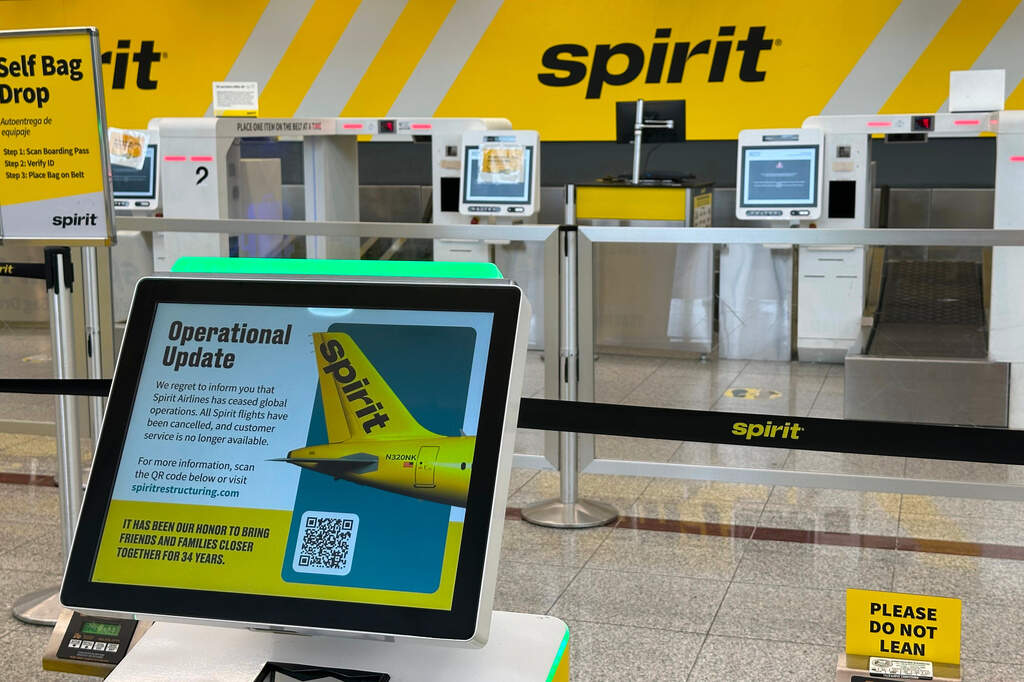
Spirit Airlines, known for cheap flights, suddenly closed earlier this month. Budget airlines seem to do fine in Europe. Why can’t they survive in the U.S.?
Guests
Robert Mann, president of the aviation consulting firm R.W. Mann & Company. Former airline executive.
Wouter Dewulf, professor in Air Transport Management at the University of Antwerp in Belgium.
Also Featured
Nichole Holze, small business owner and travel blogger.
The version of our broadcast available at the top of this page and via podcast apps is a condensed version of the full show. You can listen to the full, unedited broadcast here:
Transcript
Part I
MEGHNA CHAKRABARTI: On Saturday, May 2, Spirit Airlines Flight 1607 had just landed at Dallas Fort Worth Airport when the pilot made an announcement to his crew and passengers.
SPIRIT AIRLINES PILOT [Tape]: We are the second to the last plane to land. Every other plane has landed tonight and not taken off again. And as we landed and turned on our internet, we got a notice from our union that we're gonna be ceasing operations at 3 am Eastern time today.
CHAKRABARTI: It was 12:07 am in Dallas, 1:07 am Eastern time. Spirit Airlines would cease to exist in two hours.
PILOT: It's funny, as we sit here, I'll speak for myself, I don't remember any of the bad times, just the good ones.
CHAKRABARTI: The pilot had heard the news from his union. According to Spirit Airlines itself, some 17,000 other employees heard that their company had closed not from Spirit, but from media outlets. The DFW pilot had been flying for Spirit for 14 years, and he could not hold back how much it had meant to him.
PILOT: Spirit, believe it or not, started flying in 1983. I think it was called Charter Air at the time. What is that? Forty-three years. And unfortunately, that's over. So thank you for your support over the years. And onward and upward, right? God bless you all. (APPLAUSE)
CHAKRABARTI: It's not often that a corporate bankruptcy evokes that kind of emotion in people. But it isn't only Spirit's employees who are feeling the loss. Passengers are, too. The low-cost airline made travel possible for many people. Without it, travel might be impossible now for people like Nichole Holze from Southwest Arkansas.
NICHOLE HOLZE: It allowed my children to see their grandparents more growing up. My parents live in Phoenix, Arizona, which I've done the drive more times, in fact, more than my kids can even — they don't wanna do that drive anymore. It's a lot.
There were times where I was looking at our calendar ahead for the next six months, and I realized, you know, if we don't go see Nana and Papa now, we're not gonna have an opportunity for a really long time. And it was so quick to just jump on the Spirit app and be like, "Okay, we can go here," and just being able to fit in, like, that four-day trip kind of on a last-minute whim was a game-changer for us.
As my kids have gotten older, as our lives have gotten busier and the grandparents still work, we're crunched for time. And we wanna maximize that time being invested in spending time with our family. I don't wanna spend 19 hours in the car. I've seen every roadside attraction there is from here to Phoenix, Arizona.
Again, I go back to it's that easy yes. We miss our family. We wanna go see our family. I don't really wanna spend thousands of dollars on airfare for my kids and I to get out and see my grandparents. We've got college on the horizon. We've got expenses and life and things, and I just can't spend that kind of money on flights.
So for us, the budget airlines were quite literally life-changing in bringing our family together more often. Now I'm not sure how we're gonna do it.
For us, the budget airlines were quite literally life-changing in bringing our family together more often. Now I'm not sure how we're gonna do it.
Nichole Holze
CHAKRABARTI: Now, Spirit Airlines isn't the only budget airline to go belly-up in this country. People Express Airlines closed in 1987. Pacific Southwest Airlines out of California shuttered in 1988. ValuJet Airlines ceased operations in 1996. MetroJet closed in December of 2001. SkyBus shut down in 2008. ExpressJet Airlines filed for Chapter 11 bankruptcy and ceased operations in August of 2022.
And yet budget airlines in other parts of the world are thriving. Take Ireland-based Ryanair, for example. Ryanair says it serves more than 200 million people per year. So why can't low-cost flying survive or even thrive in the United States? That's what I wanna know.
To help us understand the answer to that question, Robert Mann joins us now. He's president of the aviation consulting firm R.W. Mann and Company. He's an aviation industry consultant and former airline executive as well, and he joins us from Port Washington, New York.
Robert, welcome to On Point.
ROBERT MANN: Great to be with you, Meghna.
CHAKRABARTI: Okay, so let's start off with kind of getting the 101 on what happened to Spirit specifically. I mean, at one time Spirit Airlines was valued at, what, $5.5 billion on the stock market. When were the beginnings of its troubles?
MANN: Well, you could argue that it was a decade-long train wreck which began when major carriers introduced basic economy fares. But the real alarm bells started to ring both during the pandemic when everyone was losing money and post-pandemic when legacy carriers used basic economy fares to really put the screws to low-fare carriers, in particular Frontier and Spirit.
And then later on, when geopolitical events drove fuel prices to a level that hurt everyone, but hurt those carriers whose largest costs were then fuel the most. And that interrupted a bankruptcy process at Spirit that ultimately the financiers in bankruptcy were unable to or unwilling to continue to fund.
CHAKRABARTI: Right. And then Spirit wasn't also getting a bailout from the federal government as well. Let's put some numbers on this for a quick second because Robert, you're exactly right.
Spirit actually first filed for Chapter 11 in 2024, citing losses that had begun in 2020, as you said, the pandemic. $2.5 billion or so from 2020, the amount of the loss. In addition, as you're saying, 2 billion worth of debt in 2025 and this year. So, or actually a little even more than that, 2.4 billion in long-term debt, and they just couldn't carry it without banks being willing to sort of hold that water for them.
Was there any operational change or business practice change that Spirit could have done to give banks more confidence to let them have that debt for longer and maybe dig themselves out of a hole?
MANN: Well, if you wanna be an ultra-low fare carrier, you have to have ultra, ultra, ultra low [inaudible] — and once you've paid your pilots at the market and once you're paying for fuel at the market price, those are the two biggest lines of expense, and really, there was no additional method by which to save money.
They had already restructured the airline once in the first bankruptcy, cut it to perhaps a half of its original size, and there really wasn't anything operationally that could be done at that point. They did not have the revenue diversification that other carriers do, which allows them to cross-subsidize some of their low fares that they offer to democratize travel, as it were.
CHAKRABARTI: I see. Okay, revenue diversification, meaning first class tickets at five times the amount, premium economy, you know, main cabin, as a lot of the airlines call it, and the basic economy fares. That's what you're talking about.
MANN: Well, and credit card programs that are national and that, in the case of the largest carriers, produce billions of dollars in revenue per year, which are non-transportation, but which cross-subsidize losses on actually carrying passengers.
CHAKRABARTI: Actually, thank you for reminding me about that, Robert. Because a couple of weeks ago I was listening to Delta Airlines' Q1, um, excuse me, Q1 shareholder call. And it was actually in that call that they said, you know, not unusual to people watching the industry, but for me it was, that really their single largest revenue stream at Delta was these credit cards. Fascinating. So Spirit didn't have anything like that?
MANN: Well, every airline has the genesis, you know, the smallest program they can start with. The problem is you don't have a national footprint of a network, you don't have a national airline, you don't have a national credit card program.
These are all scale issues, uh, that any smaller carrier has to deal with. And in fact, this is one of the issues that Frontier in particular has called out to the Department of Transportation as something it wants more of a level playing field on. I don't know how you create that. But these are the diversification issues that create opportunities to, you know, cross-subsidize basic fare competition with low-cost carriers and low-fare carriers.
CHAKRABARTI: Is that just the state of the airline industry today, that you basically also have to have a huge finance business, essentially, in order to support the kind of fares that Americans have grown used to? Like, you have to be kind of 50% airline, 50% bank essentially?
MANN: Right. Well, the irony is that, you know, in its heyday, Spirit was actually pulling in more than 50% in non, you know, seat sale fees. So they, you know, they charged for everything, as carriers now do across the board. But they were pulling in more than 50% of their revenue from seat selection, early boarding, baggage check — And so that's a factor in the industry.
But what Spirit really did not have, and what generally small carriers do not have, is this national and international credit card program that literally produces — well, I mean, Delta basically states that their credit card deal with American Express, the charges on that program combined represent more than 1% of U.S. GDP, which, you know, at $33 trillion overall is a huge number.
What Spirit really did not have, and what generally small carriers do not have, is this national and international credit card program.
Robert Mann
CHAKRABARTI: 300 billion essentially. That is an astonishing fact, Robert. (LAUGHS) That one credit card program from one airline and American Express is 1% of the United States GDP. Blows my mind.
Okay, so we have about a minute. We're gonna get deeper into all of these issues about what this says broadly about sort of the airline business model as a whole in the United States, and also other factors as well. But in the 30-ish seconds or so before our first break, Robert, how do you think Spirit's collapse is going to impact the flying market as a whole?
MANN: Well, fares are already going up. Some of the markets that Spirit was forced to abandon have been replaced by other carriers, where they can benefit from that, but not all will. And some markets will go without service until perhaps some new entrant decides to replace them. Fares will go up, choices will go down, obviously. And some of the issues that face everyone really are still not addressed by [inaudible] failure.
CHAKRABARTI: Yeah, so we're talking about those jet fuel prices to say the least.
Fares will go up, choices will go down.
Robert Mann
Part II
CHAKRABARTI: Let's hear from an executive at another one of the low-cost airlines in the United States, Houston-based Avelo Airlines. Well, its founder and CEO, Andrew Levy, recently appeared on ABC News to discuss Spirit Airlines closing, and he said budget airlines bring a lot of value to customers.
ANDREW LEVY: We appeal to the mass market. We appeal to people who are watching their dollars, who are living on a budget, and our ability to service these customers at affordable fares makes a lot of difference to their quality of life, which to a certain extent really is become a reliance on being able to fly around the country at affordable rates.
CHAKRABARTI: Well, Levy also said that budget airline critics who say, "Well, the free market dictates that there's no room for budget airlines, because the government isn't gonna bail them out," those same critics are disregarding the very bailouts that the legacy carriers have received.
LEVY: It's been the consolidation that's occurred that's created these giant behemoth airlines out there, like four of them controlling 76% of the marketplace.
And the single largest government intervention that we've ever seen during COVID, which gave over $70 billion to these same airlines in the form of grants, loans, and that doesn't even include all the loans that they were able to get thanks to the Fed and the government to support them during this period of time, which enabled them to leverage up their loyalty programs to the point where they're almost too big to fail at this point.
CHAKRABARTI: Okay. Let's now turn to Europe, where Wouter De Wolf joins us today. He's a professor in air transport management at the University of Antwerp, and he joins us from Antwerp, Belgium.
Professor Dewulf, welcome to On Point.
WOUTER DEWULF: Hi. Great to be in the show.
CHAKRABARTI: It's great to have you. Okay. So let's just stick with Europe because we could talk about budget airlines in, you know, in Asia and other places. But in Europe there are, what? At least one, two, three, four, five, six, seven, eight — I can count at least eight sort of significant budget airlines. How many more would you say there are than that?
DEWULF: Yeah, about 20 budget airlines. But there are in fact only about four large budget airlines, which take about 40% of the market in total.
CHAKRABARTI: Okay. Wait, so, so there are 20 total, but only four of them take up 40% of the over --
DEWULF: Four of them take about 15%, and the low-cost in Europe is about 40% of the market.
CHAKRABARTI: Low-cost airlines in Europe are 40% of the overall flying market?
DEWULF: Yeah. In the U.S. it's a little bit smaller if you count Southwest as a low-cost airline.
CHAKRABARTI: Okay. Right — See, it's funny, I no longer actually, they are lower cost than the sort of big three airlines, but in my mind, they're not quite the same as, say, something like Ryanair.
DEWULF: No.
CHAKRABARTI: So Professor Dewulf, I mean, how would you — let's take those two airlines as examples. What would you say is different about Ryanair than Southwest Airlines here in the United States?
DEWULF: Well, the funny thing is actually that Ryanair started as a full-service airline in the '80s, and they moved into the low-cost model when Michael O'Leary, the current CEO of the Ryanair Group, visited Southwest Airlines, and he copied their business model with a standardized fleet, short turnaround times, low fares, ultra-low cost, and so on.
Ryanair started as a full-service airline ... and they moved into the low-cost model when the current CEO ... visited Southwest Airlines, and he copied their business model.
Wouter Dewulf
And what's different, I mean, Southwest moved definitely a bit towards the middle. But what Ryanair is doing, they fly mainly to secondary airports. They have an extremely high seat density. They're doing, as Robert was explaining, they're really getting lots of additional revenues from hand luggage, seat choice, early boarding, and so on. And they try to be hyper-efficient by having a very short turnaround time. It means the time between landing and takeoff. They do that in 25 minutes.
In addition, they have low fares, so they pass their low costs on to their customers. And additionally, sometimes have some subsidies because they fly to this type of smaller regional airports, and in Europe, these smaller airports are often owned by a regional government. And these governments, they give subsidies to this type of airlines. So the business model is somewhat different than in the United States.
CHAKRABARTI: Oh, okay, actually sounds significantly different on a number of points. So Robert, let me bring you back in here to make some comparisons.
Okay, first of all, let's start with the regional airport issue. There are lots of smaller airports, you know, in the United States that I think over time, and correct me if I'm wrong, have had fewer and fewer flights servicing those airports. Or at the very least, the only way you can get to them is through the hub-and-spoke model that's very popular here in the United States. Do you think there's room for budget airlines to target those secondary airports more aggressively?
MANN: Well, as those budget airlines have gone to larger and larger [inaudible] on their aircraft, and as their fleets have evolved to larger and larger aircraft, the smaller markets are less and less suitable for their economic use.
And so the result is that's actually driven them to go fly against larger carriers at their hub and large focus city airports, which of course is, you know, putting them directly in harm's way. So the irony is some of their own actions have actually caused service to small airports to decrease.
CHAKRABARTI: Why are they moving to larger aircraft? Is it just to get more people on board?
MANN: Well, there's kind of a fallacy which says that you can get to the lowest unit cost or cost [inaudible] by going to a larger piece of equipment, and while that's true, it costs more money to [inaudible] equipment, and so you can actually lose more money with a large aircraft, or conversely, make a little less with a smaller piece of equipment.
CHAKRABARTI: Okay. And one more thing, Robert, about those regional airports. Professor Dewulf was talking about how in Europe many of them are actually owned by the government so the airlines can receive subsidies for landing at the — or servicing those airports. That doesn't — does that system exist here in the United States or no?
MANN: In the Caribbean islands it actually does. You know, the joke at one airline I used to operate at was, you know, the jets will stop when the subsidy checks don't arrive. But in international [inaudible] there's a huge business in, you know, trading reductions in normal fees for the establishment of new international service. It is a factor, but not a large one.
CHAKRABARTI: Okay. Robert, if I may, I'm gonna just spend a couple minutes with Professor Dewulf here, and I don't know if that'll give our staff a chance to see if they can fix your line. Maybe they can because you keep dropping out about every fourth word and I want everyone to hear what you have to say.
So Professor Dewulf, let me turn back to you. I would like to also talk about that very fast turnaround time. I mean, Ryanair, I've flown Ryanair quite frequently, and sometimes I can hardly believe there's enough time to even just get everybody off the plane in that 25-minute turnaround. But on the other hand, a plane on the ground isn't making money. So is that very rapid turnaround also practiced by the other budget airlines in Europe?
DEWULF: Right. The other airlines definitely try to match that one. However, Ryanair tries to have an enormous focus on this low cost, and by squeezing the turnaround time, which is typically, like, 50 minutes up to an hour, and if you have four or five flights a day, you can maybe squeeze out an extra flight, lowering your cost because you can spread your fixed cost over a bigger output.
May also not forget that Europe is of course different than the United States. Europe is much smaller than the United States, so the city pairs are much shorter and much denser compared to the United States. In Europe, if you fly a long flight, completely up north, Helsinki to Malaga in the south, that's a three hours flight. If you look at the United States, if you fly three hours from New York, you probably end up somewhere in the middle of United States.
So we have much shorter flights, allowing, of course, more flights a day with your aircraft. And if you can squeeze your turnaround time, by using two stairs to go up and down the aircraft, by basically pushing the passengers in and out of the aircraft, and fly from secondary airports, which are not very busy, they don't have to queue in order to take off or land, you can be very efficient.
Europe is much smaller than the United States, so the city pairs are much shorter and much denser compared to the United States ... allowing more flights a day with your aircraft.
Wouter Dewulf
CHAKRABARTI: Yeah. You know, Professor Dewulf, I'm glad you mentioned the size issue, because this is something I've read a lot of analysts write about, that the United States is, you know, it's a continent-sized country. But I actually think that the analogy between what's possible here in the United States and what's happening in Europe is actually very, very strong.
Because you said, okay, well, if you fly three hours from New York, you end up, "somewhere in the middle of the country." But, you know, with deep respect to every one of our listeners who lives in that middle, there's a lot going on there. (LAUGHS) I mean, you know, there's Chicago, there's all the, th- there's all the, there's, you know, Iowa, there's — the middle of the country, looking at longitude, also includes all of Texas.
I mean, there's so many places in the country that you, people want to go or need to travel from that isn't New York to L.A. So what, I just don't understand why, in that case, the budget airlines can't actually find a niche in this country that is in dire need of even more service, Professor Dewulf. Do you have any thoughts about that?
DEWULF: Yeah, you might be right. Of course, in Europe, the low-cost carriers, they benefit from large flows from Northern Europeans flying to the sun. Most of us are flying once or twice a year to the sun. You don't forget we have a bit more holidays in Europe. Here, we have an average five to six weeks holidays.
You have lots of Central and Eastern European workers who are flying from east to west and back and forwards. We do quite a lot of city trips as well. It's a bit in our DNA nowadays. So I think the stronger leisure and VFR flows are also helping out the LCCs. That's I think one of the other things.
And maybe another thing, but that's subjective because there's no real academic reason or background for that. When I'm to the United States, I really see that U.S. is a service-driven economy, you know, with the tips and everything you have to pay. It's a service-driven economy. And my feeling is that if people fly a low-cost airline, they still expect service.
In Europe, we're more a value-driven economy. We don't seem to care that you don't pay anything for a Ryanair flight, but you don't get anything apart from going from point A to B. Maybe that's a reason as well. Maybe it's a cultural thing as well.
In Europe, we're more a value-driven economy. We don't seem to care that you don't pay anything for a Ryanair flight, but you don't get anything apart from going from point A to B.
Wouter Dewulf
CHAKRABARTI: It may be. But with these low-cost European airlines, and I'm just speaking from personal experience, I mean, it's very easy and actually quite wonderful to get into that European mindset that, okay, I may not even get a glass of water when I'm flying Ryanair, and there will be advertising literally everywhere on the inside of the airplane, et cetera, et cetera.
But I was just looking up prices yesterday, and the idea of flying from London to Marrakech for $70, who cares that you don't get any service? I think many Americans in this country would say, "Well, if I could fly from Los Angeles to Seattle for 70 bucks, that would be great, and I wouldn't mind that there was, there were no additional service or, you know, a bag of peanuts."
Robert Mann, I think we've got you back on the line here. Did you wanna respond to that about the professor's observation about maybe cultural differences or expectations of service?
MANN: Well, I think there is an understanding of what the basic bargain used to be, and of course, that has been turned on its head, you know, in recent times. But to the professor's point, there actually are U.S. airlines that are, I would say, more, you know, holiday retailers who happen to operate airplanes. Allegiant Travel Group, as an example, is an airline that basically revolves around carrying people to sun destinations from places around the country, and so they've been quite successful.
And again, the whole key here is if you're gonna be a low-fare airline, you've gotta be an ultra-low-cost airline, and that's really where the failing is where, you know, expectations get created, airlines try to respond to those expectations, it drives up their costs. Suddenly they can either no longer offer low fares and thus fall out of the market or they offer low fares and fall out of the market when bankruptcy emerges.
So that's really the focus. You can be anything you want. You can sell low fares all day long in this business. The key is having the cost structure that goes with that, or having the revenue offsets that go with that.
If you're gonna be a low-fare airline, you've gotta be an ultra-low-cost airline.
Robert Mann
CHAKRABARTI: Okay, the revenue offsets. I'll accept that as a necessity because even Professor Dewulf said that Ryanair — actually, Professor, let me turn back to you. Beyond Ryanair and their revenue offsets, you know, their sort of non-airline businesses, do other low-cost airlines in Europe also have that same sort of non-flying portion of their overall business?
DEWULF: Yeah. Ryanair has about one-third of its revenues are ancillary revenues. That's for the seat selection and so on. Spirit happened to have half of it. So Spirit was even ultra low cost with the maximum extent. Indeed, absolutely. You have EasyJet, for instance, you have Wizz Air. They have very similar systems. They also generate additional revenues from extra services.
And when you talk about the 70 pounds or $70 fare to go to Marrakech, I wonder if you could really have booked that for $70, but I'm sure you probably had the hand luggage. You may pay another $20. Maybe you had the seat selection was another 10 to 15. So normally Ryanair and the other ones are quite good by adding up additional.
But what you do see is that the competitors, the full service carriers, like Air France, KLM, British Airways, Iberia, Lufthansa, you name them, they try to copy a little bit the business model of these low-cost airlines in Europe. And they also offer these basic economy fares where you have to pay for seat selection, where you have to pay for your hand luggage, and there you can see that the two business models are somewhat approaching as far as revenue composition is concerned.
CHAKRABARTI: Okay, but let me be more specific then in my question. I understand the cost for additional services, right? Seat selection, or, like, even when you get on board, can you have a carry-on versus just a tiny backpack, obviously baggage costs, et cetera.
But I guess what I was talking about regarding non-flying sources of revenue were things like the credit cards. Do other European airlines offer — or have that as a major part of their businesses as well, Professor?
DEWULF: Yeah. Definitely not the low-cost airlines. The full-service airlines, yes, but significantly less than the U.S. customers and U.S. airlines. In Europe, we like the frequent flyer programs, but we are not as addicted as our American friends are.
In Europe, we like the frequent flyer programs, but we are not as addicted as our American friends are.
Wouter Dewulf
Notice when I invite a professor from Chicago, no way I can get him on an American Airlines flight, because he will have a frequent flyer program with United Airlines. So the credit cards and collecting miles and getting upgrades and lounge access, so on, is really in the culture of the United States. Here, it's less. And if I look at the frequent flyer programs which are embedded in the large airline groups, yes, they do earn revenue, but nowhere near to what their U.S. peers are doing.
CHAKRABARTI: That's interesting. Robert Mann, we'll get back to sort of business structure here in just a second. But this issue of culture keeps coming up.
And I wonder if the things that we're presuming about the average American flyer and the expectations of service are true simply because of who can afford flying right now. Whereas, you know, I'm thinking of Nichole, who we heard from earlier from Arkansas, she could really only afford it because Spirit existed and making the compromises on paying extra for baggage when she could was fine for her. But without the low-cost airline, she wouldn't actually even be a member of the flying public.
So I wonder if flying were more affordable for more people, we would see a completely different passenger profile and people who would be willing to, you know, do what Professor Dewulf says many Americans aren't willing to do, which is just fly the lowest cost airline wherever they can find it.
MANN: Right. Well, I mean, this movie has, we've seen this movie before. And again, as you mentioned, it goes back in the States to People Express, to some of the other, you know, low-cost operators like ValuJet. Internationally, it was Laker Airways, or even the original backpacker's airline, Icelandicair.
So, you know, all of a sudden Iceland's a big focus, but actually it was back in the '60s too, when you could fly from the U.S. to Iceland and then, uh, onwards to Europe on one of their DC-8s.
Part III
CHAKRABARTI: Mr. Mann, if I have this correctly, at your time at places like American, did you help introduce things like the American sort of frequent flyer program?
MANN: Uh-oh, you got me.
CHAKRABARTI: (LAUGHS)
MANN: (LAUGHS) Actually, part of a big team, but yes, I was able to assist in that, in the original establishment of that program.
CHAKRABARTI: Yeah, that wasn't a gotcha, by the way. I'll come back to it in a minute because I think it's a good example of how, well, when they wanna be, the airlines can actually be quite creative in creating new ways to attract business. So we'll get back to that here.
And professor, I just wanted to follow up with one thing you said earlier in my waxing on the $70 ticket on Ryanair from London to Marrakech. You may be right that I couldn't get it for $70 at the end of the day because of all the add-ons, but I wanna just come clean about something. I am a super frugal flyer. So I try not to ever buy any of those add-ons, and I'm really happy to just — if I could go to Marrakech for a weekend with just the backpack on my back, I wouldn't care where I sat on the airplane or anything. So maybe I could get close to that $70 ticket.
But anyway, since we are talking about Ryanair, it's not the only budget airline, obviously, across Europe. We've also mentioned Wizz Air, EasyJet, there's Vueling, Norwegian, Eurowings, and a couple of others as well. But Ryanair seems to also have a very, let's say, charismatic CEO. He's full of character. And his name is Michael O'Leary. Professor Dewulf mentioned him earlier.
And O'Leary recently spoke at the company's investment conference. And by the way, Ryanair is based in Ireland. And O'Leary said that his airline is defined by its strict adherence to its goals.
MICHAEL O'LEARY [Tape]: Our culture is we want to deliver the lowest fare, most on-time flights, and we'll do it by having the lowest costs, bar nobody in the industry. And we will keep transforming our cost base. We lead the airline industry across the world.
CHAKRABARTI: He says Ryanair's focus is on two major things, and those primary elements have made for the company's success.
O'LEARY: Make it cheap, make it on time. After that, go away. You're not getting anything else. And then be viciously, obsessively focused on how do we make it cheaper, cheaper, cheaper by constantly reinventing the system and fundamentally changing customer behavior.
Make it cheap, make it on time. After that, go away. You're not getting anything else.
Michael O'Leary
CHAKRABARTI: Okay, "cheaper, cheaper, cheaper" means Ryanair also does not offer some things. For example, O'Leary recently got into a spat with none other than the world's richest man, Elon Musk, when O'Leary said he will not put Musk's Starlink Wi-Fi systems on Ryanair aircraft. And here's why.
O'LEARY: I think Wi-Fi, free Wi-Fi on board aircraft is coming. The problem at the moment is the technology doesn't yet exist. We have to put a couple of dimples on the outside of the aircraft. It would be about a 2% fuel drag. And my fuel bill is $5 billion a year. 2% fuel drag is something of the order about $100 million, and I'm not paying 100 million to put free Wi-Fi on board for my passengers.
CHAKRABARTI: Robert and Professor Dewulf, I also wanna talk more about government regulation of the airline industry in the United States and in Europe. Robert, do you think that the deregulation of airlines beginning in the 1980s is part of the bigger picture as to why budget airlines have a hard time really succeeding? Because we've seen rampant consolidation of the major airlines since that deregulation began.
MANN: Well, it's a positive and a negative in the sense that you really saw the establishment of so many startup carriers subsequent to deregulation. I mean, there are literally hundreds of, you know, startups since then, most of whom, by the way, since have seen their demise. On the other hand, it created the opportunity for all those startups to operate.
Now, more recently, we've seen consolidation. And that has, of course, eliminated a fair number of legacy carriers as well as startups. So it's a double-edged sword, but it's an opportunity as much as it is an impediment.
CHAKRABARTI: So where would be the opportunity for a budget airline now, given that there is, as you said earlier, so much competition from the major carriers in things like offering basic economy seats?
MANN: Sure. Well, I mean, a great example is the executive you cited earlier, Mr. Levy at Avelo. I mean, he's established a hub in the northeast at, of all places, New Haven Tweed International Airport. So that airport that nobody ever heard of that now has service to, I think, probably a dozen destinations up and down the East Coast. He also has service points on the West Coast.
Or another, uh, example is David Neeleman, a serial airline startup guy, originally started JetBlue in New York, went down to Brazil to establish Azul, also blue in Portuguese, went over to Portugal to assist TAP, the national carrier there, and now has started up Breeze, which is an ultra-low-cost carrier servicing a number of destinations around the nation. But the key, of course, to all these guys is they either grow or they become irrelevant over time.
CHAKRABARTI: Yeah. Okay. So Professor Dewulf then, describe to us a little bit about the regulatory environment around European carriers. Has there been as much deregulation there as in the United States?
DEWULF: Oh, yes, exactly the same what happened in the United States after the deregulation in '78, Europe, we did the same 20 years later in 1997. And exactly the same thing is happening 20 years later, that you have lots of bankruptcies, lots of mergers and acquisition, lots of new airlines — Ryanair, EasyJet are one of the typical new ones. And you see exactly the same thing happening as, uh, as United States. We're just a little bit slower.
But it's a fact that now every European airline can fly to whatever European destination at whatever price. And this has led to an enormous decrease in pricing, about 70% percent cheaper flights, and about five times more connectivity in Europe. So deregulation is really a big, a big success.
The downside of it, as indeed Robert was saying, yes, you do see consolidation. You do see bankruptcies as well happening. And the consolidation which is already happening or has happened more or less United States is happening for the moment in Europe, even if you don't notice it because they still keep the different brands. United States, they just go to a single brand.
CHAKRABARTI: Oh, that's interesting. Okay, but one more question about deregulation in Europe. You said it happened later or has been happening later than it did in the United States. Doesn't that timeline actually make quite a bit of difference? Because, you know, for a lot of the low-cost airlines in Europe that we've been talking about, they existed long before the deregulation schemes in Europe were happening, so they were actually quite well established.
DEWULF: Not really, no.
CHAKRABARTI: Oh.
DEWULF: I mean, Ryanair was just a small airline, but they have reinvented themselves completely. EasyJet only started up in the '90s, you know, during deregulation. And Wizz Air was the low-cost carrier of Malev, which is the Hungarian carrier which went bankrupt.
So most of the airlines are really after the deregulation. The low-cost airlines are coming from after the deregulation. And we had so many, many bankruptcies as well and merger acquisitions.
The biggest difference as well is that in Europe you always talk about Ryanair and EasyJet. However, if you look at other low-cost carriers in Europe, which have a fair market share between five, six percent, you have Eurowings, you have Vueling, you have Transavia. These are the daughters of the full-service airlines. You might remember, not remember, Delta Airlines used to have its own low-cost carrier.
I'm sure Robert remembers that. It's called Song. All of this has been consolidated into the single brand. In Europe, the airlines still use multiple brands, depending on the country or depending on the business model.
CHAKRABARTI: Okay. Robert Mann, did you wanna respond to that?
MANN: Yeah, I think the professor is on point there.
There have been a series of low-cost additions to legacy carriers, most of which, however, really didn't produce low cost. They really produced a different business model, which was helpful, and allowed those legacy carriers to understand what would work and what would not work. But by and large, they didn't produce the lower costs in any great respect because they relied on the same labor contracts that were in place with the major carrier.
There have been a series of low-cost additions to legacy carriers, most of which, however, really didn't produce low cost.
Robert Mann
CHAKRABARTI: And that's here in the — to be clear, that's here in the United States, Robert?
MANN: That is correct. Yeah. So you had United, you had Ted by United. You had Song by Delta. You had MetroJet by U.S. Airways. American never did that, but I won't comment further. (LAUGHS)
CHAKRABARTI: (LAUGHS) Okay.
DEWULF: (LAUGHS)
CHAKRABARTI: So I would like to just ask a couple of questions purely from the passenger's point of view, gentlemen, if I may. Well, I guess specifically my point of view as a passenger. Because I keep coming back to this issue that you both raised about expectations and flying culture.
And one reason which I feel personal frustration with the, I'll call it the mirage of genuine low-cost flying here in the United States is, you know, Robert, you had mentioned earlier, well, we have basic economy now. Yeah, we do. And those tickets are cheaper than any other economy or obviously let alone business or first class seats on an airplane.
But they still, sort of the baseline ticket price feels to me that it might be cheaper than other ticket prices if you're flying in the United States, but I guess what I'm saying is they don't feel as cheap to me as if I were going the same distance on a European carrier, right? So they're not actually saving me as much as they could if we fully embraced and supported budget flying here in the United States.
Do you disagree with that?
MANN: I think that's fair. To be blunt, I think in Europe there are lots of other modal alternatives, you know, high-speed rail, for example, that exists widely across Europe that provide great competition for low-cost, you know, air operations. We just don't have that in the United States. And in fact, even on the northeast corridor where we do have our version of low high-speed rail, the prices are actually higher than airfares these days.
CHAKRABARTI: Oh yeah. Okay, so there's yet another reason why we're gonna struggle, passengers are gonna struggle finding affordable tickets.
So, Professor Dewulf then, we've just got a couple of minutes left here. Do you think that the United States could ever achieve the kind of percentage that you shared with us earlier, that low-cost airlines in Europe are now, you said what, 40% of flights in Europe?
DEWULF: Right. I think United States, the train has passed. No, I mean, it's very nice you talk about competition, but let's be fair. If you have four airlines capturing 75% of the market, that's called an oligopoly, and you can have this type of passive collusion, and you see flying United States is pretty expensive.
If you have four airlines capturing 75% of the market, that's called an oligopoly.
Wouter Dewulf
So, I mean, it's very, very difficult to come up with a new airline. Robert was giving some very good and some very brave examples there. But none of these airlines are doing well financially. So I think the train has passed. I don't think there will be room for a large low-cost carrier. You even see Southwest moving a bit towards the middle.
So what you probably see is further consolidation there and probably the passengers being picked up by other airlines, and maybe you still have some niches where you have some low-cost flights, which are underserved city pairs, which the large airlines don't fly. But I think low cost is finished for United States. And in Europe we will see where we will land because the business model in Europe, on the western side of Europe, is also the big growth is also slowing down, because the large airlines are copying the business model.
CHAKRABARTI: Interesting. (LAUGHS) You, you are genuinely breaking my heart, Professor Dewulf.
DEWULF: Sorry about that.
CHAKRABARTI: (LAUGHS) Both you and Robert, because yes, maybe we can't have nice things here, but maybe we can.
Robert, let me turn back to you. I'm still holding onto the idea that maybe there is a viable niche for smaller budget regional airlines here in the United States.
MANN: Well, we have two kinds of regional carriers. We have low-cost regional operators who aspire to be national — examples recently being, you know, Breeze and Avelo. And then we have regional carriers who operate on behalf of major carriers in their smallest markets. So they're the airlines that fly the American Eagle or the United Express or the Delta Connection operations, fly 76-seat jets, by and large, and have established themselves as operators of about 40 to 45% of departures domestically in the United States.
CHAKRABARTI: Hmm. Do you think that if there's other ways, maybe even through regulation, to create more competitive space for budget airlines in this country, Robert?
MANN: Well, it's really a case of you have to focus on what you can do reasonably, and flying head-to-head against major carriers in their hubs and in major markets is just a death sentence. So if you're gonna fly to, you know, New Haven Tweed Airport up and down the East Coast to places like Myrtle Beach, that's very doable. Again, your costs have to be right, but you can provide low fares in those markets, and you won't get a lot of competition from a major carrier.
You have to focus on what you can do reasonably, and flying head-to-head against major carriers in their hubs ... is just a death sentence.
Robert Mann
You could go to, you know, Wilmington, Delaware, same situation. Norfolk, Virginia, same situation. Some of the smaller cities in Florida and in Arizona, for example. But, but again, you need to focus on what you can do reasonably and stay away from stuff that you know is just the third rail.
CHAKRABARTI: Mm-hmm. Mm-hmm.
You know, we keep talking about competition with the major carriers, and now I think more than ever, especially with the demise of Spirit, when people are searching for tickets, I just did this the other day, as an experiment for this program, kinda picking two cities, major cities even, and trying to see who serviced them. And basically, you either see, like, 90% Delta, or from another pairing of cities, it's, like, 90% American Airline flights. The choice is getting ever more smaller in this country.
So Professor Dewulf, one last question on that. I wanna be sure I heard you correctly earlier. Do you see the budget airlines in Europe, one thing they try to do is avoid direct competition with the larger carriers?
DEWULF: Well, they do avoid it a little bit. But of course, there's lots of overlap there as well. But what you do see in Europe is that the market is much more scattered than in the United States. We have, as I just said, more, more city pairs which are more, more spread around with secondary airports and so on. So I don't think you can really compare like with like.
But you're absolutely right. In United States, some airports are really dominated by one specific airline, and that's this type of passive collusion, which is legal by the way, passive collusion, which is happening. If you have only four airlines, they have economies of scale, because they're very large, they have economies of scope because of frequent flyer programs, and they have economies of density because they have their hubs where they connect. So it's very, very difficult as a new entrant to make money in the United States.
CHAKRABARTI: And it becomes ever more difficult for passengers to find tickets that aren't within $5 of each other in the United States.
DEWULF: Absolutely.
CHAKRABARTI: You know, both of you also mentioned the other big thing that's on the immediate horizon, is those rising fuel costs. So we'll see what happens across all airlines, big and small.
The first draft of this transcript was created by Descript, an AI transcription tool. An On Point producer then thoroughly reviewed, corrected, and reformatted the transcript before publication. The use of this AI tool creates the capacity to provide these transcripts.
This program aired on May 15, 2026.