Support WBUR
Why you've been misreading the Declaration of Independence
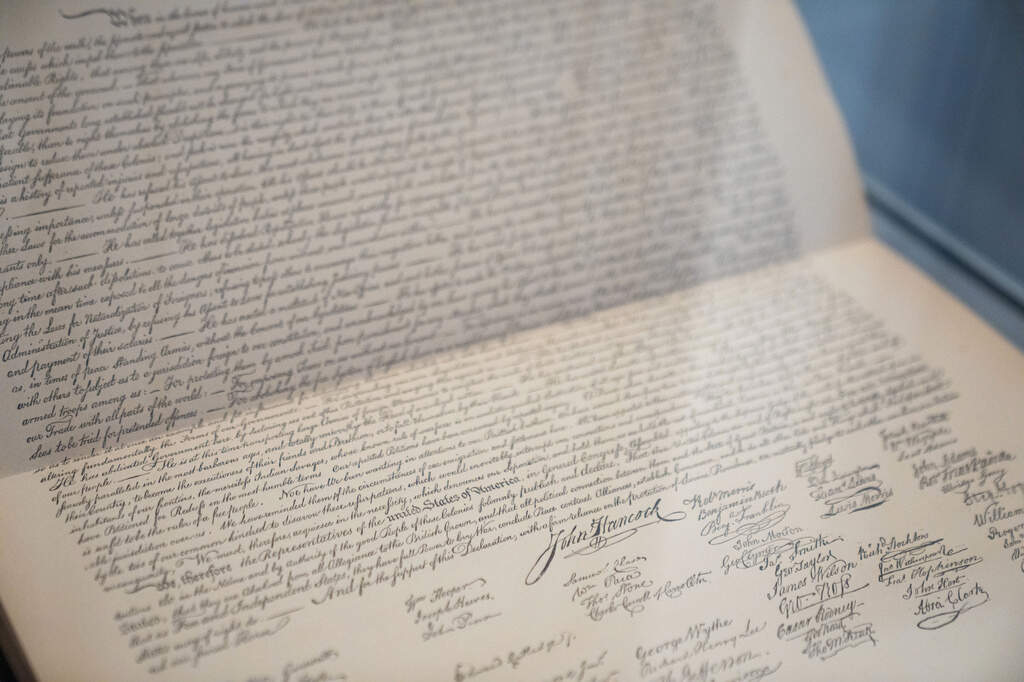
The Declaration of Independence is the founders' vision of America's values – equality, liberty and the pursuit of happiness. How that vision still lives on today.
Guest
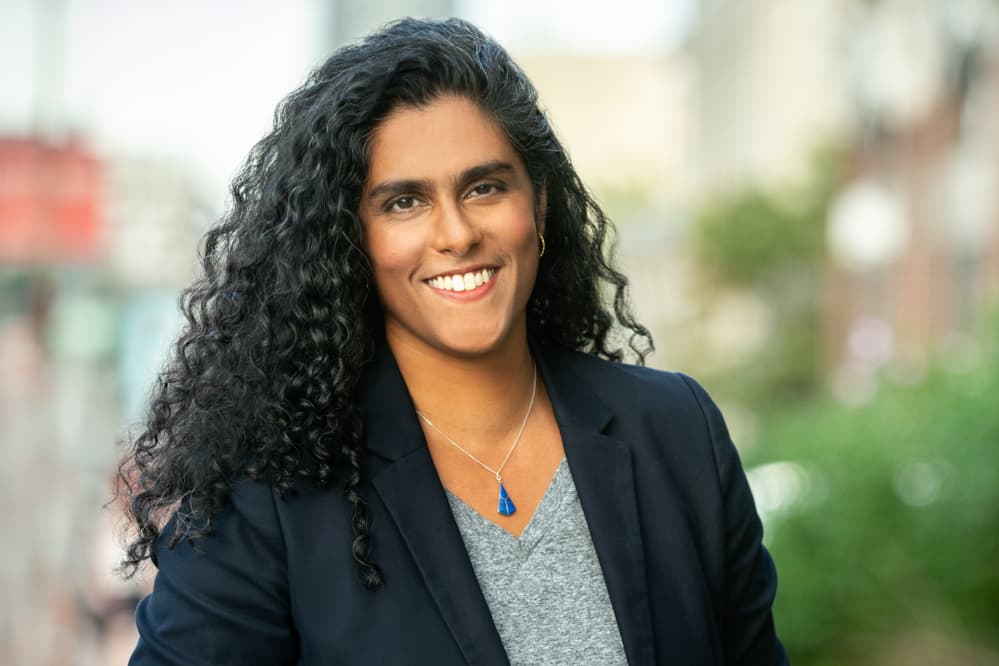
Danielle Allen, James Bryant Conant University professor at Harvard University. Author of “Our Declaration: A Reading of the Declaration of Independence in Defense of Equality."
Transcript of Full Broadcast
The version of our broadcast available at the top of this page and via podcast apps is a condensed version of the full show. You can listen to the full, unedited broadcast here:
Part I
MEGHNA CHAKRABARTI: I have always found the Declaration of Independence to be one of the most beautiful documents written in the English language. Whenever I think about what is the fundamental idea of America, that is the document I think of. Yes, the Constitution comes later and lays out in broad strokes the structure of American government and specific individual rights that ought to be protected by that government.
And it is a magnificent operating manual. But it's the Declaration where I find something even more fundamental, the deep justification for why this nation should exist at all. Now we're a little more than a month away from the 250th anniversary of the signing of the declaration, the 250th birthday of the idea of the United States. And, ugh, I can't risk being a little pedantic. Because technically the nation wouldn't really exist until the defeat of the British and the Revolution, and then the ratification of the Constitution.
But this country has always been about ideas. And the passionate debate over those ideas. And so throughout this month we'll be doing occasional shows looking at the various ideas of America. And today, of course, we will start with the Declaration of Independence. And I am so thrilled to say that Danielle Allen is here.
She is one of the country's leading scholars on the document. She's the James Bryant Conant University Professor at Harvard University, director of Harvard's Allen Lab for Democracy Renovation and the Democratic Knowledge Project. She's also author of several books, including Our Declaration: A Reading of the Declaration of Independence in Defense of Equality, and the forthcoming, very soon forthcoming, Radical Duke: How One Aristocrat and the American Revolution Transformed Britain.
And she joins us now. Professor Allen, welcome back to the show.
DANIELLE ALLEN: Thank you, Meghna. Great to be here, and what a beautiful opening. Thank you.
CHAKRABARTI: Oh well, it's hard not to wax lyrical about the declaration. Let me ask you, when did you first encounter it as a document that you wanted to really get to know well?
ALLEN: Accidentally, in truth. I'm a political theorist professor, so the Declaration of Independence has always been a text I've known. I've known it since childhood. My family was also very politically engaged. But I never honestly thought seriously about it until about 2000 when I found myself helping to build a night program, a night educational program, for low-income adults in Chicago.
We had this conundrum. It was co-sponsored by the University of Chicago and the Illinois Humanities Council. We wanted to give students who were working two jobs, maybe they hadn't finished a high school degree, we wanted to give them the same kind of quality of classroom experience as University of Chicago students had during the day.
So there was a puzzle. How do you do that? And the solution to the puzzle was we would teach only short texts. We weren't going to compromise on the quality of what we were doing, but we would compromise on length. And for that purely instrumental reason, I started teaching the declaration.
It's 1,337 words, and we taught it in the history unit, in the philosophy unit, in the literature unit, in the writing unit. So that's how I got going, and it was such an explosive teaching experience. My students connected to the text so quickly and so profoundly that it really woke me up to its power.
My students connected to the text so quickly and so profoundly that it really woke me up to its power.
CHAKRABARTI: So these are working adults who are going to school at night.
ALLEN: Exactly.
CHAKRABARTI: Okay. And then what parts of the declaration or how and why, do you have any stories from when moments where students were like, "I get this"?
ALLEN: It's pretty simple. I always, we started every class when we used it just reading it out loud, one sentence per person going around the room.
So by the end of just that first reading, you already have the whole text alive in the room. All my students there, those night students, were in that room because they wanted to change their lives. And of course, the declaration, that's the story it tells. A group of people who get together, they say, "So something's not right here. When, in the course of human events, it becomes necessary," they say. They detail what's not right, lay out some principles for responding to it, and then link arms and say, "We're going to set off in a new direction." And that's what my night students were doing themselves, and so they felt this kind of just tight electric connection.
Lincoln used to call it the electric cord, that connects people to the declaration, and they felt it. So it just came alive instantly.
CHAKRABARTI: I can imagine that especially when they get to the end of it and the declaration closes with that word, those words of "We pledge our lives and our sacred honor."
ALLEN: Exactly.
CHAKRABARTI: "Towards this effort," that must have really landed with all those people who were literally, their whole entire lives were built around trying to change their present and their family's futures.
ALLEN: Exactly. That's what they were there for. And so yes, that mutually pledging lives, fortunes, and sacred honor.
And the conversation would go immediately to things that were problematic in the workplace and things they wanted to change, things that were a challenge in the city of Chicago and things they wanted to change. The other part of the experience that was really impactful for me was that most of those night students had actually never previously encountered the text.
And so I had this just powerful sense of people having had their inheritance withheld from them.
CHAKRABARTI: And so can you tell me a little bit more about who these night students were? Obviously not specific names, but the kind of backgrounds they came from?
ALLEN: Sure, absolutely. Yes. Incredible people.
It's hard not to do with, hard to do without names to be honest. And I think if I just use first names, then you won't — Rita who was a person who had kids really early in her life, and therefore herself never got to finish school. And she was so passionate for her kids' future that she wanted to be learning as well and be bettering her own situation as she was trying to help them better their situation.
Kathy, an older woman with a disability that had kept her out of the workforce for a long time and always was living on the edge and trying to figure out how to pull the resources together to get herself a new path in life. Young men who had brushes with the law and were trying to get themselves a fresh start.
So huge variety of people.
CHAKRABARTI: Yeah. I want to come back to that in just a second, but since you talked about young men who had brushes with the law, you also actually taught the declaration to young men who were currently incarcerated as well?
ALLEN: Not exactly in a direct class.
Yeah, I know you and I, we talked a decade ago about my book about my cousin whom I lost after a long period of incarceration. And at the time when I started teaching this night class, I was also deeply engaged with trying to help my cousin get access to education inside the prison that he was in Southern California.
And the reason, as a young assistant professor at Chicago, that I wanted to work on this night course was because I desperately wanted to teach students who were like my cousin, who didn't have access to the kind of amazing opportunities that we had on campus.
CHAKRABARTI: Okay. And so then introducing the declaration to your cousin, and I guess other people he was incarcerated with, did you get a sense from them about what reaction they had to the document as well?
Or at least from your cousin?
ALLEN: Yeah, no, sure, with my cousin, it's a very powerful freedom story — the declaration. And so for folks who are incarcerated, absolutely. They are also trying to figure out their freedom story. My cousin wrote poems and raps and things like that would draw on concepts that came out of the declaration.
Wow. It was a period of time in which many people at this point are very clear on the way the carceral system, he was in California, that was a particularly stark example had gotten really out of balance and was desperately unjust in terms of disparate sentencing and so forth.
Cocaine versus marijuana kinda sentencing, or cannabis. And the sort of lack of opportunity for rehabilitation inside meant that there was no true second chance in the system. The Declaration has a list of grievances at its center, and what those grievances do is paint a portrait of tyranny.
It's a great kind of analytical tool, and I think it permits anybody who's in a condition where rights are not being fully respected to lay out a portrait of grievances.
[The Declaration is] a great kind of analytical tool. ... It permits anybody who's in a condition where rights are not being fully respected to lay out a portrait of grievances.
CHAKRABARTI: Yeah. And by the way, folks Professor Allen's book about her cousin is called Cuz.
ALLEN: That's right.
CHAKRABARTI: It's one of the most beautiful texts I've ever read, so please do go out and get it.
Really.
ALLEN: Thank you, Meghna.
CHAKRABARTI: It still stays with me, our conversation from 10 years ago. Okay, so you said a little bit earlier, the reason why I am profoundly moved by hearing that your night students, your cousin who was incarcerated at the time, that these Americans are thrilled so powerfully to the declaration. Because it just eliminates, it just destroys the stereotype that this is a document that is, you know, only for a college, you know, seminar, right? And that it's like a, it's a dusty old document. But you're describing Americans for whom it was, like, alive to them. And you said a key phrase. It was their inheritance, too.
ALLEN: Yep, exactly.
CHAKRABARTI: Talk about that.
ALLEN: Yes. For lots of reasons, we have these myths about how the text isn't relevant anymore, not relevant to working people, or not relevant to communities of color, or not relevant to women. These are all myths and stereotypes. Actually, at the time of the drafting of the declaration, John Adams, here from Massachusetts, was one of its leading architects.
He was a person who never held human beings in bondage. Ditto Abigail Adams. They both adamantly opposed enslavement. And the text, and the language about life, liberty, and pursuit of happiness, John Adams was really central to fashioning that. That language was used immediately to start advocating for abolition here in Massachusetts.
The language about life, liberty, and pursuit of happiness, John Adams was really central to fashioning that.
For example, Prince Hall, a free African American here in Boston, used the text in January 1777 to submit a petition to the Massachusetts legislature to end slavery. Didn't win then, but before the end of the Revolutionary War, the whole community of people who were working on that did succeed in abolishing enslavement here in Massachusetts.
CHAKRABARTI: Yeah. So you hit upon something that is one reason why the declaration is so powerful to me, that even though the men at the time of the drafting, we'll talk about Jefferson a little bit later in the conversation, didn't necessarily always live out the ideals in the declaration. Within the document, though, is the language with which every subsequent effort towards the expansion of rights for human beings in this country, they reflect on that, the document, the language from the declaration.
ALLEN: They do, and also there's another really important thing to say, which is that, and we will talk about Jefferson later, but the kind of Jefferson picture of hypocrisy does not apply to everybody at the founding. So the committee that drafted it included John Adams and Benjamin Franklin, and they were both actively advocating against enslavement in 1776.
So the point is the document is actually an abolitionist document, okay? And so there's a lot more to be said about that, but right from the very beginning, this country had two voices. It had an abolitionist voice. It also had a voice defending the slave interest. They were both there, so it's not really just that people had looked back later and saw these ideals and used them.
Those words in 1776 began the end of slavery right then and there.
Those words in 1776 began the end of slavery right then and there.
CHAKRABARTI: Wow. We have about 30 seconds before our first break, Professor Allen. Do you have a favorite part of the declaration?
ALLEN: The second sentence. It has to be ... right? So Lincoln called it the golden apple. The golden apple is our inheritance.
I often say to young people, like if somebody had an apple that was like pure gold and told you they weren't going to give it to you, how would you feel about that?
Part II
CHAKRABARTI: Professor Allen, just before we dive into the actual text itself, I was thinking of your Chicago night students, and teachers have such a profound impact on students' lives.
My first deep interaction with the Declaration was in fifth grade. I just had the most brilliant teacher, Mr. Roy Hart. And he made us, as fifth graders, read the Declaration out loud. And did we understand half of it? No. But then we spent weeks thereafter kind of like taking pieces of it and trying to figure it out.
And as you mentioned, I think almost everyone in life can figure, can think of something that they believe is a force for tyranny in their lives, even if you're a fifth grader. And he had us write down our own personal list of complaints. But the point is that it's the idea that you as a human being have the agency to confront an unjust power, which is what really stayed with me.
ALLEN: Good job, Mr. Hart.
CHAKRABARTI: The man's a genius, okay? Seriously, he changed my life. But so let's get into the first sentence, okay? You said the second's your favorite, but I want to start with the first.
For folks who forget, here it is. Do you have it memorized, by the way?
ALLEN: The second sentence, the full long version. I hope you have the long version of the second sentence.
CHAKRABARTI: I have it from the National Archives here.
ALLEN: They have a mistake.
CHAKRABARTI: They do?
ALLEN: They do.
ALLEN: It goes all the way to the phrase "safety and happiness," so that's what the second sentence is.
CHAKRABARTI: Okay. We'll start with, we'll do the first one first. The first sentence is, "The unanimous Declaration of the 13 United States of America," interesting, they were already calling themselves that, "When in the course of human events, it becomes necessary for one people to dissolve the political bands which have connected them with another, and to assume among the powers of the earth, the separate and equal station to which the Laws of Nature and of Nature's God entitle them, a decent respect to the opinions of mankind requires that they should declare the causes which impel them to the separation."
So what do you think, to you, what's important about the construction of that first sentence?
ALLEN: There's so much in it that's important. One, there are the beautiful metaphors of rivers underneath it. "When in the course of human events," you have to think of a waterway, and they're tapping in there to deep tradition of the idea that politics is about navigation.
The sort of ship of state, right? That's a metaphor we commonly use, and the wise leader is navigating choppy seas. So now what we have is people together assessing the seas, trying to navigate them together. So that's one important element of it, this kind of moment of diagnosis, and it's diagnosis they're doing together.
Politics is about navigation. The sort of ship of state, right? That's a metaphor we commonly use, and the wise leader is navigating choppy seas.
Also, of course, this moral justification, the laws of nature and of nature's God. I think of this as the kind of belt and suspenders phrase. So it doesn't matter whether you're a believer or not. You could be a humanist, you could be a deist, et cetera. If you're in the latter category, it's the laws of nature that give you this account of we'll get to human equality and all that it means for human flourishing. And if you're a believer, then it's the laws of nature's God. And so then what they were doing there was really building a big community. The colonies at the time had believers, and then they had deists and atheists and so forth.
And so they were really developing a kind of moral formulation that could put all of those communities together in the same moral journey.
CHAKRABARTI: This comes straight out of the Enlightenment, too, doesn't it? The idea that there could be anything other than one commonly recognized all-powerful God.
ALLEN: So yes, you have the period of sort of religious wars and then the development of ideas of toleration that come out of that. And alongside that enlightenment philosophy really exploring ideas of human nature and laws of nature and so forth, and concepts of natural right. So at this point what they're doing is essentially building a kind of intellectual architecture to resist claims of divine right from a king.
So the point is, all human beings have access to the laws of nature just through our capacity for reason. That is a feature of our equality. And so then once you recognize that, then nobody can claim to just have some special, singular divine dispensation. Instead, the laws of nature and of nature's God make the sort of rules of justice, the sort of ethics of morality available to all of us, and the understanding that we need in order to govern ourselves available to all of us.
CHAKRABARTI: This is so important, I think, because again, in terms of thinking about the subsequent efforts towards the expansion of rights, the concept that there are natural rights that all of us as human beings should literally have, right? And even though if we've had to fight for them, it's there in the document.
And now granted, in British history, of course, the monarchy in Britain had gone through several sort of, let's say, structural changes, from Magna Carta on. But the claim that you may call yourself a divinely appointed king or queen, but that in and of itself is not enough to overcome the fundamental rights of individual humans.
I don't know, writing that down in a document, to me, lack of a better term, feels quite revolutionary for the time.
ALLEN: It was. Philosophically, people had been making this argument for a while, but to put the philosophy to work in actual politics, that was new. That was revolutionary.
And what they're basically saying is, yes, you may claim that you've got this divine right from kings, but in fact, the actual authority comes from the people, and the reason the actual authority comes from the people is because we are all endowed with these basic rights, and we have all the capacity to judge for ourselves whether or not our political institutions are securing our safety and happiness.
And given that fact, given the universality of that basic natural right, any claim to governance or rule always comes back to whether or not the people have granted that right to rule.
CHAKRABARTI: The consent of the governed.
ALLEN: Exactly.
CHAKRABARTI: Okay, so since we're talking about the implied universality of natural rights in the declaration, let's go back to Jefferson and slavery and what was happening at the time.
Now, I understand, in fact, I think I have it here, that in a earlier draft of the declaration, Jefferson actually put in language that would have, that condemned slavery.
ALLEN: Yes, exactly. The first draft, so there was a committee of five that were working on the declaration, so Thomas Jefferson, John Adams from Massachusetts, Benjamin Franklin, Roger Sherman, and Robert Livingston, so Connecticut, New York, Jefferson from Virginia, Franklin from Pennsylvania.
And they, so they worked together on it, and yes, the first draft that they submitted to Congress included condemnation of the king for having permitted the continuance of the slave trade, which they described as, quote, "Violating the sacred rights of life and liberty of a distant people," meaning the people in Africa.
CHAKRABARTI: Yeah, "He has waged a cruel war against human nature itself." Exactly, yes.
ALLEN: So they were using the same concept, sacred rights of life and liberty, cruel war against human nature. Those concepts applied to the slave trade just the same way they applied to what the colonists were experiencing from the king.
So that is evidence of the seriousness with which they meant the claim about the sort of universality of human rights.
CHAKRABARTI: Yeah. I'm just going to read, again, this came out. It's not in the official signed Declaration of Independence, but the line is, "He, The king, has waged cruel war against human nature itself, violating its most sacred rights of life and liberty in the persons of a distant people who never offended him, captivating and carrying them into slavery in another hemisphere, or to incur miserable death in their transportation thither.
And he goes on to call it this piratical warfare, and it's the warfare of the Christian king of Great Britain. It comes out, Congress decides to take it out in order to appease some of the Southern colonies, yes?
ALLEN: Yes. So the Declaration is already a moment where the slave interest in the South and then the anti-slavery interests are fighting with each other, and they achieve compromises.
One compromise is that comes out, and then the pro-abolition side, they, what they get is the phrase, "Life, liberty, and pursuit of happiness." That is an abolitionist phrase. It doesn't say life, liberty, and property. Property would've been the more normal term based on the kind of 18th-century Enlightenment philosophy.
The pro-abolition side, what they get is the phrase, "Life, liberty, and pursuit of happiness."
But by the spring of 1776, the right of property was being used to defend the right to hold people in bondage.
CHAKRABARTI: Oh, interesting. Okay. I didn't realize that. So then tell me a little bit more, because again, I promised we would touch on Jefferson specifically himself. Obviously, the draft that I was, the early draft I was reading from was, I think, his early draft of the declaration.
People like to point out that be that as it may, he never went on to liberate the enslaved people that he owned. Not until even after his death. So just your thoughts on Jefferson himself as a part of this major picture of the founding of the idea of the country.
ALLEN: Yeah, no, it's really important to recognize that the five members of the committee all had very different views and different journeys. And Jefferson's is the most complicated and problematic and challenging and so forth to think about. The thing about Jefferson that folks should understand is, I do not endorse this or approve of it. He was in fact deeply consistent, so he did actually genuinely believe in that idea of universal human rights. He just didn't think that people should share them in the same society with each other. So he was fine with Africans having universal rights in Africa and white people having rights in America.
So in some sense, he was the kind of inventor of separate but equal concept.
CHAKRABARTI: Oh, interesting. Okay, so the five, Jefferson, Adams --
ALLEN: Franklin, Roger Sherman, and Robert Livingston, so four northerners and one southerner. Important to recognize that. And again, and Adams and Franklin in 1776 are already working on the abolition of enslavement.
CHAKRABARTI: Wow. Okay. So then, let's go to the second paragraph then, again your favorite, which has the famous lines, the famous words in it.
ALLEN: Yes. May I give the, you the whole sentence, just to make sure we get the whole sentence?
CHAKRABARTI: Yes, please do.
ALLEN: All right.
"We hold these truths to be self-evident, that all men are created equal, that they are endowed by their Creator with certain unalienable Rights, that among these are Life, Liberty, and the pursuit of Happiness that to secure these rights, Governments are instituted among Men, deriving their just powers from the consent of the governed, that whenever any Form of Government becomes destructive of these ends, it is the Right of the People to alter or to abolish it, and to institute new Government, laying its foundation on such principles and organizing its powers in such form, as to them shall seem most likely to affect their Safety and Happiness."
CHAKRABARTI: Okay. It looks like, first of all, ladies and gentlemen, Professor Allen did that from memory. She's not looking at a piece of paper. Remarkable. It looks like the version that I'm seeing from the National Archives online the text indeed does have that.
ALLEN: It has that full?
CHAKRABARTI: It has that full.
ALLEN: Without a period in the middle of it?
CHAKRABARTI: In the middle of that --
ALLEN: After pursuit of happiness.
CHAKRABARTI: After pursuit ... oh, no, there is a period there.
ALLEN: That's a mistake.
CHAKRABARTI: That's a mistake. Why does that matter? Why is that important?
ALLEN: Because often people stop reading after pursuit of happiness, but it's one sentence. It's a single argument. It's what philosophers call a syllogism.
You lay out a set of premises and you have your conclusion. The self-evident truths are that combination of premises plus conclusion. That's how they use the idea of self-evidence at that point in time. And importantly, when you listen to the whole argument of the sentence, the first premise is people have rights.
Here are some examples, a partial list, life, liberty, and the pursuit of happiness. People build governments to secure rights. When those governments aren't working, you have the right to change it, and the principle for changing it is that you should deliver your safety and happiness as a community.
So you move from individual rights, I have rights of life, liberty, and pursuit of happiness, to the idea that it's the right of the people to lay the foundation of government and organize it in such a way as to deliver their shared safety and happiness. So you move from I to we over the course of the sentence, and if you stop reading after just the first premise, sorry about that.
CHAKRABARTI: It's okay.
ALLEN: Then you miss that transition from I to we.
CHAKRABARTI: That is incredible. Okay. So folks, when you read it, if you read it online at the National Archives and life, liberty, and the pursuit of happiness, there is indeed a period there. That should not be there. Professor Allen is telling us, remove that because when you stop reading, you don't get the evolution of the importance of we're talking about not just individuals, but a community of individuals.
ALLEN: Exactly, that's right, and the period is not there in Jefferson's drafts. It is not there in Adams' drafts. It is not there in the minutes that the Secretary of Congress wrote into the record book of the Continental Congress. The period was introduced by a rogue newspaper printer who somehow scooped the official printer in printing the declaration, and then later engravers picked it up, and the archives is using a later engraving for its transcription of the declaration.
CHAKRABARTI: Amazing.
ALLEN: It's very annoying to me.
CHAKRABARTI: (LAUGHS) I can tell. Wow. It's the media's fault all over again. Oh my gosh.
ALLEN: No, truly it is. It was, honestly, it was a newspaper guy who showed up in Philadelphia, and he wanted to make a buck by printing faster than anybody else. And so he did, and I think he just didn't like that long sentence, and he stuck a period in the middle of it, and there it went.
And weirdly enough, he, then two days later, John Dunlap, the official printer, printed it, okay? And the newspaper guy, his version circulated to the South, and Dunlap's circulated to the North.
CHAKRABARTI: Oh my gosh. Wow. And that as actually having had it been consequential? I do. I have watched students, sometimes you go and you can do exhibits, and there'll be an a version of the Declaration hanging. And I've seen students read the declaration and hit the word pursuit of happiness and go "Yes," and then turn around and walk away, and never read the second half of the sentence.
And so yes, on a certain level, if you only ever read up to pursuit of happiness, that will teach you one lesson about rights, and you will learn a very different lesson about rights if you read the whole sentence as fully articulated.
CHAKRABARTI: You just transformed this document for me, Professor Allen. Because I honestly, I had never really read it that way, in the way that you're talking about, that it is very much a communitarian doc. Yes, obviously, because we're talking about the 13 colonies uniting in opposition to the King of England, but the idea that indeed to pursue true happiness, it has to be a shared one.
ALLEN: Exactly. And that last phrase, safety and happiness is basically an 18th century translation of a Roman phrase salus populi suprema lex esto, which means, "Let the health and wellbeing of the people be the supreme law."
In other words, every decision that you make should come down to whether or not this is actually good for the health and wellbeing of the whole people. So that's what they were really communicating there in that sentence, is that the purpose of government is this shared safety and happiness.
CHAKRABARTI: I'm looking at my watch now because I've got a little heart rate monitor on here.
My heart rate's just spiking, because this is so exciting, actually. Okay. Let's start talking about the list of grievances. We have a minute before our next break, but this is a very particular way of forwarding an argument, just making this giant list of everything that the person who you find tyrannical has done wrong.
Tell me about what you think about that.
ALLEN: So this list, I love this list. Most people think the grievances are boring. They're not boring, all right? Folks would take time to read the grievances. So for starters, they put ads in all the newspapers throughout the colonies to ask people to write in with their complaints about the king.
So they crowdsourced their diagnosis of what was wrong with the relationship with Britain. That is how sort of egalitarian they were in the process of their work. Then, if you read the grievances closely, you'll recognize that they're actually organized in accordance to constitutional structure. So first you get complaints about the legislative branch.
[The writers of the Declaration] crowdsourced their diagnosis of what was wrong with the relationship with Britain. That is how sort of egalitarian they were in the process of their work.
Then you get some complaints about the judicial branch. Then you get some complaints about the executive branch. So the point is that they were already doing constitutionalism even as they were preparing the way to break up with Britain.
Part III
CHAKRABARTI: There's another quick part of the declaration that I do want to discuss with you before we get to the actually how it closes, because we discussed slavery earlier.
The Declaration's also quite clear in its view of indigenous peoples. At the bottom of the list of grievances, the last one talks about, quote-unquote, "merciless Indian savages."
ALLEN: Yeah. No, it's a terrible part of the declaration, and there really is no recuperating that part of the declaration.
It really is what it sounds like. It is part of a very extreme kind of othering of native peoples, and that was part of forms of warfare that were ultimately genocidal. You had Lord Jeffery Amherst, for example, giving smallpox-infested blankets to indigenous peoples. That is for sure very dark blemish.
CHAKRABARTI: And there was no real disagreement amongst the drafters on that?
ALLEN: Not on that. There was, where there was a disagreement around enslavement. There were voices. There were people who could speak up and defend and make the case for all that the native peoples were contributing. Benjamin Franklin, for example, earlier, the Albany Congress had drawn on some of the sort of governance practices of tribal tribes in order to make the case for federation.
So he looked at the I think Iroquois Nation, the, I don't pronounce correctly, the Haudenosaunee Confederation and drew lessons from that as a part of advocating for the forms of government they were trying to establish. So there were people like Franklin who could offer positive accounts, who could criticize the inhumanity of the characterizations that he was seeing around them, but they were minority voices.
CHAKRABARTI: Okay. As you said, it's an inescapable dark spot on the declaration. It just gets back also to the very founding of the nation as seen by the colonists, in their minds, required the complete extermination of the people who were already here.
It's part of our history, our collected history. Okay. So let me then read the paragraph that comes out of the grievances.
"In every stage of these oppressions, we have petitioned for redress in the most humble terms. Our repeated petitions have been answered only by repeated injury. A prince whose character is thus marked by every act which may define a tyrant." And here's the line, "is unfit to be the ruler of a free people."
So they're calling themselves free even as they are still at that time under the jurisdiction, to put it lightly, of the King of England.
ALLEN: Here they're doing two things. For starters, they're actually tapping into a deep British tradition. The British people understood themselves to be a free people, and in particular, since the 1688 Glorious Revolution when they had brought Prince William over to be the new king, they had understood themselves to have a king who served at the pleasure of the people, actually.
So British liberty had centuries-long traditions, and they consider themselves to carry on that British tradition. Their freedom was about who they were, how they thought about their own liberties and their own rights, and that's what they meant by that. Then they also had now the natural rights tradition that they were layering on top of that.
CHAKRABARTI: Okay. So that makes the next paragraph even more interesting because then the Declaration turns towards British Parliament, and says, "We've been trying to tell you this for a long time," essentially. They say, we've been seeking the attentions of our British brethren. And yet they haven't responded in kind.
Can you talk about the appeal directly to Parliament?
ALLEN: This is the breaking moment, essentially. For a decade they've been having this debate about whether or not Parliament could actually act and do things like tax the colonies or not. And so in the colonies, they went back and forth for a decade over whether or not they should think of themselves as having an allegiance to Parliament or an allegiance to the king.
They definitely thought of themselves as British and as British subjects, and they came to the conclusion that no, Parliament couldn't legislate for them. They had no representation in Parliament, so they were brethren in the sense of having the same British liberties as one another, but they were very frustrated that their British brethren in Parliament did not recognize them as having those equivalent liberties.
Would not grant them their own legislative power on par with Parliament's. Now, of course, Parliament didn't want to do that, because then that would've weakened them in relationship to the king. So you had this very unstable dynamic where the sort of peoples in both places were competing with each other in order to avoid excessive subjection to the king.
CHAKRABARTI: Oh, interesting. Okay, so this is why they say, "We have appealed to their native justice and magnanimity."
ALLEN: Yeah, exactly.
CHAKRABARTI: Okay. And then they go, the declaration goes on to say, "They, too, have been deaf to the voice of justice and consanguinity. We must therefore acquiesce in the necessity which denounces our separation and hold them as we hold the rest of mankind, enemies in war, in peace friends.
ALLEN: Exactly, yes. I love that line as well, "enemies in war, in peace friends." And that's another beautiful statement of sort of natural rights philosophy, that is to say human rights are universal, and therefore human beings have the capacity universally to form consent-based practices for shared governance.
As a consequence, we should think of every human being as a potential friend, a potential ally. At the same time, we can't leave ourselves vulnerable to attack and domination and the like. And so in that regard, we'll wave the white flag of peace everywhere we go, but if you answer our white flag of peace with something dominating or violent or aggressive, why, then we will have to fight.
So that's what they mean when they say, in war, enemies in war and in peace friends. Wow, okay. So then that takes us to the last paragraph. Is there anything in particular in the last paragraph you want to point out beyond the just again "We pledge our lives, our fortunes, and our sacred honor"?
ALLEN: It's important, a couple of things to point out. So they wrote the last paragraph came first. It was actually the text of the resolution that Richard Henry Lee stood up to offer in Congress on June 7th. And when he offered that resolution that we're going to declare ourselves free and independent states, they weren't ready to vote on it yet.
They wanted to be unanimous. So instead of voting, they decided to set up three committees to do the work that they thought would be needed to carry this declaration forward. One, a committee to write the preamble. They did that for every resolution, okay? And that became the Declaration of Independence Writing Committee.
A committee to draft the Articles of Confederation, and a committee to set up treaties with Spain and France. So in other words, for them, what was happening was a real transition of their status on the world stage, and operationalizing that, the operator's manual required the Articles of Confederation and those treaties with France and Spain.
The preamble, what would become the declaration, that was the motivating justification, as you said. But if you look at that last paragraph, they're laying out those tasks, that they're about to write the articles, they're about to draft treaties with France and Spain. So it's the real to-do list for Congress at that point in time.
And then, yes, to your point, they conclude when they say, "We mutually pledge," that word mutually is also really important to me, one of my favorite words. It hearkens back to the earlier sentence where it's that move from I to we. They are doing it together, and it is that communitarian commitment.
CHAKRABARTI: And it's our lives, our fortunes, so they're putting their money on the line, too. And our sacred honor. I don't know, maybe I'm over-romanticizing this, but the concept that just their honor as a people, as a new people is something that they were willing to actually pledge in order to achieve the vision that they laid out here, I still find it moving.
ALLEN: I find it moving as well, and that notion of sacred honor means that they were willing to be judged in moral terms. Now, the word sacred is about what you hold precious. For some, it has a theological or divine connotation. It doesn't have to have that. It means really simply that which you won't sacrifice because it is held so dear.
And when they are saying that their honor is sacred to them, what they are saying is that, as I said earlier in the paragraph, we are submitting ourselves to the supreme judge. In other words, they've laid out their reasons, they've laid out their reasons to all mankind, to the candid opinion of mankind, and they believe in the righteousness of their cause.
So at that moment, what they're doing is also establishing this as a country whose actions must always have a moral basis. That's what it means to put your sacred honor on the line.
CHAKRABARTI: So you said a little bit earlier, Professor Allen, that the declaration doesn't really come blazing back into the nation's consciousness until Lincoln?
It becomes like a lesser document?
ALLEN: No, I wouldn't have said that actually. ... No, I'm sorry if I suggested that. What I meant was, what I was trying to say earlier was that it was not that people began to make use of the principles in newer ways later on. What I meant was right from the beginning, those principles were being used for equality and for liberation.
Okay? So that wasn't just a phenomenon that started later. Abolitionism basically starts now, July 4th, 1776. By January 1777, Prince Hall is using these words.
Abolitionists start to coalesce around this. They carry the second sentence forward continuously from that point. What happens with Lincoln is that the Confederacy has explicitly rejected the Declaration.
The vice president of the Confederacy, Alexander Stephens, in his famous Cornerstone Speech says literally the declaration was wrong. It made a mistake in asserting human equality. We are building a new government based on the only true principle, he said, that, white is better than Black. So from his point of view, there was some time to reject the Declaration precisely because it had committed to human equality.
And so that had obviously riven the country, split it completely in half. So what Lincoln is doing is, as he says in the Gettysburg Address, rededicating the nation. He said, "The men who died here have rededicated the nation to the proposition that all men are created equal." And that proposition for Lincoln was the golden apple, as he said.
The Constitution was the silver frame that just gives us a way of setting the golden apple. So it's not that it disappears. In fact, even in the Constitutional Convention, James Wilson reads it out loud and again points to the second sentence as the entire basis for the government that they're forming.
They ask themselves in the convention whether they need a new statement of principles or just a new operator's manual. They decide they just need a new operator's manual, so they essentially endorse the declaration as the founding basis for the operator's manual, et cetera. But so, it's the pressures of the Confederacy that lead Lincoln to make the case that we need to actually formally rededicate ourselves to these principles.
CHAKRABARTI: Ah, okay. Rededicate. Got it. Yes. Before I get to my last question for this conversation, I want to just take a moment to talk about your forthcoming book. Because in a way, the book is Radical Duke: How One Aristocrat and the American Revolution Transformed Britain. This book is also a little bit about how the declaration and obviously the Revolution, its impacts went far beyond these shores.
ALLEN: Absolutely, and also that it emerged from beyond these shores too. England and America were totally entangled. So this issue of the period of the Declaration of Independence led me to set my research team to finding all copies of the Declaration produced between 1776 and 1826, because I wanted to figure out where that mistake had come in. As a part of doing that, we discovered a second ceremonial parchment of the Declaration in a small archive in Southern England.
The world thought there was one, it's in the National Archives, but there's actually a second one, and it's in Southern England. So then there was the question of how on earth did it get there? It turns out it belonged to Charles Lennox, the Third Duke of Richmond. Richmond and Lennox here in Western Mass are named after him.
They're named after him because he was one of the biggest supporters of the Americans. He was the first member of Parliament to recommend acknowledging American independence, and he brought a bill for universal manhood suffrage in Parliament in 1780 which is incredibly early. But the other amazing thing about him was he was the first political patron of Thomas Paine.
So Thomas Paine had always told everybody that he never wrote a word before coming to America and publishing Common Sense in 1776. This was not true. He was a radical writer for 20 years in Britain, collaborating with Benjamin Franklin, and the Duke of Richmond was his patron. They were part of a secret network of radical writers writing polemical tracts against the king.
So the Declaration actually emerged, out of this cross-Atlantic conversation, in fact, and there were England, folks in England who were as much advocates for it. The Duke read it out in Parliament, for example as they were here in the colonies. And so both countries, Britain and America, changed dramatically at the same time.
The Declaration actually emerged out of this cross-Atlantic conversation ... and there were folks in England who were as much advocates for it.
Amazing, to the point that you said, that second ceremonial copy of the Declaration was in England.
ALLEN: Exactly. Yes.
CHAKRABARTI: Ah, incredible. So That's a Radical Duke, is coming out in just a couple of weeks.
ALLEN: Yep, June 16.
CHAKRABARTI: Okay. So Professor Allen, this conversation, I thought I'd read the Declaration a lot, but you've just made it a brand-new document once again for me.
But of course, now I'm thinking about it in terms of the United States as we are today. How do you think, or what do you think we can do as a people to continue to live the ideals and values that are laid out in this document.
ALLEN: Absolutely. Again, here I want to take some lessons from Lincoln, who I think understood and lived this document better than anybody else.
So he said about himself, "I've never had a political sentiment that didn't come from the Declaration of Independence." The same thing is true for me. I would encourage all Americans to really dive deep into the document and understand that. What does that mean? Excuse me. It means taking incredibly seriously that proposition that all people are created equal.
Jerome Powell last night at the JFK Library giving his speech accepting the Profile in Courage Award said, "This is a nation dedicated to the proposition that all people are created equal." He described his own commitment to the rule of law to be a reflection of that deep understanding, that what he owed in his work, he owed to the American people, not to any one individual.
All the things in our political system that keep this from being a government by the people, we need to change.
Lincoln compressed the whole argument of the declaration into the phrase that this is a government of the people, by the people, for the people. What he meant was it can be for the people only when it is by the people. What that means for all of us is that all the things in our political system that keep this from being a government by the people, we need to change.
Whenever we are shrinking the electorate through gerrymandering, whenever we are shrinking the electorate through closed or semi-closed primaries, we need to open that up. All the people need to vote in every election. We need to fight money in politics, because our institutions are being captured by that.
Vote in every election. We need to fight money in politics, because our institutions are being captured by that.
There is a list of things, it's not super long, that we can do to make sure that this is a government by the people that will make it for the people again. And that, in my view, is how you bring that proposition that we are all created equal back to life.
The first draft of this transcript was created by Descript, an AI transcription tool. An On Point producer then thoroughly reviewed, corrected, and reformatted the transcript before publication. The use of this AI tool creates the capacity to provide these transcripts.
This program aired on June 1, 2026.