Support WBUR
Why the pope wants to 'disarm' AI
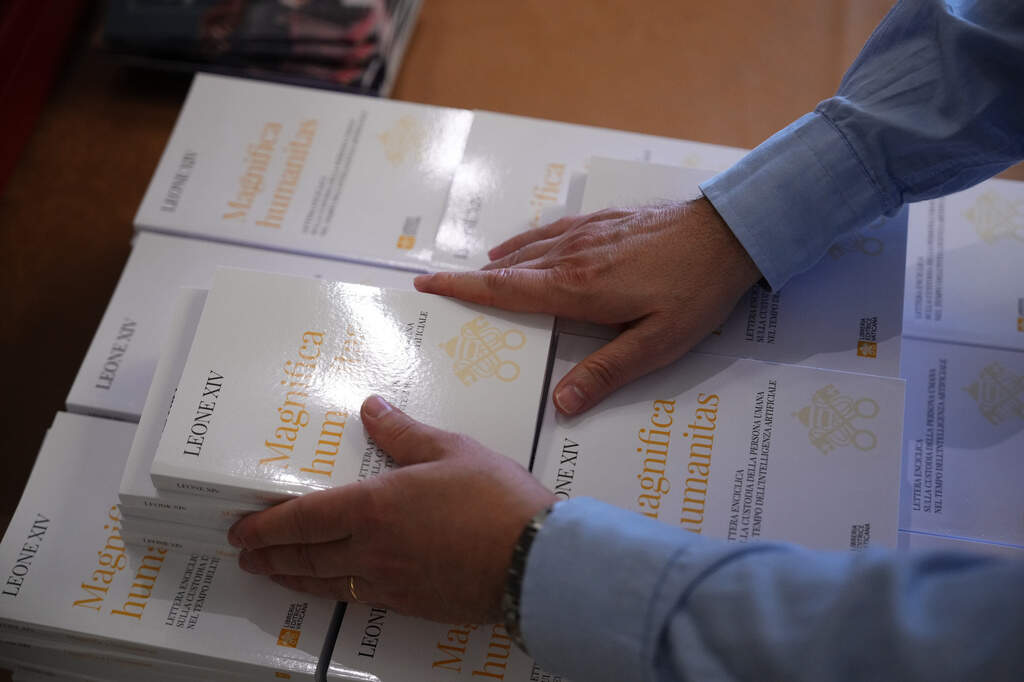
Pope Leo XIV has published his first major document. The encyclical “Magnifica Humanitas” focuses on AI and what the pope calls the “distorting effects of technological power.”
Guest
Father Michael Baggot, associate professor of bioethics at the Pontifical Athenaeum Regina Apostolorum. Adjunct professor of theology at the Pontifical University of St. Thomas Aquinas. Member of the Scholarly Advisory Board for Magisterium AI, a Catholic AI chatbot.
Transcript of Full Broadcast
The version of our broadcast available at the top of this page and via podcast apps is a condensed version of the full show. You can listen to the full, unedited broadcast here:
Part I
MEGHNA CHAKRABARTI: Pope Leo XIV has published his first major theological document. It's an encyclical called Magnifica Humanitas, Latin for Magnificent Humanity. Its subtitle is On Safeguarding the Human Person in the Time of Artificial Intelligence.
POPE LEO XIV: 135 years ago, my venerable predecessor, Leo XIII, observed the situation of factory workers, their families uprooted, and new forms of poverty generated by rapid industrial transformation.
He understood that the church could not remain distant. Today, we find ourselves facing a transformation of similar magnitude, with perhaps even greater consequences.
CHAKRABARTI: Pope Leo presented the encyclical at the Vatican last week, and he laid out some of the key arguments in his encyclical about the promises and dangers of AI.
POPE LEO XIV: Artificial intelligence needs to be disarmed. The word is strong, I know, but deliberately chosen because this moment needs words capable of attracting attention, awakening consciences, and indicating paths forward for humanity.
The Church has long been working for nuclear disarmament. In a similar sense, artificial intelligence now demands to be disarmed, freed from logics that turn it into an instrument of domination, exclusion, and death.
Like nuclear energy, it must be at the service of all and of the common good.
CHAKRABARTI: Today we're going to dig into the Pope's new encyclical, and in fact, it is not an anti-tech screed. It is, as its subtitle says, a call to all Catholics, and therefore perhaps the rest of the world, to keep humanity at the center of this technological revolution.
So what does that mean for all of us living in the AI age? Joining us now is Father Michael Baggot. He's Associate Professor of Bioethics at the Pontifical Athenaeum Regina Apostolorum and Adjunct Professor of Theology at the Pontifical University of St. Thomas Aquinas, both in Rome. He also happens to be a member of the scholarly advisory board for Magisterium AI, a Catholic AI chatbot.
And Father Baggot happens to be in Washington, D.C. today. Father, welcome to On Point.
MICHAEL BAGGOT: It's great to be with you.
CHAKRABARTI: I wonder if we could actually first start with a general definition of what an encyclical is for non-Catholics who are listening.
BAGGOT: Yeah, so basically an encyclical is a letter that the Pope sends to the whole church.
An encyclical is a letter that the Pope sends to the whole church.
In the beginning, the popes would send letters to various bishops, but over time, more recent popes have decided to address all people. And so this letter is typically the way in which the Pope applies the ancient perennial gospel to new developing situations, to those signs of the times that he wants to read in light of the gospel.
CHAKRABARTI: Okay. So then to understand the thinking that Pope Leo lays out in this encyclical, let's start where he does, because he specifically says, In the spirit of Pope Leo XIII's 1891 encyclical, Rerum Novarum, that's where he begins. First, tell us more about what the Rerum Novarum was and why it was important in the late 19th century.
BAGGOT: So Rerum Novarum is Latin for new things. So the pope of the time, Pope Leo XIII, saw the new things of the Industrial Revolution, and he wasn't just concerned about new forms of technology. He was concerned about how those new forms of technology were radically transforming family life, the nature of work, how people related to each other, how they saw the future, how they were able to worship, or how their leisure time was being taken away.
And so the pope wanted to intervene and give guidance on those key themes, and really defend the rights of workers and of families to have a decent livelihood, and also to reap the benefits of the Industrial Revolution. Pope Leo XIII was very concerned that a lot of these benefits were accruing to a very small group of people, and he thought it was important that those benefits be distributed and the potential to tap into all of the great accomplishments of the Industrial Revolution were reaching as many people as possible.
And I think that's what Pope Leo XIV wants to do today.
CHAKRABARTI: He says that explicitly, right? In his encyclical. But going back to Leo XIII, can you tell us a couple of the specific sort of ideas that he had on trying to have the Industrial Revolution actually contribute more broadly to the common good?
BAGGOT: He wanted to make sure that, for instance, the means of production were accessible to a wide group of people, and he wanted to make sure that people were not being alienated or isolated in their work. There was a great tendency to turn to more repetitive, standardized means of production.
It was easy for certain people to feel more like they were just cogs themselves in a giant machine. So he wanted to make sure that these opportunities for creative development and participation in these different developments were available to multiple people, and in particular, that various workers could gather together in unions to protect their rights and to make sure that those who had control of the capital were not exploiting these workers.
He was also very concerned that there would be these family wages. So not just enough to survive, but enough for a family to really grow and develop so that work would be at the service of the person and not the person at the service of some anonymous work.
CHAKRABARTI: Interesting. Okay. So we'll keep that in mind because I think then Pope Leo XIII's Rerum Novarum provides an example of the power of the Catholic Church in terms of raising these issues, but also then the limitations, right?
Because one could argue that as the Industrial Revolution ground on, in fact, much of what Leo had hoped for did not come to pass for the common good. But we'll come back to that. I do want to just also ask you about how Pope Leo XIV says that Rerum Novarum was actually so important, and this is, educate me as a non-Catholic, Father, if you could. That that it went on to establish what is now known as the social doctrine of the church?
BAGGOT: Yeah, so it initiated this modern reflection on how the gospel relates to economic life, to social life, to key principles of really flourishing together in society.
Of course, the Gospels and the early Christians reflected on community life, but by the time of Pope Leo XIII, we had seen all of these new developments in terms of the spread of democratic governments, greater participation in how societies were run, of course, these new technological developments that were impacting work.
And so it was the time to think more systematically about how people really thrive and flourish together in communities, and what kind of relationships are really conducive to this sort of civilization of love as it comes to be known in later teaching.
CHAKRABARTI: So that spiritual guidance exclusively was not adequate, that the church had to concern itself with the literal the body and existence of the human person.
BAGGOT: Yeah, absolutely. So we're convinced that humans are body-soul composites, right? They're not mere angels, not pure spirits. If you're proclaiming a kind of angelism or a kind of purely spiritual message in church that has no impact on how you spend your days in work, and in family, and in entertainment and culture, then it becomes very disembodied and basically irrelevant.
So in light of our very nature as embodied creatures, it's important that the key messages of the spiritual life are touching upon guiding and inspiring how we interact with each other on a day-to-day basis, in our work and in our leisure.
CHAKRABARTI: Okay. So in Magnifica Humanitas, Pope Leo XIV sets up his analysis with two biblical images, the Tower of Babel and the reconstruction of the walls of Jerusalem.
Tell us quickly about why these are the two tent poles of his analysis.
BAGGOT: In the case of Babel, we have this individualism, this selfishness, pride, a disregard for God, for the transcendent, a sort of a self-aggrandizement. It's very puffed up. Whereas in the case of the rebuilding of Temple of Jerusalem, it comes in this situation in which the people of God have, in many ways, been humiliated.
They've been exiled, but then they're moved to humbly collaborate and work together. They listen to each other. They recognize the gifts that each of them have, and they place those talents together in humble service of something that goes beyond just the particular interest of one group. So I think the Pope sees clear applications for this today.
We can build as a small little clique or as an elite focused on power or profit, or we can build AI systems that really involve various cultures, traditions, perspectives of the global north, south and of all parts of the world, and that's the kind of collaboration and humility that he thinks is the path of the future.
CHAKRABARTI: Father, I said Babel. Is it Babel or Babel?
BAGGOT: Oh, either way, Babel or Babel. I've lived in Rome for a long time and worked in different parts of the world, so I've basically forgotten how to speak any language well.
CHAKRABARTI: You're doing just fine in English, I just wanted to be sure I had it right.
But just sticking with the Tower of Babel for one more moment, in his encyclical, in fact the Pope uses very specific language, which it's tell me all about AI without saying the word AI, right? Because he said he describes a tower, the biblical tower, as a project conceived without reference to God, supported by a uniformity that eliminated diversity and chose homogenization, pfft, today is not my day.
Homogenization over communion, right? And then talks about when communication breaks down, languages become confused, and people actually no longer understand each other. I thought that was very interesting because the homogenization part, in practical terms, is something that people already are worrying about regarding large language models.
BAGGOT: We become programmed to almost speak the way in which the models themselves tend to generate text, and we see this sort of flattening our own creativity and expression, and so there's real concern about that. Not to mention the fact that we know that many of these models are drawing disproportionately from certain cultures to the exclusion of other cultures, which really causes us to lose out on that rich diversity that the pope defends.
These models are drawing disproportionately from certain cultures to the exclusion of other cultures. Which really causes us to lose out on that rich diversity that the pope defends.
Part II
CHAKRABARTI: Father, let me just play a little bit more of Pope Leo himself.
We talked about how he contrasts the story of Babel with that of the reconstruction of the walls of Jerusalem, and here is the Pope talking about just that.
POPE LEO: Before the ruined walls of Jerusalem, he gathers discouraged people to bring about rebirth. The image of walls does not legitimize closures or divisions, but invites each and every one to do their part.
Brick by brick, a more just coexistence takes shape, capable of safeguarding the dignity of all. Nehemiah's effort speaks to our time. Artificial intelligence can be a construction site of history from within a horizon of communion in which technical progress learns to serve human life.
CHAKRABARTI: Father Baggot let me ask you, broadly speaking, when Pope Leo is considering artificial intelligence, what exactly is he talking about?
Because it can be anything from ChatGPT to something much, much larger.
BAGGOT: He takes a very broad perspective. When he starts to address this around number 99, he says that it would be foolish to come up with too detailed a definition because of technological progress and change. So I think he's looking broadly at developments in machine learning and neural networks, certainly taking into account all the developments of late in generative AI.
But he wants to respect the dynamic nature of the technology and really not try to pin it down, but rather present these key philosophical theological principles that are going to be relevant even as the tech changes.
CHAKRABARTI: Okay, and then he says also early on that the position of the church, at least under his pontificate, is not one of just total opposition to AI or technology.
BAGGOT: No, not at all. In fact, he's constantly talking about the promises of AI before getting to some of the challenges and risk, and he has this beautiful number in 111 where he appeals directly to those who develop AI systems, and he says, "If this is done well and wisely, this is actually a participation in the work of the Creator, and every design decision is implicitly a decision about the view of the person."
So the problem is not the technology, but rather the particular philosophies that might guide these technologies well or poorly. But I think that number 111 is really beautiful, and it echoes a message that I recall him sending to a group that I'm part of called the Builders AI Forum. It's some 200 or so Catholics who design, develop, deploy, and invest in these technologies for the good of humanity through health care, education, media, and other fields.
[The pope believes] the problem is not the technology, but rather the particular philosophies that might guide these technologies well or poorly.
And the Pope addressed a very similar message to us, which was quite encouraging to say, "This is not just permissible, but this can actually be a vocation, a calling to serve others."
CHAKRABARTI: Okay, so let's talk then in some more detail about some of the specific aspects of how AI is changing or is poised to change the world that the Pope wants the global Catholic Church to think through in more detail.
First of all, just he talks specifically about this has been in the news recently, about the application of AI to warfare, for example. Yes, we see the very troubling spread of lethal autonomous weapons, or at least the attempts and the push to create lethal autonomous weapons, and we see ever more automated forms of warfare, which is so problematic because it distances us from the brutality of war.
It basically goes against the dignity of our human agency. It clouds our understanding of who's actually responsible, which in turn makes it very difficult, if not impossible, for us to correct abuses. And then it really prevents us from empathizing with others. Sometimes these ideas of more autonomous weapons are presented as a great way of lowering the cost of human soldiers, but so often that means lowering the human cost of your own country while de-incentivizing pushes for peace with other nations.
It makes war seem all the more feasible and productive which is so troubling and devastating.
CHAKRABARTI: In fact, here is how Pope Leo himself expressed that when he presented the Magnifica.
POPE LEO: It is also dramatically changing how war is waged. Very troubling voices have also reached me about increasingly autonomous weapons systems, practically beyond any human reach to govern them effectively.
CHAKRABARTI: In fact, in the document itself, Father, I believe that Pope Leo says something to the effect of taking away the image of the human person from the targeting, to put it bluntly, of a weapon. Like when one person is looking at another and in the moment of deciding whether to take their life or not, there remains the question of the sanctity of human life.
But when digital technology removes all evidence of the person on the other end of the weapon, then what's the implication of that?
BAGGOT: Yes, it deprives us of those opportunities to empathize with the others and to recognize a brother or sister, and it can very quickly reduce warfare to this kind of video game, and it can trivialize the human costs that are involved in taking human life.
CHAKRABARTI: Yeah. I believe my fabulous producer, Claire, has pulled it up here. It's Section 199, "Any technology that facilitates attacks without seeing the face of human beings lowers the moral threshold of the conflict." That's what you were talking about earlier. Okay. Honestly, any one of these sections we could talk for quite a bit about, so forgive me if I'm doing a little bit of a survey here, Father.
But I wanted to also get to, next, this section on truth, work, and freedom because these things also seem to direct very connect very directly back to Pope Leo XIII's encyclical. So let's talk about work actually first and foremost. How does the current Pope Leo see AI as having an impact not just on the fact of work for people, but he also talks about the dignity of work.
The dignity of work is key. Because from the Catholic perspective that Leo presents, work is not just about the product that's produced, but about the very process of growth and transformation. It's that opportunity that we all have to use our particular talents to develop ourselves and then to serve others.
And we work in a community, so we grow in so many virtues of community life through this exchange of gifts and talents. So even if our particular economic needs are met, it would be degrading to deprive us of these opportunities to use our talents, use our gifts and to engage in meaningful work.
Work is not just a punishment. Work is a path of development, and we would even see it as a path of holiness.
CHAKRABARTI: He says, "It's a requirement of the human condition, a normal path towards maturity, development, and personal fulfillment." But then he goes on and says, "AI is rapidly transforming the very structure of work.
It is said that this will bring great improvements for everyone. In reality, however, the new ways of working are not necessarily better." And then he goes on and says, for, quote, "While AI promises to boost productivity by taking over mundane tasks, it frequently forces workers to adapt to the speed and demands of machines rather than machines being designed to support those who work."
The reason why I wanted to highlight this is because very frequently, Father Baggot, out of Silicon Valley I'm just using Silicon Valley as shorthand for anyone who develops these technologies anywhere. What we hear is, yeah, the goal is actually for people to not have to work so much, and that this is presented as a positive outcome of AI.
Or conversely, as the Pope says here, that you can do more in less time. And just like how does that then position itself against what the Pope is saying about the inherent importance of the dignity of working?
BAGGOT: I think there can be great value in AI systems that save people from dangerous work or from work that produces a lot of drudgery.
So I think there are some real benefits to automation in limited fields. But you're absolutely right that we risk missing out on a lot of opportunities for the kind of depth and reflection involved in slower forms of work, in creative work as well. And the Pope says that we should not content ourselves simply with meeting people's economic needs, though that's very important.
We should ensure that all people have the opportunity to engage in meaningful work, because as I said, that is the way that they are going to use their gifts and their talents. And, that meaningful work, I think in the future will be increasingly focused on connective labor that someone like Allison Pugh has highlighted so well, that exchange of knowledge and love, that opportunity to see the other and help the other be seen, the type of thing that great nurses, doctors, professors do when they offer this kind of mentorship.
I think that those are the sorts of fields that will never be automated away, that are irreducibly human and that are good for the people who receive those services. But also, and I really wanna emphasize this, they're good for the people who offer that service. As a priest, I am constantly moved to greater growth and humility when I hear a good confession or where someone-- when someone opens up to me in spiritual direction and makes a breakthrough, it makes me want to be more courageous, or it makes me want to develop the virtues that they're displaying.
The same as a professor, I'm not just there to deliver information. I'm there to mentor. I'm involved in someone's life, and seeing others really thrive brings me such joy and fulfillment and challenges me to grow. So this kind of connective labor will never go out of style — and should never. We can never automate it away.
Connective labor will never go out of style -- and should never. We can never automate it away.
And I think those are the sorts of things that the Pope really wisely wants to protect and safeguard. Now, at the same time, if we do have more time for leisure, wonderful, but we have to learn how to use that well. We've had predictions of greater leisure for decades now. But we so often squander it away, and we scroll for hours or engage in brain rot.
And so there are lots of ways in which we also need formation, not only in the meaning of work, but also in the meaning of leisure.
CHAKRABARTI: More leisure for a diminishingly small few. We're gonna get to the inequities issue that the Pope raises here.
But you presented me with just an irresistible little tangent, Father.
BAGGOT: Yes.
CHAKRABARTI: In terms of you talked about how hearing confession is actually, it makes you a better person and a better priest as well. I just wonder, I'm seeing here that once again, you're a member of this advisory board for Magisterium AI, a Catholic AI chatbot.
And also, there's more and more, there are more and more stories out there about how people are actually turning to AI for spiritual guidance instead of maybe going to whoever their spiritual leader is. I'm wondering what you think about people looking at Claude or ChatGPT as a place to find solace in a sense.
BAGGOT: I've seen a lot of psychologists concerned with the tendency to deify AI systems, right? Because it's easy to think that these systems are practically omniscient, omnipotent, and even omnibenevolent, right? And they also have this constant presence that normally we would've associated with the gods.
We can commune with them. We can communicate with them at any moment, right? Which is, in the past, something you would do with a god. So there is that real temptation to deify the systems. Which, of course, would be quite misguided and has very dangerous impacts on people. The work that Magisterium AI and other similar platforms offers is not a replacement of God, and certainly not a replacement of ministers in the church, but rather a way of interacting more easily and readily with the patrimony of Catholic teaching.
There is that real temptation to deify the systems. Which, of course, would be quite misguided and has very dangerous impacts on people.
It's a kind of dynamic library, or I've described it as a kind of digital librarian. So you have a query or a question, and like a good librarian, the platform will tell you what to look at, where to go, and exactly which documents to read. If it's hard enough to keep track of all the encyclicals out there, let alone when you have to go to the Vatican website and you see a long list of Latin titles; you don't know where to start. Magisterium AI simply wants to facilitate that process and say, Okay you're interested in learning more about the mass and what that means. Here are some documents from the church, and here are some specific paragraphs that you can start with to understand.
Here's a brief little summary, but by all means, read it yourself. This is meant to empower, not replace people's own efforts. And thankfully, I still have job security because Magisterium AI is not interested in hearing your confession. Doesn't want to have a personal in-depth relationship with you.
It wants to provide some information and empower you to go off and find a real living, breathing, messy, sometimes disappointing community.
CHAKRABARTI: Ah, okay. So that's actually, so that's key here. And because I guess what I was asking is that, and forgive me for being unclear before, but again, it seems like increasing numbers of people instead of, say, going to confession or whatever the sort of spiritual connections they have with their houses of faith might be, when they go to AI, when they go to ChatGPT and say, "I have this problem," or, I have this concern," or, "I have this dilemma, help me think through this.
Tell me what to do," we know for a fact that these algorithms are programmed, they're created to be very sycophantic, right? They return, I don't want to say thoughts, but words that are designed to help them, the person feel better about themselves. But in keeping the human being, the human person at the center of AI development, sycophancy is not the same thing as ministry, right?
Because oftentimes as a priest during confession, the feedback that you're giving to the person confessing to you may be hard for them to hear.
BAGGOT: Yes. It's a challenge, right? And in our best relationships, in our friendship, in our relationships with mentors, in these relationships with spiritual figures, we are often challenged.
And it's precisely there that we're able to present our weaknesses, our faults, and our limits, and then find guidance and growth and encouragement to do better in the future. Not to remain in humiliation, but to learn from our mistakes and then work hard to improve and grow in virtue and be more generous.
And so you're absolutely right. We are not interested in offering sycophantic relationships, and I'm very concerned about the way in which these models are often designed to optimize for engagement at the expense of wise counsel and even the mental wellbeing of the people who use them.
I'm very concerned about the way in which these models are often designed to optimize for engagement at the expense of wise counsel and even the mental wellbeing of the people who use them.
I think in many ways, we're seeing the extension of the attention economy into a kind of affection economy, where now certain companies are gaining access not to our minds, not only to our minds, but also to our hearts. And I think that offers a kind of unparalleled sway and influence that can be exploited for profit or power or some combination thereof. And I think we need to be very attentive to that and rediscover the beauty of these challenging relationships, which will be uncomfortable, but will really bring the best out of us.
Part III
CHAKRABARTI: The human person that again and again is the pope says should be at the center of all considerations regarding technology, not the least of which is AI, leads him to talk about or to ask a specific question: What does it mean to safeguard our humanity?
And then he gets into a discussion of post-humanism. Tell us about what the pope is thinking about there.
BAGGOT: The pope recognizes, again, that the problem is not with the technology, but some of the philosophies that inform the misuse of the technology, and some of the most widespread philosophies right now among influential tech figures are trans and post-humanism.
Basically, transhumanism looks to radically enhance the human condition. Figures like Nick Bostrom speak of how humanity is this half-baked work in progress in need of serious correction, and we need to use technology to radically enhance ourselves cognitively, physically, in terms of our emotional life, morally, our lifespan.
We need to confront aging, sickness, suffering, and even death through technological means and maybe we'll eventually figure out how to conquer them. And then the post-human variation of this focuses very much on blending all boundaries, including between the human and the machine. And some of the post-humans also speak of a kind of post-biological state, which is where you get these ideas of getting to something like digital immortality, perhaps downloading the information of our personalities and being then able to upload it to the cloud to escape even death.
CHAKRABARTI: So let me just focus there on the sort of Catholic, the specific reason why this is particularly resonant for the Catholic Church, right? And that has to do with the centrality of Jesus, right? And the fact that he is, in Catholic belief, in Christian belief writ large, but he is God made flesh.
Yes? So therefore, the actual, as we've been talking about, the physical and human and spiritual being of individual people is worthy of safeguarding.
BAGGOT: Yes, absolutely. So we believe in a God made flesh, who takes on human flesh and redeems us precisely through that flesh and through suffering, and that gives a meaning and a value even to human weakness and suffering.
Not to celebrate it in a kind of masochistic way, but to help people recognize that it has meaning and value. It's not useless, and the body is not something to be ashamed of or overcome, but rather we find our fulfillment in and through our body and in and through human vulnerability and weakness.
CHAKRABARTI: But I would say that many people in the tech world would counter the Pope's concerns and say, look at how Pope Leo himself puts the definition of what the common good actually is in his encyclical." He writes that the coming out of the Second Vatican Council, the definition of the common good is, quote, "The sum total of social conditions which allow people, either as groups or as individuals, to reach their fulfillment more easily."
And tech folks would say that's exactly what we're trying to do by making a frictionless world, by optimizing our capabilities in whatever field or ability that we want, by eradicating, disease or, quote-unquote, 'imperfections.' This is all towards the common good of people fulfilling their hopes and desires, again, more easily."
BAGGOT: Yeah, so there's nothing wrong with using technology to improve the state of our life or to make advances in healthcare and medicine, even in the length of our life and the length of our health span. All of that is good, and it's something that the church engages in throughout the world. The problem here is not so much that the transhumanists are seeking too much, but that they're settling for too little.
It's a kind of quantitative extension of this life, according to some ideal of what the strong and the fit and the smart look like, where Christianity actually offers an even higher counterproposal which says that we are open to a qualitative elevation in our life, which means a life of grace as it's described in the document, and that's something that's accessible to everyone, not only those who have access to the most advanced emerging technologies or can invest in cryopreservation, brain computer interface, or radical life extension.
This is something that's open to each and every person. And even when our best tools fail us or fail to offer the promises of a longer, fitter, stronger, happier life, there's still dignity and value in that, and there's growth. We learn how to be patient, how to be courageous, how to care for others through these relationships, and then the life of grace opens up to this whole possibility of a higher life, a kind of trans human life in the Christian sense, and also opens us up to a path of eternity.
So I want to emphasize that it's not, problem's not that the transhumanists are seeking too much but perhaps settling for too little.
CHAKRABARTI: Ah, interesting. Okay. So in terms of what do we do about this now, Pope Leo offers quite a few areas for further thought, right? We can't go through all of them. But he talks about families and young people.
He talks about schools. We talked about work a little bit, Father. But he specifically continuously references, in fact, the way the economy is structured, right? Structured for increased productivity, increased profit, while ignoring its impact on the common good, right? So this takes us directly to another refrain in his encyclical, which is the impact of unregulated technology being disparate, right?
Being unequal. Can you talk about that a little bit?
BAGGOT: Yeah, I think one of the most striking sections in this regard comes at the end of chapter four in the context of freedom. He begins to talk of these new forms of slavery and even of colonization. So he goes briefly through the history of slavery and says the Christian faith has always taught that every human being is created in the image and likeness of God and has an infinite dignity.
But unfortunately, at certain moments of history, even members of the church have compromised with unjust social structures, with institutions of slavery, because it was seen as somehow necessary economically or more convenient or whatever false excuse was given. And so he humbly asks for forgiveness for those sins, but says, Let us not repeat the same mistakes, and let us not be blind to new forms of slavery or, that are taking place.
So we can speak concretely of the countless individuals who are suffering horrible physical conditions and great danger to extract rare earth minerals. Or the tremendous psychological plight of those who spend long hours exposed to extreme violence, to sexual abuse material, to bestiality and other themes so that they can label sensitive content. And basically, protect other people from that toxic material that they're being exposed to at great expense, right? Even of horrific trauma.
So the pope wants to shed light on these new forms of colonization, these new forms of slavery, and make sure that we are not exploiting some individuals so that others can have a more smooth efficient experience of their large language models or other technologies.
The pope wants to ... make sure that we are not exploiting some individuals so that others can have a more smooth efficient experience of their LLMs or other technologies.
CHAKRABARTI: Yeah. I wonder if in this case we could reflect back on Pope Leo XIII, right? Because as I said earlier, I think there's something to be learned about how when calling for a completely different model for an economy, right? Which is essentially what the current pope is doing. He says, it should not necessarily be an economy that's focused exclusively or incentivized exclusively for profit, right?
But one that also considers human good. It the subtitle is An Economy That Values Dignity. Seems like Pope Leo XIII made the same or a similar argument regarding the Industrial Revolution, but for as long as the Catholic Church, we live in a multi-religious society here in America, so hopefully this won't happen.
We don't want the church to have direct control over regulation, right? The forces that support profit-driven decision-making, especially in a capitalist or hyper-capitalist society or societies, they didn't really take into account what Pope Leo XIII said. There was still rampant inequality after the Industrial Revolution, and I think one of the only, let's say, moderating forces, sadly, was the catastrophe of the Second World War.
I'm just wondering, Pope Leo XIV definitely knows that, so how does he hope that the thoughts in his encyclical might actually work their way into broader society?
BAGGOT: The pope acknowledges from the beginning of the document that the church recognizes the legitimate autonomy and the particular responsibilities of each society and each political organization.
So the church can provide these clear criteria of human dignity, of universal destination of good, subsidiarity, solidarity, the common good, and so forth that he outlines at great length in the early chapters of the document. But it is then up to each political figure and each member of a particular society to discern how best to apply those principles to the needs of their people.
And so he's really giving us the vision, giving us the clear direction, and trying to empower those with the political responsibility to make the proper choices and use this framework as a point of reference.
CHAKRABARTI: Yeah, but he also says that, he says this a couple of times, that he believes the state, A.k.a. regulation, is not adequate to completely face this challenge.
So we also need a clear vision of the person and what flourishing communities and societies look like. So that's what he is outlining in his document and informing people with, and then from there, the particular political leaders can figure out the best way to apply that.
So regulation has its role, but if you have an impoverished view of the person, whether that's the person as a set of data points to mine and extract, or as information, or as some sort of instrument in a collective, if you have that impoverished view of the person, then no amount of regulation will work.
But if you have the proper view of the person, then you can begin to make political progress.
CHAKRABARTI: And it seems to me that the pope is saying that the people who need to have that proper view of the person are the people making this technology, right? Because he says now that these companies, or corporations more broadly, are more powerful in certain ways already than the state, yes?
BAGGOT: Yeah, absolutely. It's a real clarion call to those who have this unique power to exercise responsibility, and I think one of the things that Pope Leo XIV does so well in line with Pope Leo XIII is move us beyond a competitive model. So Leo XIII recognized that there was a real clash between labor and capital, between those who had and those who did not have, but he did not want to remain in that state of conflict.
He wanted collaboration. And so likewise, Leo XIV says, "Okay, if you have this great power and influence, you also have the opportunity to serve more people around the world." And so instead of villainizing, demonizing particular figures because of their power or position, he wants to challenge them to greater responsibility and figure out the best way to, to have dialogue, which I think precisely why the various members of the church spend so much time and energy in dialoguing with key figures in Silicon Valley and beyond who are developing these technologies.
Instead of villainizing, demonizing particular figures because of their power or position, [the pope] wants to challenge them to greater responsibility.
CHAKRABARTI: In fact, Christopher Olah, who's the co-founder of the AI company Anthropic, was actually at the presentation when Pope Leo revealed his encyclical, and he was invited there by the Catholic Church. And he spoke and said that Anthropic and other AI labs are operating with a set of incentives and constraints that, in Olah's words, quote, "Can sometimes conflict with doing the right thing."
OLAH: The pressure to stay commercially viable and to stay at the frontier of research, geopolitical pressure, and the older, plainer pressures of pride and ambition. No matter how sincerely any of us intend to do the right thing, and I believe many of us do, we will always be influenced by those incentives.
That is why if we want this technology to go well, it is enormously important that there be people outside those incentives who are paying close attention, who are willing to say hard things and insist on safety.
CHAKRABARTI: And I would hope that then the people inside these companies listen when people external to them say things like the pope has been saying.
Now, Father Baggot, we only have about a minute left. I actually just wanted to close with a follow-up to your encouragement that people have discussions with members of Silicon Valley. Is that actually one of the reasons why you're in the United States right now?
BAGGOT: It is. I'm actually on my way this weekend to Silicon Valley for an event that the Bishop of San Jose has put on, basically Rome meets Silicon Valley, and I'll be on a panel with Chloe Lubinski, who leads the dialogue with Wisdom Traditions on behalf of Anthropic, and we're looking forward to having representatives of other frontier labs and companies there, and we'll sit down and talk to each other face-to-face and see where we agree, where we disagree, and how we can collaborate and move forward.
So this is not just in a document. This is happening in real life, and I think it can only be beneficial for everyone.
The first draft of this transcript was created by Descript, an AI transcription tool. An On Point producer then thoroughly reviewed, corrected, and reformatted the transcript before publication. The use of this AI tool creates the capacity to provide these transcripts.
This program aired on June 2, 2026.