Support WBUR
Inside a diminished CDC as it confronts Ebola
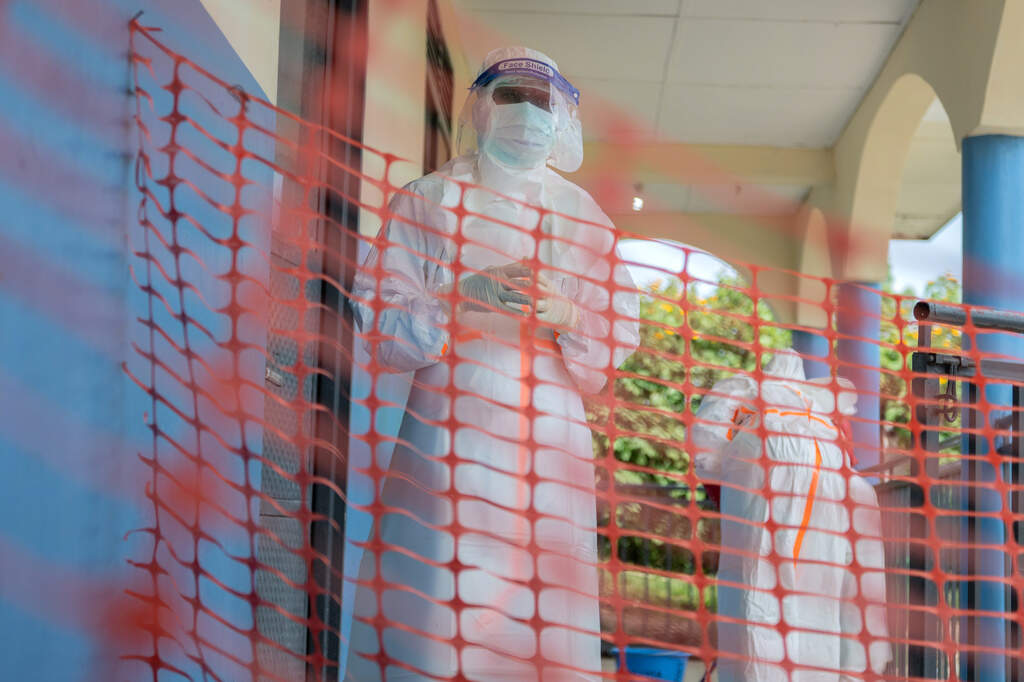
The Centers for Disease Control has lost as much as a third of its staff under the Trump administration. How the Ebola outbreak in Africa exposes a weakened CDC.
Guests
Dr. Jay Varma, former director of the International Emerging Infections Program at the Centers for Disease Control and Prevention. Former Epidemic Intelligence Service Officer at the Centers for Disease Control and Prevention. Senior Vice President for Health Practice and Chief Medical Officer at The Fedcap Group.
Also Featured
Laura Kelly, foreign policy reporter for The Hill.
Pierre Rollin, former deputy chief of the Viral Special Pathogens branch at the Centers for Disease Control and Prevention.
Transcript of Full Broadcast
The version of our broadcast available at the top of this page and via podcast apps is a condensed version of the full show. You can listen to the full, unedited broadcast here:
Part I
MEGHNA CHAKRABARTI: Laura Kelly is a foreign policy reporter for The Hill, and recently she was in Rwanda and Uganda on May 21st. Now, that happens to be exactly the same day that the United States announced new enhanced airport screening to better protect against an Ebola outbreak in the very region where she was traveling.
NEWS BRIEF: U.S.-bound flights carrying passengers who have visited Ebola-affected countries in Africa must now land at Washington Dulles International Airport. There, the CDC will conduct enhanced health screenings.
CHAKRABARTI: Kelly had just crossed the border between Rwanda and Uganda, where during that crossing, she had encountered routine measures to protect against Ebola transmission.
LAURA KELLY: There was a sign at the border crossing, and it said hand washing, and we got our temperature checked. And coming back from Uganda to Rwanda, we got our temperature checked again, and we just were made to wash our hands.
CHAKRABARTI: She didn't show any symptoms, so Kelly and her partner flew first to Brussels, Belgium, and interestingly, she didn't go through any screening in Belgium.
But then she flew home to the United States, where, as we mentioned, officials had just announced that inbound passengers who, quote, "have visited Ebola-affected countries in Africa" would have to go through enhanced screening. That was Kelly.
KELLY: You would expect maybe something a little bit COVID-like.
Maybe it might be people in protective gear with masks, maybe some goggles. If it's a bit extreme, probably going to a side room.
CHAKRABARTI: But she didn't encounter any kind of screening whatsoever, and she flew into the very same airport, Dulles International in Washington, where CDC said it would be conducting those screenings.
KELLY: We land in Dulles. We get off the plane. We go into that very obnoxious little motorized transit ... if you've ever been through Dulles, and then approached passport control. And I have Global Entry, so went up there. I took a picture in front of the computer, waited online for a few minutes. There was a man in front of me who I believe was from my flight, and he approached passport control.
I didn't hear their conversation, but I heard Uganda, and then he was pointed to go off to the side, which I imagined was the enhanced health screening. And so then it was my turn, and I walked up to passport control, and the officer said, "Laura?" I said, "Yes." He said, "Anything to declare?" I said, "No."
And he said, "Have a nice day." And then I just continued on, and then my partner was behind me and had the same experience.
CHAKRABARTI: Lots of questions to be asked about that experience, and we will in just a moment. But the point is the World Health Organization labeled the Ebola outbreak as a global emergency in May.
And although the agency says the number of suspected cases is down from prior weeks, officials claim they are, quote, "catching up" after the Ebola virus had a, quote, "big head start." And as some experts in the field of infectious diseases have noted, that head start could have been narrowed with more immediate and intense involvement from the Centers for Disease Control and Prevention here in the United States.
And that is because CDC has long been instrumental in helping curb major disease outbreaks almost everywhere in the world. But the CDC has been gutted by the Trump administration. Thousands of workers have been fired. Many more employees have resigned. The agency went some six months without a permanent director, and then President Trump dismissed Susan Monarez just a week or weeks after she was confirmed.
He then nominated a respected military and public health officer, Dr. Erica Schwartz, to lead the CDC, but Congress has not moved forward with her nomination. In addition, the Trump administration has proposed enormous budget cuts to CDC for the past two years. The Trump administration's 2027 budget proposal seeks to slash CDC funding by almost $3 billion, or more than 30%.
So today, we want to look at what impact all of that has had and how a hollowed-out CDC is hampering infectious disease control around the world and right here in the United States. So joining me now is Dr. Jay Varma. He's senior vice president for health practice and chief medical officer at the FedCap Group.
But from 2001 to 2011, he worked at CDC, including as CDC's director of the International Emerging Infections Program. Dr. Varma, welcome to On Point.
JAY VARMA: Great. Thank you for having me.
CHAKRABARTI: Okay. So I would like you to take us, on the ground, first to Dulles Inter-International Airport. What's your response to hearing Kelly's story there about not having a secondary questioning or any kind of screening when she came back from East Africa?
VARMA: It's unfortunate, but also not surprising given everything that's happened to CDC and public health over the past year and a half. Implementing these types of programs, as I did when I was leading infectious diseases for the city of New York during the large West Africa Ebola outbreak, it's a really complicated process, and, simply saying, "We're going to screen everybody," is very different than what it actually takes to make that operational on the ground.
Simply saying, "We're going to screen everybody," is very different than what it actually takes to make that operational.
Jay Varma
CHAKRABARTI: Okay. So then let's take 2014, right? The 2014 outbreak. Correct? Let's take that experience in New York and hear about it in detail and compare it to what we're seeing now. So tell me what you did.
VARMA: Yeah. No and again, it's not just me. And that's also a point that I'll keep emphasizing throughout this.
Public health only has a limited amount of authority. To make these things happen, you need cooperation from Homeland Security, which operates Customs and Border Protection. You need the individual airports, which are often under local authorities.
Public health only has a limited amount of authority.
Jay Varma
So what happened in 2014 is there was a massive political commitment and funding commitment from President Obama at that time.
They appointed a White House coordinator who basically worked with every different agency to make sure this happened. So what should have happened with this reporter is that when they arrive at the airport, the Customs and Border Protection, the Department of Homeland Security personnel, have already been trained to make sure to look through records and ask in detail about travel histories.
They would've then routed that reporter to CDC personnel, who are stationed there, who would then have to collect a really detailed amount of information, where that person was, were they exposed to sick people, hospitals, funerals, places where you could get Ebola, collect their information, and then something even more important then has to happen.
They have to actually give this person the resources so that they can be monitored. So we would give people a book and a thermometer to say, "Hey, you're going to have to check your temperature twice a day." We would hand them a portable, a mobile phone, because a lot of people didn't have phones, and we also wanted to have a reliable way to contact them, literally hand them a phone.
And then the people at the airport, the CDC officers, would use an electronic system to transmit that information to state and local health departments, who would then be responsible for then tracking that person for 21 days. And to do that in New York City, we had to set up an entire call center of hundreds of people, staffed over time on a floor of the health department to be monitoring these people for 21 days.
CHAKRABARTI: Dr. Varma, if I may, I want to play the role of a documentarian here and pretend that we're back in 2014, and I'm following you or following CDC employees around JFK International Airport. Or actually let's go back even further. In terms of travel histories, for people who were coming from outbreak-identified countries in Africa, in 2014, were airlines required to report those itineraries to health officials here in the United States, or no?
How did you know who was potentially coming in that might have been in an Ebola-affected region?
VARMA: Yeah, no, it's an excellent question. And I won't contend for a moment that the system was 100% perfect, but it required this massive collaboration. So first of all, in that situation, there were three heavily impacted countries in West Africa: Liberia, Guinea, and Sierra Leone.
Now, unfortunately, flights to those regions were eventually cut off, and so it then became even easier to track who was coming to and from. But let's just use the example before the travel restrictions were stopped. The airlines were required to transmit that information to Customs and Border Protection, specifically because of the situation that your reporter encountered.
A lot of those flights do not go direct to the United States. They get routed through European airports, so there has to be a lot of transmission and cooperation. In addition to that, the Customs and Border Protection personnel were trained and heavily well-staffed to basically look at people's passports and to ask detailed questions, and there were a lot of electronic systems put in place to make sure there was double and triple-checking that this was happening.
The other point that I'll make is that all of the flights were routed through five different airports in the United States, and that simplifies the process, and again, that's something that was supposed to happen here, but from what I understand, that hasn't entirely occurred yet.
CHAKRABARTI: Okay. More detail, Dr. Varma. Bear with me, because I think in the media, we often talk in almost irresponsible generalities when speaking of processes like these, and I don't actually think it really helps people to understand. So if you will dig into the details with me, I'd really appreciate that.
So ideally, you were saying, even though it wasn't a perfect system, that Customs and Border Protection in the specific airports in the United States, the officers would have some kind of information about people's itinerary when they came in, whether on the screen or I guess they could look through passports as well.
They were trained to ask certain questions. Were they trained to ask those questions of everybody who had come from the identified countries?
VARMA: They were definitely trained to do the initial screening about where people had been and because that's the most important priority, right? Is trying to figure out who is potentially exposed, but you also have to remember, this is why, and this is great that you're asking these questions, because I do think a lot of people think these systems turn off and on, like your air conditioner might, when the weather gets hot.
It's a huge number of people. The other advantage they have is these, what we call quarantine stations, where the CDC personnel are stationed at airports, are also walking around regularly, right? They're also there to sensitize the Customs and Border Protection people, to make sure to know to ask these specific questions about where people might have been.
So if you had any opportunity of being in those countries, you were then routed to a CDC person or person, and again, I'll emphasize another point, to know the details. These weren't originally people who were permanently stationed at those. There are CDC people who are stationed at major international airports, but they had to bulk that up, right?
We had to mobilize personnel from across CDC, and right now, the agency has had a huge number of people cut from it. So you have to try to find people, to go to those airports and staff them, and then interview everybody who then the Customs and Border Protection people say might have been exposed.
Part II
CHAKRABARTI: Dr. Varma, we're still at the Customs and Border Patrol checkpoint here in our recollections of the 2014 efforts at JFK.
So this screening first gets done there, and then people ideally were moved on to secondary screening. But I want to stay at the CPB post for just a second because Laura Kelly, in her piece from The Hill, I'm not sure if you saw this, we heard that she didn't go through any kind of secondary screening, and maybe that was because of the fact that she came in on global entry.
Don't know. The person in front of her, she said she heard the word Uganda, and he did get taken aside. We don't know the context of the conversation, though, between that person and the CBP officer.
But in her piece, she writes about the 2014 screening at JFK because she talked to a gentleman named Dr. Craig Spencer, and he was actually treating Ebola patients in Guinea. And then when he returned to New York's JFK International Airport and at that time, precaution measures that you're describing had been in place for about a month, he actually said that when he went through that same CBP checkpoint, the responsibility had fallen on him to tell the border patrol officer that he probably needed to be screened further for Ebola because he was literally treating Ebola patients.
And Dr. Spencer says, quote, "I literally said to him no, I think there's something you need to do with me." And then he explained to the officer that he needed enhanced health screening. So were there holes in the net there, Dr. Varma?
VARMA: Yes, absolutely. And this is actually why the response to Ebola outbreaks has gotten better over time. Because we've learned from these experiences. So that was the first time, that big West Africa Ebola outbreak was the first time that the U.S. and Europe and wealthy industrialized countries felt threatened by Ebola.
Previously, these outbreaks had primarily occurred in remote areas, primarily in Central Africa, but it never previously involved themselves in very large urban areas where you get people traveling in and out internationally.
And in fact, that case, Dr. Spencer, was the one case of Ebola that we had in the U.S., and we had not yet set up this system that I described to you before. Where Customs and Border Protection would do secondary screening with CDC, which would then electronically transmit information to the city health department for us to monitor that.
There was a few weeks before Dr. Spencer's case, there was a case in Texas of a Liberian man who became ill, and that's when suddenly, the White House basically started saying, "Look, we need to put a system in place." But you can see it took several weeks at that time to put that in place because it had never been done before.
And so that's really, I think, what alarms many of us in public health, is we're going to make mistakes when an outbreak occurs for the first time. We saw a lot of them, obviously, during COVID, because that's the first time we had a pandemic of that size in over 100 years. So that's what alarms us now, is that we actually have a playbook in place to do things better than we did in 2014, and we're not using it.
We actually have a playbook in place to do things better than we did in 2014, and we're not using it.
Jay Varma
CHAKRABARTI: So and then just to hearken back to what you said a little earlier, the playbook from 2014 then also included for people who did receive that additional screening, you said that they were actually monitored long-term for several weeks later.
They were given cell phones, things like that. Tell me about, all about that again, in a little bit more detail.
VARMA: Yeah, no, absolutely, and then also tell you about the one case that we had of Ebola because it's relevant to see how this all works out. So what happened was, literally, I think it was about eight or nine days after his case was identified in New York, is when we had the system fully in place.
So what would happen is that the CDC screeners at the airport would need to collect the ongoing itinerary for that person, because they may fly into JFK or Dulles, but they may be going on to Ohio or Pennsylvania or somewhere else, and then would have to then electronically transmit that information to the state health department that these people would eventually be residing in.
They may be visitors. They may be living there. There was an electronic system that CDC has called Epi-X that was used to securely transmit this information. Our team at the city health department would download this information from a secure site, put it into a call center. Basically, if you work in business, it's like customer relationship management software.
And you sit and you basically get these names pop up on your screen, and we'd have staff with headsets sitting there dialing these people on the phones that we had handed to these people, right? We'd handed them burner phones essentially, and said, "For 21 days, we are going to call you twice a day, and you need to give us your temperature check report."
And if somebody didn't answer after 48 hours, we had tried on four consecutive occasions, we had teams of people to literally go out and find them, and we even had a collaboration with the NYPD Missing Persons unit to help us try to find people. Now, that's what we put in place after Dr. Spencer was infected.
What happened with his case is also very instructive because it really explains one of the ways that this system works and doesn't work, which is it works on trust. So what happened with Dr. Spencer is he knew, he's obviously incredibly knowledgeable about this disease. He was checking his temperature and monitoring his symptoms every day.
When he got fatigue and felt a little feverish, he called his contacts at Doctors Without Borders, their medical team, to report that he was having this. And I was literally sitting in a meeting. We were having meetings every single day in New York with hundreds of our staff members to prepare for an Ebola case, and I'm literally looking at my laptop, and an email comes in with the subject line, "We have a possible case."
I need to step out of the room. And it's my colleague sitting across the room. And then, about 30 minutes later, we immediately disbanded the meeting, and because he had been responsible, he trusted his contacts, they trusted us, that we immediately had a system in place to have the fire department EMS system go there in protective gear, safely get him from his apartment, bring him to Bellevue Hospital in a protected way, and transfer him and get him the care that ensured that he survived and is a really incredible voice for public health these days.
CHAKRABARTI: Yeah. So I am so glad that you gave us this inside view because, again, even as a member of the media, as I said earlier, I want to be honest and say a lot of coverage about these things is so superficial that it makes it sound like there are catastrophes everywhere, where in truth, what you are describing is the process of disease surveillance and of standing up a brand-new process in the United States.
So thank you, Dr. Varma, for telling us all that. Okay. So now, with that background in mind again, just referencing what people are seeing in the media, just in the past, week or so, I saw headlines of, yes, we're supposed to be screening people at Dulles, but CDC doesn't even have enough people to do that, so they're asking other CDC employees to volunteer for these positions.
So when you look at the current state of the departments within the Centers for Disease Control that would be in charge of standing up disease surveillance for Ebola what condition are those departments in?
VARMA: They're in a really terrible situation. And I want to emphasize the moment.
The people I know there right now, these are incredibly highly dedicated and skilled people. So the people who remain at CDC we don't want to impugn them in any way, because I know many of them, and they are really wonderful people. But unfortunately, you need much far more staff than currently exists there right now.
You need ... far more [CDC] staff than currently exists there right now.
Jay Varma
That's one problem. And the second is, a lot of the things that make CDC work well, and it obviously has its problems like any other agency does, but a lot of them work well, are people with decades of experience, right? So me describing to you that we had a playbook in place only because we weren't doing it right, before Dr. Spencer's case occurred, that is important information.
Because when you're trying to put a system in place now, 12 years later, you need to have some of that institutional knowledge and memory. And a lot of the people who are in those positions and rose up to leadership positions are now gone, right?
Some of them were forced out. Some of them quit because they were being asked to do things that were non-scientific. And that's really where you get the biggest gaps, when you lose that incredibly important institutional knowledge and expertise, because every outbreak is a little bit different, and you need to have that experience to make sure you are applying the lessons from the past.
CHAKRABARTI: Okay, so tell me a little bit more. Are there specific CDC programs or departments that you look at right now and say these guys were particularly essential to, we're sticking with Ebola for now, but for Ebola control, surveillance, even global assistance when an Ebola outbreak occurs, that either those departments are shadows of their former selves or just gone.
VARMA: Yeah. Let's talk about a couple of different areas that are really important. So number one is the Global Health Center. And I spent about half of my career at CDC in our global health operation. I was based in Southeast Asia, in China, and in Africa. And a lot of those personnel, both the personnel in Atlanta as well as overseas, have either lost their jobs or their programs have been completely defunded in many ways.
And those are the eyes and ears on the ground, as it were, to detect and understand what's going on, right? We're never going to be able to build a wall around our country to prevent these diseases. You need to control them at their source. So that's problem number one. And related to that, I would say problem number two is even among the people that are in those global health centers, they're restricted from talking to the World Health Organization, which has offices at the country level, the regional level, and global level.
We're never going to be able to build a wall around our country to prevent these diseases. You need to control them at their source.
Jay Varma
So that type of ongoing communication where you just hear things and know things so that you can anticipate the next problem, that's gone.
CHAKRABARTI: Wait. Wait. This is important, Dr. Varma. Yes. Tell me more about this, because I did see some reporting that said that when you say restricted from talking, you mean literally restricted from talking?
I've seen some reporting saying that CDC employees can be in certain meetings just quietly taking notes, but they cannot actually speak to WHO officials?
VARMA: Yeah. So it's baffling. I'm in contact with a lot of current and former CDC people, and the reality is that you're not supposed to officially declare you're attending a meeting or in these collaborations except under very sort of limited circumstances, and I don't even know if those circumstances have been explicitly articulated.
I do have friends and colleagues who use their sort of back-channel methods because they're so dedicated to their jobs that they want to be in contact with people. And keep in mind that a lot of WHO personnel either historically trained at CDC, or they were CDC people assigned to WHO. So these are friends and colleagues of ours as well, too.
And yes, the reality is that CDC was not involved in a lot of the initial assessments of what was going on in the Congo before WHO made its declaration. Publicly, CDC officials have said they only found out a day before WHO made its announcement that they were calling this a public health event of emergency concern.
And that, just to be very clear, is not normal. CDC has historically been the most widely respected public health agency in the world, and we were treated essentially as equals in all of these global health events and meetings. And the value to the U.S. is not specifically for charity. Obviously, it's good to, I care a lot about helping people around the world and making sure their lives are safe, but this is benevolent self-interest. We do this to protect the health of American people as well, and that's really been lost. Because we don't have the personnel, and the personnel are handcuffed from having the collaborations that are needed to keep the American people safe.
CHAKRABARTI: I just wanna make it clear to listeners that we did obviously reach out to the Center for Disease Control and Prevention. We had a whole list of questions for them. Asked either for them to answer those questions or give us a statement or return our calls in some way, shape, or form, and they did not, which is truly unfortunate because, Dr. Varma, the question I would've, and one of the questions I would wanna ask CDC right now is, okay, it's one thing for the Trump administration to say, We're pulling the United States out of the WHO over political differences or even, issues of money," but it's another thing altogether, especially after COVID, when the entire world was just reminded once again how major disease outbreaks anywhere could suddenly be outbreaks everywhere.
It's another thing entirely to tell American public health officials you can't even talk to people who are dealing with a disease somewhere else that could show up on our shores. I can't see any logic in that. Unfortunately, I can't ask CDC what their logic is. Do you have any insight, Dr. Varma?
VARMA: Obviously this is an issue that is above and beyond public health, right? This has to do with this current administration views the world through a lens of power, right? They don't view it through a lens of cooperation. When you look at the world and you divide the world up into great powers, that's one way the world could function, and historically it has, before the 20th century.
This current administration views the world through a lens of power. ... They don't view it through a lens of cooperation.
Jay Varma
But what we learned, in every sphere of importance to government, whether it is defense, whether it is commerce, and whether it is public health, we are a better country, we are stronger, we are economically more productive, we're happier and healthier when we cooperate with the rest of the world.
And one of the things I really loved about my work overseas and all of the colleagues that I had who worked overseas is we rarely sought to be in a country. When I was in China, for example, we were not there announcing that, "Hey, we're the Americans, and we're here to save you." No, I literally had a desk within what was then called China's CDC, because they modeled their public health system after their big SARS outbreak after the U.S., and was sitting there working behind the scenes, helping and collaborating and cooperating with people.
And that work is what eventually helped lead to even the detection of the COVID outbreak, because we were working on their ability to detect new and emerging viruses by building their lab capacity and their data analysis capacity. And those types of programs are so essential because when the U.S. cooperates with the rest of the world, it gives us information and access to things that are going to make us a better country.
It also helps other people, which I care about, but just from a purely utilitarian perspective it makes America better.
CHAKRABARTI: We have just one minute before our next break, Dr. Varma. So what is your answer to the question of did this weakened CDC, did its weakened state actually contribute to the current Ebola outbreak getting bigger than it otherwise might have?
VARMA: I think there's two things that matter, and I'll say them really quickly. The first is the dismantling of USAID, the U.S. Agency for International Development. If we had more aid workers on the ground, not just for health, but for nutrition and sanitation and hygiene, those are the eyes and ears to detect these things earlier.
And one of the reasons it grew so quickly was because there wasn't eyes and ears on the ground. So that's number one. And then number two, yes, the absence of our personnel from USAID and from CDC there to stop it once it has been detected, that is delaying the control right now.
One of the reasons [Ebola] grew so quickly was because there wasn't eyes and ears on the ground.
Jay Varma
CHAKRABARTI: I understand that USAID was also formerly in charge of transporting samples for testing, right?
And without them there, that delayed how quickly test results could come back from the Ebola strain.
VARMA: Yeah. USAID has flexibility that CDC does not to fund transportation networks, you name it, food, nutrition, payments, and that is a critical part of every major outbreak response.
Part III
CHAKRABARTI: We actually also spoke with a colleague of yours to get his view on this, and that is Pierre Rollin, and he worked at CDC for 25 years in the Special Pathogen Branch, and he's a globally recognized expert in Ebola, Marburg virus, Lassa fever, Hantavirus, other diseases.
And Rollin helped develop tests to identify the Bundibugyo strain of Ebola, and that's the strain in this current outbreak. Now, we had been speaking about that 2014 outbreak and efforts here in the United States. Pierre Rollin was actually called to Dallas. His team was called to Dallas the first time Ebola was diagnosed on U.S. soil, and his CDC team helped train the medical staff in Texas that was responsible for treating Ebola patients.
PIERRE ROLLIN: Our role was not to take care of the patient, but it was to be sure that the nurse were doing that safely, know how to dress with protective equipment and undress with protective equipment. And we put that in place, and everybody was happy. I spent a lot of hours in the ward, so the first day I spent twenty hours without getting out.
At the end, the nurse were, "Wow, that's great. We can do it." And one thing by not sending CDC people in outbreak, Ebola or other, is how the U.S. or the CDC or whatever other group in the U.S. going to get the experience? It's over. If you don't train young people, it's over. I retire, and nobody in what left of the branch had done the lab work, the diagnostic work, the field work, the everything, had a broad-spectrum view of hemorrhagic fever.
How [is] the U.S. or the CDC or whatever other group in the U.S. going to get the experience? It's over. If you don't train young people, it's over.
Pierre Rollin
And it's just too bad because, as I said before, then CDC is irrelevant.
So I joined CDC in '92, and then in '95 there was the outbreak in Kikwit. So I went there. I took care of the patients, but there was no treatment, no vaccine, nothing. There is a CNN report now on Ebola in Congo. It looks for me the outbreak of '95 in Kikwit, exactly the same thing. There was a hospital where they had a ward with patient.
Half of the patient in the ward were dead. The family were there because the family there to feed you, to take care of you, to wash you, to take care of the dejection and everything. The protective equipment are the same. The patient are coming the same way, unload from a truck, and then you have when people die, you don't want to give them to the family because everybody going to touch the body, and it will be a small cluster following that.
People still go to the traditional healers before going to the doctor because traditional healer is there all the time and the doctor is not. It seems to me that nothing change. 30 years ago it was exactly the same. And the Red Cross is trying to take care of the body and doing the safe burial, but the Red Cross people are scared because it's health, so they don't behave very well with the family, and then that vicious circle, and then the family's not happy, then the neighbor is not happy, da, na na, na.
I think it's important again to centralize a little bit at CDC or if you create another place formerly known as CDC, you give another name, but a place where they have all the data, where they have people that have experience that can go and that can help. The only good thing is maybe other country will be able to do something, but that mean the U.S. will be no more relevant.
Create another place formerly known as CDC. ... A place where they have all the data, where they have people that have experience that can go and that can help.
Pierre Rollin
CHAKRABARTI: That's Pierre Rollin. Well, Dr. Jay Varma, it really struck me to hear Pierre Rollin say maybe you should make another place and call it what was formally known as CDC.
But I have to say, current leadership at CDC, even though they didn't respond to our requests for an interview, the current acting director of CDC, Dr. Jay Bhattacharya, just yesterday, he wrote an opinion piece in The Wall Street Journal really defending CDC's response so far to this Ebola outbreak, and I was actually wondering if I might put a couple of his points to you and get your thoughts on them.
VARMA: Sure.
CHAKRABARTI: Yeah, so first and foremost he says that CDC is doing a great job because there's a, as he says, whole of government response going on.
That, what does he say? That they immediately transported missionaries to a hospital where they could quarantine and receive advanced medical care if needed. This is in Africa. State Department, Defense, Homeland Security, HHS all worked with the White House to coordinate care. The U.S. secured agreements with Germany and the Czech Republic to provide treatment in Europe.
So according to Dr. Bhattacharya, this whole of government response was enacted almost immediately after the detection of Ebola. Your thoughts?
VARMA: I think we can tell by the story that you started this whole show with, that things aren't actually in place, right? We have experience knowing how to put a playbook for screening in place and that wasn't done.
Now I'm not going to dispute that any of the things he said have actually happened. The question is, are they really happening, or is this simply that's just been said, right? And I think as we've been talking about during this interview, the details really matter, right? There has been, I'll use one example. I still, and my colleagues at CDC who I chat with very regularly, still don't really understand, are Americans who are exposed in the Congo being taken to a facility in Kenya? Is that facility for observation? Is it for treatment? What happens if you become severely ill? There has been just this constant back and forth without clarity, and I think that is one of the single biggest problems.
So Dr. Bhattacharya is absolutely correct. To make these responses work, you need a whole of government response. So what happened in, 2014, '15 is that President Obama appointed Ron Klain to be his Ebola coordinator out of the White House. We had something very similar in New York City.
You actually need a point person. And what happened was the White House learned from Ebola, and it learned from COVID, and so there was an office of pandemic preparedness created in the White House that Biden had a staff person who was going to be the lead for these events. What happened during this administration?
They took that away. So it may very well be that they're trying to put a whole-of-government responses, but the structures you need, a leadership with expertise at the White House, is not there. And we can already see the gaps along the way.
CHAKRABARTI: So there's a couple other points that Bhattacharya makes that I'd love to get your response to, so I'm gonna go through them quickly but one by one.
So about that quarantining Americans who may have been exposed to Ebola in Kenya, he does say, again, this was just published yesterday in The Wall Street Journal, that he says, "To accomplish this goal, we are sending U.S. Public Health Service officers, including doctors experienced in treating Ebola, to a new facility in Kenya, which provides a location to quarantine Americans who are at risk of developing Ebola."
So whether they're doing that right now or they will do that in the coming days, not clear, but is the idea of quarantining exposed Americans in Kenya a good one?
VARMA: No. And I'll make it really quickly clear why that is. First of all, to get people to respond, I went to Sierra Leone for almost six weeks in the middle of the West Africa Ebola outbreak.
If you told me that when I get Ebola, you're going to transfer me, not to the United States, where I know the mortality of this rate is close to zero, the death rate is close to zero when you have high-quality disease control, I might not have deployed. Many of my colleagues might not have deployed.
Part of the bargain we make, for example, with our military personnel when we send them overseas is, if you get injured on the battlefield, we're going to treat you with the best quality care. So we need to be able to do that. That's number one. And then number two is what happens to these people while they are there?
Are they getting food? Are they getting paid for their time while they're there? Again, you make it harder for people to deploy and to support these responses when you don't actually provide them with the resources that they need to live a productive life.
You make it harder for people to deploy and to support these responses when you don't actually provide them with the resources ... to live a productive life.
Jay Varma
CHAKRABARTI: Okay, so back to the identification of Ebola, because as we know the early identification is really key in terms of reducing the velocity of a disease's spread.
Dr. Bhattacharya says the outbreak wasn't detected earlier because of a combination of diagnostic and security challenges. This strain is rare, wasn't reliably identified by most available Ebola tests, which are designed to detect more common Zaire and Sudan strains, and that's his explanation.
Is that a satisfactory explanation to you?
VARMA: Those two things are incredibly important, okay? Yeah. This is a rare strain of the virus that is not detected by the standard diagnostic tests that are used for it. That is a technical reason that he is absolutely correct about.
I think where I would make the pushback on this is a point that I made a little bit earlier, that if we had more people in the field, and I don't just mean foreigners, the local staff who are employed by foreign aid programs, if we hadn't gutted WHO's budget, which also has personnel in the field, I do believe with absolute certainty that this would have been detected earlier.
So what would have been detected is something that, again, something we learned during the West Africa Ebola response, is that you need the sort of, if you see something, say something approach, and that doesn't exist in a lot of foreign countries. In underdeveloped countries, somebody dies, nobody thinks to call an ambulance service because there isn't necessarily an ambulance service that exists.
We literally had to set up 911 call systems in West Africa. So I guess the point I would make is that, yes, that is a important technical reason why it was delayed, but it doesn't get at the entire reason why recognition was delayed, which is the lack of the resources of human personnel to say, Hey, something unusual is going on. We need to investigate this quicker.
CHAKRABARTI: Okay. So the point being, as you said earlier, that this takes person power, and that person power isn't there the way it was at CDC before this, the most recent Trump administration. Yes or no?
VARMA: Yes. I would summarize it this way. Infections are inevitable.
Outbreaks like this are a choice. We can't prevent Ebola from spilling over from, say, an animal into a human. Those interactions are almost certainly gonna occur. But we do have human design capacity to invest in tests that pick this up, hospitals that care for patients safely, so the disease doesn't spread, ways to work with communities to make sure that burials are done in a safe and dignified manner.
Those are choices.
Infections are inevitable. Outbreaks like this are a choice.
Jay Varma
CHAKRABARTI: Dr. Bhattacharya, in his Wall Street Journal op-ed, closes with this. "By combining targeted border screening, world-class medical expertise, and proven outbreak control measures, the U.S. is again demonstrating our leadership role in global health security." That's his belief as acting director of the CDC, but from public health officials that we've been talking to and reading their thoughts, I'm not sure the rest of the world has that same opinion of CDC right now.
Give me your honest take.
VARMA: My honest take is that I hope this is a wake-up call to this administration. Dr. Bhattacharya rose to fame by being a COVID contrarian and saying that infectious diseases don't really matter anymore, right? As in his role as the NIH director, they have gutted the entire what's called NIAID, which is the institute that Dr. Fauci used to run. They've shut off vaccine development that is critically important to things like Ebola. This administration closed one of the largest Defense Department research units that works on Ebola-like diseases. And they said that CDC is corrupt, and that it should retrench and be shrunk down.
So I think what they are realizing is that you can't simply wish infectious diseases away simply because you didn't agree with all of the COVID control measures. We live in a world that's dangerous, and that includes infectious diseases. And just as we protect our security by investing in defense and diplomacy overseas, we need to do the same thing for infectious diseases.
So I hope this represents a change of perspective and a return to the way things used to be, which were not perfect, but they were far better than they are right now.
CHAKRABARTI: We just have a couple of minutes left, Dr. Varma, and looking ahead to, if there's an opportunity in the future for CDC to be rebuilt or restructured in a way that strengthens it as this world influential public health institution.
The money can be added, et cetera, but the one thing that I'm concerned about is just that institutional knowledge that you said earlier has walked out the door or was fired. How are the people who used to work for CDC coping that you know? Could we get them to come back?
Because you can't really just grow infectious disease experts in a vat and put them back in CDC.
VARMA: Yeah. I think there are two ways of looking at this, right? The pessimistic approach is that it takes decades to build credibility and it takes just minutes to destroy it, right?
And so I do think CDC's credibility has been deeply damaged, right? There were obvious problems during COVID. Those are, everybody has to reckon with regardless of what you believe. But now it's been destroyed even further. There is a possibility that it will never get back to where it is.
On the other hand, I like to be hopeful, and what I really hope is that for listeners out there, many of whom probably don't work in health, you have the power to vote. You have the power to make your voice heard through community organizing. And what we really need is an increasing political and community commitment to public health, just the way people care about public safety from their police or their fire departments.
You have the power to vote. You have the power to make your voice heard through community organizing.
Jay Varma
We need the same thing for public health. And I think if we have that through elected, local elected officials, through Congress, and eventually through a White House that cares about this, it can be rebuilt and people can come back, and the training programs that I was a benefit from with CDC and other people can grow and rebuild.
The first draft of this transcript was created by Descript, an AI transcription tool. An On Point producer then thoroughly reviewed, corrected, and reformatted the transcript before publication. The use of this AI tool creates the capacity to provide these transcripts.
This program aired on June 5, 2026.