Support WBUR
Is it safe for Americans to go into the woods today?
Health Secretary RFK Jr. doesn't think so. That's why the Trump Administration is investing millions of federal dollars to reduce Lyme disease by 25 percent by 2035. But how?
Guests
Thomas Mather, professor and researcher at the University of Rhode Island. He serves as director of URI’s Center for Vector-Borne Disease and its TickEncounter Resource Center.
Dr. Seth Lederman, co-founder and CEO of Tonix Pharmaceuticals.
Also Featured
Dr. Allen Steere, who helped discover Lyme disease in 1976.
Ali Moresco, Lyme disease patient.
Transcript of Full Broadcast
The version of our broadcast available at the top of this page and via podcast apps is a condensed version of the full show. You can listen to the full, unedited broadcast here:
Part I
MEGHNA CHAKRABARTI: United States Health and Human Services Secretary, Robert F. Kennedy Jr., says the nation is facing an increasing threat. It's a threat as small as a poppy seed.
ROBERT F. KENNEDY JR.: This spring, Americans visited an emergency room for tick bites more than any other time in history.
And one of the real tragedies about it is that Americans can't go in the woods anymore safely.
CHAKRABARTI: So those tick bites, in several or many cases, lead to Lyme disease. In fact, every year, some 476,000 Americans are diagnosed with Lyme disease, according to the Centers for Disease Control and Prevention.
CDC also says that makes Lyme the most common vector-borne disease in the United States. It can cause fever, rash, arthritis, long-term issues such as brain fog and chronic fatigue. Just last month in May, Secretary Kennedy told a crowd in New Hampshire that he, his wife, and his six kids have all been diagnosed with Lyme disease at some point while living in Bedford, New York.
And he said that now the Department of Health and Human Services is making combating Lyme disease a top priority.
KENNEDY JR.: Millions of Americans living with Lyme disease and other tick-borne illnesses have struggled for decades to get diagnoses, treatments, and care. They deserve better prevention, better treatments, and real support.
And today, led by the Trump administration, we're launching one of the most ambitious federal efforts ever to undertake and combat Lyme disease, accelerate research, and improve care for parents and families.
CHAKRABARTI: Kennedy announced that some $2.5 million will go to businesses, scientists, and the general public for projects focused on public awareness, prevention, and treatment.
And he has an ambitious goal, reducing Lyme disease by 25% in the next 10 years. Now, one of the best ways to reduce disease prevalence would be through a vaccine. Same thing goes for Lyme disease. But currently, there is no FDA-approved Lyme vaccine for human beings, and historically, Secretary Kennedy has been one of the nation's most vocal opponents of vaccination.
So what will it take to truly bring down Lyme disease, especially as it continues to spread, now beginning to push beyond the Northeast and Upper Midwest? Thomas Mather joins us today. He's one of the nation's experts in tick-borne diseases. He's a professor at the University of Rhode Island and director of URI's Center for Vector-Borne Disease and its Tick EncounterResource Center, and he joins us from Wakefield, Rhode Island.
Professor Mather, welcome to On Point.
THOMAS MATHER: Thanks for having me.
CHAKRABARTI: Okay, let's get your first thoughts on Secretary Kennedy's announcement that he's putting a particular focus on this ambitious desire to reduce Lyme disease prevalence by 25% in 10 years. Your response to that?
MATHER: I think it's always great when we have help to support our research and outreach activities to reduce tick-borne diseases.
So I think that any attention that we can get is great, and hearing his enthusiasm for this goal I think is just feels like good support to us.
CHAKRABARTI: You sound a little hesitant, professor. Am I misreading your tone?
MATHER: (LAUGHS) Before we can do anything, it has to go beyond words, and so that's what we're anxiously looking forward to.
CHAKRABARTI: It says here in HHS's press statement that the new multimillion dollar pilot program will be led by CDC and HHS in collaboration with leading tick control researchers. I presume that would be you. So have you heard from CDC or HHS about new opportunities or new funding?
MATHER: Yes, they have been in contact with us through our New England Center of Excellence for Vector-Borne Diseases, which is headquartered at the University of Massachusetts, but it involves researchers from all six New England states.
We actually have been working on a five-year grant, and we're going into the fifth year, but I think part of the plan would be to shuttle additional funds into our efforts, in particular for a project that may focus initially on Martha's Vineyard, and with the hope of reducing tick populations leading to fewer encounters with ticks and less disease.
CHAKRABARTI: Okay, so we're going to come back a little bit later in the show, Professor Mather, to the government's new efforts and your thoughts on what it would really take to reach that goal of a 25% reduction in Lyme incidents. So we'll come back to that a little bit later. But yeah, obviously everything you're saying, since I'm sitting here in Boston, is resonating quite powerfully being in New England and the Northeast.
But I'm thinking for all of our listeners who are beyond the Northeast or the upper Midwest, I was looking at a CDC incidence map just this morning of Lyme disease, and Michigan, the upper peninsula, and Wisconsin were also pretty bright red in terms of incidence. But for people living elsewhere in the country, does this matter to them?
Why should they care, Professor?
MATHER: They're all at risk. These ticks that transmit the Lyme disease germ are well-distributed, and that distribution continues to increase. And we can come back to that at a later point. But it definitely is something that there's a lot of, I don't want to call it misinformation because the information is actually pretty good, but it's more of a misperception about ticks.
Ticks that transmit the Lyme disease germ are well-distributed, and that distribution continues to increase.
Thomas Mather
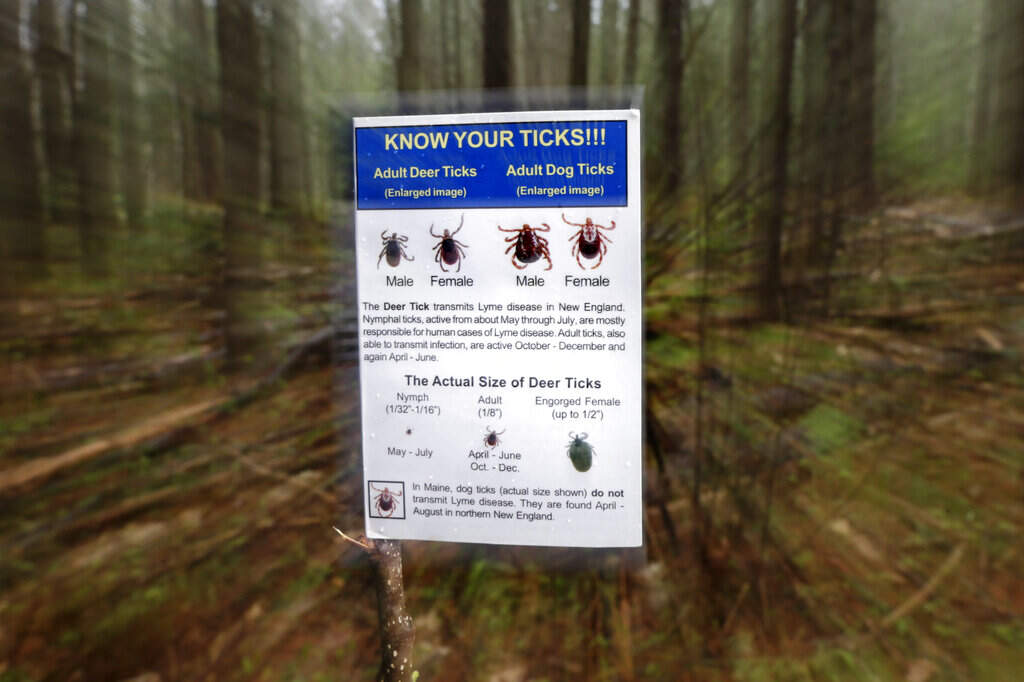
In fact, it starts right there when you say, "Oh ticks." Which tick? There's three main ticks that people encounter in the United States, and they're all three, even though they're all ticks, they're all a little bit different, and they do different things and cause different diseases.
And so it's, I think, critical that we get people to say, which tick is it? And which tick should I be most worried about when it comes to Lyme disease?"
CHAKRABARTI: Okay, so let's just do that right now. So three different kinds of ticks, right? The deer tick, that's the vector for Lyme.
And then the other two, dog ticks, I've seen them on my dog. They're quite big, right? They're much bigger than the deer ticks. And the lone star tick, that's the other one.
MATHER: Yeah, so those are the three main ticks probably that people get across the United States. On the West Coast, they have a Western blacklegged tick, so that's the equivalent of the deer tick here.
Its technical name is blacklegged tick. And yeah, it's widely distributed this blacklegged tick, whether it's Western or Eastern. And but to be honest, it's not the most common tick that people get. By far and away, the American dog tick and the lone star tick are more likely to be encountered.
And the good news, if there is any good news associated with ticks, is that they don't transmit the Lyme disease germ. So it pays to know what kind of tick you've encountered so that you would know more appropriately what symptoms to look for, what treatments to take and just give guidance to your health professional.
CHAKRABARTI: Okay. But the lone star tick, though, before we focus almost exclusively on the blacklegged or aka deer tick, the lone star tick is a tick that has higher prevalence, what, in the Southwest of the United States? And I thought, and correct, please correct me if I'm wrong, but does it also carry a dangerous disease?
MATHER: So lone star ticks have long been associated with sort of southern states. I'd say southeast is probably more. And but historical records show that they used to have a natural distribution as far north as Albany, New York. And that was in the 1700s, and then they disappeared when deer populations disappeared due to both clear-cutting of the eastern United States as well as hunting pressure. So they were thought of as more of a southern tick even 30, 40 years ago, but have been making a strong move up to the north.
The people on Long Island, New York, for instance, are well familiar with lone star ticks. They've pretty much overrun, and that's really what we're starting to face right now in southern New England as well. Rhode Island and Cape Cod are really on the sort of the leading edge of this northern remigration of lone star ticks.
Rhode Island and Cape Cod are really on the sort of the leading edge of this northern remigration of lone star ticks.
Thomas Mather
CHAKRABARTI: Okay. And the lone star tick, I'm looking at a picture of it right now. We're drifting away from Lyme here, but I think this is important because it carries the alpha-gal molecule which causes the supposed red meat allergy, yes?
MATHER: Yes. So the important thing to remember about this alpha-gal phenomenon is that it's not a disease-causing germ.
It's actually a component of mammalian blood, and when it gets into a lone star tick, I think it gets changed just a little bit so that when it comes back out of the tick in a tick bite it stimulates an allergic reaction in some people. Not all people. What we don't know is what proportion of the people are getting this allergic reaction that's significant enough to cause alpha-gal syndrome, which is what can vary from gastric distress after eating red meat products or anything red meat or products that are derived from mammalian blood, like even gelatin can trigger it in some people.
But it can be also very severe, causing anaphylaxis- ... like a severe peanut allergy, for instance.
CHAKRABARTI: The lone star tick, by the way, is identifiable. It's a muddy brown, but it has that tiny little beige-ish, yellow-ish dot on its back, right?
MATHER: That's the female. That's the female.
Okay. And the male, so one of the things that people don't seem to get about ticks is that if you wanna identify your tick, this is just a tick hack from the tick guy, You need to look at the top side of the tick because the underside of most ticks looks the same unless you have a microscope.
Look at the top side of the tick, because the underside of most ticks looks the same unless you have a microscope.
Thomas Mather
But if you want to see the differences, you need to look at the top side. And these ticks that we're paying attention to today, lone star ticks, the female has that bright white spot. It's actually a pigment in some cells focused on the back of what we call the scutum or shield. And in the male, the scutum or shield, goes all the way to the back end of the tick, and so the white spots are distributed across the back margin.
Part II
CHAKRABARTI: Professor Mather, you called yourself the tick guy. Is that ... you wear that that name with pride, I presume?
MATHER: Years ago, it just seemed like you might not remember my name, Thomas Mather, but if you just know that there's a tick guy at the URI, when you're thinking about ticks or the worries about ticks, who else would you rather talk to than the tick guy?
CHAKRABARTI: Literally nobody else, actually. Later on I'm gonna, I wanna get your origin story in terms of how you became the tick guy but first, let's actually get the origin story of Lyme disease itself, because it was only about 50 years ago that no one had actually ever even heard of this illness, and maybe no one would for quite a long time if it hadn't been for a group of concerned mothers.
ALLEN STEERE: Telephone calls from two mothers reporting that there were a number of children who had developed arthritis in recent years, and it was so many that they thought there must be some reason for this.
CHAKRABARTI: So this is Dr. Allen Steere.
STEERE: And where were they from? Lyme, Connecticut.
CHAKRABARTI: This was back in 1975. Dr. Steere is at Massachusetts General Hospital now, but at the time he was a post-doctoral fellow at Yale University, and he was part of a team that was charged with investigating the mothers' concerns.
And the team quickly found that it wasn't just a couple of kids. The team identified 39 children and 12 adults in Lyme, Connecticut, who had arthritis.
STEERE: It wasn't just that there were 39 children in Lyme, Connecticut, but half of them lived on four country roads in Lyme, Connecticut, where one in 10 children had arthritis. That was really striking. That's completely unheard of.
In Lyme, Connecticut, where one in 10 children had arthritis. That was really striking. That's completely unheard of.
Allen Steere
CHAKRABARTI: Completely unheard of because arthritis in children generally is very rare.
The CDC estimates that only 300 out of every 100,000 kids in the U.S. under the age of 18 has arthritis. 300 out of every 100,000, so compare that to the one in 10 that Dr. Steere observed on those four country roads in Lyme, Connecticut. Now, he also tells us that the Connecticut cases had other strange patterns.
STEERE: More of the children had onsets of their illness in the summer or fall.
Then there was also family clustering. There were a number of families that had more than one affected member, but the family clustering was hit and miss in that different people were often affected in different years, not the same year. That's not what one expects to see with person-to-person transmission.
CHAKRABARTI: So could it be genetic? Could it be something in the water, something in the air? Disease clusters can have a variety of causes. So Dr. Steere's team kept talking with residents, and they pointed him in a completely different direction.
STEERE: There were people who said, "We never saw ticks in Lyme, Connecticut, but now we're inundated by ticks."
The most important clue, however, was that a quarter of the children had an unusual skin lesion weeks, months before the onset of arthritis, and they'd never seen an insect bite like that.
CHAKRABARTI: Lyme, Connecticut is a small rural community along the Connecticut River. It's wooded and laced with lakes, so the perfect habitat for ticks.
Now, one resident even saved the insect that bit him so the team could identify it.
STEERE: It was an immature stage of an Ixodes scapularis tick, which is related to the type of tick that was thought to cause the skin lesion in Europe.
CHAKRABARTI: But unlike in Europe, the Connecticut tick-borne illness caused arthritis, so it had to be a different strain of bacteria.
But like the European strain, this Connecticut strain, now known as Borrelia burgdorferi, also responded to antibiotic therapy, specifically penicillin. So two things now, the illness officially had a name, Lyme disease, due to where it was discovered, and also fortunately it had a treatment, those antibiotics.
But given the severity of Lyme, Dr. Steere and others were not satisfied with simply treatments. They wanted to prevent kids and adults from suffering. That meant a vaccine. Many years later, and multiple clinical trials later, FDA approved the first ever Lyme vaccine, called LYMErix, in December of 1998.
STEERE: But there was great pushback from anti-vaccine advocates who said that having had Lyme disease vaccination made their Lyme disease worse, or even caused Lyme disease.
CHAKRABARTI: According to Dr. Steere, there has never been any verifiable evidence to support those claims, but the pushback, along with class action lawsuits, was effective.
So in 2002, GlaxoSmithKline, the company developing the vaccine, withdrew it. About a million and a half doses were distributed in the four years it was made available. And since then, the only Lyme disease vaccine available anywhere is for pets.
STEERE: I view it as the most traumatic event that's happened in my 50 years of working on Lyme disease.
I view [the withdrawal of the Lyme disease vaccine] as the most traumatic event that's happened in my 50 years of working on Lyme disease.
Allen Steere
We've seen the effects, haven't we, of what happens in the natural infection with the ecology, which is it just continues to spread. Many more people are affected now.
CHAKRABARTI: So that's Dr. Allen Steere. He's currently director of the Massachusetts General Hospital Lyme Arthritis Program, but as you heard, back in 1975, he was on the team that led to the discovery of Lyme disease.
Professor Mather, I just wanted to get your quick thoughts on the issue of a vaccine. Pfizer is currently at work on a human Lyme vaccine. Do you have hopes or a desire for a vaccine to eventually come onto the market for people?
MATHER: I think that vaccines have an important role, but in this case of the Lyme vaccine, I worry a little bit about the fact that these same blacklegged ticks that transmit the Lyme disease germ also transmit other serious infections, babesiosis, anaplasmosis, relapsing fever, and also Powassan virus.
And so what we saw with the first vaccine was people boldly saying I've been vaccinated. You were vaccinated against Lyme disease, but not the other infections, and so they may be more casual about their other tick prevention activities that are important knowing that this one tick can cause a lot of other germs as well.
CHAKRABARTI: Okay, Professor Mather, hang on here for just a second. And by the way, we reached out to Pfizer to ask them more about the current state of development of a human Lyme vaccine. They couldn't, they declined our opportunity or our invitation to come on live, but they did actually respond to some of our questions that we sent them.
First, we asked them, what would be the protocol for a Lyme vaccine to reach the market? And they said, if approved, their vaccine would be administered to people over a four-dose schedule over 18 months, and then there would have to be booster shots as well. They also interestingly had a recent clinical study in which the Pfizer researchers found that there were fewer anticipated Lyme disease cases that were accrued over the study period, which meant that the confidence they had in their recent clinical trial was not as high as they wanted to because the general prevalence of Lyme at the time of the clinical trial was lower.
And Thomas Mather, do you want to just decipher that quickly for people about whether that's significant or not?
MATHER: I haven't heard all of that. I did hear that there was, it wasn't 100% effective, which I think when people take a vaccine, they assume that it's going to be effective.
I did hear that [the vaccine] ... wasn't 100% effective, which I think when people take a vaccine, they assume that it's going to be effective.
Thomas Mather
And so if you really put the reality on it and if it's, let's say, 70 or even 80% effective, I think that usually makes people like, "Oh, but I'm still at risk."
CHAKRABARTI: Okay, so just so you know, the Pfizer told us in the spokesperson's statement that their observed vaccine efficacy in this trial was 73.2%, they said.
But again, because the overall prevalence of Lyme disease wasn't as high at the time of the trial that it was at other times, it just didn't have a big enough pool of people who had been potentially exposed to Lyme to get a real strong confidence in that efficacy level.
So we'll come back to the Pfizer issue in just a moment, but now I wanna bring in Dr. Seth Lederman. He is the co-founder and CEO of Tonix Pharmaceuticals. He previously served as an associate professor at Columbia University, where he directed research in molecular immunology, and he's joining us today from South Dartmouth in Massachusetts. Dr. Lederman, welcome to On Point.
SETH LEDERMAN: Thank you for having me on, Meghna.
CHAKRABARTI: So first of all, I know that you're actually developing a completely different type of therapy, but I did want to get your thoughts on the possibility of a Lyme vaccine. Do you think in terms of the overall arsenal of sort of tools to fight Lyme that a vaccine would be important?
LEDERMAN: Yes. First of all, it is an honor to be on any program that also features Dr. Steere. Dr. Steere is a giant in medical history, frankly, for the work that he did deciphering Lyme and taking it all the way to identifying the causative agent, and then as you discussed, bringing an effective vaccine to the market.
So you have to look There are very few people like Dr. Steere. But yeah, his vaccine, LYMErix, he was the senior author of the paper in 1998 in The New England Journal of Medicine that announced it and showed about an 80% efficacy rate. That really was a landmark paper not only for Lyme, but for, I believe, for medicine, because it showed that there was an Achilles' heel, if you will, of the Borrelia bacteria, and that was a protein called OspA.
And by targeting OspA with a vaccine, he was able to prevent Lyme, with about 80% efficacy. And that right now is the gold standard. And it's something that all of our work is derived from, and I'd be happy to talk about it further, but it's hard to explain how significant that was.
Targeting [the protein] OspA with a vaccine ... was able to prevent Lyme, with about 80% efficacy. And that right now is the gold standard.
Thomas Mather
CHAKRABARTI: Your passion in describing it I think transmits the significance of it quite effectively. But Dr. Lederman, you're working on a different kind of therapy, right? A monoclonal antibody to treat Lyme. So first and foremost, explain what a monoclonal antibody is.
LEDERMAN: Thank you.
Yes, we're working on a monoclonal antibody that is also a preventative to Lyme. And a monoclonal antibody is a product. There are many products that are available. The largest drugs in the world until recently with the GLP-1s were all monoclonal antibodies. Keytruda, Humira, Skyrizi. You could look all over the market, many monoclonal antibodies that are marketed for a number of different areas.
And this is really a breakthrough.
CHAKRABARTI: Yeah, what do they do? How do they work? Yeah.
LEDERMAN: Most monoclonal antibodies that you see advertised on TV or many of your listeners, many of the listeners probably take react with proteins in the body that are natural human proteins and affect their function.
But there are a few monoclonal antibodies that actually target pathogens, and some of them take the place of vaccines. For example, infants are now protected against RSV, respiratory syncytial virus by two marketed vaccines. During the COVID pandemic, there were a number of preventative monoclonal antibodies that protected against COVID, and there's one marketed today for immunocompromised people.
So antibodies that target pathogens are a new and growing area and we think that the Lyme problem is particularly well-suited to a monoclonal antibody instead of a vaccine.
The Lyme problem is particularly well-suited to a monoclonal antibody instead of a vaccine.
Seth Lederman
CHAKRABARTI: Okay. So I get stuck sometimes doctor, and forgive me. Because I wanna be sure that people understand the function of a monoclonal antibody.
So I'm looking here, and tell me if this is a satisfactory summary, right? They mimic natural antibodies, so these are immune cells or immune little pieces of our immune system that are used to fight, our bodies use to fight off viruses, bacterias, and harmful cells.
So by mimicking those antibodies, they essentially get the immune system to start working against a pathogen?
LEDERMAN: That's an excellent explanation, but let me take it one step further that when a vaccine induces antibody, antibodies, it's like turning on a incandescent light bulb, and you get a diffuse response of multiple different antibodies that are all related by being light, let's say.
But a monoclonal antibody is like a laser. Monoclonal means one. So a monoclonal antibody is a highly purified monoclonal antibody that is all identical to each other and all targeted on what you want to achieve.
CHAKRABARTI: Okay. We've got about a minute or so before our next break, so tell me a little bit more then about how you're using this technology of monoclonal antibodies in trying to come up with both, you said, a therapy and a potential preventative for Lyme.
LEDERMAN: Yeah, so ours is just a preventative. Okay. But in the same way that Allen Steere and his team pointed the way to the Achilles' teal, the Achilles' heel of Borrelia being this protein called OspA. He immunized people with OspA so that their own bodies made an active immune response, and we have developed a highly specific antibody that targets OspA, so that's called passive immunity. So by delivering our monoclonal antibody, we're not only doing what Professor Steere's vaccine did, but we're doing it more efficiently, more targeted, and, we hope, it hasn't been in human clinical trials yet for efficacy, but we think it has the possibility of being more effective.
CHAKRABARTI: Would it come in the form of a shot?
LEDERMAN: Yes. Currently, most, almost all monoclonal antibodies are shots, and ours would be what's called a subcutaneous shot, which is similar to getting insulin or some of the weight loss drugs.
CHAKRABARTI: And how often would one have to take it? The protocol that we've proposed to the FDA, and we're looking forward to meeting with the FDA early in the third quarter would be two doses.
One at the beginning of Lyme season, and one three month later.
Part III
CHAKRABARTI: Dr. Lederman, I just have one other quick question for you. So you said that your monoclonal antibody preventative that you're still developing would be essentially two shots.
Would that be an annual thing or a one-time deal?
LEDERMAN: Yes, it would be an annual protocol ritual.
CHAKRABARTI: Okay. And how far off are you from actually getting to the clinical trial stage?
LEDERMAN: We hope to start a study in 2027 to test its efficacy. But we have already-- we licensed this from University of Massachusetts, UMass Chan Medical School, and last year, and they had already conducted a phase one study.
So we know a lot about the safety and the characteristics of the antibody in humans, but we have not yet tested its efficacy in humans.
CHAKRABARTI: Okay. Dr. Seth Lederman, co-founder and CEO of Tonix Pharmaceuticals, thank you so much for joining us.
LEDERMAN: Thank you for having me, Meghna.
CHAKRABARTI: Okay, Professor Mather, hang on here for another second because we wanted to be able to describe to people who have never suffered from Lyme disease what it's actually and why this is such a big issue in certain parts of the United States.
So let's hear now from someone with that firsthand experience.
ALI MORESCO: Growing up in Illinois, Lyme disease and ticks, I would say, at least in my area, was not talked about. It wasn't really a conversation in Illinois.
CHAKRABARTI: So for the longest time, Ali Moresco believed she had very little reason to worry about ticks.
MORESCO: I'm the definition of the meme you see all over Instagram that says, "I'm outdoorsy in the sense that I like to eat on a patio."
That is my version of being outside.
CHAKRABARTI: In 2015, Ali was 22 years old, living in Chicago, and dating a guy who would later become her husband. He's from Michigan, and every summer he and his family would vacation in the woods of northern Michigan, a true outdoors experience, and Ali was invited to join them.
MORESCO: And a few days after returning home from that trip, I had cold and flu symptoms, and they didn't go away, so I went to my GP at a very prominent hospital system in Chicago and said, "Oh my gosh, I feel horrible, SOS," basically. And she was like, "Ah, you've got a summer cold, it'll pass, give it time."
Unfortunately, it just, it never passed.
And every time I went in, there was a different, acute classic explanation for it until eventually, probably about a month to a month and a half in, my mom actually asked her could she have Lyme disease? Should we test her for Lyme disease? My provider said to her, Nope, it's too rare that it's not even a possibility.
She wasn't on the East Coast. We're not gonna test her. By this point, I had all of these additional symptoms, the absolutely crushing fatigue and exhaustion. The memory loss continued to get worse, both short-term and long-term, to the point where, I was in my early 20s, and I felt like I had dementia or Alzheimer's.
I could barely get out of bed on my own, so my life really came to a halt for two years.
I was in my early 20s, and I felt like I had dementia or Alzheimer's. I could barely get out of bed on my own.
Ali Moresco
I was like, "Oh, there's something really wrong with me." And once again, went to a specialist. He's, "Have you ever been tested for Lyme disease?" And I was like, "No." And he was like, "I just had a woman come see me," and it was a very similar path where she had all these, quote-unquote, "mystery symptoms." No one could figure out what was wrong with her.
And he went back into medical literature, and a lot of her symptoms matched up with tick-borne illness.
It was the first sense of, "Oh my gosh, I'm not crazy." Because I had been told for two years by multiple specialists that I would go see that it was stress, that I needed to relax, or that it was depression, and it was really explained away as mental health symptoms.
I do have some permanent issues that I will continue to deal with.
Memory is still an issue. Fatigue is still an issue. It is night and day substantially better than it was. I'm probably 85 to 90% well most days, which I never thought I would be able to say.
Memory is still an issue. Fatigue is still an issue. [But] it is night and day substantially better than it was.
Ali Moresco
CHAKRABARTI: Ali Moresco now lives in Nashville, Tennessee with her husband. And Ali says she will never return to the northern woods of Michigan, but she still enjoys the outdoors, spending a lot of time in her garden, growing flowers and tomatoes, but she takes extra precautions like using tick repellent and frequent tick checks.
Now, Professor Mather, I understand that Lyme disease in adults, when adults get it, some 10 to 20% of them can have these very severe long-term consequences like Ali did. In a child, though, it can also change the developmental trajectory of a child's life. But these things hinge on that early diagnosis of the disease.
So I'm wondering what you think of the fact that HHS has also said that they recently launched a $10 million diagnostics prize that's aimed at the development of faster, more accurate Lyme disease tests.
MATHER: Yeah I would encourage development of better tests. I know that has been a sort of an Achilles heel for a long time.
I would encourage development of better tests.
Thomas Mather
People don't necessarily believe that it is as accurate or as effective, the testing, because it doesn't pick up some of the evidence that usually an infection leaves. But that's outside of my area. I think more power to them if they have the funds to develop better tests.
It's always a good thing.
CHAKRABARTI: Yeah. And it seems that HHS believes this is of importance because of the fact that with early detection of the disease, there's very successful treatments, doxycycline, the antibiotics that we talked about that can lead people to total recovery from Lyme disease.
But again, it's that early detection that's important. Or even before that, the willingness of doctors perhaps more so outside of the hotspot areas in the United States to be open to the fact that it could potentially be Lyme or another tick-borne disease.
CHAKRABARTI: So I'm wondering Professor Mather, more broadly, do you think actually medical education is part of or a key part of the, again, the suite of tools that would be necessary to drastically reduce how many people suffer from Lyme every year?
MATHER: Yeah, I think physicians sometimes when they seem like they're not being helpful get a bad rap. They have a lot of things on their plate that they have to consider, and tick-borne disease certainly one. It is more front of mind if they're in an area where they're seeing other cases and people are having ticks.
I think it's really part of the education of medical professionals, though. It would be helpful if we just got them all to be a little bit more expert in knowing about the ticks, because, you can take a tick to your medical professional. We actually did a study with people in the Boston area, docs and medical students and everything, and their recognition of the different types of ticks was low.
And so that might be a good first step, if we focused on, if I see the tick and it's the kind that would transmit the Lyme disease germ, then perhaps that would raise my level of awareness of doing tests for that or treating with doxycycline.
CHAKRABARTI: Yeah, and especially you said if I've seen the tick, because people oftentimes just wait to see if they get that typical bullseye rash, but that doesn't always happen, right?
MATHER: Yes. No. Yeah. It happens fairly commonly, but it doesn't always happen, and it's not always a typical bullseye rash. It's sometimes a more diffused redness that goes unnoticed.
CHAKRABARTI: So I keep going back to, in my mind, to Secretary Kennedy's desire to really, in the next 10 years, just get Lyme disease incidents down by 25%.
We've been focusing a lot on medical ways to do that, but this is a disease of, that's really being spread by environmental changes and human interactions with the environment. So what about, just briefly, Professor Mather, just getting rid of the ticks or making it harder for the ticks to reproduce or deer control or, I don't know, other sort of environmental methods to actually get the vectors themselves to be less of an issue?
MATHER: Yeah, that's definitely in my wheelhouse as well. And I think it's important for people to understand that it's a complicated situation. So the ticks come in three sizes, small, medium, and large, larvae, nymphs, and adults. The larvae hatch from eggs generally free of infection, but they pick up the infection from when they take their first blood meal from small rodents, usually mice or shrews.
And if they then pick up an infection from the animals, then they can carry it through to the next stage. And as a nymph, which is the size of a poppy seed, their bite can transmit those infections. If somehow we could break the life cycle of the tick so that it didn't, the adult tick, can lay thousands of eggs, and then those eggs hatch out and start the whole cycle again.
If we could stop tick reproduction at its source, which is the white-tailed deer that you alluded to, the prime host. They will feed on other things, but what really drives the population of black-legged ticks is they're feeding in the adult stage on white-tailed deer. If something could be done to reduce the success of that feeding, presumably it would reduce the number of eggs that are laid and larvae that are hatched and little larvae that are feeding on mice and rodents.
So you could break the life cycle, and that's what our strategy, it seems like a bit of a moonshot to do, but working in partnership with environmental managers that are also trying to restore a greater balance in terms of the deer population. Get the deer numbers back to something that the environment can support and not have it be overrun, but also then just like you do with your dogs, you give them a chew tablet to kill ticks that might bite them.
Perhaps we could target deer in the same way. That's at least, that's the idea that we're working on now to kill the ticks that are feeding on the deer when they're feeding on the deer, and reduce the tick reproduction in that way.
CHAKRABARTI: Interesting. But as you said, these are interventions in a complex, sort of very web-like ecosystem, so we'll see what can come of that.
I suppose people also want to know about basic personal things they can do for prevention, right? There's permethrin. Is that your preferred spray that people should use?
MATHER: Yeah, for personal protection, I adhere to what I call the three Ts for personal tick bite protection, and the first one is tucking.
Believe it or not, people don't like the look of tucking their pants into their socks, but you can go to one of the other Ts, and if you just have treated clothes, permethrin-treated clothes, that's a great layer of protection because the ticks are quite susceptible to permethrin treated in clothing.
Permethrin-treated clothes, that's a great layer of protection because the ticks are quite susceptible to permethrin treated in clothing.
Thomas Mather
So it'd be, for instance, at the little tiny nymphal blacklegged tick, its first point of contact is generally on the ground with your feet. So spraying your shoes, almost everybody is willing to put something on their shoes because they figure they're walking through crap anyway. And so just getting them used to that concept, I think, is really shoe sprays will last, if it's using .5% permethrin spray, for about a month. And so that's a great way to step out into nature with some level of protection against these tiny nymphal ticks.
But the tucking is important because for instance, the larger size of ticks, the adults, don't, they're not at the ground level, so they're not really affected by the shoe spray so much as if you tuck your shirt in, they latch on around knee level, and they head up towards the head of every host that they get on, whether it's a deer or a person, and if you don't tuck your shirt in, they're up underneath your shirt.
And lost on your back or places that you can't see very well until later. And so that's, tucking is important. And then I have, now that we have lone star ticks around here, those are the fastest ticks that I've ever seen. And so they can get up underneath your sleeve or your shirt faster than the other ticks, and so you may not even know it.
And that T is compression or tight clothing. So I have a compression shirt made by Rhino Skin that is fairly cool in the summer. But also, very tight so that the ticks can't get underneath of it which is really important. Wearing leggings is also a good thing.
The first draft of this transcript was created by Descript, an AI transcription tool. An On Point producer then thoroughly reviewed, corrected, and reformatted the transcript before publication. The use of this AI tool creates the capacity to provide these transcripts.
This program aired on June 11, 2026.