Support WBUR
Field Guide to Boston
How a doll named Polly Sumner witnessed the Boston Tea Party
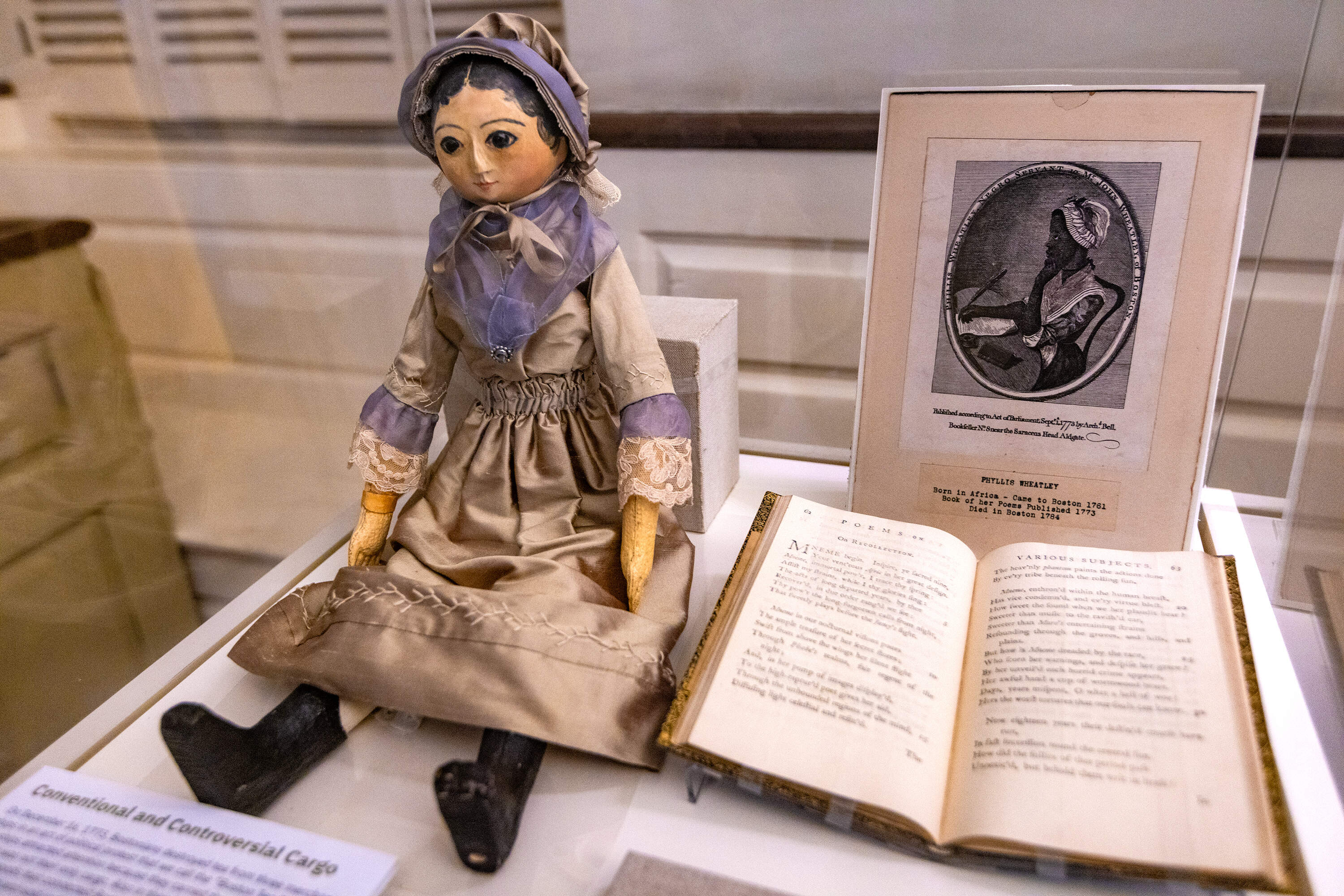
What if we still had an eyewitness to the Boston Tea Party — or a sort of button-eyed witness to those events?
Polly Sumner is a doll that's been on display at Boston's Old State House since 1919. Before that, the lore goes, Polly was on one of the ships that held the tea party tea.
Richard Wigan, a longtime executive director of the of Boston's Old State House, has written a children's book about the doll aptly titled "Polly Sumner, witness to the Boston Tea Party."
"Polly's claim to fame, I think, is that for over for a hundred years plus, she has received fan mail from kids," Wigan said.
That fan mail shouldn't be surprising, since lots of kids talk to their toys, Wigan said. But the letter writers are also getting a connection to history. In one case, a girl from New York told The Boston Globe she'd been writing letters to Polly for six years, according to Wigan.
"When she learned about Polly's history, about how old she was, about having to live through the revolutionary war, Polly suddenly became real to her," he said. "She's able to bridge the 250 years of of history, bringing that history into the the modern day, into the present."
The 18-inch wooden doll was originally used by dressmakers to show potential clients what they could design and sew. She currently sports what Wigan has heard called a Quaker dress, but that wasn't always the case.
"When she arrived, she was in a splendid brocade gown which stood stiffly over a large hoop. She had a pearl necklace and a cap with a curved ostrich plume," he said. "So she was really quite the the figure of fashion at the time."
Stories about Polly's place among the Boston tea partiers started in the years following the events that December, from the family that had owned her for generations.
"This sort of family history dates back to the early 1800's [so] it's a little bit removed from from 1773," Wigan said. "But I think it's a pretty good sense of and this is told by the second generation playmate of Polly Sumner."
Wigan said Polly's place in history is meaningful, because she helps kids make a connection to history in an era when he feels an appreciation of history has been on the decline because of how we try to teach it to children.
"We teach expository history, the names, dates, facts — exactly what turns the kids off," he said. "What is necessary is to teach these kids through narratives. Here is a story and the kids can connect to it. Here is ... a character that that kids can connect with. And between the character and the story, they can absorb the history, which is critical to learn."
This segment aired on December 15, 2023.