Support WBUR
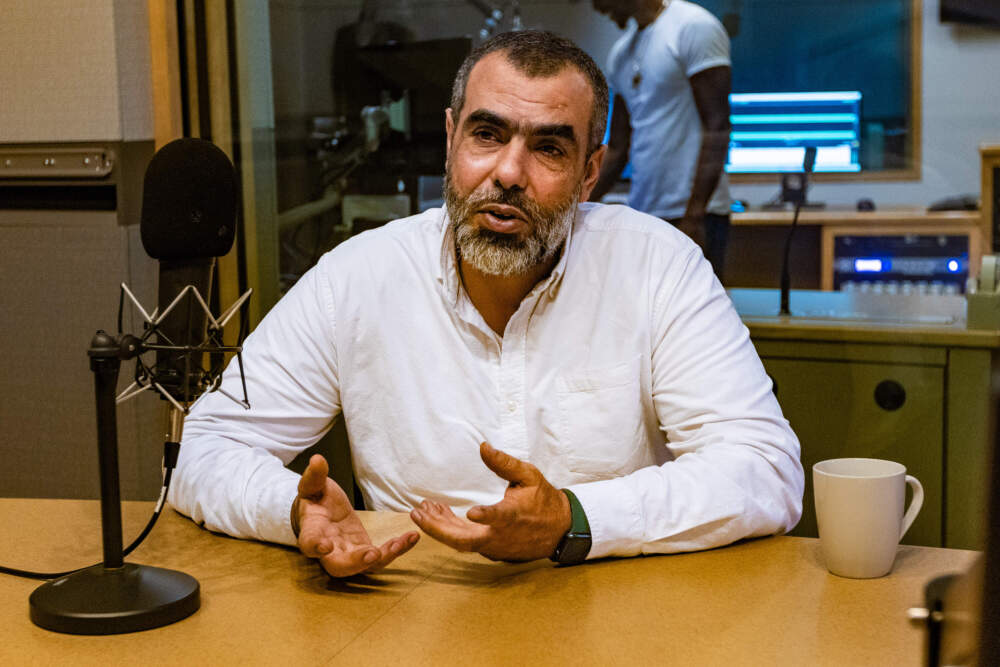
Gazan father and 2 children build new life in Mass. after losing family members in war
There's once again hope for peace in Gaza after two years of war between Israel and Hamas.
Several parties are in Egypt to discuss the White House's 20-point ceasefire plan. In the last few days, Hamas and Israel signaled a willingness to continue peace negotiations.
The brutal onslaught began when Hamas killed approximately 1,200 Israelis and kidnapped 251 during a violent incursion into Israeli territory on Oct. 7, 2023. In response, the Israeli military's continued bombardment of Gaza has so far killed at least 67,000 Palestinians.
Jaser AbuMousa said before the war, he led what he considered a "perfect" life. He and his wife of 19 years, Heba, had four children, successful careers and a nice home in Gaza.
An Israeli airstrike hit AbuMousa's home a week into the war. AbuMousa had just walked across the street to talk with a neighbor.
"I looked up and there were two missiles hitting my house," he said.
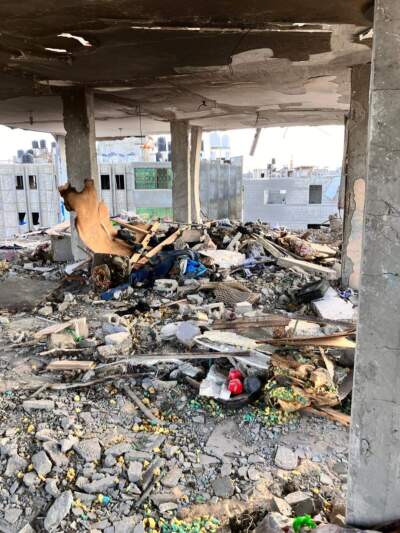
His wife, two of his children and three other family members, including his young nephew, were killed. In July of this year, another airstrike killed his mother, his sister and several other relatives. AbuMousa said Israeli authorities arrested one of his brothers, a doctor, in a roundup of medical personnel. That brother remains imprisoned.
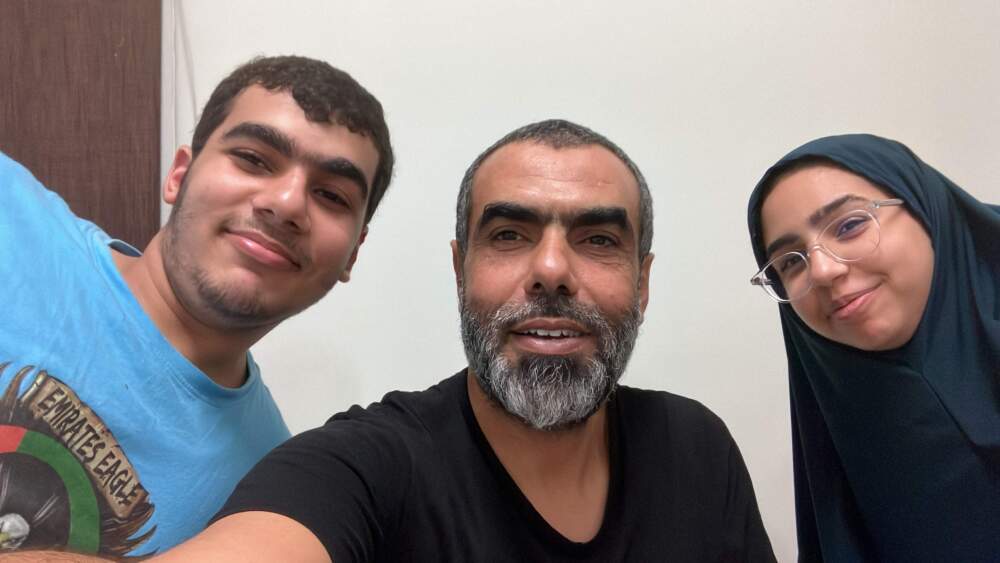
AbuMousa ended up in United Arab Emirates, where his two surviving children, ages 18 and 14, got medical care. From there, he earned a peace fellowship at Yale University. He and his kids spent six months in Connecticut.
AbuMousa had previously worked in civil engineering, but switched to work in economic development in the mid-2000s after an Israeli blockade made it nearly impossible to get construction materials into Gaza. His late wife was an architect and writer.
Now, AbuMousa is working to build a new life for himself and his children in Walpole. He recently obtained his U.S. work permit and is actively searching for a job.
He spoke with WBUR's All Things Considered host Lisa Mullins.
Interview Highlights
Below are highlights from their conversation, which have been lightly edited.
On the initial stages of processing his grief:
"During the first two months after the strike [on my home], I remained in Gaza. And I distributed myself, like, in three shifts. So, one with my son at the hospital, one with my daughter, and one with my father because he was injured, but not directly. He was injured due to the rubble.
"Only after I felt safe in the Emirates, I started to realize that my life has completely shattered.
"I bought a computer online, and I started to write my story. But I had a very long pause after reaching a scene that I wrote [about having] to identify the body of my wife. I could not actually go further in writing. I resumed writing only after reaching New Haven in Connecticut."
On the transition to living in suburban Massachusetts:
"I have to give a shout-out for a friend of mine that is living in Walpole. Actually, he was very enthusiastic to have me in the States, and even in the first night that I landed in JFK (Airport) and arrived in New Haven, he was waiting for me. ... And he introduced me to the community here at Sharon — the Muslim community there, the mosque. I was very much impressed by this community, and I felt like they are like a family to me."
On how his son and daughter are recovering from their injuries:
"Abdallah is, like, 70 [%], 80% okay, but there's nothing further to happen or to be done. I mean, he has been through a lot. He was badly injured. One of the things that I cannot forget — on the 10th day after the strike, Abdallah was having a dressing on his wounds. And they completely forgot a wound in his butt. And after 10 days it was rotten. So this, I saw it [with] my eyes.
"Sham has burns all over her back and her hip, but again, there's nothing to happen or to be done. Maybe later on with a plastic surgery or something. But yeah, they are functional, let's say 100%. They are going to school. They are doing great at school. ... They have formed some friends. They were a bit sad that they had to leave New Haven after the friends that they [had]. But now I think they are flourishing here.
"I think I'm very sensitive towards [Sham] more than Abdallah because she's the daughter and she's the younger, and she has lost her mother in an age that is the most needed, actually. So I'm trying to replace the mother role with some hybrid solutions. Sometimes I play this role; sometimes I ask for help from others, especially females. ... And I consult, actually, psychologists… to make sure that they are at least OK."
On how he has dealt with the deaths of his mother, sister and other relatives killed in an Israeli air strike in July of this year:
"I remained, like, [for] two weeks unable to make a simple conversation with anyone after the killing of my mother. I literally was avoiding any phone calls. I completely shut myself down. ... It was a very, very strange [experience] compared to the first strike. After the first strike, I felt very stronger ... maybe because I was under the war, so I had no option but to continue. But here, at this time ... I completely collapsed. ... But I think I received a lot of support from friends ... from the community and the Sharon mosque. They were very, very supportive."
On whether it's difficult to pray now or whether praying gives him hope:
"Someone with the trauma that I have received and that I survived, let's say, I think if there was no strong thing to rely on, I think they will go crazy. So the faith, or the God that I believe in and I rely on, is what keeps me going, actually."
On what he would say to Americans about the war and what he believes should happen moving forward:
"I'm still believing in peace. I'm still believing in a conflict resolution for this. And it was easier to me to take the other way — to be an extremist or to be someone that's calling for a vengeance.
"But there's a thing that I have advocated for during my time at Yale and my writings there, which is, as Palestinians, we need to have an internal peace first. Because unfortunately, the long term of oppression — I would say the 20 years of ruling by Hamas — have destroyed, actually, the social fabric, have destroyed the organic social cohesion in the society in Gaza."
"I think there is a very big chance if we invested in time, if we invested in having things done right for the first time, or for the only time, to make the [Palestinian] people at the center and to let them decide what they want, to let them own the process of reconstruction instead of being dictated for them from above, maybe when they feel like owners, I think they will protect it. They will not allow such thing like the 7th of October to happen again."
On whether he can seem himself ever going back to Gaza:
"Definitely, yes. And I would love to have a role in building a healthy community, or a healthy society anytime ... not because I don't like here. Here is like a dreamland. ... But at the same time, I feel very affiliated and very belonging to Gaza."
This segment aired on October 6, 2025.