Support WBUR
Commentary
'How perfect this is / How lucky we are': Stories from 266 benches along the Esplanade
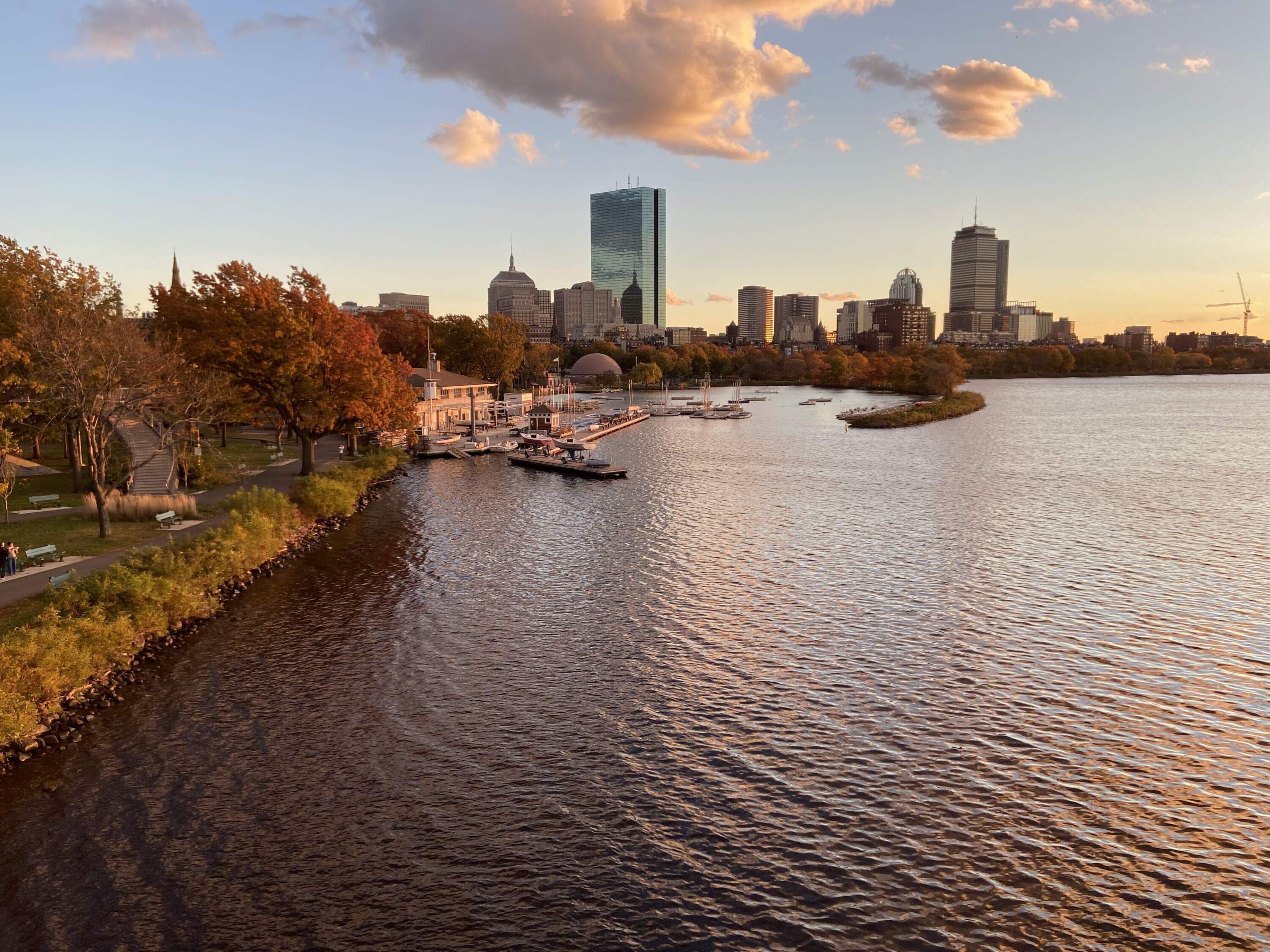
I’d always thought that moving to Boston would be like coming home. Chicago, where I’d spent the previous six years in grad school, had felt overlarge and wide, like a borrowed coat that had warmed to my shape but never really fit. I’d come to love my neighborhood, even the winters, but the city’s sprawling streets never really felt like mine. Boston, by contrast, was as dense as the New England I’d known as a child, the highway leading to it forest-lined and familiar. I’d looked forward to moving.
Like many young people in their first job out of school, I spent the first few years here wondering how anyone made friends. My coworkers were kind, but I worked from home three days a week. I was 29, and for the first time in my life, without a cohort of students in the same phase of life as me. I didn’t know where to turn. Long-distance friends urged me to join a gym or a sports team, but physical activity in a group — maybe extroversion in general — had never been my idea of fun.
Instead, I took a lot of walks on my own. I gravitated towards the river, walking the length of the Esplanade as cherry trees blossomed in the spring. On summer evenings, I passed Night Shift Brewing and groups of friends laughing as they drank beer from plastic cups, shoulders touching. Young families picnicked underneath the willows. Runners passed me in pairs. Even the geese had their flocks.
In October, on an unseasonably warm Friday more than a year after I moved, I lingered on the Esplanade as the sun set. I was kicking leaves off the path, idly wondering how I’d fill the weekend, when a plaque beneath a bench drew my attention:
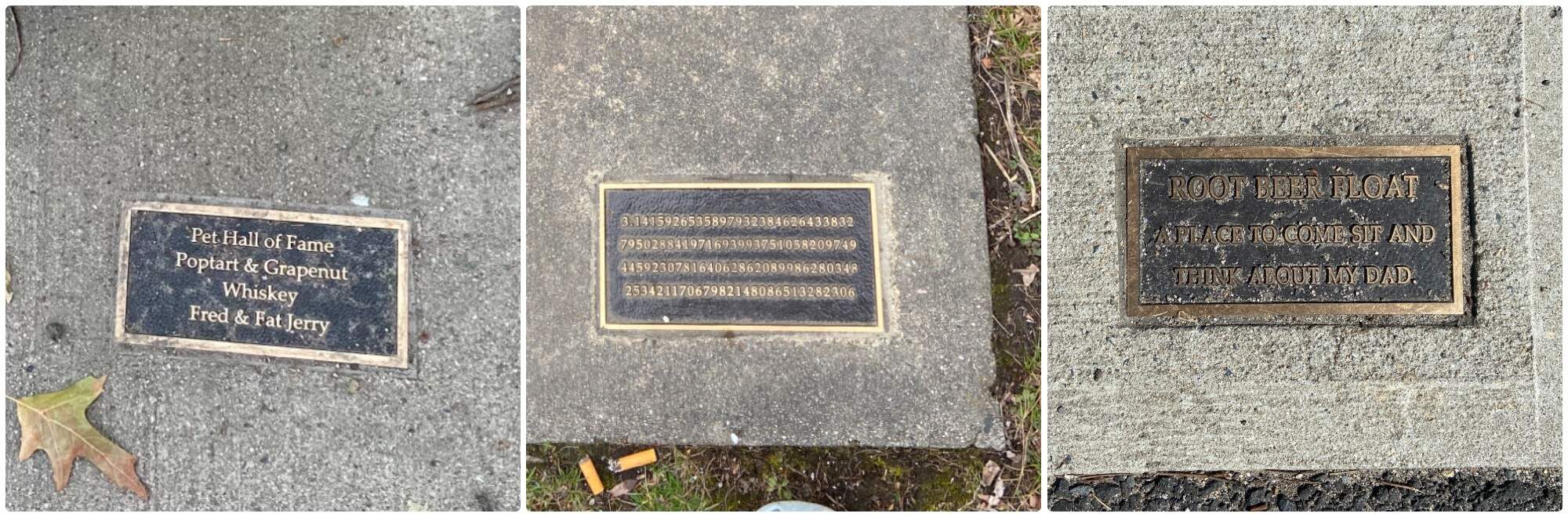
Pet Hall of Fame/ Poptart & Grapenut/ Whiskey/ Fred & Fat Jerry.
I couldn’t help but smile, drawn out of my well-worn self pity by the specificity of someone else’s story. Had a child chosen those names and then, when they were grown, paid to engrave them on a tiny plaque near the river, the marker of a childhood they remembered fondly and wanted to share? Or were the names a shared joke, family legends memorialized by an adult with a wry sense of humor? Something made me hope Poptart and Grapenut were hamsters — small, unsuspecting pets that didn’t in any way resemble or respond to their quirky human-given names.
I moved on to the next bench, and the next. Some dedications were expected: tributes in loving memory of family members, celebrations of birthdays and anniversaries, favorite quotes, appreciation from coworkers. Others were brief and lighthearted: A bench across the Charles from MIT had no words, only the first 118 digits of π.
Another near the Longfellow Bridge was so sharply bittersweet, so particular and universal all at once, that I paused a moment, stilled by the absence of two people I’d never met:
Root beer float/ A place to come sit and/ Think about my dad.
Although I’d never struggled with alcoholism, I was struck by a plaque that told a story of recovery in four lines:
Past: morning drink/ Present: morning run/ Beyond grateful/ For the gift.
And another, near a bench looking out over the river just opposite the lagoon, was surely a quiet conversation between two people who’d known each other a very long time:
How perfect is this/ How lucky are we.
I turned toward home that night a little lighter. Months later, on the Esplanade Association’s website, I found an interactive map of all the benches that currently have sponsors. Two hundred and sixty-six green pins flanked the river, each bearing a photo of its bench’s plaque. I clicked through a few, but it felt a little wrong, like gulping something meant to be savored.
Today, when I pass the benches along the Esplanade, I usually don’t stop. Instead, I’ve found a place here, in a kind of community of words. I entered a contest challenging Bostonians to describe the city in 100 words (only slightly longer than a bench plaque), and, sitting in an award ceremony at the public library, learned how many different ways people have made this city their home. I enrolled in a local journalism course and swapped assignments, hopes and favorite articles with other writers over pizza after class. I've heard authors speak at bookstores and universities across the city and, after years of reading alone, now often find myself in a crowd of people all holding the same book in our laps.
Though I’m more comfortable here today, I’ve kept up my habit of reading dedications when I find them: on benches made from tulip tree wood in the Arnold Arboretum; on the statues in the Common casting long shadows in the sun; on baseball diamonds in the North End; a fountain in Charlestown. Because Boston is so much bigger than the path of an everyday walk. Because a sense of place, and the relationships in it, ebbs and flows. And because when this city seemed especially impersonal — when all I felt was disconnected — the words of strangers reminded me we are anything but.