Support WBUR
Commentary
Educators keep making 'good trouble'
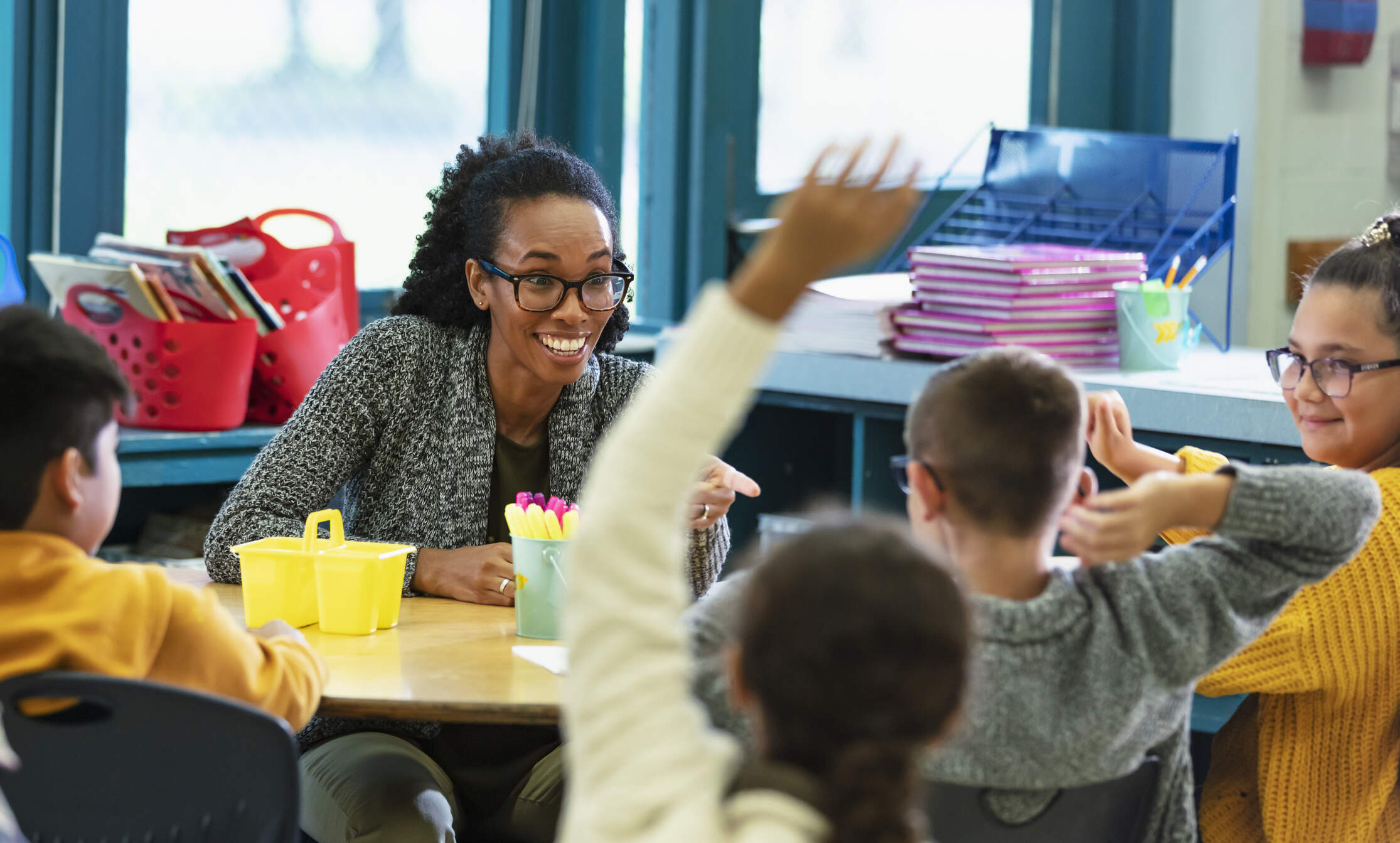
Every winter for the past 20 years, I’ve had the honor of convening a two-day course focused on student mental health. Educators travel to Boston from as far as Alaska, Louisiana and even Thailand to attend. We cover a wide range of topics, from supporting impulsive kids and depressed adolescents, to bullying (or peer aggression), vaping, learning challenges, as well as the larger systemic issues of race, poverty and immigration.
The pressure on educators has been even more relentless than usual this year, thanks to the decimation of the federal Department of Education, funding struggles in districts everywhere, and the looming possibility of ICE showing up at the school gates. I was apprehensive about whether they would find the energy for two long days of learning.
But of course — and this won’t surprise you if you have educators in your life — they proved me wrong. Educators, perhaps more than anyone, don’t have the luxury of waiting out the chaos of our national politics.
I began this year’s conference by asking the 400 participants to share an example of “good trouble” they had witnessed or participated in at their school or beyond. (“Good trouble,” a term coined by the late Congressman John Lewis, denotes acts of non-violent disobedience to create positive change.) Their stories reminded me that good trouble comes in all sizes.
Educators, perhaps more than anyone, don’t have the luxury of waiting out the chaos of our national politics.
One educator, from Maine, shared how her school had wrestled with the question of whether to hold a community night. Their community felt under siege by a large influx of ICE agents and they didn’t want to jeopardize anyone’s safety. Rather than canceling, the community mobilized. Any family who wanted to attend was offered a ride or walked in with school/family volunteers to provide an added level of security.
Another school counselor, from Cambridge, talked about a “know your rights” training her school offered all students during an advising block. Her school community includes a large number of immigrants and non-English speakers, and students were understandably worried about their family members being caught up by ICE. Teachers also volunteered to take turns walking the school block to spot unmarked vans and report to Luce defense hotline.
Another educator, from Somerville, talked about her school implementing “reverse evacuation” drills at recess, just in case ICE showed up at school.
Still others talked about teaching crucial topics and texts despite pressure to avoid them; ensuring students are fed; and hosting “civility meetings,” where students learn to talk with those who hold different views.
We also talked about how the very process of building and maintaining strong public schools can be good trouble. School systems can create safe spaces for students to be curious and learn. Niobe Way, the director of the Science of Human Connection Lab at New York University, delivered a session about the “crisis of connection,” noting that educators often focus on children’s physical and mental/emotional health, but neglect social health. She now starts each class by asking students to partner and interview each other with questions such as “What is your favorite memory?,” “When do you feel joy?” or “When was the last time you laughed out loud?” Creating this kind of “good trouble” strengthens communities by nurturing social connections and uplifting mutually supportive healthy relationships.
I always feel a momentary reprieve from the deluge of bad news after this conference — a sense of hope that comes from spending time with a group of educators who have the endurance and spirit to show up day after day.
I’ve worked in schools as a child psychiatrist for 30 years, and I’ve seen how educators help students navigate crises. No matter how worried, exhausted and scared for the future they may be, educators carry on teaching, listening and nurturing the next generation. They’ve learned to exercise what agency they have, where they have it — and that’s a critical lesson for anyone who is feeling a little helpless.
None of us have the illusion of control these days, but there is a sea of humanity who shelters and fortifies our kids — school crossing guards, bus drivers, cafeteria workers, teachers, counselors, school psychologists, administrators, coaches. What I pray for right now, is that we can sustain that army of goodness.