Support WBUR
Commentary
What I’ve learned by volunteering with recent immigrants to the US — beyond facts and figures
I want to introduce you to Adje, an immigrant from the Central African Republic. I met Adje a couple of years ago in my capacity as a volunteer helping refugees access housing, employment, education and get generally settled in this country. I’m not using her full name because, as a refugee, she’s concerned about harassment in the current environment.
This role, this work, are new to me — a retirement gift to myself. But the inspiration for it isn’t. Though I’m not an especially observant Jew, I’ve been ever more moved to action by one of the injunctions I’ve heard in countless sermons over the years: “The stranger who resides with you shall be to you as one of your citizens; you shall love him as yourself, for you were strangers in the land of Egypt.”
I’m writing this now because Adje has just lost the SNAP benefits she relies on to feed her family. She is just one of the roughly 90,000 people per month — many of them documented immigrants — who, thanks to the grotesquely named One Big Beautiful Bill are (with a handful of exceptions) losing this essential food subsidy. In this respect Adje is both singular and painfully typical of the roughly 6 million immigrants to this country who are documented but not yet Green Card holders.
But let me zoom in, because those facts and figures tell you nothing about who she is.
Adje is as competent and fierce a mother as anyone I’ve ever met. She both herds and adores her children — high school-age twins, a 10-year-old, a 6-year-old and a 4-year-old. If their school bus is even five minutes late in returning them home, I get a panicked call from her asking for my help to track them down. With enormous pride, she sends me pictures of their completed homework and report cards. In her home, she will issue instructions to them at a volume and speed that I’d find incomprehensible (even if my French was impeccable), but also tickle, tease, hug, humor and spoil them in a fashion as extravagant as her circumstances allow.
She is also impulsive and demanding. Within the first few months of my meeting her, she repeatedly asked me to take her to a car dealer to evaluate a used SUV for sale — despite the fact that she had no driver’s license or money to buy one. When Catholic Charities stopped subsidizing her rent after three months — a loss she could ill-afford — it took weeks to convince her that this was their standard policy, not a slight directed specifically at her.
Adje is continually trying to upgrade her furnishings with free stuff she’s found or been offered. Her living room looks different every time I visit. She is determined and artful in her efforts to beautify her poorly maintained unit, with vases housing artificial flowers, perfume bottles arrayed on faux brass trays or plates, and small dishes of a face cream she has proudly made herself.
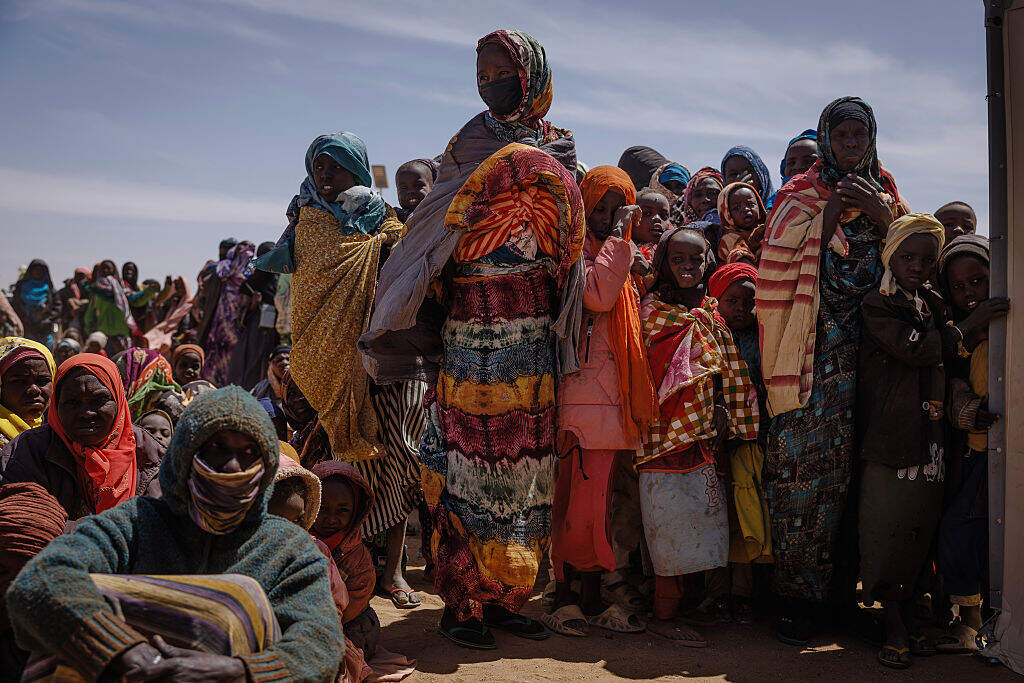
All of the other immigrants I’ve worked with have been literate, oftentimes in multiple languages. Adje speaks French and Arabic fluently but cannot read or write in either language. Despite that, she has somehow managed to navigate the bureaucracies governing two refugee camps in Africa and the U.S. Citizenship and Immigration Services. She’s browbeaten her way into jobs she can do without literacy — scrubbing floors, folding laundry, washing dishes. A single mother, she has managed to keep her five children clothed, sheltered and fed despite the disappearance of their father, the loss of her extended family to civil war and exile, the misery of forced migration from one inadequate shelter to another.
Tenacity doesn’t begin to describe her dogged pursuit of what she needs. All of the other immigrant families I’ve worked with are patient to the point of stoic, and appreciative nearly to the point of obsequious. Not Adje. She rarely makes appointments with the caseworkers, daycare providers, and other functionaries whose help she depends on. Instead, she simply shows up in their offices, refusing to leave until someone meets with her.
Quite honestly, she exhausts me. But then I look at her life — at least the pale sliver that I know of it — and realize that her doggedness, her forcefulness are precisely the qualities that have been essential to her survival and that of her children. Docility and acceptance would have been — are still — the recipe for extinction. So, too, is returning to her homeland, where her remaining friends send her videos of young men murdered in the country’s civil war and share their own efforts to flee the carnage.
Since being offered admission to the United States as a refugee, Adje has done everything she is supposed to do
Since being offered admission to the United States as a refugee, Adje has done everything she is supposed to do, taking English classes every morning, and securing employment, working in a laundromat seven afternoons a week. But her job pays minimum wage, and $525 a week is barely adequate to pay her rent of $1,700/month, let alone cover food, clothes, the essential cellphone coverage and utilities.
Pending legislation in the Massachusetts State House would provide state-funded SNAP benefits to people like Adje who have lost them, and I fervently hope that the state House and Senate will move quickly to pass and implement H.135 and S.76 . But in the meantime, Adje faces the very real choice between food and rent.
To make matters worse, the Department of Homeland Security just issued a memo stating, in part, that “federal immigration agents should arrest refugees who have not yet obtained a green card and detain them indefinitely for rescreening.” To be clear, they are seeking to imprison people like Adje who came this country legally, are paying their taxes and are either awaiting the permanent residency status they’ve applied for (but not yet had their required interview) or haven’t yet been able to muster the average $200-$650 per person charge for a green card application medical exam. It’s hard not to believe that in this case, and many others, the cruelty is the point.
Jewish Family Service of Western Massachusetts has partnered with other agencies and six individual refugees to challenge this malevolent refugee detention policy. Meanwhile, though, the Department of Justice doggedly pursues its strategy: Change the rules, punish the deserving, set an example that will lead would-be immigrants to conclude that the civil war, starvation or genocide occurring in their countries of origin are preferable to the lives they’ll find here.
We should all be as impatient, demanding and dogged as Adje — and considerably more ashamed.
***Editor’s Note: This story has been updated to reflect WBUR’s anonymity guidelines.