Support WBUR
Opinion
Ambulances function like public infrastructure, but they’re financed like a transportation business
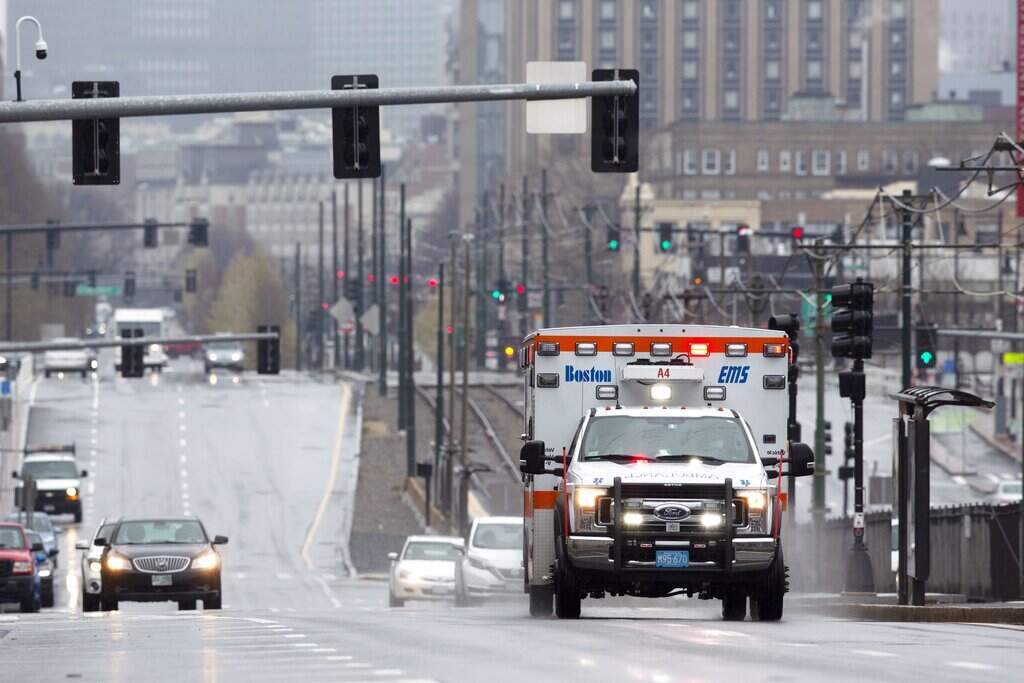
A university professor collapses at his home in a Boston suburb. He can’t move the left side of his body. His speech is slurred. Someone calls 911, and an ambulance takes him to the nearest hospital. A scan shows a large clot blocking blood flow to his brain. His care team at the hospital knows what to do. He needs an endovascular thrombectomy or EVT, a specialized procedure to reverse paralysis and prevent permanent disability. But it’s only available at a comprehensive stroke center.
And getting him there takes time.
In stroke care, we often say “time is brain.” It’s not just a metaphor. Nearly 2 million brain cells die every minute a major stroke goes untreated. The faster blood flow is restored, the better the chance a patient regains normal functions and can return to their life. And the effectiveness of treatment declines rapidly with every passing minute. But the way things unfold in practice uncovers a stark reality — how the different parts of our medical system value time plays out in very real and conflicting ways.
Time on the biological clock measures every passing minute in lost neurons and lost function. We can’t control this clock and it’s not forgiving. But there’s a second clock running at the same time. It’s less visible, but no less important. It governs how ambulances are deployed, how they’re staffed and how they’re paid for.
Because ambulances earn revenue when transporting patients and not parked idly, EMS agencies face strong incentives to keep lean fleets and focus on predictable transport such as taking patients from hospital to rehab or for dialysis ("dialysis runs"). That business logic conflicts with public need for ambulances immediately available for time-sensitive emergencies such as stroke.
Ambulance services are asked to function like essential public safety infrastructure. But they are financed largely like transport businesses, reimbursed based on completed trips. That creates a quiet but consequential tension: In one part of the system, time is brain; in another, time is money. No one at the bedside is thinking about revenue. Paramedics, emergency medical technicians, nurses and physicians act with urgency and determination. But the infrastructure around them still shapes what’s possible.
Massachusetts has invested heavily in stroke care. Today, 66 hospitals are designated primary stroke centers, able to quickly diagnose stroke and give clot-busting drugs. Eight are comprehensive stroke centers, where specialists can physically remove large clots using minimally invasive techniques. This network is a strength. It allows most patients to receive care close to home, while ensuring that those with the most severe strokes can access advanced treatment. But the system depends on fast, reliable transfers between hospitals. And that’s where it can falter.
Guidelines recommend that patients who need advanced stroke care be transferred within 90 minutes of their arrival at the initial hospital, typically a primary stroke center, to a higher-level comprehensive stroke center. In practice, it often takes much longer, sometimes up to three hours. Three hours while brain cells perish. Three hours that can mean the difference between going back to work and needing lifelong care. These delays aren’t due to indifference or lack of effort. The problem is structural. The system they operate within wasn’t designed for this kind of coordinated, time-critical care.

Decades ago, ambulances were primarily used to bring patients to the nearest hospital. Today, they are a critical link in a far more complex system, one that depends on getting the right patient to the right place at the right time. But ambulance services are constrained by workforce shortages, fragmented coordination, municipal contracting structures and payment models that don’t reward readiness. Urgent transfers, which are essential to stroke care, are not what the system is built to prioritize. This is the core mismatch.
The transport system is built around throughput: predictable, optimized and measured in completed trips. In practice this can mean that no ambulance is available for transfer because the crews are already on scheduled transport. It can mean delays while a vehicle is located, reassigned or brought in from another area.
One clock is counting brain cells. The other is counting transports.
Meanwhile, science continues to advance. Mobile stroke units, which are ambulances equipped with CT scanners and telemedicine, can begin diagnosis and treatment before a patient even reaches the hospital. Early studies show they improve outcomes and may reduce health care costs. But innovation doesn’t implement itself. These units require investment, staffing, and a reimbursement model that rewards readiness and early care, not just completed transports. If ambulance services are paid per trip, then technologies designed to save time can become financially unsustainable. In a system where time is money, innovations built around saving minutes for time-sensitive medical care aren’t prioritized.
Massachusetts has taken an important step by introducing a statewide stroke point-of-entry plan, guiding EMS teams to bring patients directly to the most appropriate hospital, whether a primary or comprehensive stroke center. That kind of triage can save precious time. But it doesn’t solve the problem on its own. When patients still need transfer, time is often lost, waiting for an available ambulance or coordinating transport between hospitals, leading to delays that can stretch into hours.
We need to align incentives with urgency. That means reimbursing not just for transport, but for readiness and rapid response. It means better coordination, including real-time data on ambulance availability, traffic and hospital capacity. And it means treating EMS as the essential healthcare infrastructure it is, not just as a logistical service.
My patient, the professor, is eventually transferred. The clot is removed. Blood flow returns. By the next day, his strength starts improving. Within three months, he is back at work.
This is what modern stroke care can do — when the system works. But too often, it doesn’t.
The difference between recovery and lifelong disability depends not just on what medicine can do, but on whether our system values time the same way the human brain does.