Support WBUR
TikTok star Geo Rutherford teaches us about spooky lakes, from Lake Superior to Lake Baikal
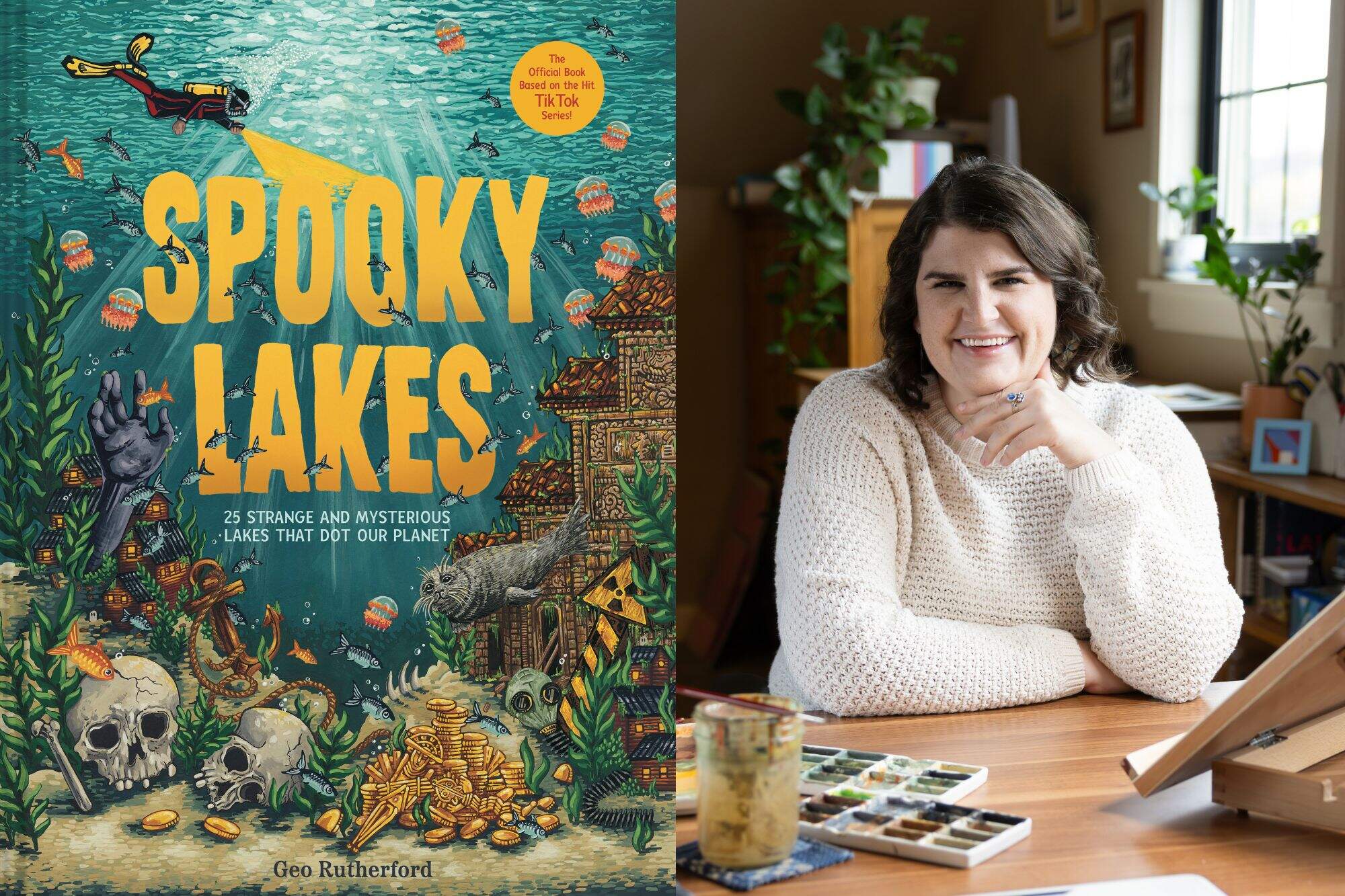
Lakes are spooky. That’s something Geo Rutherford knows well.
Rutherford is a TikTok sensation with more than 1.7 million followers. Her videos focus on lakes around the world with eerie histories.
But Rutherford isn’t just a social media star. The writer and illustrator just released a book based on her popular series, "Spooky Lakes: 25 Strange and Mysterious Lakes that Dot Our Planet."
The book details a number of lakes across the world that Rutherford dubs ‘spooky.’ One lake featured in the book is Pitch Lake in Trinidad. The lake is a giant pit of asphalt that is used for harvesting asphalt to this day. The lake’s surface isn’t liquid, and people can walk across it. But when warmed by the sun, the surface becomes sticky like glue.
“It's spooky because it can catch people,” Rutherford says. “There's all of these bones and artifacts that have been uncovered from the pitch, from the tar, inside of the lake and kind of has this history of archeology that's been preserved in it.”
8 questions with Geo Rutherford
What makes a lake spooky? Why is Lake Superior included but other lakes like Lake George are not?
“Spooky lakes are not about ghosts and ghouls or the supernatural, but actually about just the natural world being spooky all by herself, and just the strange things that happen in the natural world along with human interaction and environmental disasters and the way that we interact with these waters, which is what makes Lake Superior so spooky because there are hundreds of shipwrecks in that lake and thousands of people have died there. So it's a very spooky lake because it holds onto her dead.”
Tell us about the Jacuzzi of Death, a set of lakes filled with brine.
“The Gulf of Mexico is pitted with these deep-sea pools of brine and salt, which makes them more dense and heavier than the surrounding water, so they have a halocline — a little edge — that kind of delineates them from the surrounding saltwater.
“They're anoxic, which means they don't have any dissolved oxygen, which makes them deadly to all of the marine life that depend on dissolved oxygen to breathe. So if a creature falls in or wanders in without knowing what would happen, they can end up suffocating.”
You say that Lake Baikal in Eastern Russia is one of the spookiest lakes out there. Why?
“It's the oldest and deepest lake in the world: 25 million years old and over 5,000 feet deep, which means it's over a mile deep. It is a wild lake.
“80% of the creatures that live in Baikal can only be found there, and they have the only exclusively freshwater seal in the world. We have no idea how it even got there in the middle of Siberia.”
What other kinds of creatures are down there?
“There are all sorts of crazy little creatures that live there. There's a blind, white, little creepy fish called golomyankas which is rumored to, if you lift it up out of the depths of Lake Baikal and into the sunlight, it'll just melt in your hand.
“So there are all sorts of weird creatures that can only be found there.”
Can you talk about Spirit Lake in Washington and how it was transformed by the eruption of Mount St. Helens?
“Mount St. Helens was a lateral eruption, which means that half of the mountain kind of collapsed and it exploded outwards instead of up. And there was a massive landslide into the nearby Spirit Lake, which resulted in a 600-foot tidal wave that washed across the lake and tore all of these enormous trees down from the surrounding hills and sucked them back into the lake.
“It totally changed the shape of the lake. And now today, there are tens of potentially thousands of these trees still in the lake today — bleached, smoothed out and enormous — and they've never been removed because they're kind of preserved for scientific study.”
How did it feel to visit Spirit Lake?
“I was surprised at how spooky the Mount St. Helen's Park was. I had never been there before. We had to kind of go out of our way to try to get there because a lot of the roads have been taken out by landslides. So for the entire day that we were there, we only saw about six people.
“Nobody's there. None of the buildings are open. All of the signs have kind of been left to and forgotten about. And the path is overgrown. We didn't see a single other person. It was quiet. And then when we reached the lake, it was these enormous trees.
“I'm 6 foot 3. And these were like humongous trees that were taller than me. The width of them was much taller than I am. And they're just perched on the edge of the lake and we weren't even close to the largest part of the mat, which is where all the trees are in the water. We were just experiencing the trees that were only on the shore and they completely surround the entire lake.”
Why do you think people gravitate toward your TikTok content?
“I feel like it hasn't been explored that much on the internet before, this specific niche of spooky waters of the world and lakes specifically. I think we've always explored oceans, but who knew that lakes could be so strange and spooky?”
What’s the next stop on your spooky lakes bucket list?
“I need to go to Yellowstone National Park.
“All of the lakes in that national park are so spooky. So I definitely got to go there.”
Gabrielle Healy produced and edited this interview for broadcast with Mark Navin. Grace Griffin adapted it for the web.
This segment aired on October 1, 2024.